warning SUZUKI SX4 2006 1.G Service User Guide
[x] Cancel search | Manufacturer: SUZUKI, Model Year: 2006, Model line: SX4, Model: SUZUKI SX4 2006 1.GPages: 1556, PDF Size: 37.31 MB
Page 30 of 1556
Downloaded from www.Manualslib.com manuals search engine 0A-7 General Information:
Component Location
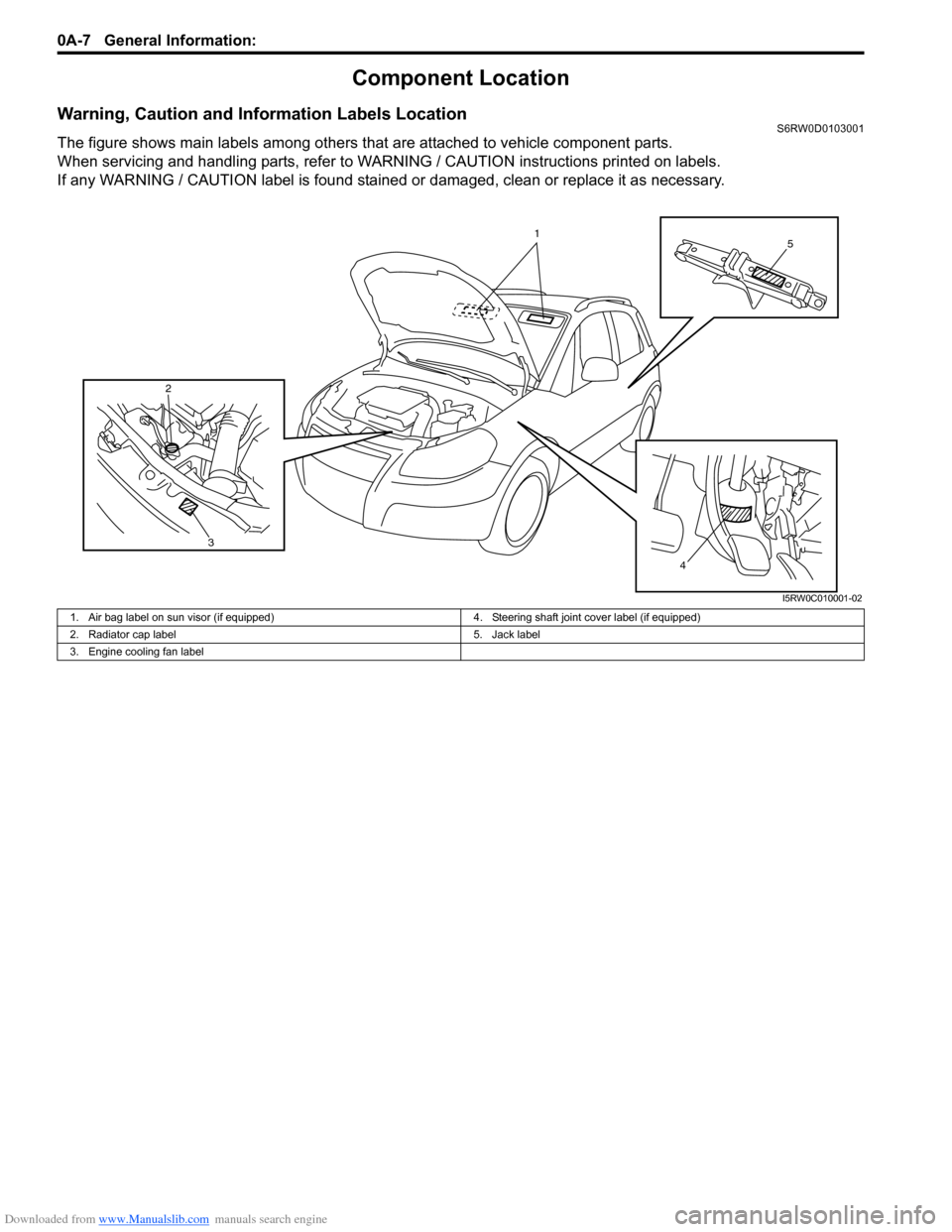
Warning, Caution and Information Labels LocationS6RW0D0103001
The figure shows main labels among others that are attached to vehicle component parts.
When servicing and handling parts, refer to WARNING / CAUTION instructions printed on labels.
If any WARNING / CAUTION label is found stained or damaged, clean or replace it as necessary.
1
5
4
2
3
I5RW0C010001-02
1. Air bag label on sun visor (if equipped) 4. Steering shaft joint cover label (if equipped)
2. Radiator cap label 5. Jack label
3. Engine cooling fan label
Page 32 of 1556
Downloaded from www.Manualslib.com manuals search engine 0B-1 Maintenance and Lubrication:
General Information
Maintenance and Lubrication
Precautions
Precautions for Maintenance and LubricationS6RW0D0200001
Air Bag Warning
Refer to “Air Bag Warning in Section 00”.
Scheduled Maintenance
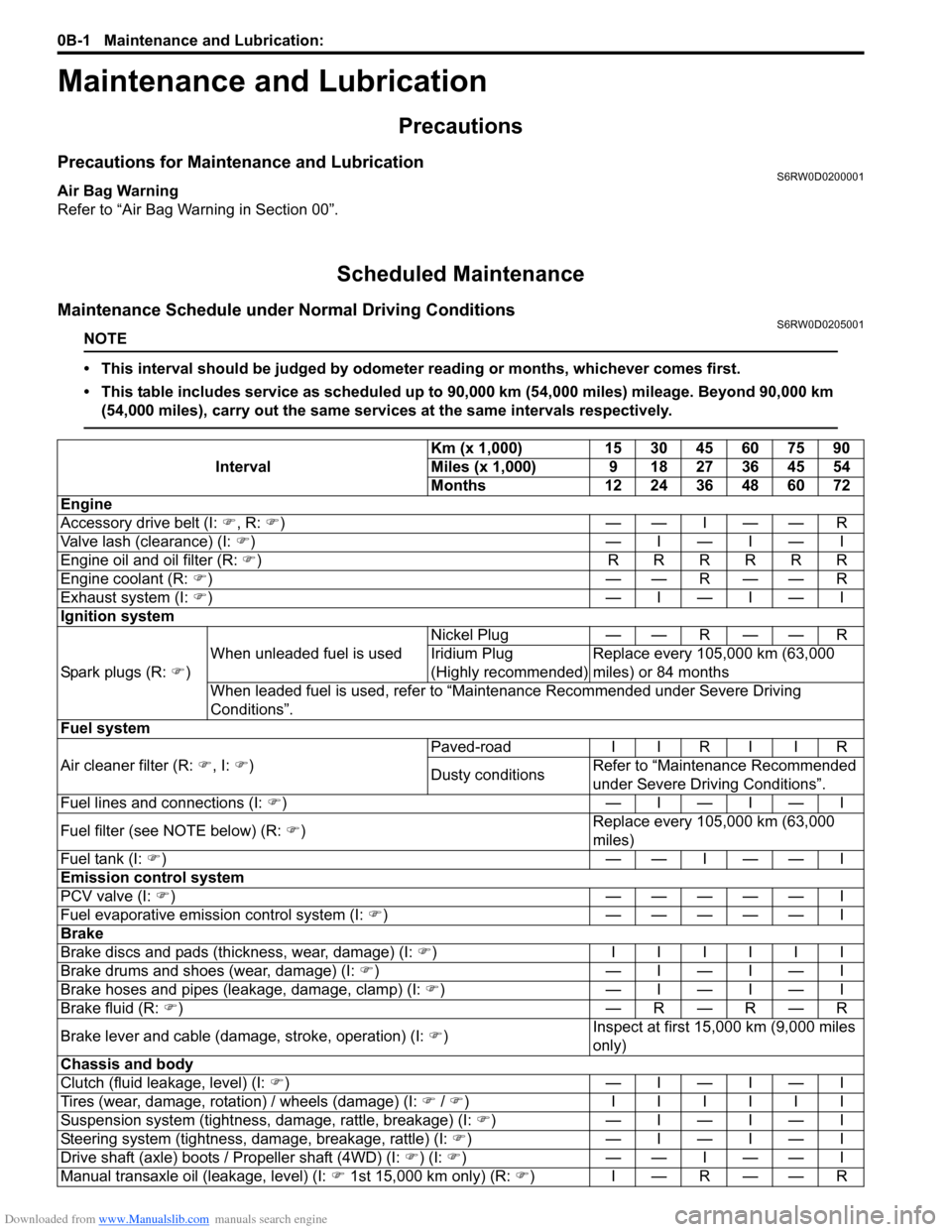
Maintenance Schedule under Normal Driving ConditionsS6RW0D0205001
NOTE
• This interval should be judged by odometer reading or months, whichever comes first.
• This table includes service as scheduled up to 90,000 km (54,000 miles) mileage. Beyond 90,000 km
(54,000 miles), carry out the same services at the same intervals respectively.
IntervalKm (x 1,000) 15 30 45 60 75 90
Miles (x 1,000) 9 18 27 36 45 54
Months 12 24 36 48 60 72
Engine
Accessory drive belt (I: ), R: ))——I——R
Valve lash (clearance) (I: ))—I—I—I
Engine oil and oil filter (R: )) RRRRRR
Engine coolant (R: ))——R——R
Exhaust system (I: ))—I—I—I
Ignition system
Spark plugs (R: ))When unleaded fuel is usedNickel Plug — — R — — R
Iridium Plug
(Highly recommended)Replace every 105,000 km (63,000
miles) or 84 months
When leaded fuel is used, refer to “Maintenance Recommended under Severe Driving
Conditions”.
Fuel system
Air cleaner filter (R: ), I: ))Paved-road I I R I I R
Dusty conditionsRefer to “Maintenance Recommended
under Severe Driving Conditions”.
Fuel lines and connections (I: ))—I—I—I
Fuel filter (see NOTE below) (R: ))Replace every 105,000 km (63,000
miles)
Fuel tank (I: ))——I——I
Emission control system
PCV valve (I: )) ————— I
Fuel evaporative emission control system (I: )) ————— I
Brake
Brake discs and pads (thickness, wear, damage) (I: )) IIIIII
Brake drums and shoes (wear, damage) (I: ))—I—I—I
Brake hoses and pipes (leakage, damage, clamp) (I: ))—I—I—I
Brake fluid (R: ))—R—R—R
Brake lever and cable (damage, stroke, operation) (I: ))Inspect at first 15,000 km (9,000 miles
only)
Chassis and body
Clutch (fluid leakage, level) (I: ))—I—I—I
Tires (wear, damage, rotation) / wheels (damage) (I: ) / )) IIIIII
Suspension system (tightness, damage, rattle, breakage) (I: ))—I—I—I
Steering system (tightness, damage, breakage, rattle) (I: ))—I—I—I
Drive shaft (axle) boots / Propeller shaft (4WD) (I: )) (I: ))——I——I
Manual transaxle oil (leakage, level) (I: ) 1st 15,000 km only) (R: ))I—R——R
Page 34 of 1556
Downloaded from www.Manualslib.com manuals search engine 0B-3 Maintenance and Lubrication:
NOTE
• “I”: Inspect and correct or replace if necessary
• “R”: Replace or change
• *1: Inspect or replace more frequently if the vehicle is used under dusty conditions.
• *2: Clean or replace more frequently if the air from the air conditioning decreases.
Repair Instructions
Accessory Drive Belt InspectionS6RW0D0206001
WARNING!
All inspection and replacement are to be
performed with ENGINE NOT RUNNING.
Water Pump and Generator Drive Belt
Inspect belt for cracks, cuts, deformation, wear and
cleanliness. If any defect exists, replace.
Check belt for tension referring to “Water Pump /
Generator Drive Belt Tension Inspection and Adjustment
in Section 1J”.
A/C Compressor Drive Belt (If Equipped)
Inspect belt for cracks, cuts, deformation, wear and
cleanliness. If any defect exists, replace.
Check belt for tension referring to “Compressor Drive
Belt Inspection and Adjustment in Section 7B” or
“Compressor Drive Belt Inspection and Adjustment in
Section 7B”.
Accessory Drive Belt ReplacementS6RW0D0206002
Water Pump and Generator Drive Belt
Replace belt with new one referring to “Water Pump /
Generator Drive Belt Removal and Installation in Section
1J”.
A/C Compressor Drive Belt (If Equipped)
Replace belt with new one referring to “Compressor
Drive Belt Removal and Installation in Section 7B” or
“Compressor Drive Belt Removal and Installation in
Section 7B”.
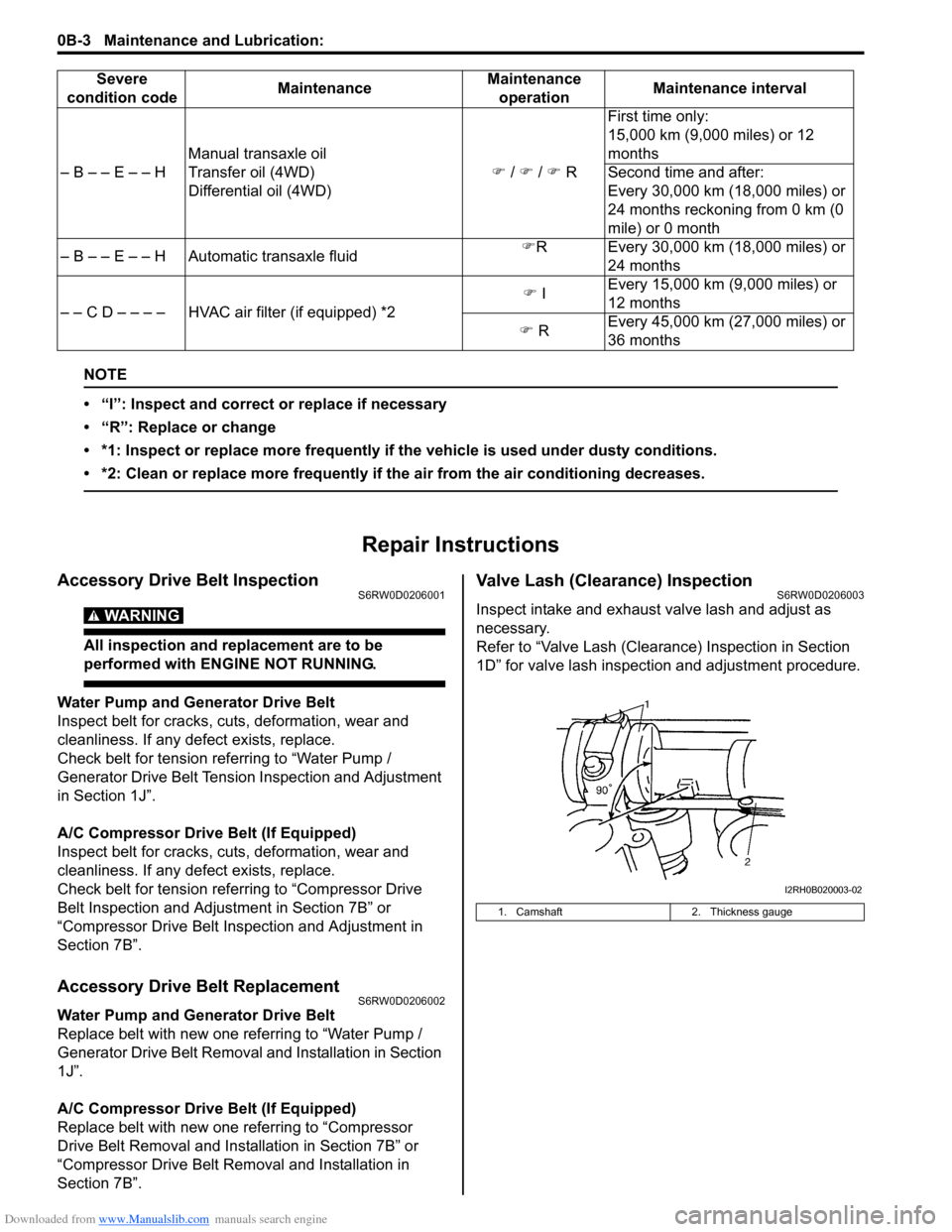
Valve Lash (Clearance) InspectionS6RW0D0206003
Inspect intake and exhaust valve lash and adjust as
necessary.
Refer to “Valve Lash (Clearance) Inspection in Section
1D” for valve lash inspection and adjustment procedure. – B – – E – – HManual transaxle oil
Transfer oil (4WD)
Differential oil (4WD)) / ) / ) RFirst time only:
15,000 km (9,000 miles) or 12
months
Second time and after:
Every 30,000 km (18,000 miles) or
24 months reckoning from 0 km (0
mile) or 0 month
– B – – E – – H Automatic transaxle fluid)R Every 30,000 km (18,000 miles) or
24 months
– – C D – – – – HVAC air filter (if equipped) *2) IEvery 15,000 km (9,000 miles) or
12 months
) REvery 45,000 km (27,000 miles) or
36 months Severe
condition codeMaintenanceMaintenance
operationMaintenance interval
1. Camshaft 2. Thickness gauge
I2RH0B020003-02
Page 35 of 1556
Downloaded from www.Manualslib.com manuals search engine Maintenance and Lubrication: 0B-4
Engine Oil and Filter ChangeS6RW0D0206004
WARNING!
• New and used engine oil can be
hazardous.
Be sure to read “WARNING” in “General
Precautions in Section 00” and observe
what is written there.
• Step 1) – 7) outlined below must be
performed with ENGINE NOT RUNNING.
For Step 8), be sure to have adequate
ventilation while engine is running.
Before draining engine oil, check engine for oil leakage.
If any evidence of leakage is found, make sure to correct
defective part before proceeding to the following work.
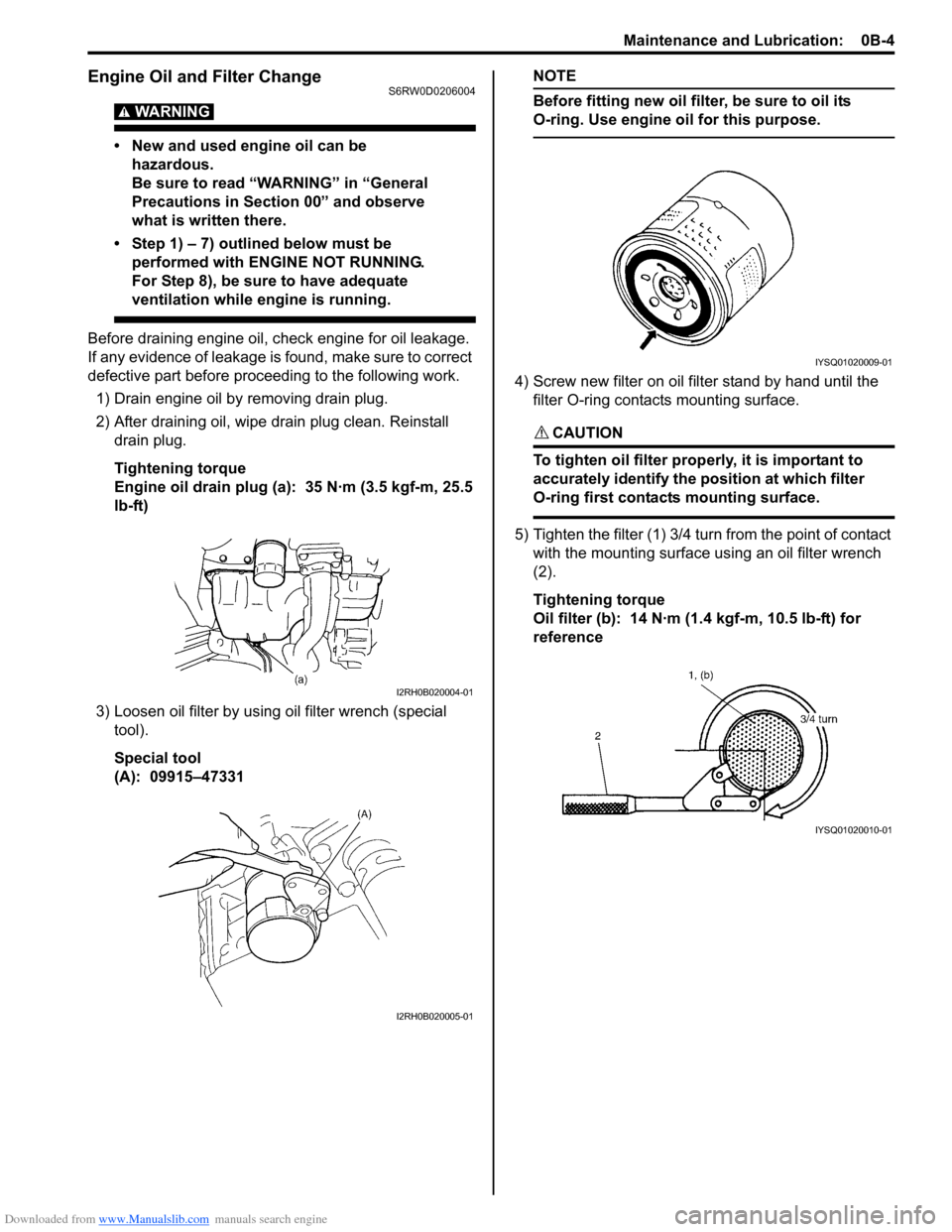
1) Drain engine oil by removing drain plug.
2) After draining oil, wipe drain plug clean. Reinstall
drain plug.
Tightening torque
Engine oil drain plug (a): 35 N·m (3.5 kgf-m, 25.5
lb-ft)
3) Loosen oil filter by using oil filter wrench (special
tool).
Special tool
(A): 09915–47331
NOTE
Before fitting new oil filter, be sure to oil its
O-ring. Use engine oil for this purpose.
4) Screw new filter on oil filter stand by hand until the
filter O-ring contacts mounting surface.
CAUTION!
To tighten oil filter properly, it is important to
accurately identify the position at which filter
O-ring first contacts mounting surface.
5) Tighten the filter (1) 3/4 turn from the point of contact
with the mounting surface using an oil filter wrench
(2).
Tightening torque
Oil filter (b): 14 N·m (1.4 kgf-m, 10.5 lb-ft) for
reference
I2RH0B020004-01
I2RH0B020005-01
IYSQ01020009-01
IYSQ01020010-01
Page 36 of 1556
Downloaded from www.Manualslib.com manuals search engine 0B-5 Maintenance and Lubrication:
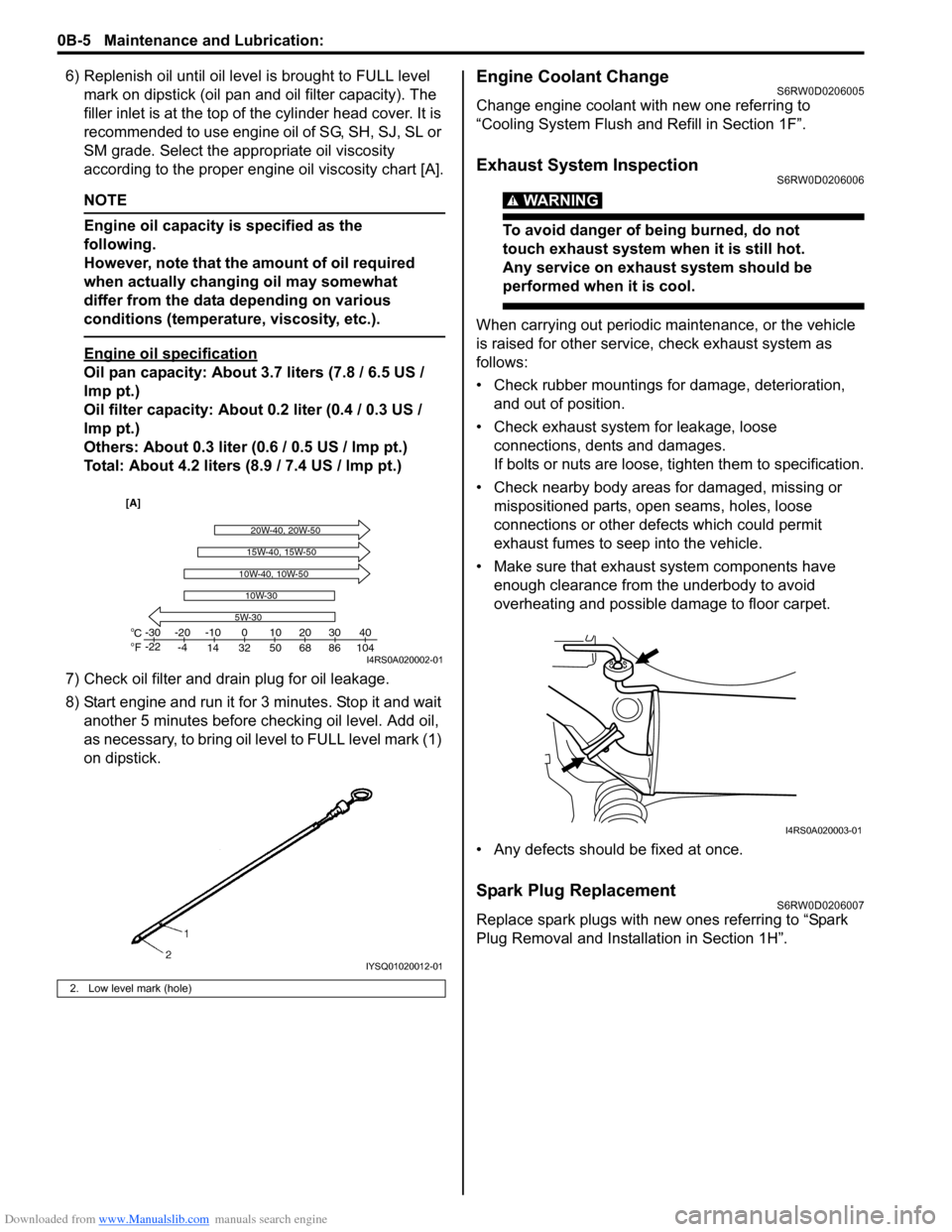
6) Replenish oil until oil level is brought to FULL level
mark on dipstick (oil pan and oil filter capacity). The
filler inlet is at the top of the cylinder head cover. It is
recommended to use engine oil of SG, SH, SJ, SL or
SM grade. Select the appropriate oil viscosity
according to the proper engine oil viscosity chart [A].
NOTE
Engine oil capacity is specified as the
following.
However, note that the amount of oil required
when actually changing oil may somewhat
differ from the data depending on various
conditions (temperature, viscosity, etc.).
Engine oil specification
Oil pan capacity: About 3.7 liters (7.8 / 6.5 US /
lmp pt.)
Oil filter capacity: About 0.2 liter (0.4 / 0.3 US /
lmp pt.)
Others: About 0.3 liter (0.6 / 0.5 US / lmp pt.)
Total: About 4.2 liters (8.9 / 7.4 US / lmp pt.)
7) Check oil filter and drain plug for oil leakage.
8) Start engine and run it for 3 minutes. Stop it and wait
another 5 minutes before checking oil level. Add oil,
as necessary, to bring oil level to FULL level mark (1)
on dipstick.
Engine Coolant ChangeS6RW0D0206005
Change engine coolant with new one referring to
“Cooling System Flush and Refill in Section 1F”.
Exhaust System InspectionS6RW0D0206006
WARNING!
To avoid danger of being burned, do not
touch exhaust system when it is still hot.
Any service on exhaust system should be
performed when it is cool.
When carrying out periodic maintenance, or the vehicle
is raised for other service, check exhaust system as
follows:
• Check rubber mountings for damage, deterioration,
and out of position.
• Check exhaust system for leakage, loose
connections, dents and damages.
If bolts or nuts are loose, tighten them to specification.
• Check nearby body areas for damaged, missing or
mispositioned parts, open seams, holes, loose
connections or other defects which could permit
exhaust fumes to seep into the vehicle.
• Make sure that exhaust system components have
enough clearance from the underbody to avoid
overheating and possible damage to floor carpet.
• Any defects should be fixed at once.
Spark Plug ReplacementS6RW0D0206007
Replace spark plugs with new ones referring to “Spark
Plug Removal and Installation in Section 1H”.
2. Low level mark (hole)
C
Fo o-30
-22-20
-4-10
14 32 50 68 86 104010203040
5W-30
20W-40, 20W-50
10W-30
15W-40, 15W-50
10W-40, 10W-50
[A]
I4RS0A020002-01
IYSQ01020012-01
I4RS0A020003-01
Page 42 of 1556
Downloaded from www.Manualslib.com manuals search engine 0B-11 Maintenance and Lubrication:
HVAC Air Filter (If Equipped) InspectionS6RW0D0206034
Check HVAC air filter for dirt and dust referring to “HVAC
Air Filter Inspection (If Equipped) in Section 7A”. If air
filter is dirty, clean or replace air filter with new one.
HVAC Air Filter (If Equipped) ReplacementS6RW0D0206035
Replace HVAC air filter with new one referring to “HVAC
Air Filter Removal and Installation (If Equipped) in
Section 7A”.
Final Inspection for Maintenance ServiceS6RW0D0206036
WARNING!
When carrying out road tests, select a safe
place where no man or no running vehicle is
seen so as to prevent any accident.
Seats
Check that seat slides smoothly and locks securely at
any position. Also check that reclining mechanism of
front seat back allows it to be locked at any angle.
Seat Belt
Inspect belt system including webbing, buckles, latch
plates, retractors and anchors for damage or wear.
Check that seat belt is securely locked. If “REPLACE
BELT” label on seat belt is visible, replace belt.
Battery Electrolyte Level Check
Check that the electrolyte level of all battery cells is
between the upper and lower level lines on the case. If
battery is equipped with built-in indicator, check battery
condition by the indicator.
Accelerator Pedal Operation
Check that pedal operates smoothly without getting
caught or interfered by any other part.
Engine Start
Check engine start for readiness.
WARNING!
Before performing the following check, be
sure to have enough room around the
vehicle. Then, firmly apply both the parking
brake and the regular brakes. Do not use the
accelerator pedal. If the engine starts, be
ready to turn off the ignition promptly. Take
these precautions because the vehicle could
move without warning and possibly cause
personal injury or property damage.
On automatic transaxle vehicles, try to start the engine in
each select lever position. The starting motor should
crank only in “P” (Park) or “N” (Neutral).
On manual transaxle vehicles, place the shift lever in
“Neutral,” depress clutch pedal fully and try to start.
Exhaust System Check
Check for leakage, cracks or loose supports.
Clutch (for Manual Transaxle)
Check for the following.
• Clutch is completely released when depressing clutch
pedal,
• No slipping clutch occurs when releasing pedal and
accelerating.
• Clutch itself is free from any abnormal condition.
Gearshift or Select Lever
Check gear shift or select lever for smooth shifting to all
positions and for good performance of transaxle in any
position.
With automatic transaxle equipped vehicle, also check
that shift indicator indicates properly according to which
position select lever is shifted to.
With automatic transaxle equipped vehicle, make sure
that vehicle is at complete stop when shifting select lever
to “P” range position and release all brakes.
Brake
Foot brake
Check the following:
• that brake pedal has proper travel,
• that brake works properly,
• that it is free from noise,
• that vehicle does not pull to one side when brake is
applied.
• and that brake do not drag.
Parking brake
Check that lever has proper travel.
WARNING!
With vehicle parked on a fairly steep slope,
make sure nothing is in the way downhill to
avoid any personal injury or property
damage. Be prepared to apply regular brake
quickly even if vehicle should start to move.
Check to ensure that parking brake is fully effective
when the vehicle is stopped on the safe slope and brake
lever is pulled all the way.
Page 50 of 1556
Downloaded from www.Manualslib.com manuals search engine 1-1 Precautions:
Engine
Precautions
Precautions
Precautions for EngineS6RW0D1000001
Air Bag Warning
Refer to “Air Bag Warning in Section 00”.
Precautions on Engine Service
Refer to “Precautions on Engine Service in Section 1A”.
Precautions in Diagnosing Trouble
Refer to “Precautions in Diagnosing Trouble in Section 1A”.
Precautions of ECM Circuit Inspection
Refer to “Precautions of ECM Circuit Inspection in Section 1A”.
Precautions on Fuel System Service
Refer to “Precautions on Fuel System Service in Section 1G”.
Precaution for CAN Communication System
Refer to “Precaution for CAN Communication System in Section 00”.
Precautions for Catalytic Converter
Refer to “Precautions for Catalytic Converter in Section 00”.
Precautions for Electrical Circuit Service
Refer to “Precautions for Electrical Circuit Service in Section 00”.
Page 60 of 1556
Downloaded from www.Manualslib.com manuals search engine 1A-10 Engine General Information and Diagnosis:
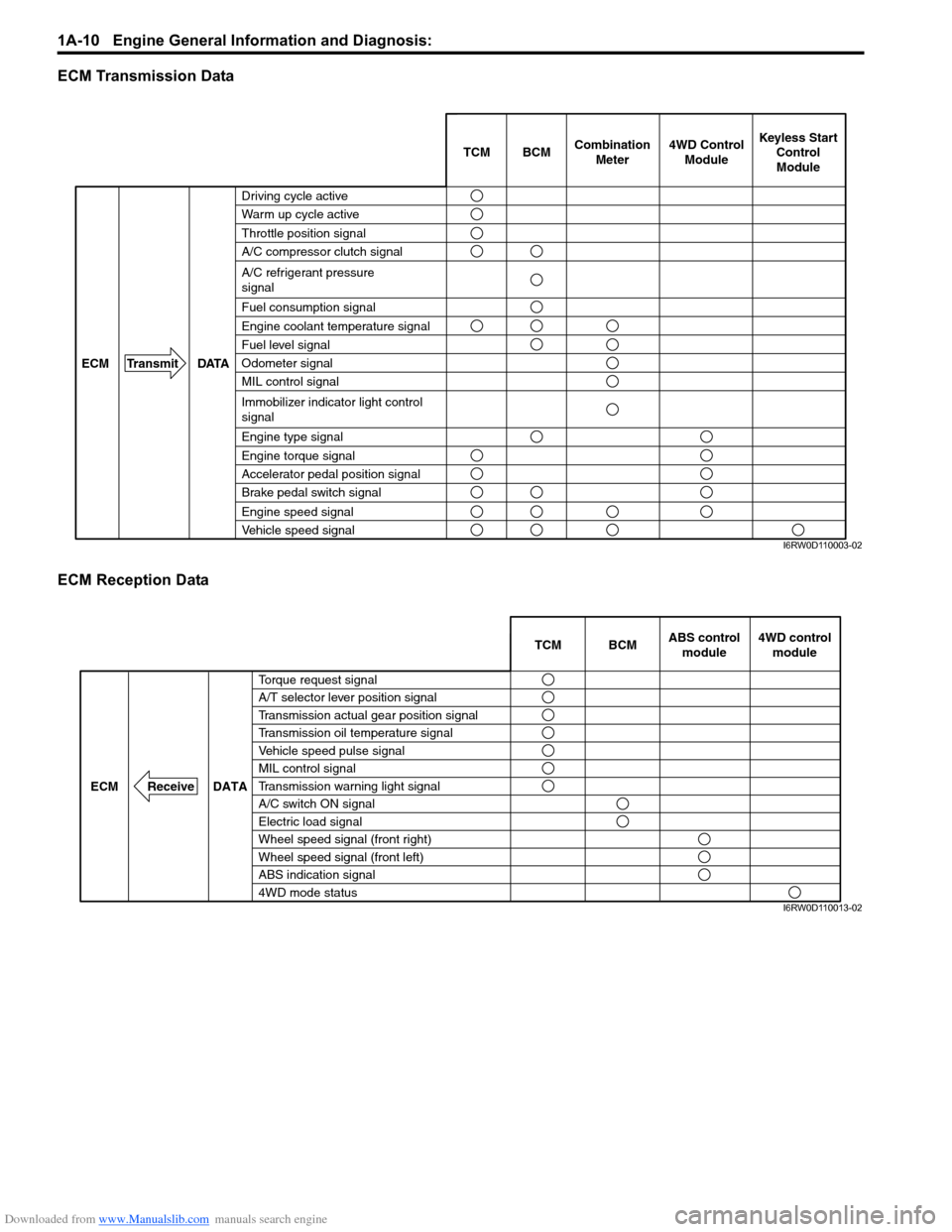
ECM Transmission Data
ECM Reception Data
BCM TCMCombination
Meter
DATA ECM Transmit
Brake pedal switch signal
Vehicle speed signal
Engine speed signal
Engine torque signal
Accelerator pedal position signal
4WD Control
ModuleKeyless Start
Control
Module
A/C refrigerant pressure
signal
A/C compressor clutch signal
Engine type signal
Immobilizer indicator light control
signal
MIL control signal
Engine coolant temperature signal
Fuel level signal
Fuel consumption signal
Throttle position signal
Driving cycle active
Warm up cycle active
Odometer signal
I6RW0D110003-02
DATA ECM Receive
ABS control
module
Transmission oil temperature signal
Transmission warning light signal Vehicle speed pulse signal A/T selector lever position signal
Transmission actual gear position signal
Wheel speed signal (front right)
Wheel speed signal (front left)
ABS indication signal
A/C switch ON signal
Electric load signalBCM
4WD mode status
Torque request signalTCM
MIL control signal4WD control
module
I6RW0D110013-02
Page 93 of 1556
Downloaded from www.Manualslib.com manuals search engine Engine General Information and Diagnosis: 1A-43
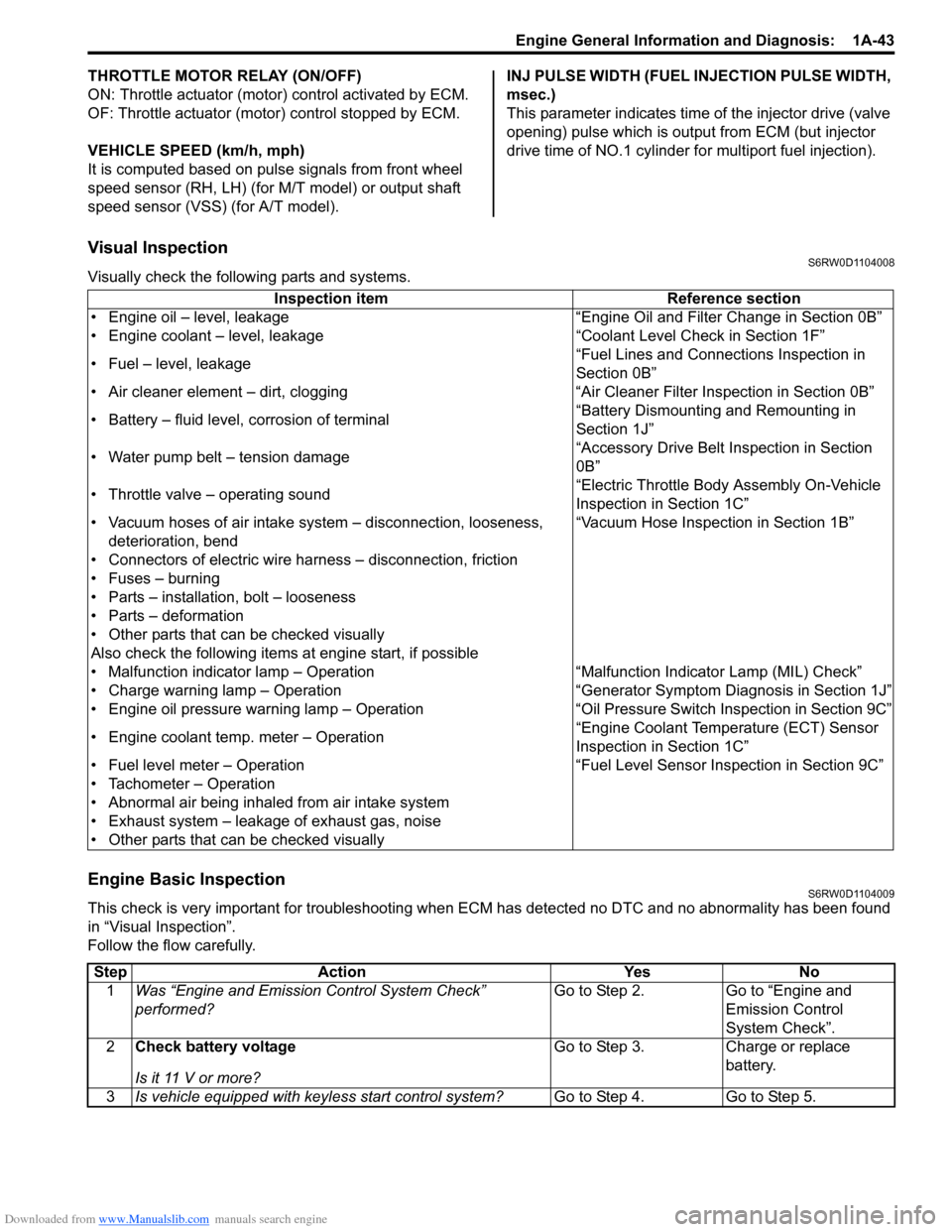
THROTTLE MOTOR RELAY (ON/OFF)
ON: Throttle actuator (motor) control activated by ECM.
OF: Throttle actuator (motor) control stopped by ECM.
VEHICLE SPEED (km/h, mph)
It is computed based on pulse signals from front wheel
speed sensor (RH, LH) (for M/T model) or output shaft
speed sensor (VSS) (for A/T model).INJ PULSE WIDTH (FUEL INJECTION PULSE WIDTH,
msec.)
This parameter indicates time of the injector drive (valve
opening) pulse which is output from ECM (but injector
drive time of NO.1 cylinder for multiport fuel injection).
Visual InspectionS6RW0D1104008
Visually check the following parts and systems.
Engine Basic InspectionS6RW0D1104009
This check is very important for troubleshooting when ECM has detected no DTC and no abnormality has been found
in “Visual Inspection”.
Follow the flow carefully.Inspection item Reference section
• Engine oil – level, leakage “Engine Oil and Filter Change in Section 0B”
• Engine coolant – level, leakage “Coolant Level Check in Section 1F”
• Fuel – level, leakage“Fuel Lines and Connections Inspection in
Section 0B”
• Air cleaner element – dirt, clogging “Air Cleaner Filter Inspection in Section 0B”
• Battery – fluid level, corrosion of terminal“Battery Dismounting and Remounting in
Section 1J”
• Water pump belt – tension damage“Accessory Drive Belt Inspection in Section
0B”
• Throttle valve – operating sound“Electric Throttle Body Assembly On-Vehicle
Inspection in Section 1C”
• Vacuum hoses of air intake system – disconnection, looseness,
deterioration, bend“Vacuum Hose Inspection in Section 1B”
• Connectors of electric wire harness – disconnection, friction
• Fuses – burning
• Parts – installation, bolt – looseness
• Parts – deformation
• Other parts that can be checked visually
Also check the following items at engine start, if possible
• Malfunction indicator lamp – Operation “Malfunction Indicator Lamp (MIL) Check”
• Charge warning lamp – Operation “Generator Symptom Diagnosis in Section 1J”
• Engine oil pressure warning lamp – Operation “Oil Pressure Switch Inspection in Section 9C”
• Engine coolant temp. meter – Operation“Engine Coolant Temperature (ECT) Sensor
Inspection in Section 1C”
• Fuel level meter – Operation “Fuel Level Sensor Inspection in Section 9C”
• Tachometer – Operation
• Abnormal air being inhaled from air intake system
• Exhaust system – leakage of exhaust gas, noise
• Other parts that can be checked visually
Step Action Yes No
1Was “Engine and Emission Control System Check”
performed?Go to Step 2. Go to “Engine and
Emission Control
System Check”.
2Check battery voltage
Is it 11 V or more?Go to Step 3. Charge or replace
battery.
3Is vehicle equipped with keyless start control system?Go to Step 4. Go to Step 5.
Page 103 of 1556
Downloaded from www.Manualslib.com manuals search engine Engine General Information and Diagnosis: 1A-53
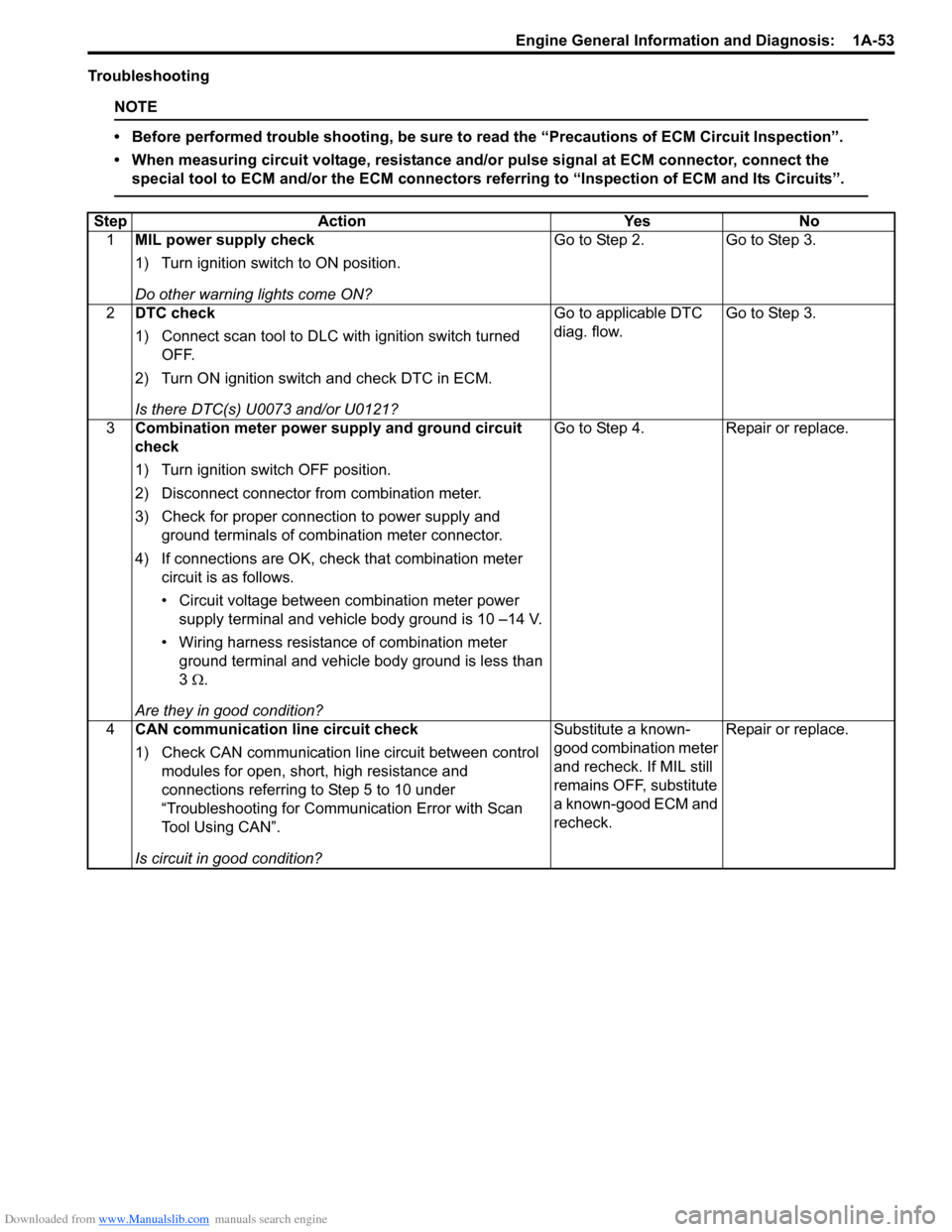
Troubleshooting
NOTE
• Before performed trouble shooting, be sure to read the “Precautions of ECM Circuit Inspection”.
• When measuring circuit voltage, resistance and/or pulse signal at ECM connector, connect the
special tool to ECM and/or the ECM connectors referring to “Inspection of ECM and Its Circuits”.
Step Action Yes No
1MIL power supply check
1) Turn ignition switch to ON position.
Do other warning lights come ON?Go to Step 2. Go to Step 3.
2DTC check
1) Connect scan tool to DLC with ignition switch turned
OFF.
2) Turn ON ignition switch and check DTC in ECM.
Is there DTC(s) U0073 and/or U0121?Go to applicable DTC
diag. flow.Go to Step 3.
3Combination meter power supply and ground circuit
check
1) Turn ignition switch OFF position.
2) Disconnect connector from combination meter.
3) Check for proper connection to power supply and
ground terminals of combination meter connector.
4) If connections are OK, check that combination meter
circuit is as follows.
• Circuit voltage between combination meter power
supply terminal and vehicle body ground is 10 –14 V.
• Wiring harness resistance of combination meter
ground terminal and vehicle body ground is less than
3 Ω.
Are they in good condition?Go to Step 4. Repair or replace.
4CAN communication line circuit check
1) Check CAN communication line circuit between control
modules for open, short, high resistance and
connections referring to Step 5 to 10 under
“Troubleshooting for Communication Error with Scan
Tool Using CAN”.
Is circuit in good condition?Substitute a known-
good combination meter
and recheck. If MIL still
remains OFF, substitute
a known-good ECM and
recheck.Repair or replace.