Oil ring SUZUKI SX4 2006 1.G Service Owner's Manual
[x] Cancel search | Manufacturer: SUZUKI, Model Year: 2006, Model line: SX4, Model: SUZUKI SX4 2006 1.GPages: 1556, PDF Size: 37.31 MB
Page 71 of 1556

Downloaded from www.Manualslib.com manuals search engine Engine General Information and Diagnosis: 1A-21
Component Location
Electronic Control System Components LocationS6RW0D1103001
NOTE
The figure shows left-hand steering vehicle. For right-hand steering vehicle, parts with (*) are installed
at the opposite side.
H*E*
10
D
G* C
6A
B*
e
3*
12*
a8 13
b
1
5-1
d
2
11
g
4
7
9
i
j
Fh k f
n
c J
5
K*
14
I6RW0D110016-03
Information sensors Control devices Others
1. MAF and IAT sensor a: Fuel injector A: ECM
2. Electric throttle body assembly
(built-in throttle position sensor and throttle
actuator)b: EVAP canister purge valve B: Combination meter
3. Brake light switch c: Fuel pump relay C: EVAP canister
4. ECT sensor d: EGR valve (if equipped) D: A/C evaporator outlet air temp. sensor
(if equipped with A/C)
5. Heated oxygen sensor-1 e: Malfunction indicator lamp E: Data link connector
5-1. Heated oxygen sensor-2 (if equipped) f: Radiator cooling fan relay F: A/C compressor relay (if equipped with A/C)
6. Battery g: Ignition coil assembly (with ignitor) G: BCM (included in junction block assembly)
7. CMP sensor (for engine with VVT system) h: Main relay H: Immobilizer coil antenna
8. MAP sensor (if equipped) i: Oil control valve (for engine with VVT system) J: A/C refrigerant pressure sensor
(if equipped with A/C)
9. CKP sensor j: A/C condenser cooling fan relay K: TCM (for A/T model)
10. Fuel level sensor k: Starting motor control relay
11. Knock sensor m: Immobilizer indicator lamp
12. APP sensor n: Throttle actuator control relay
13. Front wheel speed sensor (RH, LH) (VSS)
14. CMP sensor (for engine without VVT system)
Page 82 of 1556
Downloaded from www.Manualslib.com manuals search engine 1A-32 Engine General Information and Diagnosis:
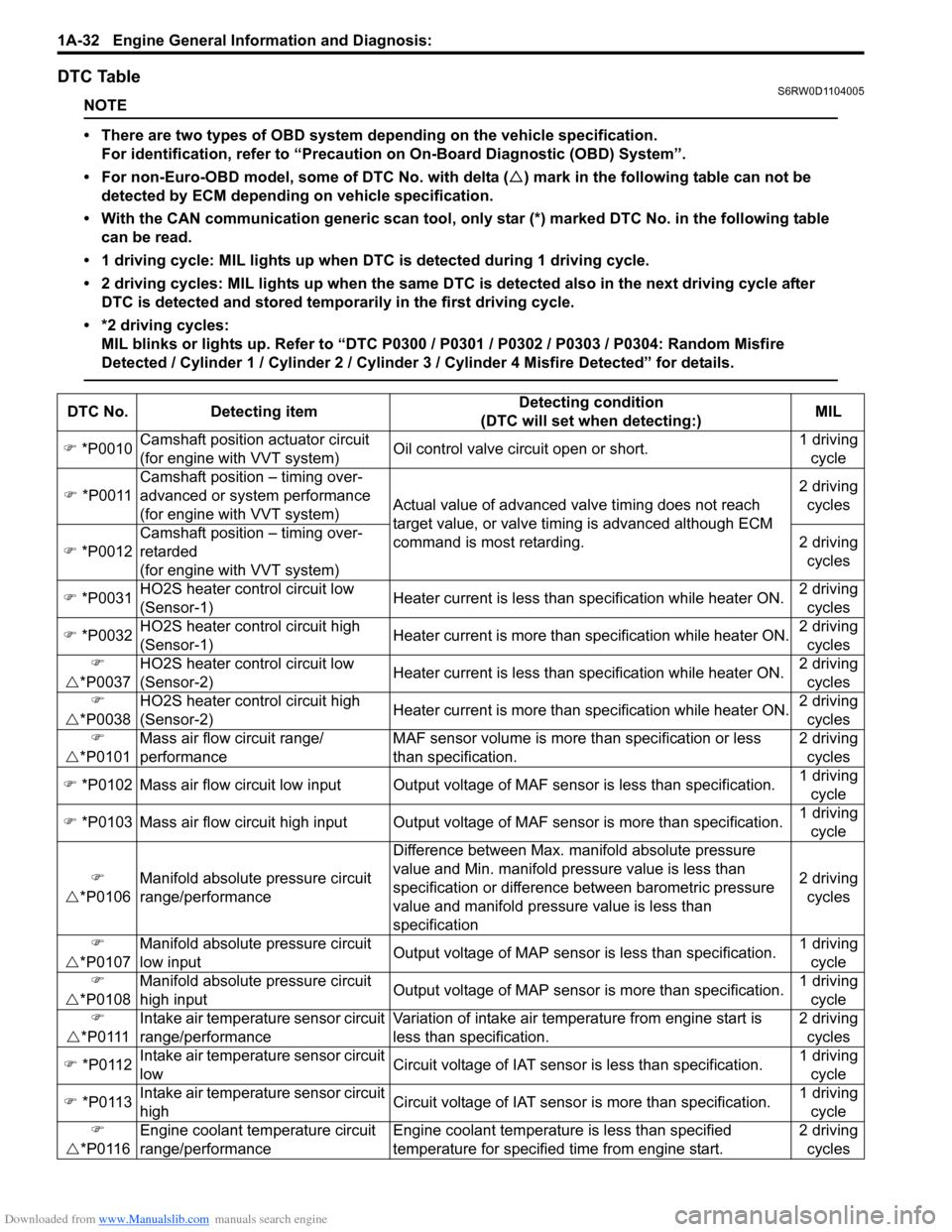
DTC TableS6RW0D1104005
NOTE
• There are two types of OBD system depending on the vehicle specification.
For identification, refer to “Precaution on On-Board Diagnostic (OBD) System”.
• For non-Euro-OBD model, some of DTC No. with delta (U) mark in the following table can not be
detected by ECM depending on vehicle specification.
• With the CAN communication generic scan tool, only star (*) marked DTC No. in the following table
can be read.
• 1 driving cycle: MIL lights up when DTC is detected during 1 driving cycle.
• 2 driving cycles: MIL lights up when the same DTC is detected also in the next driving cycle after
DTC is detected and stored temporarily in the first driving cycle.
• *2 driving cycles:
MIL blinks or lights up. Refer to “DTC P0300 / P0301 / P0302 / P0303 / P0304: Random Misfire
Detected / Cylinder 1 / Cylinder 2 / Cylinder 3 / Cylinder 4 Misfire Detected” for details.
DTC No. Detecting itemDetecting condition
(DTC will set when detecting:)MIL
) *P0010Camshaft position actuator circuit
(for engine with VVT system)Oil control valve circuit open or short.1 driving
cycle
) *P0011Camshaft position – timing over-
advanced or system performance
(for engine with VVT system)Actual value of advanced valve timing does not reach
target value, or valve timing is advanced although ECM
command is most retarding.2 driving
cycles
) *P0012Camshaft position – timing over-
retarded
(for engine with VVT system)2 driving
cycles
) *P0031HO2S heater control circuit low
(Sensor-1)Heater current is less than specification while heater ON.2 driving
cycles
) *P0032HO2S heater control circuit high
(Sensor-1)Heater current is more than specification while heater ON.2 driving
cycles
)
U*P0037HO2S heater control circuit low
(Sensor-2)Heater current is less than specification while heater ON.2 driving
cycles
)
U*P0038HO2S heater control circuit high
(Sensor-2)Heater current is more than specification while heater ON.2 driving
cycles
)
U*P0101Mass air flow circuit range/
performanceMAF sensor volume is more than specification or less
than specification.2 driving
cycles
) *P0102 Mass air flow circuit low input Output voltage of MAF sensor is less than specification.1 driving
cycle
) *P0103 Mass air flow circuit high input Output voltage of MAF sensor is more than specification.1 driving
cycle
)
U*P0106Manifold absolute pressure circuit
range/performanceDifference between Max. manifold absolute pressure
value and Min. manifold pressure value is less than
specification or difference between barometric pressure
value and manifold pressure value is less than
specification2 driving
cycles
)
U*P0107Manifold absolute pressure circuit
low inputOutput voltage of MAP sensor is less than specification.
1 driving
cycle
)
U*P0108Manifold absolute pressure circuit
high inputOutput voltage of MAP sensor is more than specification.1 driving
cycle
)
U* P 0 111Intake air temperature sensor circuit
range/performanceVariation of intake air temperature from engine start is
less than specification.2 driving
cycles
) *P0112Intake air temperature sensor circuit
lowCircuit voltage of IAT sensor is less than specification.1 driving
cycle
) *P0113Intake air temperature sensor circuit
highCircuit voltage of IAT sensor is more than specification.1 driving
cycle
)
U*P0116Engine coolant temperature circuit
range/performanceEngine coolant temperature is less than specified
temperature for specified time from engine start.2 driving
cycles
Page 95 of 1556
Downloaded from www.Manualslib.com manuals search engine Engine General Information and Diagnosis: 1A-45
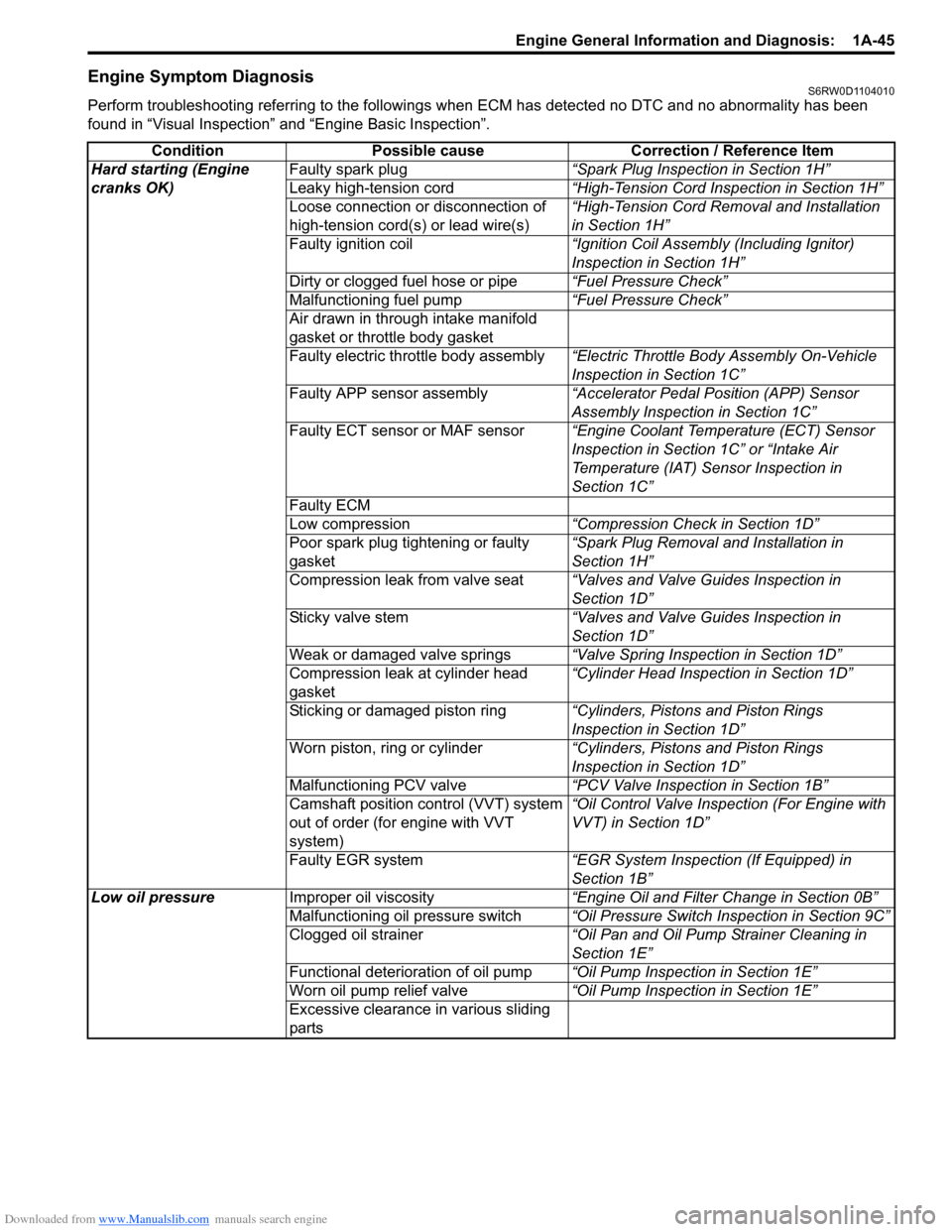
Engine Symptom DiagnosisS6RW0D1104010
Perform troubleshooting referring to the followings when ECM has detected no DTC and no abnormality has been
found in “Visual Inspection” and “Engine Basic Inspection”.
Condition Possible cause Correction / Reference Item
Hard starting (Engine
cranks OK)Faulty spark plug“Spark Plug Inspection in Section 1H”
Leaky high-tension cord“High-Tension Cord Inspection in Section 1H”
Loose connection or disconnection of
high-tension cord(s) or lead wire(s)“High-Tension Cord Removal and Installation
in Section 1H”
Faulty ignition coil“Ignition Coil Assembly (Including Ignitor)
Inspection in Section 1H”
Dirty or clogged fuel hose or pipe“Fuel Pressure Check”
Malfunctioning fuel pump“Fuel Pressure Check”
Air drawn in through intake manifold
gasket or throttle body gasket
Faulty electric throttle body assembly“Electric Throttle Body Assembly On-Vehicle
Inspection in Section 1C”
Faulty APP sensor assembly“Accelerator Pedal Position (APP) Sensor
Assembly Inspection in Section 1C”
Faulty ECT sensor or MAF sensor“Engine Coolant Temperature (ECT) Sensor
Inspection in Section 1C” or “Intake Air
Temperature (IAT) Sensor Inspection in
Section 1C”
Faulty ECM
Low compression“Compression Check in Section 1D”
Poor spark plug tightening or faulty
gasket“Spark Plug Removal and Installation in
Section 1H”
Compression leak from valve seat“Valves and Valve Guides Inspection in
Section 1D”
Sticky valve stem“Valves and Valve Guides Inspection in
Section 1D”
Weak or damaged valve springs“Valve Spring Inspection in Section 1D”
Compression leak at cylinder head
gasket“Cylinder Head Inspection in Section 1D”
Sticking or damaged piston ring“Cylinders, Pistons and Piston Rings
Inspection in Section 1D”
Worn piston, ring or cylinder“Cylinders, Pistons and Piston Rings
Inspection in Section 1D”
Malfunctioning PCV valve“PCV Valve Inspection in Section 1B”
Camshaft position control (VVT) system
out of order (for engine with VVT
system)“Oil Control Valve Inspection (For Engine with
VVT) in Section 1D”
Faulty EGR system“EGR System Inspection (If Equipped) in
Section 1B”
Low oil pressureImproper oil viscosity“Engine Oil and Filter Change in Section 0B”
Malfunctioning oil pressure switch“Oil Pressure Switch Inspection in Section 9C”
Clogged oil strainer“Oil Pan and Oil Pump Strainer Cleaning in
Section 1E”
Functional deterioration of oil pump“Oil Pump Inspection in Section 1E”
Worn oil pump relief valve“Oil Pump Inspection in Section 1E”
Excessive clearance in various sliding
parts
Page 96 of 1556
Downloaded from www.Manualslib.com manuals search engine 1A-46 Engine General Information and Diagnosis:
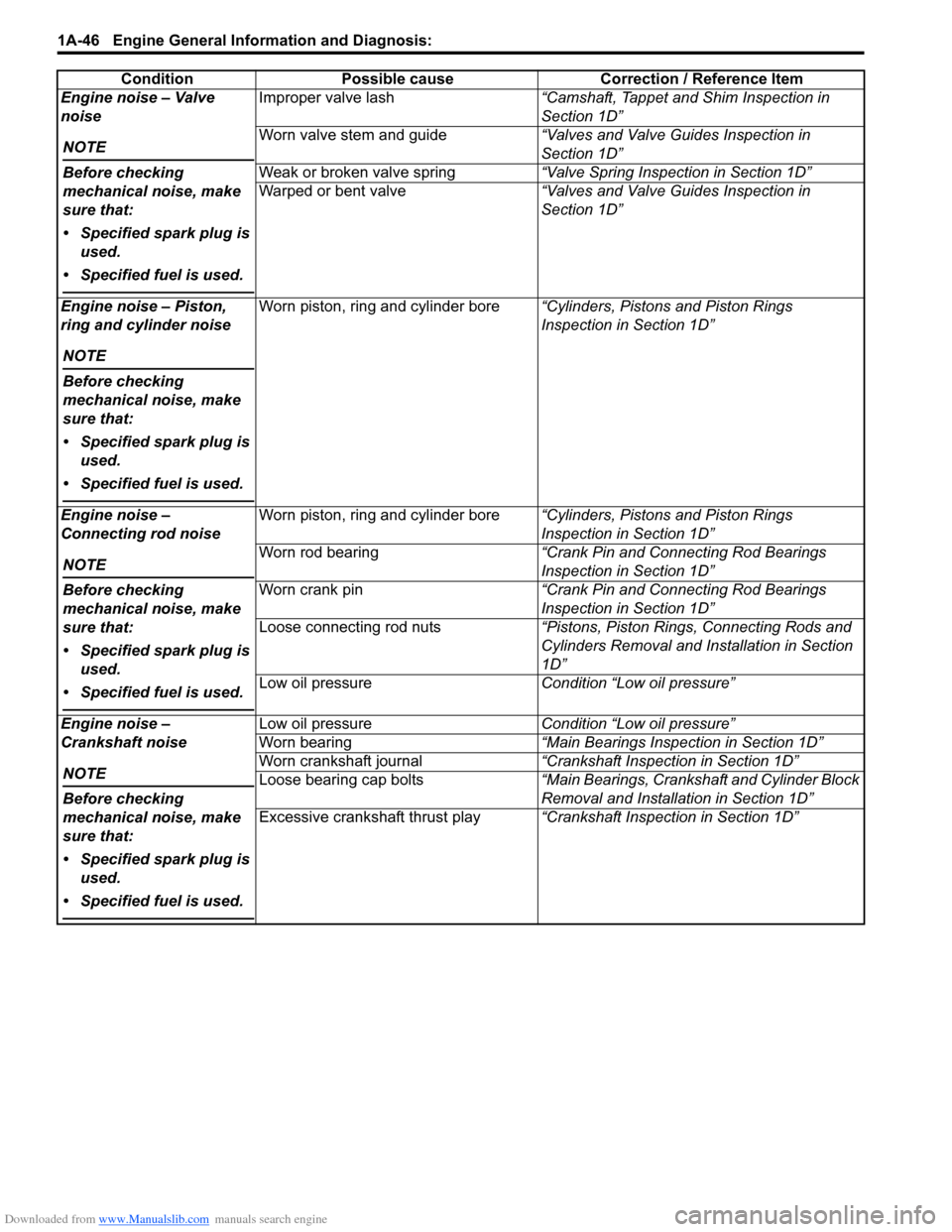
Engine noise – Valve
noise
NOTE
Before checking
mechanical noise, make
sure that:
• Specified spark plug is
used.
• Specified fuel is used.
Improper valve lash“Camshaft, Tappet and Shim Inspection in
Section 1D”
Worn valve stem and guide“Valves and Valve Guides Inspection in
Section 1D”
Weak or broken valve spring“Valve Spring Inspection in Section 1D”
Warped or bent valve“Valves and Valve Guides Inspection in
Section 1D”
Engine noise – Piston,
ring and cylinder noise
NOTE
Before checking
mechanical noise, make
sure that:
• Specified spark plug is
used.
• Specified fuel is used.
Worn piston, ring and cylinder bore“Cylinders, Pistons and Piston Rings
Inspection in Section 1D”
Engine noise –
Connecting rod noise
NOTE
Before checking
mechanical noise, make
sure that:
• Specified spark plug is
used.
• Specified fuel is used.
Worn piston, ring and cylinder bore“Cylinders, Pistons and Piston Rings
Inspection in Section 1D”
Worn rod bearing“Crank Pin and Connecting Rod Bearings
Inspection in Section 1D”
Worn crank pin“Crank Pin and Connecting Rod Bearings
Inspection in Section 1D”
Loose connecting rod nuts“Pistons, Piston Rings, Connecting Rods and
Cylinders Removal and Installation in Section
1D”
Low oil pressureCondition “Low oil pressure”
Engine noise –
Crankshaft noise
NOTE
Before checking
mechanical noise, make
sure that:
• Specified spark plug is
used.
• Specified fuel is used.
Low oil pressureCondition “Low oil pressure”
Worn bearing“Main Bearings Inspection in Section 1D”
Worn crankshaft journal“Crankshaft Inspection in Section 1D”
Loose bearing cap bolts“Main Bearings, Crankshaft and Cylinder Block
Removal and Installation in Section 1D”
Excessive crankshaft thrust play“Crankshaft Inspection in Section 1D” Condition Possible cause Correction / Reference Item
Page 98 of 1556
Downloaded from www.Manualslib.com manuals search engine 1A-48 Engine General Information and Diagnosis:
Excessive engine oil
consumption – Oil
entering combustion
chamberSticky piston ring“Cylinders, Pistons and Piston Rings
Inspection in Section 1D”
Worn piston and cylinder“Cylinders, Pistons and Piston Rings
Inspection in Section 1D”
Worn piston ring groove and ring“Cylinders, Pistons and Piston Rings
Inspection in Section 1D”
Improper location of piston ring gap“Pistons, Piston Rings, Connecting Rods and
Cylinders Disassembly and Assembly in
Section 1D”
Worn or damaged valve stem seal“Valves and Valve Guides Inspection in
Section 1D”
Worn valve stem“Valves and Valve Guides Inspection in
Section 1D”
Engine hesitates –
Momentary lack of
response as accelerator
is depressed. Can occur
at all vehicle speeds.
Usually most severe when
first trying to make
vehicle move, as from a
stop sign.Spark plug faulty or plug gap out of
adjustment“Spark Plug Inspection in Section 1H”
Leaky high-tension cord“High-Tension Cord Inspection in Section 1H”
Fuel pressure out of specification“Fuel Pressure Check”
Malfunctioning EGR valve“EGR Valve Inspection (If Equipped) in Section
1B”
Poor performance of ECT sensor or
MAF sensor, “Engine Coolant Temperature (ECT) Sensor
Inspection in Section 1C” or “Intake Air
Temperature (IAT) Sensor Inspection in
Section 1C”
Faulty electric throttle body assembly“Electric Throttle Body Assembly On-Vehicle
Inspection in Section 1C”
Faulty APP sensor assembly“Accelerator Pedal Position (APP) Sensor
Assembly Inspection in Section 1C”
Faulty fuel injector“Fuel Injector Circuit Check”
Faulty ECM
Engine overheatingCondition “Engine overheating”
Low compression“Compression Check in Section 1D”
Camshaft position control (VVT) system
out of order (for engine with VVT
system)“Oil Control Valve Inspection (For Engine with
VVT) in Section 1D”
Surge – Engine power
variation under steady
throttle or cruise. Feels
like vehicle speeds up
and down with no change
in accelerator pedal.Leaky or loosely connected high-tension
cord“High-Tension Cord Removal and Installation
in Section 1H”
Faulty spark plug (excess carbon
deposits, improper gap, burned
electrodes, etc.)“Spark Plug Inspection in Section 1H”
Variable fuel pressure“Fuel Pressure Check”
Kinky or damaged fuel hose and lines
Faulty fuel pump (clogged fuel filter)
Malfunctioning EGR valve“EGR Valve Inspection (If Equipped) in Section
1B”
Poor performance of MAF sensor“Intake Air Temperature (IAT) Sensor
Inspection in Section 1C”
Faulty fuel injector“Fuel Injector Circuit Check”
Faulty ECM
Faulty electric throttle body assembly“Electric Throttle Body Assembly On-Vehicle
Inspection in Section 1C”
Faulty APP sensor assembly“Accelerator Pedal Position (APP) Sensor
Assembly Inspection in Section 1C” Condition Possible cause Correction / Reference Item
Page 99 of 1556
Downloaded from www.Manualslib.com manuals search engine Engine General Information and Diagnosis: 1A-49
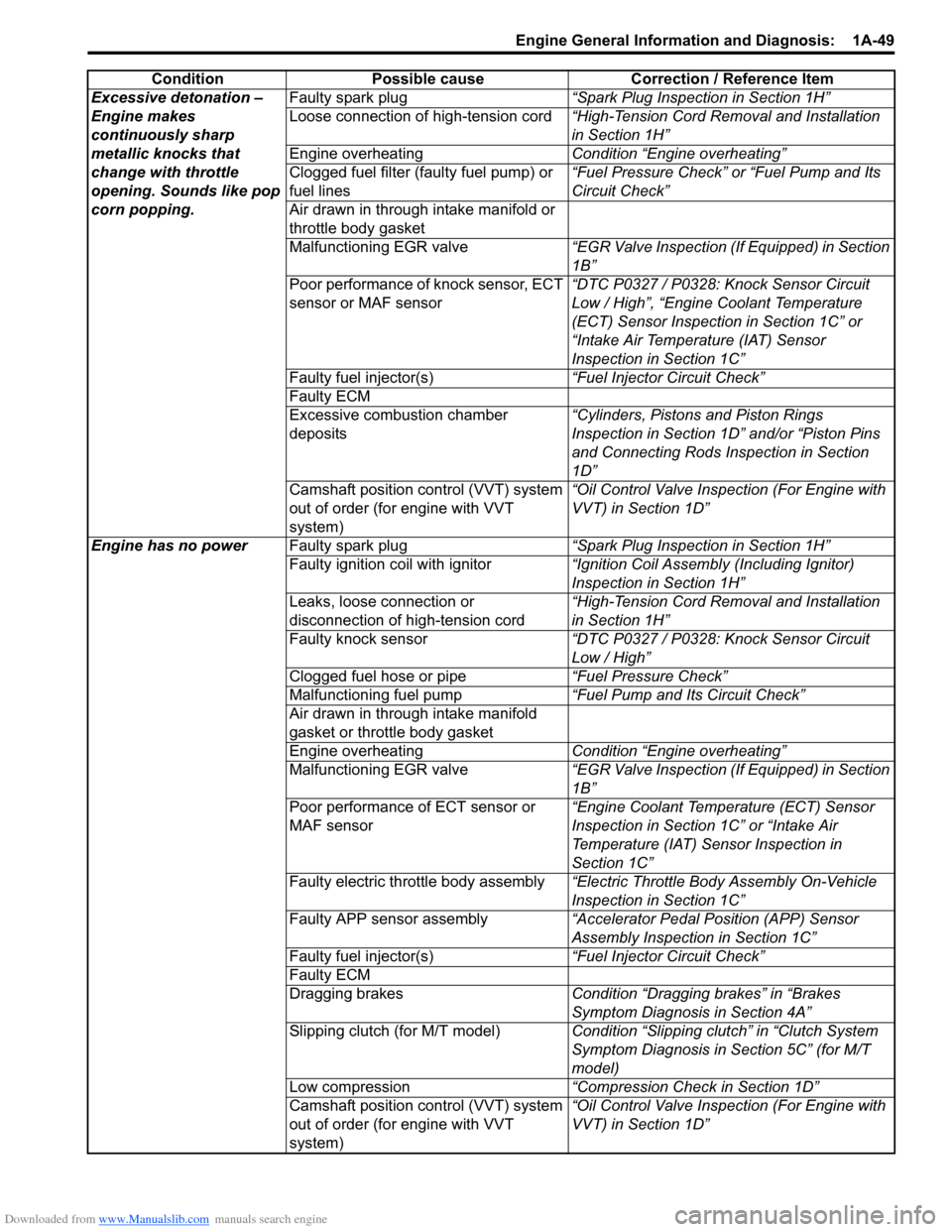
Excessive detonation –
Engine makes
continuously sharp
metallic knocks that
change with throttle
opening. Sounds like pop
corn popping.Faulty spark plug“Spark Plug Inspection in Section 1H”
Loose connection of high-tension cord“High-Tension Cord Removal and Installation
in Section 1H”
Engine overheatingCondition “Engine overheating”
Clogged fuel filter (faulty fuel pump) or
fuel lines“Fuel Pressure Check” or “Fuel Pump and Its
Circuit Check”
Air drawn in through intake manifold or
throttle body gasket
Malfunctioning EGR valve“EGR Valve Inspection (If Equipped) in Section
1B”
Poor performance of knock sensor, ECT
sensor or MAF sensor“DTC P0327 / P0328: Knock Sensor Circuit
Low / High”, “Engine Coolant Temperature
(ECT) Sensor Inspection in Section 1C” or
“Intake Air Temperature (IAT) Sensor
Inspection in Section 1C”
Faulty fuel injector(s)“Fuel Injector Circuit Check”
Faulty ECM
Excessive combustion chamber
deposits“Cylinders, Pistons and Piston Rings
Inspection in Section 1D” and/or “Piston Pins
and Connecting Rods Inspection in Section
1D”
Camshaft position control (VVT) system
out of order (for engine with VVT
system)“Oil Control Valve Inspection (For Engine with
VVT) in Section 1D”
Engine has no powerFaulty spark plug“Spark Plug Inspection in Section 1H”
Faulty ignition coil with ignitor“Ignition Coil Assembly (Including Ignitor)
Inspection in Section 1H”
Leaks, loose connection or
disconnection of high-tension cord“High-Tension Cord Removal and Installation
in Section 1H”
Faulty knock sensor“DTC P0327 / P0328: Knock Sensor Circuit
Low / High”
Clogged fuel hose or pipe“Fuel Pressure Check”
Malfunctioning fuel pump“Fuel Pump and Its Circuit Check”
Air drawn in through intake manifold
gasket or throttle body gasket
Engine overheatingCondition “Engine overheating”
Malfunctioning EGR valve“EGR Valve Inspection (If Equipped) in Section
1B”
Poor performance of ECT sensor or
MAF sensor“Engine Coolant Temperature (ECT) Sensor
Inspection in Section 1C” or “Intake Air
Temperature (IAT) Sensor Inspection in
Section 1C”
Faulty electric throttle body assembly“Electric Throttle Body Assembly On-Vehicle
Inspection in Section 1C”
Faulty APP sensor assembly“Accelerator Pedal Position (APP) Sensor
Assembly Inspection in Section 1C”
Faulty fuel injector(s)“Fuel Injector Circuit Check”
Faulty ECM
Dragging brakesCondition “Dragging brakes” in “Brakes
Symptom Diagnosis in Section 4A”
Slipping clutch (for M/T model)Condition “Slipping clutch” in “Clutch System
Symptom Diagnosis in Section 5C” (for M/T
model)
Low compression“Compression Check in Section 1D”
Camshaft position control (VVT) system
out of order (for engine with VVT
system)“Oil Control Valve Inspection (For Engine with
VVT) in Section 1D” Condition Possible cause Correction / Reference Item
Page 102 of 1556
Downloaded from www.Manualslib.com manuals search engine 1A-52 Engine General Information and Diagnosis:
Malfunction Indicator Lamp Does Not Come ON with Ignition Switch ON and Engine Stop (but
Engine Can Be Started)
S6RW0D1104011
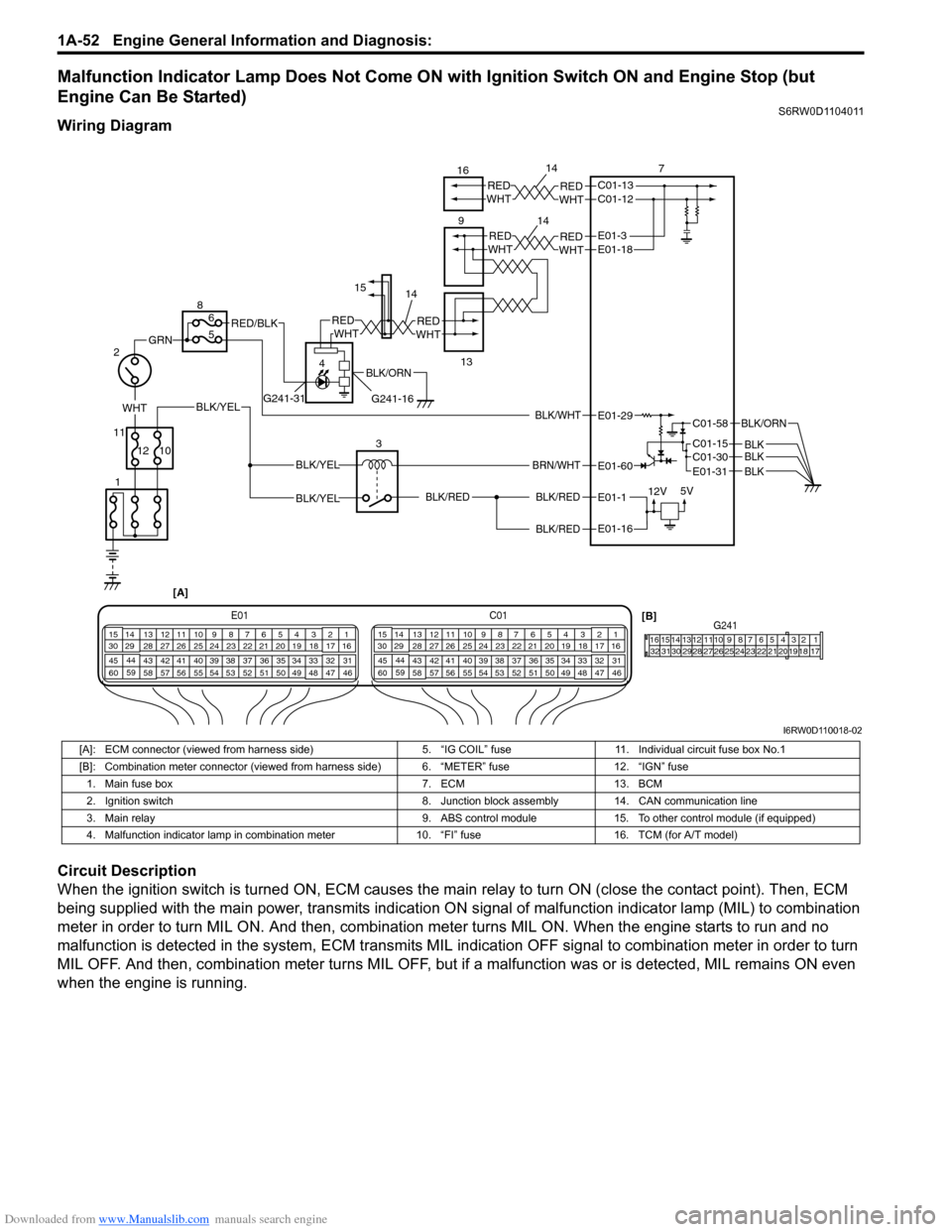
Wiring Diagram
Circuit Description
When the ignition switch is turned ON, ECM causes the main relay to turn ON (close the contact point). Then, ECM
being supplied with the main power, transmits indication ON signal of malfunction indicator lamp (MIL) to combination
meter in order to turn MIL ON. And then, combination meter turns MIL ON. When the engine starts to run and no
malfunction is detected in the system, ECM transmits MIL indication OFF signal to combination meter in order to turn
MIL OFF. And then, combination meter turns MIL OFF, but if a malfunction was or is detected, MIL remains ON even
when the engine is running.
BLK/WHT
BLK/RED
BLK/RED
BLK/RED
WHTBLK/YEL
BLK/YEL
RED/BLK
BLK/YEL
GRN
BRN/WHT
12V5V
2
3 8
6
57
REDWHTREDWHT
REDWHTREDWHT
E01-29
E01-3
E01-1
E01-60
E01-18
E01-16
BLK/ORN49
13
10 12 11G241-31
1414
G241-16
[A]
E01 C01
3 4
18 19 5 6 7 10 11
17 20
47 46 49 50 51 21 22
5216 259
24 14
29
55 57 54 53 59
60 582
26 27 28 15
30
56 4832 31 34 35 36 37 40 42 39 38 44
45 43 41 331 12 13
238 3 4
18 19 5 6 7 10 11
17 20
47 46 49 50 51 21 22
5216 259
24 14
29
55 57 54 53 59
60 582
26 27 28 15
30
56 4832 31 34 35 36 37 40 42 39 38 44
45 43 41 331 12 13
238G2411 2 3 4 5 6 7 8 9 10 11 12 13 14 15 16
17 18 19 20 21 22 23 24 25 26 27 28 29 30 31 32
[B]
1
C01-58
C01-15 C01-30
BLK/ORN
BLKBLKBLK
15
E01-31
REDWHTREDWHTC01-13 C01-12
1614
I6RW0D110018-02
[A]: ECM connector (viewed from harness side) 5. “IG COIL” fuse 11. Individual circuit fuse box No.1
[B]: Combination meter connector (viewed from harness side) 6. “METER” fuse 12. “IGN” fuse
1. Main fuse box 7. ECM 13. BCM
2. Ignition switch 8. Junction block assembly 14. CAN communication line
3. Main relay 9. ABS control module 15. To other control module (if equipped)
4. Malfunction indicator lamp in combination meter 10. “FI” fuse 16. TCM (for A/T model)
Page 105 of 1556
Downloaded from www.Manualslib.com manuals search engine Engine General Information and Diagnosis: 1A-55
DTC P0010: Camshaft Position Actuator Circuit (for engine with VVT system)S6RW0D1104013
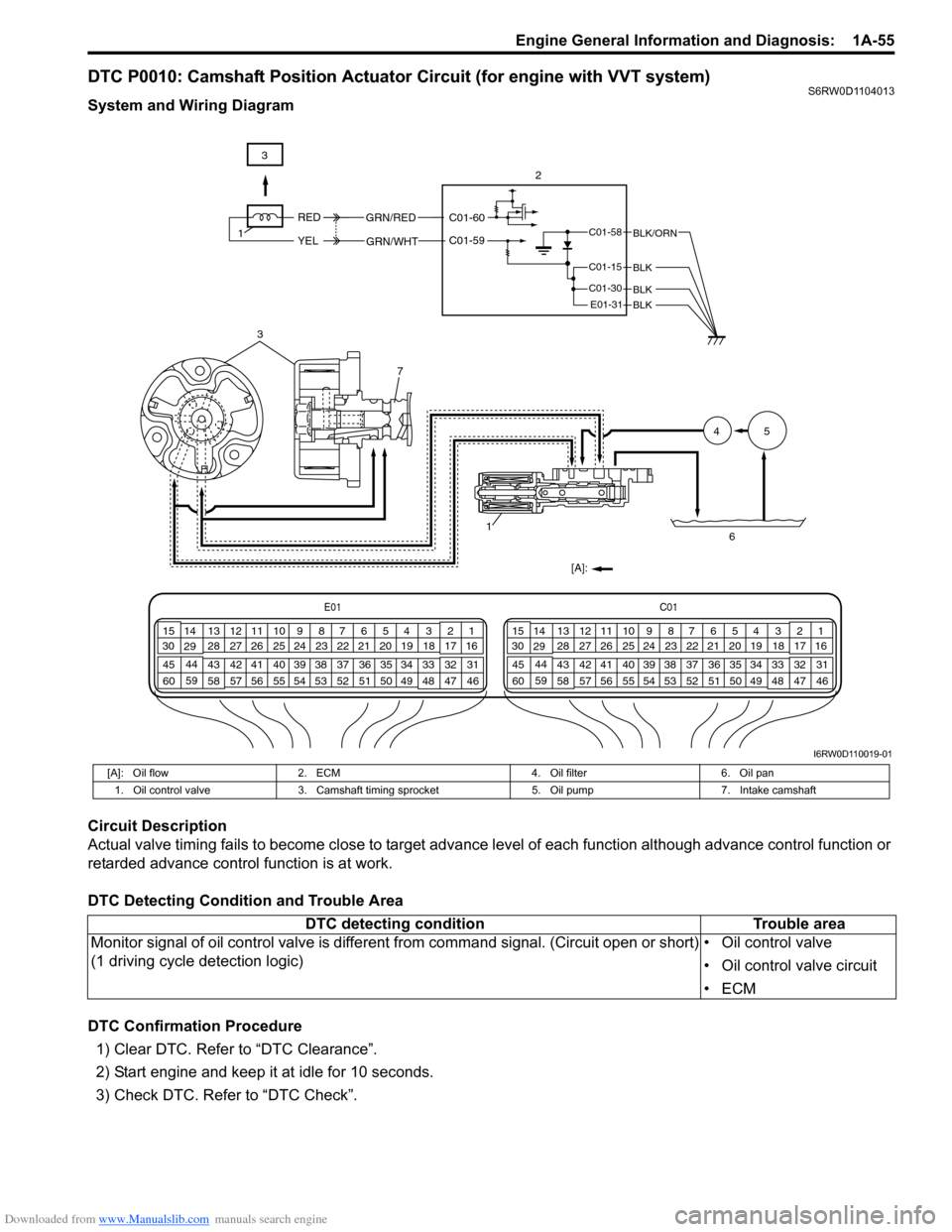
System and Wiring Diagram
Circuit Description
Actual valve timing fails to become close to target advance level of each function although advance control function or
retarded advance control function is at work.
DTC Detecting Condition and Trouble Area
DTC Confirmation Procedure
1) Clear DTC. Refer to “DTC Clearance”.
2) Start engine and keep it at idle for 10 seconds.
3) Check DTC. Refer to “DTC Check”.
3
7
1
[A]:45
6
C01-58
C01-15
C01-30
E01-31BLK
BLK
BLK/ORN
RED
YEL
GRN/RED
GRN/WHT
C01-60
C01-59
3
2
1
E01C01
3 4
18 19 5 6 7 10 11
17 20
47 46 49 50 51 21 22
5216 259
24 14
29
55 57 54 53 59
60 582
26 27 28 15
30
56 4832 31 34 35 36 37 40 42 39 38 44
45 43 41 331 12 13
238 3 4
18 19 5 6 7 10 11
17 20
47 46 49 50 51 21 22
5216 259
24 14
29
55 57 54 53 59
60 582
26 27 28 15
30
56 4832 31 34 35 36 37 40 42 39 38 44
45 43 41 331 12 13
238
BLK
I6RW0D110019-01
[A]: Oil flow 2. ECM 4. Oil filter 6. Oil pan
1. Oil control valve 3. Camshaft timing sprocket 5. Oil pump 7. Intake camshaft
DTC detecting condition Trouble area
Monitor signal of oil control valve is different from command signal. (Circuit open or short)
(1 driving cycle detection logic)• Oil control valve
• Oil control valve circuit
•ECM
Page 106 of 1556
Downloaded from www.Manualslib.com manuals search engine 1A-56 Engine General Information and Diagnosis:
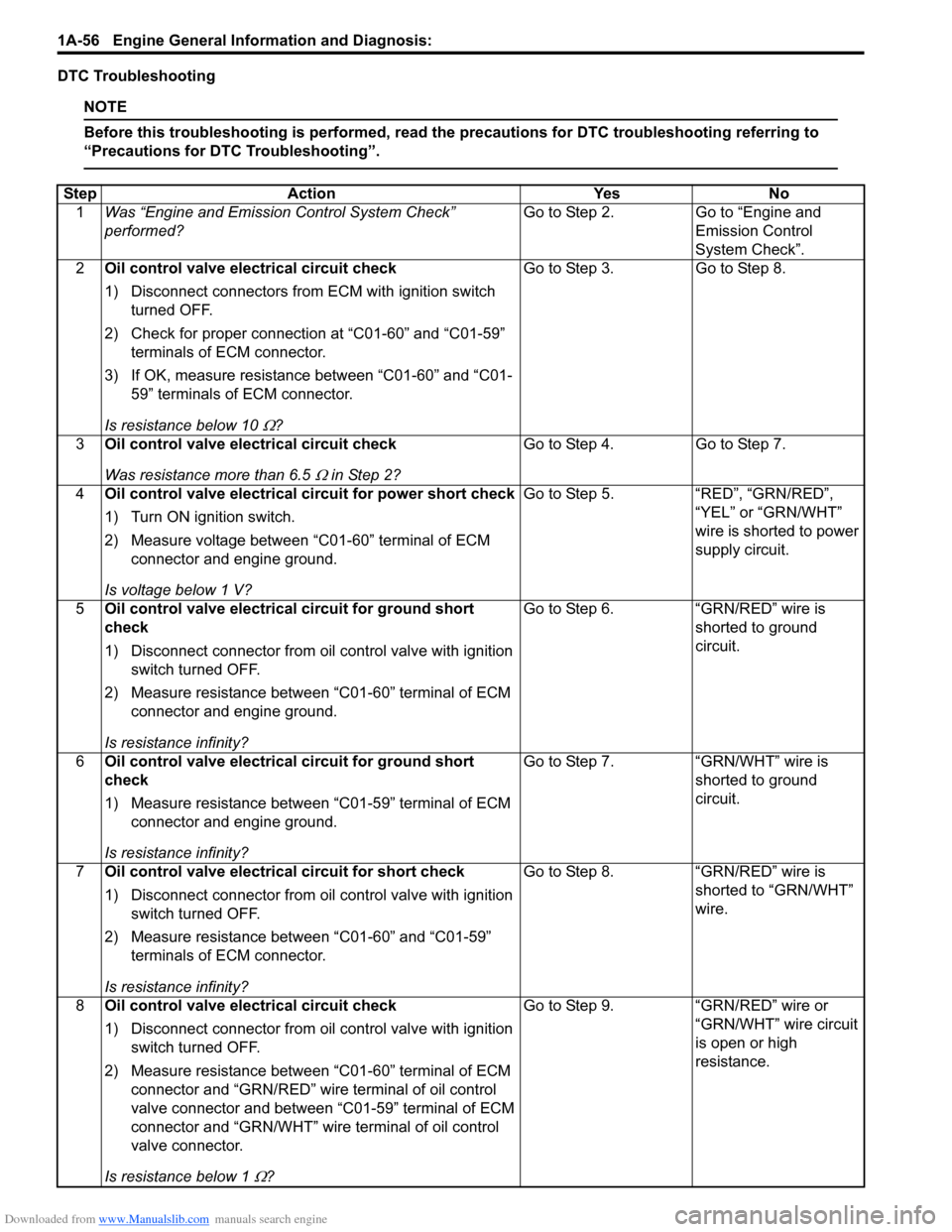
DTC Troubleshooting
NOTE
Before this troubleshooting is performed, read the precautions for DTC troubleshooting referring to
“Precautions for DTC Troubleshooting”.
Step Action Yes No
1Was “Engine and Emission Control System Check”
performed?Go to Step 2. Go to “Engine and
Emission Control
System Check”.
2Oil control valve electrical circuit check
1) Disconnect connectors from ECM with ignition switch
turned OFF.
2) Check for proper connection at “C01-60” and “C01-59”
terminals of ECM connector.
3) If OK, measure resistance between “C01-60” and “C01-
59” terminals of ECM connector.
Is resistance below 10
Ω?Go to Step 3. Go to Step 8.
3Oil control valve electrical circuit check
Was resistance more than 6.5
Ω in Step 2?Go to Step 4. Go to Step 7.
4Oil control valve electrical circuit for power short check
1) Turn ON ignition switch.
2) Measure voltage between “C01-60” terminal of ECM
connector and engine ground.
Is voltage below 1 V?Go to Step 5. “RED”, “GRN/RED”,
“YEL” or “GRN/WHT”
wire is shorted to power
supply circuit.
5Oil control valve electrical circuit for ground short
check
1) Disconnect connector from oil control valve with ignition
switch turned OFF.
2) Measure resistance between “C01-60” terminal of ECM
connector and engine ground.
Is resistance infinity?Go to Step 6. “GRN/RED” wire is
shorted to ground
circuit.
6Oil control valve electrical circuit for ground short
check
1) Measure resistance between “C01-59” terminal of ECM
connector and engine ground.
Is resistance infinity?Go to Step 7. “GRN/WHT” wire is
shorted to ground
circuit.
7Oil control valve electrical circuit for short check
1) Disconnect connector from oil control valve with ignition
switch turned OFF.
2) Measure resistance between “C01-60” and “C01-59”
terminals of ECM connector.
Is resistance infinity?Go to Step 8. “GRN/RED” wire is
shorted to “GRN/WHT”
wire.
8Oil control valve electrical circuit check
1) Disconnect connector from oil control valve with ignition
switch turned OFF.
2) Measure resistance between “C01-60” terminal of ECM
connector and “GRN/RED” wire terminal of oil control
valve connector and between “C01-59” terminal of ECM
connector and “GRN/WHT” wire terminal of oil control
valve connector.
Is resistance below 1
Ω?Go to Step 9. “GRN/RED” wire or
“GRN/WHT” wire circuit
is open or high
resistance.
Page 107 of 1556
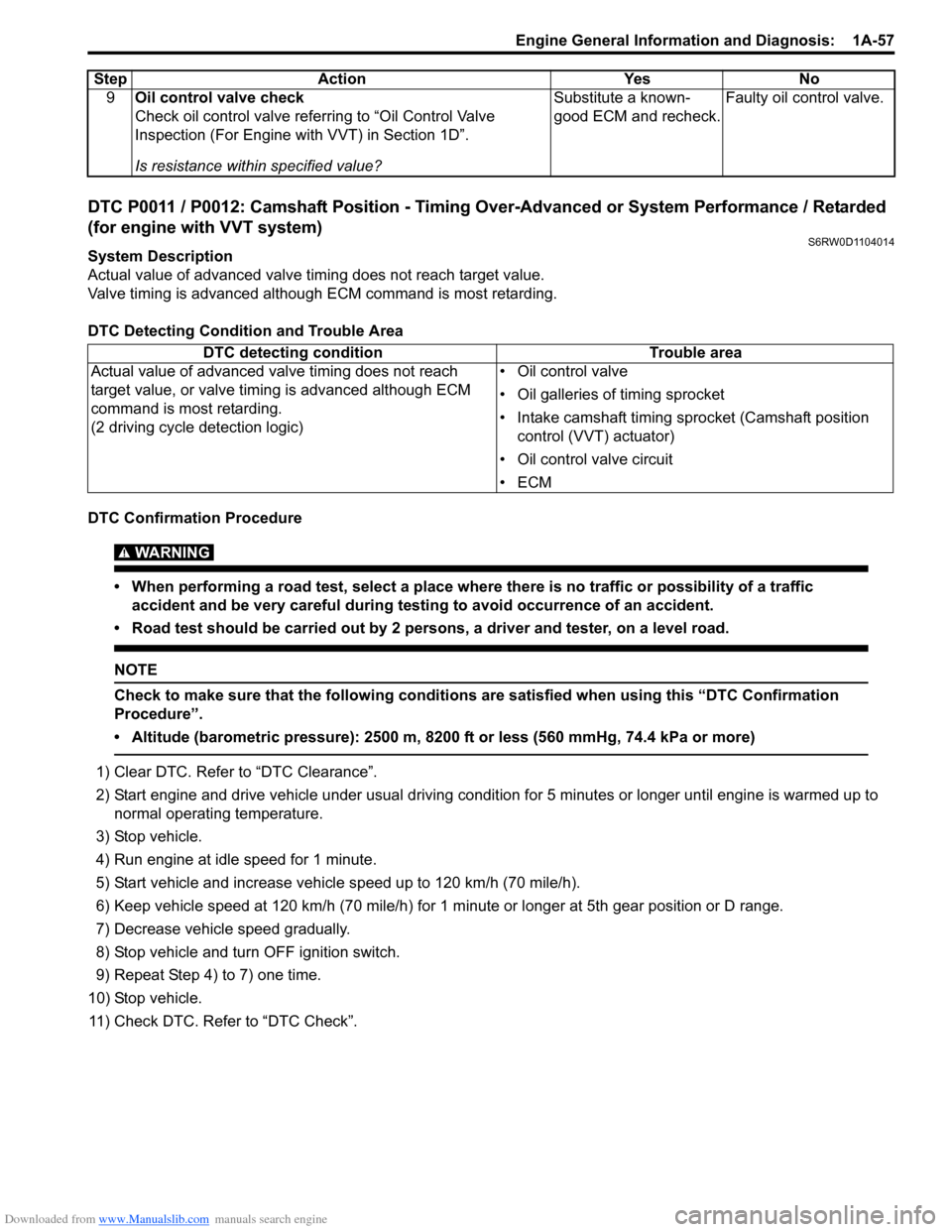
Downloaded from www.Manualslib.com manuals search engine Engine General Information and Diagnosis: 1A-57
DTC P0011 / P0012: Camshaft Position - Timing Over-Advanced or System Performance / Retarded
(for engine with VVT system)
S6RW0D1104014
System Description
Actual value of advanced valve timing does not reach target value.
Valve timing is advanced although ECM command is most retarding.
DTC Detecting Condition and Trouble Area
DTC Confirmation Procedure
WARNING!
• When performing a road test, select a place where there is no traffic or possibility of a traffic
accident and be very careful during testing to avoid occurrence of an accident.
• Road test should be carried out by 2 persons, a driver and tester, on a level road.
NOTE
Check to make sure that the following conditions are satisfied when using this “DTC Confirmation
Procedure”.
• Altitude (barometric pressure): 2500 m, 8200 ft or less (560 mmHg, 74.4 kPa or more)
1) Clear DTC. Refer to “DTC Clearance”.
2) Start engine and drive vehicle under usual driving condition for 5 minutes or longer until engine is warmed up to
normal operating temperature.
3) Stop vehicle.
4) Run engine at idle speed for 1 minute.
5) Start vehicle and increase vehicle speed up to 120 km/h (70 mile/h).
6) Keep vehicle speed at 120 km/h (70 mile/h) for 1 minute or longer at 5th gear position or D range.
7) Decrease vehicle speed gradually.
8) Stop vehicle and turn OFF ignition switch.
9) Repeat Step 4) to 7) one time.
10) Stop vehicle.
11) Check DTC. Refer to “DTC Check”.9Oil control valve check
Check oil control valve referring to “Oil Control Valve
Inspection (For Engine with VVT) in Section 1D”.
Is resistance within specified value?Substitute a known-
good ECM and recheck.Faulty oil control valve. Step Action Yes No
DTC detecting condition Trouble area
Actual value of advanced valve timing does not reach
target value, or valve timing is advanced although ECM
command is most retarding.
(2 driving cycle detection logic)• Oil control valve
• Oil galleries of timing sprocket
• Intake camshaft timing sprocket (Camshaft position
control (VVT) actuator)
• Oil control valve circuit
•ECM