boot SUZUKI SX4 2006 1.G Service Owner's Manual
[x] Cancel search | Manufacturer: SUZUKI, Model Year: 2006, Model line: SX4, Model: SUZUKI SX4 2006 1.GPages: 1556, PDF Size: 37.31 MB
Page 495 of 1556
Downloaded from www.Manualslib.com manuals search engine Drive Shaft / Axle: Rear 3A-16
Rear Drive Shaft Assembly Removal and
Installation
S6RW0D3126002
Removal
1) Hoist vehicle and remove rear wheel.
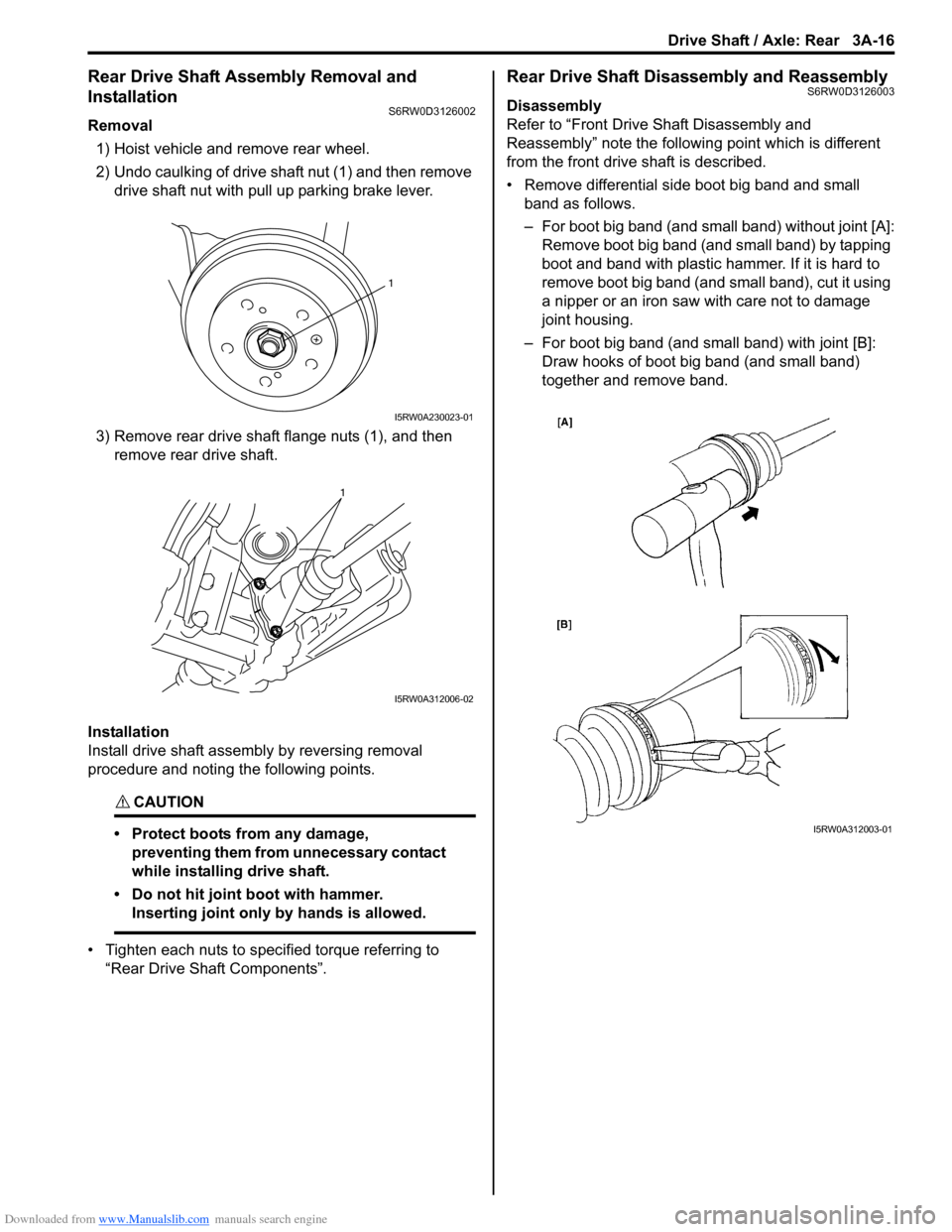
2) Undo caulking of drive shaft nut (1) and then remove
drive shaft nut with pull up parking brake lever.
3) Remove rear drive shaft flange nuts (1), and then
remove rear drive shaft.
Installation
Install drive shaft assembly by reversing removal
procedure and noting the following points.
CAUTION!
• Protect boots from any damage,
preventing them from unnecessary contact
while installing drive shaft.
• Do not hit joint boot with hammer.
Inserting joint only by hands is allowed.
• Tighten each nuts to specified torque referring to
“Rear Drive Shaft Components”.
Rear Drive Shaft Disassembly and ReassemblyS6RW0D3126003
Disassembly
Refer to “Front Drive Shaft Disassembly and
Reassembly” note the following point which is different
from the front drive shaft is described.
• Remove differential side boot big band and small
band as follows.
– For boot big band (and small band) without joint [A]:
Remove boot big band (and small band) by tapping
boot and band with plastic hammer. If it is hard to
remove boot big band (and small band), cut it using
a nipper or an iron saw with care not to damage
joint housing.
– For boot big band (and small band) with joint [B]:
Draw hooks of boot big band (and small band)
together and remove band.
1
I5RW0A230023-01
1
I5RW0A312006-02
I5RW0A312003-01
Page 496 of 1556
Downloaded from www.Manualslib.com manuals search engine 3A-17 Drive Shaft / Axle: Rear
Reassembly
Refer to “Front Drive Shaft Disassembly and
Reassembly” note the following points which is different
from the front drive shaft is described.
• Apply grease to each joint.
Grease color
Wheel side: Black
Differential side: Dark gray
Amount
Wheel side: 50 – 70 g (1.8 – 2.5 oz)
Differential side: 70 – 90 g (2.5 – 3.2 oz)
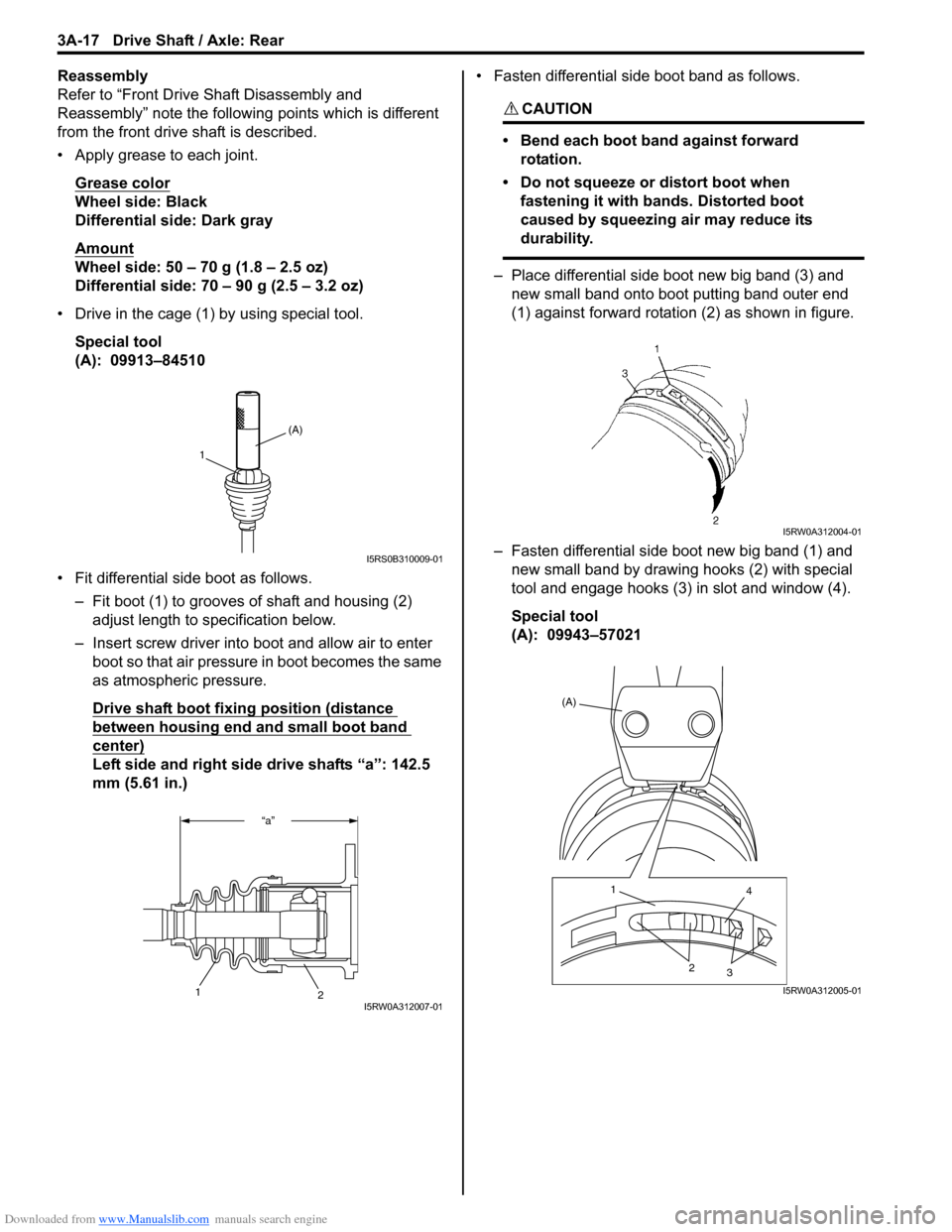
• Drive in the cage (1) by using special tool.
Special tool
(A): 09913–84510
• Fit differential side boot as follows.
– Fit boot (1) to grooves of shaft and housing (2)
adjust length to specification below.
– Insert screw driver into boot and allow air to enter
boot so that air pressure in boot becomes the same
as atmospheric pressure.
Drive shaft boot fixing position (distance
between housing end and small boot band
center)
Left side and right side drive shafts “a”: 142.5
mm (5.61 in.)• Fasten differential side boot band as follows.
CAUTION!
• Bend each boot band against forward
rotation.
• Do not squeeze or distort boot when
fastening it with bands. Distorted boot
caused by squeezing air may reduce its
durability.
– Place differential side boot new big band (3) and
new small band onto boot putting band outer end
(1) against forward rotation (2) as shown in figure.
– Fasten differential side boot new big band (1) and
new small band by drawing hooks (2) with special
tool and engage hooks (3) in slot and window (4).
Special tool
(A): 09943–57021
(A)
1
I5RS0B310009-01
“a”
2
1I5RW0A312007-01
I5RW0A312004-01
(A)
1
4
2
3
I5RW0A312005-01
Page 586 of 1556
Downloaded from www.Manualslib.com manuals search engine 4A-15 Brake Control System and Diagnosis:
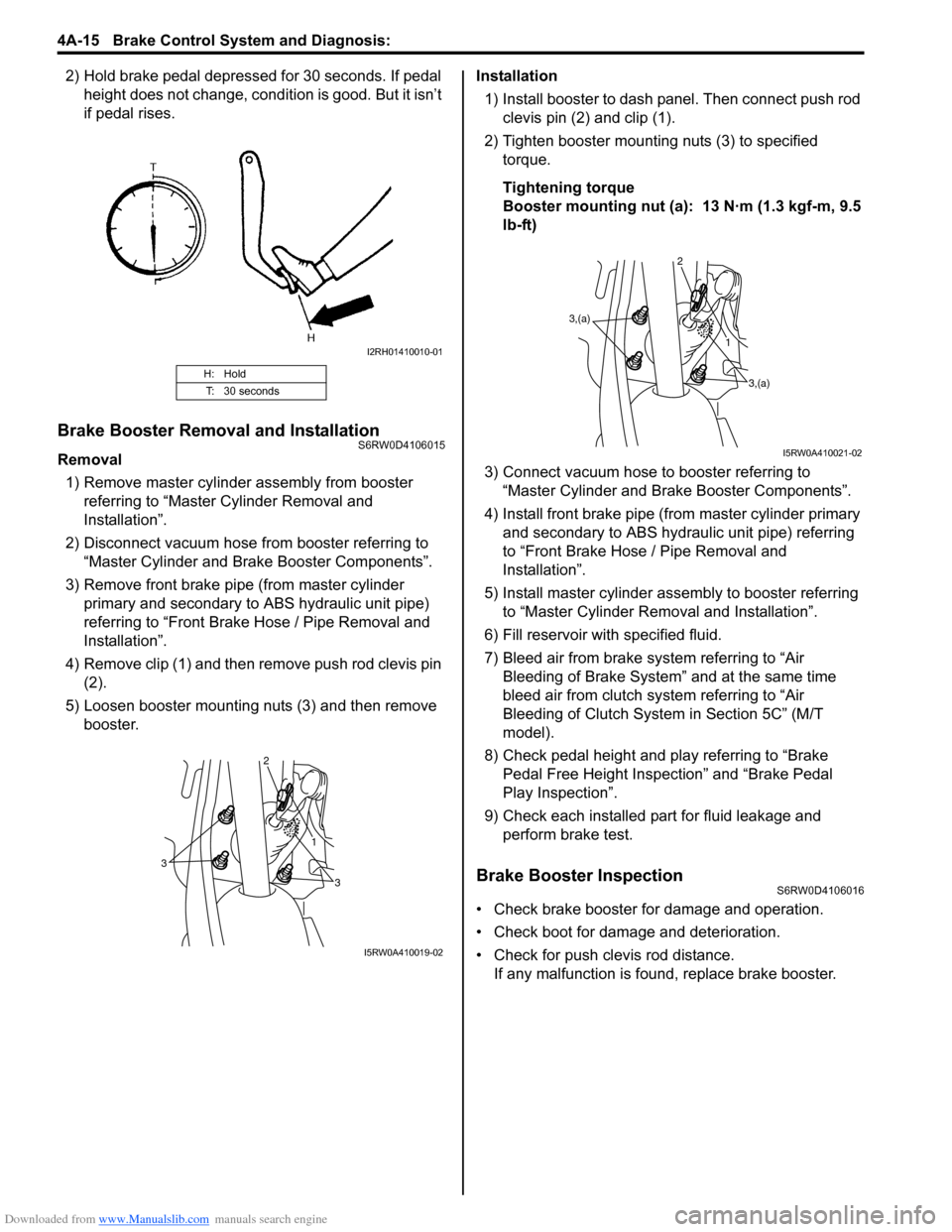
2) Hold brake pedal depressed for 30 seconds. If pedal
height does not change, condition is good. But it isn’t
if pedal rises.
Brake Booster Removal and InstallationS6RW0D4106015
Removal
1) Remove master cylinder assembly from booster
referring to “Master Cylinder Removal and
Installation”.
2) Disconnect vacuum hose from booster referring to
“Master Cylinder and Brake Booster Components”.
3) Remove front brake pipe (from master cylinder
primary and secondary to ABS hydraulic unit pipe)
referring to “Front Brake Hose / Pipe Removal and
Installation”.
4) Remove clip (1) and then remove push rod clevis pin
(2).
5) Loosen booster mounting nuts (3) and then remove
booster.Installation
1) Install booster to dash panel. Then connect push rod
clevis pin (2) and clip (1).
2) Tighten booster mounting nuts (3) to specified
torque.
Tightening torque
Booster mounting nut (a): 13 N·m (1.3 kgf-m, 9.5
lb-ft)
3) Connect vacuum hose to booster referring to
“Master Cylinder and Brake Booster Components”.
4) Install front brake pipe (from master cylinder primary
and secondary to ABS hydraulic unit pipe) referring
to “Front Brake Hose / Pipe Removal and
Installation”.
5) Install master cylinder assembly to booster referring
to “Master Cylinder Removal and Installation”.
6) Fill reservoir with specified fluid.
7) Bleed air from brake system referring to “Air
Bleeding of Brake System” and at the same time
bleed air from clutch system referring to “Air
Bleeding of Clutch System in Section 5C” (M/T
model).
8) Check pedal height and play referring to “Brake
Pedal Free Height Inspection” and “Brake Pedal
Play Inspection”.
9) Check each installed part for fluid leakage and
perform brake test.
Brake Booster InspectionS6RW0D4106016
• Check brake booster for damage and operation.
• Check boot for damage and deterioration.
• Check for push clevis rod distance.
If any malfunction is found, replace brake booster.
H: Hold
T: 30 seconds
I2RH01410010-01
3
3 1 2
I5RW0A410019-02
3,(a)
3,(a) 1 2
I5RW0A410021-02
Page 588 of 1556
Downloaded from www.Manualslib.com manuals search engine 4B-1 Front Brakes:
Brakes
Front Brakes
Repair Instructions
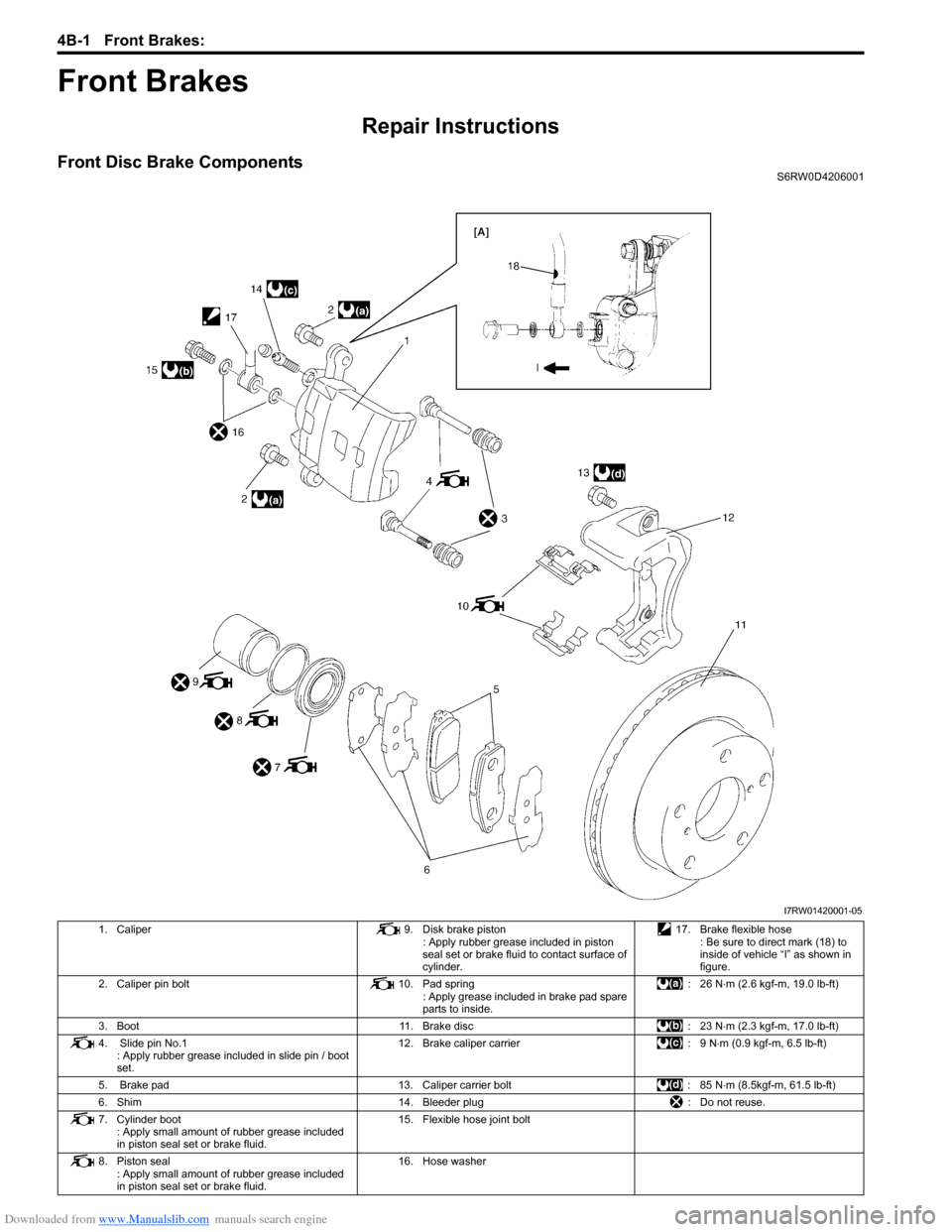
Front Disc Brake ComponentsS6RW0D4206001
I7RW01420001-05
1. Caliper 9. Disk brake piston
: Apply rubber grease included in piston
seal set or brake fluid to contact surface of
cylinder.17. Brake flexible hose
: Be sure to direct mark (18) to
inside of vehicle “I” as shown in
figure.
2. Caliper pin bolt 10. Pad spring
: Apply grease included in brake pad spare
parts to inside.: 26 N⋅m (2.6 kgf-m, 19.0 lb-ft)
3. Boot 11. Brake disc : 23 N⋅m (2.3 kgf-m, 17.0 lb-ft)
4. Slide pin No.1
: Apply rubber grease included in slide pin / boot
set.12. Brake caliper carrier : 9 N⋅m (0.9 kgf-m, 6.5 lb-ft)
5. Brake pad 13. Caliper carrier bolt : 85 N⋅m (8.5kgf-m, 61.5 lb-ft)
6. Shim 14. Bleeder plug : Do not reuse.
7. Cylinder boot
: Apply small amount of rubber grease included
in piston seal set or brake fluid.15. Flexible hose joint bolt
8. Piston seal
: Apply small amount of rubber grease included
in piston seal set or brake fluid.16. Hose washer
Page 590 of 1556
Downloaded from www.Manualslib.com manuals search engine 4B-3 Front Brakes:
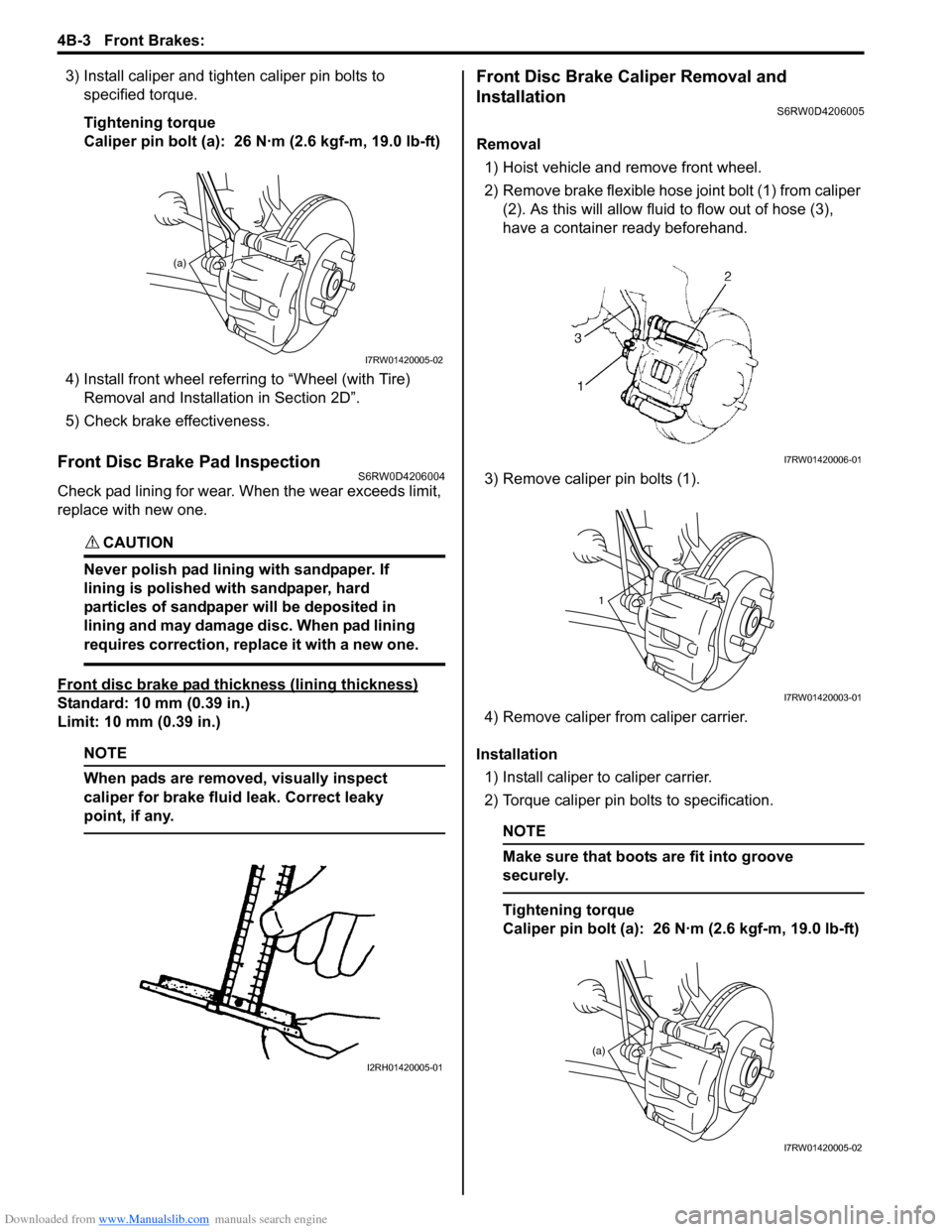
3) Install caliper and tighten caliper pin bolts to
specified torque.
Tightening torque
Caliper pin bolt (a): 26 N·m (2.6 kgf-m, 19.0 lb-ft)
4) Install front wheel referring to “Wheel (with Tire)
Removal and Installation in Section 2D”.
5) Check brake effectiveness.
Front Disc Brake Pad InspectionS6RW0D4206004
Check pad lining for wear. When the wear exceeds limit,
replace with new one.
CAUTION!
Never polish pad lining with sandpaper. If
lining is polished with sandpaper, hard
particles of sandpaper will be deposited in
lining and may damage disc. When pad lining
requires correction, replace it with a new one.
Front disc brake pad thickness (lining thickness)
Standard: 10 mm (0.39 in.)
Limit: 10 mm (0.39 in.)
NOTE
When pads are removed, visually inspect
caliper for brake fluid leak. Correct leaky
point, if any.
Front Disc Brake Caliper Removal and
Installation
S6RW0D4206005
Removal
1) Hoist vehicle and remove front wheel.
2) Remove brake flexible hose joint bolt (1) from caliper
(2). As this will allow fluid to flow out of hose (3),
have a container ready beforehand.
3) Remove caliper pin bolts (1).
4) Remove caliper from caliper carrier.
Installation
1) Install caliper to caliper carrier.
2) Torque caliper pin bolts to specification.
NOTE
Make sure that boots are fit into groove
securely.
Tightening torque
Caliper pin bolt (a): 26 N·m (2.6 kgf-m, 19.0 lb-ft)
(a)
I7RW01420005-02
I2RH01420005-01
I7RW01420006-01
1
I7RW01420003-01
(a)
I7RW01420005-02
Page 591 of 1556
Downloaded from www.Manualslib.com manuals search engine Front Brakes: 4B-4
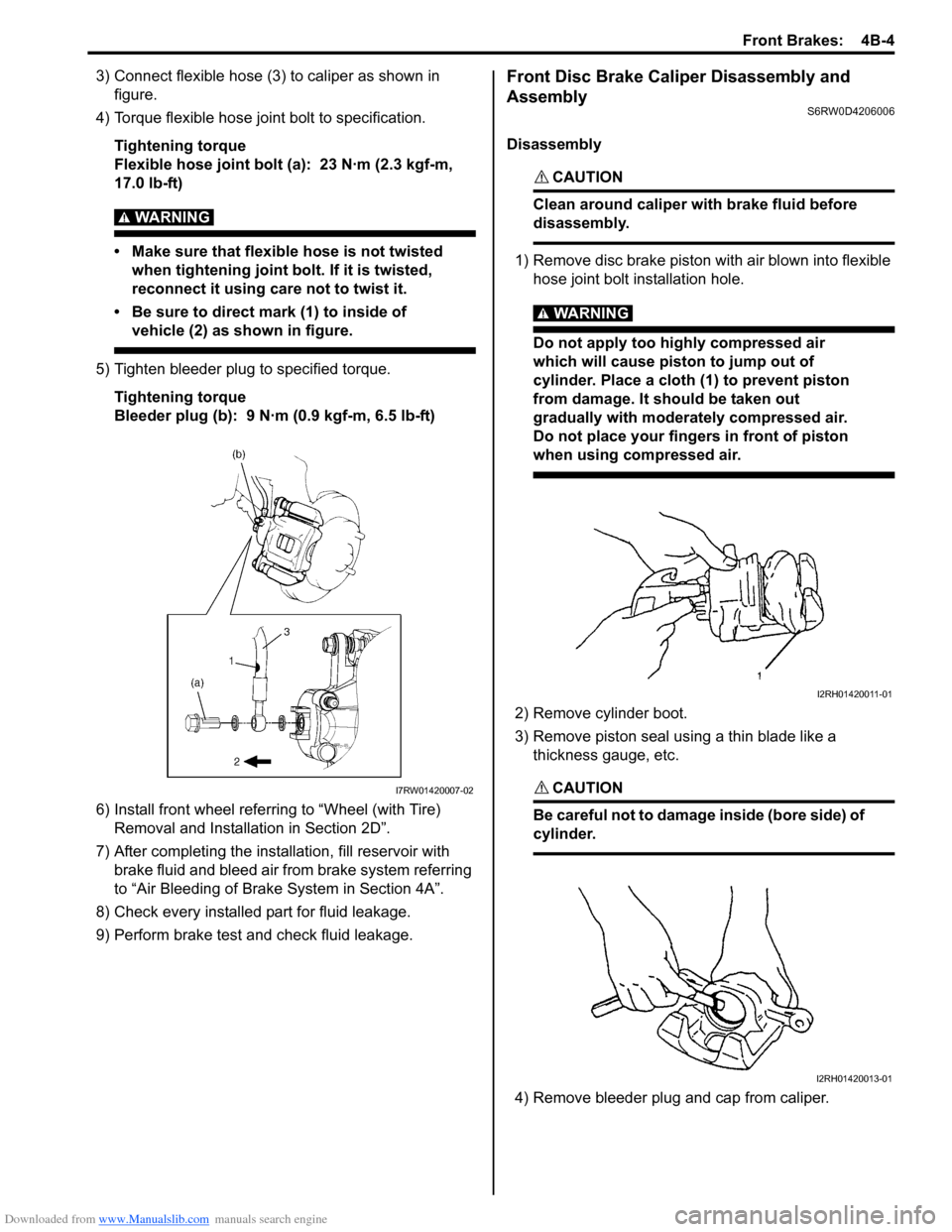
3) Connect flexible hose (3) to caliper as shown in
figure.
4) Torque flexible hose joint bolt to specification.
Tightening torque
Flexible hose joint bolt (a): 23 N·m (2.3 kgf-m,
17.0 lb-ft)
WARNING!
• Make sure that flexible hose is not twisted
when tightening joint bolt. If it is twisted,
reconnect it using care not to twist it.
• Be sure to direct mark (1) to inside of
vehicle (2) as shown in figure.
5) Tighten bleeder plug to specified torque.
Tightening torque
Bleeder plug (b): 9 N·m (0.9 kgf-m, 6.5 lb-ft)
6) Install front wheel referring to “Wheel (with Tire)
Removal and Installation in Section 2D”.
7) After completing the installation, fill reservoir with
brake fluid and bleed air from brake system referring
to “Air Bleeding of Brake System in Section 4A”.
8) Check every installed part for fluid leakage.
9) Perform brake test and check fluid leakage.
Front Disc Brake Caliper Disassembly and
Assembly
S6RW0D4206006
Disassembly
CAUTION!
Clean around caliper with brake fluid before
disassembly.
1) Remove disc brake piston with air blown into flexible
hose joint bolt installation hole.
WARNING!
Do not apply too highly compressed air
which will cause piston to jump out of
cylinder. Place a cloth (1) to prevent piston
from damage. It should be taken out
gradually with moderately compressed air.
Do not place your fingers in front of piston
when using compressed air.
2) Remove cylinder boot.
3) Remove piston seal using a thin blade like a
thickness gauge, etc.
CAUTION!
Be careful not to damage inside (bore side) of
cylinder.
4) Remove bleeder plug and cap from caliper.
I7RW01420007-02
I2RH01420011-01
I2RH01420013-01
Page 592 of 1556
Downloaded from www.Manualslib.com manuals search engine 4B-5 Front Brakes:
Assembly
Assemble parts in reverse order of disassembly,
observing the following instructions.
CAUTION!
• Wash each part cleanly before installation
in the same fluid as the one used in master
cylinder reservoir.
• Never use other fluid or thinner.
• Before installing piston seal and cylinder
boot to cylinder, apply rubber grease
included in piston seal set or brake fluid to
them.
• Install a new piston seal into groove in
cylinder securely making sure that it is not
twisted.
• After reassembling brake lines, bleed air
from them.
Before installing caliper to carrier, install slide pins with
rubber grease included in slide pin / boot set applied into
caliper carrier hole and check for its smooth movement
in thrust direction.
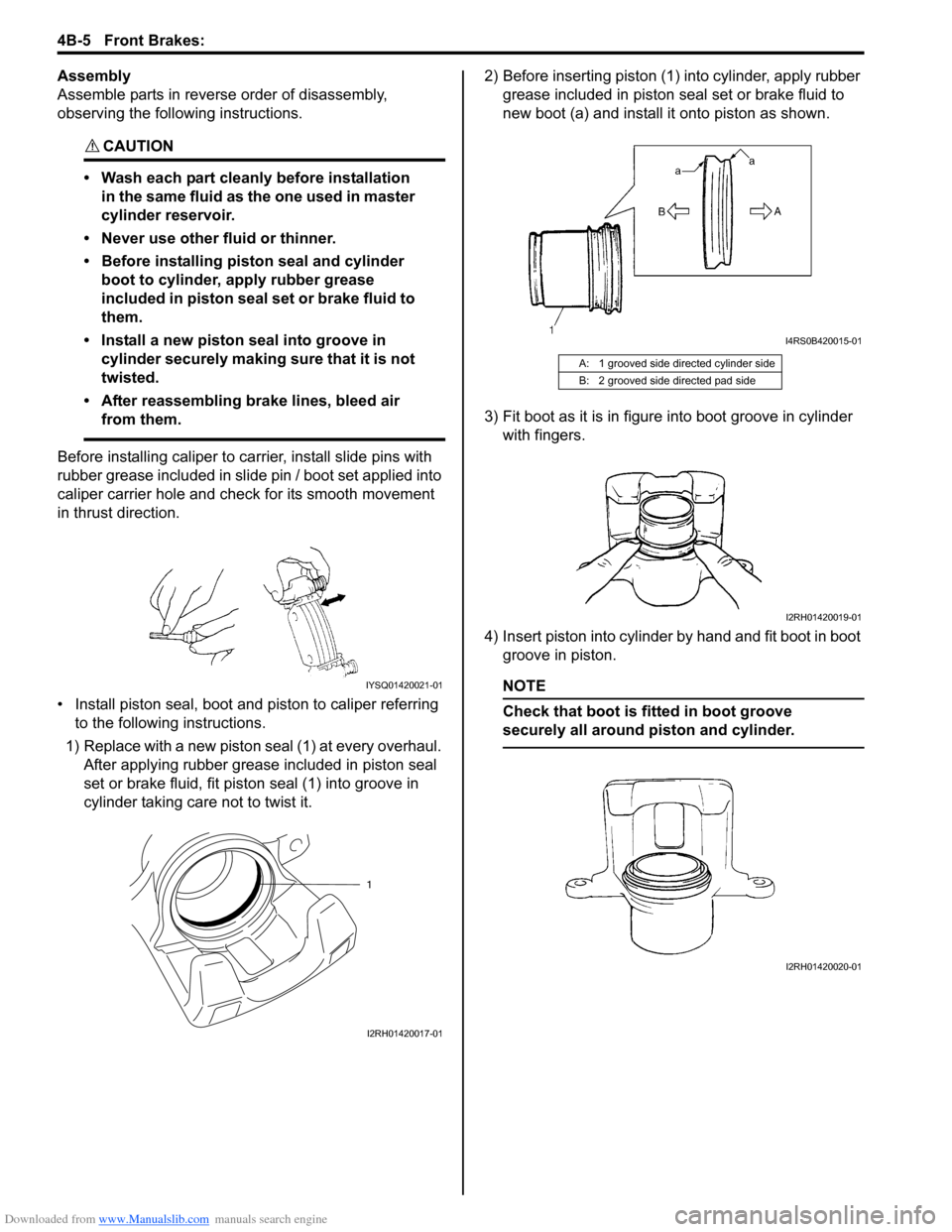
• Install piston seal, boot and piston to caliper referring
to the following instructions.
1) Replace with a new piston seal (1) at every overhaul.
After applying rubber grease included in piston seal
set or brake fluid, fit piston seal (1) into groove in
cylinder taking care not to twist it.2) Before inserting piston (1) into cylinder, apply rubber
grease included in piston seal set or brake fluid to
new boot (a) and install it onto piston as shown.
3) Fit boot as it is in figure into boot groove in cylinder
with fingers.
4) Insert piston into cylinder by hand and fit boot in boot
groove in piston.
NOTE
Check that boot is fitted in boot groove
securely all around piston and cylinder.
IYSQ01420021-01
1
I2RH01420017-01
A: 1 grooved side directed cylinder side
B: 2 grooved side directed pad side
I4RS0B420015-01
I2RH01420019-01
I2RH01420020-01
Page 593 of 1556
Downloaded from www.Manualslib.com manuals search engine Front Brakes: 4B-6
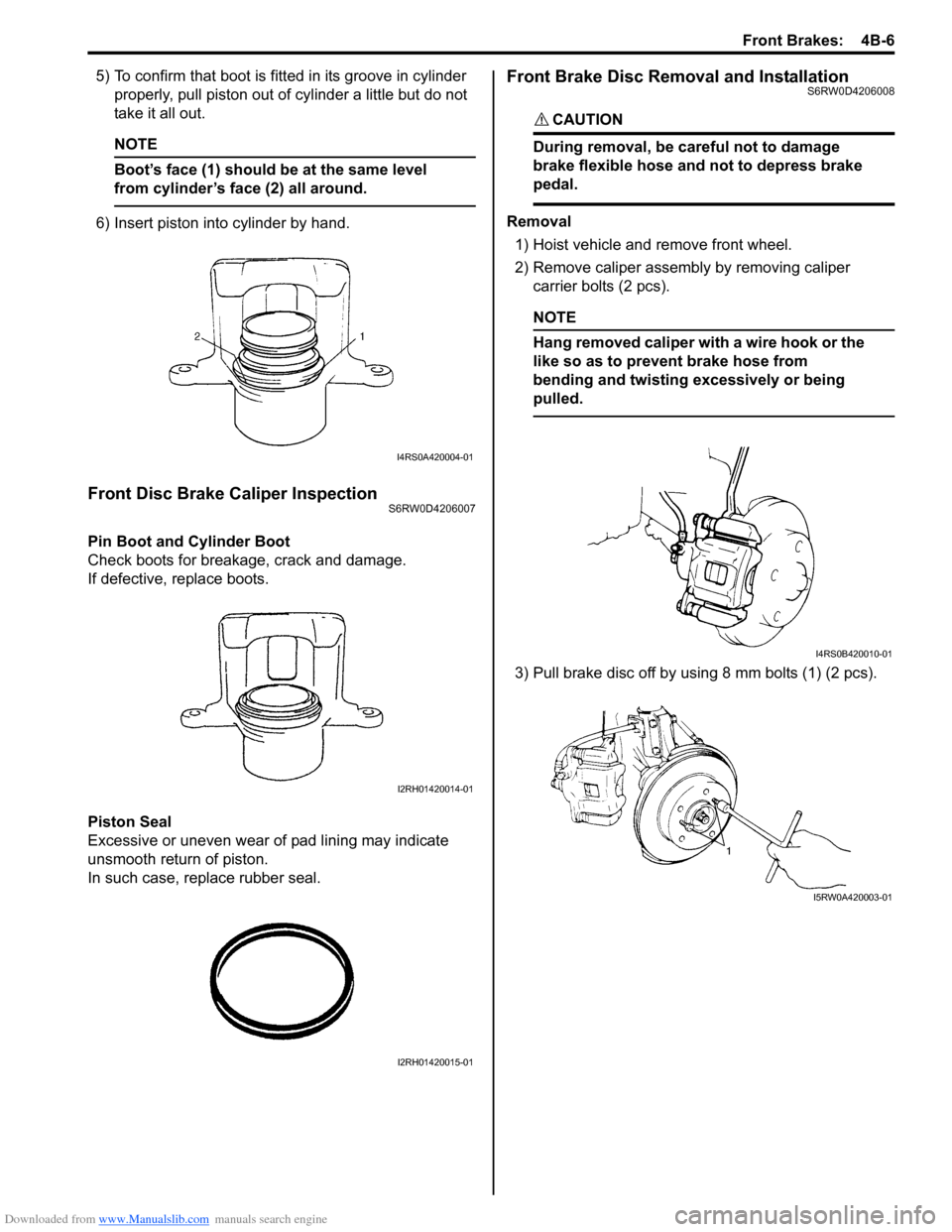
5) To confirm that boot is fitted in its groove in cylinder
properly, pull piston out of cylinder a little but do not
take it all out.
NOTE
Boot’s face (1) should be at the same level
from cylinder’s face (2) all around.
6) Insert piston into cylinder by hand.
Front Disc Brake Caliper InspectionS6RW0D4206007
Pin Boot and Cylinder Boot
Check boots for breakage, crack and damage.
If defective, replace boots.
Piston Seal
Excessive or uneven wear of pad lining may indicate
unsmooth return of piston.
In such case, replace rubber seal.
Front Brake Disc Removal and InstallationS6RW0D4206008
CAUTION!
During removal, be careful not to damage
brake flexible hose and not to depress brake
pedal.
Removal
1) Hoist vehicle and remove front wheel.
2) Remove caliper assembly by removing caliper
carrier bolts (2 pcs).
NOTE
Hang removed caliper with a wire hook or the
like so as to prevent brake hose from
bending and twisting excessively or being
pulled.
3) Pull brake disc off by using 8 mm bolts (1) (2 pcs).
I4RS0A420004-01
I2RH01420014-01
I2RH01420015-01
I4RS0B420010-01
I5RW0A420003-01
Page 820 of 1556
Downloaded from www.Manualslib.com manuals search engine 5B-8 Manual Transmission/Transaxle:
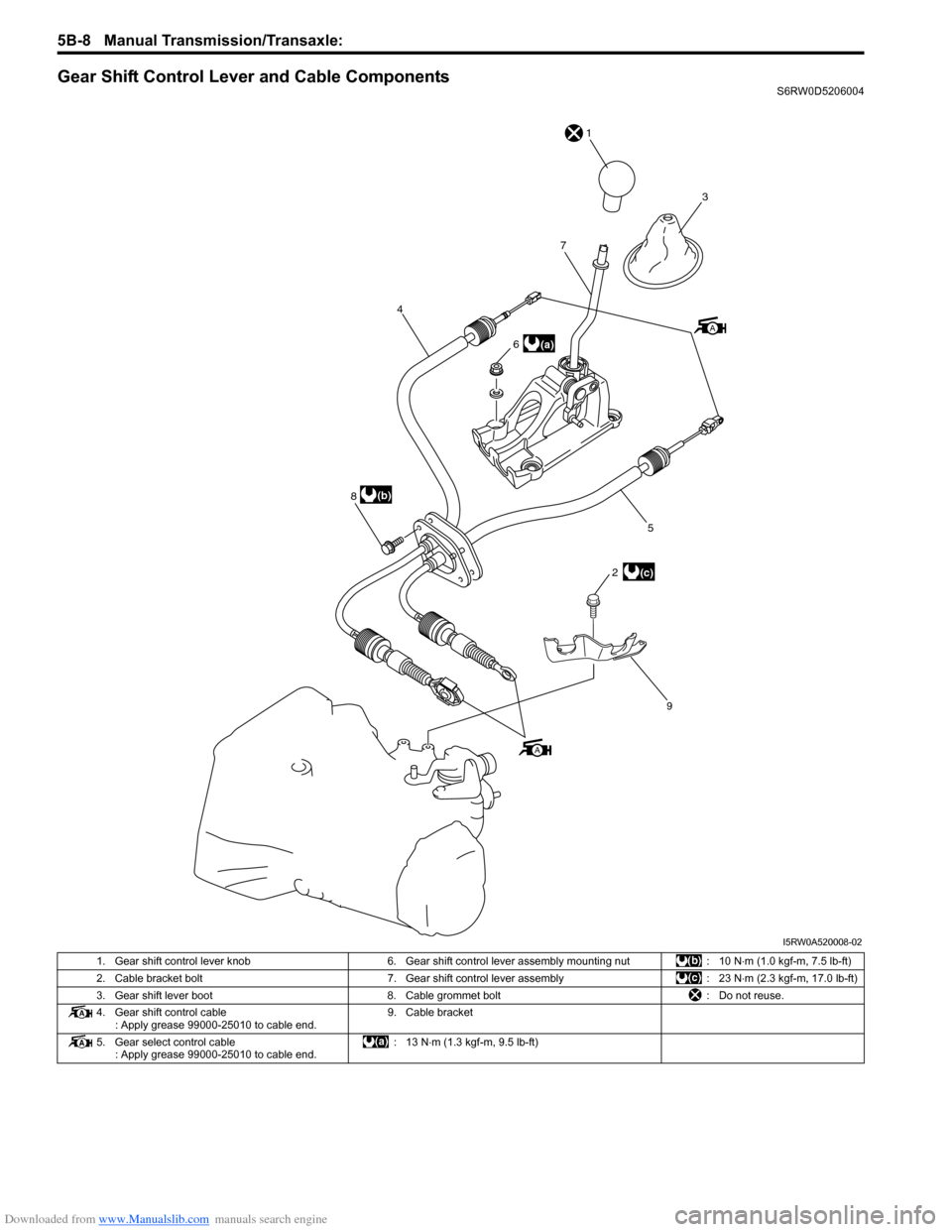
Gear Shift Control Lever and Cable ComponentsS6RW0D5206004
1
7
3
4
(a) 6
A
8(b)
2
(c)
5
9
A
I5RW0A520008-02
1. Gear shift control lever knob 6. Gear shift control lever assembly mounting nut : 10 N⋅m (1.0 kgf-m, 7.5 lb-ft)
2. Cable bracket bolt 7. Gear shift control lever assembly : 23 N⋅m (2.3 kgf-m, 17.0 lb-ft)
3. Gear shift lever boot 8. Cable grommet bolt : Do not reuse.
4. Gear shift control cable
: Apply grease 99000-25010 to cable end.9. Cable bracket
5. Gear select control cable
: Apply grease 99000-25010 to cable end.:13 N⋅m (1.3 kgf-m, 9.5 lb-ft)
Page 865 of 1556
Downloaded from www.Manualslib.com manuals search engine Table of Contents 6- i
6
Section 6
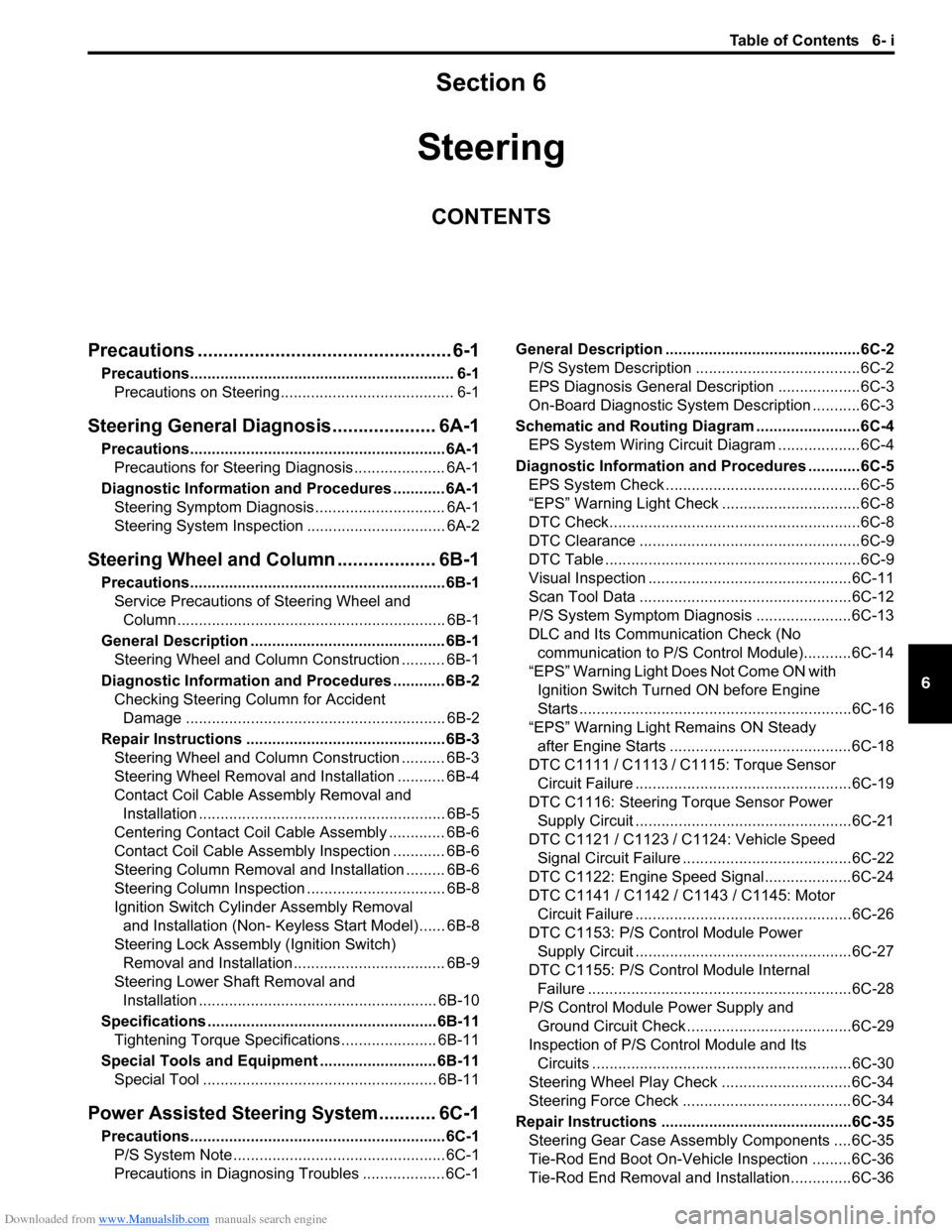
CONTENTS
Steering
Precautions ................................................. 6-1
Precautions............................................................. 6-1
Precautions on Steering........................................ 6-1
Steering General Diagnosis.................... 6A-1
Precautions........................................................... 6A-1
Precautions for Steering Diagnosis ..................... 6A-1
Diagnostic Information and Procedures ............ 6A-1
Steering Symptom Diagnosis .............................. 6A-1
Steering System Inspection ................................ 6A-2
Steering Wheel and Column................... 6B-1
Precautions........................................................... 6B-1
Service Precautions of Steering Wheel and
Column.............................................................. 6B-1
General Description ............................................. 6B-1
Steering Wheel and Column Construction .......... 6B-1
Diagnostic Information and Procedures ............ 6B-2
Checking Steering Column for Accident
Damage ............................................................ 6B-2
Repair Instructions .............................................. 6B-3
Steering Wheel and Column Construction .......... 6B-3
Steering Wheel Removal and Installation ........... 6B-4
Contact Coil Cable Assembly Removal and
Installation ......................................................... 6B-5
Centering Contact Coil Cable Assembly ............. 6B-6
Contact Coil Cable Assembly Inspection ............ 6B-6
Steering Column Removal and Installation ......... 6B-6
Steering Column Inspection ................................ 6B-8
Ignition Switch Cylinder Assembly Removal
and Installation (Non- Keyless Start Model)...... 6B-8
Steering Lock Assembly (Ignition Switch)
Removal and Installation................................... 6B-9
Steering Lower Shaft Removal and
Installation ....................................................... 6B-10
Specifications..................................................... 6B-11
Tightening Torque Specifications ...................... 6B-11
Special Tools and Equipment ........................... 6B-11
Special Tool ...................................................... 6B-11
Power Assisted Steering System........... 6C-1
Precautions........................................................... 6C-1
P/S System Note ................................................. 6C-1
Precautions in Diagnosing Troubles ................... 6C-1General Description .............................................6C-2
P/S System Description ......................................6C-2
EPS Diagnosis General Description ...................6C-3
On-Board Diagnostic System Description ...........6C-3
Schematic and Routing Diagram ........................6C-4
EPS System Wiring Circuit Diagram ...................6C-4
Diagnostic Information and Procedures ............6C-5
EPS System Check .............................................6C-5
“EPS” Warning Light Check ................................6C-8
DTC Check..........................................................6C-8
DTC Clearance ...................................................6C-9
DTC Table ...........................................................6C-9
Visual Inspection ...............................................6C-11
Scan Tool Data .................................................6C-12
P/S System Symptom Diagnosis ......................6C-13
DLC and Its Communication Check (No
communication to P/S Control Module)...........6C-14
“EPS” Warning Light Does Not Come ON with
Ignition Switch Turned ON before Engine
Starts ...............................................................6C-16
“EPS” Warning Light Remains ON Steady
after Engine Starts ..........................................6C-18
DTC C1111 / C1113 / C1115: Torque Sensor
Circuit Failure ..................................................6C-19
DTC C1116: Steering Torque Sensor Power
Supply Circuit ..................................................6C-21
DTC C1121 / C1123 / C1124: Vehicle Speed
Signal Circuit Failure .......................................6C-22
DTC C1122: Engine Speed Signal....................6C-24
DTC C1141 / C1142 / C1143 / C1145: Motor
Circuit Failure ..................................................6C-26
DTC C1153: P/S Control Module Power
Supply Circuit ..................................................6C-27
DTC C1155: P/S Control Module Internal
Failure .............................................................6C-28
P/S Control Module Power Supply and
Ground Circuit Check ......................................6C-29
Inspection of P/S Control Module and Its
Circuits ............................................................6C-30
Steering Wheel Play Check ..............................6C-34
Steering Force Check .......................................6C-34
Repair Instructions ............................................6C-35
Steering Gear Case Assembly Components ....6C-35
Tie-Rod End Boot On-Vehicle Inspection .........6C-36
Tie-Rod End Removal and Installation..............6C-36