heater SUZUKI SX4 2006 1.G Service Owner's Manual
[x] Cancel search | Manufacturer: SUZUKI, Model Year: 2006, Model line: SX4, Model: SUZUKI SX4 2006 1.GPages: 1556, PDF Size: 37.31 MB
Page 150 of 1556
Downloaded from www.Manualslib.com manuals search engine 1A-100 Engine General Information and Diagnosis:
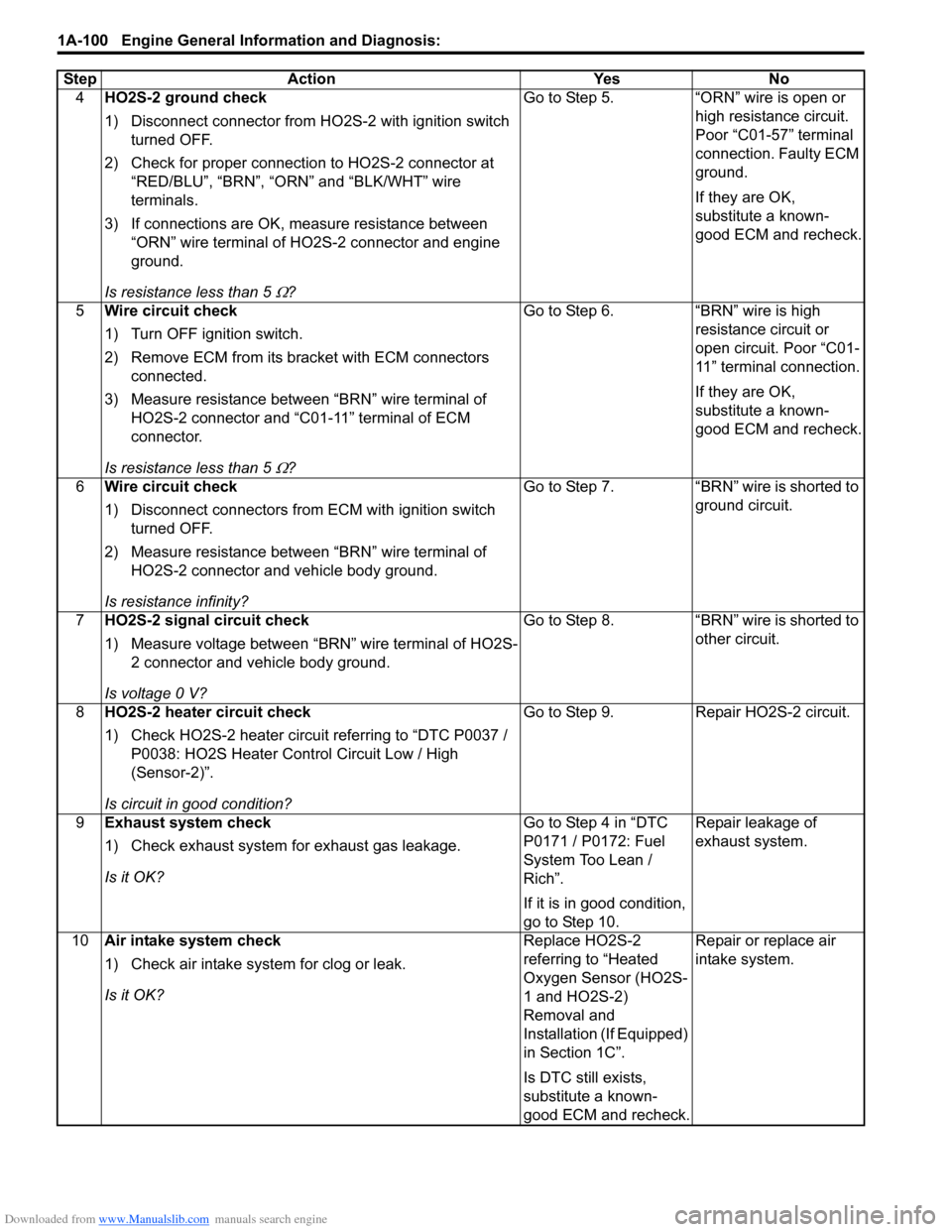
4HO2S-2 ground check
1) Disconnect connector from HO2S-2 with ignition switch
turned OFF.
2) Check for proper connection to HO2S-2 connector at
“RED/BLU”, “BRN”, “ORN” and “BLK/WHT” wire
terminals.
3) If connections are OK, measure resistance between
“ORN” wire terminal of HO2S-2 connector and engine
ground.
Is resistance less than 5
Ω?Go to Step 5. “ORN” wire is open or
high resistance circuit.
Poor “C01-57” terminal
connection. Faulty ECM
ground.
If they are OK,
substitute a known-
good ECM and recheck.
5Wire circuit check
1) Turn OFF ignition switch.
2) Remove ECM from its bracket with ECM connectors
connected.
3) Measure resistance between “BRN” wire terminal of
HO2S-2 connector and “C01-11” terminal of ECM
connector.
Is resistance less than 5
Ω?Go to Step 6. “BRN” wire is high
resistance circuit or
open circuit. Poor “C01-
11” terminal connection.
If they are OK,
substitute a known-
good ECM and recheck.
6Wire circuit check
1) Disconnect connectors from ECM with ignition switch
turned OFF.
2) Measure resistance between “BRN” wire terminal of
HO2S-2 connector and vehicle body ground.
Is resistance infinity?Go to Step 7. “BRN” wire is shorted to
ground circuit.
7HO2S-2 signal circuit check
1) Measure voltage between “BRN” wire terminal of HO2S-
2 connector and vehicle body ground.
Is voltage 0 V?Go to Step 8. “BRN” wire is shorted to
other circuit.
8HO2S-2 heater circuit check
1) Check HO2S-2 heater circuit referring to “DTC P0037 /
P0038: HO2S Heater Control Circuit Low / High
(Sensor-2)”.
Is circuit in good condition?Go to Step 9. Repair HO2S-2 circuit.
9Exhaust system check
1) Check exhaust system for exhaust gas leakage.
Is it OK?Go to Step 4 in “DTC
P0171 / P0172: Fuel
System Too Lean /
Rich”.
If it is in good condition,
go to Step 10.Repair leakage of
exhaust system.
10Air intake system check
1) Check air intake system for clog or leak.
Is it OK?Replace HO2S-2
referring to “Heated
Oxygen Sensor (HO2S-
1 and HO2S-2)
Removal and
Installation (If Equipped)
in Section 1C”.
Is DTC still exists,
substitute a known-
good ECM and recheck.Repair or replace air
intake system. Step Action Yes No
Page 152 of 1556
Downloaded from www.Manualslib.com manuals search engine 1A-102 Engine General Information and Diagnosis:
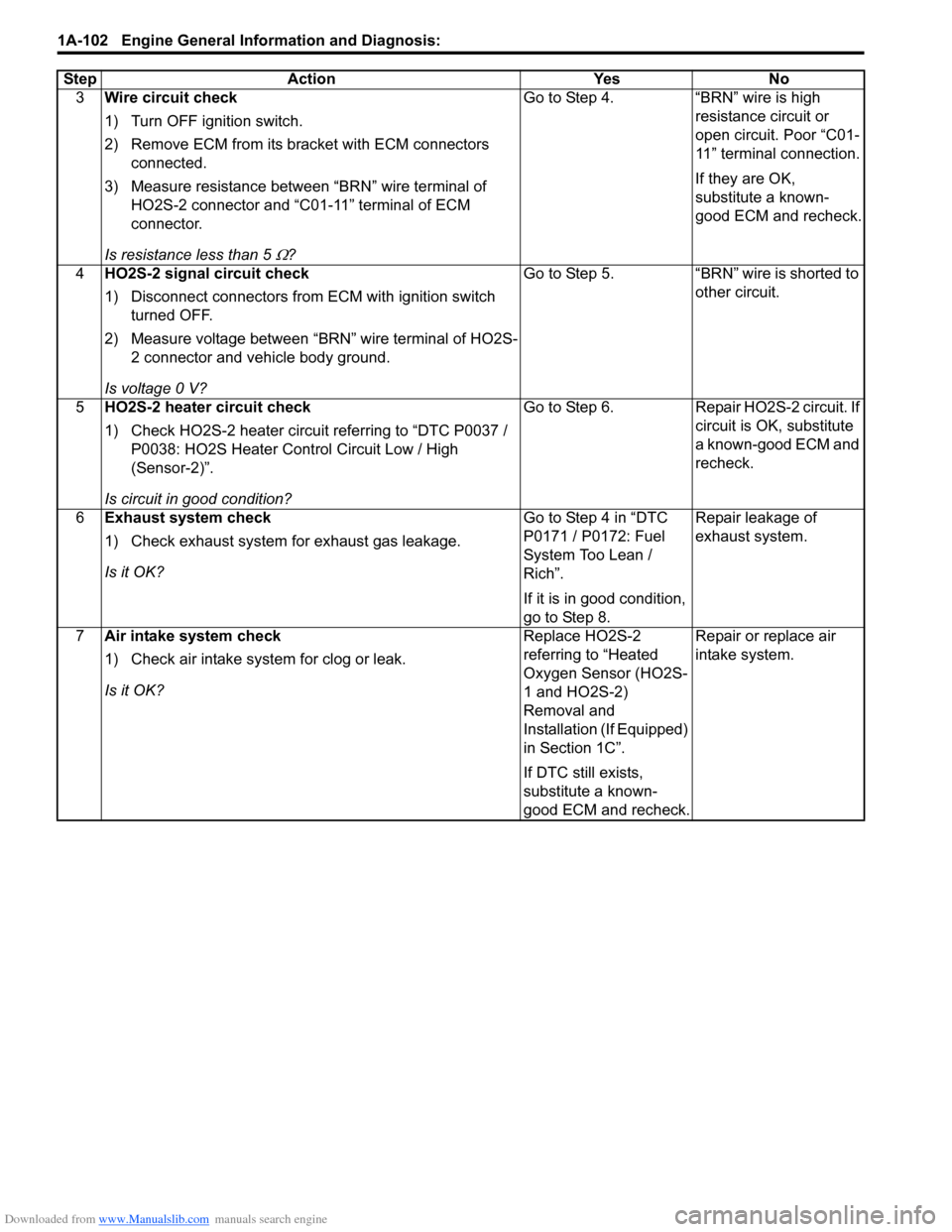
3Wire circuit check
1) Turn OFF ignition switch.
2) Remove ECM from its bracket with ECM connectors
connected.
3) Measure resistance between “BRN” wire terminal of
HO2S-2 connector and “C01-11” terminal of ECM
connector.
Is resistance less than 5
Ω?Go to Step 4. “BRN” wire is high
resistance circuit or
open circuit. Poor “C01-
11” terminal connection.
If they are OK,
substitute a known-
good ECM and recheck.
4HO2S-2 signal circuit check
1) Disconnect connectors from ECM with ignition switch
turned OFF.
2) Measure voltage between “BRN” wire terminal of HO2S-
2 connector and vehicle body ground.
Is voltage 0 V?Go to Step 5. “BRN” wire is shorted to
other circuit.
5HO2S-2 heater circuit check
1) Check HO2S-2 heater circuit referring to “DTC P0037 /
P0038: HO2S Heater Control Circuit Low / High
(Sensor-2)”.
Is circuit in good condition?Go to Step 6. Repair HO2S-2 circuit. If
circuit is OK, substitute
a known-good ECM and
recheck.
6Exhaust system check
1) Check exhaust system for exhaust gas leakage.
Is it OK?Go to Step 4 in “DTC
P0171 / P0172: Fuel
System Too Lean /
Rich”.
If it is in good condition,
go to Step 8.Repair leakage of
exhaust system.
7Air intake system check
1) Check air intake system for clog or leak.
Is it OK?Replace HO2S-2
referring to “Heated
Oxygen Sensor (HO2S-
1 and HO2S-2)
Removal and
Installation (If Equipped)
in Section 1C”.
If DTC still exists,
substitute a known-
good ECM and recheck.Repair or replace air
intake system. Step Action Yes No
Page 177 of 1556

Downloaded from www.Manualslib.com manuals search engine Engine General Information and Diagnosis: 1A-127
DTC Troubleshooting
WARNING!
In order to reduce risk of fire and personal injury, this work must be performed in a well ventilated area
and away from any open flames such as gas water heater.
NOTE
Before this troubleshooting is performed, read the precautions for DTC troubleshooting referring to
“Precautions for DTC Troubleshooting”.
Step Action Yes No
1Was “Engine and Emission Control System Check”
performed?Go to Step 2. Go to “Engine and
Emission Control
System Check”.
2EVAP canister purge power supply circuit check
1) Turn OFF ignition switch and disconnect connector from
EVAP canister purge valve.
2) Measure voltage between engine ground and “BLK/
RED” wire terminal of EVAP canister purge valve
connector with ignition switch turned ON.
Is it voltage 10 – 14 V?Go to Step 3. “BLK/RED” wire is open
circuit.
3Wire circuit check
1) Disconnect connectors from ECM with ignition switch
turned OFF.
2) Measure resistance between “C01-29” terminal of ECM
connector and vehicle body ground.
Is resistance infinity?Go to Step 4. “BLU/BLK” wire is
shorted to ground
circuit.
4Wire circuit check
1) Measure voltage between “C01-29” terminal of ECM
connector and vehicle body ground with ignition switch
turned ON.
Is voltage 0 V?Go to Step 5. “BLU/BLK” wire is
shorted to other circuit.
5Wire circuit check
1) Connect connector to purge control valve with ignition
switch turned OFF.
2) Turn ON ignition switch and measure voltage between
“C01-29” terminal of ECM connector and vehicle body
ground.
Is it voltage 10 – 14 V?Go to Step 6. “BLU/BLK” wire is open
circuit.
6EVAP canister purge control valve check
1) Check EVAP canister purge control valve referring to
“EVAP Canister Purge Valve Inspection in Section 1B”.
Is it in good condition?Go to Step 7. Faulty EVAP canister
purge control valve.
7EVAP canister purge control circuit check
1) With ignition switch turn OFF, measure resistance
between “E01-1/16” terminal and “C01-29” terminal of
ECM connector.
Is resistance below 34
Ω at 20 °C, 68 °F?Faulty ECM. Substitute
a known-good ECM and
recheck.“BLK/RED” and/or
“BLU/BLK” wire are high
resistance circuit.
Page 182 of 1556
Downloaded from www.Manualslib.com manuals search engine 1A-132 Engine General Information and Diagnosis:
DTC Confirmation Procedure
1) With ignition switch turned OFF, connect scan tool.
2) Turn ON ignition switch and clear DTC using scan tool.
3) Start engine and warm up engine to normal operating temperature.
4) Run engine at idle and turn both A/C switch and heater blower switch ON (turn ON air conditioning) for 3 min. or
more.
5) Check DTC and pending DTC.
DTC Troubleshooting
NOTE
Before this troubleshooting is performed, read the precautions for DTC troubleshooting referring to
“Precautions for DTC Troubleshooting”.
Step Action Yes No
1Was “Engine and Emission Control System Check”
performed?Go to Step 2. Go to “Engine and
Emission Control
System Check”.
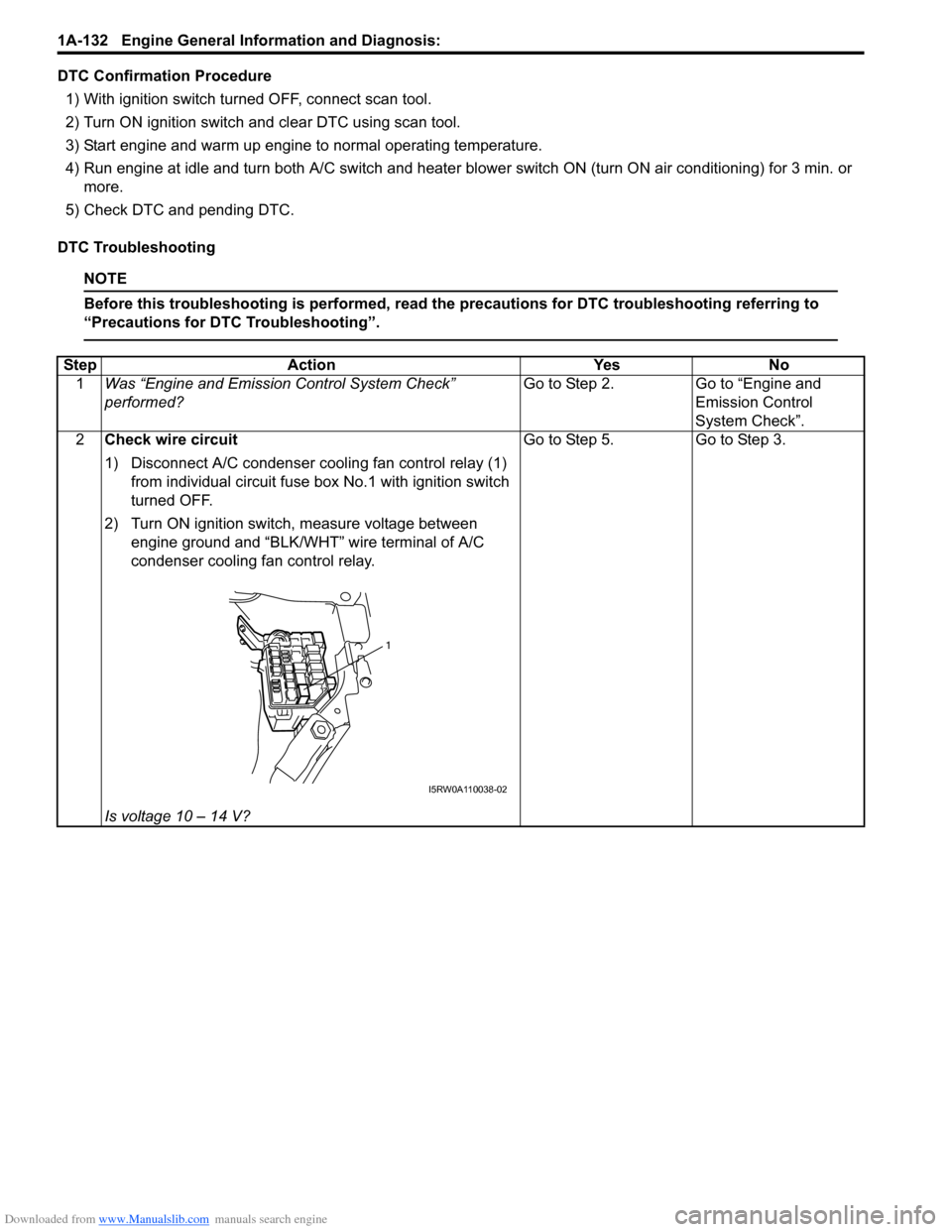
2Check wire circuit
1) Disconnect A/C condenser cooling fan control relay (1)
from individual circuit fuse box No.1 with ignition switch
turned OFF.
2) Turn ON ignition switch, measure voltage between
engine ground and “BLK/WHT” wire terminal of A/C
condenser cooling fan control relay.
Is voltage 10 – 14 V?Go to Step 5. Go to Step 3.
1
I5RW0A110038-02
Page 186 of 1556
Downloaded from www.Manualslib.com manuals search engine 1A-136 Engine General Information and Diagnosis:
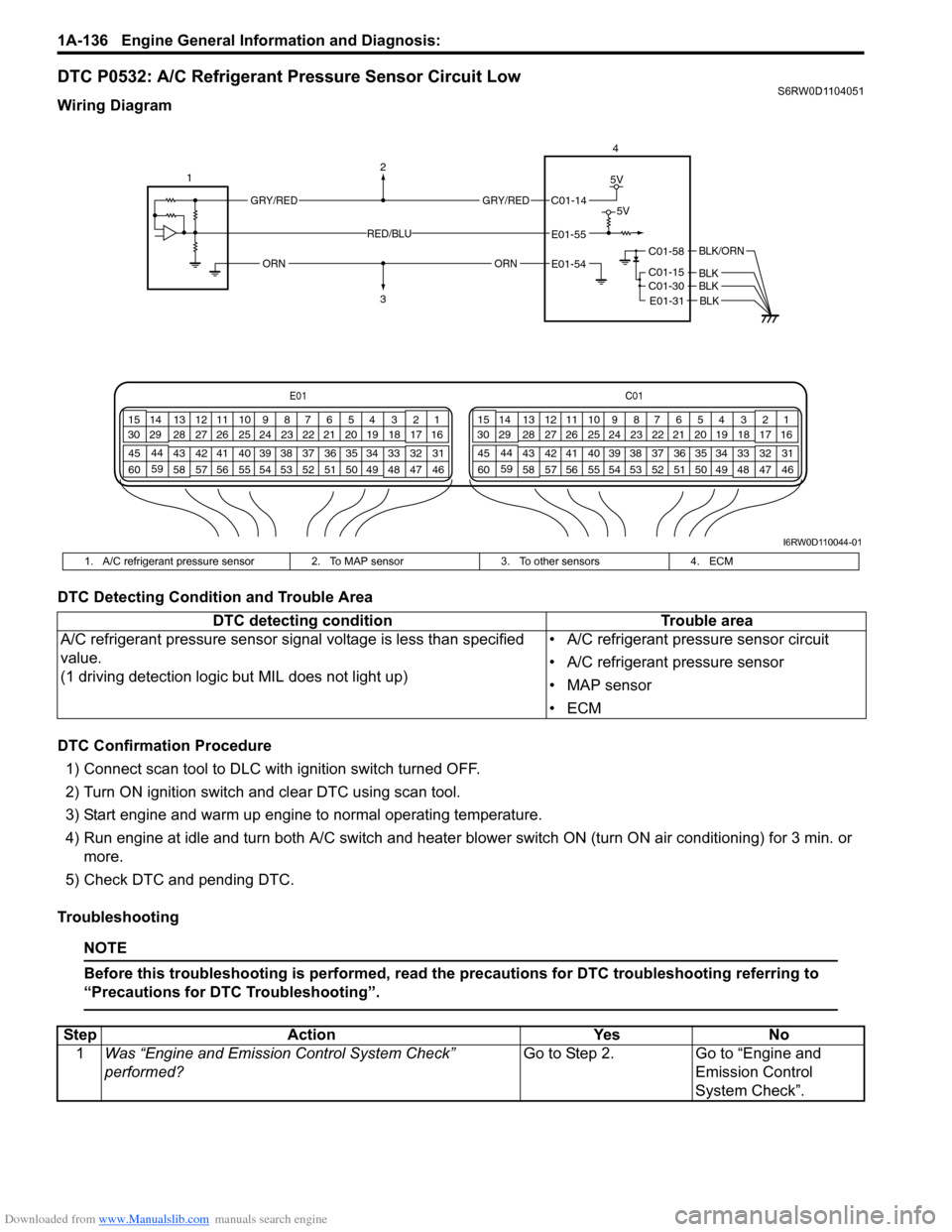
DTC P0532: A/C Refrigerant Pressure Sensor Circuit LowS6RW0D1104051
Wiring Diagram
DTC Detecting Condition and Trouble Area
DTC Confirmation Procedure
1) Connect scan tool to DLC with ignition switch turned OFF.
2) Turn ON ignition switch and clear DTC using scan tool.
3) Start engine and warm up engine to normal operating temperature.
4) Run engine at idle and turn both A/C switch and heater blower switch ON (turn ON air conditioning) for 3 min. or
more.
5) Check DTC and pending DTC.
Troubleshooting
NOTE
Before this troubleshooting is performed, read the precautions for DTC troubleshooting referring to
“Precautions for DTC Troubleshooting”.
E01C01
3 4
18 19 5 6 7 10 11
17 20
47 46 49 50 51 21 22
5216 259
24 14
29
55 57 54 53 59
60 582
26 27 28 15
30
56 4832 31 34 35 36 37 40 42 39 38 44
45 43 41 331 12 13
238 3 4
18 19 5 6 7 10 11
17 20
47 46 49 50 51 21 22
5216 259
24 14
29
55 57 54 53 59
60 582
26 27 28 15
30
56 4832 31 34 35 36 37 40 42 39 38 44
45 43 41 331 12 13
238
4
C01-58
C01-15 C01-30
BLK/ORN
BLKBLK
12
3
GRY/REDGRY/RED
ORNORN
5V
5VC01-14
E01-55
E01-54
RED/BLU
E01-31 BLK
I6RW0D110044-01
1. A/C refrigerant pressure sensor 2. To MAP sensor 3. To other sensors 4. ECM
DTC detecting condition Trouble area
A/C refrigerant pressure sensor signal voltage is less than specified
value.
(1 driving detection logic but MIL does not light up)• A/C refrigerant pressure sensor circuit
• A/C refrigerant pressure sensor
• MAP sensor
•ECM
Step Action Yes No
1Was “Engine and Emission Control System Check”
performed?Go to Step 2. Go to “Engine and
Emission Control
System Check”.
Page 188 of 1556
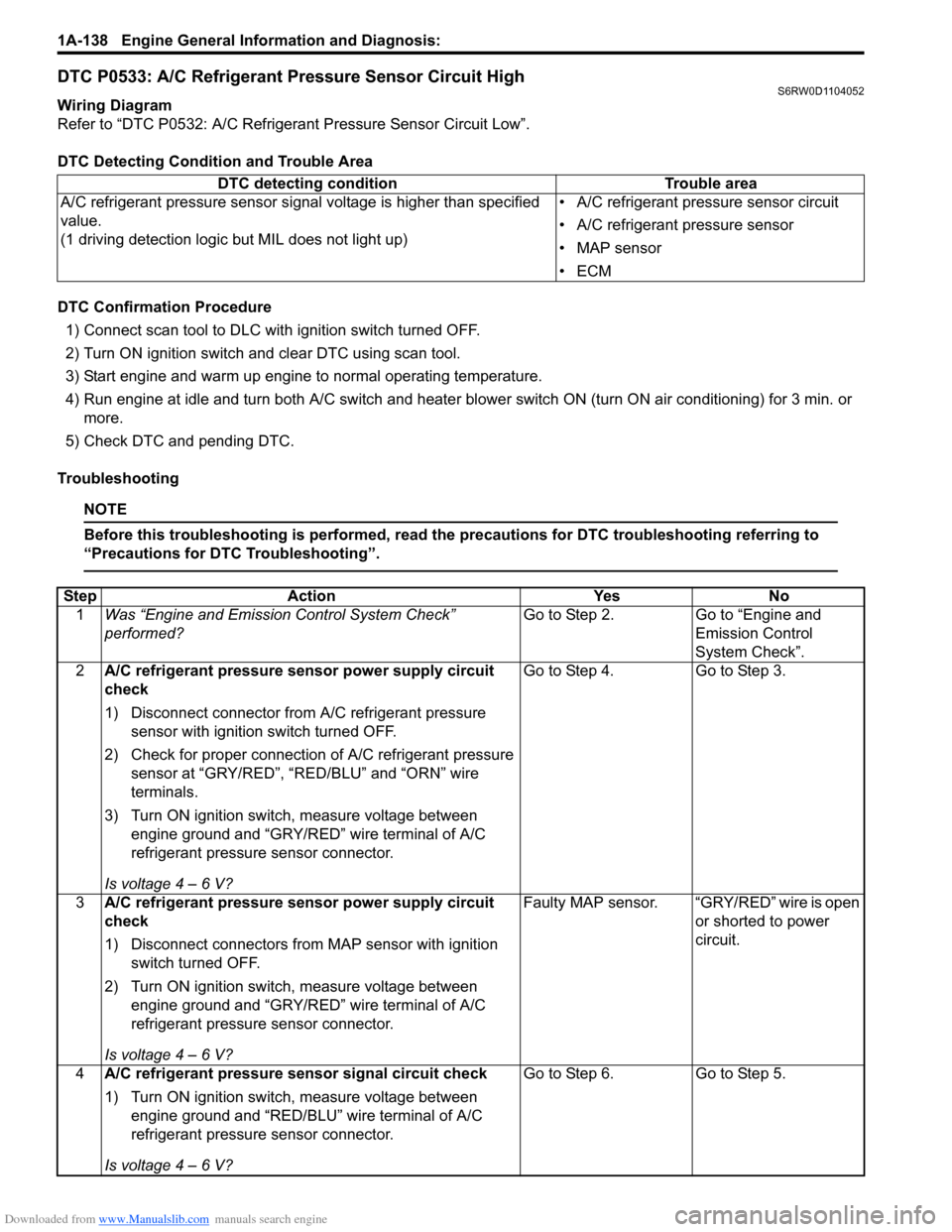
Downloaded from www.Manualslib.com manuals search engine 1A-138 Engine General Information and Diagnosis:
DTC P0533: A/C Refrigerant Pressure Sensor Circuit HighS6RW0D1104052
Wiring Diagram
Refer to “DTC P0532: A/C Refrigerant Pressure Sensor Circuit Low”.
DTC Detecting Condition and Trouble Area
DTC Confirmation Procedure
1) Connect scan tool to DLC with ignition switch turned OFF.
2) Turn ON ignition switch and clear DTC using scan tool.
3) Start engine and warm up engine to normal operating temperature.
4) Run engine at idle and turn both A/C switch and heater blower switch ON (turn ON air conditioning) for 3 min. or
more.
5) Check DTC and pending DTC.
Troubleshooting
NOTE
Before this troubleshooting is performed, read the precautions for DTC troubleshooting referring to
“Precautions for DTC Troubleshooting”.
DTC detecting condition Trouble area
A/C refrigerant pressure sensor signal voltage is higher than specified
value.
(1 driving detection logic but MIL does not light up)• A/C refrigerant pressure sensor circuit
• A/C refrigerant pressure sensor
• MAP sensor
•ECM
Step Action Yes No
1Was “Engine and Emission Control System Check”
performed?Go to Step 2. Go to “Engine and
Emission Control
System Check”.
2A/C refrigerant pressure sensor power supply circuit
check
1) Disconnect connector from A/C refrigerant pressure
sensor with ignition switch turned OFF.
2) Check for proper connection of A/C refrigerant pressure
sensor at “GRY/RED”, “RED/BLU” and “ORN” wire
terminals.
3) Turn ON ignition switch, measure voltage between
engine ground and “GRY/RED” wire terminal of A/C
refrigerant pressure sensor connector.
Is voltage 4 – 6 V?Go to Step 4. Go to Step 3.
3A/C refrigerant pressure sensor power supply circuit
check
1) Disconnect connectors from MAP sensor with ignition
switch turned OFF.
2) Turn ON ignition switch, measure voltage between
engine ground and “GRY/RED” wire terminal of A/C
refrigerant pressure sensor connector.
Is voltage 4 – 6 V?Faulty MAP sensor. “GRY/RED” wire is open
or shorted to power
circuit.
4A/C refrigerant pressure sensor signal circuit check
1) Turn ON ignition switch, measure voltage between
engine ground and “RED/BLU” wire terminal of A/C
refrigerant pressure sensor connector.
Is voltage 4 – 6 V?Go to Step 6. Go to Step 5.
Page 226 of 1556

Downloaded from www.Manualslib.com manuals search engine 1A-176 Engine General Information and Diagnosis:
C01-34 — — — — —
C01-35 — — — — —
C01-36 — — — — —
C01-37 — — — — —
C01-38 — — — — —
C01-39 — — — — —
C01-40 WHTThrottle position
sensor (sub) signal1.57 – 1.90 VIgnition switch turned ON
and accelerator pedal at
idle position after warmed
up engine.
—
3.88 – 4.45 V
(“Reference
waveform No.29: ”)Ignition switch turned ON
and accelerator pedal at
full depressed position
after warmed up engine.
C01-41 GRYGround for shield
wire of TP sensor
circuitBelow 0.3 V Ignition switch turned ON. —
C01-42 BLKGround for throttle
position sensorBelow 0.3 V Ignition switch turned ON. —
C01-43 REDOutput for 5 V
power source of
throttle position
sensor4.5 – 5.5 V Ignition switch turned ON. —
C01-44 YELOutput of throttle
actuator0 – 1 VIgnition switch turned ON
and accelerator pedal at
idle position after warmed
up engine. Output signal is pulse.
Duty ratio varies
depending on throttle
valve and accelerator
pedal position. *0 – 1 V
↑↓
10 – 14 V
(“Reference
waveform No.26: ”
and “Reference
waveform No.27: ”)Ignition switch turned ON
and accelerator pedal at
full depressed position
after warmed up engine.
C01-45 BLUOutput of throttle
actuator0 – 1 VIgnition switch turned ON
and accelerator pedal at
full depressed position
after warmed up engine. Output signal is pulse.
Duty ratio varies
depending on throttle
valve and accelerator
pedal position. *0 – 1 V
↑↓
10 – 14 V
(“Reference
waveform No.26: ”
and “Reference
waveform No.27: ”)Ignition switch turned ON
and accelerator pedal at
idle position after warmed
up engine.
C01-46BLK/
REDHeater output of
heated oxygen
sensor-110 – 14 V Ignition switch turned ON. —
*0 – 2 V
↑↓
10 – 14 V
(“Reference
waveform No.8: ” and
“Reference waveform
No.9: ”)Engine running at idle
after warmed up engine.Output signal is active low
duty pulse. Duty ratio
varies depending on
engine condition.
C01-47RED/
BLUHeater output of
heated oxygen
sensor-2 (if
equipped)10 – 14 V Ignition switch turned ON.
— 0 – 1 V
(“Reference
waveform No.10: ”)Engine running at idle
after vehicle running over
30 km/h, 19 mph for 5 min. Terminal
No.Wire
colorCircuit Normal voltage Condition Remarks
Page 228 of 1556
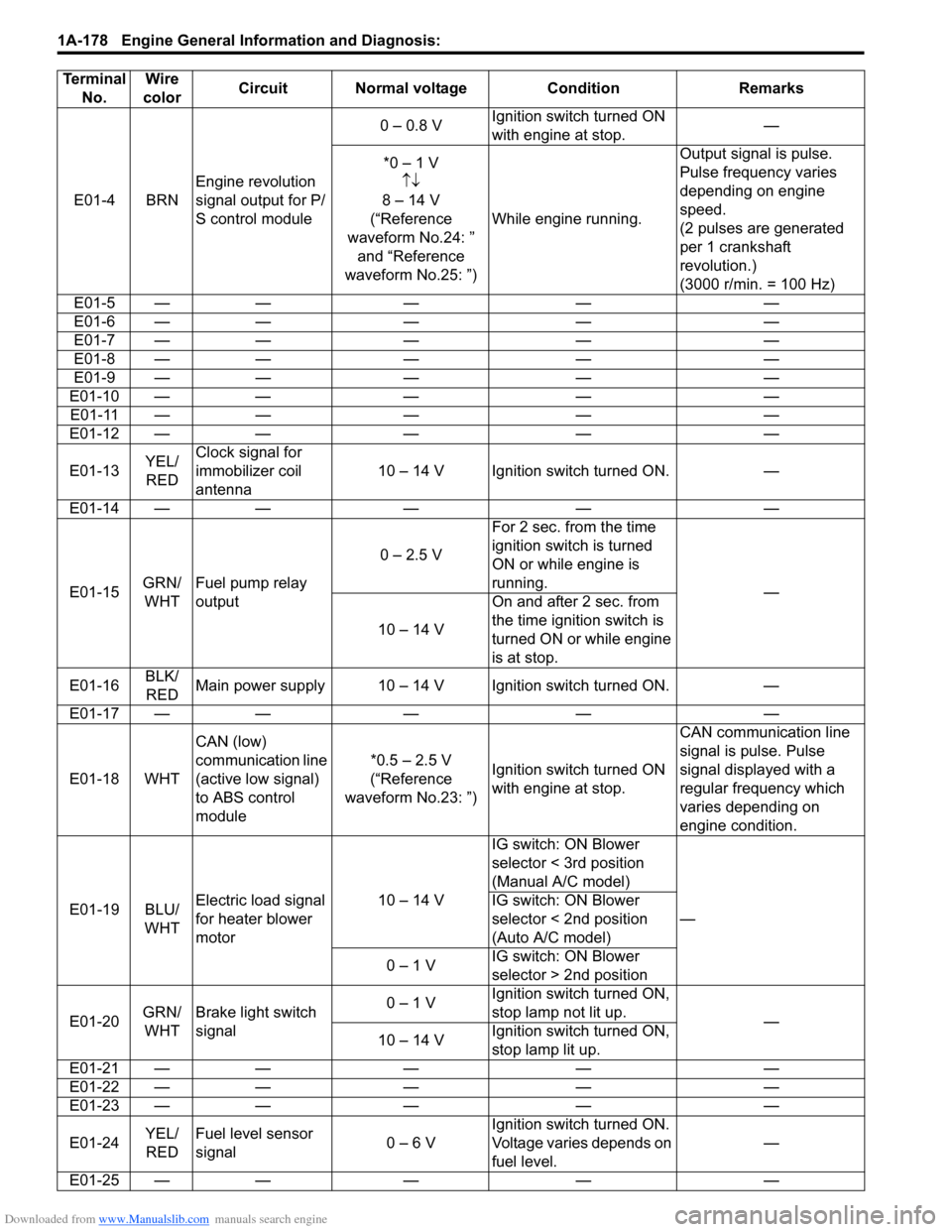
Downloaded from www.Manualslib.com manuals search engine 1A-178 Engine General Information and Diagnosis:
E01-4 BRNEngine revolution
signal output for P/
S control module0 – 0.8 VIgnition switch turned ON
with engine at stop.—
*0 – 1 V
↑↓
8 – 14 V
(“Reference
waveform No.24: ”
and “Reference
waveform No.25: ”)While engine running.Output signal is pulse.
Pulse frequency varies
depending on engine
speed.
(2 pulses are generated
per 1 crankshaft
revolution.)
(3000 r/min. = 100 Hz)
E01-5 — — — — —
E01-6 — — — — —
E01-7 — — — — —
E01-8 — — — — —
E01-9 — — — — —
E01-10 — — — — —
E01-11 — — — — —
E01-12 — — — — —
E01-13YEL/
REDClock signal for
immobilizer coil
antenna10 – 14 V Ignition switch turned ON. —
E01-14 — — — — —
E01-15GRN/
WHTFuel pump relay
output0 – 2.5 VFor 2 sec. from the time
ignition switch is turned
ON or while engine is
running.
—
10 – 14 VOn and after 2 sec. from
the time ignition switch is
turned ON or while engine
is at stop.
E01-16BLK/
REDMain power supply 10 – 14 V Ignition switch turned ON. —
E01-17 — — — — —
E01-18 WHTCAN (low)
communication line
(active low signal)
to ABS control
module*0.5 – 2.5 V
(“Reference
waveform No.23: ”)Ignition switch turned ON
with engine at stop.CAN communication line
signal is pulse. Pulse
signal displayed with a
regular frequency which
varies depending on
engine condition.
E01-19 BLU/
WHTElectric load signal
for heater blower
motor10 – 14 VIG switch: ON Blower
selector < 3rd position
(Manual A/C model)
— IG switch: ON Blower
selector < 2nd position
(Auto A/C model)
0 – 1 VIG switch: ON Blower
selector > 2nd position
E01-20GRN/
WHTBrake light switch
signal0 – 1 VIgnition switch turned ON,
stop lamp not lit up.
—
10 – 14 VIgnition switch turned ON,
stop lamp lit up.
E01-21 — — — — —
E01-22 — — — — —
E01-23 — — — — —
E01-24YEL/
REDFuel level sensor
signal0 – 6 VIgnition switch turned ON.
Voltage varies depends on
fuel level.—
E01-25 — — — — — Terminal
No.Wire
colorCircuit Normal voltage Condition Remarks
Page 234 of 1556

Downloaded from www.Manualslib.com manuals search engine 1A-184 Engine General Information and Diagnosis:
Reference waveform No.8
Heated oxygen sensor-1 signal (1) with engine idling
Reference waveform No.9
Heated oxygen sensor-1 heater signal (2) with engine
idlingReference waveform No.10
Heated oxygen sensor-2 heater signal (4) with engine
idling
Measurement
terminalCH1: “C01-10” to “C01-57”
CH2: “C01-46” to “C01-58”
Oscilloscope
settingCH1: 500 mV/DIV, CH2: 20 V/DIV
TIME: 1 s/DIV
Measurement
condition• After warmed up to normal
operating temperature
• Engine at specified idle speed
2. Heated oxygen sensor-1 heater signal
Measurement
terminalCH1: “C01-10” to “C01-57”
CH2: “C01-46” to “C01-58”
Oscilloscope
settingCH1: 500 mV/DIV, CH2: 10 V/DIV
TIME: 200 ms/DIV
Measurement
condition• After warmed up to normal
operating temperature
• Engine at specified idle speed
1. Heated oxygen sensor-1 signal 4. ON signal
3. OFF signal 5. One duty cycle
I4RS0B110058-01
I4RS0B110059-01
Measurement
terminalCH1: “C01-11” to “C01-57”
CH2: “C01-47” to “C01-58”
Oscilloscope
settingCH1: 500 mV/DIV, CH2: 10 V/DIV
TIME: 2 s/DIV
Measurement
condition• After warmed up to normal
operating temperature
• Vehicle driving at 60 km/h (37
mph) for 10 min.
• Engine at specified idle speed
1. Heated oxygen sensor-2 signal upper limit
2. Heated oxygen sensor-2 signal lower limit
3. Normal waveform range
I4RS0B110060-01
Page 242 of 1556

Downloaded from www.Manualslib.com manuals search engine 1A-192 Engine General Information and Diagnosis:
Resistance Check
1) Remove ECM from its bracket referring to “Engine Control Module (ECM) Removal and Installation in Section 1C”.
CAUTION!
Never touch terminals of ECM itself or connect voltmeter or ohmmeter (2).
2) Connect special tool to ECM connectors (1) securely.
NOTE
Do not connect the other connector of special tool to ECM.
Special tool
(A): 09933–06320
3) Check resistance between each pair of terminals of special tool connectors (1) as listed in the following table.
CAUTION!
• Be sure to connect ohmmeter probe from wire harness side of coupler.
• Be sure to turn OFF ignition switch for this check.
• Resistance in the following table represents that measured when parts temperature is 20 °C (68 °F).
1
(A)
2
3
I7RW01110032-02
Terminals Circuit Standard resistance Condition
C01-47 to E01-29 Heater of HO2S-2 4 – 15 Ω—
E01-46 to E01-1/16 Radiator cooling fan relay No.1 160 – 240 Ω—
E01-60 to E01-29 Main relay 160 – 240 ΩBattery disconnected and
ignition switch turned ON
E01-15 to E01-29 Fuel pump relay 160 – 240 Ω—
C01-16 to E01-1/16No.3 fuel injector
10.8 – 18.2 Ω—
C01-17 to E01-1/16No.4 fuel injector
C01-4 to E01-1/16EGR valve (stepping motor No.1 coil) (if
equipped)20 – 31 Ω—
C01-29 to E01-1/16 EVAP canister purge valve 28 – 35 Ω—
C01-2 to E01-1/16 No.2 fuel injector 10.8 – 18.2 Ω—
C01-3 to E01-1/16EGR valve (stepping motor No.2 coil) (if
equipped)
20 – 31 Ω— C01-18 to E01-1/16EGR valve (stepping motor No.4 coil) (if
equipped)
C01-19 to E01-1/16EGR valve (stepping motor No.3 coil) (if
equipped)
C01-46 to E01-29 Heater of HO2S-1 2 – 11 Ω—
C01-1 to E01-1/16 No.1 fuel injector 10.8 – 18.2 Ω—
E01-29 to E01-47 A/C compressor relay (if equipped with A/C) 160 – 240 Ω—
E01-58 to E01-1/16A/C condenser cooling fan relay
(if equipped with A/C)160 – 240 Ω—
C01-60 to C01-59 Oil control valve (for engine with VVT system) 6 – 15 Ω—
E01-45 to E01-1/16 Throttle actuator control relay 160 – 240 Ω—