Ignition SUZUKI SX4 2006 1.G Service Owner's Guide
[x] Cancel search | Manufacturer: SUZUKI, Model Year: 2006, Model line: SX4, Model: SUZUKI SX4 2006 1.GPages: 1556, PDF Size: 37.31 MB
Page 92 of 1556
Downloaded from www.Manualslib.com manuals search engine 1A-42 Engine General Information and Diagnosis:
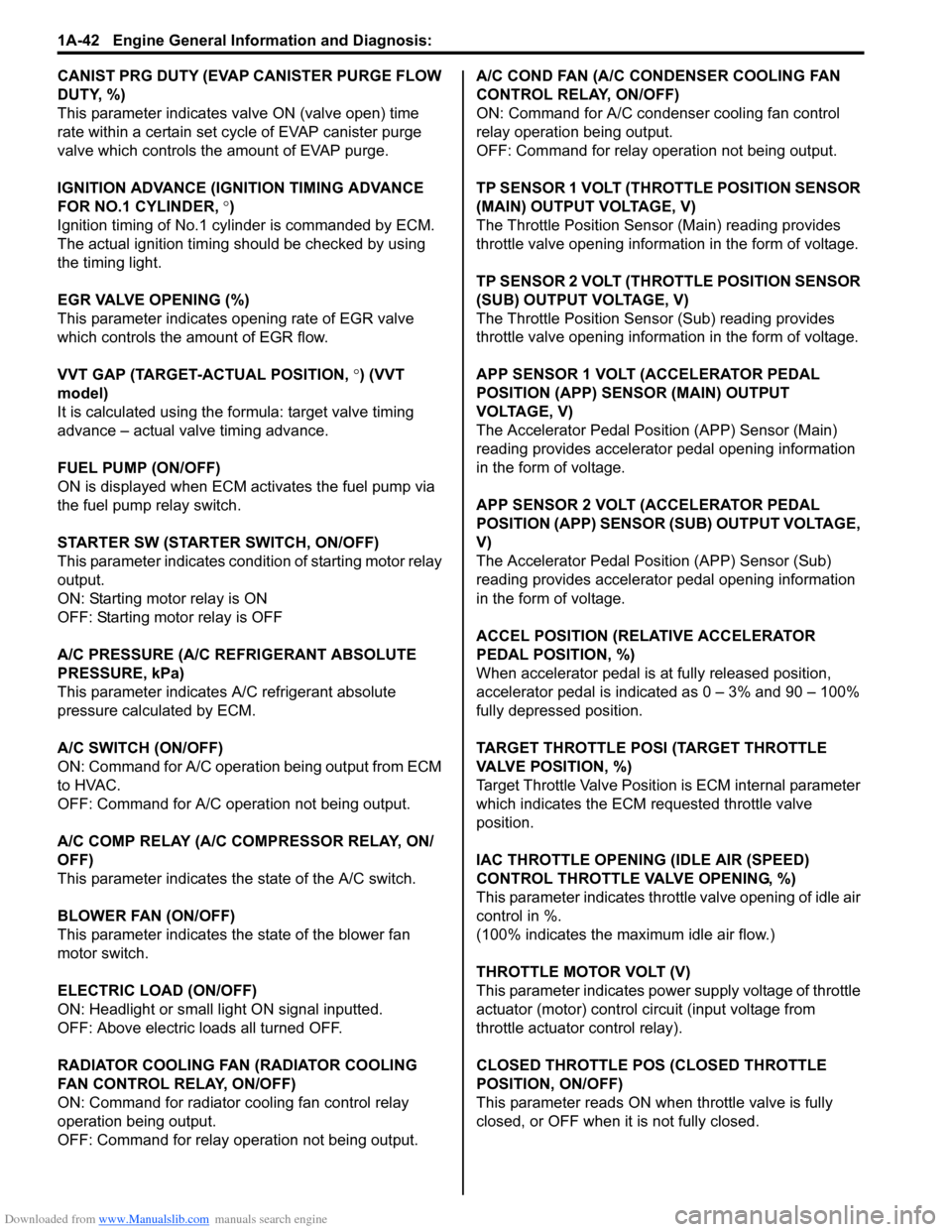
CANIST PRG DUTY (EVAP CANISTER PURGE FLOW
DUTY, %)
This parameter indicates valve ON (valve open) time
rate within a certain set cycle of EVAP canister purge
valve which controls the amount of EVAP purge.
IGNITION ADVANCE (IGNITION TIMING ADVANCE
FOR NO.1 CYLINDER, °)
Ignition timing of No.1 cylinder is commanded by ECM.
The actual ignition timing should be checked by using
the timing light.
EGR VALVE OPENING (%)
This parameter indicates opening rate of EGR valve
which controls the amount of EGR flow.
VVT GAP (TARGET-ACTUAL POSITION, °) (VVT
model)
It is calculated using the formula: target valve timing
advance – actual valve timing advance.
FUEL PUMP (ON/OFF)
ON is displayed when ECM activates the fuel pump via
the fuel pump relay switch.
STARTER SW (STARTER SWITCH, ON/OFF)
This parameter indicates condition of starting motor relay
output.
ON: Starting motor relay is ON
OFF: Starting motor relay is OFF
A/C PRESSURE (A/C REFRIGERANT ABSOLUTE
PRESSURE, kPa)
This parameter indicates A/C refrigerant absolute
pressure calculated by ECM.
A/C SWITCH (ON/OFF)
ON: Command for A/C operation being output from ECM
to HVAC.
OFF: Command for A/C operation not being output.
A/C COMP RELAY (A/C COMPRESSOR RELAY, ON/
OFF)
This parameter indicates the state of the A/C switch.
BLOWER FAN (ON/OFF)
This parameter indicates the state of the blower fan
motor switch.
ELECTRIC LOAD (ON/OFF)
ON: Headlight or small light ON signal inputted.
OFF: Above electric loads all turned OFF.
RADIATOR COOLING FAN (RADIATOR COOLING
FAN CONTROL RELAY, ON/OFF)
ON: Command for radiator cooling fan control relay
operation being output.
OFF: Command for relay operation not being output.A/C COND FAN (A/C CONDENSER COOLING FAN
CONTROL RELAY, ON/OFF)
ON: Command for A/C condenser cooling fan control
relay operation being output.
OFF: Command for relay operation not being output.
TP SENSOR 1 VOLT (THROTTLE POSITION SENSOR
(MAIN) OUTPUT VOLTAGE, V)
The Throttle Position Sensor (Main) reading provides
throttle valve opening information in the form of voltage.
TP SENSOR 2 VOLT (THROTTLE POSITION SENSOR
(SUB) OUTPUT VOLTAGE, V)
The Throttle Position Sensor (Sub) reading provides
throttle valve opening information in the form of voltage.
APP SENSOR 1 VOLT (ACCELERATOR PEDAL
POSITION (APP) SENSOR (MAIN) OUTPUT
VOLTAGE, V)
The Accelerator Pedal Position (APP) Sensor (Main)
reading provides accelerator pedal opening information
in the form of voltage.
APP SENSOR 2 VOLT (ACCELERATOR PEDAL
POSITION (APP) SENSOR (SUB) OUTPUT VOLTAGE,
V)
The Accelerator Pedal Position (APP) Sensor (Sub)
reading provides accelerator pedal opening information
in the form of voltage.
ACCEL POSITION (RELATIVE ACCELERATOR
PEDAL POSITION, %)
When accelerator pedal is at fully released position,
accelerator pedal is indicated as 0 – 3% and 90 – 100%
fully depressed position.
TARGET THROTTLE POSI (TARGET THROTTLE
VALVE POSITION, %)
Target Throttle Valve Position is ECM internal parameter
which indicates the ECM requested throttle valve
position.
IAC THROTTLE OPENING (IDLE AIR (SPEED)
CONTROL THROTTLE VALVE OPENING, %)
This parameter indicates throttle valve opening of idle air
control in %.
(100% indicates the maximum idle air flow.)
THROTTLE MOTOR VOLT (V)
This parameter indicates power supply voltage of throttle
actuator (motor) control circuit (input voltage from
throttle actuator control relay).
CLOSED THROTTLE POS (CLOSED THROTTLE
POSITION, ON/OFF)
This parameter reads ON when throttle valve is fully
closed, or OFF when it is not fully closed.
Page 94 of 1556
Downloaded from www.Manualslib.com manuals search engine 1A-44 Engine General Information and Diagnosis:
4Check keyless start control system malfunction
1) Check keyless start control system referring to “Keyless
Start System Operation Inspection in Section 10E”.
Is check result satisfactory?Go to Step 5. Keyless start control
system malfunction.
5Is engine cranked?Go to Step 6. Go to “Cranking System
Symptom Diagnosis in
Section 1I”.
6Does engine start?Go to Step 7. Go to Step 9.
7Check idle speed
1) Check engine idle speed referring to “Idle Speed and
IAC Throttle Valve Opening Inspection”.
Is check result as specified?Go to Step 8. Go to “Engine Symptom
Diagnosis”.
8Check ignition timing
1) Check ignition timing referring to “Ignition Timing
Inspection in Section 1H”.
Is check result as specified?Go to “Engine Symptom
Diagnosis”.Check ignition control
related parts referring to
“Ignition Timing
Inspection in Section
1H”.
9Check immobilizer system malfunction
1) Check immobilizer indicator lamp for flashing.
Is it flashing when ignition switch is turned to ON position?Go to “DTC Check in
Section 10C”.Go to Step 10.
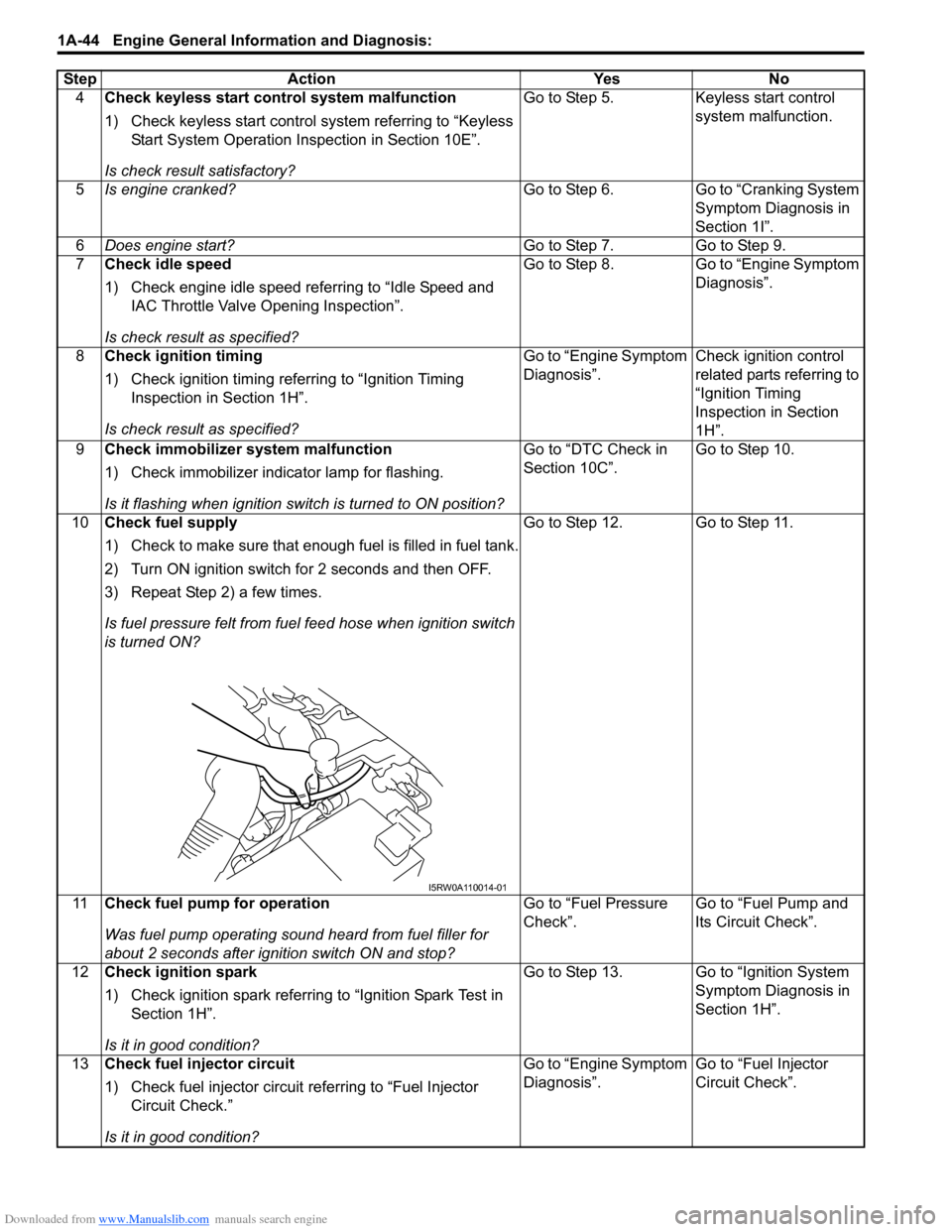
10Check fuel supply
1) Check to make sure that enough fuel is filled in fuel tank.
2) Turn ON ignition switch for 2 seconds and then OFF.
3) Repeat Step 2) a few times.
Is fuel pressure felt from fuel feed hose when ignition switch
is turned ON?Go to Step 12. Go to Step 11.
11Check fuel pump for operation
Was fuel pump operating sound heard from fuel filler for
about 2 seconds after ignition switch ON and stop?Go to “Fuel Pressure
Check”.Go to “Fuel Pump and
Its Circuit Check”.
12Check ignition spark
1) Check ignition spark referring to “Ignition Spark Test in
Section 1H”.
Is it in good condition?Go to Step 13. Go to “Ignition System
Symptom Diagnosis in
Section 1H”.
13Check fuel injector circuit
1) Check fuel injector circuit referring to “Fuel Injector
Circuit Check.”
Is it in good condition?Go to “Engine Symptom
Diagnosis”.Go to “Fuel Injector
Circuit Check”. Step Action Yes No
I5RW0A110014-01
Page 95 of 1556
Downloaded from www.Manualslib.com manuals search engine Engine General Information and Diagnosis: 1A-45
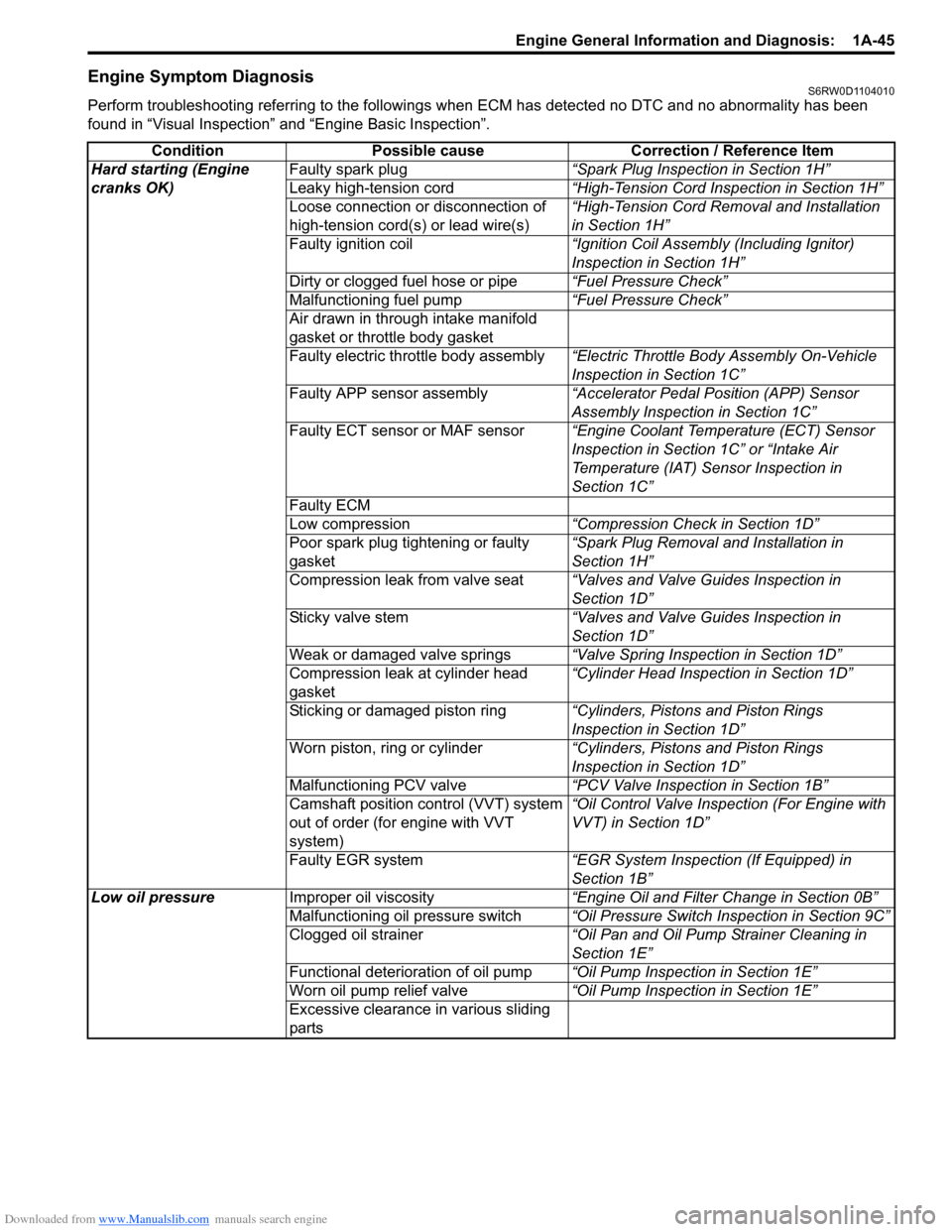
Engine Symptom DiagnosisS6RW0D1104010
Perform troubleshooting referring to the followings when ECM has detected no DTC and no abnormality has been
found in “Visual Inspection” and “Engine Basic Inspection”.
Condition Possible cause Correction / Reference Item
Hard starting (Engine
cranks OK)Faulty spark plug“Spark Plug Inspection in Section 1H”
Leaky high-tension cord“High-Tension Cord Inspection in Section 1H”
Loose connection or disconnection of
high-tension cord(s) or lead wire(s)“High-Tension Cord Removal and Installation
in Section 1H”
Faulty ignition coil“Ignition Coil Assembly (Including Ignitor)
Inspection in Section 1H”
Dirty or clogged fuel hose or pipe“Fuel Pressure Check”
Malfunctioning fuel pump“Fuel Pressure Check”
Air drawn in through intake manifold
gasket or throttle body gasket
Faulty electric throttle body assembly“Electric Throttle Body Assembly On-Vehicle
Inspection in Section 1C”
Faulty APP sensor assembly“Accelerator Pedal Position (APP) Sensor
Assembly Inspection in Section 1C”
Faulty ECT sensor or MAF sensor“Engine Coolant Temperature (ECT) Sensor
Inspection in Section 1C” or “Intake Air
Temperature (IAT) Sensor Inspection in
Section 1C”
Faulty ECM
Low compression“Compression Check in Section 1D”
Poor spark plug tightening or faulty
gasket“Spark Plug Removal and Installation in
Section 1H”
Compression leak from valve seat“Valves and Valve Guides Inspection in
Section 1D”
Sticky valve stem“Valves and Valve Guides Inspection in
Section 1D”
Weak or damaged valve springs“Valve Spring Inspection in Section 1D”
Compression leak at cylinder head
gasket“Cylinder Head Inspection in Section 1D”
Sticking or damaged piston ring“Cylinders, Pistons and Piston Rings
Inspection in Section 1D”
Worn piston, ring or cylinder“Cylinders, Pistons and Piston Rings
Inspection in Section 1D”
Malfunctioning PCV valve“PCV Valve Inspection in Section 1B”
Camshaft position control (VVT) system
out of order (for engine with VVT
system)“Oil Control Valve Inspection (For Engine with
VVT) in Section 1D”
Faulty EGR system“EGR System Inspection (If Equipped) in
Section 1B”
Low oil pressureImproper oil viscosity“Engine Oil and Filter Change in Section 0B”
Malfunctioning oil pressure switch“Oil Pressure Switch Inspection in Section 9C”
Clogged oil strainer“Oil Pan and Oil Pump Strainer Cleaning in
Section 1E”
Functional deterioration of oil pump“Oil Pump Inspection in Section 1E”
Worn oil pump relief valve“Oil Pump Inspection in Section 1E”
Excessive clearance in various sliding
parts
Page 99 of 1556
Downloaded from www.Manualslib.com manuals search engine Engine General Information and Diagnosis: 1A-49
Excessive detonation –
Engine makes
continuously sharp
metallic knocks that
change with throttle
opening. Sounds like pop
corn popping.Faulty spark plug“Spark Plug Inspection in Section 1H”
Loose connection of high-tension cord“High-Tension Cord Removal and Installation
in Section 1H”
Engine overheatingCondition “Engine overheating”
Clogged fuel filter (faulty fuel pump) or
fuel lines“Fuel Pressure Check” or “Fuel Pump and Its
Circuit Check”
Air drawn in through intake manifold or
throttle body gasket
Malfunctioning EGR valve“EGR Valve Inspection (If Equipped) in Section
1B”
Poor performance of knock sensor, ECT
sensor or MAF sensor“DTC P0327 / P0328: Knock Sensor Circuit
Low / High”, “Engine Coolant Temperature
(ECT) Sensor Inspection in Section 1C” or
“Intake Air Temperature (IAT) Sensor
Inspection in Section 1C”
Faulty fuel injector(s)“Fuel Injector Circuit Check”
Faulty ECM
Excessive combustion chamber
deposits“Cylinders, Pistons and Piston Rings
Inspection in Section 1D” and/or “Piston Pins
and Connecting Rods Inspection in Section
1D”
Camshaft position control (VVT) system
out of order (for engine with VVT
system)“Oil Control Valve Inspection (For Engine with
VVT) in Section 1D”
Engine has no powerFaulty spark plug“Spark Plug Inspection in Section 1H”
Faulty ignition coil with ignitor“Ignition Coil Assembly (Including Ignitor)
Inspection in Section 1H”
Leaks, loose connection or
disconnection of high-tension cord“High-Tension Cord Removal and Installation
in Section 1H”
Faulty knock sensor“DTC P0327 / P0328: Knock Sensor Circuit
Low / High”
Clogged fuel hose or pipe“Fuel Pressure Check”
Malfunctioning fuel pump“Fuel Pump and Its Circuit Check”
Air drawn in through intake manifold
gasket or throttle body gasket
Engine overheatingCondition “Engine overheating”
Malfunctioning EGR valve“EGR Valve Inspection (If Equipped) in Section
1B”
Poor performance of ECT sensor or
MAF sensor“Engine Coolant Temperature (ECT) Sensor
Inspection in Section 1C” or “Intake Air
Temperature (IAT) Sensor Inspection in
Section 1C”
Faulty electric throttle body assembly“Electric Throttle Body Assembly On-Vehicle
Inspection in Section 1C”
Faulty APP sensor assembly“Accelerator Pedal Position (APP) Sensor
Assembly Inspection in Section 1C”
Faulty fuel injector(s)“Fuel Injector Circuit Check”
Faulty ECM
Dragging brakesCondition “Dragging brakes” in “Brakes
Symptom Diagnosis in Section 4A”
Slipping clutch (for M/T model)Condition “Slipping clutch” in “Clutch System
Symptom Diagnosis in Section 5C” (for M/T
model)
Low compression“Compression Check in Section 1D”
Camshaft position control (VVT) system
out of order (for engine with VVT
system)“Oil Control Valve Inspection (For Engine with
VVT) in Section 1D” Condition Possible cause Correction / Reference Item
Page 100 of 1556
Downloaded from www.Manualslib.com manuals search engine 1A-50 Engine General Information and Diagnosis:
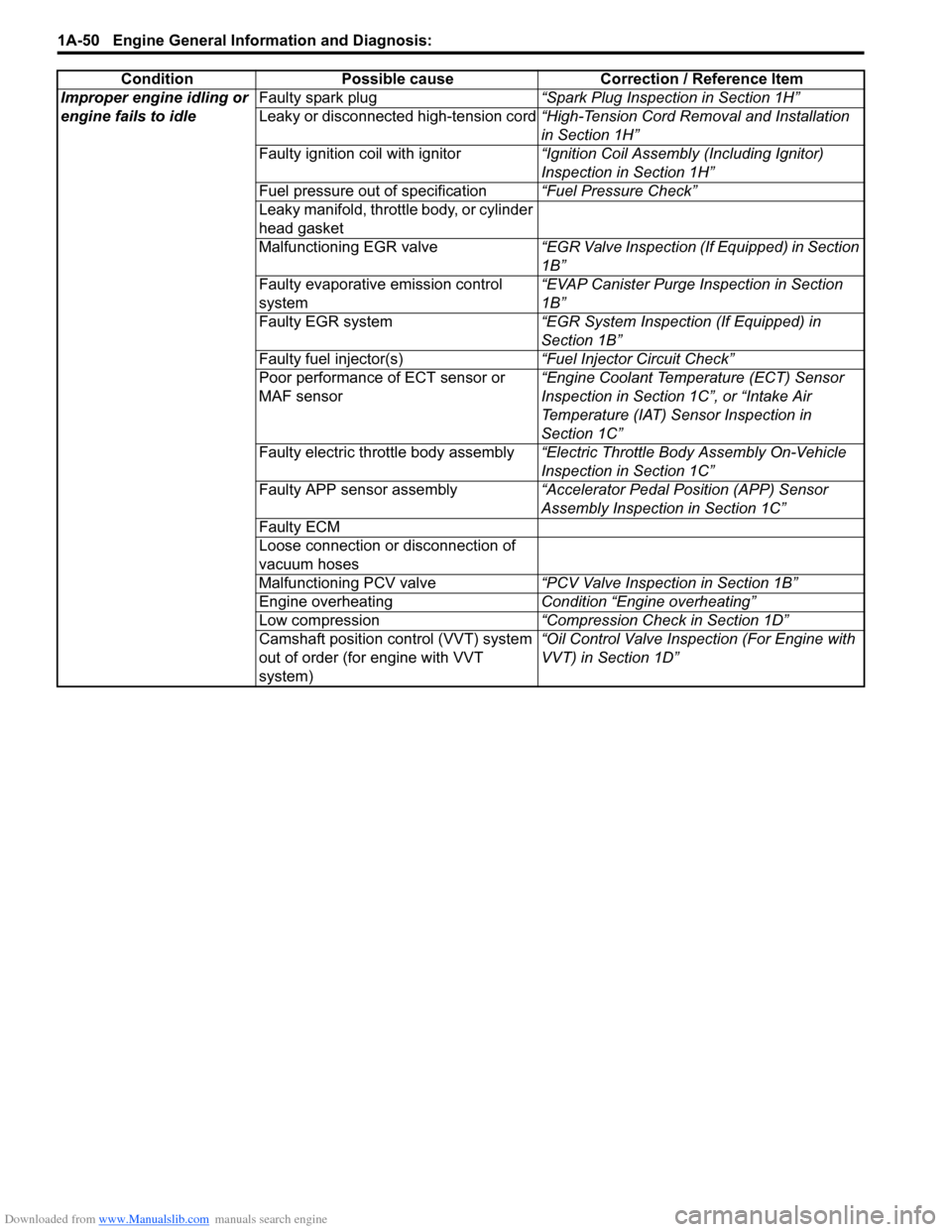
Improper engine idling or
engine fails to idleFaulty spark plug“Spark Plug Inspection in Section 1H”
Leaky or disconnected high-tension cord“High-Tension Cord Removal and Installation
in Section 1H”
Faulty ignition coil with ignitor“Ignition Coil Assembly (Including Ignitor)
Inspection in Section 1H”
Fuel pressure out of specification“Fuel Pressure Check”
Leaky manifold, throttle body, or cylinder
head gasket
Malfunctioning EGR valve“EGR Valve Inspection (If Equipped) in Section
1B”
Faulty evaporative emission control
system“EVAP Canister Purge Inspection in Section
1B”
Faulty EGR system“EGR System Inspection (If Equipped) in
Section 1B”
Faulty fuel injector(s)“Fuel Injector Circuit Check”
Poor performance of ECT sensor or
MAF sensor“Engine Coolant Temperature (ECT) Sensor
Inspection in Section 1C”, or “Intake Air
Temperature (IAT) Sensor Inspection in
Section 1C”
Faulty electric throttle body assembly“Electric Throttle Body Assembly On-Vehicle
Inspection in Section 1C”
Faulty APP sensor assembly“Accelerator Pedal Position (APP) Sensor
Assembly Inspection in Section 1C”
Faulty ECM
Loose connection or disconnection of
vacuum hoses
Malfunctioning PCV valve“PCV Valve Inspection in Section 1B”
Engine overheatingCondition “Engine overheating”
Low compression“Compression Check in Section 1D”
Camshaft position control (VVT) system
out of order (for engine with VVT
system)“Oil Control Valve Inspection (For Engine with
VVT) in Section 1D” Condition Possible cause Correction / Reference Item
Page 101 of 1556
Downloaded from www.Manualslib.com manuals search engine Engine General Information and Diagnosis: 1A-51
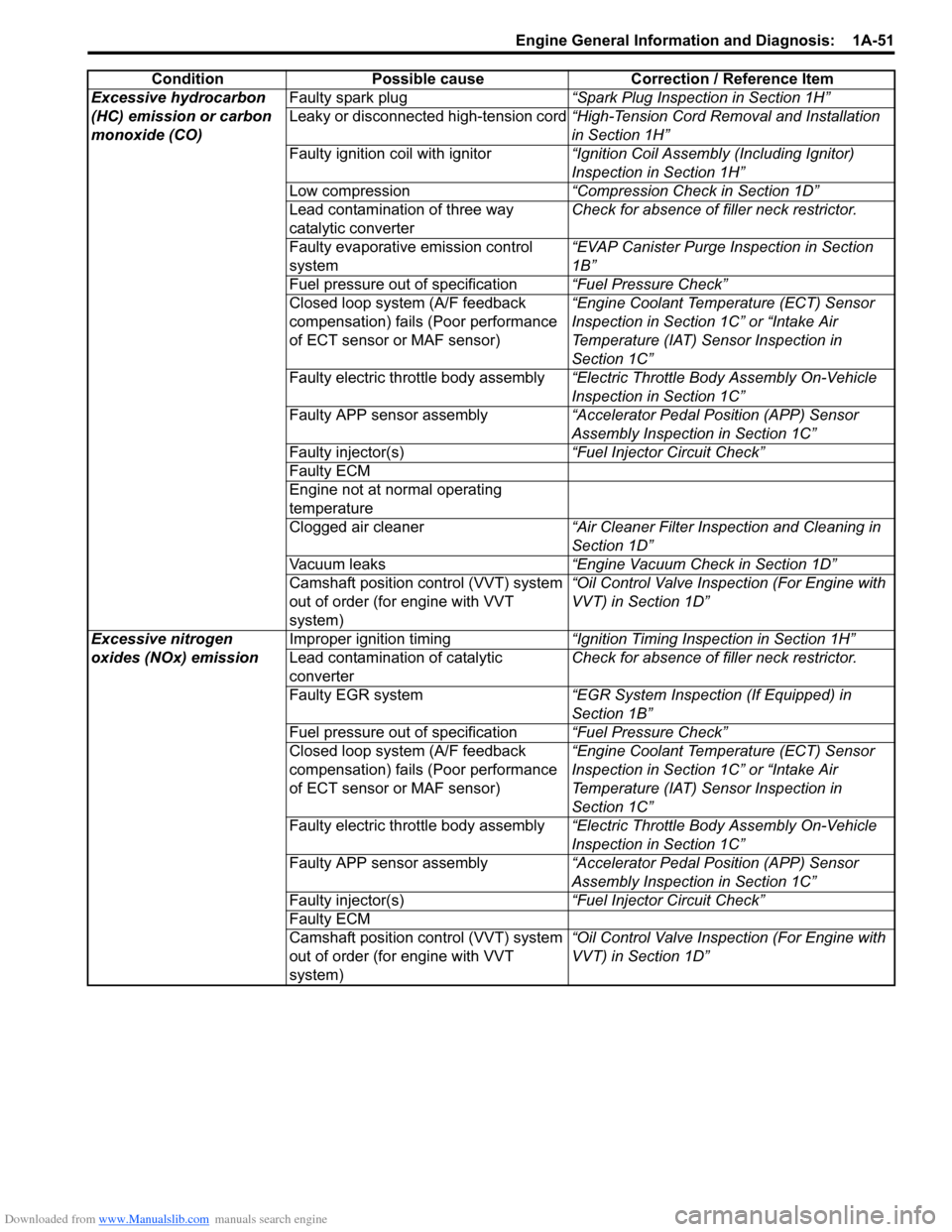
Excessive hydrocarbon
(HC) emission or carbon
monoxide (CO)Faulty spark plug“Spark Plug Inspection in Section 1H”
Leaky or disconnected high-tension cord“High-Tension Cord Removal and Installation
in Section 1H”
Faulty ignition coil with ignitor“Ignition Coil Assembly (Including Ignitor)
Inspection in Section 1H”
Low compression“Compression Check in Section 1D”
Lead contamination of three way
catalytic converterCheck for absence of filler neck restrictor.
Faulty evaporative emission control
system“EVAP Canister Purge Inspection in Section
1B”
Fuel pressure out of specification“Fuel Pressure Check”
Closed loop system (A/F feedback
compensation) fails (Poor performance
of ECT sensor or MAF sensor)“Engine Coolant Temperature (ECT) Sensor
Inspection in Section 1C” or “Intake Air
Temperature (IAT) Sensor Inspection in
Section 1C”
Faulty electric throttle body assembly“Electric Throttle Body Assembly On-Vehicle
Inspection in Section 1C”
Faulty APP sensor assembly“Accelerator Pedal Position (APP) Sensor
Assembly Inspection in Section 1C”
Faulty injector(s)“Fuel Injector Circuit Check”
Faulty ECM
Engine not at normal operating
temperature
Clogged air cleaner“Air Cleaner Filter Inspection and Cleaning in
Section 1D”
Vacuum leaks“Engine Vacuum Check in Section 1D”
Camshaft position control (VVT) system
out of order (for engine with VVT
system)“Oil Control Valve Inspection (For Engine with
VVT) in Section 1D”
Excessive nitrogen
oxides (NOx) emissionImproper ignition timing“Ignition Timing Inspection in Section 1H”
Lead contamination of catalytic
converterCheck for absence of filler neck restrictor.
Faulty EGR system“EGR System Inspection (If Equipped) in
Section 1B”
Fuel pressure out of specification“Fuel Pressure Check”
Closed loop system (A/F feedback
compensation) fails (Poor performance
of ECT sensor or MAF sensor)“Engine Coolant Temperature (ECT) Sensor
Inspection in Section 1C” or “Intake Air
Temperature (IAT) Sensor Inspection in
Section 1C”
Faulty electric throttle body assembly“Electric Throttle Body Assembly On-Vehicle
Inspection in Section 1C”
Faulty APP sensor assembly“Accelerator Pedal Position (APP) Sensor
Assembly Inspection in Section 1C”
Faulty injector(s)“Fuel Injector Circuit Check”
Faulty ECM
Camshaft position control (VVT) system
out of order (for engine with VVT
system)“Oil Control Valve Inspection (For Engine with
VVT) in Section 1D” Condition Possible cause Correction / Reference Item
Page 102 of 1556
Downloaded from www.Manualslib.com manuals search engine 1A-52 Engine General Information and Diagnosis:
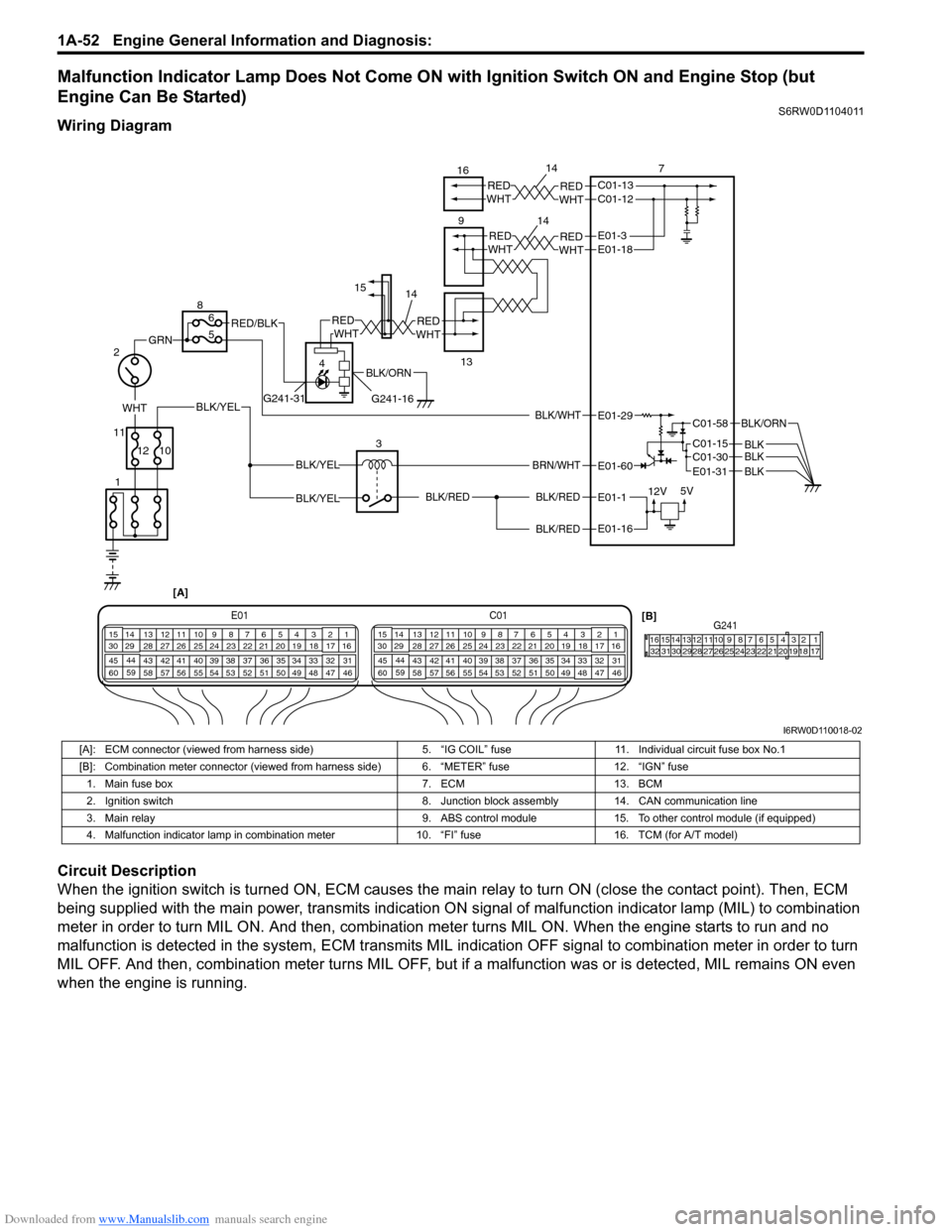
Malfunction Indicator Lamp Does Not Come ON with Ignition Switch ON and Engine Stop (but
Engine Can Be Started)
S6RW0D1104011
Wiring Diagram
Circuit Description
When the ignition switch is turned ON, ECM causes the main relay to turn ON (close the contact point). Then, ECM
being supplied with the main power, transmits indication ON signal of malfunction indicator lamp (MIL) to combination
meter in order to turn MIL ON. And then, combination meter turns MIL ON. When the engine starts to run and no
malfunction is detected in the system, ECM transmits MIL indication OFF signal to combination meter in order to turn
MIL OFF. And then, combination meter turns MIL OFF, but if a malfunction was or is detected, MIL remains ON even
when the engine is running.
BLK/WHT
BLK/RED
BLK/RED
BLK/RED
WHTBLK/YEL
BLK/YEL
RED/BLK
BLK/YEL
GRN
BRN/WHT
12V5V
2
3 8
6
57
REDWHTREDWHT
REDWHTREDWHT
E01-29
E01-3
E01-1
E01-60
E01-18
E01-16
BLK/ORN49
13
10 12 11G241-31
1414
G241-16
[A]
E01 C01
3 4
18 19 5 6 7 10 11
17 20
47 46 49 50 51 21 22
5216 259
24 14
29
55 57 54 53 59
60 582
26 27 28 15
30
56 4832 31 34 35 36 37 40 42 39 38 44
45 43 41 331 12 13
238 3 4
18 19 5 6 7 10 11
17 20
47 46 49 50 51 21 22
5216 259
24 14
29
55 57 54 53 59
60 582
26 27 28 15
30
56 4832 31 34 35 36 37 40 42 39 38 44
45 43 41 331 12 13
238G2411 2 3 4 5 6 7 8 9 10 11 12 13 14 15 16
17 18 19 20 21 22 23 24 25 26 27 28 29 30 31 32
[B]
1
C01-58
C01-15 C01-30
BLK/ORN
BLKBLKBLK
15
E01-31
REDWHTREDWHTC01-13 C01-12
1614
I6RW0D110018-02
[A]: ECM connector (viewed from harness side) 5. “IG COIL” fuse 11. Individual circuit fuse box No.1
[B]: Combination meter connector (viewed from harness side) 6. “METER” fuse 12. “IGN” fuse
1. Main fuse box 7. ECM 13. BCM
2. Ignition switch 8. Junction block assembly 14. CAN communication line
3. Main relay 9. ABS control module 15. To other control module (if equipped)
4. Malfunction indicator lamp in combination meter 10. “FI” fuse 16. TCM (for A/T model)
Page 103 of 1556
Downloaded from www.Manualslib.com manuals search engine Engine General Information and Diagnosis: 1A-53
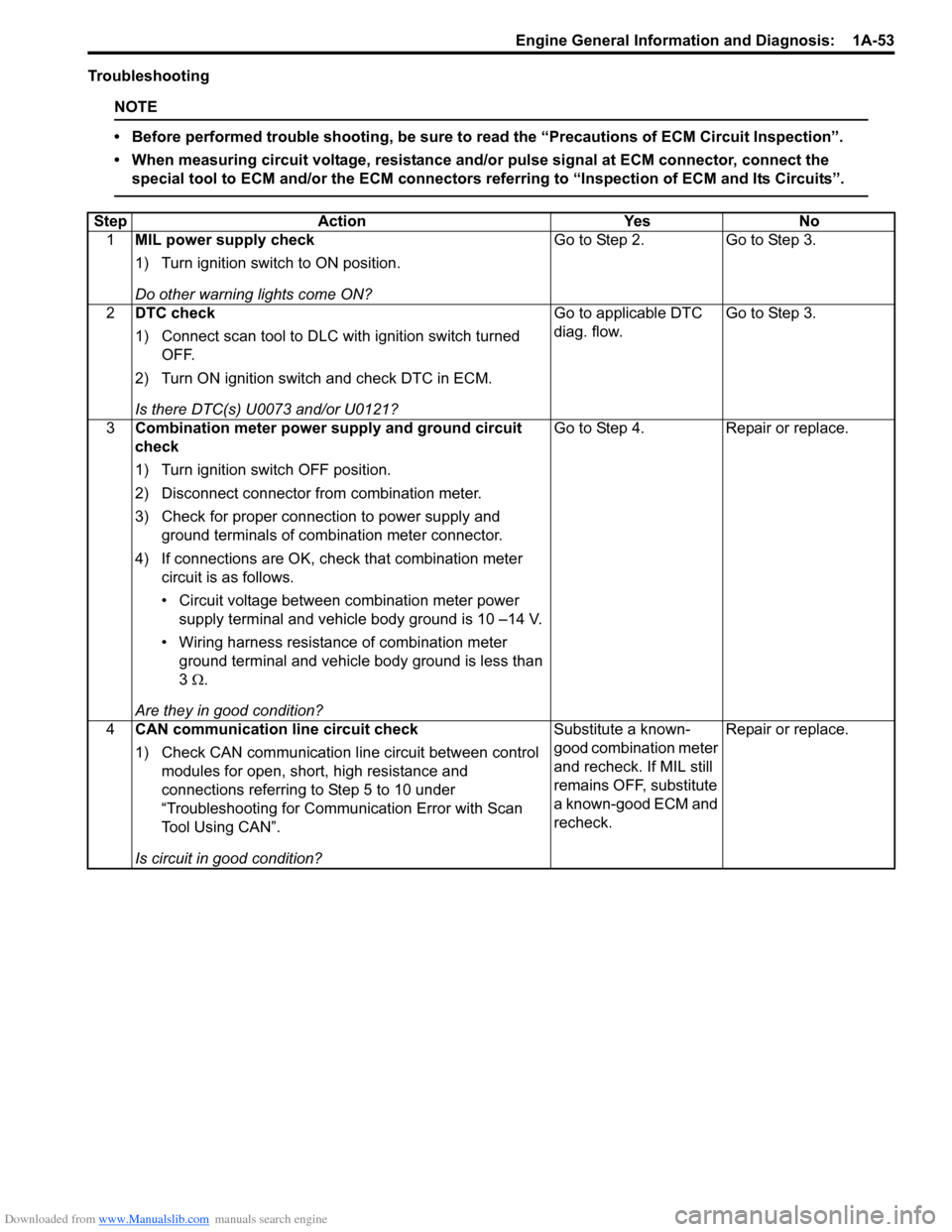
Troubleshooting
NOTE
• Before performed trouble shooting, be sure to read the “Precautions of ECM Circuit Inspection”.
• When measuring circuit voltage, resistance and/or pulse signal at ECM connector, connect the
special tool to ECM and/or the ECM connectors referring to “Inspection of ECM and Its Circuits”.
Step Action Yes No
1MIL power supply check
1) Turn ignition switch to ON position.
Do other warning lights come ON?Go to Step 2. Go to Step 3.
2DTC check
1) Connect scan tool to DLC with ignition switch turned
OFF.
2) Turn ON ignition switch and check DTC in ECM.
Is there DTC(s) U0073 and/or U0121?Go to applicable DTC
diag. flow.Go to Step 3.
3Combination meter power supply and ground circuit
check
1) Turn ignition switch OFF position.
2) Disconnect connector from combination meter.
3) Check for proper connection to power supply and
ground terminals of combination meter connector.
4) If connections are OK, check that combination meter
circuit is as follows.
• Circuit voltage between combination meter power
supply terminal and vehicle body ground is 10 –14 V.
• Wiring harness resistance of combination meter
ground terminal and vehicle body ground is less than
3 Ω.
Are they in good condition?Go to Step 4. Repair or replace.
4CAN communication line circuit check
1) Check CAN communication line circuit between control
modules for open, short, high resistance and
connections referring to Step 5 to 10 under
“Troubleshooting for Communication Error with Scan
Tool Using CAN”.
Is circuit in good condition?Substitute a known-
good combination meter
and recheck. If MIL still
remains OFF, substitute
a known-good ECM and
recheck.Repair or replace.
Page 104 of 1556
Downloaded from www.Manualslib.com manuals search engine 1A-54 Engine General Information and Diagnosis:
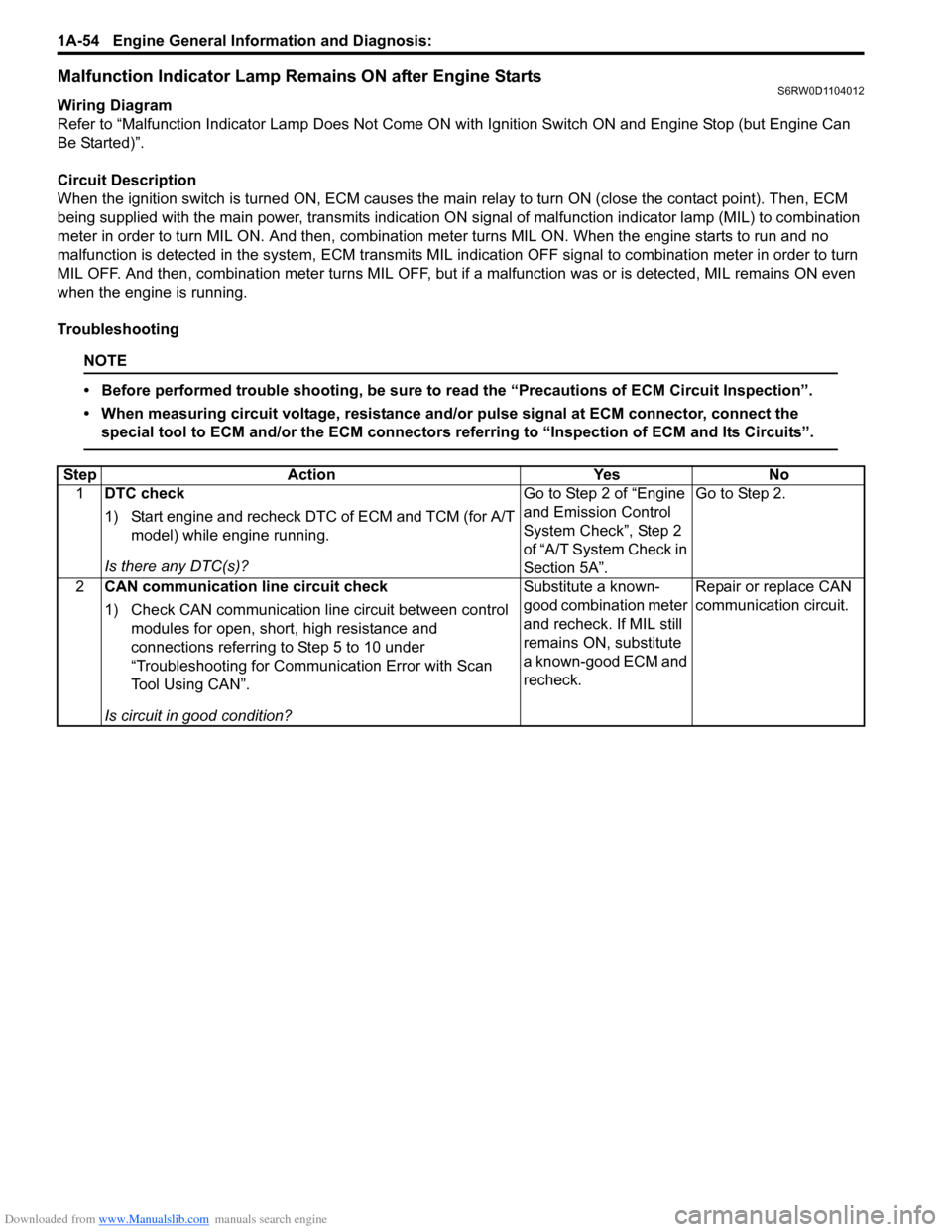
Malfunction Indicator Lamp Remains ON after Engine StartsS6RW0D1104012
Wiring Diagram
Refer to “Malfunction Indicator Lamp Does Not Come ON with Ignition Switch ON and Engine Stop (but Engine Can
Be Started)”.
Circuit Description
When the ignition switch is turned ON, ECM causes the main relay to turn ON (close the contact point). Then, ECM
being supplied with the main power, transmits indication ON signal of malfunction indicator lamp (MIL) to combination
meter in order to turn MIL ON. And then, combination meter turns MIL ON. When the engine starts to run and no
malfunction is detected in the system, ECM transmits MIL indication OFF signal to combination meter in order to turn
MIL OFF. And then, combination meter turns MIL OFF, but if a malfunction was or is detected, MIL remains ON even
when the engine is running.
Troubleshooting
NOTE
• Before performed trouble shooting, be sure to read the “Precautions of ECM Circuit Inspection”.
• When measuring circuit voltage, resistance and/or pulse signal at ECM connector, connect the
special tool to ECM and/or the ECM connectors referring to “Inspection of ECM and Its Circuits”.
Step Action Yes No
1DTC check
1) Start engine and recheck DTC of ECM and TCM (for A/T
model) while engine running.
Is there any DTC(s)?Go to Step 2 of “Engine
and Emission Control
System Check”, Step 2
of “A/T System Check in
Section 5A”.Go to Step 2.
2CAN communication line circuit check
1) Check CAN communication line circuit between control
modules for open, short, high resistance and
connections referring to Step 5 to 10 under
“Troubleshooting for Communication Error with Scan
Tool Using CAN”.
Is circuit in good condition?Substitute a known-
good combination meter
and recheck. If MIL still
remains ON, substitute
a known-good ECM and
recheck.Repair or replace CAN
communication circuit.
Page 106 of 1556
Downloaded from www.Manualslib.com manuals search engine 1A-56 Engine General Information and Diagnosis:
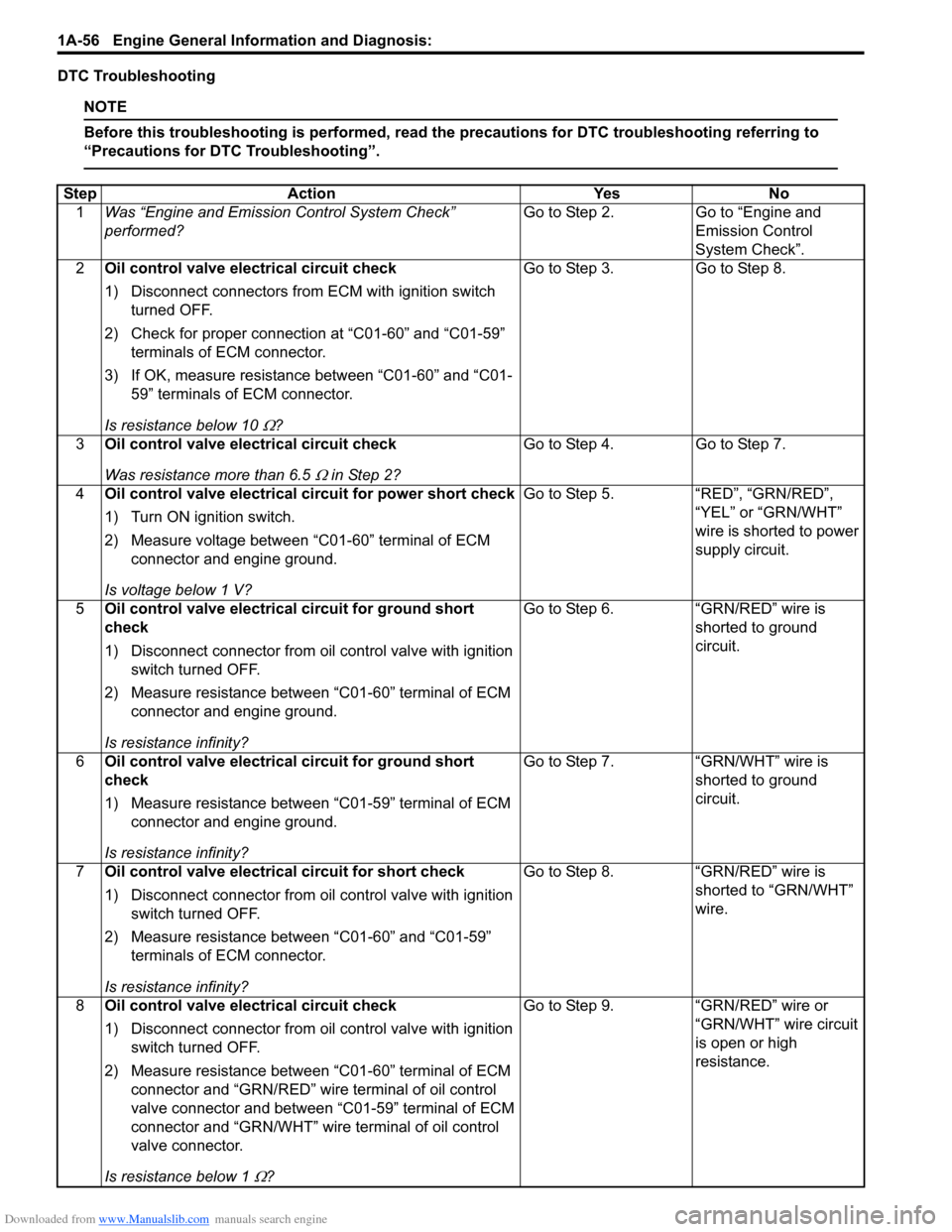
DTC Troubleshooting
NOTE
Before this troubleshooting is performed, read the precautions for DTC troubleshooting referring to
“Precautions for DTC Troubleshooting”.
Step Action Yes No
1Was “Engine and Emission Control System Check”
performed?Go to Step 2. Go to “Engine and
Emission Control
System Check”.
2Oil control valve electrical circuit check
1) Disconnect connectors from ECM with ignition switch
turned OFF.
2) Check for proper connection at “C01-60” and “C01-59”
terminals of ECM connector.
3) If OK, measure resistance between “C01-60” and “C01-
59” terminals of ECM connector.
Is resistance below 10
Ω?Go to Step 3. Go to Step 8.
3Oil control valve electrical circuit check
Was resistance more than 6.5
Ω in Step 2?Go to Step 4. Go to Step 7.
4Oil control valve electrical circuit for power short check
1) Turn ON ignition switch.
2) Measure voltage between “C01-60” terminal of ECM
connector and engine ground.
Is voltage below 1 V?Go to Step 5. “RED”, “GRN/RED”,
“YEL” or “GRN/WHT”
wire is shorted to power
supply circuit.
5Oil control valve electrical circuit for ground short
check
1) Disconnect connector from oil control valve with ignition
switch turned OFF.
2) Measure resistance between “C01-60” terminal of ECM
connector and engine ground.
Is resistance infinity?Go to Step 6. “GRN/RED” wire is
shorted to ground
circuit.
6Oil control valve electrical circuit for ground short
check
1) Measure resistance between “C01-59” terminal of ECM
connector and engine ground.
Is resistance infinity?Go to Step 7. “GRN/WHT” wire is
shorted to ground
circuit.
7Oil control valve electrical circuit for short check
1) Disconnect connector from oil control valve with ignition
switch turned OFF.
2) Measure resistance between “C01-60” and “C01-59”
terminals of ECM connector.
Is resistance infinity?Go to Step 8. “GRN/RED” wire is
shorted to “GRN/WHT”
wire.
8Oil control valve electrical circuit check
1) Disconnect connector from oil control valve with ignition
switch turned OFF.
2) Measure resistance between “C01-60” terminal of ECM
connector and “GRN/RED” wire terminal of oil control
valve connector and between “C01-59” terminal of ECM
connector and “GRN/WHT” wire terminal of oil control
valve connector.
Is resistance below 1
Ω?Go to Step 9. “GRN/RED” wire or
“GRN/WHT” wire circuit
is open or high
resistance.