length SUZUKI SX4 2006 1.G Service Owner's Guide
[x] Cancel search | Manufacturer: SUZUKI, Model Year: 2006, Model line: SX4, Model: SUZUKI SX4 2006 1.GPages: 1556, PDF Size: 37.31 MB
Page 919 of 1556
Downloaded from www.Manualslib.com manuals search engine Power Assisted Steering System: 6C-39
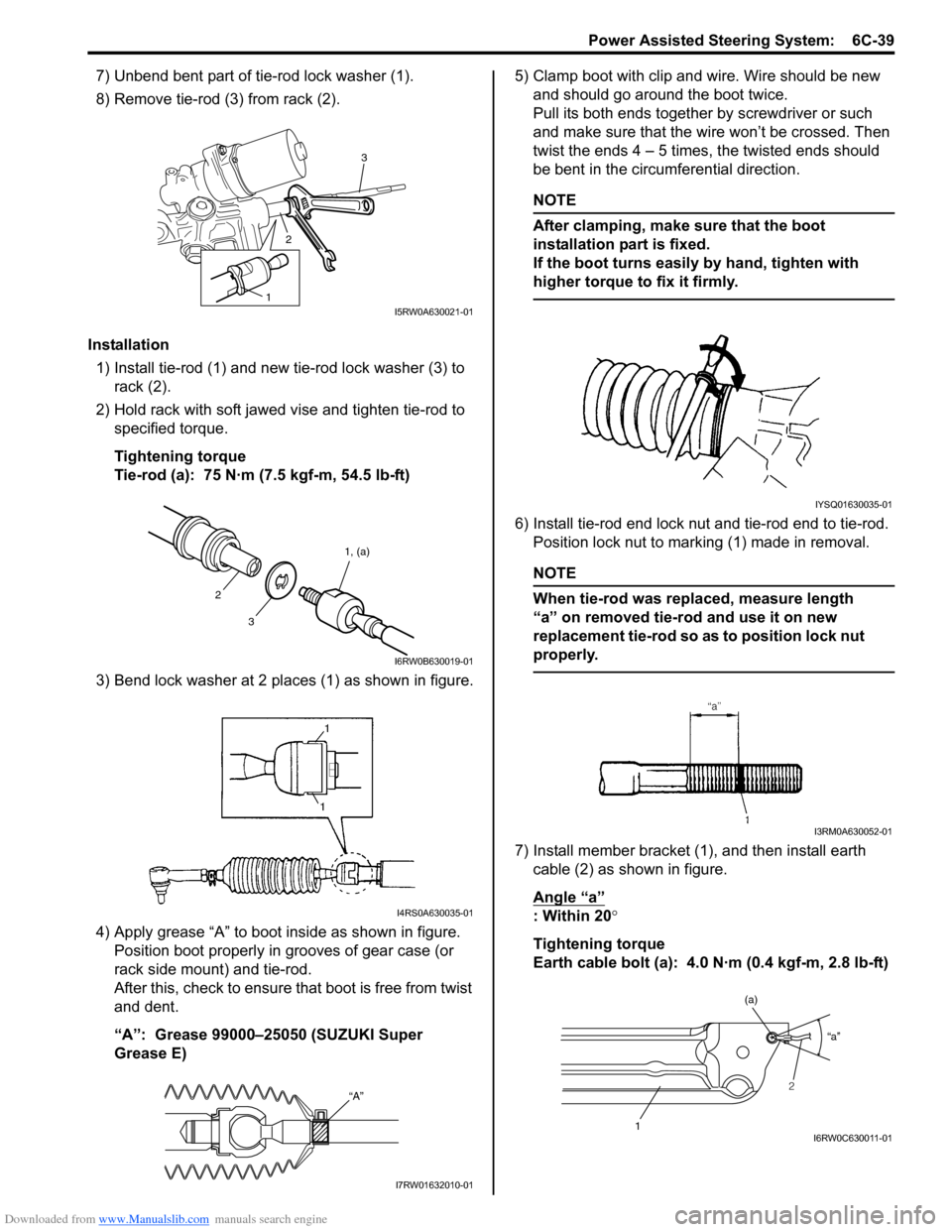
7) Unbend bent part of tie-rod lock washer (1).
8) Remove tie-rod (3) from rack (2).
Installation
1) Install tie-rod (1) and new tie-rod lock washer (3) to
rack (2).
2) Hold rack with soft jawed vise and tighten tie-rod to
specified torque.
Tightening torque
Tie-rod (a): 75 N·m (7.5 kgf-m, 54.5 lb-ft)
3) Bend lock washer at 2 places (1) as shown in figure.
4) Apply grease “A” to boot inside as shown in figure.
Position boot properly in grooves of gear case (or
rack side mount) and tie-rod.
After this, check to ensure that boot is free from twist
and dent.
“A”: Grease 99000–25050 (SUZUKI Super
Grease E) 5) Clamp boot with clip and wire. Wire should be new
and should go around the boot twice.
Pull its both ends together by screwdriver or such
and make sure that the wire won’t be crossed. Then
twist the ends 4 – 5 times, the twisted ends should
be bent in the circumferential direction.
NOTE
After clamping, make sure that the boot
installation part is fixed.
If the boot turns easily by hand, tighten with
higher torque to fix it firmly.
6) Install tie-rod end lock nut and tie-rod end to tie-rod.
Position lock nut to marking (1) made in removal.
NOTE
When tie-rod was replaced, measure length
“a” on removed tie-rod and use it on new
replacement tie-rod so as to position lock nut
properly.
7) Install member bracket (1), and then install earth
cable (2) as shown in figure.
Angle “a”
: Within 20°
Tightening torque
Earth cable bolt (a): 4.0 N·m (0.4 kgf-m, 2.8 lb-ft)
3
2
1I5RW0A630021-01
31, (a)
2
I6RW0B630019-01
I4RS0A630035-01
“A”
I7RW01632010-01
IYSQ01630035-01
I3RM0A630052-01
“a”
1
(a)
2
I6RW0C630011-01
Page 956 of 1556
Downloaded from www.Manualslib.com manuals search engine 7B-16 Air Conditioning System: Manual Type
Abnormal Noise from Tubing
Abnormal Noise from Condenser Assembly
Abnormal Noise from Crankshaft Pulley
Abnormal Noise from Tension Pulley
Abnormal Noise from A/C Evaporator
Abnormal Noise from Blower MotorCondition Possible cause Correction / Reference Item
A droning noise is heard
from inside of the vehicle,
but not particularly
noticeable in engine
compartmentFaulty tubing clampsReposition clamps or increase the number of
clamps.
Resonance caused by pulsation from
variations in refrigerant pressureAttach a silencer to tubing, or modify its
position and length.
Condition Possible cause Correction / Reference Item
Considerable vibration in
condenser assemblyResonance from condenser assembly
bracket and bodyFirmly insert a silencer between condenser
assembly bracket and body.
Condition Possible cause Correction / Reference Item
A large rattling noise is
heard at idle or sudden
accelerationLoosen crankshaft pulley boltRetighten bolt.
Condition Possible cause Correction / Reference Item
Clattering noise is heard
from pulleyWorn or damaged bearingReplace tension pulley.
Pulley cranks upon
contactCracked or loose bracketReplace or retighten bracket.
Condition Possible cause Correction / Reference Item
Whistling sound is heard
from A/C evaporatorDepending on the combination of the
interior / exterior temperatures, engine
rpm and refrigerant pressure, the
refrigerant flowing out of the expansion
valve may, under certain conditions,
make a whistling soundAt times, slightly decreasing refrigerant volume
may stop this noise.
Inspect expansion valve and replace if faulty.
Condition Possible cause Correction / Reference Item
Blower motor emits a
chirping sound in
proportion to its speed of
rotationWorn or damaged motor brushes or
commutatorReplace blower motor.
Fluttering noise or large
droning noise is heard
from blower motorLeaves or other debris introduced from
fresh air inlet to blower motorRemove debris and make sure that the screen
at fresh air inlet is intact.
Page 1130 of 1556
Downloaded from www.Manualslib.com manuals search engine 8B-91 Air Bag System:
CAUTION!
After detecting one time of such collision as
to meet deployment conditions, the SDM
must not be used.
Refer to “Air Bag Diagnostic System Check”
when checking the SDM.
Accident with Deployment / Activation – Component
Replacement
When driver and passenger air bags are deployed, the
following components must be replaced.
• Driver and passenger air bag (inflator) modules
• Driver and passenger seat belt pretensioners
• SDM after detecting such collision as to meet
deployment conditions
• Forward impact-sensor
• Instrument panel
When side-air bag and side curtain-air bag are deployed,
the following components must be replaced.
• Deployed side-air bag (inflator) module
• Deployed side curtain-air bag (inflator) module
• Side impact-sensor
•SDM
Accident with or without Deployment / Activation –
Component Inspections
Certain air bag and restraint system components must
be inspected after any crash, whether the air bag system
activated or not. If any faulty condition is found in the
following checks, replace faulty part.
Those components are:
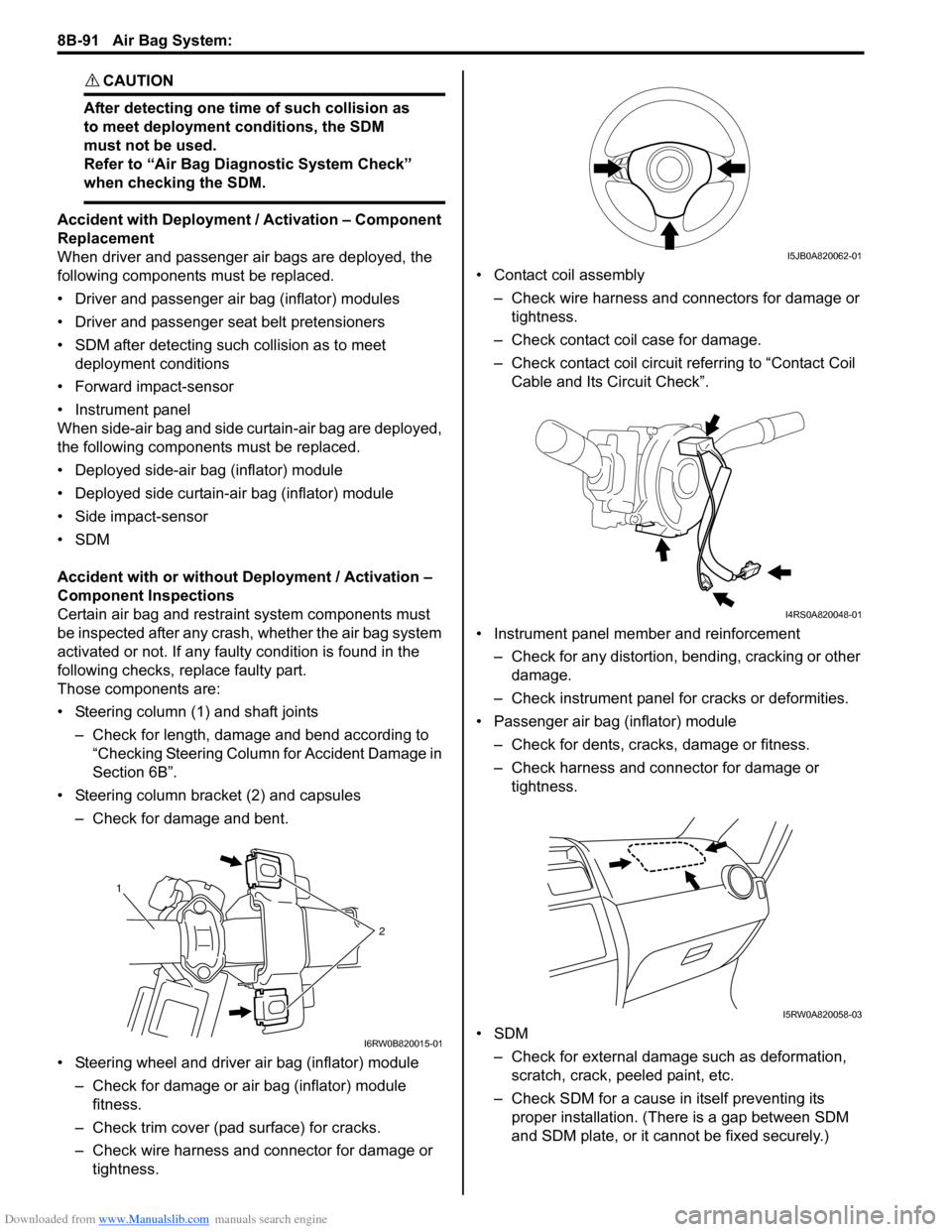
• Steering column (1) and shaft joints
– Check for length, damage and bend according to
“Checking Steering Column for Accident Damage in
Section 6B”.
• Steering column bracket (2) and capsules
– Check for damage and bent.
• Steering wheel and driver air bag (inflator) module
– Check for damage or air bag (inflator) module
fitness.
– Check trim cover (pad surface) for cracks.
– Check wire harness and connector for damage or
tightness.• Contact coil assembly
– Check wire harness and connectors for damage or
tightness.
– Check contact coil case for damage.
– Check contact coil circuit referring to “Contact Coil
Cable and Its Circuit Check”.
• Instrument panel member and reinforcement
– Check for any distortion, bending, cracking or other
damage.
– Check instrument panel for cracks or deformities.
• Passenger air bag (inflator) module
– Check for dents, cracks, damage or fitness.
– Check harness and connector for damage or
tightness.
•SDM
– Check for external damage such as deformation,
scratch, crack, peeled paint, etc.
– Check SDM for a cause in itself preventing its
proper installation. (There is a gap between SDM
and SDM plate, or it cannot be fixed securely.)
1
2
I6RW0B820015-01
I5JB0A820062-01
I4RS0A820048-01
I5RW0A820058-03
Page 1150 of 1556

Downloaded from www.Manualslib.com manuals search engine 8B-111 Air Bag System:
• For seat belt pretensioner
a. Cut webbing (1) at tongue plate stopper (3) of
seat belt pretensioner (2) side as shown.
NOTE
Hold seat belt pretensioner (2) vertically in
the same condition as it is installed.
Otherwise, webbing can’t be pulled out.
b. Remove tongue plate (4) and shoulder anchor
(5) from webbing.
c. Tie webbing (1) tightly at 10 cm (3.9 in.) from
cutting edge as shown.
d. Tie seat belt pretensioner (2) with wire
harness (3) to wheel-installed tire (4) as
shown.
Wire harness specifications
Stripped wire harness section 1.25 mm2
(0.0019 in.2) or more (Stripped wire harness
diameter 1.25 mm (0.05 in.) or more)
NOTE
Wind wire harness (3) around at least 3 times.
e. Clear space (5) on ground about 185 cm (6 ft)
in diameter where seat belt pretensioner (2) is
to be activated. Paved, outdoor location where
there is no activity is preferred. If outdoor
location is not available, use space on shop
floor where there is no activity and sufficient
ventilation is provided. Ensure no loose or
flammable object exists within activation area.
f. Place wheel-installed tire (4) with seat belt
pretensioner (2) on ground in Step e.
7) Stretch deployment harness (A) from air bag
(inflator) module or seat belt pretensioner to its full
length 10 m (33 ft).
Special tool
(A): 09932-75031
8) Place 12 volts vehicle battery (1) near the shorted
end of deployment harness (A).
9) Check that area around air bag (inflator) module or
seat belt pretensioner is clear of all people and loose
or flammable objects.
31452I3JA01820037-01
10 cm (3.9 in.)
1
I4RS0A820104-01
1. Webbing
4 3
3
25
I4RS0A820105-01
Page 1155 of 1556
Downloaded from www.Manualslib.com manuals search engine Air Bag System: 8B-116
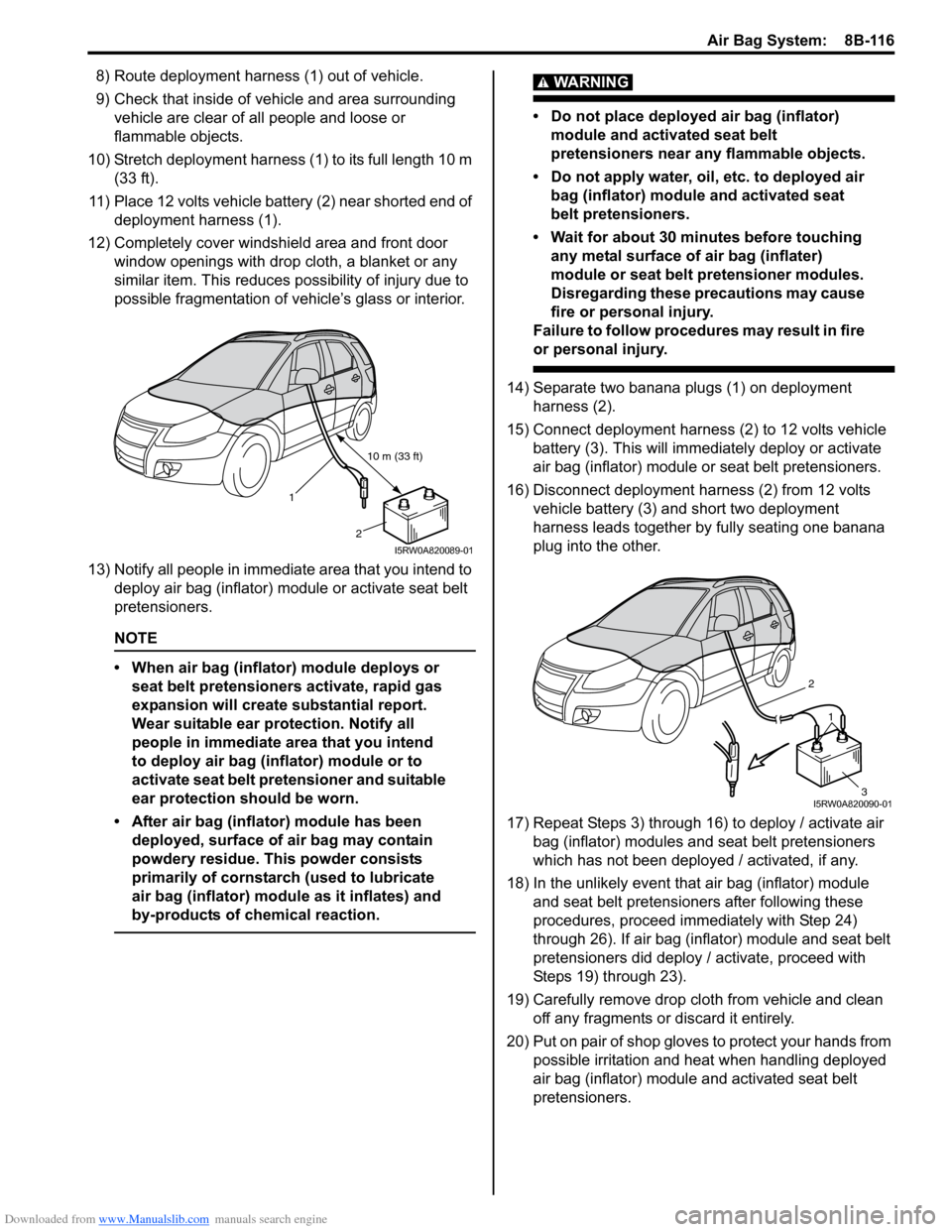
8) Route deployment harness (1) out of vehicle.
9) Check that inside of vehicle and area surrounding
vehicle are clear of all people and loose or
flammable objects.
10) Stretch deployment harness (1) to its full length 10 m
(33 ft).
11) Place 12 volts vehicle battery (2) near shorted end of
deployment harness (1).
12) Completely cover windshield area and front door
window openings with drop cloth, a blanket or any
similar item. This reduces possibility of injury due to
possible fragmentation of vehicle’s glass or interior.
13) Notify all people in immediate area that you intend to
deploy air bag (inflator) module or activate seat belt
pretensioners.
NOTE
• When air bag (inflator) module deploys or
seat belt pretensioners activate, rapid gas
expansion will create substantial report.
Wear suitable ear protection. Notify all
people in immediate area that you intend
to deploy air bag (inflator) module or to
activate seat belt pretensioner and suitable
ear protection should be worn.
• After air bag (inflator) module has been
deployed, surface of air bag may contain
powdery residue. This powder consists
primarily of cornstarch (used to lubricate
air bag (inflator) module as it inflates) and
by-products of chemical reaction.
WARNING!
• Do not place deployed air bag (inflator)
module and activated seat belt
pretensioners near any flammable objects.
• Do not apply water, oil, etc. to deployed air
bag (inflator) module and activated seat
belt pretensioners.
• Wait for about 30 minutes before touching
any metal surface of air bag (inflater)
module or seat belt pretensioner modules.
Disregarding these precautions may cause
fire or personal injury.
Failure to follow procedures may result in fire
or personal injury.
14) Separate two banana plugs (1) on deployment
harness (2).
15) Connect deployment harness (2) to 12 volts vehicle
battery (3). This will immediately deploy or activate
air bag (inflator) module or seat belt pretensioners.
16) Disconnect deployment harness (2) from 12 volts
vehicle battery (3) and short two deployment
harness leads together by fully seating one banana
plug into the other.
17) Repeat Steps 3) through 16) to deploy / activate air
bag (inflator) modules and seat belt pretensioners
which has not been deployed / activated, if any.
18) In the unlikely event that air bag (inflator) module
and seat belt pretensioners after following these
procedures, proceed immediately with Step 24)
through 26). If air bag (inflator) module and seat belt
pretensioners did deploy / activate, proceed with
Steps 19) through 23).
19) Carefully remove drop cloth from vehicle and clean
off any fragments or discard it entirely.
20) Put on pair of shop gloves to protect your hands from
possible irritation and heat when handling deployed
air bag (inflator) module and activated seat belt
pretensioners.
10 m (33 ft)
1
2
I5RW0A820089-01
1
3 2
I5RW0A820090-01