shaft SUZUKI SX4 2006 1.G Service Service Manual
[x] Cancel search | Manufacturer: SUZUKI, Model Year: 2006, Model line: SX4, Model: SUZUKI SX4 2006 1.GPages: 1556, PDF Size: 37.31 MB
Page 184 of 1556
Downloaded from www.Manualslib.com manuals search engine 1A-134 Engine General Information and Diagnosis:
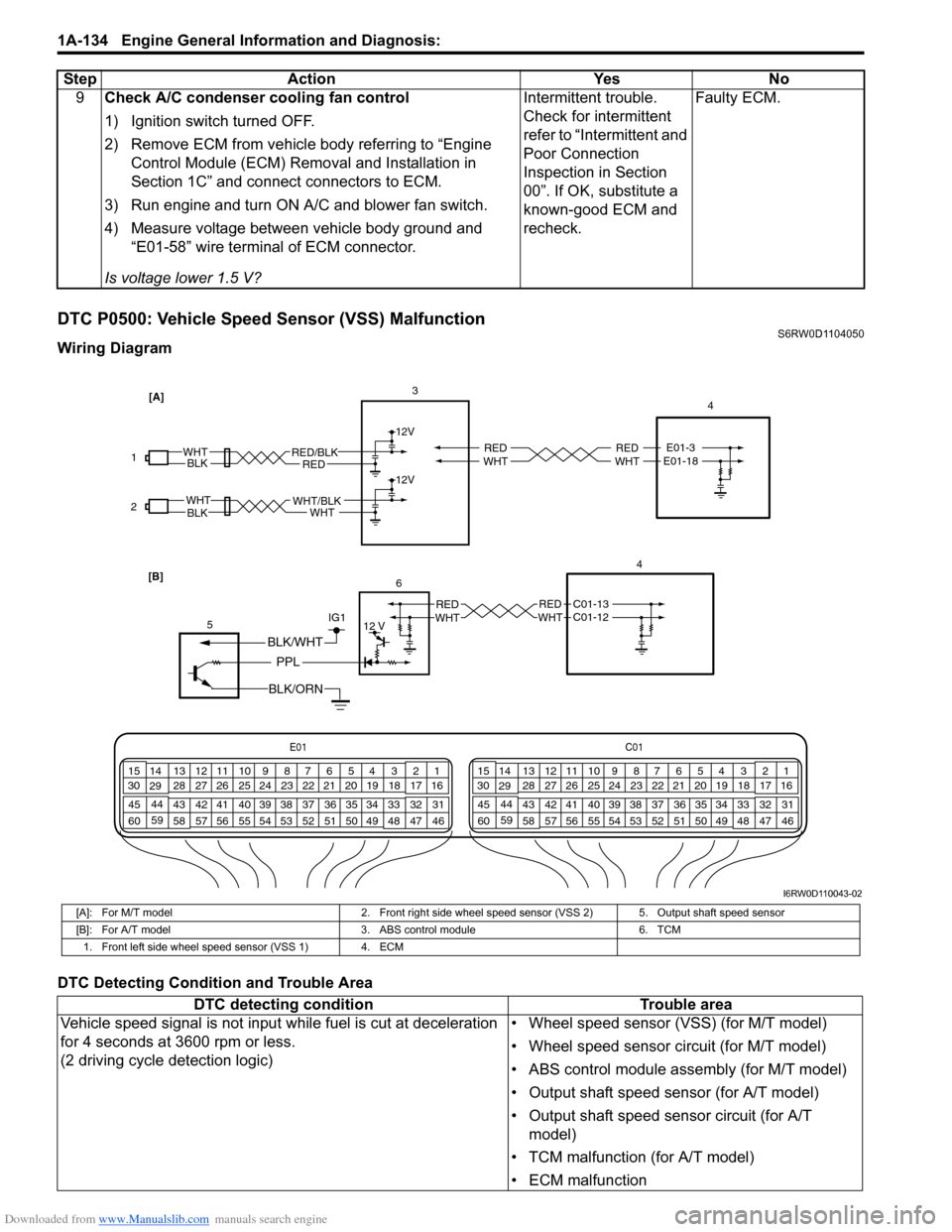
DTC P0500: Vehicle Speed Sensor (VSS) MalfunctionS6RW0D1104050
Wiring Diagram
DTC Detecting Condition and Trouble Area9Check A/C condenser cooling fan control
1) Ignition switch turned OFF.
2) Remove ECM from vehicle body referring to “Engine
Control Module (ECM) Removal and Installation in
Section 1C” and connect connectors to ECM.
3) Run engine and turn ON A/C and blower fan switch.
4) Measure voltage between vehicle body ground and
“E01-58” wire terminal of ECM connector.
Is voltage lower 1.5 V?Intermittent trouble.
Check for intermittent
refer to “Intermittent and
Poor Connection
Inspection in Section
00”. If OK, substitute a
known-good ECM and
recheck.Faulty ECM. Step Action Yes No
[B]
REDWHTC01-13C01-12REDWHT
PPL
5IG112 V
BLK/WHT
BLK/ORN
4
6 [A]
E01-3E01-18REDWHTREDWHT
E01C01
3 4
18 19 5 6 7 10 11
17 20
47 46 49 50 51 21 22
5216 259
24 14
29
55 57 54 53 59
60 582
26 27 28 15
30
56 4832 31 34 35 36 37 40 42 39 38 44
45 43 41 331 12 13
238 3 4
18 19 5 6 7 10 11
17 20
47 46 49 50 51 21 22
5216 259
24 14
29
55 57 54 53 59
60 582
26 27 28 15
30
56 4832 31 34 35 36 37 40 42 39 38 44
45 43 41 331 12 13
238
BLK
RED
WHT WHT
12V
12V
1
23
4
WHT/BLK
WHT BLKRED/BLK
I6RW0D110043-02
[A]: For M/T model 2. Front right side wheel speed sensor (VSS 2) 5. Output shaft speed sensor
[B]: For A/T model 3. ABS control module 6. TCM
1. Front left side wheel speed sensor (VSS 1) 4. ECM
DTC detecting condition Trouble area
Vehicle speed signal is not input while fuel is cut at deceleration
for 4 seconds at 3600 rpm or less.
(2 driving cycle detection logic)• Wheel speed sensor (VSS) (for M/T model)
• Wheel speed sensor circuit (for M/T model)
• ABS control module assembly (for M/T model)
• Output shaft speed sensor (for A/T model)
• Output shaft speed sensor circuit (for A/T
model)
• TCM malfunction (for A/T model)
• ECM malfunction
Page 225 of 1556
Downloaded from www.Manualslib.com manuals search engine Engine General Information and Diagnosis: 1A-175
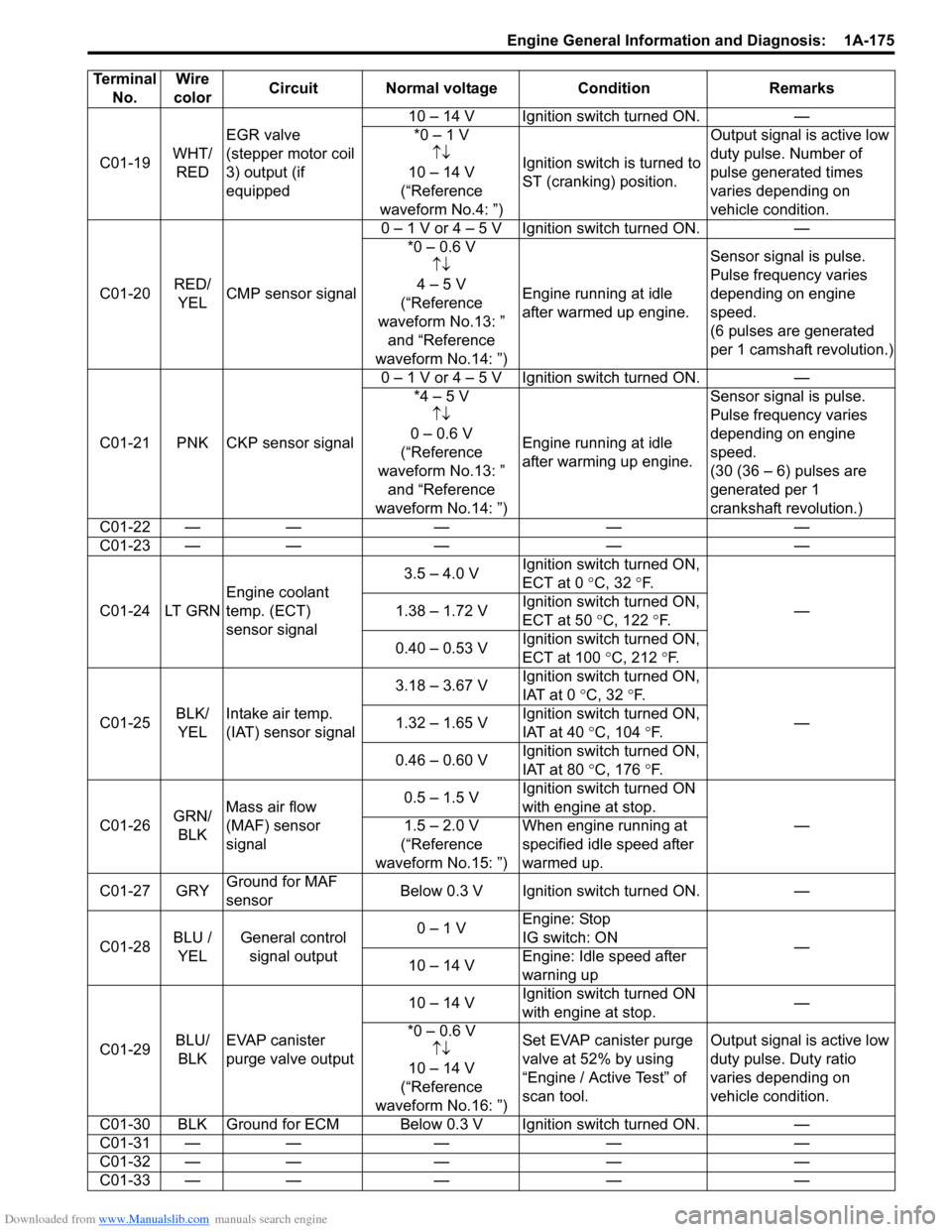
C01-19WHT/
REDEGR valve
(stepper motor coil
3) output (if
equipped10 – 14 V Ignition switch turned ON. —
*0 – 1 V
↑↓
10 – 14 V
(“Reference
waveform No.4: ”)Ignition switch is turned to
ST (cranking) position.Output signal is active low
duty pulse. Number of
pulse generated times
varies depending on
vehicle condition.
C01-20RED/
YELCMP sensor signal0 – 1 V or 4 – 5 V Ignition switch turned ON. —
*0 – 0.6 V
↑↓
4 – 5 V
(“Reference
waveform No.13: ”
and “Reference
waveform No.14: ”)Engine running at idle
after warmed up engine.Sensor signal is pulse.
Pulse frequency varies
depending on engine
speed.
(6 pulses are generated
per 1 camshaft revolution.)
C01-21 PNK CKP sensor signal0 – 1 V or 4 – 5 V Ignition switch turned ON. —
*4 – 5 V
↑↓
0 – 0.6 V
(“Reference
waveform No.13: ”
and “Reference
waveform No.14: ”)Engine running at idle
after warming up engine.Sensor signal is pulse.
Pulse frequency varies
depending on engine
speed.
(30 (36 – 6) pulses are
generated per 1
crankshaft revolution.)
C01-22 — — — — —
C01-23 — — — — —
C01-24 LT GRNEngine coolant
temp. (ECT)
sensor signal3.5 – 4.0 VIgnition switch turned ON,
ECT at 0 °C, 32 °F.
— 1.38 – 1.72 VIgnition switch turned ON,
ECT at 50 °C, 122 °F.
0.40 – 0.53 VIgnition switch turned ON,
ECT at 100 °C, 212 °F.
C01-25BLK/
YELIntake air temp.
(IAT) sensor signal3.18 – 3.67 VIgnition switch turned ON,
IAT at 0 °C, 32 °F.
— 1.32 – 1.65 VIgnition switch turned ON,
IAT at 40 °C, 104 °F.
0.46 – 0.60 VIgnition switch turned ON,
IAT at 80 °C, 176 °F.
C01-26GRN/
BLKMass air flow
(MAF) sensor
signal0.5 – 1.5 VIgnition switch turned ON
with engine at stop.
— 1.5 – 2.0 V
(“Reference
waveform No.15: ”)When engine running at
specified idle speed after
warmed up.
C01-27 GRYGround for MAF
sensorBelow 0.3 V Ignition switch turned ON. —
C01-28BLU /
YELGeneral control
signal output0 – 1 VEngine: Stop
IG switch: ON
—
10 – 14 VEngine: Idle speed after
warning up
C01-29BLU/
BLKEVAP canister
purge valve output10 – 14 VIgnition switch turned ON
with engine at stop.—
*0 – 0.6 V
↑↓
10 – 14 V
(“Reference
waveform No.16: ”)Set EVAP canister purge
valve at 52% by using
“Engine / Active Test” of
scan tool.Output signal is active low
duty pulse. Duty ratio
varies depending on
vehicle condition.
C01-30 BLK Ground for ECM Below 0.3 V Ignition switch turned ON. —
C01-31 — — — — —
C01-32 — — — — —
C01-33 — — — — — Terminal
No.Wire
colorCircuit Normal voltage Condition Remarks
Page 228 of 1556
Downloaded from www.Manualslib.com manuals search engine 1A-178 Engine General Information and Diagnosis:
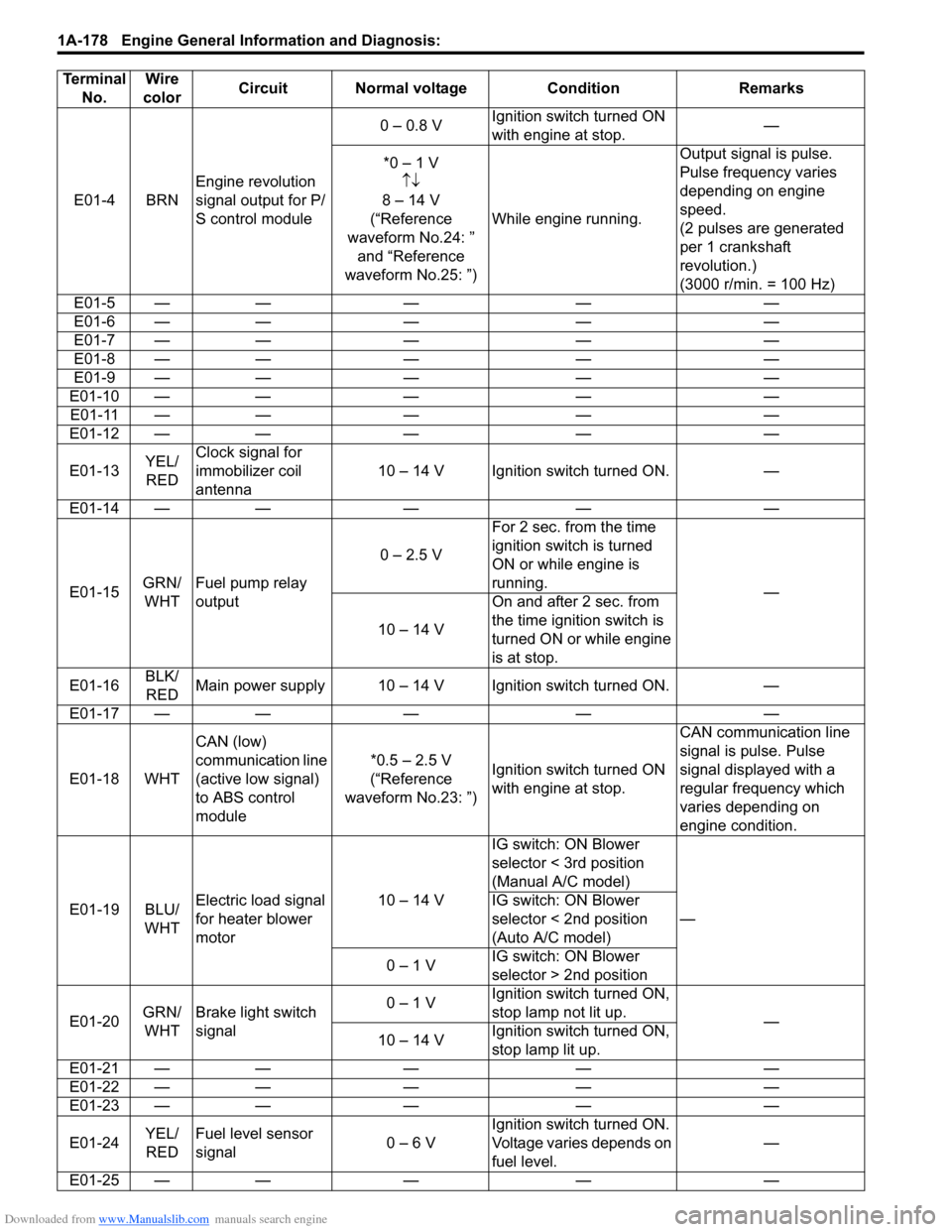
E01-4 BRNEngine revolution
signal output for P/
S control module0 – 0.8 VIgnition switch turned ON
with engine at stop.—
*0 – 1 V
↑↓
8 – 14 V
(“Reference
waveform No.24: ”
and “Reference
waveform No.25: ”)While engine running.Output signal is pulse.
Pulse frequency varies
depending on engine
speed.
(2 pulses are generated
per 1 crankshaft
revolution.)
(3000 r/min. = 100 Hz)
E01-5 — — — — —
E01-6 — — — — —
E01-7 — — — — —
E01-8 — — — — —
E01-9 — — — — —
E01-10 — — — — —
E01-11 — — — — —
E01-12 — — — — —
E01-13YEL/
REDClock signal for
immobilizer coil
antenna10 – 14 V Ignition switch turned ON. —
E01-14 — — — — —
E01-15GRN/
WHTFuel pump relay
output0 – 2.5 VFor 2 sec. from the time
ignition switch is turned
ON or while engine is
running.
—
10 – 14 VOn and after 2 sec. from
the time ignition switch is
turned ON or while engine
is at stop.
E01-16BLK/
REDMain power supply 10 – 14 V Ignition switch turned ON. —
E01-17 — — — — —
E01-18 WHTCAN (low)
communication line
(active low signal)
to ABS control
module*0.5 – 2.5 V
(“Reference
waveform No.23: ”)Ignition switch turned ON
with engine at stop.CAN communication line
signal is pulse. Pulse
signal displayed with a
regular frequency which
varies depending on
engine condition.
E01-19 BLU/
WHTElectric load signal
for heater blower
motor10 – 14 VIG switch: ON Blower
selector < 3rd position
(Manual A/C model)
— IG switch: ON Blower
selector < 2nd position
(Auto A/C model)
0 – 1 VIG switch: ON Blower
selector > 2nd position
E01-20GRN/
WHTBrake light switch
signal0 – 1 VIgnition switch turned ON,
stop lamp not lit up.
—
10 – 14 VIgnition switch turned ON,
stop lamp lit up.
E01-21 — — — — —
E01-22 — — — — —
E01-23 — — — — —
E01-24YEL/
REDFuel level sensor
signal0 – 6 VIgnition switch turned ON.
Voltage varies depends on
fuel level.—
E01-25 — — — — — Terminal
No.Wire
colorCircuit Normal voltage Condition Remarks
Page 277 of 1556
Downloaded from www.Manualslib.com manuals search engine Engine Electrical Devices: 1C-9
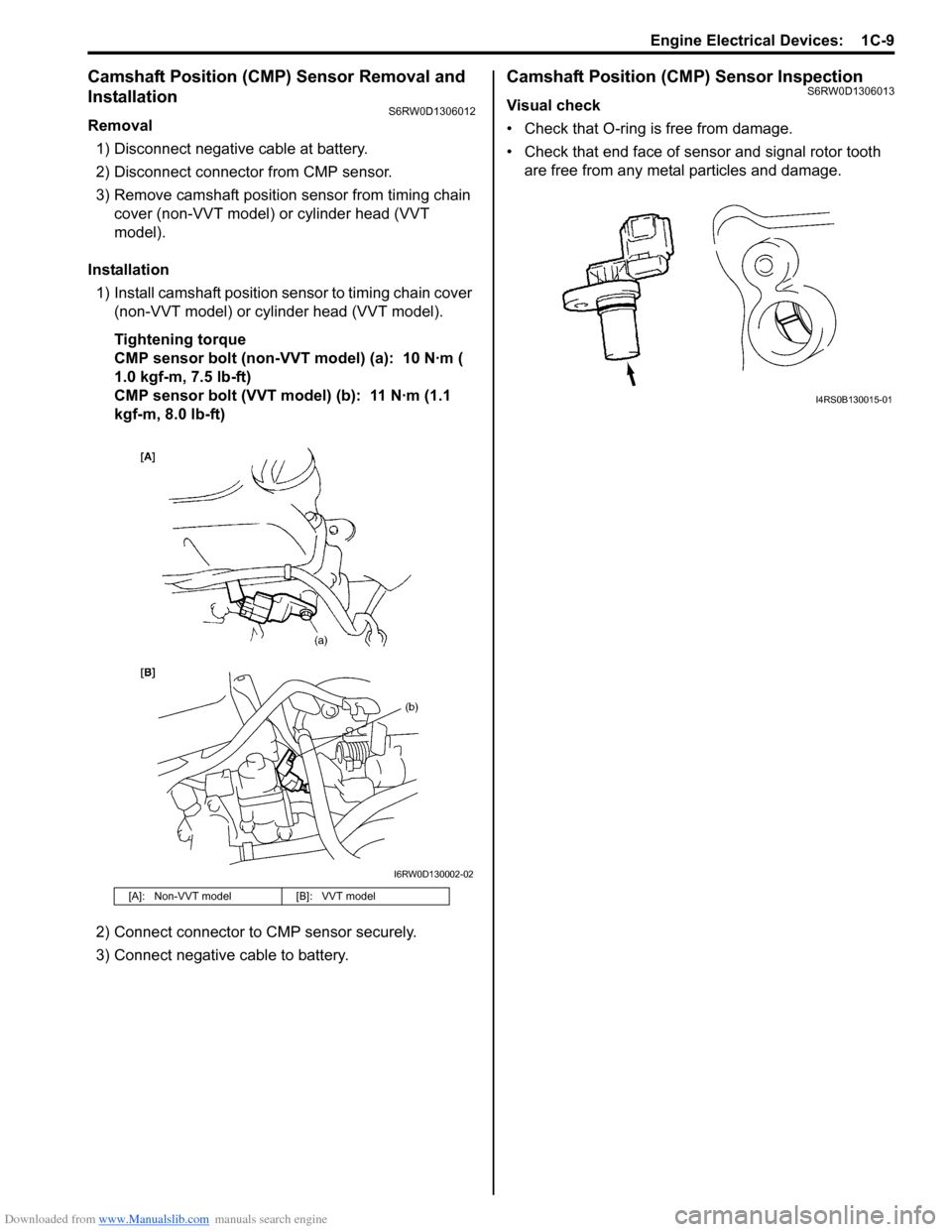
Camshaft Position (CMP) Sensor Removal and
Installation
S6RW0D1306012
Removal
1) Disconnect negative cable at battery.
2) Disconnect connector from CMP sensor.
3) Remove camshaft position sensor from timing chain
cover (non-VVT model) or cylinder head (VVT
model).
Installation
1) Install camshaft position sensor to timing chain cover
(non-VVT model) or cylinder head (VVT model).
Tightening torque
CMP sensor bolt (non-VVT model) (a): 10 N·m (
1.0 kgf-m, 7.5 lb-ft)
CMP sensor bolt (VVT model) (b): 11 N·m (1.1
kgf-m, 8.0 lb-ft)
2) Connect connector to CMP sensor securely.
3) Connect negative cable to battery.
Camshaft Position (CMP) Sensor InspectionS6RW0D1306013
Visual check
• Check that O-ring is free from damage.
• Check that end face of sensor and signal rotor tooth
are free from any metal particles and damage.
[A]: Non-VVT model [B]: VVT model
I6RW0D130002-02
I4RS0B130015-01
Page 278 of 1556
Downloaded from www.Manualslib.com manuals search engine 1C-10 Engine Electrical Devices:
Performance check
1) Remove metal particles on end face of CMP sensor,
if any.
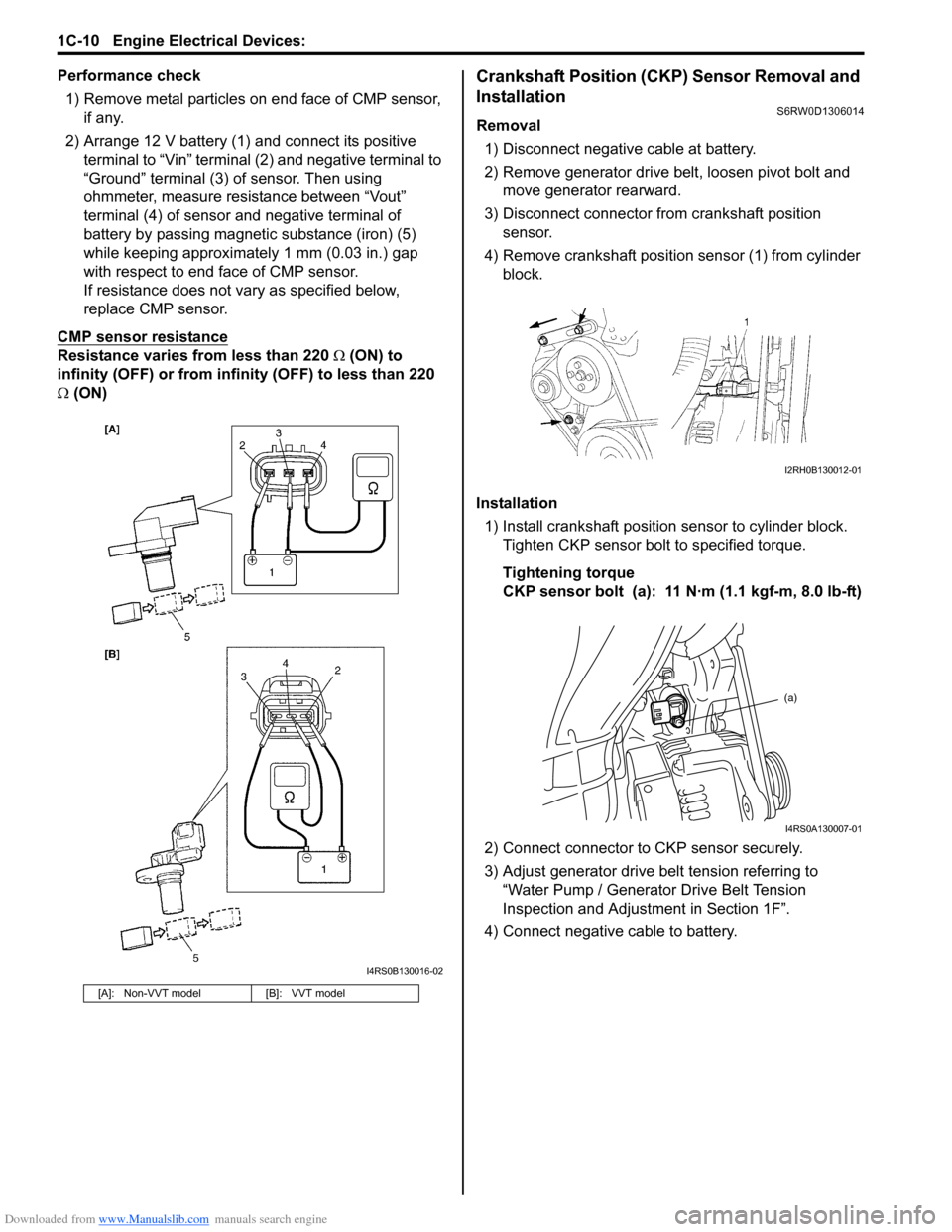
2) Arrange 12 V battery (1) and connect its positive
terminal to “Vin” terminal (2) and negative terminal to
“Ground” terminal (3) of sensor. Then using
ohmmeter, measure resistance between “Vout”
terminal (4) of sensor and negative terminal of
battery by passing magnetic substance (iron) (5)
while keeping approximately 1 mm (0.03 in.) gap
with respect to end face of CMP sensor.
If resistance does not vary as specified below,
replace CMP sensor.
CMP sensor resistance
Resistance varies from less than 220 Ω (ON) to
infinity (OFF) or from infinity (OFF) to less than 220
Ω (ON)
Crankshaft Position (CKP) Sensor Removal and
Installation
S6RW0D1306014
Removal
1) Disconnect negative cable at battery.
2) Remove generator drive belt, loosen pivot bolt and
move generator rearward.
3) Disconnect connector from crankshaft position
sensor.
4) Remove crankshaft position sensor (1) from cylinder
block.
Installation
1) Install crankshaft position sensor to cylinder block.
Tighten CKP sensor bolt to specified torque.
Tightening torque
CKP sensor bolt (a): 11 N·m (1.1 kgf-m, 8.0 lb-ft)
2) Connect connector to CKP sensor securely.
3) Adjust generator drive belt tension referring to
“Water Pump / Generator Drive Belt Tension
Inspection and Adjustment in Section 1F”.
4) Connect negative cable to battery.
[A]: Non-VVT model [B]: VVT model
I4RS0B130016-02
I2RH0B130012-01
(a)
I4RS0A130007-01
Page 279 of 1556
Downloaded from www.Manualslib.com manuals search engine Engine Electrical Devices: 1C-11
Crankshaft Position (CKP) Sensor InspectionS6RW0D1306015
Visual check
• Check that O-ring is free from damage.
• Check that end face of sensor and signal pulley tooth
are free from any metal particles and damage.
Performance check
1) Remove metal particles on end face of CKP sensor,
if any.
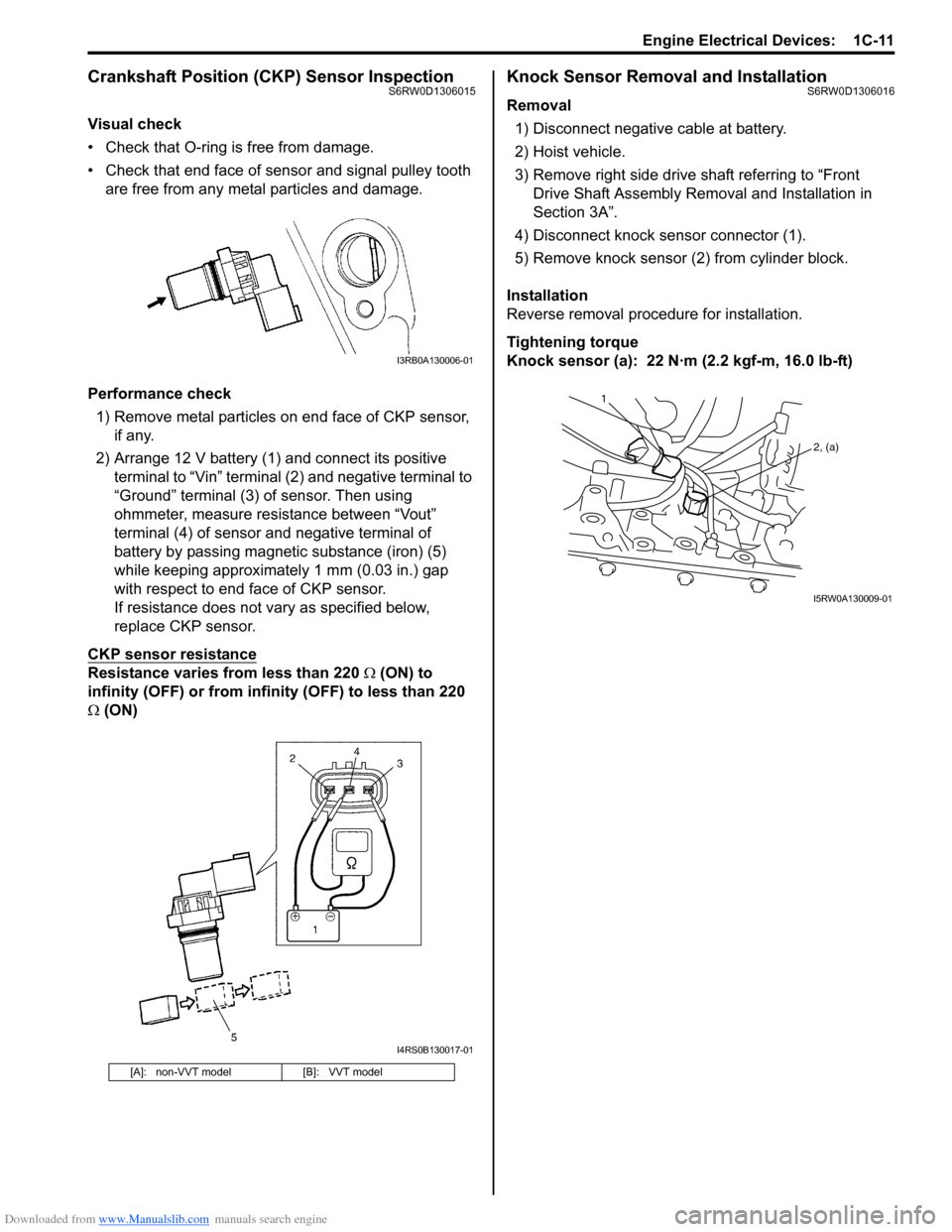
2) Arrange 12 V battery (1) and connect its positive
terminal to “Vin” terminal (2) and negative terminal to
“Ground” terminal (3) of sensor. Then using
ohmmeter, measure resistance between “Vout”
terminal (4) of sensor and negative terminal of
battery by passing magnetic substance (iron) (5)
while keeping approximately 1 mm (0.03 in.) gap
with respect to end face of CKP sensor.
If resistance does not vary as specified below,
replace CKP sensor.
CKP sensor resistance
Resistance varies from less than 220 Ω (ON) to
infinity (OFF) or from infinity (OFF) to less than 220
Ω (ON)
Knock Sensor Removal and InstallationS6RW0D1306016
Removal
1) Disconnect negative cable at battery.
2) Hoist vehicle.
3) Remove right side drive shaft referring to “Front
Drive Shaft Assembly Removal and Installation in
Section 3A”.
4) Disconnect knock sensor connector (1).
5) Remove knock sensor (2) from cylinder block.
Installation
Reverse removal procedure for installation.
Tightening torque
Knock sensor (a): 22 N·m (2.2 kgf-m, 16.0 lb-ft)
[A]: non-VVT model [B]: VVT model
I3RB0A130006-01
I4RS0B130017-01
1
2, (a)
I5RW0A130009-01
Page 283 of 1556
Downloaded from www.Manualslib.com manuals search engine Engine Mechanical: 1D-1
Engine
Engine Mechanical
General Description
Engine Construction DescriptionS6RW0D1401001
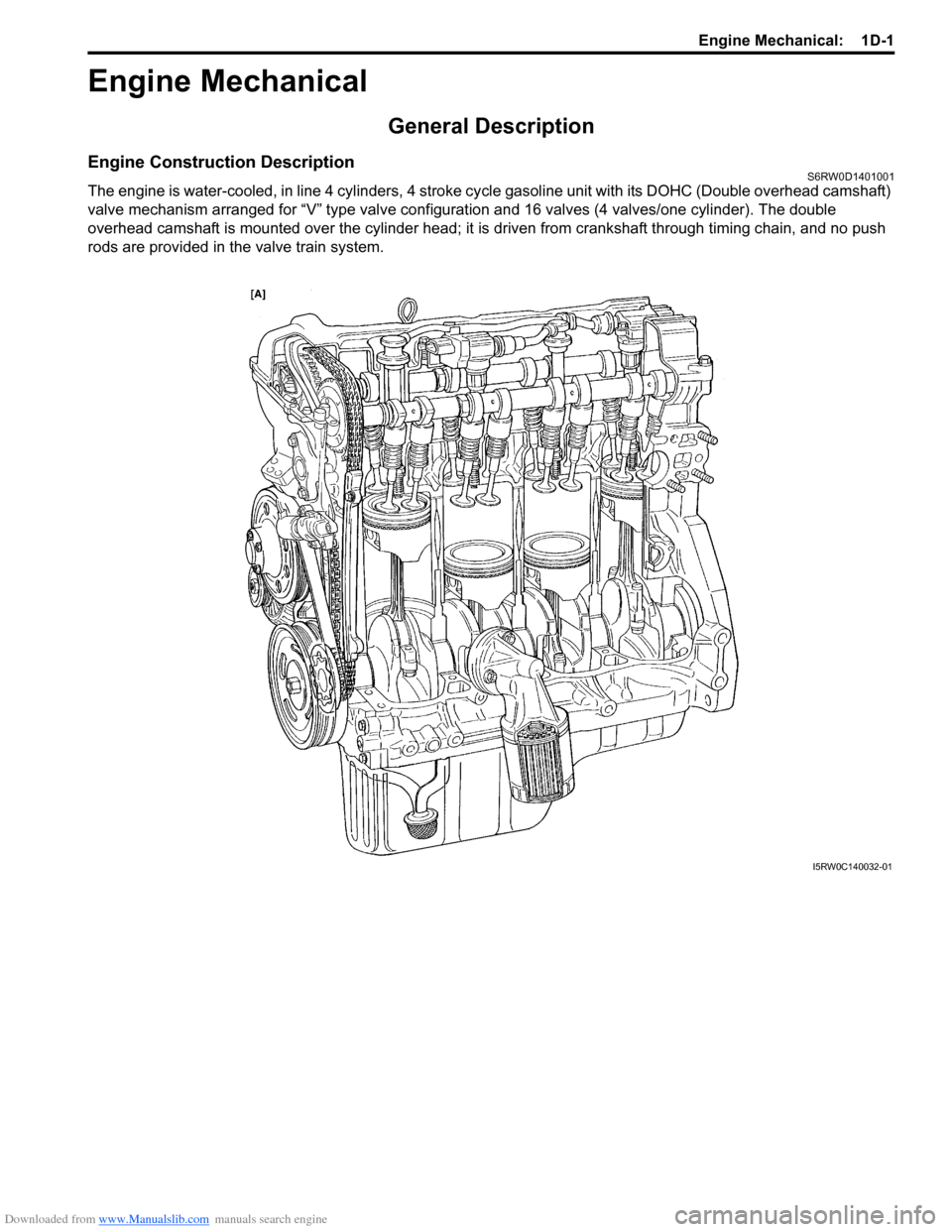
The engine is water-cooled, in line 4 cylinders, 4 stroke cycle gasoline unit with its DOHC (Double overhead camshaft)
valve mechanism arranged for “V” type valve configuration and 16 valves (4 valves/one cylinder). The double
overhead camshaft is mounted over the cylinder head; it is driven from crankshaft through timing chain, and no push
rods are provided in the valve train system.
I5RW0C140032-01
Page 285 of 1556
Downloaded from www.Manualslib.com manuals search engine Engine Mechanical: 1D-3
Camshaft Position Control (VVT Variable Valve Timing) System DescriptionS6RW0D1401002
System Description
The VVT system is an electronic control system which continuously vary and optimize the intake valve timing in
response to the engine operating condition.
The optimized intake valve timing produce such an air intake with high efficiency that both the higher power generation
and lower fuel consumption can be attained in the whole engine speed range from low to high. In the area of the
average engine load, low emission of nitrogen oxides (NOx) and high fuel efficiency can also be attained by making
the valve opening overlap between the intake and exhaust valves longer.
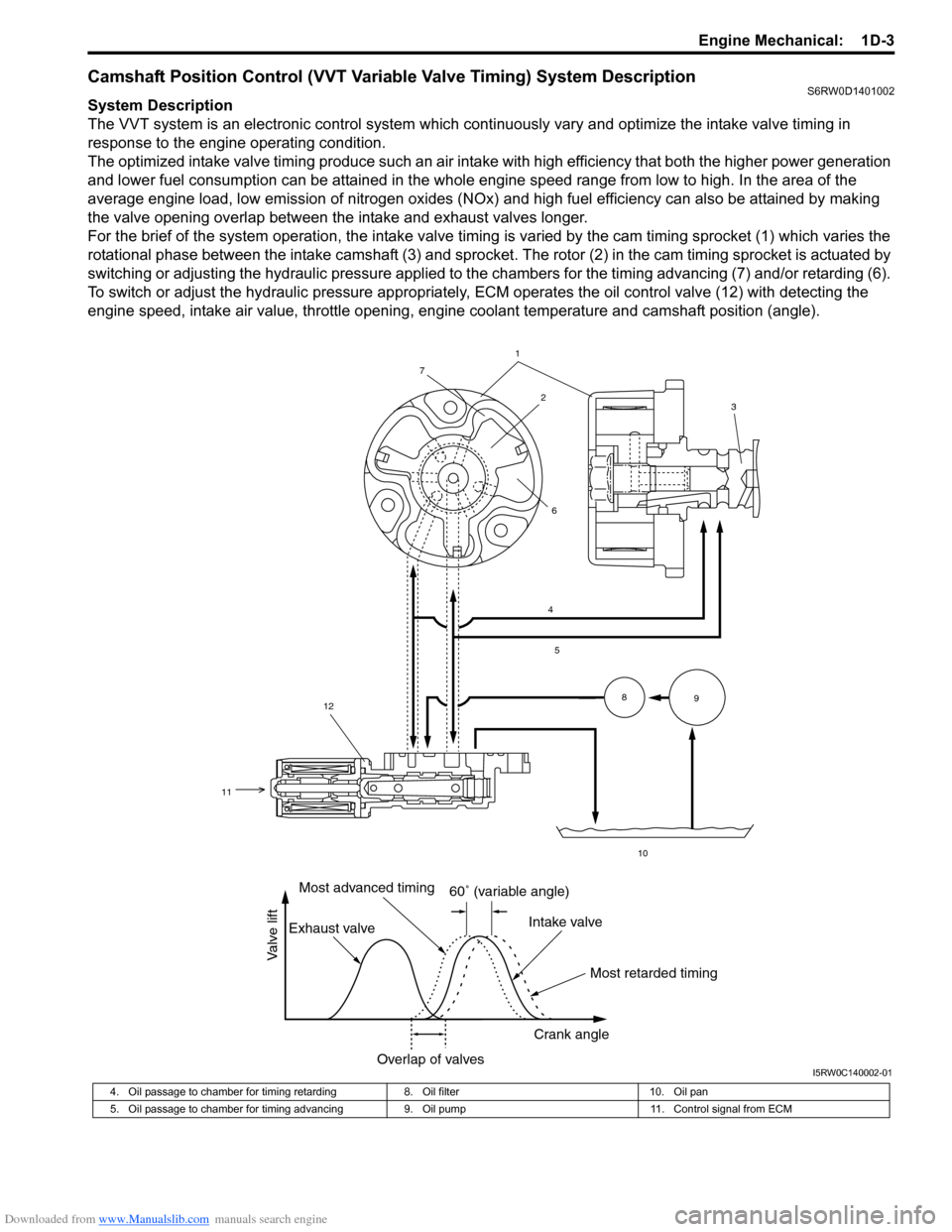
For the brief of the system operation, the intake valve timing is varied by the cam timing sprocket (1) which varies the
rotational phase between the intake camshaft (3) and sprocket. The rotor (2) in the cam timing sprocket is actuated by
switching or adjusting the hydraulic pressure applied to the chambers for the timing advancing (7) and/or retarding (6).
To switch or adjust the hydraulic pressure appropriately, ECM operates the oil control valve (12) with detecting the
engine speed, intake air value, throttle opening, engine coolant temperature and camshaft position (angle).
1
4
5
10
8
9
2
7
6
12
11
3
60˚ (variable angle)
Most retarded timing Most advanced timing
Exhaust valveIntake valve
Crank angle
Overlap of valves
Valve lift
I5RW0C140002-01
4. Oil passage to chamber for timing retarding 8. Oil filter 10. Oil pan
5. Oil passage to chamber for timing advancing 9. Oil pump 11. Control signal from ECM
Page 286 of 1556
Downloaded from www.Manualslib.com manuals search engine 1D-4 Engine Mechanical:
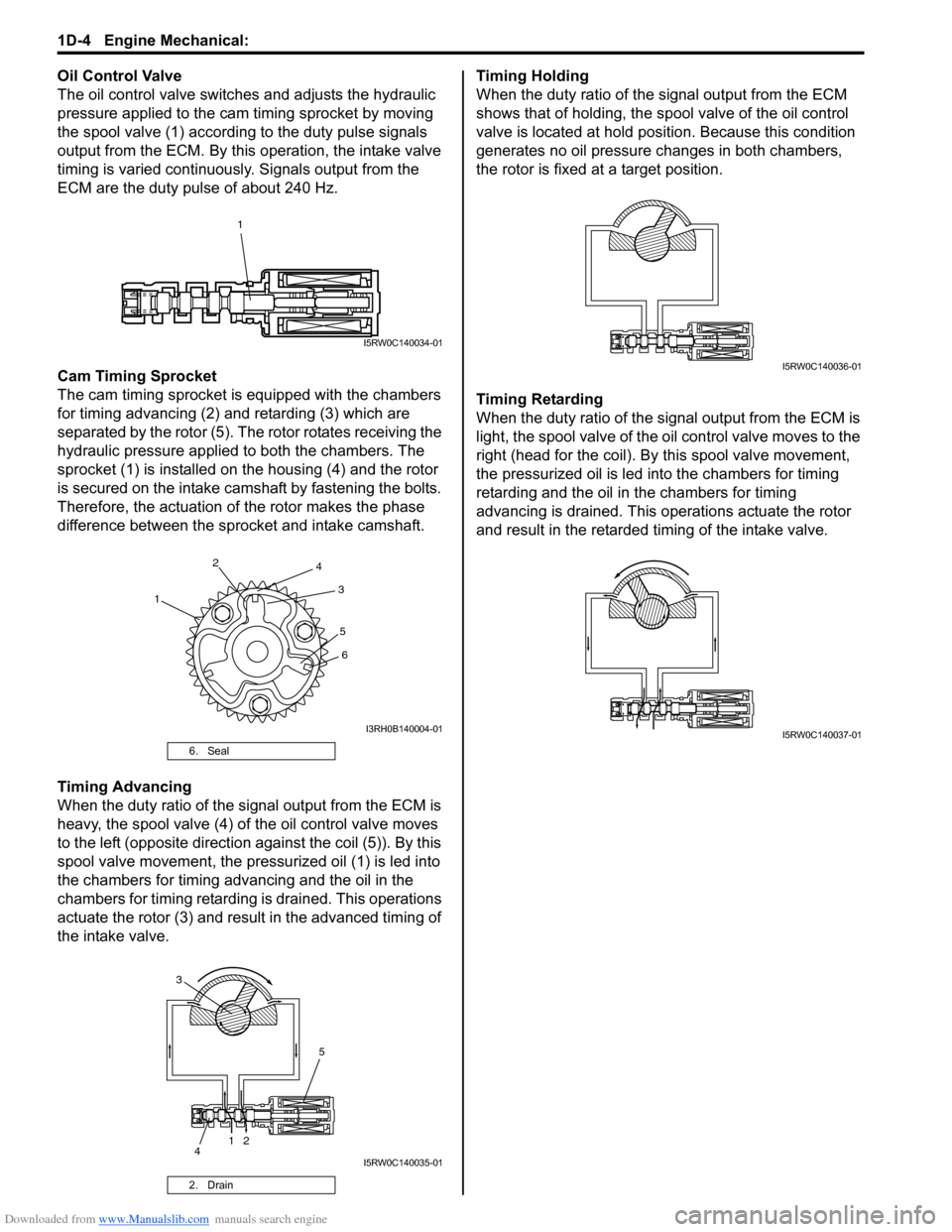
Oil Control Valve
The oil control valve switches and adjusts the hydraulic
pressure applied to the cam timing sprocket by moving
the spool valve (1) according to the duty pulse signals
output from the ECM. By this operation, the intake valve
timing is varied continuously. Signals output from the
ECM are the duty pulse of about 240 Hz.
Cam Timing Sprocket
The cam timing sprocket is equipped with the chambers
for timing advancing (2) and retarding (3) which are
separated by the rotor (5). The rotor rotates receiving the
hydraulic pressure applied to both the chambers. The
sprocket (1) is installed on the housing (4) and the rotor
is secured on the intake camshaft by fastening the bolts.
Therefore, the actuation of the rotor makes the phase
difference between the sprocket and intake camshaft.
Timing Advancing
When the duty ratio of the signal output from the ECM is
heavy, the spool valve (4) of the oil control valve moves
to the left (opposite direction against the coil (5)). By this
spool valve movement, the pressurized oil (1) is led into
the chambers for timing advancing and the oil in the
chambers for timing retarding is drained. This operations
actuate the rotor (3) and result in the advanced timing of
the intake valve.Timing Holding
When the duty ratio of the signal output from the ECM
shows that of holding, the spool valve of the oil control
valve is located at hold position. Because this condition
generates no oil pressure changes in both chambers,
the rotor is fixed at a target position.
Timing Retarding
When the duty ratio of the signal output from the ECM is
light, the spool valve of the oil control valve moves to the
right (head for the coil). By this spool valve movement,
the pressurized oil is led into the chambers for timing
retarding and the oil in the chambers for timing
advancing is drained. This operations actuate the rotor
and result in the retarded timing of the intake valve.
6. Seal
2. Drain
1
I5RW0C140034-01
12
3 4
5
6
I3RH0B140004-01
1
2
5
4
3
I5RW0C140035-01
I5RW0C140036-01
I5RW0C140037-01
Page 289 of 1556
Downloaded from www.Manualslib.com manuals search engine Engine Mechanical: 1D-7
7) Install air cleaner assembly with air suction hose
referring to “Air Cleaner Assembly Removal and
Installation”.
8) Run engine at specified idle speed and read vacuum
gauge. Vacuum should be within specification.
Vacuum specification (at sea level)
59 – 73 kPa (45 – 55 cmHg, 17.7 – 21.6 in.Hg) at
specified idle speed
9) After checking, disconnect special tool (Vacuum
gauge) from PCV valve.
10) Detach blind cap from PCV valve.
11) Install air cleaner assembly with air suction hose
referring to “Air Cleaner Assembly Removal and
Installation”.
Valve Lash (Clearance) InspectionS6RW0D1404003
1) Remove negative cable at battery.
2) Remove cylinder head cover referring to “Cylinder
Head Cover Removal and Installation”.
3) Remove right side engine under cover, if necessary.
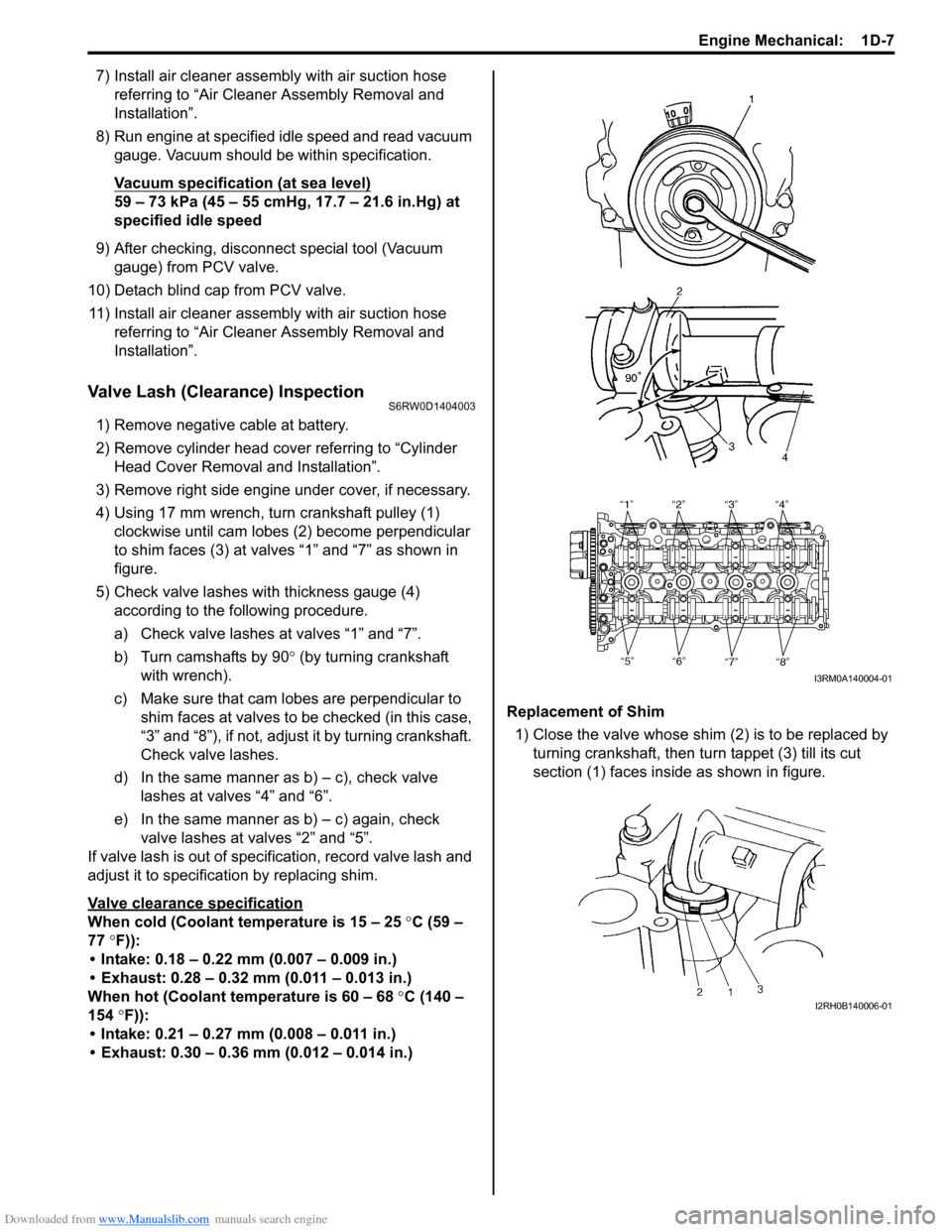
4) Using 17 mm wrench, turn crankshaft pulley (1)
clockwise until cam lobes (2) become perpendicular
to shim faces (3) at valves “1” and “7” as shown in
figure.
5) Check valve lashes with thickness gauge (4)
according to the following procedure.
a) Check valve lashes at valves “1” and “7”.
b) Turn camshafts by 90° (by turning crankshaft
with wrench).
c) Make sure that cam lobes are perpendicular to
shim faces at valves to be checked (in this case,
“3” and “8”), if not, adjust it by turning crankshaft.
Check valve lashes.
d) In the same manner as b) – c), check valve
lashes at valves “4” and “6”.
e) In the same manner as b) – c) again, check
valve lashes at valves “2” and “5”.
If valve lash is out of specification, record valve lash and
adjust it to specification by replacing shim.
Valve clearance specification
When cold (Coolant temperature is 15 – 25 °C (59 –
77 °F)):
• Intake: 0.18 – 0.22 mm (0.007 – 0.009 in.)
• Exhaust: 0.28 – 0.32 mm (0.011 – 0.013 in.)
When hot (Coolant temperature is 60 – 68 °C (140 –
154 °F)):
• Intake: 0.21 – 0.27 mm (0.008 – 0.011 in.)
• Exhaust: 0.30 – 0.36 mm (0.012 – 0.014 in.)Replacement of Shim
1) Close the valve whose shim (2) is to be replaced by
turning crankshaft, then turn tappet (3) till its cut
section (1) faces inside as shown in figure.
I3RM0A140004-01
I2RH0B140006-01