terminal SUZUKI SX4 2006 1.G Service Repair Manual
[x] Cancel search | Manufacturer: SUZUKI, Model Year: 2006, Model line: SX4, Model: SUZUKI SX4 2006 1.GPages: 1556, PDF Size: 37.31 MB
Page 157 of 1556
Downloaded from www.Manualslib.com manuals search engine Engine General Information and Diagnosis: 1A-107
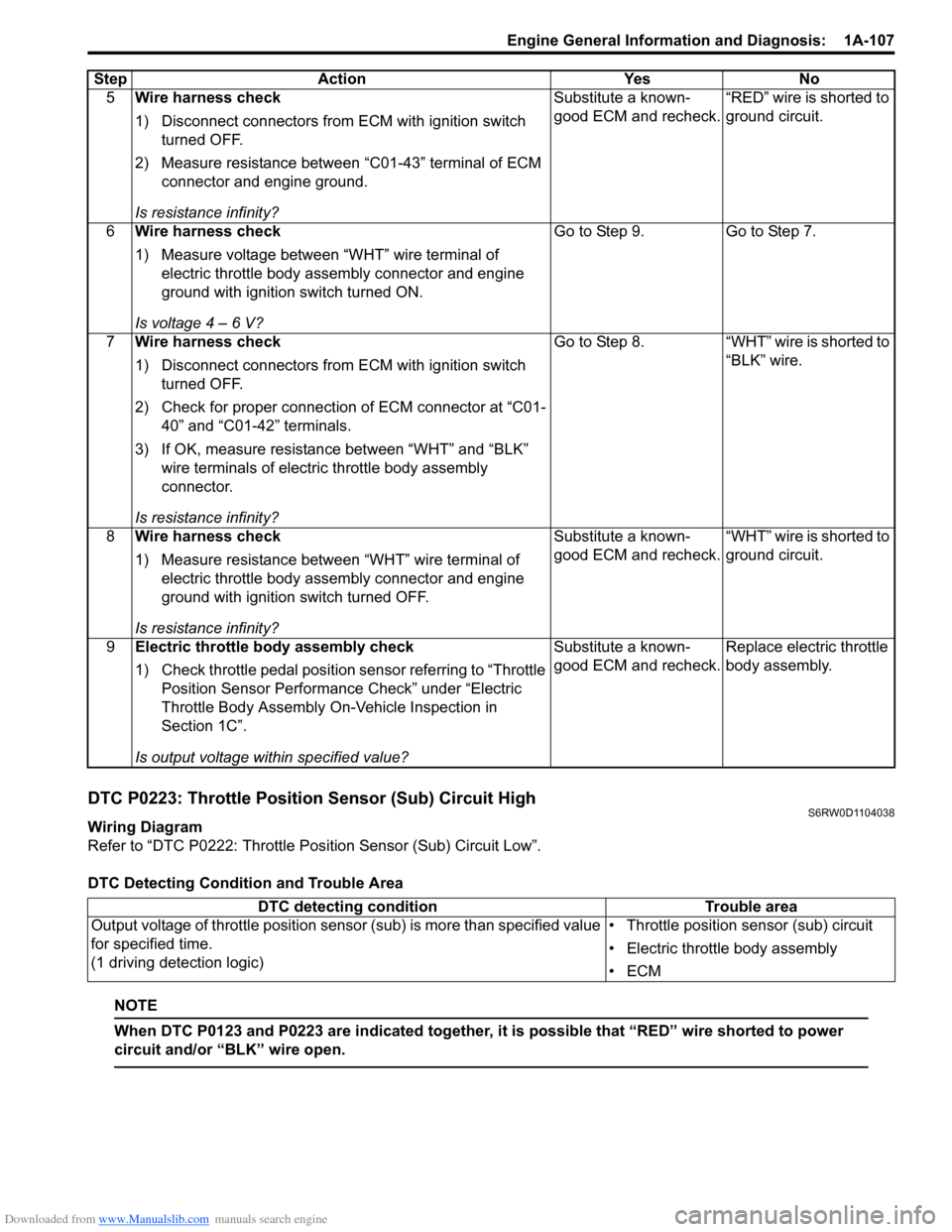
DTC P0223: Throttle Position Sensor (Sub) Circuit HighS6RW0D1104038
Wiring Diagram
Refer to “DTC P0222: Throttle Position Sensor (Sub) Circuit Low”.
DTC Detecting Condition and Trouble Area
NOTE
When DTC P0123 and P0223 are indicated together, it is possible that “RED” wire shorted to power
circuit and/or “BLK” wire open.
5Wire harness check
1) Disconnect connectors from ECM with ignition switch
turned OFF.
2) Measure resistance between “C01-43” terminal of ECM
connector and engine ground.
Is resistance infinity?Substitute a known-
good ECM and recheck.“RED” wire is shorted to
ground circuit.
6Wire harness check
1) Measure voltage between “WHT” wire terminal of
electric throttle body assembly connector and engine
ground with ignition switch turned ON.
Is voltage 4 – 6 V?Go to Step 9. Go to Step 7.
7Wire harness check
1) Disconnect connectors from ECM with ignition switch
turned OFF.
2) Check for proper connection of ECM connector at “C01-
40” and “C01-42” terminals.
3) If OK, measure resistance between “WHT” and “BLK”
wire terminals of electric throttle body assembly
connector.
Is resistance infinity?Go to Step 8. “WHT” wire is shorted to
“BLK” wire.
8Wire harness check
1) Measure resistance between “WHT” wire terminal of
electric throttle body assembly connector and engine
ground with ignition switch turned OFF.
Is resistance infinity?Substitute a known-
good ECM and recheck.“WHT” wire is shorted to
ground circuit.
9Electric throttle body assembly check
1) Check throttle pedal position sensor referring to “Throttle
Position Sensor Performance Check” under “Electric
Throttle Body Assembly On-Vehicle Inspection in
Section 1C”.
Is output voltage within specified value?Substitute a known-
good ECM and recheck.Replace electric throttle
body assembly. Step Action Yes No
DTC detecting condition Trouble area
Output voltage of throttle position sensor (sub) is more than specified value
for specified time.
(1 driving detection logic)• Throttle position sensor (sub) circuit
• Electric throttle body assembly
•ECM
Page 158 of 1556

Downloaded from www.Manualslib.com manuals search engine 1A-108 Engine General Information and Diagnosis:
DTC Confirmation Procedure
1) With ignition switch turned OFF, connect scan tool.
2) Turn ON ignition switch and clear DTC using scan tool.
3) Keep the accelerator pedal at idle position for 2 seconds.
4) Keep the accelerator pedal at fully depressed position for 2 seconds.
5) Repeat Step 3) and 4) for 3 times.
6) Check DTC.
DTC Troubleshooting
NOTE
Before this troubleshooting is performed, read the precautions for DTC troubleshooting referring to
“Precautions for DTC Troubleshooting”.
Step Action Yes No
1Was “Engine and Emission Control System Check”
performed?Go to Step 2. Go to “Engine and
Emission Control
System Check”.
2Throttle position sensor and its circuit check
1) Connect scan tool to DLC with ignition switch turned
OFF.
2) Turn ON ignition switch, check “TP Sensor 2 Volt”
displayed on scan tool when accelerator pedal is idle
position and fully depressed.
Is each TP sensor voltage within specified value in the table
“Scan Tool Data”?Intermittent trouble.
Check for intermittent
referring to “Intermittent
and Poor Connection
Inspection in Section
00”.Go to Step 3.
3ECM voltage check
1) Disconnect connector from electric throttle body
assembly with ignition switch turned OFF.
2) Check for proper connection to electric throttle body
assembly at “RED”, “WHT” and “BLK” wire terminals.
3) If OK, measure voltage between “RED” wire terminal of
electric throttle body assembly connector and engine
ground with ignition switch turned ON.
Is voltage 4 – 6 V?Go to Step 5. Go to Step 4.
4Wire harness check
1) Disconnect connectors from ECM with ignition switch
turned OFF.
2) Check for proper connection of ECM connector at “C01-
43” terminal.
3) Measure voltage between “C01-43” terminal of ECM
connector and engine ground with ignition switch turned
ON.
Is voltage 0 V?Substitute a known-
good ECM and recheck.“RED” wire is shorted to
power circuit.
“WHT”
“YEL”“RED”
“GRN” “BLU”“BLK”
I5RW0C110016-01
Page 159 of 1556

Downloaded from www.Manualslib.com manuals search engine Engine General Information and Diagnosis: 1A-109
5Wire harness check
1) Measure voltage between “WHT” wire terminal of
electric throttle body assembly connector and engine
ground with ignition switch turned ON.
Is voltage 4 – 6 V?Go to Step 9. Go to Step 6.
6Wire harness check
1) Turn OFF ignition switch.
2) Remove ECM from its bracket with ECM connectors
connected.
3) Check for proper connection of ECM connector at “C01-
43” and “C01-40” terminals.
4) If OK, measure voltage between “C01-40” terminal of
ECM connector and engine ground with ignition switch
turned ON.
Is voltage 4 – 6 V?“WHT” wire is open or
high resistance circuit.Go to Step 7.
7Wire harness check
1) Disconnect connectors from ECM with ignition switch
turned OFF.
2) Measure resistance between “WHT” and “RED” wire
terminals of electric throttle body assembly connector.
Is resistance infinity?Go to Step 8. “WHT” wire is shorted to
“RED” wire.
8Wire harness check
1) Turn ON ignition switch.
2) Measure voltage between “C01-40” terminal of ECM
connector and engine ground.
Is voltage 0 V?Substitute a known-
good ECM and recheck.“WHT” wire is shorted to
power circuit.
9Ground circuit check
1) Turn OFF ignition switch.
2) Measure resistance between “BLK” wire terminal of
electric throttle body assembly connector and engine
ground.
Is resistance below 5
Ω?Go to Step 11. Go to Step 10.
10Ground circuit check
1) Remove ECM from its bracket with ECM connectors
connected.
2) Check for proper connection of ECM connector at “C01-
42” terminal.
3) Measure resistance between “C01-42” terminal of ECM
connector and engine ground with ignition switch turned
OFF.
Is resistance below 5
Ω?“BLK” wire is open or
high resistance circuit.Faulty ECM ground
circuit. If circuit is OK,
substitute a known-
good ECM and recheck.
11Electric throttle body assembly check
1) Check throttle position sensor referring to “Throttle
Position Sensor Performance Check” under “Electric
Throttle Body Assembly On-Vehicle Inspection in
Section 1C”.
Is output voltage within specified value?Substitute a known-
good ECM and recheck.Replace electric throttle
body assembly. Step Action Yes No
Page 163 of 1556

Downloaded from www.Manualslib.com manuals search engine Engine General Information and Diagnosis: 1A-113
DTC Troubleshooting
NOTE
Before this troubleshooting is performed, read the precautions for DTC troubleshooting referring to
“Precautions for DTC Troubleshooting”.
Step Action Yes No
1Was “Engine and Emission Control System Check”
performed?Go to Step 2. Go to “Engine and
Emission Control
System Check”.
2Knock sensor circuit check
1) Remove ECM from its bracket with ECM connectors
connected.
2) Measure voltage between “C01-56” terminal of ECM
connector and vehicle body ground with engine running.
Is voltage within 1.23 – 3.91 V?Intermittent trouble.
Check for intermittent
referring to “Intermittent
and Poor Connection
Inspection in Section
00”. If OK, substitute a
known-good ECM and
recheck.Go to Step 3.
3Knock sensor circuit for open check
1) Disconnect connector from knock sensor with ignition
switch turned OFF.
2) Turn ON ignition switch, measure voltage between
“RED” wire of knock sensor connector and engine
ground.
Is voltage 4 – 6 V?Go to Step 6. Go to Step 4.
4Knock sensor circuit for open check
1) Turn ON ignition switch, measure voltage between “C01-
56” terminal of ECM connector and engine ground
Is voltage 4 – 6 V?“RED” wire is open
circuit.Go to Step 5.
5Knock sensor circuit for short check
1) Disconnect connectors from ECM with ignition switch
turned OFF.
2) Measure resistance between “C01-56” terminal of ECM
connector and vehicle body ground.
Is resistance infinity?Go to Step 6. “RED” wire is shorted to
ground circuit.
If wire is OK, substitute
a known-good ECM and
recheck.
6Knock sensor circuit for short check
1) Disconnect connectors from ECM with ignition switch
turned OFF.
2) Turn ON ignition switch, measure voltage between “C01-
56” terminal of ECM connector and vehicle body ground.
Is voltage 0 V?Go to Step 7. “RED” wire is shorted to
other circuit.
I2RH01110089-01
Page 164 of 1556
Downloaded from www.Manualslib.com manuals search engine 1A-114 Engine General Information and Diagnosis:
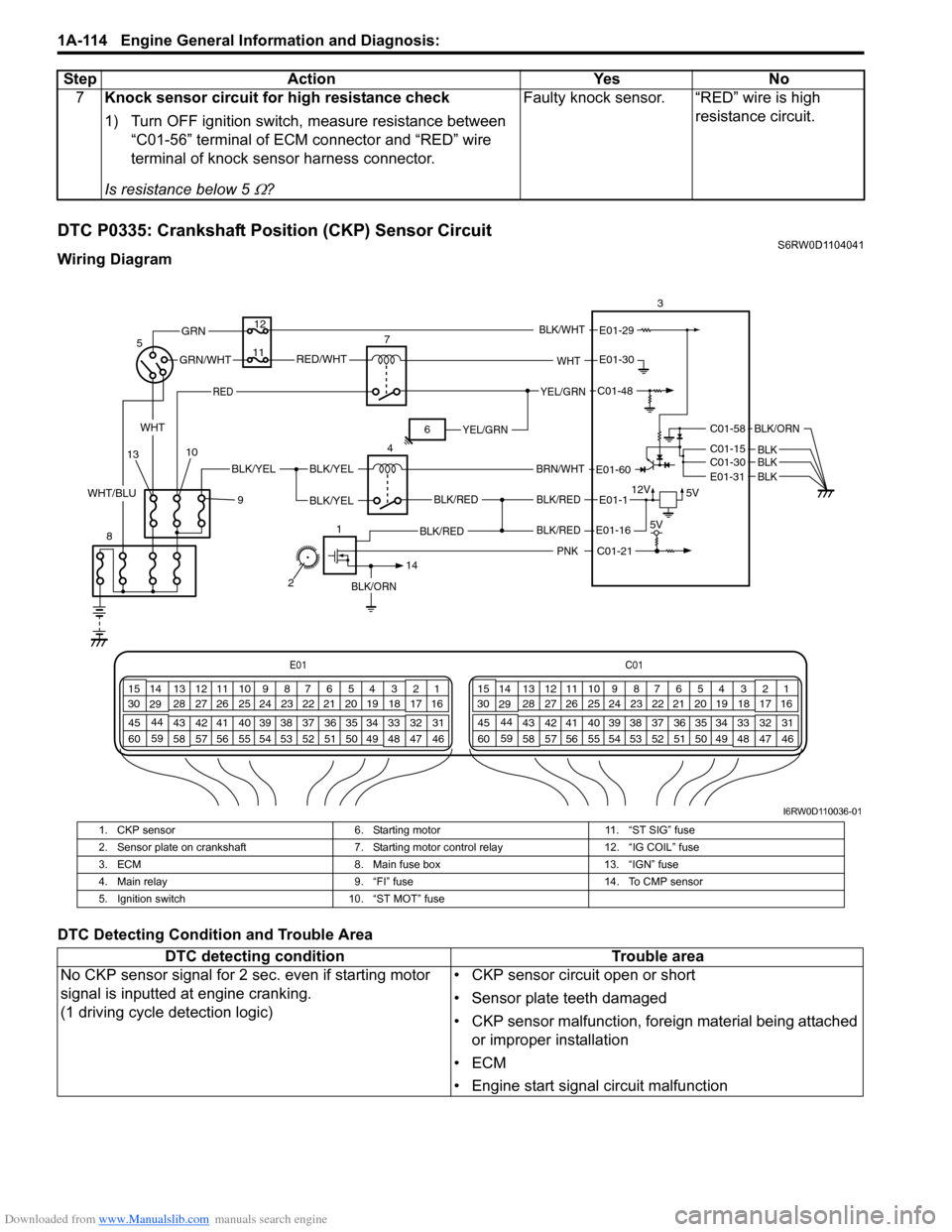
DTC P0335: Crankshaft Position (CKP) Sensor CircuitS6RW0D1104041
Wiring Diagram
DTC Detecting Condition and Trouble Area7Knock sensor circuit for high resistance check
1) Turn OFF ignition switch, measure resistance between
“C01-56” terminal of ECM connector and “RED” wire
terminal of knock sensor harness connector.
Is resistance below 5
Ω?Faulty knock sensor. “RED” wire is high
resistance circuit. Step Action Yes No
E01C01
3 4
18 19 5 6 7 10 11
17 20
47 46 49 50 51 21 22
5216 259
24 14
29
55 57 54 53 59
60 582
26 27 28 15
30
56 4832 31 34 35 36 37 40 42 39 38 44
45 43 41 331 12 13
238 3 4
18 19 5 6 7 10 11
17 20
47 46 49 50 51 21 22
5216 259
24 14
29
55 57 54 53 59
60 582
26 27 28 15
30
56 4832 31 34 35 36 37 40 42 39 38 44
45 43 41 331 12 13
238
12V
5VBLK/REDBLK/RED
BLK/RED
BLK/YELBLK/YEL
BLK/YEL
BRN/WHT
5
84 123E01-29
E01-1
E01-60
C01-58
C01-15 C01-30
BLK/ORN
BLKBLK
9
BLK/REDE01-16
BLK/ORN
1
14
C01-21 5V
7
RED/WHTGRN/WHT
GRN
RED
E01-30
C01-48
BLK/WHT
YEL/GRN
YEL/GRN
WHT
6 11
10
13
PNK
2
WHT
WHT/BLU
BLKE01-31
I6RW0D110036-01
1. CKP sensor 6. Starting motor 11. “ST SIG” fuse
2. Sensor plate on crankshaft 7. Starting motor control relay 12. “IG COIL” fuse
3. ECM 8. Main fuse box 13. “IGN” fuse
4. Main relay 9. “FI” fuse 14. To CMP sensor
5. Ignition switch 10. “ST MOT” fuse
DTC detecting condition Trouble area
No CKP sensor signal for 2 sec. even if starting motor
signal is inputted at engine cranking.
(1 driving cycle detection logic)• CKP sensor circuit open or short
• Sensor plate teeth damaged
• CKP sensor malfunction, foreign material being attached
or improper installation
•ECM
• Engine start signal circuit malfunction
Page 165 of 1556

Downloaded from www.Manualslib.com manuals search engine Engine General Information and Diagnosis: 1A-115
DTC Confirmation Procedure
1) With ignition switch turned OFF, connect scan tool.
2) Turn ON ignition switch and clear DTC using scan tool.
3) Crank engine for 3 – 5 sec.
4) Check DTC and pending DTC.
DTC Troubleshooting
NOTE
Before this troubleshooting is performed, read the precautions for DTC troubleshooting referring to
“Precautions for DTC Troubleshooting”.
Step Action Yes No
1Was “Engine and Emission Control System Check”
performed?Go to Step 2. Go to “Engine and
Emission Control
System Check”.
2CKP sensor and connector for proper installation check
Is CKP sensor installed properly and connector connected
securely?Go to Step 3. Correct.
3Wire harness and connection check
1) Disconnect connector from CKP sensor with ignition
switch turned OFF.
2) Check for proper connection to CKP sensor at “BLK/
RED”, “PNK” and “BLK/ORN” wire terminals.
3) If OK, turn ON ignition switch and check voltage at “BLK/
RED”, “PNK” and “BLK/ORN” wire terminals of
disconnected CKP sensor connector.
CKP sensor voltage
Terminal “B+”: 10 – 14 V
Terminal “Vout”: 4 – 5 V
Terminal “GND”: 0 V
Is check result satisfactory?Go to Step 7. Go to Step 4.
4Was terminal “Vout” voltage in Step 3 within specification?Go to Step 5. “PNK” wire is open or
shorted to ground /
power supply circuit.
If wire and connection
are OK, substitute a
known-good ECM and
recheck.
I2RH0B110048-01
Page 166 of 1556
Downloaded from www.Manualslib.com manuals search engine 1A-116 Engine General Information and Diagnosis:
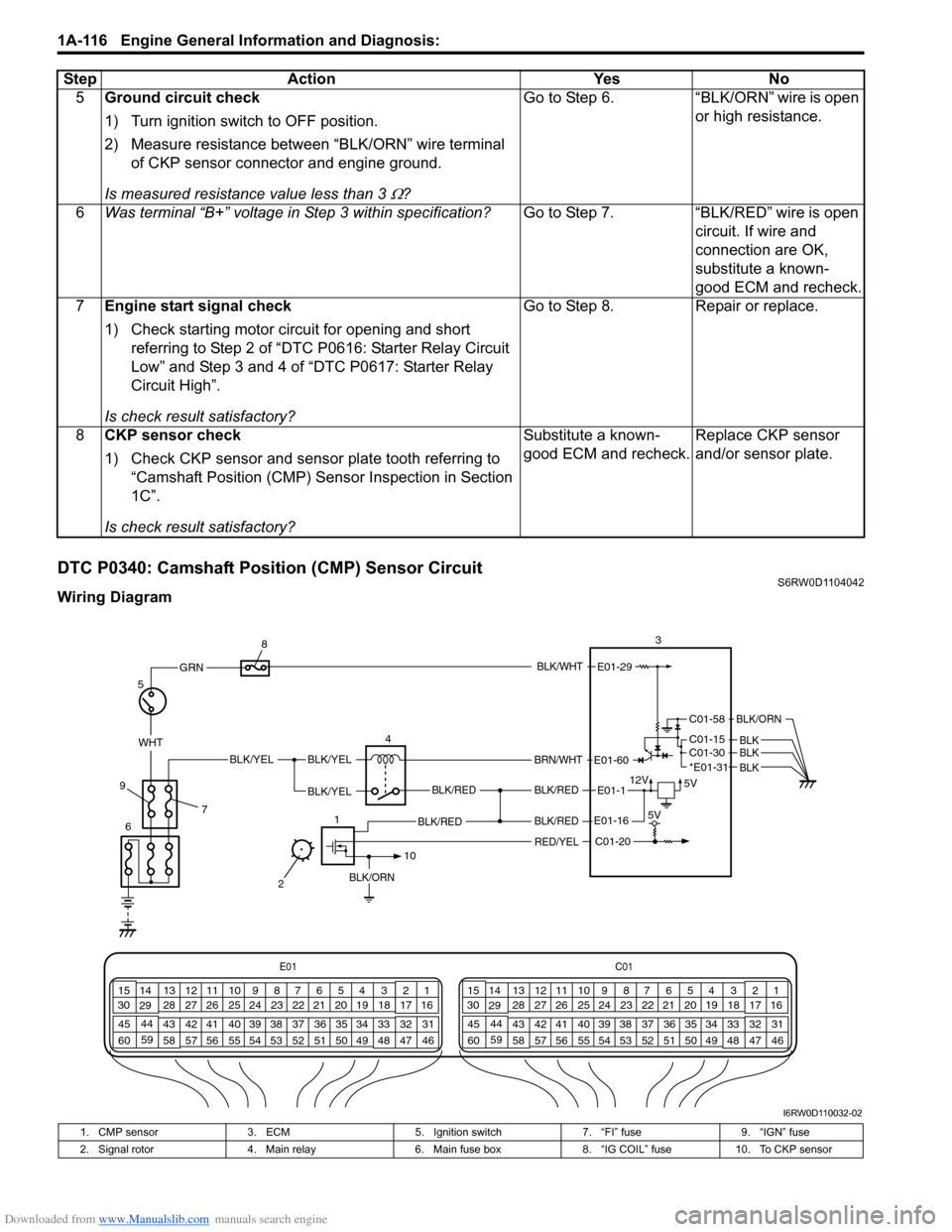
DTC P0340: Camshaft Position (CMP) Sensor CircuitS6RW0D1104042
Wiring Diagram5Ground circuit check
1) Turn ignition switch to OFF position.
2) Measure resistance between “BLK/ORN” wire terminal
of CKP sensor connector and engine ground.
Is measured resistance value less than 3
Ω?Go to Step 6. “BLK/ORN” wire is open
or high resistance.
6Was terminal “B+” voltage in Step 3 within specification?Go to Step 7. “BLK/RED” wire is open
circuit. If wire and
connection are OK,
substitute a known-
good ECM and recheck.
7Engine start signal check
1) Check starting motor circuit for opening and short
referring to Step 2 of “DTC P0616: Starter Relay Circuit
Low” and Step 3 and 4 of “DTC P0617: Starter Relay
Circuit High”.
Is check result satisfactory?Go to Step 8. Repair or replace.
8CKP sensor check
1) Check CKP sensor and sensor plate tooth referring to
“Camshaft Position (CMP) Sensor Inspection in Section
1C”.
Is check result satisfactory?Substitute a known-
good ECM and recheck.Replace CKP sensor
and/or sensor plate. Step Action Yes No
E01C01
3 4
18 19 5 6 7 10 11
17 20
47 46 49 50 51 21 22
5216 259
24 14
29
55 57 54 53 59
60 582
26 27 28 15
30
56 4832 31 34 35 36 37 40 42 39 38 44
45 43 41 331 12 13
238 3 4
18 19 5 6 7 10 11
17 20
47 46 49 50 51 21 22
5216 259
24 14
29
55 57 54 53 59
60 582
26 27 28 15
30
56 4832 31 34 35 36 37 40 42 39 38 44
45 43 41 331 12 13
238
12V
5VBLK/REDBLK/RED
BLK/RED
BLK/YELBLK/YEL
BLK/YEL
BRN/WHT
5
64 83
E01-29
E01-1
E01-60
C01-58
C01-15 C01-30
BLK/ORN
BLKBLK
7BLK/REDE01-16
BLK/ORN
1
10
C01-20 5V
GRNBLK/WHT
9
WHT
*E01-31 BLK
2
RED/YEL
I6RW0D110032-02
1. CMP sensor 3. ECM 5. Ignition switch 7. “FI” fuse 9. “IGN” fuse
2. Signal rotor 4. Main relay 6. Main fuse box 8. “IG COIL” fuse 10. To CKP sensor
Page 168 of 1556

Downloaded from www.Manualslib.com manuals search engine 1A-118 Engine General Information and Diagnosis:
3Wire harness and connection check
1) Disconnect connector from CMP sensor.
2) Check for proper connection to CMP sensor at “BLK/
RED”, “RED/YEL” and “BLK/ORN” wire terminals.
3) If OK, turn ON ignition switch and check voltage at “BLK/
RED”, “RED/YEL” and “BLK/ORN” wire terminals of
disconnected CMP sensor connector.
CMP sensor voltage
Terminal “B+”: 10 – 14 V
Terminal “Vout”: 4 – 5 V
Terminal “GND”: 0 V
For engine without VVT system
For engine with VVT system
Is check result satisfactory?Go to Step 7. Go to Step 4.
4Was terminal “Vout” voltage in Step 3 within specification?Go to Step 5. “RED/YEL” wire is open
or shorted to ground /
power supply circuit.
If wire and connection
are OK, substitute a
known-good ECM and
recheck.
5Ground circuit check
1) Turn ignition switch to OFF position.
2) Measure resistance between “BLK/ORN” wire terminal
of CMP sensor connector and engine ground.
Is measured resistance value less than 3
Ω?Go to Step 6. “BLK/ORN” wire is open
or high resistance
circuit.
6Was terminal “B+” voltage in Step 3 within specification?Go to Step 7. “BLK/RED” wire is open
circuit. If wire and
connection are OK,
substitute a known-
good ECM and recheck. Step Action Yes No
I4RS0B110031-01
I4RS0B110094-01
Page 173 of 1556
Downloaded from www.Manualslib.com manuals search engine Engine General Information and Diagnosis: 1A-123
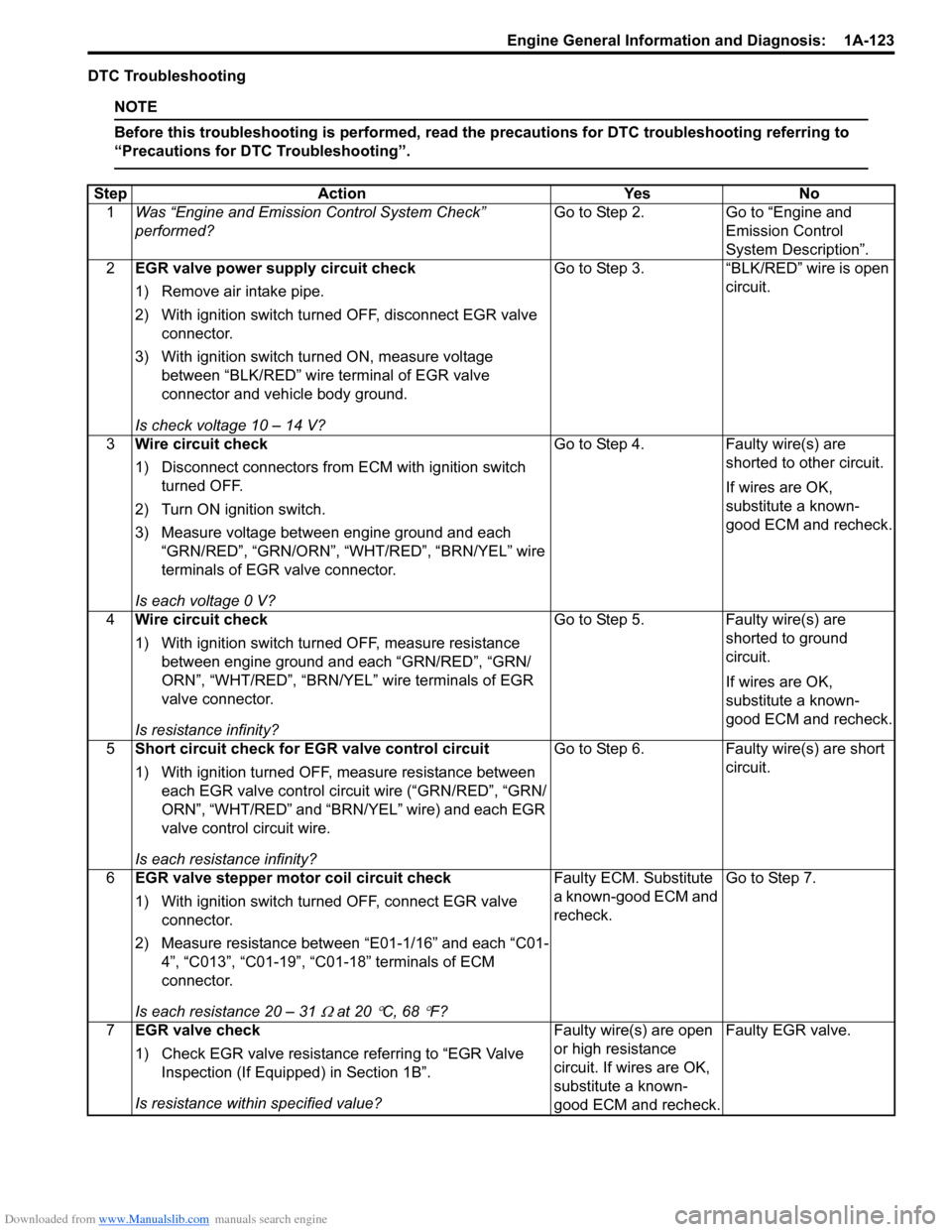
DTC Troubleshooting
NOTE
Before this troubleshooting is performed, read the precautions for DTC troubleshooting referring to
“Precautions for DTC Troubleshooting”.
Step Action Yes No
1Was “Engine and Emission Control System Check”
performed?Go to Step 2. Go to “Engine and
Emission Control
System Description”.
2EGR valve power supply circuit check
1) Remove air intake pipe.
2) With ignition switch turned OFF, disconnect EGR valve
connector.
3) With ignition switch turned ON, measure voltage
between “BLK/RED” wire terminal of EGR valve
connector and vehicle body ground.
Is check voltage 10 – 14 V?Go to Step 3. “BLK/RED” wire is open
circuit.
3Wire circuit check
1) Disconnect connectors from ECM with ignition switch
turned OFF.
2) Turn ON ignition switch.
3) Measure voltage between engine ground and each
“GRN/RED”, “GRN/ORN”, “WHT/RED”, “BRN/YEL” wire
terminals of EGR valve connector.
Is each voltage 0 V?Go to Step 4. Faulty wire(s) are
shorted to other circuit.
If wires are OK,
substitute a known-
good ECM and recheck.
4Wire circuit check
1) With ignition switch turned OFF, measure resistance
between engine ground and each “GRN/RED”, “GRN/
ORN”, “WHT/RED”, “BRN/YEL” wire terminals of EGR
valve connector.
Is resistance infinity?Go to Step 5. Faulty wire(s) are
shorted to ground
circuit.
If wires are OK,
substitute a known-
good ECM and recheck.
5Short circuit check for EGR valve control circuit
1) With ignition turned OFF, measure resistance between
each EGR valve control circuit wire (“GRN/RED”, “GRN/
ORN”, “WHT/RED” and “BRN/YEL” wire) and each EGR
valve control circuit wire.
Is each resistance infinity?Go to Step 6. Faulty wire(s) are short
circuit.
6EGR valve stepper motor coil circuit check
1) With ignition switch turned OFF, connect EGR valve
connector.
2) Measure resistance between “E01-1/16” and each “C01-
4”, “C013”, “C01-19”, “C01-18” terminals of ECM
connector.
Is each resistance 20 – 31
Ω at 20 °C, 68 °F?Faulty ECM. Substitute
a known-good ECM and
recheck.Go to Step 7.
7EGR valve check
1) Check EGR valve resistance referring to “EGR Valve
Inspection (If Equipped) in Section 1B”.
Is resistance within specified value?Faulty wire(s) are open
or high resistance
circuit. If wires are OK,
substitute a known-
good ECM and recheck.Faulty EGR valve.
Page 177 of 1556

Downloaded from www.Manualslib.com manuals search engine Engine General Information and Diagnosis: 1A-127
DTC Troubleshooting
WARNING!
In order to reduce risk of fire and personal injury, this work must be performed in a well ventilated area
and away from any open flames such as gas water heater.
NOTE
Before this troubleshooting is performed, read the precautions for DTC troubleshooting referring to
“Precautions for DTC Troubleshooting”.
Step Action Yes No
1Was “Engine and Emission Control System Check”
performed?Go to Step 2. Go to “Engine and
Emission Control
System Check”.
2EVAP canister purge power supply circuit check
1) Turn OFF ignition switch and disconnect connector from
EVAP canister purge valve.
2) Measure voltage between engine ground and “BLK/
RED” wire terminal of EVAP canister purge valve
connector with ignition switch turned ON.
Is it voltage 10 – 14 V?Go to Step 3. “BLK/RED” wire is open
circuit.
3Wire circuit check
1) Disconnect connectors from ECM with ignition switch
turned OFF.
2) Measure resistance between “C01-29” terminal of ECM
connector and vehicle body ground.
Is resistance infinity?Go to Step 4. “BLU/BLK” wire is
shorted to ground
circuit.
4Wire circuit check
1) Measure voltage between “C01-29” terminal of ECM
connector and vehicle body ground with ignition switch
turned ON.
Is voltage 0 V?Go to Step 5. “BLU/BLK” wire is
shorted to other circuit.
5Wire circuit check
1) Connect connector to purge control valve with ignition
switch turned OFF.
2) Turn ON ignition switch and measure voltage between
“C01-29” terminal of ECM connector and vehicle body
ground.
Is it voltage 10 – 14 V?Go to Step 6. “BLU/BLK” wire is open
circuit.
6EVAP canister purge control valve check
1) Check EVAP canister purge control valve referring to
“EVAP Canister Purge Valve Inspection in Section 1B”.
Is it in good condition?Go to Step 7. Faulty EVAP canister
purge control valve.
7EVAP canister purge control circuit check
1) With ignition switch turn OFF, measure resistance
between “E01-1/16” terminal and “C01-29” terminal of
ECM connector.
Is resistance below 34
Ω at 20 °C, 68 °F?Faulty ECM. Substitute
a known-good ECM and
recheck.“BLK/RED” and/or
“BLU/BLK” wire are high
resistance circuit.