Brak system SUZUKI SX4 2006 1.G Service Repair Manual
[x] Cancel search | Manufacturer: SUZUKI, Model Year: 2006, Model line: SX4, Model: SUZUKI SX4 2006 1.GPages: 1556, PDF Size: 37.31 MB
Page 585 of 1556
Downloaded from www.Manualslib.com manuals search engine Brake Control System and Diagnosis: 4A-14
Booster Operation InspectionS6RW0D4106014
There are two ways to perform this inspection, with and
without a tester. Ordinarily, it is possible to roughly
determine its condition without using a tester.
NOTE
For this check, make sure that no air is in
hydraulic line.
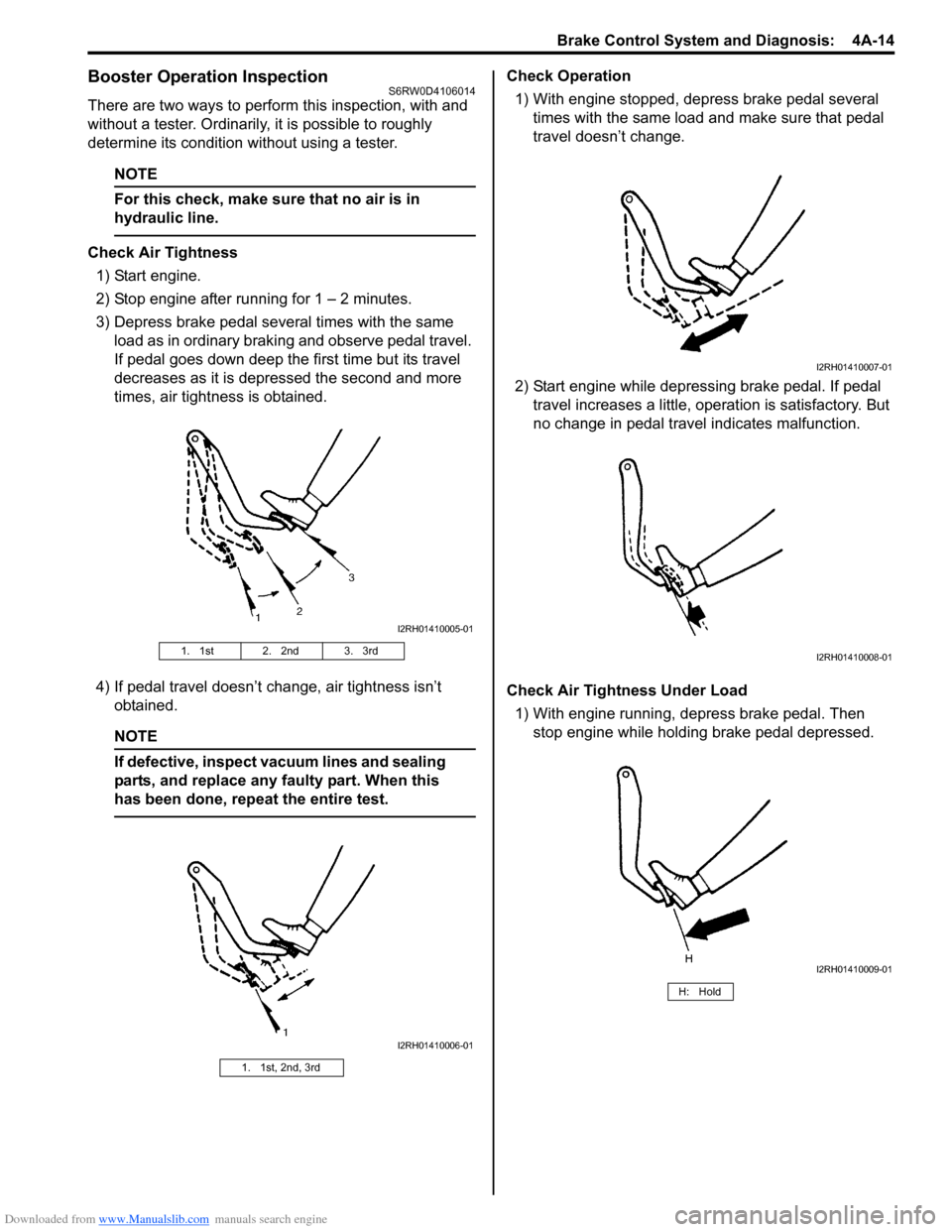
Check Air Tightness
1) Start engine.
2) Stop engine after running for 1 – 2 minutes.
3) Depress brake pedal several times with the same
load as in ordinary braking and observe pedal travel.
If pedal goes down deep the first time but its travel
decreases as it is depressed the second and more
times, air tightness is obtained.
4) If pedal travel doesn’t change, air tightness isn’t
obtained.
NOTE
If defective, inspect vacuum lines and sealing
parts, and replace any faulty part. When this
has been done, repeat the entire test.
Check Operation
1) With engine stopped, depress brake pedal several
times with the same load and make sure that pedal
travel doesn’t change.
2) Start engine while depressing brake pedal. If pedal
travel increases a little, operation is satisfactory. But
no change in pedal travel indicates malfunction.
Check Air Tightness Under Load
1) With engine running, depress brake pedal. Then
stop engine while holding brake pedal depressed.
1. 1st 2. 2nd 3. 3rd
1. 1st, 2nd, 3rd
I2RH01410005-01
I2RH01410006-01
H: Hold
I2RH01410007-01
I2RH01410008-01
I2RH01410009-01
Page 586 of 1556
Downloaded from www.Manualslib.com manuals search engine 4A-15 Brake Control System and Diagnosis:
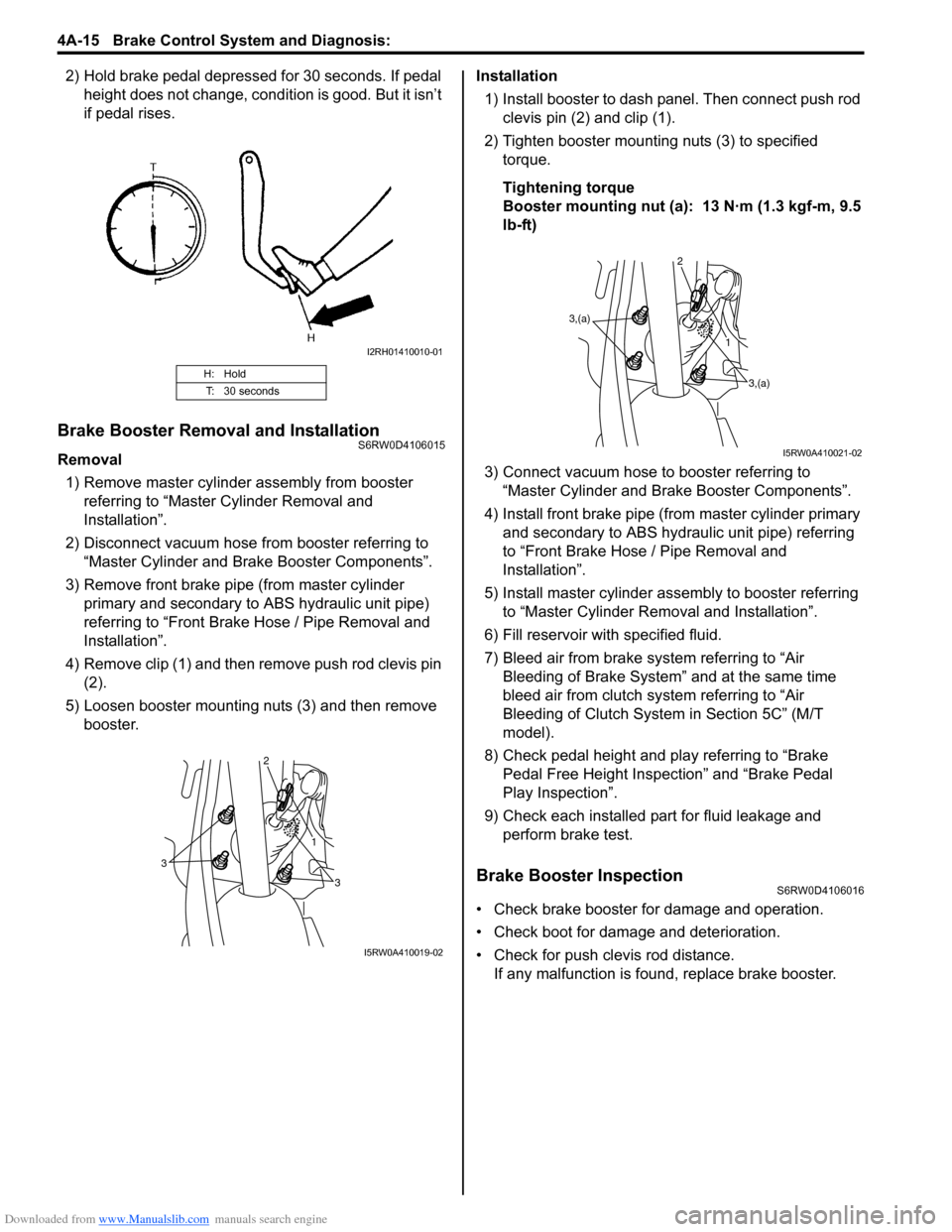
2) Hold brake pedal depressed for 30 seconds. If pedal
height does not change, condition is good. But it isn’t
if pedal rises.
Brake Booster Removal and InstallationS6RW0D4106015
Removal
1) Remove master cylinder assembly from booster
referring to “Master Cylinder Removal and
Installation”.
2) Disconnect vacuum hose from booster referring to
“Master Cylinder and Brake Booster Components”.
3) Remove front brake pipe (from master cylinder
primary and secondary to ABS hydraulic unit pipe)
referring to “Front Brake Hose / Pipe Removal and
Installation”.
4) Remove clip (1) and then remove push rod clevis pin
(2).
5) Loosen booster mounting nuts (3) and then remove
booster.Installation
1) Install booster to dash panel. Then connect push rod
clevis pin (2) and clip (1).
2) Tighten booster mounting nuts (3) to specified
torque.
Tightening torque
Booster mounting nut (a): 13 N·m (1.3 kgf-m, 9.5
lb-ft)
3) Connect vacuum hose to booster referring to
“Master Cylinder and Brake Booster Components”.
4) Install front brake pipe (from master cylinder primary
and secondary to ABS hydraulic unit pipe) referring
to “Front Brake Hose / Pipe Removal and
Installation”.
5) Install master cylinder assembly to booster referring
to “Master Cylinder Removal and Installation”.
6) Fill reservoir with specified fluid.
7) Bleed air from brake system referring to “Air
Bleeding of Brake System” and at the same time
bleed air from clutch system referring to “Air
Bleeding of Clutch System in Section 5C” (M/T
model).
8) Check pedal height and play referring to “Brake
Pedal Free Height Inspection” and “Brake Pedal
Play Inspection”.
9) Check each installed part for fluid leakage and
perform brake test.
Brake Booster InspectionS6RW0D4106016
• Check brake booster for damage and operation.
• Check boot for damage and deterioration.
• Check for push clevis rod distance.
If any malfunction is found, replace brake booster.
H: Hold
T: 30 seconds
I2RH01410010-01
3
3 1 2
I5RW0A410019-02
3,(a)
3,(a) 1 2
I5RW0A410021-02
Page 587 of 1556
Downloaded from www.Manualslib.com manuals search engine Brake Control System and Diagnosis: 4A-16
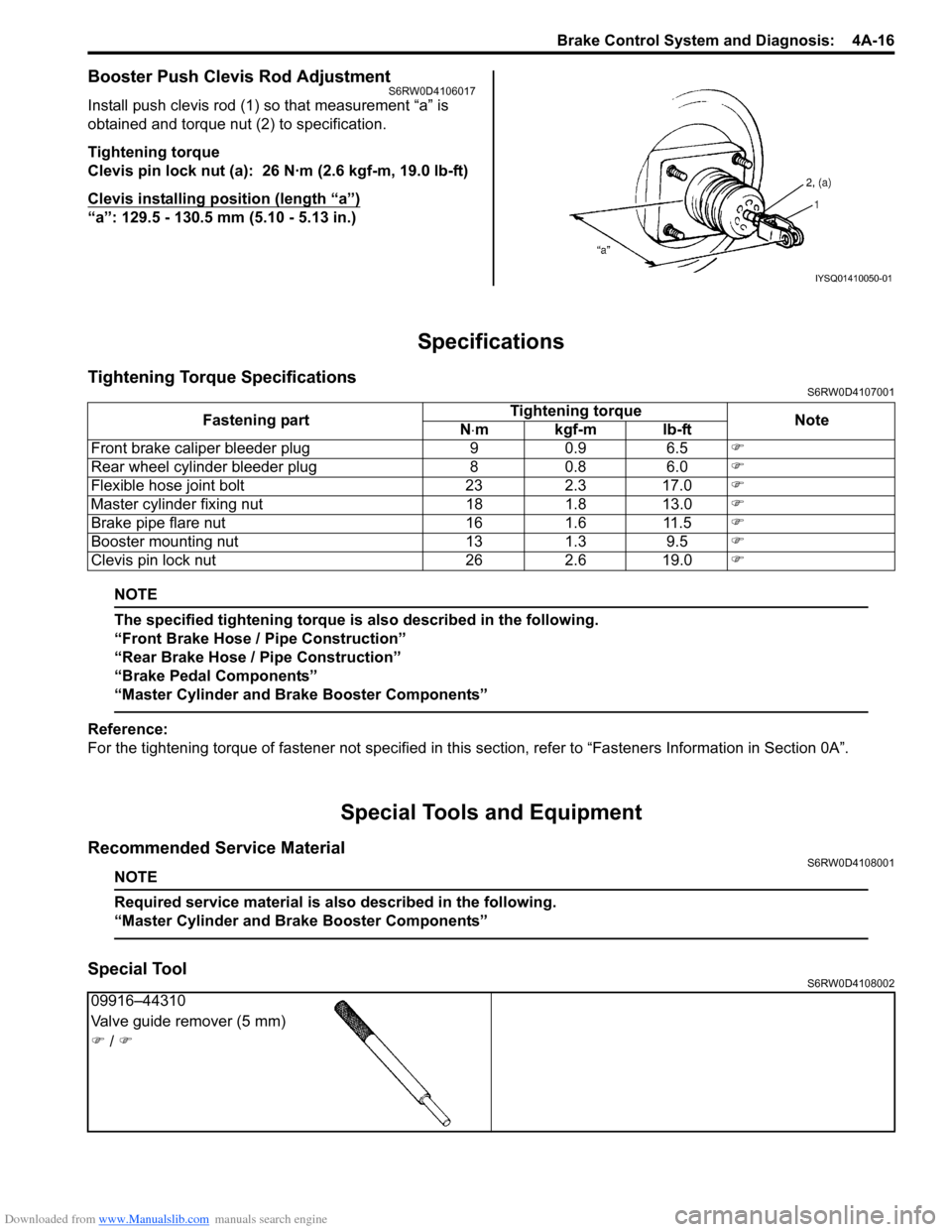
Booster Push Clevis Rod AdjustmentS6RW0D4106017
Install push clevis rod (1) so that measurement “a” is
obtained and torque nut (2) to specification.
Tightening torque
Clevis pin lock nut (a): 26 N·m (2.6 kgf-m, 19.0 lb-ft)
Clevis installing position (length “a”)
“a”: 129.5 - 130.5 mm (5.10 - 5.13 in.)
Specifications
Tightening Torque SpecificationsS6RW0D4107001
NOTE
The specified tightening torque is also described in the following.
“Front Brake Hose / Pipe Construction”
“Rear Brake Hose / Pipe Construction”
“Brake Pedal Components”
“Master Cylinder and Brake Booster Components”
Reference:
For the tightening torque of fastener not specified in this section, refer to “Fasteners Information in Section 0A”.
Special Tools and Equipment
Recommended Service MaterialS6RW0D4108001
NOTE
Required service material is also described in the following.
“Master Cylinder and Brake Booster Components”
Special ToolS6RW0D4108002
IYSQ01410050-01
Fastening partTightening torque
Note
N⋅mkgf-mlb-ft
Front brake caliper bleeder plug 9 0.9 6.5)
Rear wheel cylinder bleeder plug 8 0.8 6.0)
Flexible hose joint bolt 23 2.3 17.0)
Master cylinder fixing nut 18 1.8 13.0)
Brake pipe flare nut 16 1.6 11.5)
Booster mounting nut 13 1.3 9.5)
Clevis pin lock nut 26 2.6 19.0)
09916–44310
Valve guide remover (5 mm)
) / )
Page 591 of 1556
Downloaded from www.Manualslib.com manuals search engine Front Brakes: 4B-4
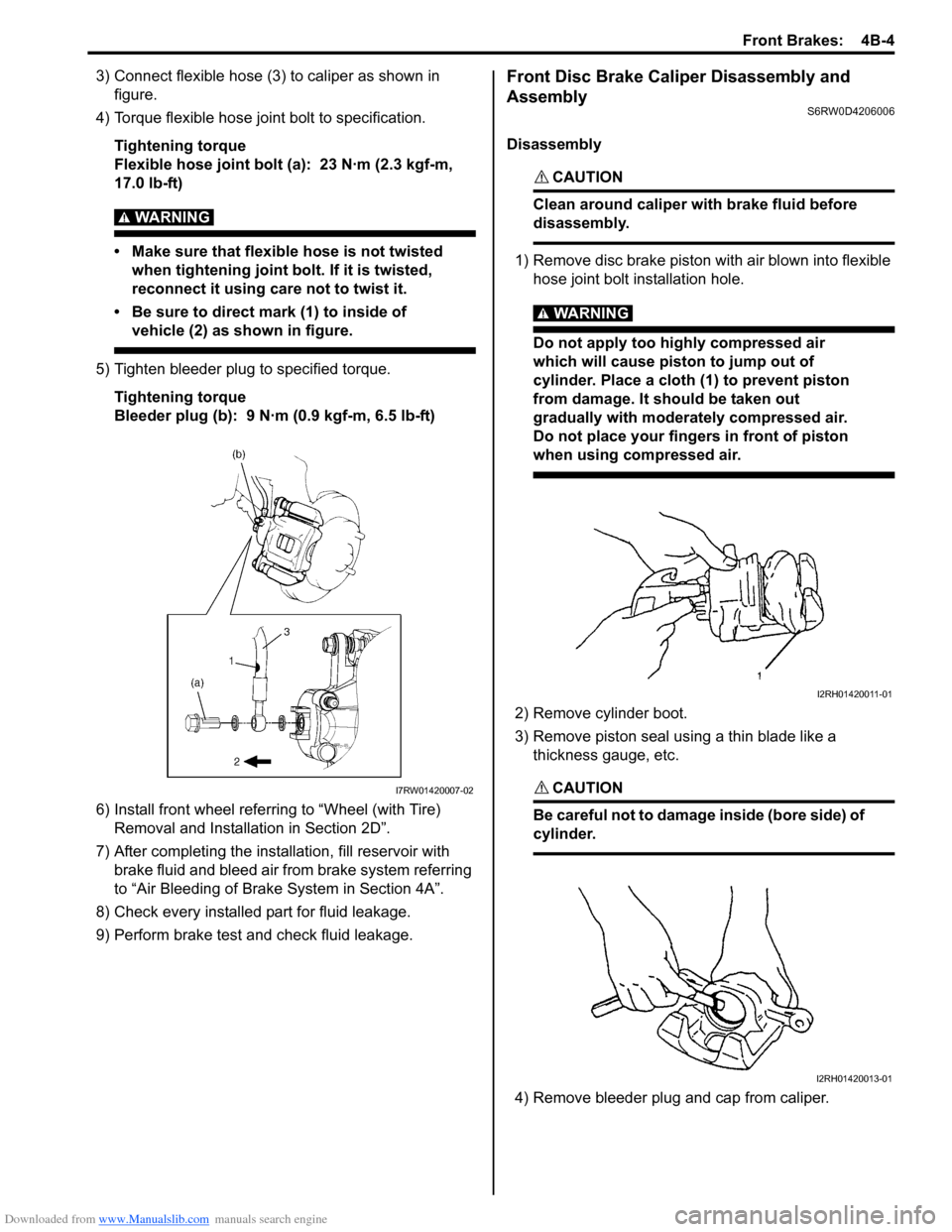
3) Connect flexible hose (3) to caliper as shown in
figure.
4) Torque flexible hose joint bolt to specification.
Tightening torque
Flexible hose joint bolt (a): 23 N·m (2.3 kgf-m,
17.0 lb-ft)
WARNING!
• Make sure that flexible hose is not twisted
when tightening joint bolt. If it is twisted,
reconnect it using care not to twist it.
• Be sure to direct mark (1) to inside of
vehicle (2) as shown in figure.
5) Tighten bleeder plug to specified torque.
Tightening torque
Bleeder plug (b): 9 N·m (0.9 kgf-m, 6.5 lb-ft)
6) Install front wheel referring to “Wheel (with Tire)
Removal and Installation in Section 2D”.
7) After completing the installation, fill reservoir with
brake fluid and bleed air from brake system referring
to “Air Bleeding of Brake System in Section 4A”.
8) Check every installed part for fluid leakage.
9) Perform brake test and check fluid leakage.
Front Disc Brake Caliper Disassembly and
Assembly
S6RW0D4206006
Disassembly
CAUTION!
Clean around caliper with brake fluid before
disassembly.
1) Remove disc brake piston with air blown into flexible
hose joint bolt installation hole.
WARNING!
Do not apply too highly compressed air
which will cause piston to jump out of
cylinder. Place a cloth (1) to prevent piston
from damage. It should be taken out
gradually with moderately compressed air.
Do not place your fingers in front of piston
when using compressed air.
2) Remove cylinder boot.
3) Remove piston seal using a thin blade like a
thickness gauge, etc.
CAUTION!
Be careful not to damage inside (bore side) of
cylinder.
4) Remove bleeder plug and cap from caliper.
I7RW01420007-02
I2RH01420011-01
I2RH01420013-01
Page 600 of 1556
Downloaded from www.Manualslib.com manuals search engine 4C-5 Rear Brakes:
Installation
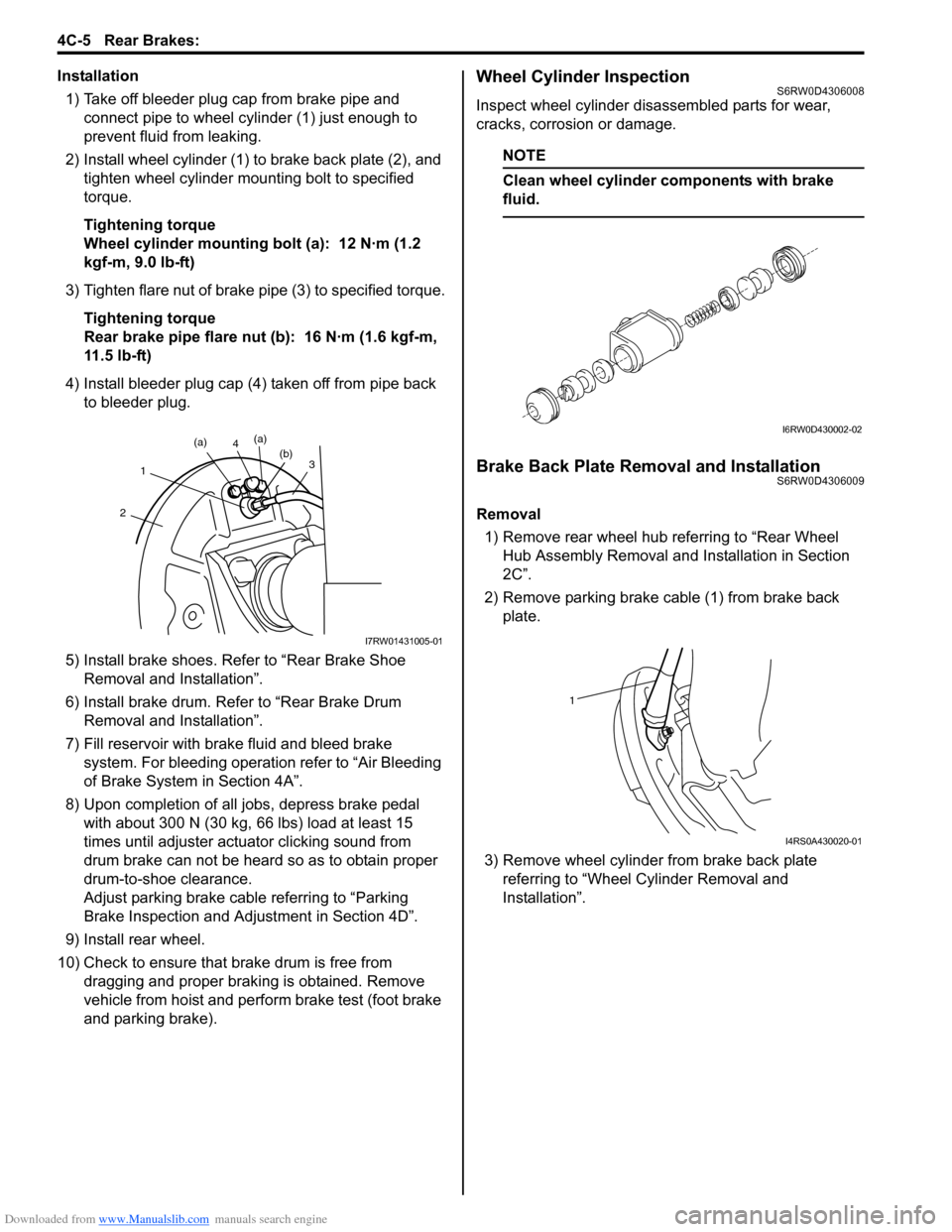
1) Take off bleeder plug cap from brake pipe and
connect pipe to wheel cylinder (1) just enough to
prevent fluid from leaking.
2) Install wheel cylinder (1) to brake back plate (2), and
tighten wheel cylinder mounting bolt to specified
torque.
Tightening torque
Wheel cylinder mounting bolt (a): 12 N·m (1.2
kgf-m, 9.0 lb-ft)
3) Tighten flare nut of brake pipe (3) to specified torque.
Tightening torque
Rear brake pipe flare nut (b): 16 N·m (1.6 kgf-m,
11.5 lb-ft)
4) Install bleeder plug cap (4) taken off from pipe back
to bleeder plug.
5) Install brake shoes. Refer to “Rear Brake Shoe
Removal and Installation”.
6) Install brake drum. Refer to “Rear Brake Drum
Removal and Installation”.
7) Fill reservoir with brake fluid and bleed brake
system. For bleeding operation refer to “Air Bleeding
of Brake System in Section 4A”.
8) Upon completion of all jobs, depress brake pedal
with about 300 N (30 kg, 66 lbs) load at least 15
times until adjuster actuator clicking sound from
drum brake can not be heard so as to obtain proper
drum-to-shoe clearance.
Adjust parking brake cable referring to “Parking
Brake Inspection and Adjustment in Section 4D”.
9) Install rear wheel.
10) Check to ensure that brake drum is free from
dragging and proper braking is obtained. Remove
vehicle from hoist and perform brake test (foot brake
and parking brake).Wheel Cylinder InspectionS6RW0D4306008
Inspect wheel cylinder disassembled parts for wear,
cracks, corrosion or damage.
NOTE
Clean wheel cylinder components with brake
fluid.
Brake Back Plate Removal and InstallationS6RW0D4306009
Removal
1) Remove rear wheel hub referring to “Rear Wheel
Hub Assembly Removal and Installation in Section
2C”.
2) Remove parking brake cable (1) from brake back
plate.
3) Remove wheel cylinder from brake back plate
referring to “Wheel Cylinder Removal and
Installation”.
(b)3
4(a)
(a)
1
2
I7RW01431005-01
I6RW0D430002-02
1
I4RS0A430020-01
Page 601 of 1556
Downloaded from www.Manualslib.com manuals search engine Rear Brakes: 4C-6
Installation
Install brake back plate by reversing removal procedure,
noting the instructions.
CAUTION!
Never reuse rear wheel hub mounting bolts.
• Install rear wheel hub and brake back plate, and then
tighten mounting bolt. Refer to “Rear Drum Brake
Components”.
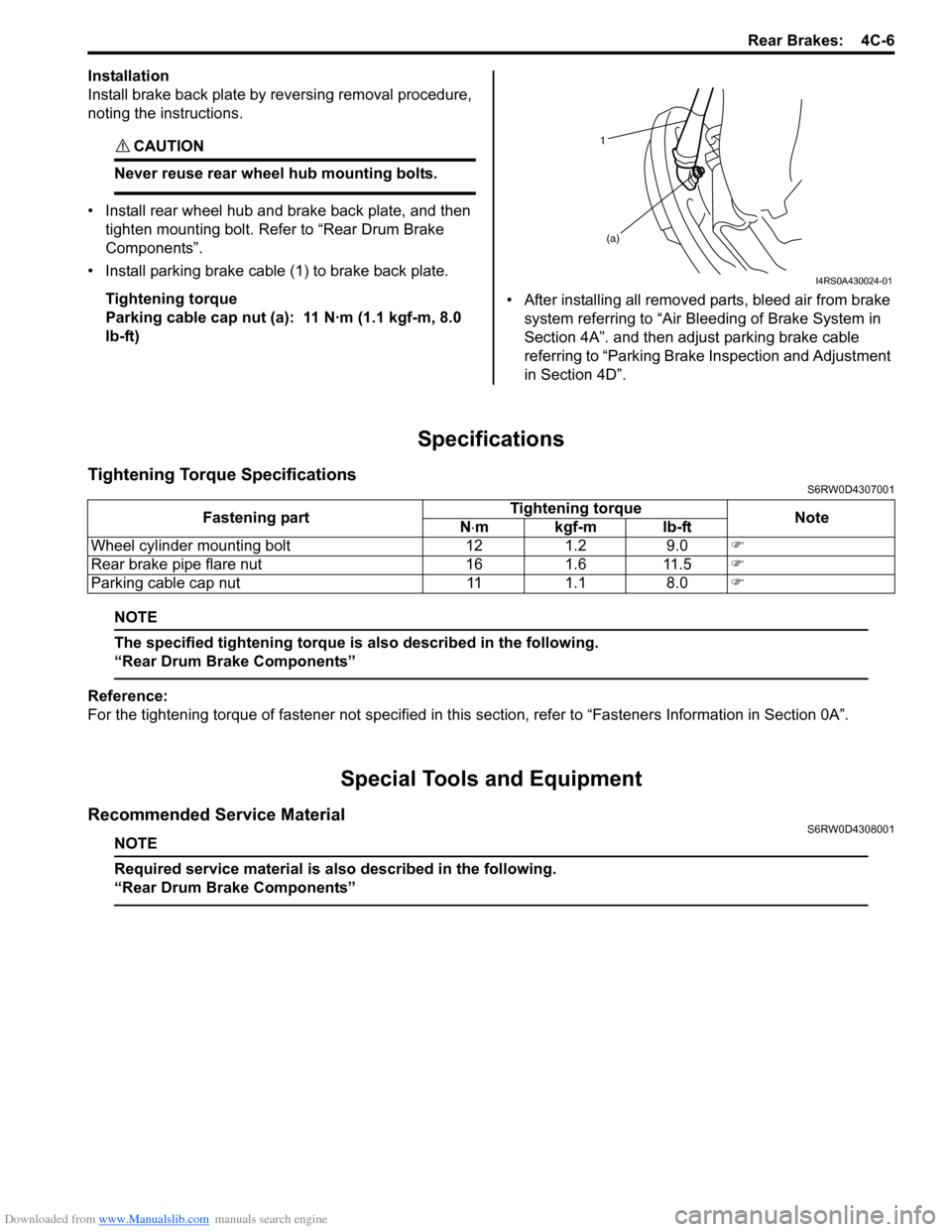
• Install parking brake cable (1) to brake back plate.
Tightening torque
Parking cable cap nut (a): 11 N·m (1.1 kgf-m, 8.0
lb-ft)• After installing all removed parts, bleed air from brake
system referring to “Air Bleeding of Brake System in
Section 4A”. and then adjust parking brake cable
referring to “Parking Brake Inspection and Adjustment
in Section 4D”.
Specifications
Tightening Torque SpecificationsS6RW0D4307001
NOTE
The specified tightening torque is also described in the following.
“Rear Drum Brake Components”
Reference:
For the tightening torque of fastener not specified in this section, refer to “Fasteners Information in Section 0A”.
Special Tools and Equipment
Recommended Service MaterialS6RW0D4308001
NOTE
Required service material is also described in the following.
“Rear Drum Brake Components”
1
(a)
I4RS0A430024-01
Fastening partTightening torque
Note
N⋅mkgf-mlb-ft
Wheel cylinder mounting bolt 12 1.2 9.0)
Rear brake pipe flare nut 16 1.6 11.5)
Parking cable cap nut 11 1.1 8.0)
Page 603 of 1556
Downloaded from www.Manualslib.com manuals search engine Parking Brake: 4D-2
Repair Instructions
Parking Brake Inspection and AdjustmentS6RW0D4406001
Inspection
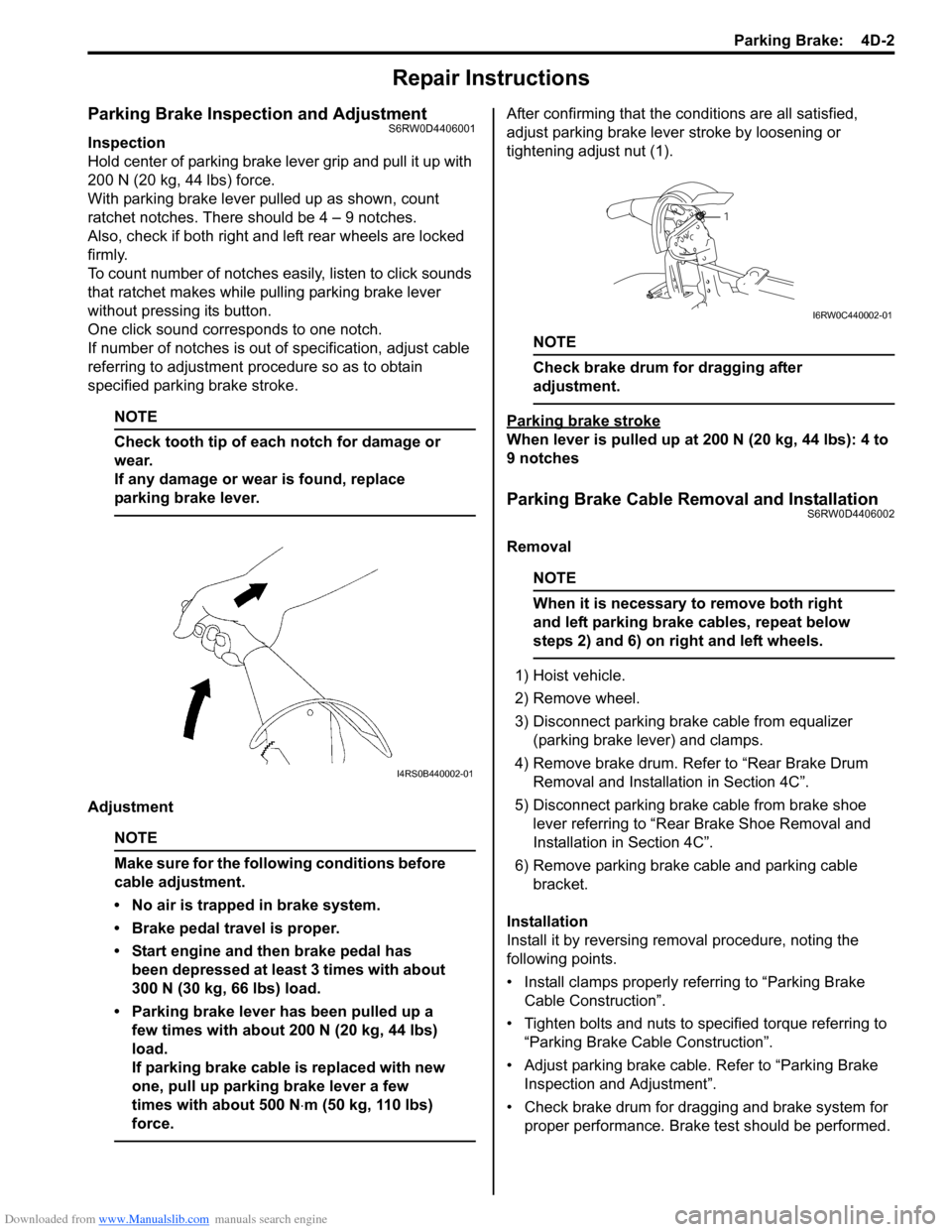
Hold center of parking brake lever grip and pull it up with
200 N (20 kg, 44 lbs) force.
With parking brake lever pulled up as shown, count
ratchet notches. There should be 4 – 9 notches.
Also, check if both right and left rear wheels are locked
firmly.
To count number of notches easily, listen to click sounds
that ratchet makes while pulling parking brake lever
without pressing its button.
One click sound corresponds to one notch.
If number of notches is out of specification, adjust cable
referring to adjustment procedure so as to obtain
specified parking brake stroke.
NOTE
Check tooth tip of each notch for damage or
wear.
If any damage or wear is found, replace
parking brake lever.
Adjustment
NOTE
Make sure for the following conditions before
cable adjustment.
• No air is trapped in brake system.
• Brake pedal travel is proper.
• Start engine and then brake pedal has
been depressed at least 3 times with about
300 N (30 kg, 66 lbs) load.
• Parking brake lever has been pulled up a
few times with about 200 N (20 kg, 44 lbs)
load.
If parking brake cable is replaced with new
one, pull up parking brake lever a few
times with about 500 N⋅m (50 kg, 110 lbs)
force.
After confirming that the conditions are all satisfied,
adjust parking brake lever stroke by loosening or
tightening adjust nut (1).
NOTE
Check brake drum for dragging after
adjustment.
Parking brake stroke
When lever is pulled up at 200 N (20 kg, 44 lbs): 4 to
9 notches
Parking Brake Cable Removal and InstallationS6RW0D4406002
Removal
NOTE
When it is necessary to remove both right
and left parking brake cables, repeat below
steps 2) and 6) on right and left wheels.
1) Hoist vehicle.
2) Remove wheel.
3) Disconnect parking brake cable from equalizer
(parking brake lever) and clamps.
4) Remove brake drum. Refer to “Rear Brake Drum
Removal and Installation in Section 4C”.
5) Disconnect parking brake cable from brake shoe
lever referring to “Rear Brake Shoe Removal and
Installation in Section 4C”.
6) Remove parking brake cable and parking cable
bracket.
Installation
Install it by reversing removal procedure, noting the
following points.
• Install clamps properly referring to “Parking Brake
Cable Construction”.
• Tighten bolts and nuts to specified torque referring to
“Parking Brake Cable Construction”.
• Adjust parking brake cable. Refer to “Parking Brake
Inspection and Adjustment”.
• Check brake drum for dragging and brake system for
proper performance. Brake test should be performed.
I4RS0B440002-01
1
I6RW0C440002-01
Page 604 of 1556
Downloaded from www.Manualslib.com manuals search engine 4D-3 Parking Brake:
Parking Brake Lever Removal and InstallationS6RW0D4406003
Removal
1) Remove console box.
2) Block vehicle wheels and release parking brake
lever.
3) Disconnect lead wire of parking brake switch at
coupler.
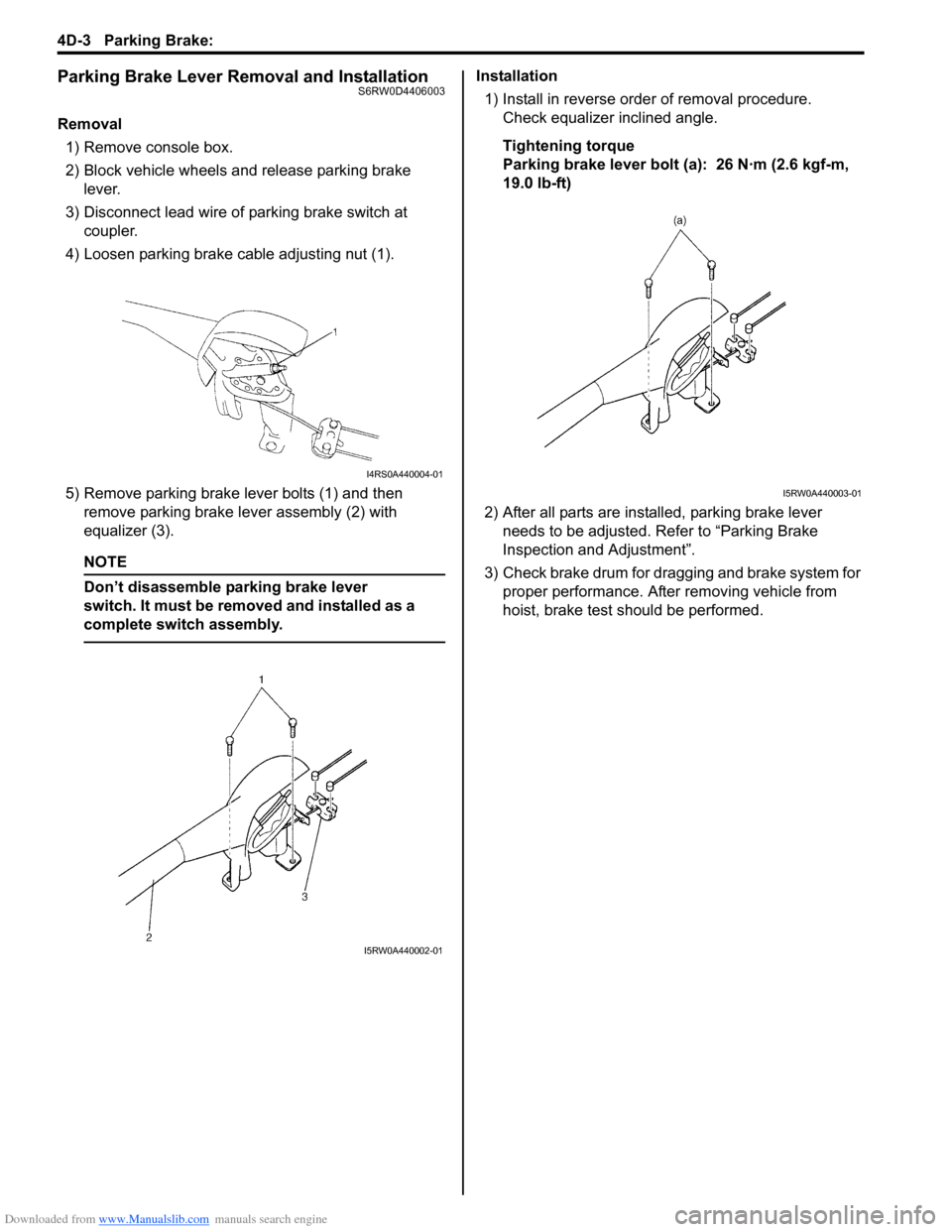
4) Loosen parking brake cable adjusting nut (1).
5) Remove parking brake lever bolts (1) and then
remove parking brake lever assembly (2) with
equalizer (3).
NOTE
Don’t disassemble parking brake lever
switch. It must be removed and installed as a
complete switch assembly.
Installation
1) Install in reverse order of removal procedure.
Check equalizer inclined angle.
Tightening torque
Parking brake lever bolt (a): 26 N·m (2.6 kgf-m,
19.0 lb-ft)
2) After all parts are installed, parking brake lever
needs to be adjusted. Refer to “Parking Brake
Inspection and Adjustment”.
3) Check brake drum for dragging and brake system for
proper performance. After removing vehicle from
hoist, brake test should be performed.
I4RS0A440004-01
I5RW0A440002-01
I5RW0A440003-01
Page 606 of 1556
Downloaded from www.Manualslib.com manuals search engine 4E-1 ABS:
Brakes
ABS
Precautions
Precautions in Diagnosing TroublesS6RW0D4500001
To ensure that the trouble diagnosis is done accurately
and smoothly, observe the following and follow “ABS
Check”.
• Diagnostic information stored in ABS control module
memory can be cleared as well as checked by using
SUZUKI scan tool. Before using scan tool, read its
Operator's (Instruction) Manual carefully to have good
understanding as to what functions are available and
how to use it.
• If the vehicle was operated in any of the following
ways, ABS warning light may light momentarily but
this does not indicate anything abnormal in ABS.
– The vehicle was driven with parking brake pulled.
– The vehicle was driven with brake dragging.
– The vehicle was stuck in mud, sand, etc.
– Wheel spin occurred while driving.
– Wheel(s) was rotated while the vehicle was jacked
up.
• Be sure to read “Precautions for Electrical Circuit
Service in Section 00” and “Precaution for CAN
Communication System in Section 00” before
inspection and observe what is written there.
• Be sure to use the trouble diagnosis procedure as
described in “ABS Check”. Failure to follow it may
result in incorrect diagnosis. (Some other diagnosis
trouble code may be stored by mistake in the memory
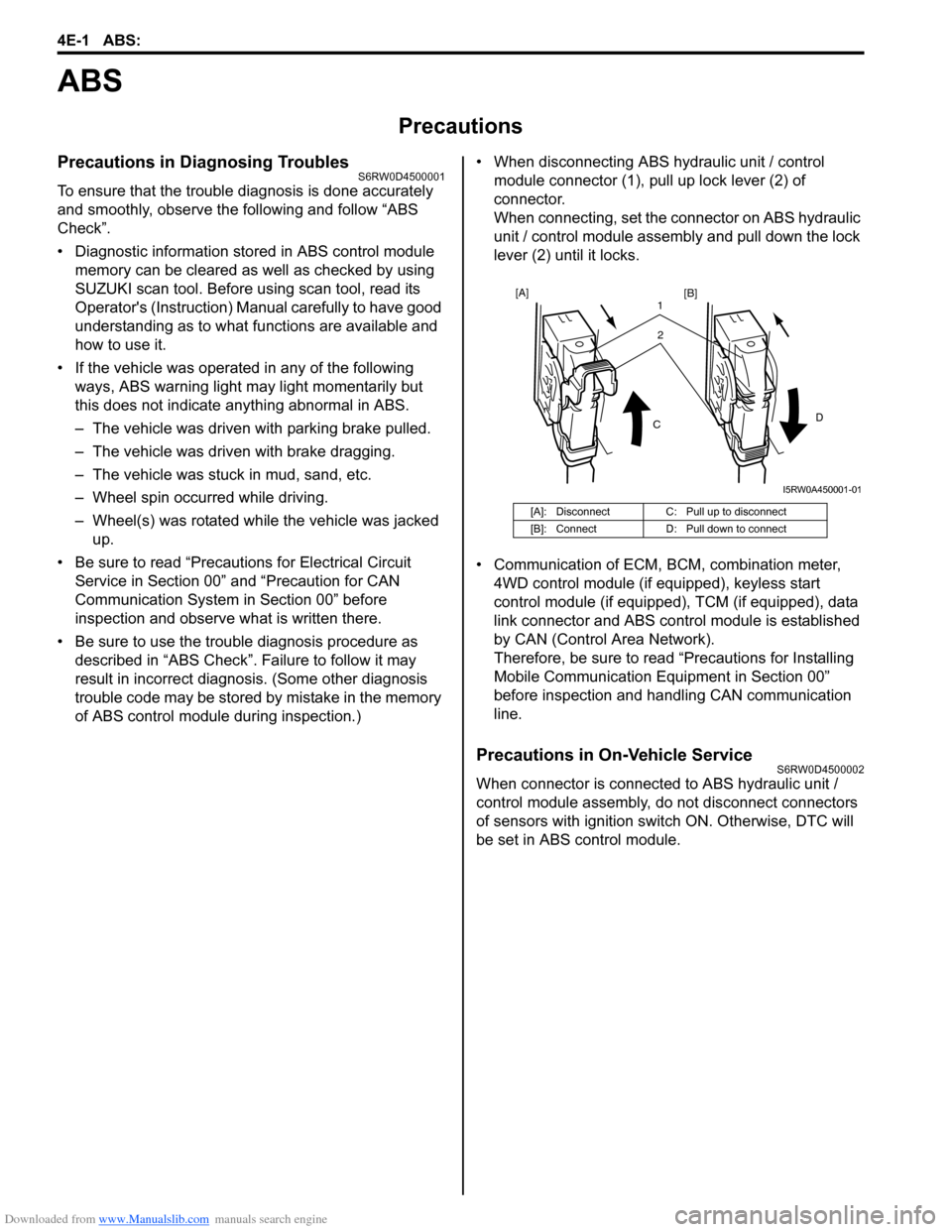
of ABS control module during inspection.)• When disconnecting ABS hydraulic unit / control
module connector (1), pull up lock lever (2) of
connector.
When connecting, set the connector on ABS hydraulic
unit / control module assembly and pull down the lock
lever (2) until it locks.
• Communication of ECM, BCM, combination meter,
4WD control module (if equipped), keyless start
control module (if equipped), TCM (if equipped), data
link connector and ABS control module is established
by CAN (Control Area Network).
Therefore, be sure to read “Precautions for Installing
Mobile Communication Equipment in Section 00”
before inspection and handling CAN communication
line.
Precautions in On-Vehicle ServiceS6RW0D4500002
When connector is connected to ABS hydraulic unit /
control module assembly, do not disconnect connectors
of sensors with ignition switch ON. Otherwise, DTC will
be set in ABS control module.
[A]: Disconnect C: Pull up to disconnect
[B]: Connect D: Pull down to connect
2 1
CD
[A]
[B]
I5RW0A450001-01
Page 607 of 1556
Downloaded from www.Manualslib.com manuals search engine ABS: 4E-2
General Description
ABS DescriptionS6RW0D4501001
The ABS (Antilock Brake System) controls the fluid
pressure applied to the wheel cylinder of each brake
from the master cylinder so that each wheel is not locked
even when hard braking is applied.
This ABS has also the following function.
While braking is applied, but before ABS control
becomes effective, braking force is distributed between
the front and rear so as to prevent the rear wheels from
being locked too early for better stability of the vehicle.
The main component parts of this ABS include the
following parts in addition to those of the conventional
brake system.
• Wheel speed sensor which senses revolution speed
of each wheel and outputs its signal.
Rear wheel speed sensor of 4WD vehicle is
integrated in rear wheel hub assembly and supplied
as rear wheel hub assembly part.
Front wheel speed sensor and rear wheel speed
sensor of 2WD model are separated from wheel hub
assembly and supplied as spare parts.
• ABS warning light which lights to inform abnormality
when system fails to operate properly.• ABS hydraulic unit / control module assembly is
incorporated ABS control module, ABS hydraulic unit
(actuator assembly), solenoid valve power supply
driver (transistor), solenoid valve driver (transistor),
pump motor driver (transistor).
– ABS control module which sends operation signal
to ABS hydraulic unit to control fluid pressure
applied to each wheel cylinder based on signal
from each wheel speed sensor so as to prevent
wheel from locking.
– ABS hydraulic unit which operates according to
signal from ABS control module to control fluid
pressure applied to wheel cylinder of each 4
wheels.
– Solenoid valve power supply driver (transistor)
which supplies power to solenoid valve in ABS
hydraulic unit.
– Solenoid valve driver (transistor) which controls
each solenoid valves in ABS hydraulic unit.
– Pump motor driver (transistor) which supplies
power to pump motor in ABS hydraulic unit.
• G sensor which detects body deceleration speed for
4WD model.
This ABS is equipped with Electronic Brake force
Distribution (EBD) system that controls a fluid pressure
of rear wheels to best condition, which is the same
function as that of proportioning valve, by the signal from
wheel sensor independently of change of load due to
load capacity and so on. And if the EBD system fails to
operate properly, the brake warning light lights to inform
abnormality.