air condition SUZUKI SX4 2006 1.G Service Repair Manual
[x] Cancel search | Manufacturer: SUZUKI, Model Year: 2006, Model line: SX4, Model: SUZUKI SX4 2006 1.GPages: 1556, PDF Size: 37.31 MB
Page 160 of 1556
Downloaded from www.Manualslib.com manuals search engine 1A-110 Engine General Information and Diagnosis:
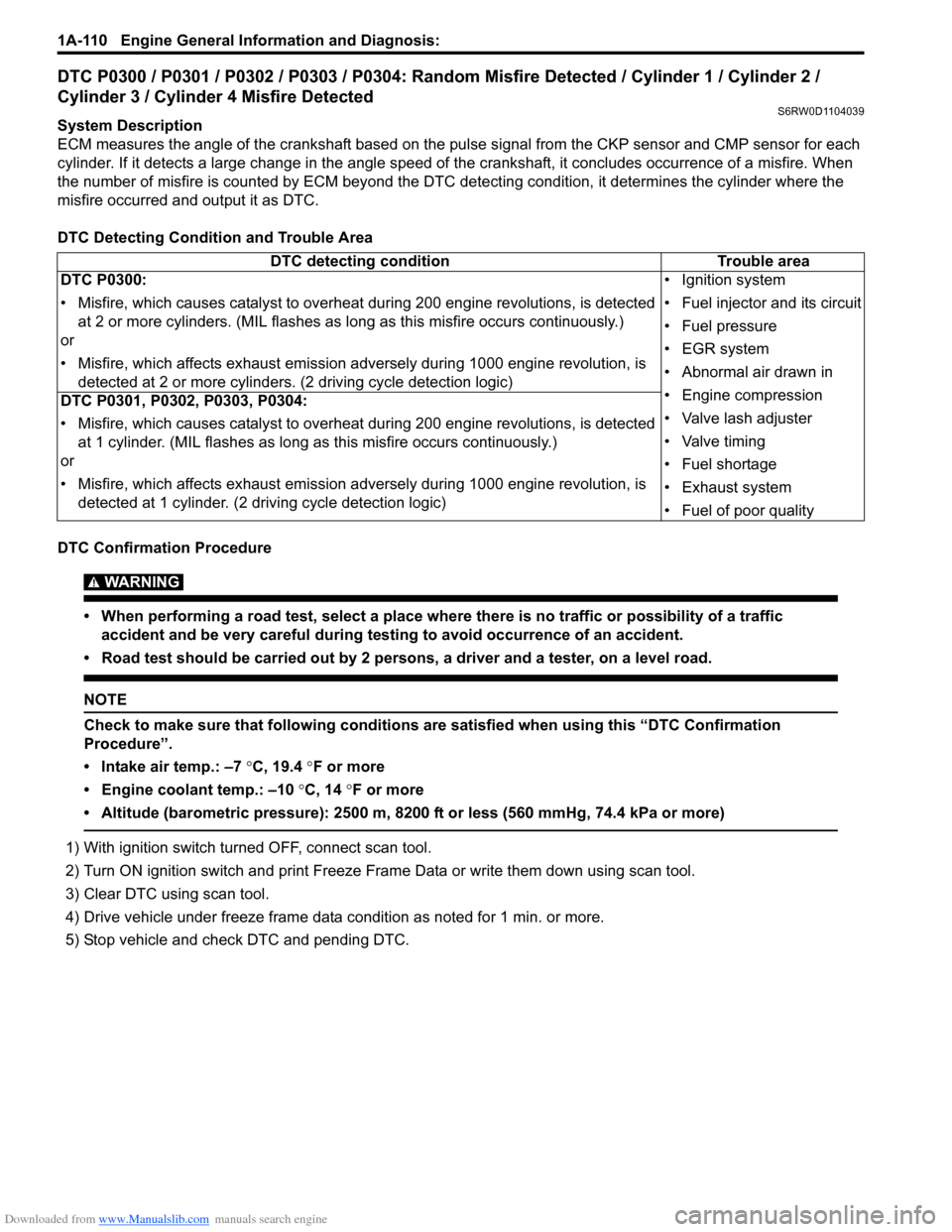
DTC P0300 / P0301 / P0302 / P0303 / P0304: Random Misfire Detected / Cylinder 1 / Cylinder 2 /
Cylinder 3 / Cylinder 4 Misfire Detected
S6RW0D1104039
System Description
ECM measures the angle of the crankshaft based on the pulse signal from the CKP sensor and CMP sensor for each
cylinder. If it detects a large change in the angle speed of the crankshaft, it concludes occurrence of a misfire. When
the number of misfire is counted by ECM beyond the DTC detecting condition, it determines the cylinder where the
misfire occurred and output it as DTC.
DTC Detecting Condition and Trouble Area
DTC Confirmation Procedure
WARNING!
• When performing a road test, select a place where there is no traffic or possibility of a traffic
accident and be very careful during testing to avoid occurrence of an accident.
• Road test should be carried out by 2 persons, a driver and a tester, on a level road.
NOTE
Check to make sure that following conditions are satisfied when using this “DTC Confirmation
Procedure”.
• Intake air temp.: –7 °C, 19.4 °F or more
• Engine coolant temp.: –10 °C, 14 °F or more
• Altitude (barometric pressure): 2500 m, 8200 ft or less (560 mmHg, 74.4 kPa or more)
1) With ignition switch turned OFF, connect scan tool.
2) Turn ON ignition switch and print Freeze Frame Data or write them down using scan tool.
3) Clear DTC using scan tool.
4) Drive vehicle under freeze frame data condition as noted for 1 min. or more.
5) Stop vehicle and check DTC and pending DTC.DTC detecting condition Trouble area
DTC P0300:
• Misfire, which causes catalyst to overheat during 200 engine revolutions, is detected
at 2 or more cylinders. (MIL flashes as long as this misfire occurs continuously.)
or
• Misfire, which affects exhaust emission adversely during 1000 engine revolution, is
detected at 2 or more cylinders. (2 driving cycle detection logic)• Ignition system
• Fuel injector and its circuit
• Fuel pressure
• EGR system
• Abnormal air drawn in
• Engine compression
• Valve lash adjuster
• Valve timing
• Fuel shortage
• Exhaust system
• Fuel of poor quality DTC P0301, P0302, P0303, P0304:
• Misfire, which causes catalyst to overheat during 200 engine revolutions, is detected
at 1 cylinder. (MIL flashes as long as this misfire occurs continuously.)
or
• Misfire, which affects exhaust emission adversely during 1000 engine revolution, is
detected at 1 cylinder. (2 driving cycle detection logic)
Page 161 of 1556
Downloaded from www.Manualslib.com manuals search engine Engine General Information and Diagnosis: 1A-111
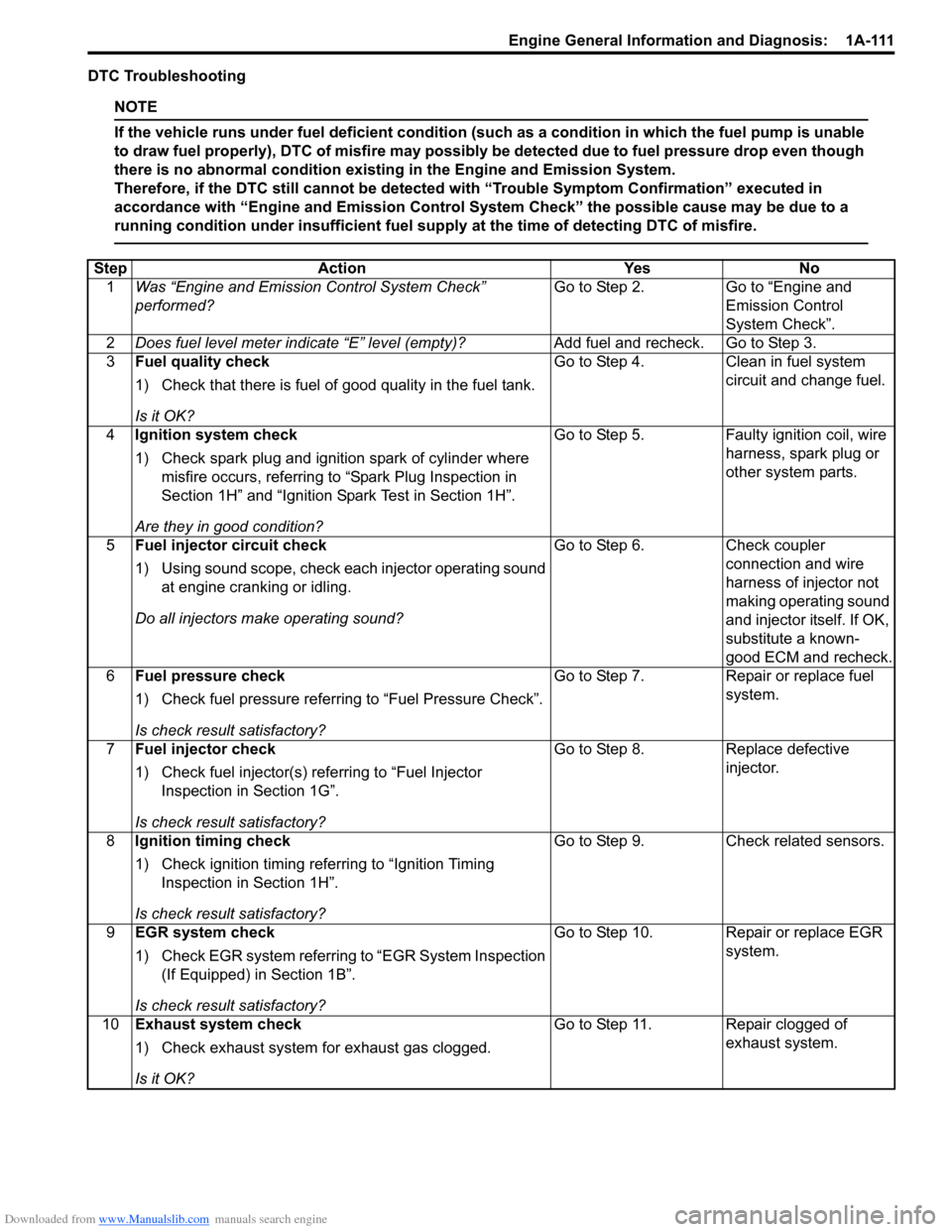
DTC Troubleshooting
NOTE
If the vehicle runs under fuel deficient condition (such as a condition in which the fuel pump is unable
to draw fuel properly), DTC of misfire may possibly be detected due to fuel pressure drop even though
there is no abnormal condition existing in the Engine and Emission System.
Therefore, if the DTC still cannot be detected with “Trouble Symptom Confirmation” executed in
accordance with “Engine and Emission Control System Check” the possible cause may be due to a
running condition under insufficient fuel supply at the time of detecting DTC of misfire.
Step Action Yes No
1Was “Engine and Emission Control System Check”
performed?Go to Step 2. Go to “Engine and
Emission Control
System Check”.
2Does fuel level meter indicate “E” level (empty)?Add fuel and recheck. Go to Step 3.
3Fuel quality check
1) Check that there is fuel of good quality in the fuel tank.
Is it OK?Go to Step 4. Clean in fuel system
circuit and change fuel.
4Ignition system check
1) Check spark plug and ignition spark of cylinder where
misfire occurs, referring to “Spark Plug Inspection in
Section 1H” and “Ignition Spark Test in Section 1H”.
Are they in good condition?Go to Step 5. Faulty ignition coil, wire
harness, spark plug or
other system parts.
5Fuel injector circuit check
1) Using sound scope, check each injector operating sound
at engine cranking or idling.
Do all injectors make operating sound?Go to Step 6. Check coupler
connection and wire
harness of injector not
making operating sound
and injector itself. If OK,
substitute a known-
good ECM and recheck.
6Fuel pressure check
1) Check fuel pressure referring to “Fuel Pressure Check”.
Is check result satisfactory?Go to Step 7. Repair or replace fuel
system.
7Fuel injector check
1) Check fuel injector(s) referring to “Fuel Injector
Inspection in Section 1G”.
Is check result satisfactory?Go to Step 8. Replace defective
injector.
8Ignition timing check
1) Check ignition timing referring to “Ignition Timing
Inspection in Section 1H”.
Is check result satisfactory?Go to Step 9. Check related sensors.
9EGR system check
1) Check EGR system referring to “EGR System Inspection
(If Equipped) in Section 1B”.
Is check result satisfactory?Go to Step 10. Repair or replace EGR
system.
10Exhaust system check
1) Check exhaust system for exhaust gas clogged.
Is it OK?Go to Step 11. Repair clogged of
exhaust system.
Page 162 of 1556
Downloaded from www.Manualslib.com manuals search engine 1A-112 Engine General Information and Diagnosis:
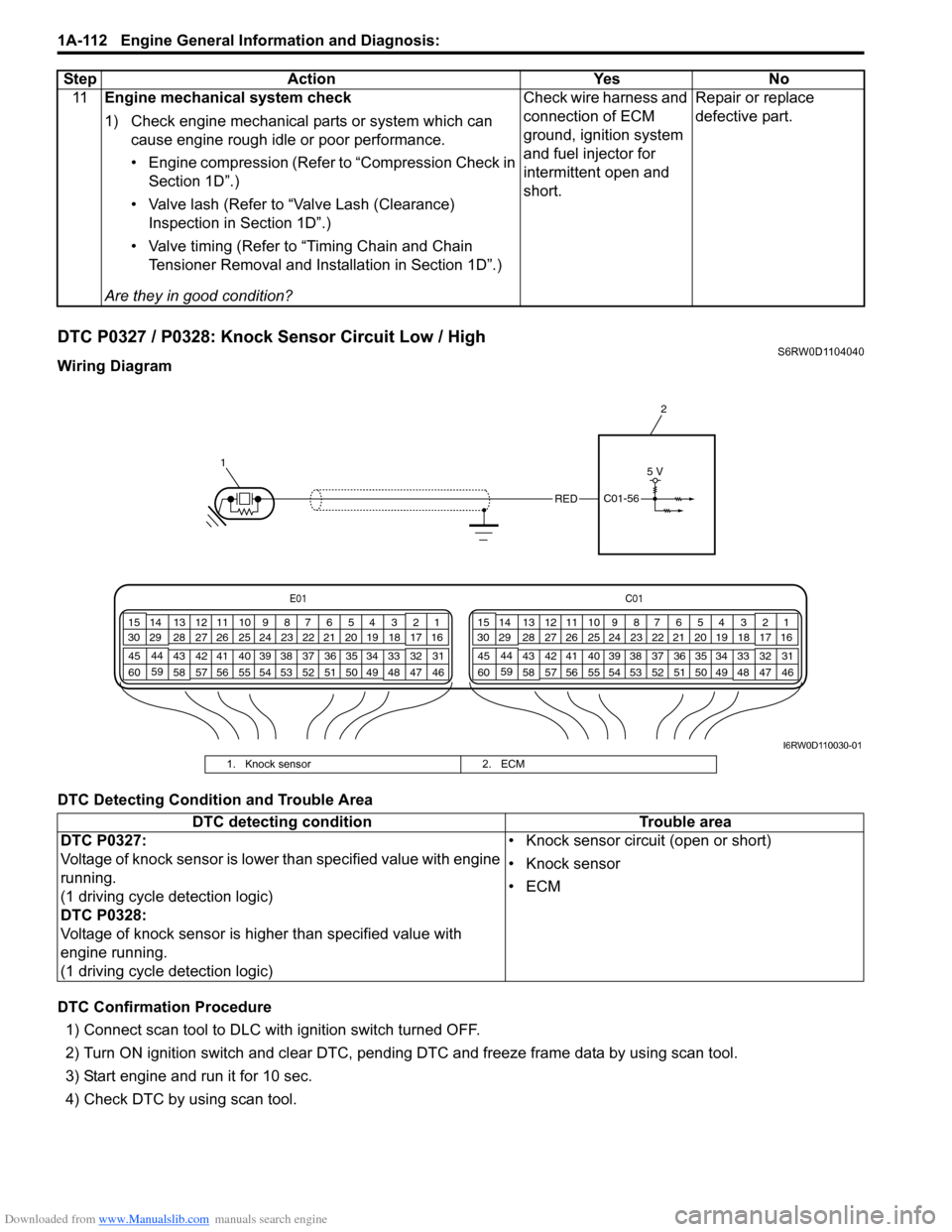
DTC P0327 / P0328: Knock Sensor Circuit Low / HighS6RW0D1104040
Wiring Diagram
DTC Detecting Condition and Trouble Area
DTC Confirmation Procedure
1) Connect scan tool to DLC with ignition switch turned OFF.
2) Turn ON ignition switch and clear DTC, pending DTC and freeze frame data by using scan tool.
3) Start engine and run it for 10 sec.
4) Check DTC by using scan tool.11Engine mechanical system check
1) Check engine mechanical parts or system which can
cause engine rough idle or poor performance.
• Engine compression (Refer to “Compression Check in
Section 1D”.)
• Valve lash (Refer to “Valve Lash (Clearance)
Inspection in Section 1D”.)
• Valve timing (Refer to “Timing Chain and Chain
Tensioner Removal and Installation in Section 1D”.)
Are they in good condition?Check wire harness and
connection of ECM
ground, ignition system
and fuel injector for
intermittent open and
short.Repair or replace
defective part. Step Action Yes No
E01C01
3 4
18 19 5 6 7 10 11
17 20
47 46 49 50 51 21 22
5216 259
24 14
29
55 57 54 53 59
60 582
26 27 28 15
30
56 4832 31 34 35 36 37 40 42 39 38 44
45 43 41 331 12 13
238 3 4
18 19 5 6 7 10 11
17 20
47 46 49 50 51 21 22
5216 259
24 14
29
55 57 54 53 59
60 582
26 27 28 15
30
56 4832 31 34 35 36 37 40 42 39 38 44
45 43 41 331 12 13
238
12
REDC01-56
5 V
I6RW0D110030-01
1. Knock sensor 2. ECM
DTC detecting condition Trouble area
DTC P0327:
Voltage of knock sensor is lower than specified value with engine
running.
(1 driving cycle detection logic)
DTC P0328:
Voltage of knock sensor is higher than specified value with
engine running.
(1 driving cycle detection logic)• Knock sensor circuit (open or short)
• Knock sensor
•ECM
Page 170 of 1556
Downloaded from www.Manualslib.com manuals search engine 1A-120 Engine General Information and Diagnosis:
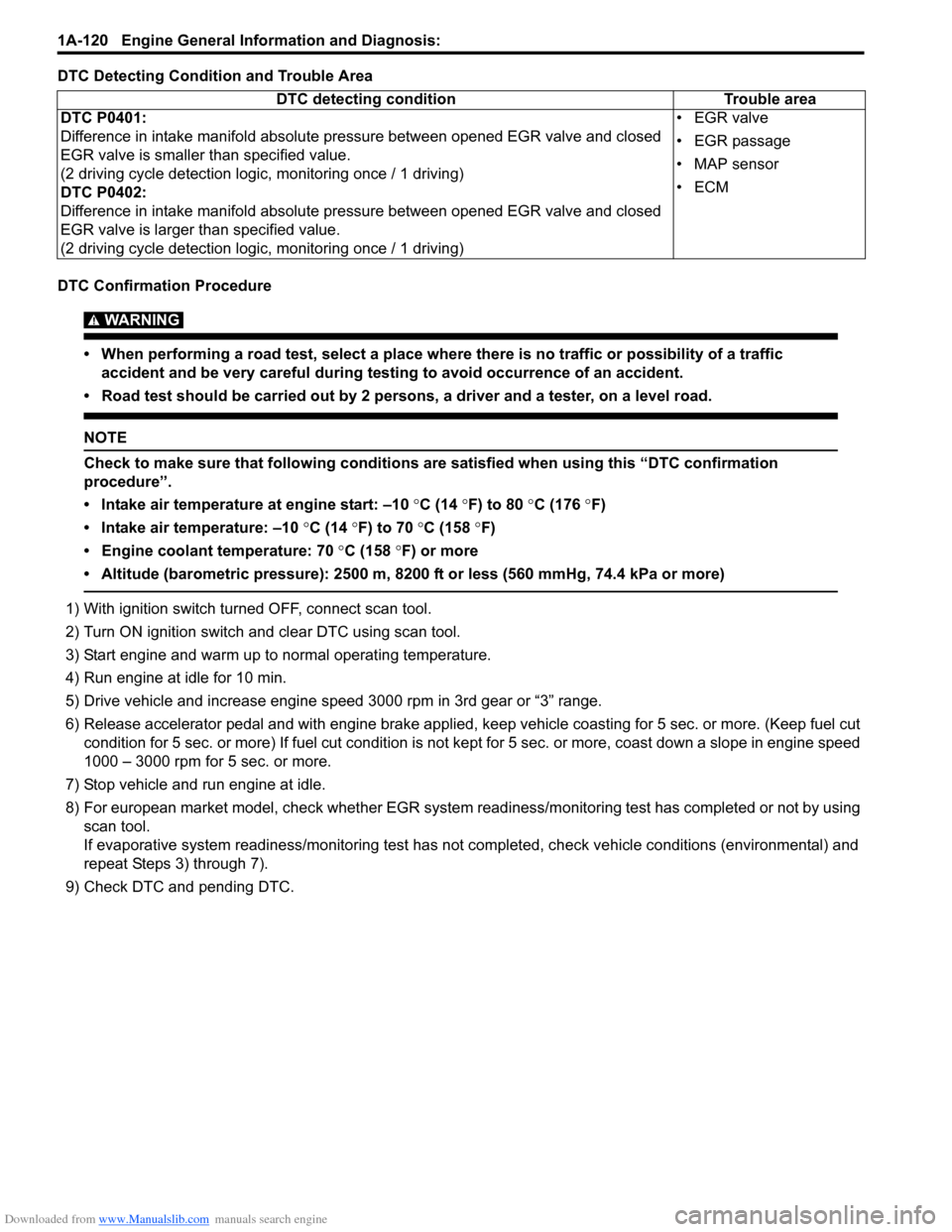
DTC Detecting Condition and Trouble Area
DTC Confirmation Procedure
WARNING!
• When performing a road test, select a place where there is no traffic or possibility of a traffic
accident and be very careful during testing to avoid occurrence of an accident.
• Road test should be carried out by 2 persons, a driver and a tester, on a level road.
NOTE
Check to make sure that following conditions are satisfied when using this “DTC confirmation
procedure”.
• Intake air temperature at engine start: –10 °C (14 °F) to 80 °C (176 °F)
• Intake air temperature: –10 °C (14 °F) to 70 °C (158 °F)
• Engine coolant temperature: 70 °C (158 °F) or more
• Altitude (barometric pressure): 2500 m, 8200 ft or less (560 mmHg, 74.4 kPa or more)
1) With ignition switch turned OFF, connect scan tool.
2) Turn ON ignition switch and clear DTC using scan tool.
3) Start engine and warm up to normal operating temperature.
4) Run engine at idle for 10 min.
5) Drive vehicle and increase engine speed 3000 rpm in 3rd gear or “3” range.
6) Release accelerator pedal and with engine brake applied, keep vehicle coasting for 5 sec. or more. (Keep fuel cut
condition for 5 sec. or more) If fuel cut condition is not kept for 5 sec. or more, coast down a slope in engine speed
1000 – 3000 rpm for 5 sec. or more.
7) Stop vehicle and run engine at idle.
8) For european market model, check whether EGR system readiness/monitoring test has completed or not by using
scan tool.
If evaporative system readiness/monitoring test has not completed, check vehicle conditions (environmental) and
repeat Steps 3) through 7).
9) Check DTC and pending DTC.DTC detecting condition Trouble area
DTC P0401:
Difference in intake manifold absolute pressure between opened EGR valve and closed
EGR valve is smaller than specified value.
(2 driving cycle detection logic, monitoring once / 1 driving)
DTC P0402:
Difference in intake manifold absolute pressure between opened EGR valve and closed
EGR valve is larger than specified value.
(2 driving cycle detection logic, monitoring once / 1 driving)• EGR valve
• EGR passage
• MAP sensor
•ECM
Page 171 of 1556
Downloaded from www.Manualslib.com manuals search engine Engine General Information and Diagnosis: 1A-121
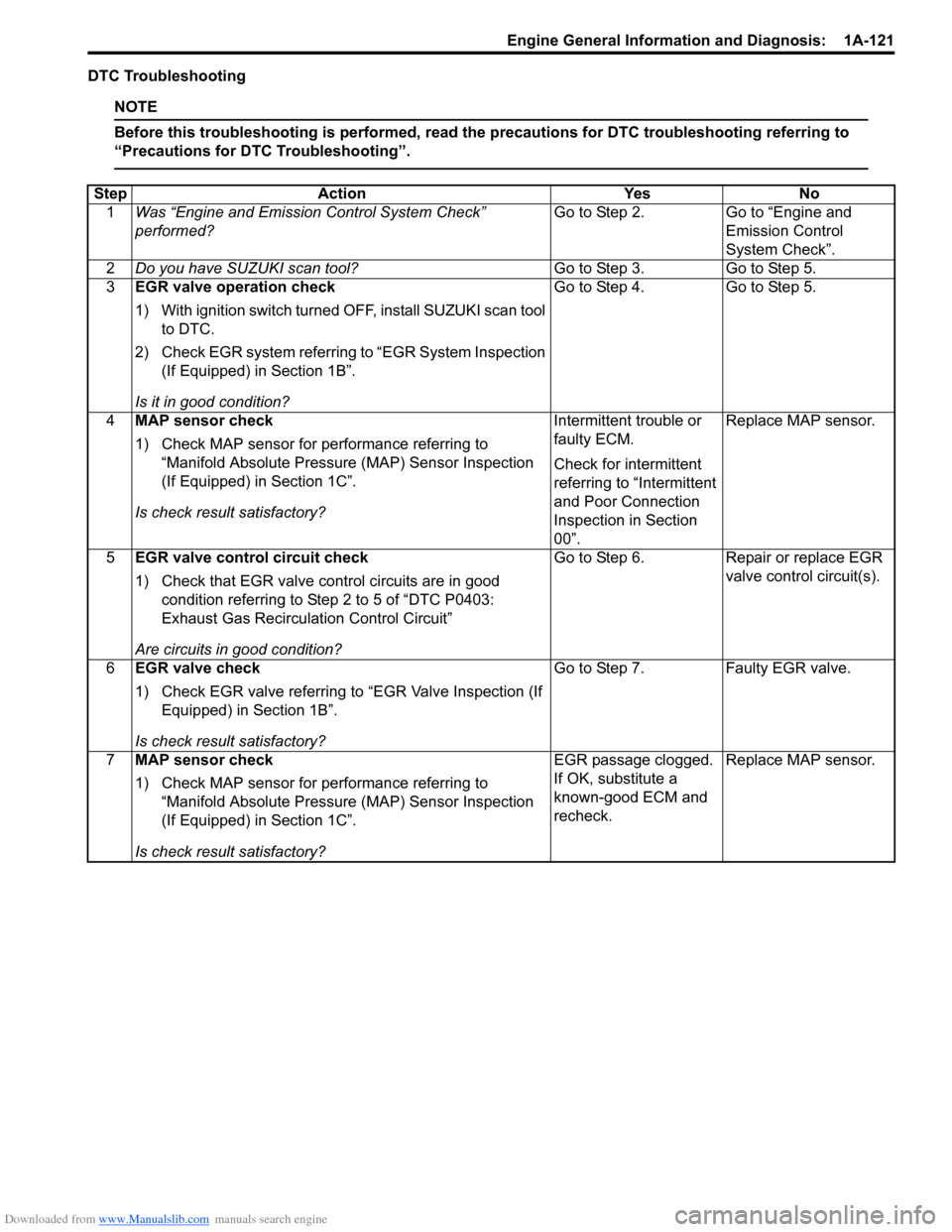
DTC Troubleshooting
NOTE
Before this troubleshooting is performed, read the precautions for DTC troubleshooting referring to
“Precautions for DTC Troubleshooting”.
Step Action Yes No
1Was “Engine and Emission Control System Check”
performed?Go to Step 2. Go to “Engine and
Emission Control
System Check”.
2Do you have SUZUKI scan tool?Go to Step 3. Go to Step 5.
3EGR valve operation check
1) With ignition switch turned OFF, install SUZUKI scan tool
to DTC.
2) Check EGR system referring to “EGR System Inspection
(If Equipped) in Section 1B”.
Is it in good condition?Go to Step 4. Go to Step 5.
4MAP sensor check
1) Check MAP sensor for performance referring to
“Manifold Absolute Pressure (MAP) Sensor Inspection
(If Equipped) in Section 1C”.
Is check result satisfactory?Intermittent trouble or
faulty ECM.
Check for intermittent
referring to “Intermittent
and Poor Connection
Inspection in Section
00”.Replace MAP sensor.
5EGR valve control circuit check
1) Check that EGR valve control circuits are in good
condition referring to Step 2 to 5 of “DTC P0403:
Exhaust Gas Recirculation Control Circuit”
Are circuits in good condition?Go to Step 6. Repair or replace EGR
valve control circuit(s).
6EGR valve check
1) Check EGR valve referring to “EGR Valve Inspection (If
Equipped) in Section 1B”.
Is check result satisfactory?Go to Step 7. Faulty EGR valve.
7MAP sensor check
1) Check MAP sensor for performance referring to
“Manifold Absolute Pressure (MAP) Sensor Inspection
(If Equipped) in Section 1C”.
Is check result satisfactory?EGR passage clogged.
If OK, substitute a
known-good ECM and
recheck.Replace MAP sensor.
Page 175 of 1556
Downloaded from www.Manualslib.com manuals search engine Engine General Information and Diagnosis: 1A-125
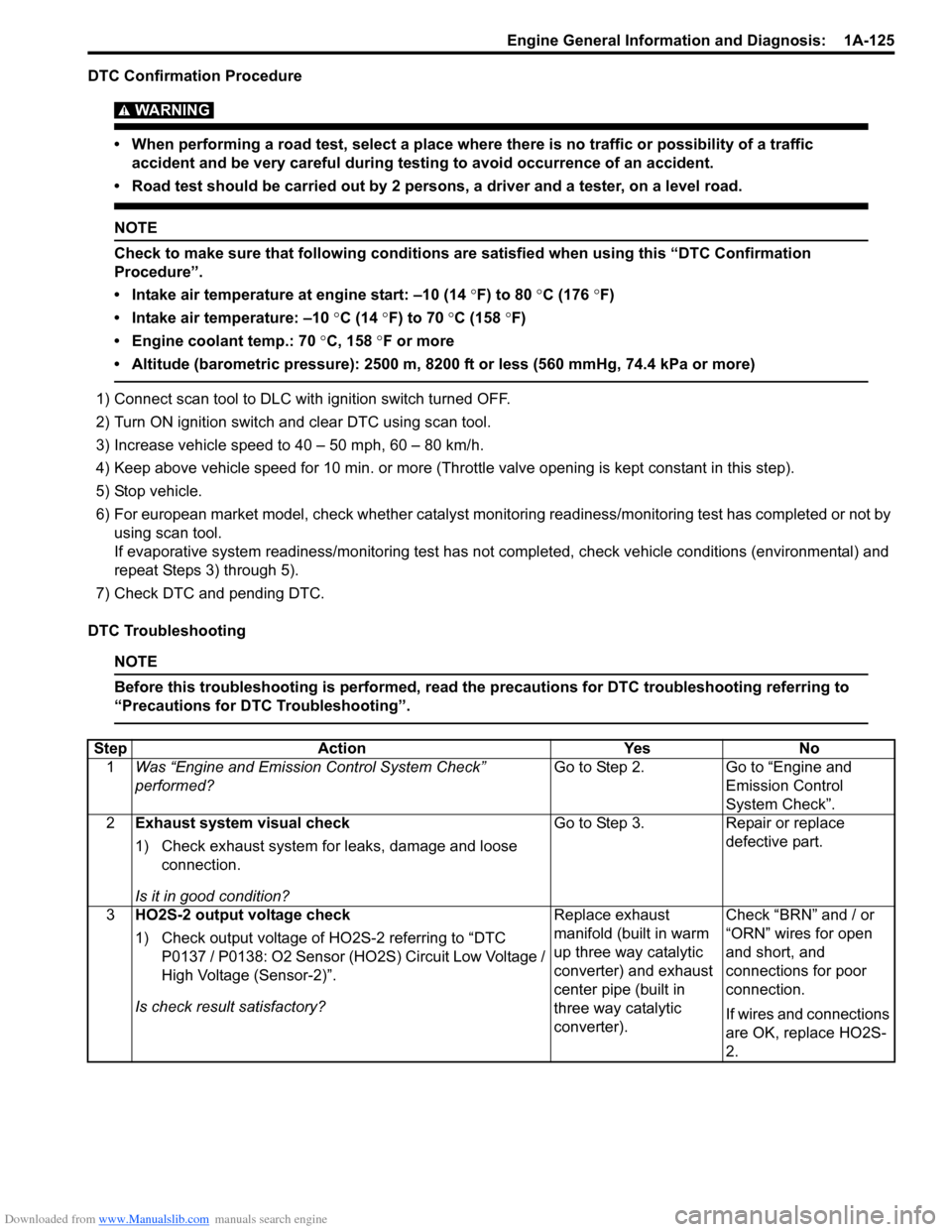
DTC Confirmation Procedure
WARNING!
• When performing a road test, select a place where there is no traffic or possibility of a traffic
accident and be very careful during testing to avoid occurrence of an accident.
• Road test should be carried out by 2 persons, a driver and a tester, on a level road.
NOTE
Check to make sure that following conditions are satisfied when using this “DTC Confirmation
Procedure”.
• Intake air temperature at engine start: –10 (14 °F) to 80 °C (176 °F)
• Intake air temperature: –10 °C (14 °F) to 70 °C (158 °F)
• Engine coolant temp.: 70 °C, 158 °F or more
• Altitude (barometric pressure): 2500 m, 8200 ft or less (560 mmHg, 74.4 kPa or more)
1) Connect scan tool to DLC with ignition switch turned OFF.
2) Turn ON ignition switch and clear DTC using scan tool.
3) Increase vehicle speed to 40 – 50 mph, 60 – 80 km/h.
4) Keep above vehicle speed for 10 min. or more (Throttle valve opening is kept constant in this step).
5) Stop vehicle.
6) For european market model, check whether catalyst monitoring readiness/monitoring test has completed or not by
using scan tool.
If evaporative system readiness/monitoring test has not completed, check vehicle conditions (environmental) and
repeat Steps 3) through 5).
7) Check DTC and pending DTC.
DTC Troubleshooting
NOTE
Before this troubleshooting is performed, read the precautions for DTC troubleshooting referring to
“Precautions for DTC Troubleshooting”.
Step Action Yes No
1Was “Engine and Emission Control System Check”
performed?Go to Step 2. Go to “Engine and
Emission Control
System Check”.
2Exhaust system visual check
1) Check exhaust system for leaks, damage and loose
connection.
Is it in good condition?Go to Step 3. Repair or replace
defective part.
3HO2S-2 output voltage check
1) Check output voltage of HO2S-2 referring to “DTC
P0137 / P0138: O2 Sensor (HO2S) Circuit Low Voltage /
High Voltage (Sensor-2)”.
Is check result satisfactory?Replace exhaust
manifold (built in warm
up three way catalytic
converter) and exhaust
center pipe (built in
three way catalytic
converter).Check “BRN” and / or
“ORN” wires for open
and short, and
connections for poor
connection.
If wires and connections
are OK, replace HO2S-
2.
Page 179 of 1556
Downloaded from www.Manualslib.com manuals search engine Engine General Information and Diagnosis: 1A-129
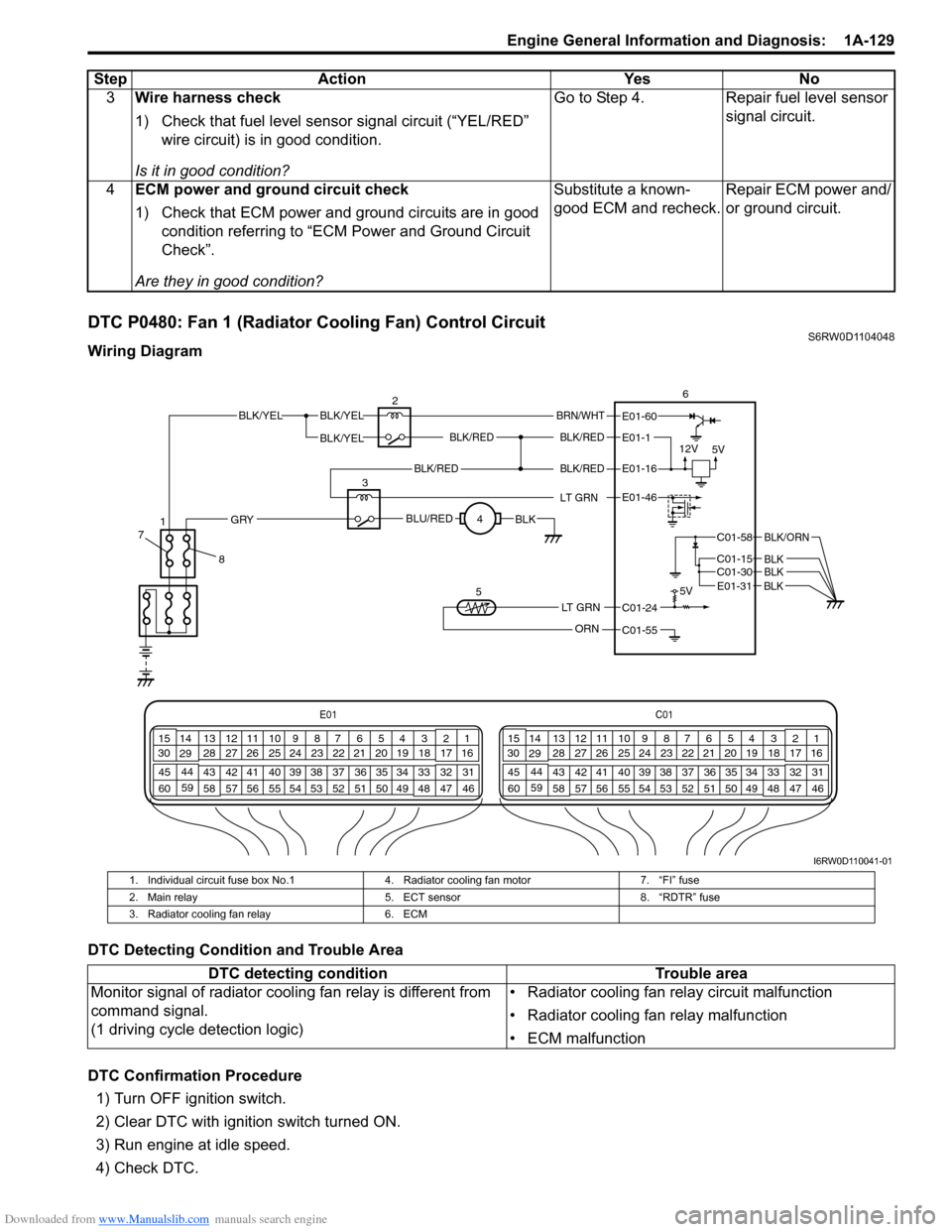
DTC P0480: Fan 1 (Radiator Cooling Fan) Control CircuitS6RW0D1104048
Wiring Diagram
DTC Detecting Condition and Trouble Area
DTC Confirmation Procedure
1) Turn OFF ignition switch.
2) Clear DTC with ignition switch turned ON.
3) Run engine at idle speed.
4) Check DTC.3Wire harness check
1) Check that fuel level sensor signal circuit (“YEL/RED”
wire circuit) is in good condition.
Is it in good condition?Go to Step 4. Repair fuel level sensor
signal circuit.
4ECM power and ground circuit check
1) Check that ECM power and ground circuits are in good
condition referring to “ECM Power and Ground Circuit
Check”.
Are they in good condition?Substitute a known-
good ECM and recheck.Repair ECM power and/
or ground circuit. Step Action Yes No
E01C01
3 4
18 19 5 6 7 10 11
17 20
47 46 49 50 51 21 22
5216 259
24 14
29
55 57 54 53 59
60 582
26 27 28 15
30
56 4832 31 34 35 36 37 40 42 39 38 44
45 43 41 331 12 13
238 3 4
18 19 5 6 7 10 11
17 20
47 46 49 50 51 21 22
5216 259
24 14
29
55 57 54 53 59
60 582
26 27 28 15
30
56 4832 31 34 35 36 37 40 42 39 38 44
45 43 41 331 12 13
238
BLK/REDBLK/RED
BLK/YELBLK/YEL
BLK/YEL
BRN/WHT
12V
5V5V
26
E01-1
E01-60
C01-58
C01-15 C01-30
BLK/ORN
BLKBLK
BLK/RED
LT GRN
BLK/REDE01-16
E01-46
BLU/REDBLKGRY
LT GRN
ORN
C01-24
C01-55 3
4
5
E01-31 BLK
8 71
I6RW0D110041-01
1. Individual circuit fuse box No.1 4. Radiator cooling fan motor 7. “FI” fuse
2. Main relay 5. ECT sensor 8. “RDTR” fuse
3. Radiator cooling fan relay 6. ECM
DTC detecting condition Trouble area
Monitor signal of radiator cooling fan relay is different from
command signal.
(1 driving cycle detection logic)• Radiator cooling fan relay circuit malfunction
• Radiator cooling fan relay malfunction
• ECM malfunction
Page 182 of 1556
Downloaded from www.Manualslib.com manuals search engine 1A-132 Engine General Information and Diagnosis:
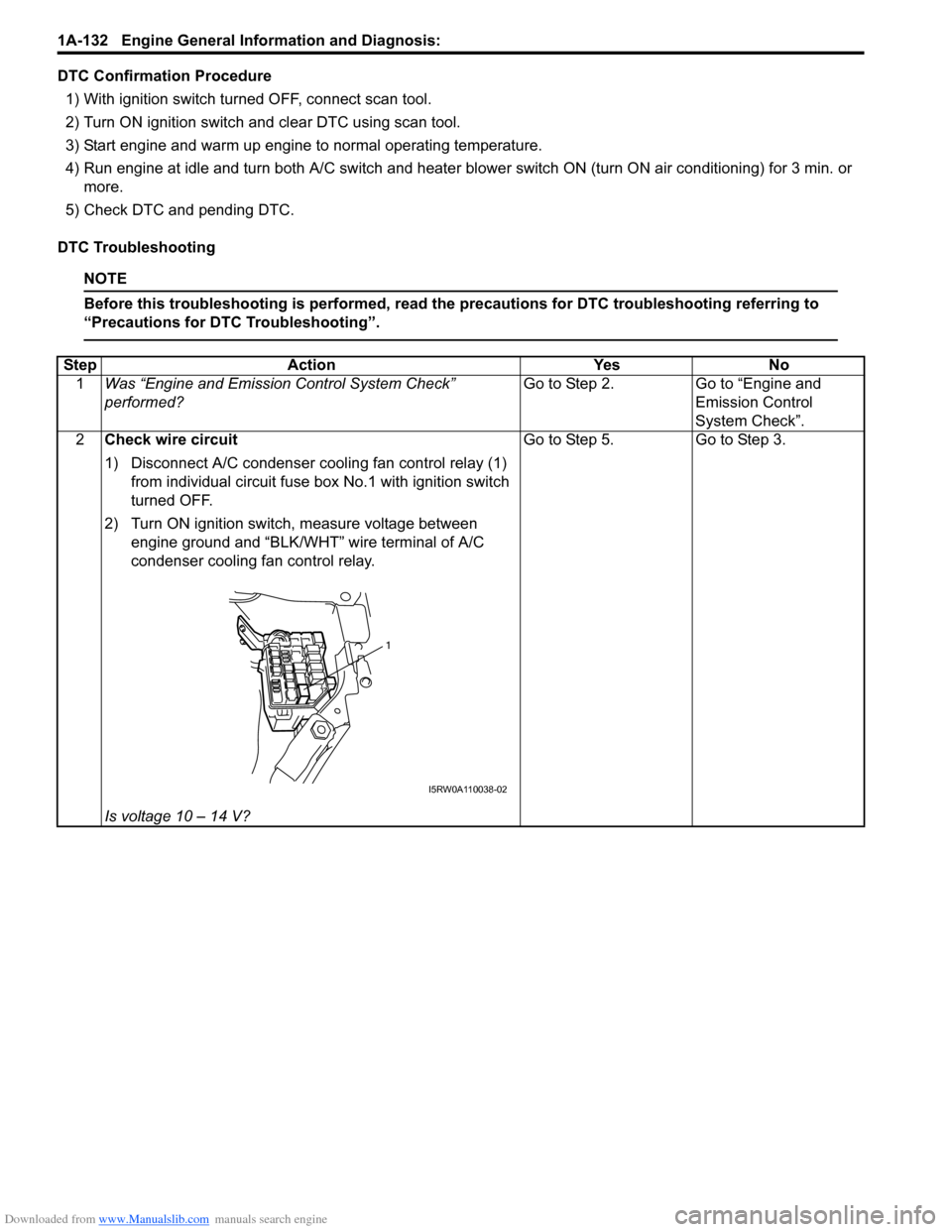
DTC Confirmation Procedure
1) With ignition switch turned OFF, connect scan tool.
2) Turn ON ignition switch and clear DTC using scan tool.
3) Start engine and warm up engine to normal operating temperature.
4) Run engine at idle and turn both A/C switch and heater blower switch ON (turn ON air conditioning) for 3 min. or
more.
5) Check DTC and pending DTC.
DTC Troubleshooting
NOTE
Before this troubleshooting is performed, read the precautions for DTC troubleshooting referring to
“Precautions for DTC Troubleshooting”.
Step Action Yes No
1Was “Engine and Emission Control System Check”
performed?Go to Step 2. Go to “Engine and
Emission Control
System Check”.
2Check wire circuit
1) Disconnect A/C condenser cooling fan control relay (1)
from individual circuit fuse box No.1 with ignition switch
turned OFF.
2) Turn ON ignition switch, measure voltage between
engine ground and “BLK/WHT” wire terminal of A/C
condenser cooling fan control relay.
Is voltage 10 – 14 V?Go to Step 5. Go to Step 3.
1
I5RW0A110038-02
Page 186 of 1556
Downloaded from www.Manualslib.com manuals search engine 1A-136 Engine General Information and Diagnosis:
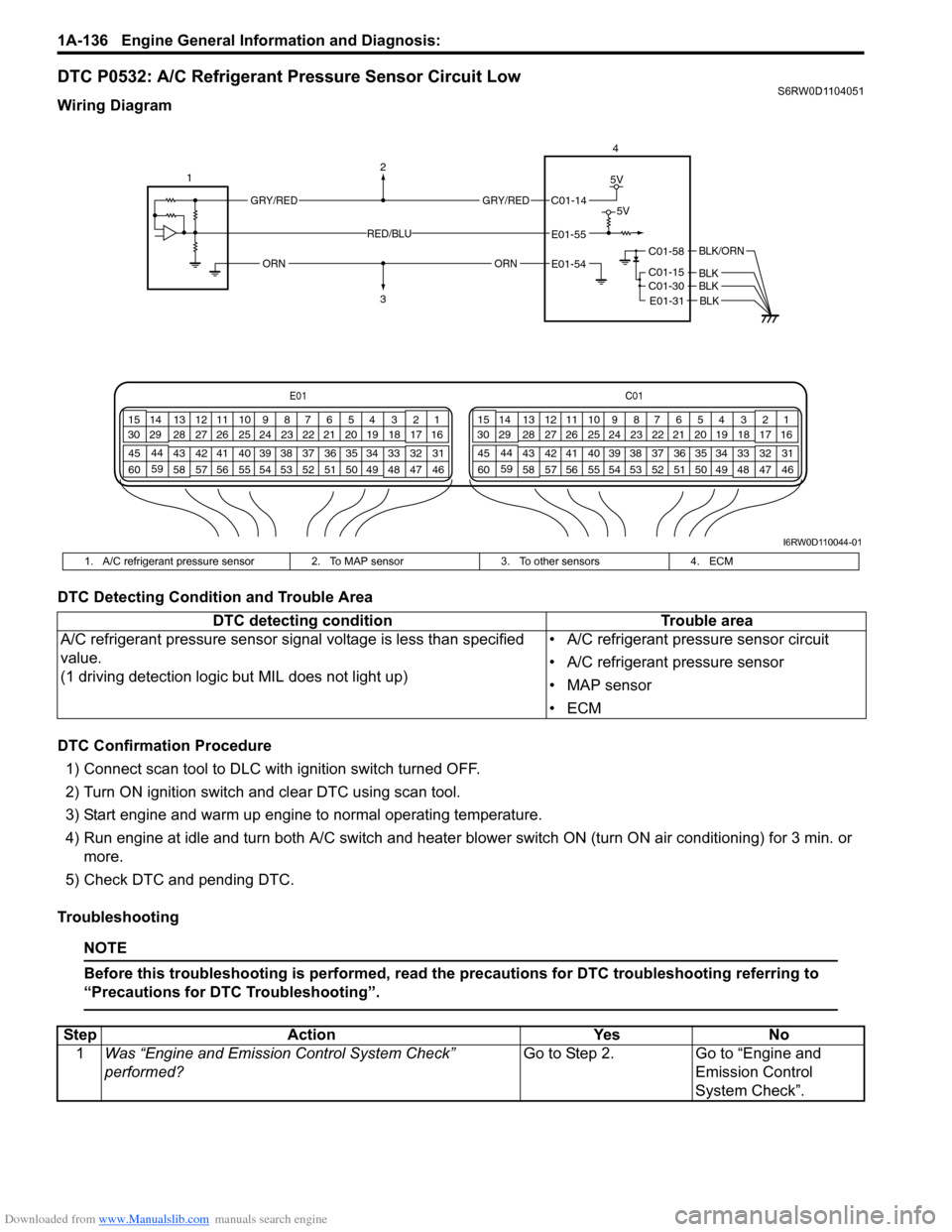
DTC P0532: A/C Refrigerant Pressure Sensor Circuit LowS6RW0D1104051
Wiring Diagram
DTC Detecting Condition and Trouble Area
DTC Confirmation Procedure
1) Connect scan tool to DLC with ignition switch turned OFF.
2) Turn ON ignition switch and clear DTC using scan tool.
3) Start engine and warm up engine to normal operating temperature.
4) Run engine at idle and turn both A/C switch and heater blower switch ON (turn ON air conditioning) for 3 min. or
more.
5) Check DTC and pending DTC.
Troubleshooting
NOTE
Before this troubleshooting is performed, read the precautions for DTC troubleshooting referring to
“Precautions for DTC Troubleshooting”.
E01C01
3 4
18 19 5 6 7 10 11
17 20
47 46 49 50 51 21 22
5216 259
24 14
29
55 57 54 53 59
60 582
26 27 28 15
30
56 4832 31 34 35 36 37 40 42 39 38 44
45 43 41 331 12 13
238 3 4
18 19 5 6 7 10 11
17 20
47 46 49 50 51 21 22
5216 259
24 14
29
55 57 54 53 59
60 582
26 27 28 15
30
56 4832 31 34 35 36 37 40 42 39 38 44
45 43 41 331 12 13
238
4
C01-58
C01-15 C01-30
BLK/ORN
BLKBLK
12
3
GRY/REDGRY/RED
ORNORN
5V
5VC01-14
E01-55
E01-54
RED/BLU
E01-31 BLK
I6RW0D110044-01
1. A/C refrigerant pressure sensor 2. To MAP sensor 3. To other sensors 4. ECM
DTC detecting condition Trouble area
A/C refrigerant pressure sensor signal voltage is less than specified
value.
(1 driving detection logic but MIL does not light up)• A/C refrigerant pressure sensor circuit
• A/C refrigerant pressure sensor
• MAP sensor
•ECM
Step Action Yes No
1Was “Engine and Emission Control System Check”
performed?Go to Step 2. Go to “Engine and
Emission Control
System Check”.
Page 188 of 1556
Downloaded from www.Manualslib.com manuals search engine 1A-138 Engine General Information and Diagnosis:
DTC P0533: A/C Refrigerant Pressure Sensor Circuit HighS6RW0D1104052
Wiring Diagram
Refer to “DTC P0532: A/C Refrigerant Pressure Sensor Circuit Low”.
DTC Detecting Condition and Trouble Area
DTC Confirmation Procedure
1) Connect scan tool to DLC with ignition switch turned OFF.
2) Turn ON ignition switch and clear DTC using scan tool.
3) Start engine and warm up engine to normal operating temperature.
4) Run engine at idle and turn both A/C switch and heater blower switch ON (turn ON air conditioning) for 3 min. or
more.
5) Check DTC and pending DTC.
Troubleshooting
NOTE
Before this troubleshooting is performed, read the precautions for DTC troubleshooting referring to
“Precautions for DTC Troubleshooting”.
DTC detecting condition Trouble area
A/C refrigerant pressure sensor signal voltage is higher than specified
value.
(1 driving detection logic but MIL does not light up)• A/C refrigerant pressure sensor circuit
• A/C refrigerant pressure sensor
• MAP sensor
•ECM
Step Action Yes No
1Was “Engine and Emission Control System Check”
performed?Go to Step 2. Go to “Engine and
Emission Control
System Check”.
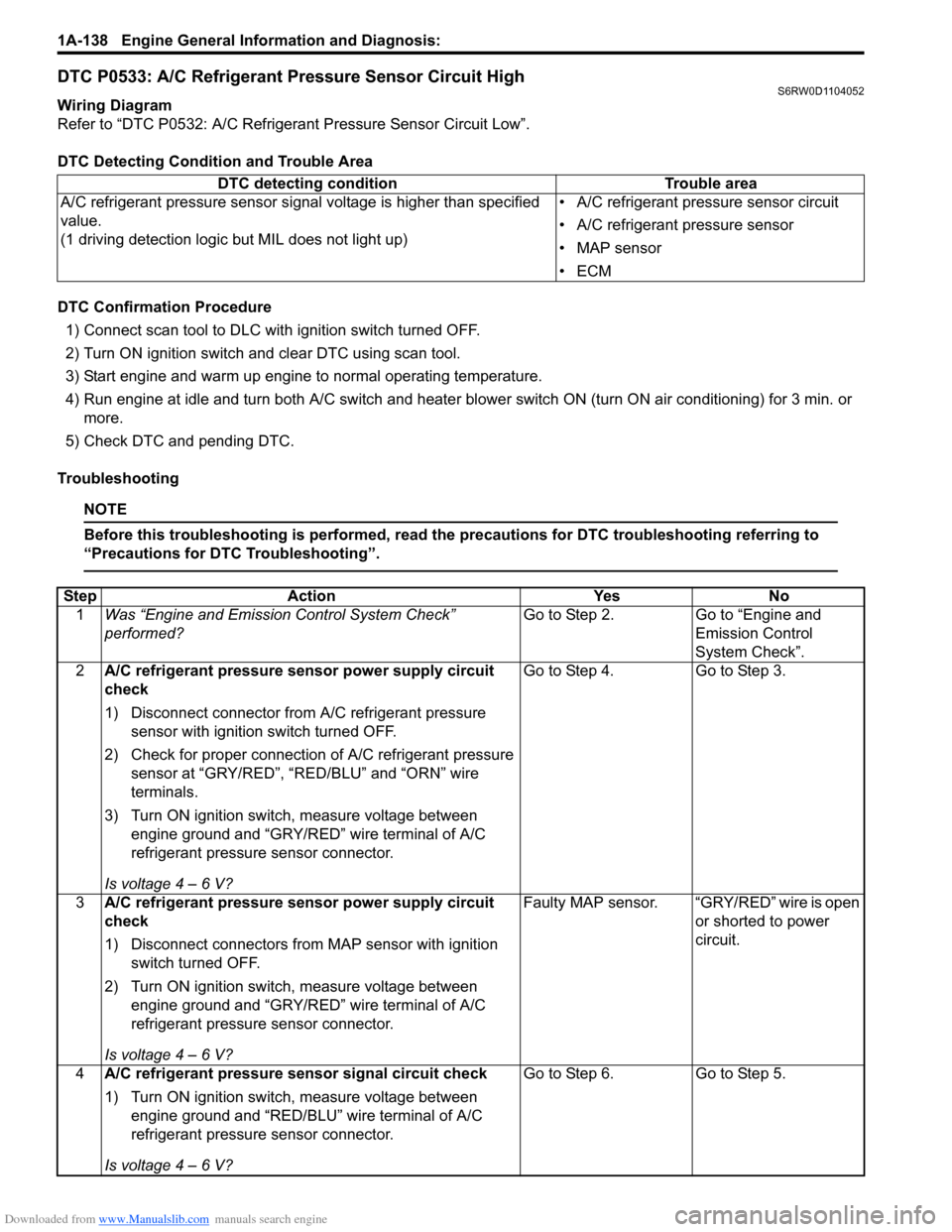
2A/C refrigerant pressure sensor power supply circuit
check
1) Disconnect connector from A/C refrigerant pressure
sensor with ignition switch turned OFF.
2) Check for proper connection of A/C refrigerant pressure
sensor at “GRY/RED”, “RED/BLU” and “ORN” wire
terminals.
3) Turn ON ignition switch, measure voltage between
engine ground and “GRY/RED” wire terminal of A/C
refrigerant pressure sensor connector.
Is voltage 4 – 6 V?Go to Step 4. Go to Step 3.
3A/C refrigerant pressure sensor power supply circuit
check
1) Disconnect connectors from MAP sensor with ignition
switch turned OFF.
2) Turn ON ignition switch, measure voltage between
engine ground and “GRY/RED” wire terminal of A/C
refrigerant pressure sensor connector.
Is voltage 4 – 6 V?Faulty MAP sensor. “GRY/RED” wire is open
or shorted to power
circuit.
4A/C refrigerant pressure sensor signal circuit check
1) Turn ON ignition switch, measure voltage between
engine ground and “RED/BLU” wire terminal of A/C
refrigerant pressure sensor connector.
Is voltage 4 – 6 V?Go to Step 6. Go to Step 5.