warning SUZUKI SX4 2006 1.G Service Repair Manual
[x] Cancel search | Manufacturer: SUZUKI, Model Year: 2006, Model line: SX4, Model: SUZUKI SX4 2006 1.GPages: 1556, PDF Size: 37.31 MB
Page 390 of 1556
Downloaded from www.Manualslib.com manuals search engine 1G-13 Fuel System:
Fuel Tank Removal and InstallationS6RW0D1706011
WARNING!
Before starting the following procedure, be
sure to observe “Precautions on Fuel System
Service” in order to reduce the risk of fire and
personal injury.
Removal
1) Relieve fuel pressure in fuel feed line according to
“Fuel Pressure Relief Procedure”.
2) Disconnect negative cable at battery.
3) Remove fuel filler cap.
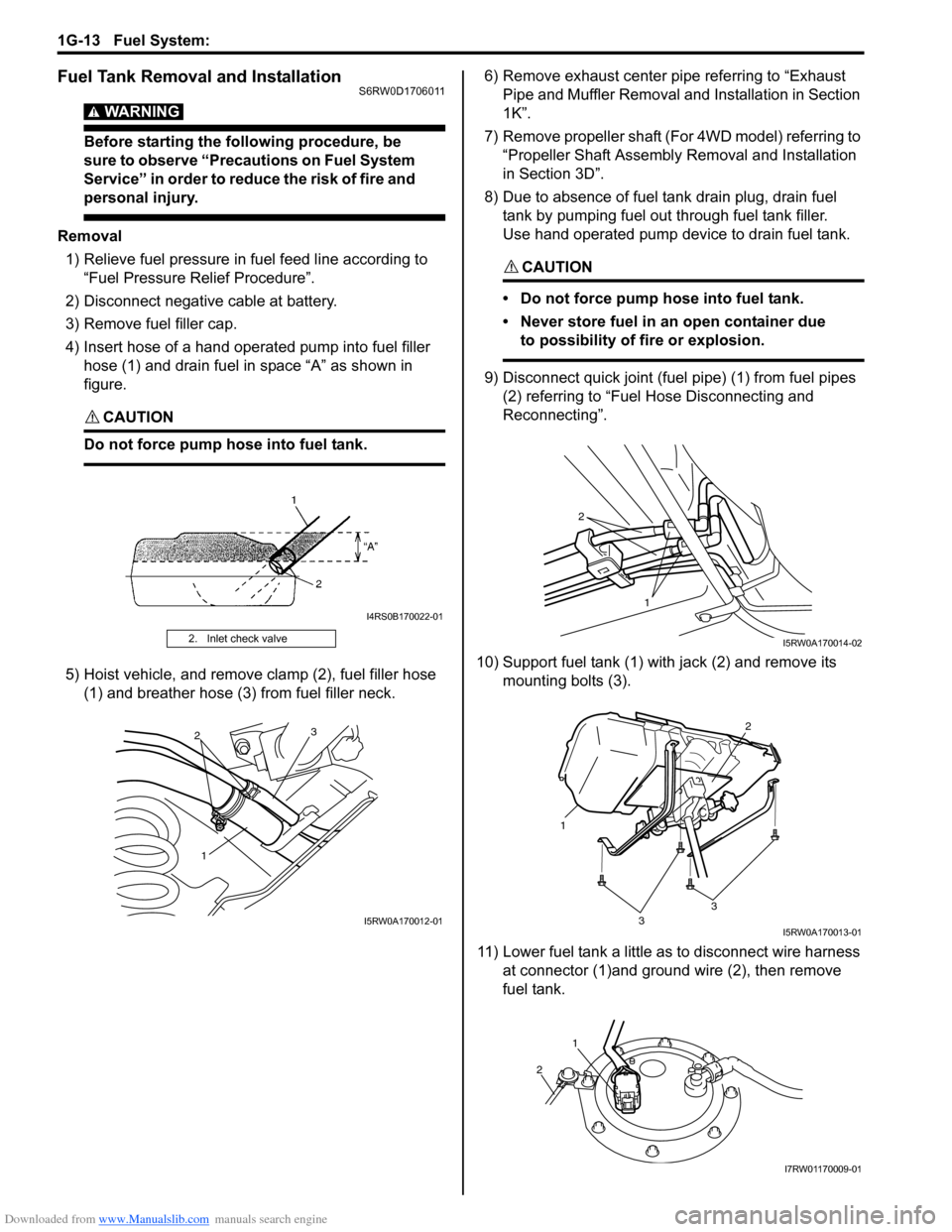
4) Insert hose of a hand operated pump into fuel filler
hose (1) and drain fuel in space “A” as shown in
figure.
CAUTION!
Do not force pump hose into fuel tank.
5) Hoist vehicle, and remove clamp (2), fuel filler hose
(1) and breather hose (3) from fuel filler neck.6) Remove exhaust center pipe referring to “Exhaust
Pipe and Muffler Removal and Installation in Section
1K”.
7) Remove propeller shaft (For 4WD model) referring to
“Propeller Shaft Assembly Removal and Installation
in Section 3D”.
8) Due to absence of fuel tank drain plug, drain fuel
tank by pumping fuel out through fuel tank filler.
Use hand operated pump device to drain fuel tank.
CAUTION!
• Do not force pump hose into fuel tank.
• Never store fuel in an open container due
to possibility of fire or explosion.
9) Disconnect quick joint (fuel pipe) (1) from fuel pipes
(2) referring to “Fuel Hose Disconnecting and
Reconnecting”.
10) Support fuel tank (1) with jack (2) and remove its
mounting bolts (3).
11) Lower fuel tank a little as to disconnect wire harness
at connector (1)and ground wire (2), then remove
fuel tank.
2. Inlet check valve
I4RS0B170022-01
1 23
I5RW0A170012-01
2
1
I5RW0A170014-02
1
2
33
I5RW0A170013-01
1
2
I7RW01170009-01
Page 392 of 1556
Downloaded from www.Manualslib.com manuals search engine 1G-15 Fuel System:
Fuel Tank Purging ProcedureS6RW0D1706013
WARNING!
• Before starting the following procedure, be
sure to observe “Precautions on Fuel
System Service” in order to reduce the risk
of fire and personal injury.
• This purging procedure will not remove all
fuel vapor.
Do not attempt any repair on tank using
heat of flame as an explosion resulting in
personal injury could occur.
CAUTION!
Never remain water in fuel tank after washing,
or fuel tank inside will get corrosion.
The following procedure are used for purging fuel tank.
1) After removing fuel tank, remove all hoses, pipes
and fuel pump assembly from fuel tank.
2) Drain all remaining fuel from tank.
3) Place fuel tank to flushing area.
4) Fill tank with warm water or tap water, and agitate
vigorously and drain. Repeat this washing until
inside of tank is clean. Replace tank if its inside is
rusty.
5) Completely flush out remaining water after washing.
6) Be sure to dry fuel tank assembly thoroughly out of
direct sunlight after washing.
Fuel Pump On-Vehicle InspectionS6RW0D1706014
WARNING!
Before starting the following procedure, be
sure to observe “Precautions on Fuel System
Service” in order to reduce the risk of fire and
personal injury.
NOTE
The fuel pressure regulator is incorporated
with the fuel pump assembly so individual
inspection of it is impossible.
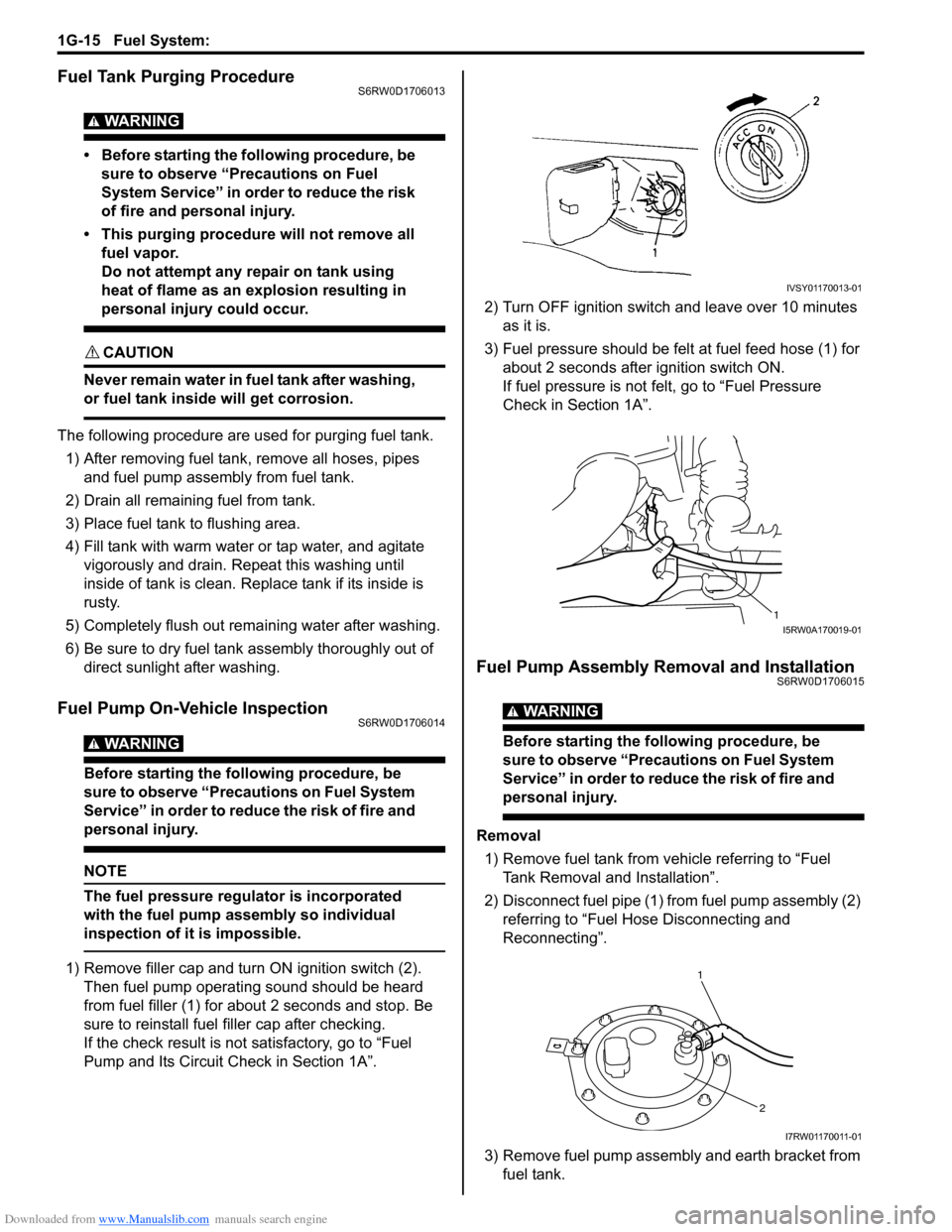
1) Remove filler cap and turn ON ignition switch (2).
Then fuel pump operating sound should be heard
from fuel filler (1) for about 2 seconds and stop. Be
sure to reinstall fuel filler cap after checking.
If the check result is not satisfactory, go to “Fuel
Pump and Its Circuit Check in Section 1A”.2) Turn OFF ignition switch and leave over 10 minutes
as it is.
3) Fuel pressure should be felt at fuel feed hose (1) for
about 2 seconds after ignition switch ON.
If fuel pressure is not felt, go to “Fuel Pressure
Check in Section 1A”.
Fuel Pump Assembly Removal and InstallationS6RW0D1706015
WARNING!
Before starting the following procedure, be
sure to observe “Precautions on Fuel System
Service” in order to reduce the risk of fire and
personal injury.
Removal
1) Remove fuel tank from vehicle referring to “Fuel
Tank Removal and Installation”.
2) Disconnect fuel pipe (1) from fuel pump assembly (2)
referring to “Fuel Hose Disconnecting and
Reconnecting”.
3) Remove fuel pump assembly and earth bracket from
fuel tank.
IVSY01170013-01
1I5RW0A170019-01
1
2
I7RW01170011-01
Page 401 of 1556
Downloaded from www.Manualslib.com manuals search engine Ignition System: 1H-6
Ignition Spark TestS6RW0D1804004
1) Remove air cleaner assembly with air intake pipe.
2) Disconnect all injector couplers from injectors.
WARNING!
Without disconnection of injector couplers,
combustible gas may come out from spark
plug holes during this test and may get
ignited in engine room.
3) Remove spark plug and check it for condition and
type referring to “Spark Plug Inspection”.
4) If OK, connect ignition coil coupler to ignition coil
assembly and connect spark plug to ignition coil
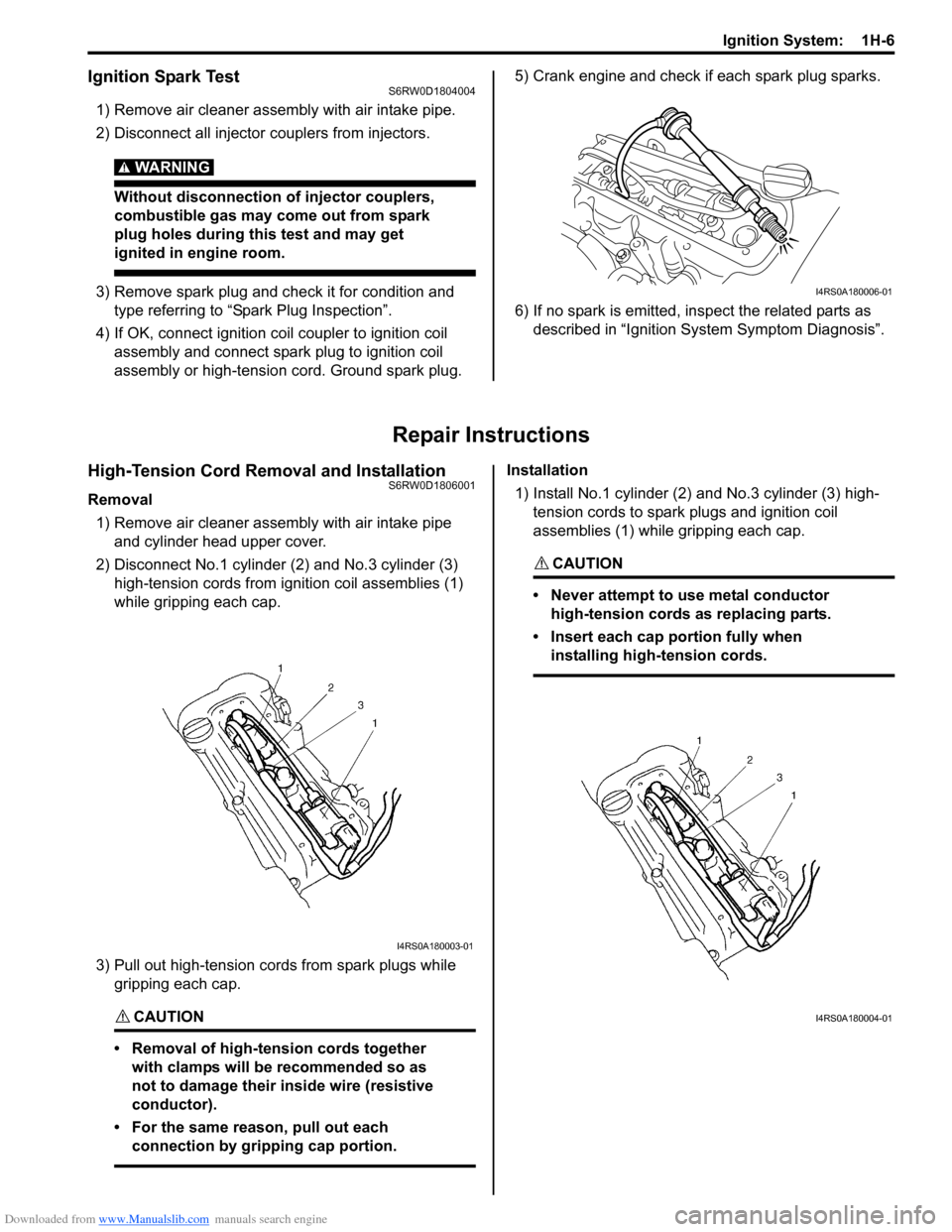
assembly or high-tension cord. Ground spark plug.5) Crank engine and check if each spark plug sparks.
6) If no spark is emitted, inspect the related parts as
described in “Ignition System Symptom Diagnosis”.
Repair Instructions
High-Tension Cord Removal and InstallationS6RW0D1806001
Removal
1) Remove air cleaner assembly with air intake pipe
and cylinder head upper cover.
2) Disconnect No.1 cylinder (2) and No.3 cylinder (3)
high-tension cords from ignition coil assemblies (1)
while gripping each cap.
3) Pull out high-tension cords from spark plugs while
gripping each cap.
CAUTION!
• Removal of high-tension cords together
with clamps will be recommended so as
not to damage their inside wire (resistive
conductor).
• For the same reason, pull out each
connection by gripping cap portion.
Installation
1) Install No.1 cylinder (2) and No.3 cylinder (3) high-
tension cords to spark plugs and ignition coil
assemblies (1) while gripping each cap.
CAUTION!
• Never attempt to use metal conductor
high-tension cords as replacing parts.
• Insert each cap portion fully when
installing high-tension cords.
I4RS0A180006-01
I4RS0A180003-01
I4RS0A180004-01
Page 416 of 1556
Downloaded from www.Manualslib.com manuals search engine 1J-2 Charging System:
Care of battery
WARNING!
• Never expose battery to open flame or electric spark because of battery generate gas which is
flammable and explosive.
• Do not allow battery fluid to contact eyes, skin, fabrics, or painted surfaces as fluid is a corrosive
acid. Flush any contacted area with water immediately and thoroughly.
• Batteries should always be kept out of reach of children.
1) The battery is a very reliable component, but needs periodical attentions.
• Keep the battery carrier clean.
• Prevent rust formation on the terminal posts.
• Keep the electrolyte up to the upper level uniformly in all cells.
• When keeping battery on vehicle over a long period of time, follow instructions given below.
– Weekly, start the engine and run it until it reaches normal operating temperature with engine speed of 2000 to
3000 rpm. Make sure all electric switches are off before storing the vehicle.
– Recharge the battery twice a month to prevent it from discharging excessively. This is especially important
when ambient temperature is low.
The battery discharges even when it is not used, while vehicles are being stored. Battery electrolyte can
freeze and battery case can crack at cold ambient condition if battery is not properly charged.
2) Keep the battery cable connections clean.
The cable connections, particularly at the positive (+) terminal post, tend to become corroded. The product of
corrosion, or rust, on the mating faces of conductors resists the flow of current.
Clean the terminals and fittings periodically to ensure good metal-to-metal contact, and grease the connections
after each cleaning to protect them against rusting.
3) Be always in the know as to the state of charge of the battery. The simplest way to tell the state of charge is to
carry out a hydrometer test. The hydrometer is an instrument for measuring the specific gravity (S.G.) of the
battery electrolyte. The S.G. of the electrolyte is indicative of the state of charge. Refer to “Battery Inspection”.
Page 420 of 1556
Downloaded from www.Manualslib.com manuals search engine 1J-6 Charging System:
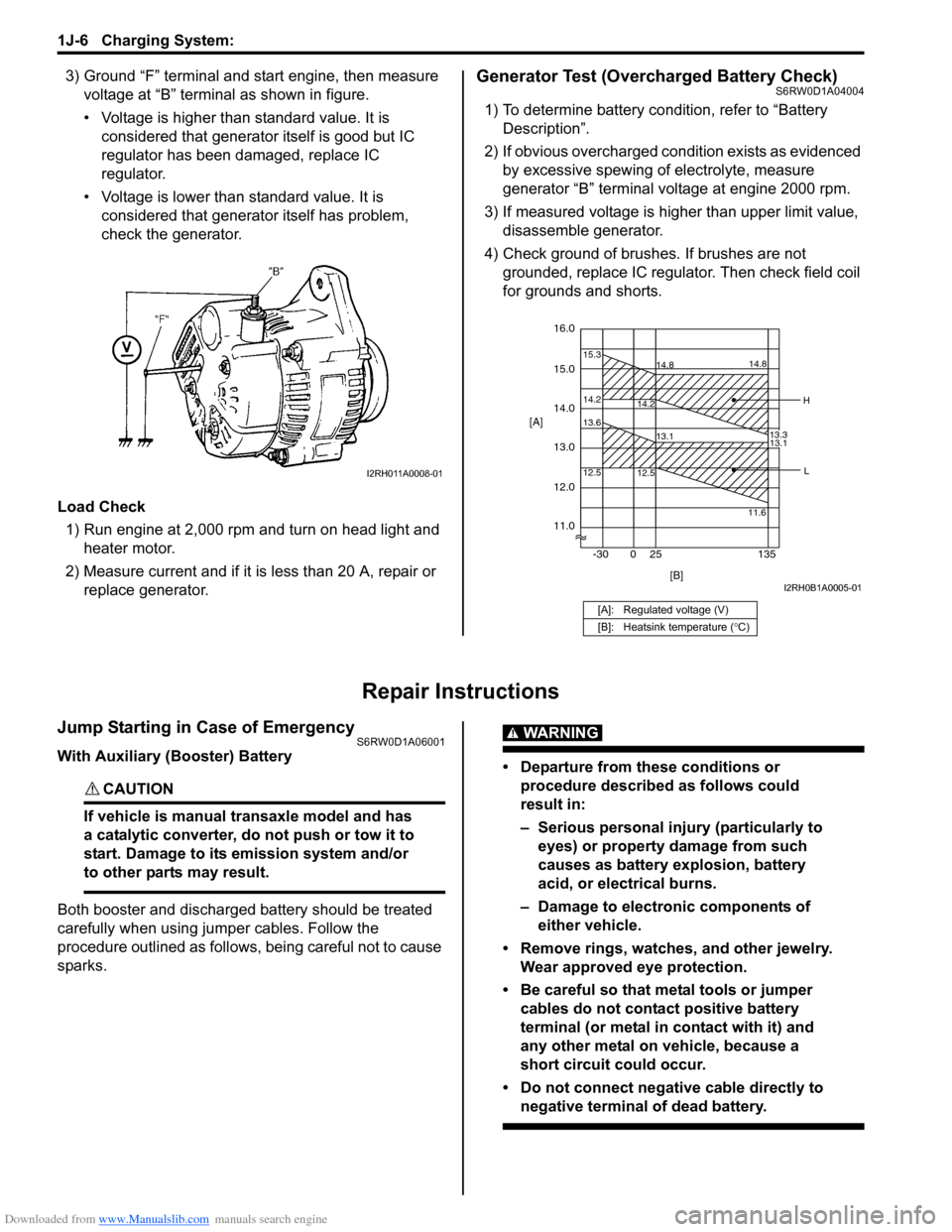
3) Ground “F” terminal and start engine, then measure
voltage at “B” terminal as shown in figure.
• Voltage is higher than standard value. It is
considered that generator itself is good but IC
regulator has been damaged, replace IC
regulator.
• Voltage is lower than standard value. It is
considered that generator itself has problem,
check the generator.
Load Check
1) Run engine at 2,000 rpm and turn on head light and
heater motor.
2) Measure current and if it is less than 20 A, repair or
replace generator.Generator Test (Overcharged Battery Check)S6RW0D1A04004
1) To determine battery condition, refer to “Battery
Description”.
2) If obvious overcharged condition exists as evidenced
by excessive spewing of electrolyte, measure
generator “B” terminal voltage at engine 2000 rpm.
3) If measured voltage is higher than upper limit value,
disassemble generator.
4) Check ground of brushes. If brushes are not
grounded, replace IC regulator. Then check field coil
for grounds and shorts.
Repair Instructions
Jump Starting in Case of EmergencyS6RW0D1A06001
With Auxiliary (Booster) Battery
CAUTION!
If vehicle is manual transaxle model and has
a catalytic converter, do not push or tow it to
start. Damage to its emission system and/or
to other parts may result.
Both booster and discharged battery should be treated
carefully when using jumper cables. Follow the
procedure outlined as follows, being careful not to cause
sparks.
WARNING!
• Departure from these conditions or
procedure described as follows could
result in:
– Serious personal injury (particularly to
eyes) or property damage from such
causes as battery explosion, battery
acid, or electrical burns.
– Damage to electronic components of
either vehicle.
• Remove rings, watches, and other jewelry.
Wear approved eye protection.
• Be careful so that metal tools or jumper
cables do not contact positive battery
terminal (or metal in contact with it) and
any other metal on vehicle, because a
short circuit could occur.
• Do not connect negative cable directly to
negative terminal of dead battery.
I2RH011A0008-01
[A]: Regulated voltage (V)
[B]: Heatsink temperature (°C)
16.0
12.0
14.2 15.3
14.8
14.2
13.3 14.8
15.0
11.0 14.0
13.0 [A]
12.5 13.6
13.1
12.5
11.613.1
[B] -30 0 25 135
H
L
I2RH0B1A0005-01
Page 421 of 1556
Downloaded from www.Manualslib.com manuals search engine Charging System: 1J-7
1) Set parking brake and place automatic transaxle in
PARK (NEUTRAL on manual transaxle). Turn off
ignition, turn off lights and all other electrical loads.
2) Check electrolyte level. If it is below low level line,
add distilled water.
3) Attach end of one jumper cable to positive terminal
of booster battery and the other end of the same
cable to positive terminal of discharged battery. (Use
12-volt battery only to jump start engine).
4) Attach one end of the remaining negative cable to
negative terminal of booster battery, and the other
end to a solid engine ground (such as exhaust
manifold) at least 45 cm (18 in.) away from battery of
vehicle being started.
5) Start engine of vehicle with booster battery and turn
off electrical accessories. Then start engine of the
vehicle with discharged battery.
6) Disconnect jumper cables in the exact reverse order.
With Charging Equipment
CAUTION!
When jump starting engine with charging
equipment, be sure equipment used is 12-
volt and negative ground. Do not use 24-volt
charging equipment. Using such equipment
can cause serious damage to electrical
system or electronic parts.
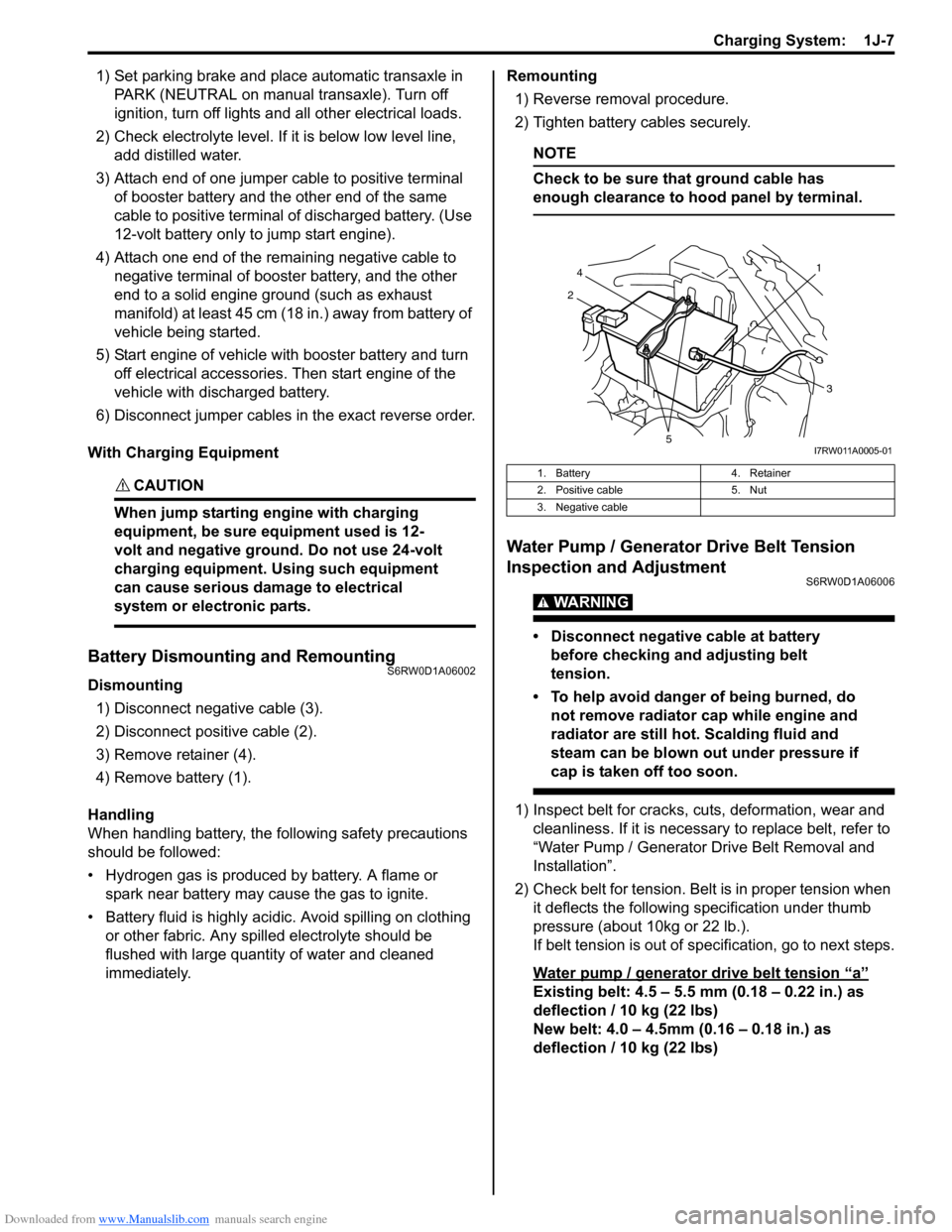
Battery Dismounting and RemountingS6RW0D1A06002
Dismounting
1) Disconnect negative cable (3).
2) Disconnect positive cable (2).
3) Remove retainer (4).
4) Remove battery (1).
Handling
When handling battery, the following safety precautions
should be followed:
• Hydrogen gas is produced by battery. A flame or
spark near battery may cause the gas to ignite.
• Battery fluid is highly acidic. Avoid spilling on clothing
or other fabric. Any spilled electrolyte should be
flushed with large quantity of water and cleaned
immediately.Remounting
1) Reverse removal procedure.
2) Tighten battery cables securely.
NOTE
Check to be sure that ground cable has
enough clearance to hood panel by terminal.
Water Pump / Generator Drive Belt Tension
Inspection and Adjustment
S6RW0D1A06006
WARNING!
• Disconnect negative cable at battery
before checking and adjusting belt
tension.
• To help avoid danger of being burned, do
not remove radiator cap while engine and
radiator are still hot. Scalding fluid and
steam can be blown out under pressure if
cap is taken off too soon.
1) Inspect belt for cracks, cuts, deformation, wear and
cleanliness. If it is necessary to replace belt, refer to
“Water Pump / Generator Drive Belt Removal and
Installation”.
2) Check belt for tension. Belt is in proper tension when
it deflects the following specification under thumb
pressure (about 10kg or 22 lb.).
If belt tension is out of specification, go to next steps.
Water pump / generator drive belt tension
“a”
Existing belt: 4.5 – 5.5 mm (0.18 – 0.22 in.) as
deflection / 10 kg (22 lbs)
New belt: 4.0 – 4.5mm (0.16 – 0.18 in.) as
deflection / 10 kg (22 lbs)
1. Battery 4. Retainer
2. Positive cable 5. Nut
3. Negative cable
21
4
3
5I7RW011A0005-01
Page 428 of 1556
Downloaded from www.Manualslib.com manuals search engine 1K-1 Exhaust System:
Engine
Exhaust System
General Description
Exhaust System DescriptionS6RW0D1B01001
The exhaust system consists of an exhaust manifold, three-way catalytic converter (TWC) in catalyst case, exhaust
pipes, a muffler and seals, gasket and etc.
The three-way catalytic converter is an emission control device added to the exhaust system to lower the levels of
Hydrocarbon (HC), Carbon Monoxide (CO), and Oxides of Nitrogen (NOx) pollutants in the exhaust gas.
Diagnostic Information and Procedures
Exhaust System CheckS6RW0D1B04001
WARNING!
To avoid the danger of being burned, do not touch the exhaust system when the system is hot. Any
service on the exhaust system should be performed when the system is cool.
At every interval of periodic maintenance service, and when vehicle is raised for other service, check exhaust system
as follows:
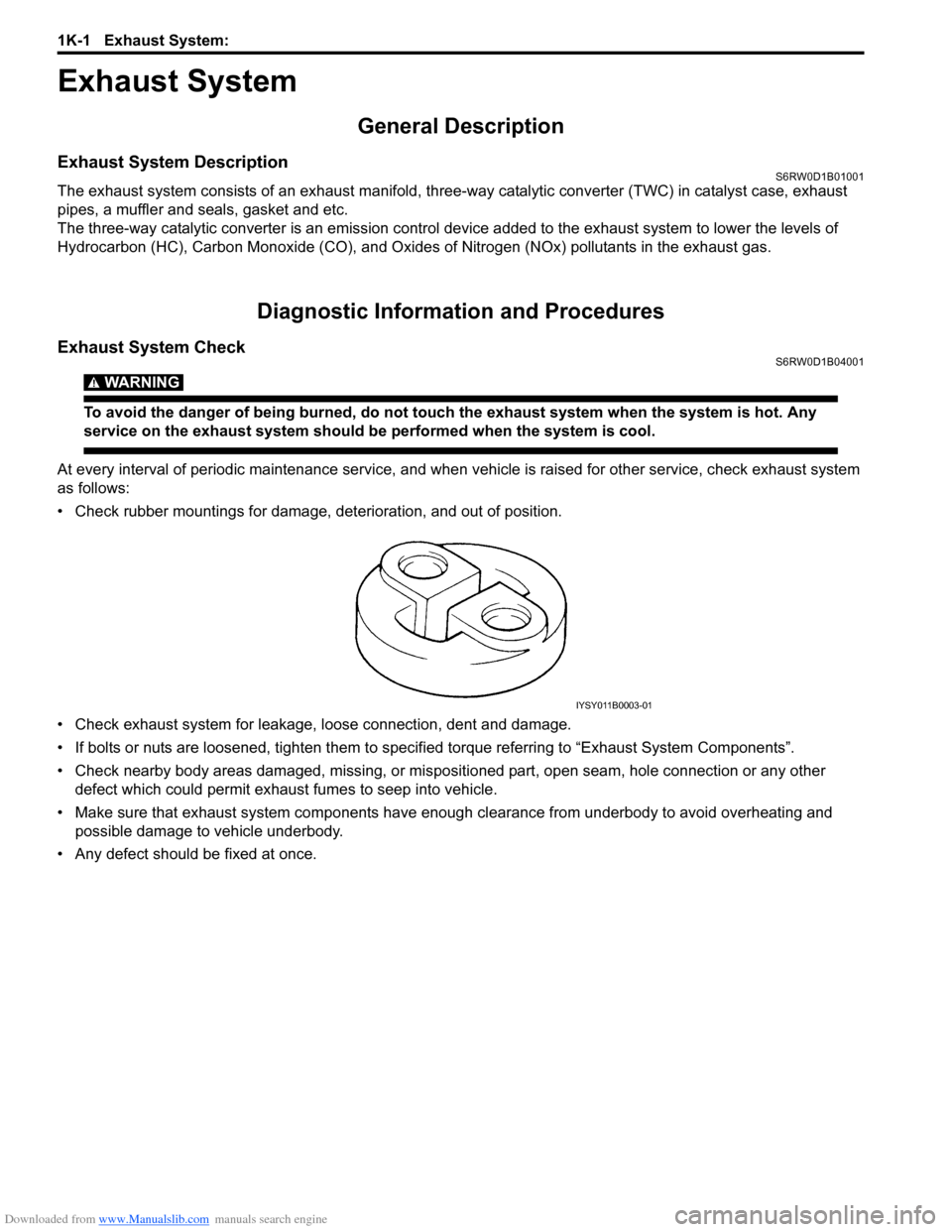
• Check rubber mountings for damage, deterioration, and out of position.
• Check exhaust system for leakage, loose connection, dent and damage.
• If bolts or nuts are loosened, tighten them to specified torque referring to “Exhaust System Components”.
• Check nearby body areas damaged, missing, or mispositioned part, open seam, hole connection or any other
defect which could permit exhaust fumes to seep into vehicle.
• Make sure that exhaust system components have enough clearance from underbody to avoid overheating and
possible damage to vehicle underbody.
• Any defect should be fixed at once.
IYSY011B0003-01
Page 429 of 1556
Downloaded from www.Manualslib.com manuals search engine Exhaust System: 1K-2
Repair Instructions
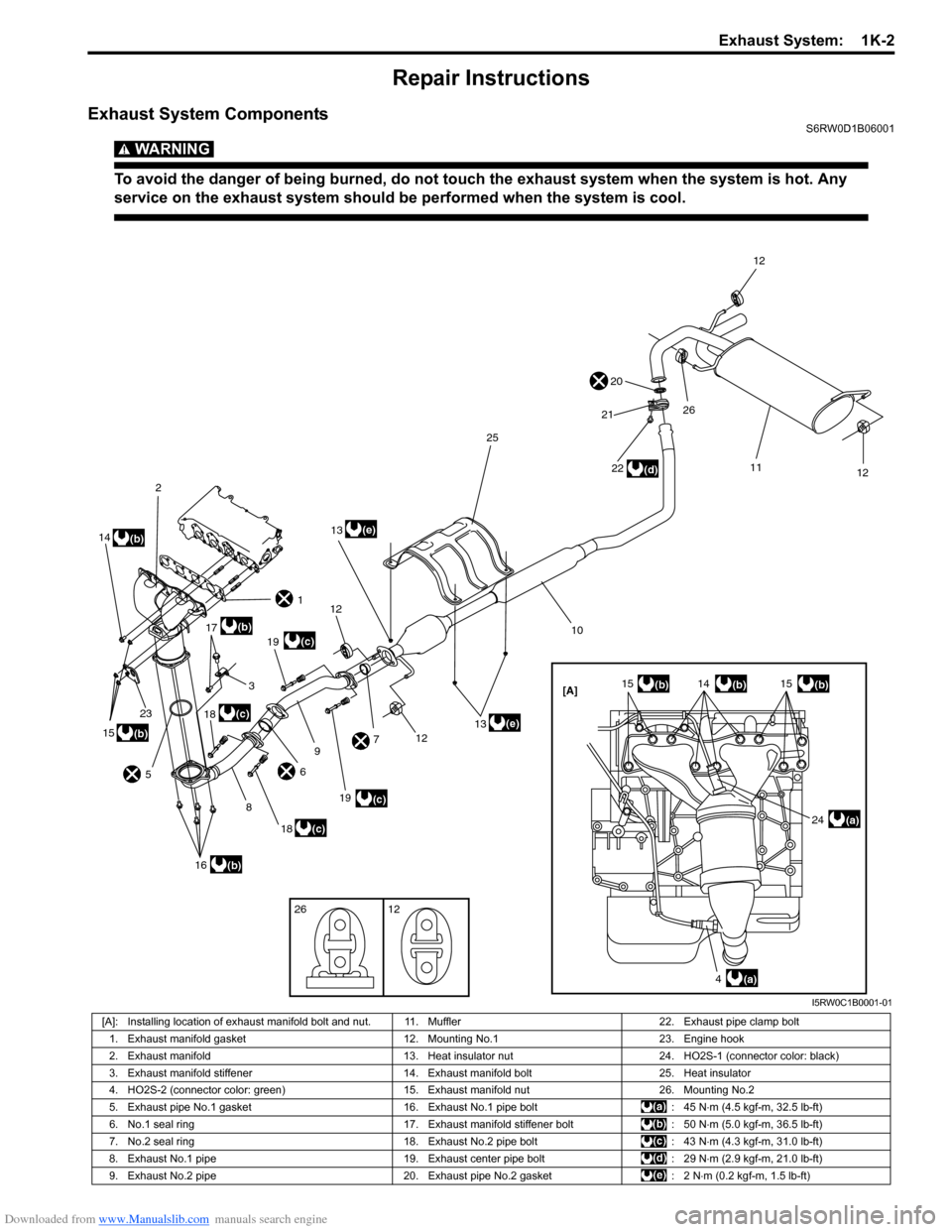
Exhaust System ComponentsS6RW0D1B06001
WARNING!
To avoid the danger of being burned, do not touch the exhaust system when the system is hot. Any
service on the exhaust system should be performed when the system is cool.
[A]
1
2
3
4
56
7
8
9
10
11
12
12
26
12
12
141515
16
26 12
17
18
18
19
19
20
21
23
22
24
25
(a)(c)
(c)
(d)
(e)
(b)
(a)
(b)(b)
(c)
(c)
(b)
(b)
14(b)
15(b)13
(e)
13
I5RW0C1B0001-01
[A]: Installing location of exhaust manifold bolt and nut. 11. Muffler 22. Exhaust pipe clamp bolt
1. Exhaust manifold gasket 12. Mounting No.1 23. Engine hook
2. Exhaust manifold 13. Heat insulator nut 24. HO2S-1 (connector color: black)
3. Exhaust manifold stiffener 14. Exhaust manifold bolt 25. Heat insulator
4. HO2S-2 (connector color: green) 15. Exhaust manifold nut 26. Mounting No.2
5. Exhaust pipe No.1 gasket 16. Exhaust No.1 pipe bolt : 45 N⋅m (4.5 kgf-m, 32.5 lb-ft)
6. No.1 seal ring 17. Exhaust manifold stiffener bolt : 50 N⋅m (5.0 kgf-m, 36.5 lb-ft)
7. No.2 seal ring 18. Exhaust No.2 pipe bolt : 43 N⋅m (4.3 kgf-m, 31.0 lb-ft)
8. Exhaust No.1 pipe 19. Exhaust center pipe bolt : 29 N⋅m (2.9 kgf-m, 21.0 lb-ft)
9. Exhaust No.2 pipe 20. Exhaust pipe No.2 gasket : 2 N⋅m (0.2 kgf-m, 1.5 lb-ft)
Page 430 of 1556
Downloaded from www.Manualslib.com manuals search engine 1K-3 Exhaust System:
Exhaust Manifold Removal and InstallationS6RW0D1B06002
Removal
WARNING!
To avoid danger of being burned, do not
service exhaust system while it is still hot.
Service should be performed after system
cools down.
1) Disconnect negative cable at battery.
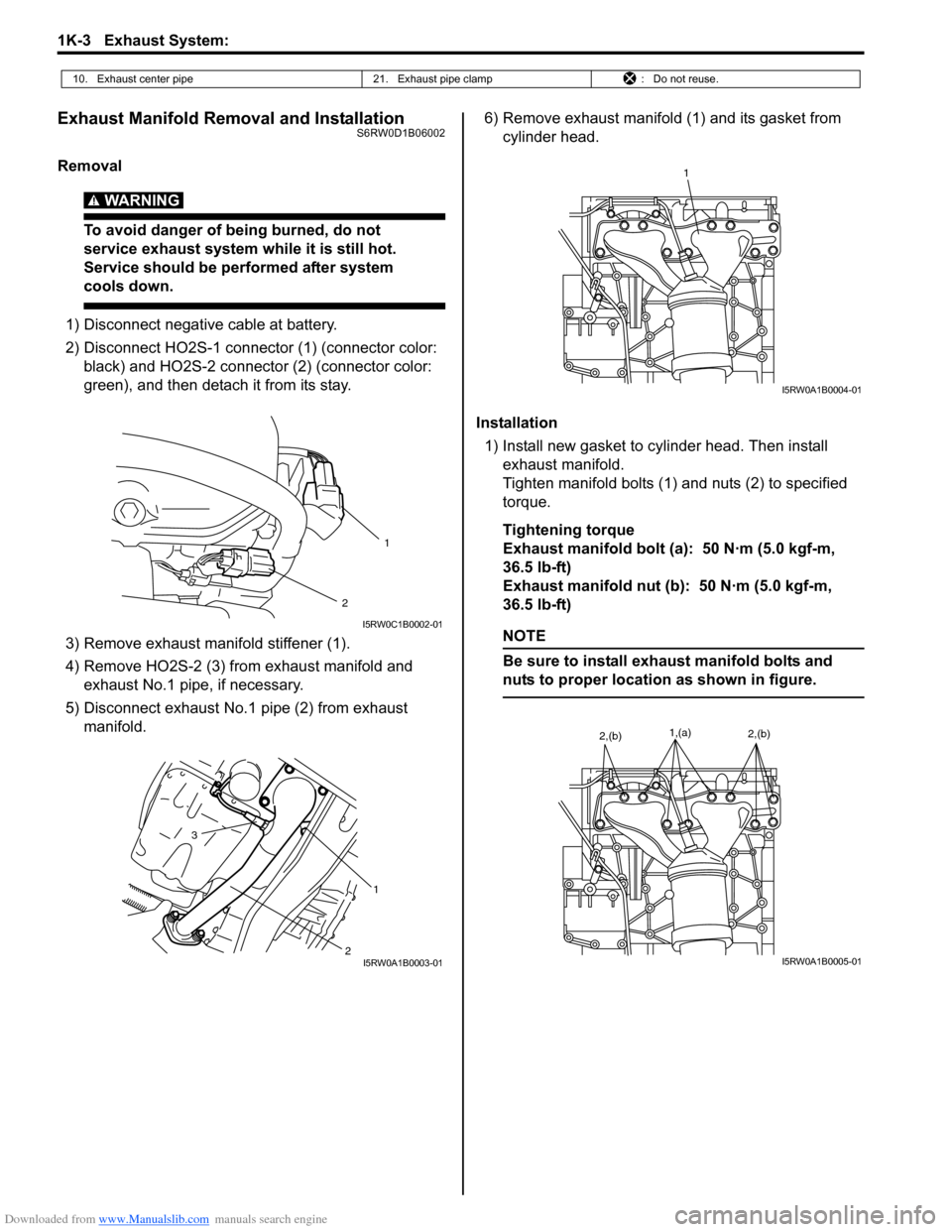
2) Disconnect HO2S-1 connector (1) (connector color:
black) and HO2S-2 connector (2) (connector color:
green), and then detach it from its stay.
3) Remove exhaust manifold stiffener (1).
4) Remove HO2S-2 (3) from exhaust manifold and
exhaust No.1 pipe, if necessary.
5) Disconnect exhaust No.1 pipe (2) from exhaust
manifold.6) Remove exhaust manifold (1) and its gasket from
cylinder head.
Installation
1) Install new gasket to cylinder head. Then install
exhaust manifold.
Tighten manifold bolts (1) and nuts (2) to specified
torque.
Tightening torque
Exhaust manifold bolt (a): 50 N·m (5.0 kgf-m,
36.5 lb-ft)
Exhaust manifold nut (b): 50 N·m (5.0 kgf-m,
36.5 lb-ft)
NOTE
Be sure to install exhaust manifold bolts and
nuts to proper location as shown in figure.
10. Exhaust center pipe 21. Exhaust pipe clamp : Do not reuse.
2
1
I5RW0C1B0002-01
2 3
1
I5RW0A1B0003-01
1
I5RW0A1B0004-01
1,(a)2,(b)2,(b)
I5RW0A1B0005-01
Page 431 of 1556
Downloaded from www.Manualslib.com manuals search engine Exhaust System: 1K-4
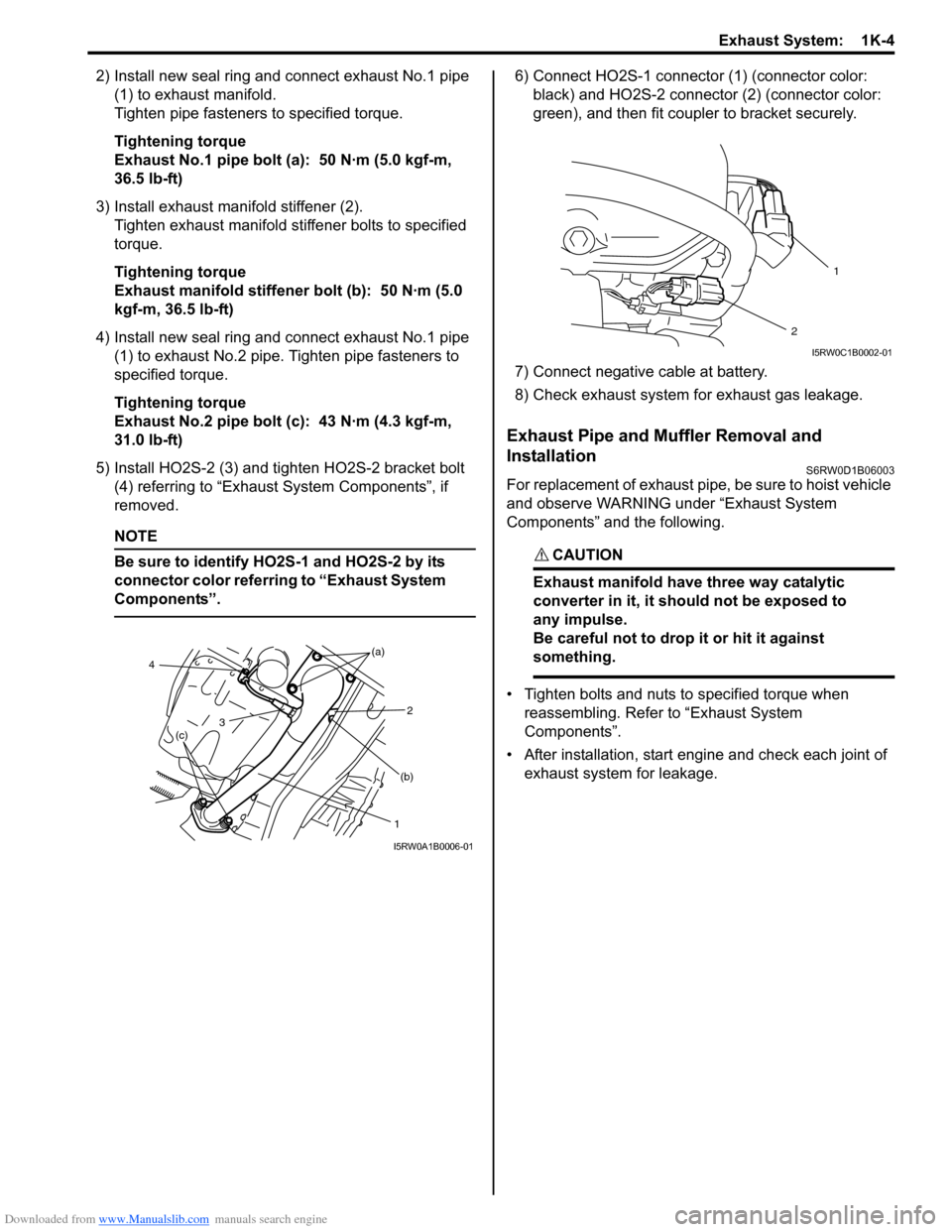
2) Install new seal ring and connect exhaust No.1 pipe
(1) to exhaust manifold.
Tighten pipe fasteners to specified torque.
Tightening torque
Exhaust No.1 pipe bolt (a): 50 N·m (5.0 kgf-m,
36.5 lb-ft)
3) Install exhaust manifold stiffener (2).
Tighten exhaust manifold stiffener bolts to specified
torque.
Tightening torque
Exhaust manifold stiffener bolt (b): 50 N·m (5.0
kgf-m, 36.5 lb-ft)
4) Install new seal ring and connect exhaust No.1 pipe
(1) to exhaust No.2 pipe. Tighten pipe fasteners to
specified torque.
Tightening torque
Exhaust No.2 pipe bolt (c): 43 N·m (4.3 kgf-m,
31.0 lb-ft)
5) Install HO2S-2 (3) and tighten HO2S-2 bracket bolt
(4) referring to “Exhaust System Components”, if
removed.
NOTE
Be sure to identify HO2S-1 and HO2S-2 by its
connector color referring to “Exhaust System
Components”.
6) Connect HO2S-1 connector (1) (connector color:
black) and HO2S-2 connector (2) (connector color:
green), and then fit coupler to bracket securely.
7) Connect negative cable at battery.
8) Check exhaust system for exhaust gas leakage.
Exhaust Pipe and Muffler Removal and
Installation
S6RW0D1B06003
For replacement of exhaust pipe, be sure to hoist vehicle
and observe WARNING under “Exhaust System
Components” and the following.
CAUTION!
Exhaust manifold have three way catalytic
converter in it, it should not be exposed to
any impulse.
Be careful not to drop it or hit it against
something.
• Tighten bolts and nuts to specified torque when
reassembling. Refer to “Exhaust System
Components”.
• After installation, start engine and check each joint of
exhaust system for leakage.
1 (c)3 4
(a)
(b)
2
I5RW0A1B0006-01
2
1
I5RW0C1B0002-01