Lamp SUZUKI SX4 2006 1.G Service Workshop Manual
[x] Cancel search | Manufacturer: SUZUKI, Model Year: 2006, Model line: SX4, Model: SUZUKI SX4 2006 1.GPages: 1556, PDF Size: 37.31 MB
Page 16 of 1556
Downloaded from www.Manualslib.com manuals search engine 00-9 Precautions:
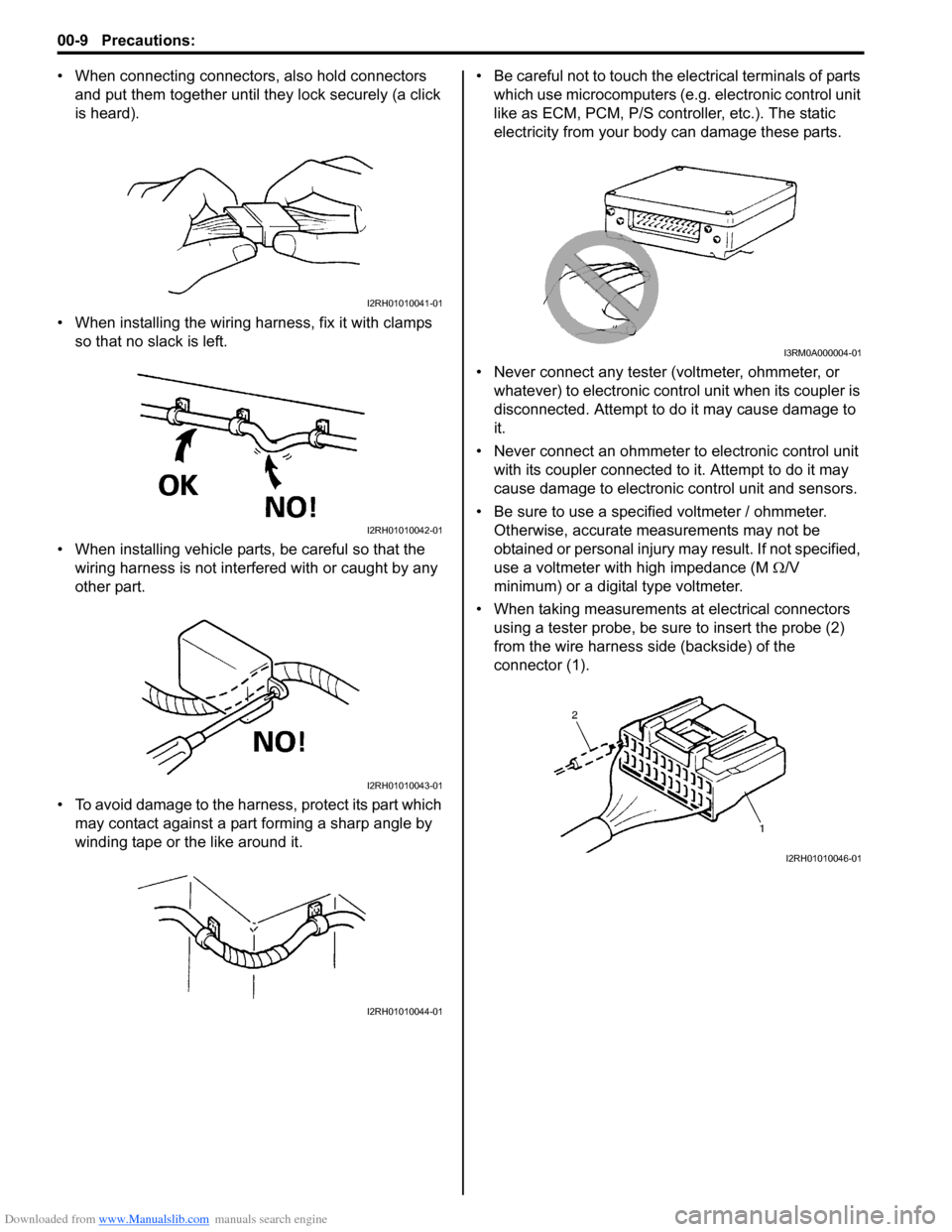
• When connecting connectors, also hold connectors
and put them together until they lock securely (a click
is heard).
• When installing the wiring harness, fix it with clamps
so that no slack is left.
• When installing vehicle parts, be careful so that the
wiring harness is not interfered with or caught by any
other part.
• To avoid damage to the harness, protect its part which
may contact against a part forming a sharp angle by
winding tape or the like around it.• Be careful not to touch the electrical terminals of parts
which use microcomputers (e.g. electronic control unit
like as ECM, PCM, P/S controller, etc.). The static
electricity from your body can damage these parts.
• Never connect any tester (voltmeter, ohmmeter, or
whatever) to electronic control unit when its coupler is
disconnected. Attempt to do it may cause damage to
it.
• Never connect an ohmmeter to electronic control unit
with its coupler connected to it. Attempt to do it may
cause damage to electronic control unit and sensors.
• Be sure to use a specified voltmeter / ohmmeter.
Otherwise, accurate measurements may not be
obtained or personal injury may result. If not specified,
use a voltmeter with high impedance (M Ω/V
minimum) or a digital type voltmeter.
• When taking measurements at electrical connectors
using a tester probe, be sure to insert the probe (2)
from the wire harness side (backside) of the
connector (1).
I2RH01010041-01
I2RH01010042-01
I2RH01010043-01
I2RH01010044-01
I3RM0A000004-01
I2RH01010046-01
Page 24 of 1556
Downloaded from www.Manualslib.com manuals search engine 0A-1 General Information:
General Information
General Information
General Description
AbbreviationsS6RW0D0101001
A:
ABDC: After Bottom Dead Center
ABS: Anti-lock Brake System
AC: Alternating Current
A/C: Air Conditioning
A-ELR: Automatic-Emergency Locking Retractor
A/F: Air Fuel Mixture Ratio
ALR: Automatic Locking Retractor
API: American Petroleum Institute
APP sensor: Accelerator Pedal Position Sensor
A/T: Automatic Transmission, Automatic Transaxle
AT D C : After Top Dead Center
ATF: Automatic Transmission Fluid, Automatic
Transaxle Fluid
B:
B+: Battery Positive Voltage
BBDC: Before Bottom Dead Center
BCM: Body Electrical Control Module
BTDC: Before Top Dead Center
C:
CAN: Controller Area Network
CKT: Circuit
CKP Sensor: Crankshaft Position Sensor
CMP Sensor: Camshaft Position Sensor
CO: Carbon Monoxide
CPP Switch: Clutch Pedal Position Switch (Clutch
Switch, Clutch Start Switch)
CPU: Central Processing Unit
CRS: Child Restraint System
D:
DC: Direct Current
DLC: Data Link Connector (Assembly Line Diag. Link,
ALDL, Serial Data Link, SDL)
DOHC: Double Over Head Camshaft
DOJ: Double Offset Joint
DRL: Daytime Running Light
DTC: Diagnostic Trouble Code (Diagnostic Code)
E:
EBCM: Electronic Brake Control Module, ABS Control
Module
EBD: Electronic Brake Force Distribution
ECM: Engine Control Module
ECT Sensor: Engine Coolant Temperature Sensor
(Water Temp. Sensor, WTS)
EFE Heater: Early Fuel Evaporation Heater (Positive
Temperature Coefficient, PTC Heater)
EGR: Exhaust Gas Recirculation
EGRT Sensor: EGR Temperature Sensor (Recirculated
Exhaust Gas Temp. Sensor, REGTS)
EPS: Electronic Power Steering
EVAP: Evaporative Emission
EVAP Canister: Evaporative Emission Canister
(Charcoal Canister)F:
4WD: 4 Wheel Drive
G:
GEN: Generator
GND: Ground
GPS: Global Positioning System
H:
HAVC: Heating, Ventilating and Air Conditioning
HC: Hydrocarbons
HO2S: Heated Oxygen Sensor
I:
IAC Valve: Idle Air Control Valve (Idle Speed Control
Solenoid Valve, ISC Solenoid Valve)
IAT Sensor: Intake Air Temperature Sensor (Air
temperature Sensor, ATS)
ICM: Immobilizer Control Module
IG: Ignition
ISC Actuator: Idle Speed Control Actuator
L:
LH: Left Hand
LHD: Left Hand Drive vehicle
LSPV: Load Sensing Proportioning Valve
M:
MAF Sensor: Mass Air Flow Sensor (Air Flow Sensor,
AFS, Air Flow Meter, AFM)
MAP Sensor: Manifold Absolute Pressure Sensor
(Pressure Sensor, PS)
Max: Maximum
MFI: Multiport Fuel Injection (Multipoint Fuel Injection)
Min: Minimum
MIL: Malfunction Indicator Lamp (“SERVICE ENGINE
SOON” Light)
M/T: Manual Transmission, Manual Transaxle
N:
NOx: Nitrogen Oxides
O:
OBD: On-Board Diagnostic System (Self-Diagnosis
Function)
O/D: Overdrive
OHC: Over Head Camshaft
O2S: Oxygen Sensor
P:
PCM: Powertrain Control Module
PCV: Positive Crankcase Ventilation
PNP: Park / Neutral Position
P/S: Power Steering
PSP Switch: Power Steering Pressure Switch (P/S
Pressure Switch)
R:
RH: Right Hand
RHD: Right Hand Drive vehicle
Page 32 of 1556
Downloaded from www.Manualslib.com manuals search engine 0B-1 Maintenance and Lubrication:
General Information
Maintenance and Lubrication
Precautions
Precautions for Maintenance and LubricationS6RW0D0200001
Air Bag Warning
Refer to “Air Bag Warning in Section 00”.
Scheduled Maintenance
Maintenance Schedule under Normal Driving ConditionsS6RW0D0205001
NOTE
• This interval should be judged by odometer reading or months, whichever comes first.
• This table includes service as scheduled up to 90,000 km (54,000 miles) mileage. Beyond 90,000 km
(54,000 miles), carry out the same services at the same intervals respectively.
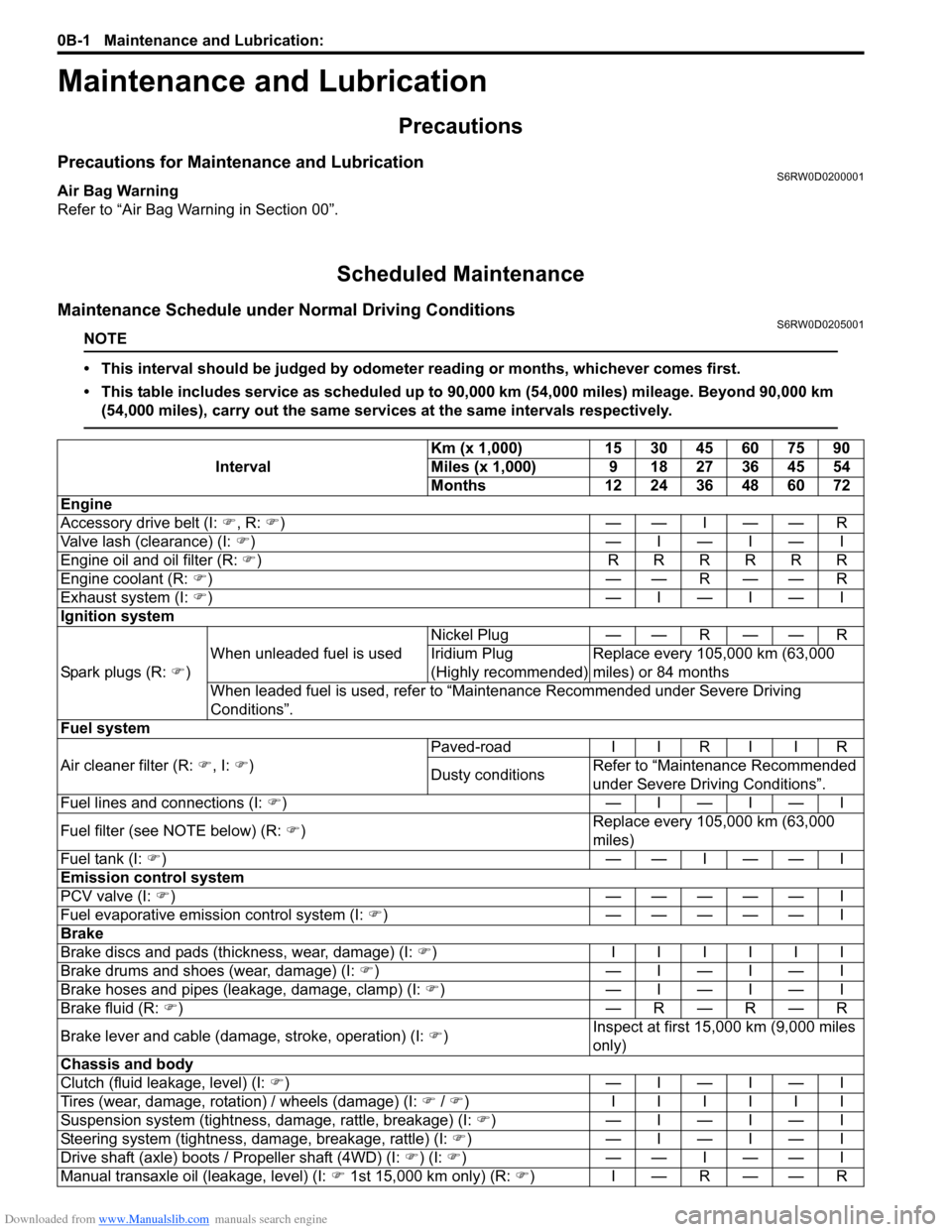
IntervalKm (x 1,000) 15 30 45 60 75 90
Miles (x 1,000) 9 18 27 36 45 54
Months 12 24 36 48 60 72
Engine
Accessory drive belt (I: ), R: ))——I——R
Valve lash (clearance) (I: ))—I—I—I
Engine oil and oil filter (R: )) RRRRRR
Engine coolant (R: ))——R——R
Exhaust system (I: ))—I—I—I
Ignition system
Spark plugs (R: ))When unleaded fuel is usedNickel Plug — — R — — R
Iridium Plug
(Highly recommended)Replace every 105,000 km (63,000
miles) or 84 months
When leaded fuel is used, refer to “Maintenance Recommended under Severe Driving
Conditions”.
Fuel system
Air cleaner filter (R: ), I: ))Paved-road I I R I I R
Dusty conditionsRefer to “Maintenance Recommended
under Severe Driving Conditions”.
Fuel lines and connections (I: ))—I—I—I
Fuel filter (see NOTE below) (R: ))Replace every 105,000 km (63,000
miles)
Fuel tank (I: ))——I——I
Emission control system
PCV valve (I: )) ————— I
Fuel evaporative emission control system (I: )) ————— I
Brake
Brake discs and pads (thickness, wear, damage) (I: )) IIIIII
Brake drums and shoes (wear, damage) (I: ))—I—I—I
Brake hoses and pipes (leakage, damage, clamp) (I: ))—I—I—I
Brake fluid (R: ))—R—R—R
Brake lever and cable (damage, stroke, operation) (I: ))Inspect at first 15,000 km (9,000 miles
only)
Chassis and body
Clutch (fluid leakage, level) (I: ))—I—I—I
Tires (wear, damage, rotation) / wheels (damage) (I: ) / )) IIIIII
Suspension system (tightness, damage, rattle, breakage) (I: ))—I—I—I
Steering system (tightness, damage, breakage, rattle) (I: ))—I—I—I
Drive shaft (axle) boots / Propeller shaft (4WD) (I: )) (I: ))——I——I
Manual transaxle oil (leakage, level) (I: ) 1st 15,000 km only) (R: ))I—R——R
Page 37 of 1556
Downloaded from www.Manualslib.com manuals search engine Maintenance and Lubrication: 0B-6
Air Cleaner Filter InspectionS6RW0D0206008
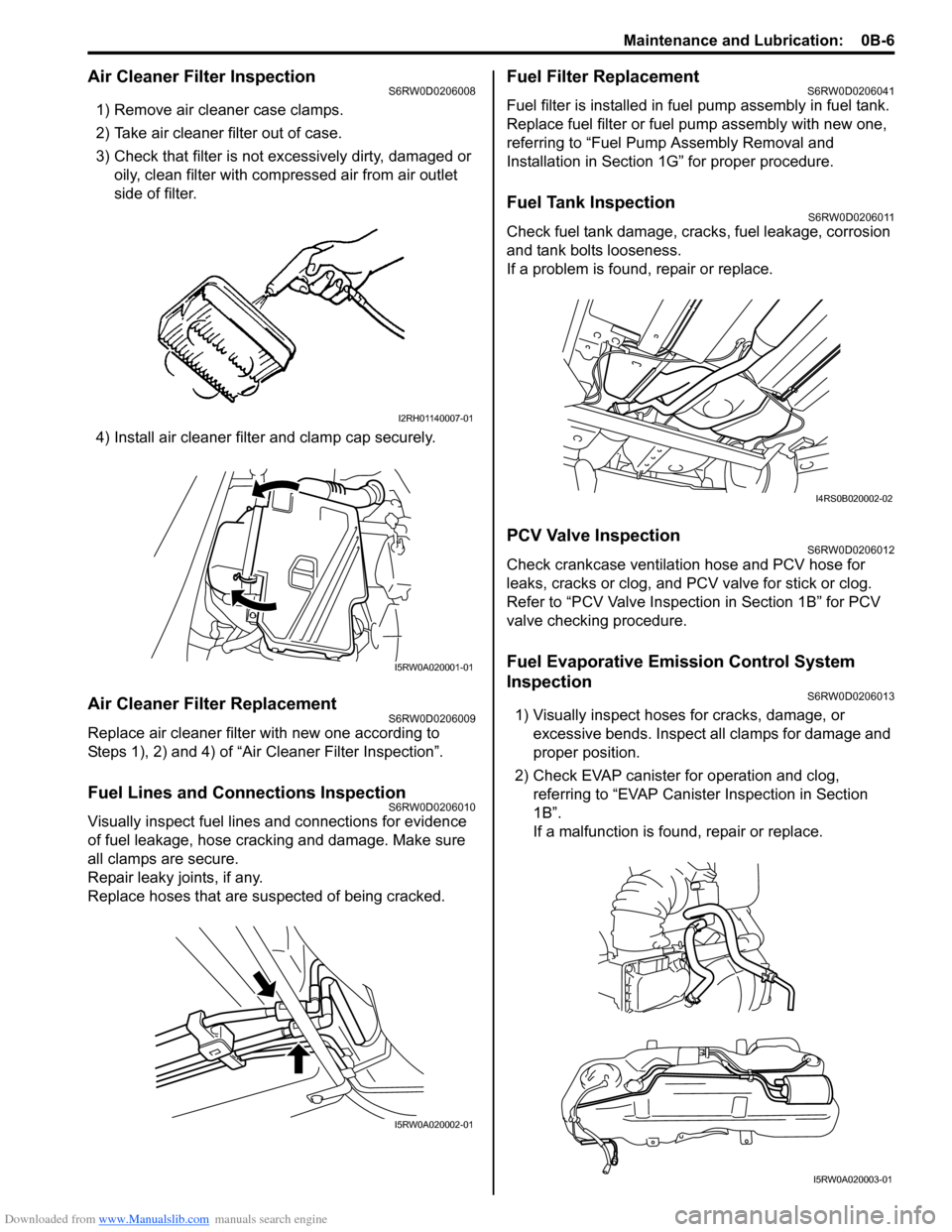
1) Remove air cleaner case clamps.
2) Take air cleaner filter out of case.
3) Check that filter is not excessively dirty, damaged or
oily, clean filter with compressed air from air outlet
side of filter.
4) Install air cleaner filter and clamp cap securely.
Air Cleaner Filter ReplacementS6RW0D0206009
Replace air cleaner filter with new one according to
Steps 1), 2) and 4) of “Air Cleaner Filter Inspection”.
Fuel Lines and Connections InspectionS6RW0D0206010
Visually inspect fuel lines and connections for evidence
of fuel leakage, hose cracking and damage. Make sure
all clamps are secure.
Repair leaky joints, if any.
Replace hoses that are suspected of being cracked.
Fuel Filter ReplacementS6RW0D0206041
Fuel filter is installed in fuel pump assembly in fuel tank.
Replace fuel filter or fuel pump assembly with new one,
referring to “Fuel Pump Assembly Removal and
Installation in Section 1G” for proper procedure.
Fuel Tank InspectionS6RW0D0206011
Check fuel tank damage, cracks, fuel leakage, corrosion
and tank bolts looseness.
If a problem is found, repair or replace.
PCV Valve InspectionS6RW0D0206012
Check crankcase ventilation hose and PCV hose for
leaks, cracks or clog, and PCV valve for stick or clog.
Refer to “PCV Valve Inspection in Section 1B” for PCV
valve checking procedure.
Fuel Evaporative Emission Control System
Inspection
S6RW0D0206013
1) Visually inspect hoses for cracks, damage, or
excessive bends. Inspect all clamps for damage and
proper position.
2) Check EVAP canister for operation and clog,
referring to “EVAP Canister Inspection in Section
1B”.
If a malfunction is found, repair or replace.
I2RH01140007-01
I5RW0A020001-01
I5RW0A020002-01
I4RS0B020002-02
I5RW0A020003-01
Page 41 of 1556
Downloaded from www.Manualslib.com manuals search engine Maintenance and Lubrication: 0B-10
Propeller Shaft (4WD) InspectionS6RW0D0206026
1) Check propeller shaft connecting bolts for
looseness. If looseness is found, tighten to specified
torque.
2) Check propeller shaft joints for wear, play and
damage. If any defect is found, replace.
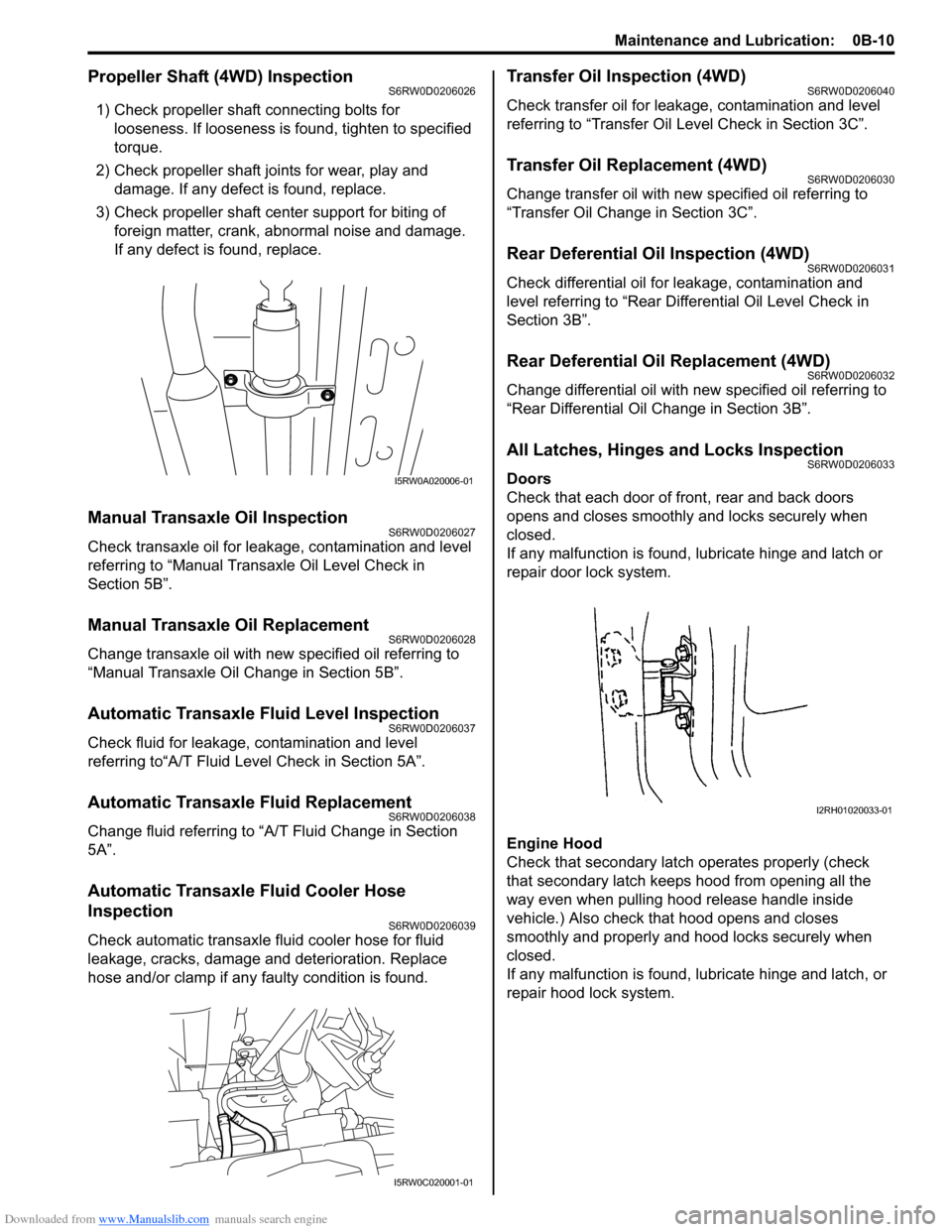
3) Check propeller shaft center support for biting of
foreign matter, crank, abnormal noise and damage.
If any defect is found, replace.
Manual Transaxle Oil InspectionS6RW0D0206027
Check transaxle oil for leakage, contamination and level
referring to “Manual Transaxle Oil Level Check in
Section 5B”.
Manual Transaxle Oil ReplacementS6RW0D0206028
Change transaxle oil with new specified oil referring to
“Manual Transaxle Oil Change in Section 5B”.
Automatic Transaxle Fluid Level InspectionS6RW0D0206037
Check fluid for leakage, contamination and level
referring to“A/T Fluid Level Check in Section 5A”.
Automatic Transaxle Fluid ReplacementS6RW0D0206038
Change fluid referring to “A/T Fluid Change in Section
5A”.
Automatic Transaxle Fluid Cooler Hose
Inspection
S6RW0D0206039
Check automatic transaxle fluid cooler hose for fluid
leakage, cracks, damage and deterioration. Replace
hose and/or clamp if any faulty condition is found.
Transfer Oil Inspection (4WD)S6RW0D0206040
Check transfer oil for leakage, contamination and level
referring to “Transfer Oil Level Check in Section 3C”.
Transfer Oil Replacement (4WD)S6RW0D0206030
Change transfer oil with new specified oil referring to
“Transfer Oil Change in Section 3C”.
Rear Deferential Oil Inspection (4WD)S6RW0D0206031
Check differential oil for leakage, contamination and
level referring to “Rear Differential Oil Level Check in
Section 3B”.
Rear Deferential Oil Replacement (4WD)S6RW0D0206032
Change differential oil with new specified oil referring to
“Rear Differential Oil Change in Section 3B”.
All Latches, Hinges and Locks InspectionS6RW0D0206033
Doors
Check that each door of front, rear and back doors
opens and closes smoothly and locks securely when
closed.
If any malfunction is found, lubricate hinge and latch or
repair door lock system.
Engine Hood
Check that secondary latch operates properly (check
that secondary latch keeps hood from opening all the
way even when pulling hood release handle inside
vehicle.) Also check that hood opens and closes
smoothly and properly and hood locks securely when
closed.
If any malfunction is found, lubricate hinge and latch, or
repair hood lock system.I5RW0A020006-01
I5RW0C020001-01
I2RH01020033-01
Page 45 of 1556
Downloaded from www.Manualslib.com manuals search engine Table of Contents 1- i
1
Section 1
CONTENTS
Engine
Precautions ................................................. 1-1
Precautions............................................................. 1-1
Precautions for Engine .......................................... 1-1
Engine General Information and
Diagnosis ................................................. 1A-1
Precautions........................................................... 1A-1
Precautions on Engine Service ........................... 1A-1
Precaution on On-Board Diagnostic (OBD)
System .............................................................. 1A-1
Precautions in Diagnosing Trouble ..................... 1A-1
Precautions for DTC Troubleshooting ................. 1A-2
Precautions of ECM Circuit Inspection................ 1A-2
Precautions of Electric Throttle Body System
Calibration ......................................................... 1A-2
Precaution on CAN Troubleshooting .................. 1A-3
General Description ............................................. 1A-5
Statement on Cleanliness and Care ................... 1A-5
Engine Diagnosis General Description ............... 1A-5
On-Board Diagnostic System Description ........... 1A-5
Data Link Connector (DLC) ................................. 1A-8
Engine and Emission Control System
Description ........................................................ 1A-8
CAN Communication System Description........... 1A-9
Air Intake System Description ........................... 1A-11
Description of Electric Throttle Body System
Calibration ....................................................... 1A-11
Description of Electric Throttle Body System .... 1A-11
Engine and Emission Control Input / Output
Table ............................................................... 1A-18
Schematic and Routing Diagram ...................... 1A-19
Engine and Emission Control System
Diagram .......................................................... 1A-19
Component Location ......................................... 1A-21
Electronic Control System Components
Location .......................................................... 1A-21
Diagnostic Information and Procedures .......... 1A-22
Engine and Emission Control System Check.... 1A-22
Malfunction Indicator Lamp (MIL) Check .......... 1A-25
DTC Check ....................................................... 1A-25
DTC Clearance ................................................. 1A-26
Troubleshooting for Communication Error
with Scan Tool Using CAN.............................. 1A-26
DTC Table ......................................................... 1A-32For Vehicle Equipped with A/T .......................... 1A-36
Fail-Safe Table .................................................. 1A-36
Scan Tool Data ................................................. 1A-38
Visual Inspection ............................................... 1A-43
Engine Basic Inspection .................................... 1A-43
Engine Symptom Diagnosis .............................. 1A-45
Malfunction Indicator Lamp Does Not Come
ON with Ignition Switch ON and Engine Stop
(but Engine Can Be Started) ........................... 1A-52
Malfunction Indicator Lamp Remains ON after
Engine Starts................................................... 1A-54
DTC P0010: Camshaft Position Actuator
Circuit (for engine with VVT system) ............... 1A-55
DTC P0011 / P0012: Camshaft Position -
Timing Over-Advanced or System
Performance / Retarded (for engine with
VVT system).................................................... 1A-57
DTC P0031 / P0032: HO2S Heater Control
Circuit Low / High (Sensor-1) .......................... 1A-59
DTC P0037 / P0038: HO2S Heater Control
Circuit Low / High (Sensor-2) .......................... 1A-61
DTC P0101: Mass Air Flow Circuit Range /
Performance.................................................... 1A-63
DTC P0102: Mass Air Flow Circuit Low Input ... 1A-66
DTC P0103: Mass Air Flow Circuit High Input .. 1A-67
DTC P0106: Manifold Absolute Pressure
Range / Performance ...................................... 1A-69
DTC P0107: Manifold Absolute Pressure
Circuit Low Input ............................................. 1A-70
DTC P0108: Manifold Absolute Pressure
Circuit High Input............................................. 1A-72
DTC P0111: Intake Air Temperature Circuit
Range / Performance ...................................... 1A-74
DTC P0112: Intake Air Temperature Sensor
Circuit Low ...................................................... 1A-76
DTC P0113: Intake Air Temperature Sensor
Circuit High...................................................... 1A-78
DTC P0116: Engine Coolant Temperature
Circuit Range / Performance ........................... 1A-80
DTC P0117: Engine Coolant Temperature
Circuit Low ...................................................... 1A-83
DTC P0118: Engine Coolant Temperature
Circuit High...................................................... 1A-85
DTC P0122: Throttle Position Sensor (Main)
Circuit Low ...................................................... 1A-87
Page 55 of 1556
Downloaded from www.Manualslib.com manuals search engine Engine General Information and Diagnosis: 1A-5
General Description
Statement on Cleanliness and CareS6RW0D1101001
An automobile engine is a combination of many
machined, honed, polished and lapped surfaces with
tolerances that are measured in the thousands of an
millimeter (ten thousands of an inch).
Accordingly, when any internal engine parts are
serviced, care and cleanliness are important.
It should be understood that proper cleaning and
protection of machined surfaces and friction areas is part
of the repair procedure. This is considered standard
shop practice even if not specifically stated.
• A liberal coating of engine oil should be applied to
friction areas during assembly to protect and lubricate
the surfaces on initial operation.
• Whenever valve train components, pistons, piston
rings, connecting rods, rod bearings, and crankshaft
journal bearings are removed for service, they should
be retained in order.
At the time of installation, they should be installed in
the same locations and with the same mating
surfaces as when removed.
• Battery cables should be disconnected before any
major work is performed on the engine.
Failure to disconnect cables may result in damage to
wire harness or other electrical parts.
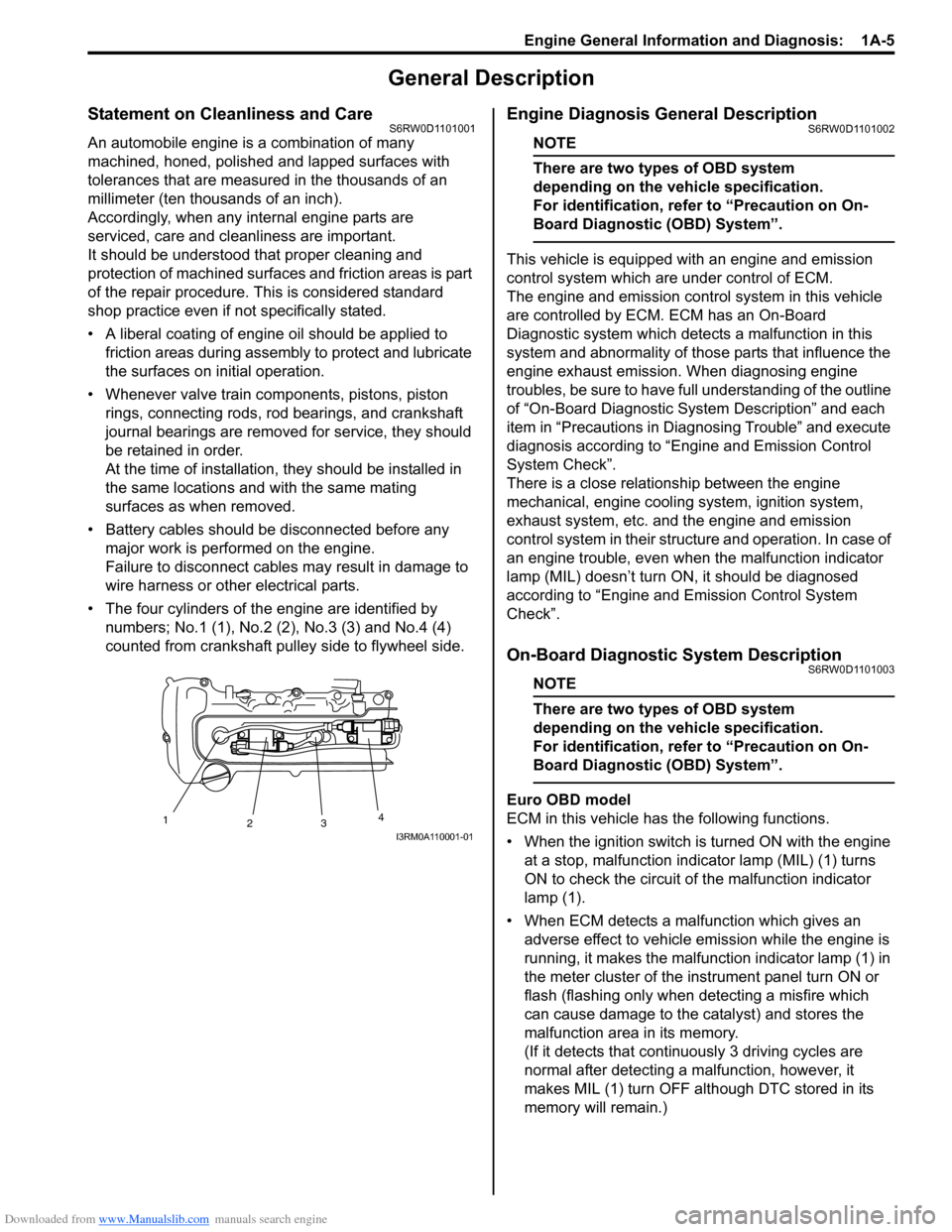
• The four cylinders of the engine are identified by
numbers; No.1 (1), No.2 (2), No.3 (3) and No.4 (4)
counted from crankshaft pulley side to flywheel side.
Engine Diagnosis General DescriptionS6RW0D1101002
NOTE
There are two types of OBD system
depending on the vehicle specification.
For identification, refer to “Precaution on On-
Board Diagnostic (OBD) System”.
This vehicle is equipped with an engine and emission
control system which are under control of ECM.
The engine and emission control system in this vehicle
are controlled by ECM. ECM has an On-Board
Diagnostic system which detects a malfunction in this
system and abnormality of those parts that influence the
engine exhaust emission. When diagnosing engine
troubles, be sure to have full understanding of the outline
of “On-Board Diagnostic System Description” and each
item in “Precautions in Diagnosing Trouble” and execute
diagnosis according to “Engine and Emission Control
System Check”.
There is a close relationship between the engine
mechanical, engine cooling system, ignition system,
exhaust system, etc. and the engine and emission
control system in their structure and operation. In case of
an engine trouble, even when the malfunction indicator
lamp (MIL) doesn’t turn ON, it should be diagnosed
according to “Engine and Emission Control System
Check”.
On-Board Diagnostic System DescriptionS6RW0D1101003
NOTE
There are two types of OBD system
depending on the vehicle specification.
For identification, refer to “Precaution on On-
Board Diagnostic (OBD) System”.
Euro OBD model
ECM in this vehicle has the following functions.
• When the ignition switch is turned ON with the engine
at a stop, malfunction indicator lamp (MIL) (1) turns
ON to check the circuit of the malfunction indicator
lamp (1).
• When ECM detects a malfunction which gives an
adverse effect to vehicle emission while the engine is
running, it makes the malfunction indicator lamp (1) in
the meter cluster of the instrument panel turn ON or
flash (flashing only when detecting a misfire which
can cause damage to the catalyst) and stores the
malfunction area in its memory.
(If it detects that continuously 3 driving cycles are
normal after detecting a malfunction, however, it
makes MIL (1) turn OFF although DTC stored in its
memory will remain.)
1
234
I3RM0A110001-01
Page 56 of 1556
Downloaded from www.Manualslib.com manuals search engine 1A-6 Engine General Information and Diagnosis:
• As a condition for detecting a malfunction in some
areas in the system being monitored by ECM and
turning ON the malfunction indicator lamp (1) due to
that malfunction, 2 driving cycle detection logic is
adopted to prevent erroneous detection.
• When a malfunction is detected, engine and driving
conditions then are stored in ECM memory as freeze
frame data. (For the details, refer to description on
“Freeze Frame Data: ”.)
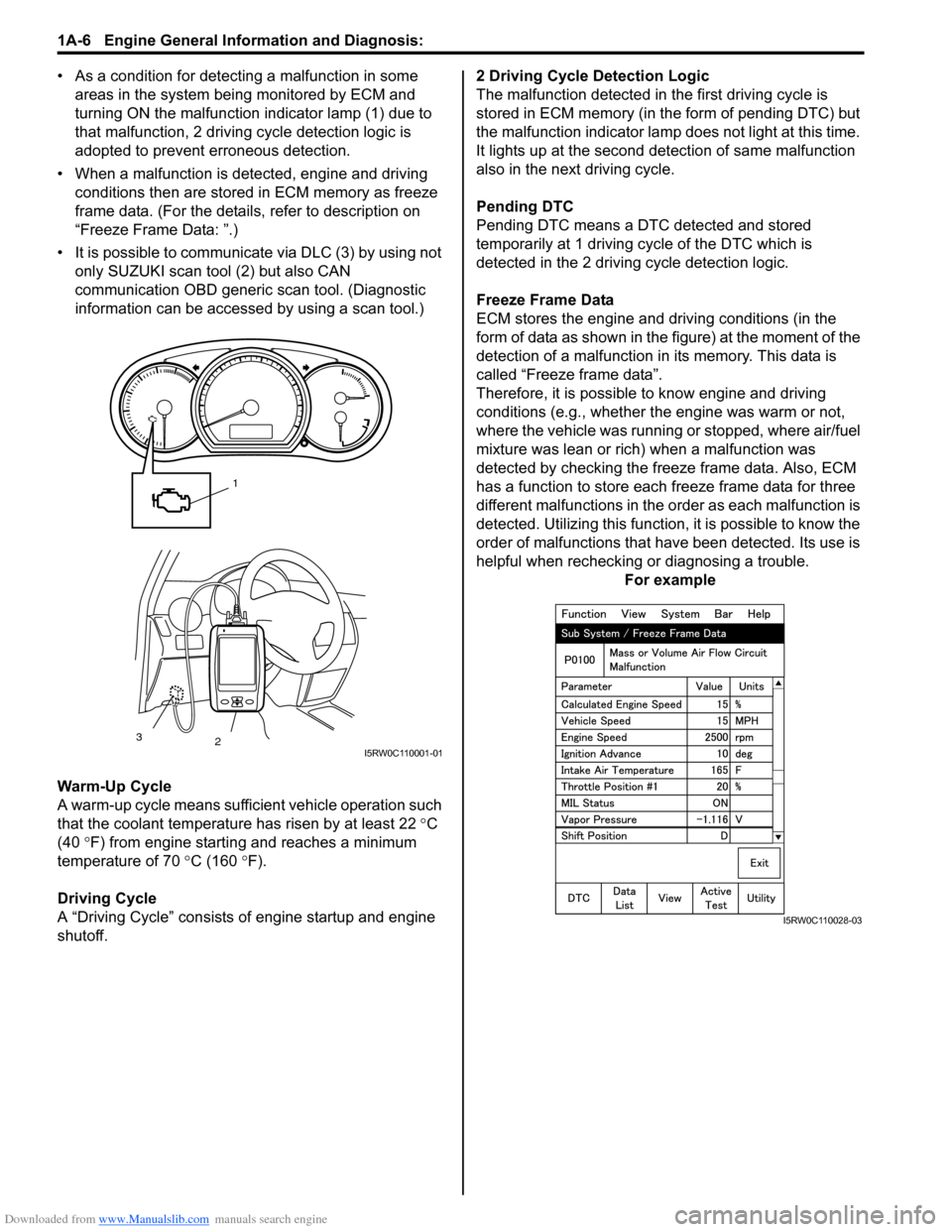
• It is possible to communicate via DLC (3) by using not
only SUZUKI scan tool (2) but also CAN
communication OBD generic scan tool. (Diagnostic
information can be accessed by using a scan tool.)
Warm-Up Cycle
A warm-up cycle means sufficient vehicle operation such
that the coolant temperature has risen by at least 22 °C
(40 °F) from engine starting and reaches a minimum
temperature of 70 °C (160 °F).
Driving Cycle
A “Driving Cycle” consists of engine startup and engine
shutoff.2 Driving Cycle Detection Logic
The malfunction detected in the first driving cycle is
stored in ECM memory (in the form of pending DTC) but
the malfunction indicator lamp does not light at this time.
It lights up at the second detection of same malfunction
also in the next driving cycle.
Pending DTC
Pending DTC means a DTC detected and stored
temporarily at 1 driving cycle of the DTC which is
detected in the 2 driving cycle detection logic.
Freeze Frame Data
ECM stores the engine and driving conditions (in the
form of data as shown in the figure) at the moment of the
detection of a malfunction in its memory. This data is
called “Freeze frame data”.
Therefore, it is possible to know engine and driving
conditions (e.g., whether the engine was warm or not,
where the vehicle was running or stopped, where air/fuel
mixture was lean or rich) when a malfunction was
detected by checking the freeze frame data. Also, ECM
has a function to store each freeze frame data for three
different malfunctions in the order as each malfunction is
detected. Utilizing this function, it is possible to know the
order of malfunctions that have been detected. Its use is
helpful when rechecking or diagnosing a trouble.
For example
1
2 3
I5RW0C110001-01
I5RW0C110028-03
Page 57 of 1556
Downloaded from www.Manualslib.com manuals search engine Engine General Information and Diagnosis: 1A-7
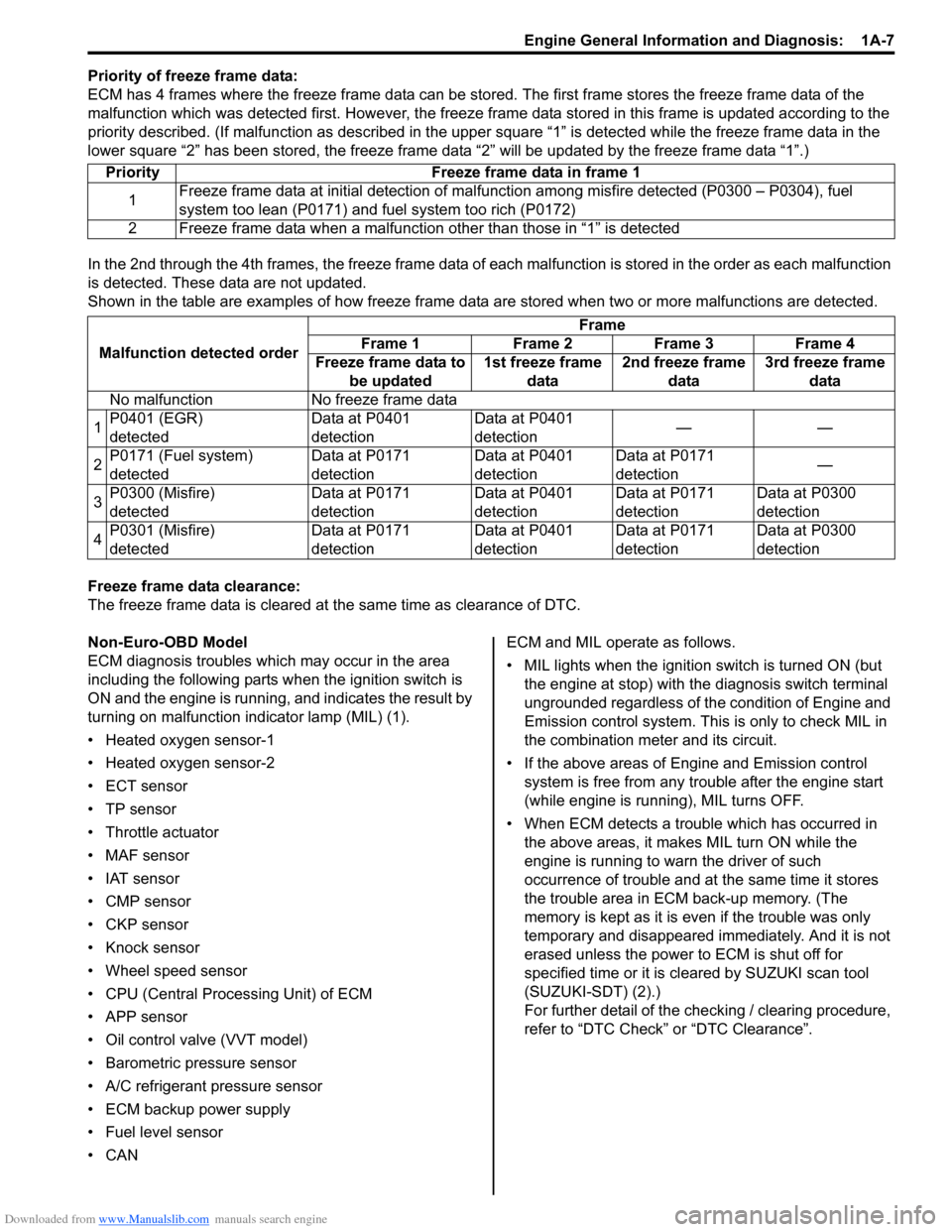
Priority of freeze frame data:
ECM has 4 frames where the freeze frame data can be stored. The first frame stores the freeze frame data of the
malfunction which was detected first. However, the freeze frame data stored in this frame is updated according to the
priority described. (If malfunction as described in the upper square “1” is detected while the freeze frame data in the
lower square “2” has been stored, the freeze frame data “2” will be updated by the freeze frame data “1”.)
In the 2nd through the 4th frames, the freeze frame data of each malfunction is stored in the order as each malfunction
is detected. These data are not updated.
Shown in the table are examples of how freeze frame data are stored when two or more malfunctions are detected.
Freeze frame data clearance:
The freeze frame data is cleared at the same time as clearance of DTC.
Non-Euro-OBD Model
ECM diagnosis troubles which may occur in the area
including the following parts when the ignition switch is
ON and the engine is running, and indicates the result by
turning on malfunction indicator lamp (MIL) (1).
• Heated oxygen sensor-1
• Heated oxygen sensor-2
• ECT sensor
•TP sensor
• Throttle actuator
• MAF sensor
• IAT sensor
• CMP sensor
• CKP sensor
• Knock sensor
• Wheel speed sensor
• CPU (Central Processing Unit) of ECM
• APP sensor
• Oil control valve (VVT model)
• Barometric pressure sensor
• A/C refrigerant pressure sensor
• ECM backup power supply
• Fuel level sensor
•CANECM and MIL operate as follows.
• MIL lights when the ignition switch is turned ON (but
the engine at stop) with the diagnosis switch terminal
ungrounded regardless of the condition of Engine and
Emission control system. This is only to check MIL in
the combination meter and its circuit.
• If the above areas of Engine and Emission control
system is free from any trouble after the engine start
(while engine is running), MIL turns OFF.
• When ECM detects a trouble which has occurred in
the above areas, it makes MIL turn ON while the
engine is running to warn the driver of such
occurrence of trouble and at the same time it stores
the trouble area in ECM back-up memory. (The
memory is kept as it is even if the trouble was only
temporary and disappeared immediately. And it is not
erased unless the power to ECM is shut off for
specified time or it is cleared by SUZUKI scan tool
(SUZUKI-SDT) (2).)
For further detail of the checking / clearing procedure,
refer to “DTC Check” or “DTC Clearance”. Priority Freeze frame data in frame 1
1Freeze frame data at initial detection of malfunction among misfire detected (P0300 – P0304), fuel
system too lean (P0171) and fuel system too rich (P0172)
2 Freeze frame data when a malfunction other than those in “1” is detected
Malfunction detected orderFrame
Frame 1 Frame 2 Frame 3 Frame 4
Freeze frame data to
be updated1st freeze frame
data2nd freeze frame
data3rd freeze frame
data
No malfunction No freeze frame data
1P0401 (EGR)
detectedData at P0401
detectionData at P0401
detection——
2P0171 (Fuel system)
detectedData at P0171
detectionData at P0401
detectionData at P0171
detection—
3P0300 (Misfire)
detectedData at P0171
detectionData at P0401
detectionData at P0171
detectionData at P0300
detection
4P0301 (Misfire)
detectedData at P0171
detectionData at P0401
detectionData at P0171
detectionData at P0300
detection
Page 71 of 1556

Downloaded from www.Manualslib.com manuals search engine Engine General Information and Diagnosis: 1A-21
Component Location
Electronic Control System Components LocationS6RW0D1103001
NOTE
The figure shows left-hand steering vehicle. For right-hand steering vehicle, parts with (*) are installed
at the opposite side.
H*E*
10
D
G* C
6A
B*
e
3*
12*
a8 13
b
1
5-1
d
2
11
g
4
7
9
i
j
Fh k f
n
c J
5
K*
14
I6RW0D110016-03
Information sensors Control devices Others
1. MAF and IAT sensor a: Fuel injector A: ECM
2. Electric throttle body assembly
(built-in throttle position sensor and throttle
actuator)b: EVAP canister purge valve B: Combination meter
3. Brake light switch c: Fuel pump relay C: EVAP canister
4. ECT sensor d: EGR valve (if equipped) D: A/C evaporator outlet air temp. sensor
(if equipped with A/C)
5. Heated oxygen sensor-1 e: Malfunction indicator lamp E: Data link connector
5-1. Heated oxygen sensor-2 (if equipped) f: Radiator cooling fan relay F: A/C compressor relay (if equipped with A/C)
6. Battery g: Ignition coil assembly (with ignitor) G: BCM (included in junction block assembly)
7. CMP sensor (for engine with VVT system) h: Main relay H: Immobilizer coil antenna
8. MAP sensor (if equipped) i: Oil control valve (for engine with VVT system) J: A/C refrigerant pressure sensor
(if equipped with A/C)
9. CKP sensor j: A/C condenser cooling fan relay K: TCM (for A/T model)
10. Fuel level sensor k: Starting motor control relay
11. Knock sensor m: Immobilizer indicator lamp
12. APP sensor n: Throttle actuator control relay
13. Front wheel speed sensor (RH, LH) (VSS)
14. CMP sensor (for engine without VVT system)