Steering angle SUZUKI SX4 2006 1.G Service Workshop Manual
[x] Cancel search | Manufacturer: SUZUKI, Model Year: 2006, Model line: SX4, Model: SUZUKI SX4 2006 1.GPages: 1556, PDF Size: 37.31 MB
Page 437 of 1556
Downloaded from www.Manualslib.com manuals search engine Suspension General Diagnosis: 2A-3
Specifications
Wheel Alignment SpecificationsS6RW0D2107001
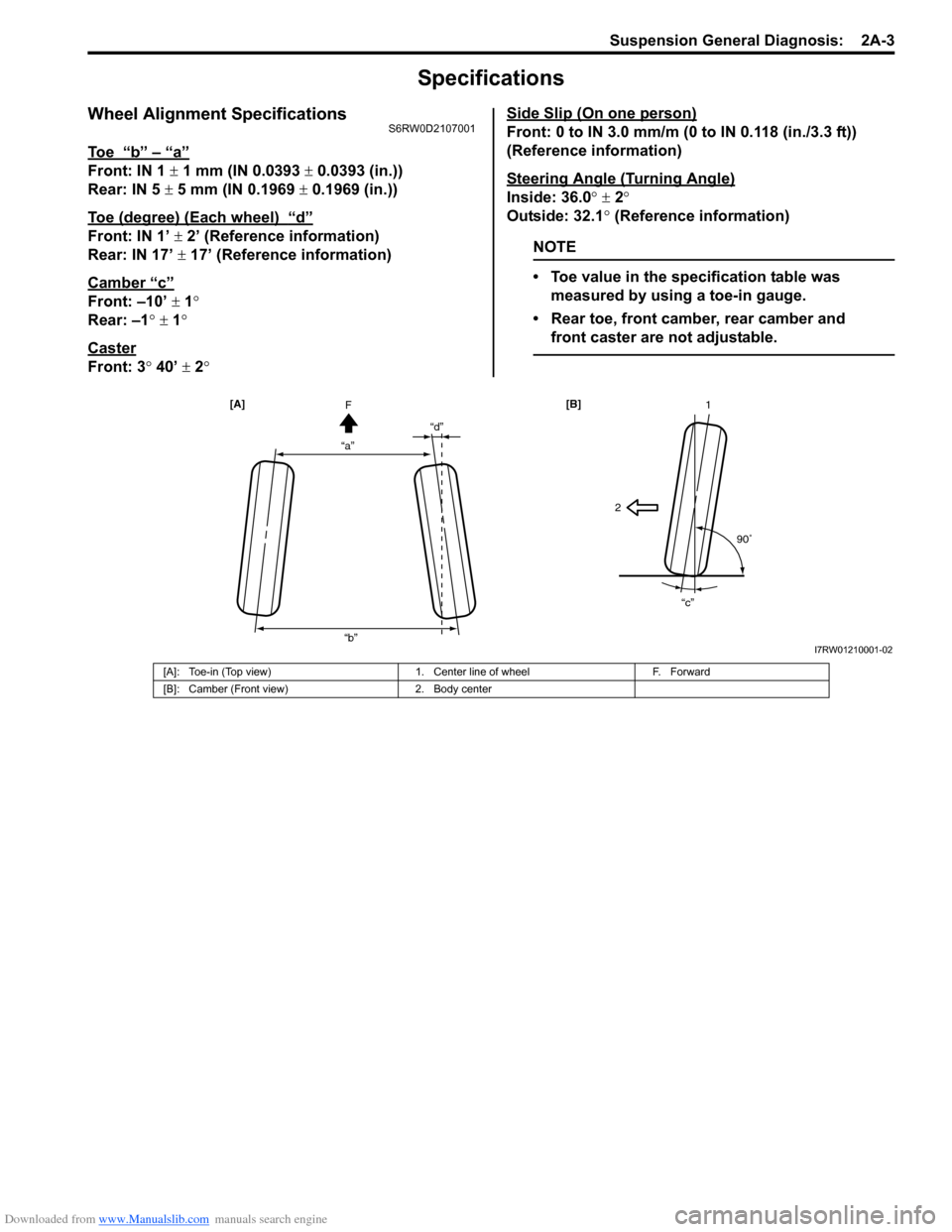
To e “b” – “a”
Front: IN 1 ± 1 mm (IN 0.0393 ± 0.0393 (in.))
Rear: IN 5 ± 5 mm (IN 0.1969 ± 0.1969 (in.))
Toe (degree) (Each wheel)
“d”
Front: IN 1’ ± 2’ (Reference information)
Rear: IN 17’ ± 17’ (Reference information)
Camber
“c”
Front: –10’ ± 1°
Rear: –1° ± 1°
Caster
Front: 3° 40’ ± 2°Side Slip (On one person)
Front: 0 to IN 3.0 mm/m (0 to IN 0.118 (in./3.3 ft))
(Reference information)
Steering Angle (Turning Angle)
Inside: 36.0° ± 2°
Outside: 32.1° (Reference information)
NOTE
• Toe value in the specification table was
measured by using a toe-in gauge.
• Rear toe, front camber, rear camber and
front caster are not adjustable.
“a”“d”
“b”F [A]
21
90
“c” [B]
I7RW01210001-02
[A]: Toe-in (Top view) 1. Center line of wheel F. Forward
[B]: Camber (Front view) 2. Body center
Page 440 of 1556
Downloaded from www.Manualslib.com manuals search engine 2B-3 Front Suspension:
Adjustment
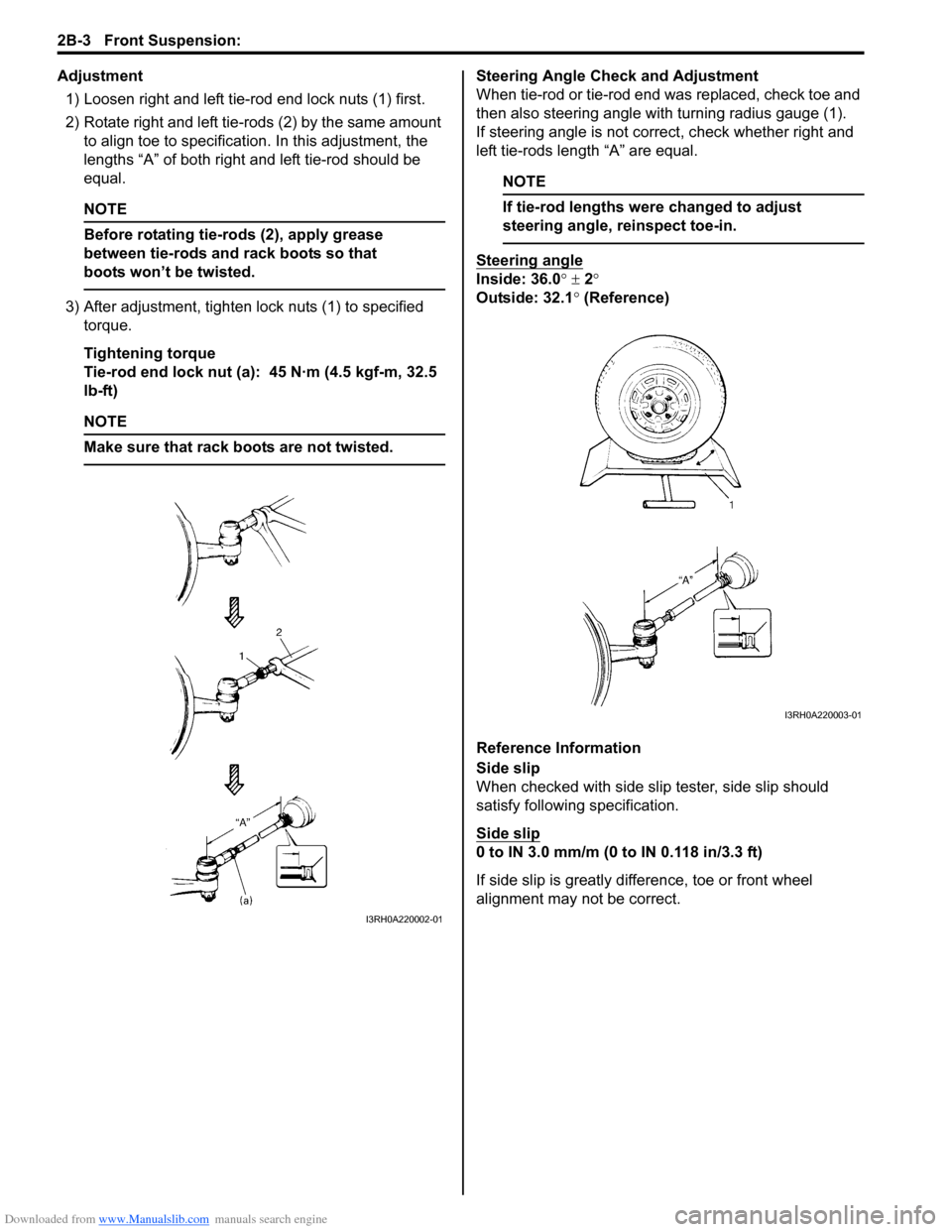
1) Loosen right and left tie-rod end lock nuts (1) first.
2) Rotate right and left tie-rods (2) by the same amount
to align toe to specification. In this adjustment, the
lengths “A” of both right and left tie-rod should be
equal.
NOTE
Before rotating tie-rods (2), apply grease
between tie-rods and rack boots so that
boots won’t be twisted.
3) After adjustment, tighten lock nuts (1) to specified
torque.
Tightening torque
Tie-rod end lock nut (a): 45 N·m (4.5 kgf-m, 32.5
lb-ft)
NOTE
Make sure that rack boots are not twisted.
Steering Angle Check and Adjustment
When tie-rod or tie-rod end was replaced, check toe and
then also steering angle with turning radius gauge (1).
If steering angle is not correct, check whether right and
left tie-rods length “A” are equal.
NOTE
If tie-rod lengths were changed to adjust
steering angle, reinspect toe-in.
Steering angle
Inside: 36.0° ± 2°
Outside: 32.1° (Reference)
Reference Information
Side slip
When checked with side slip tester, side slip should
satisfy following specification.
Side slip
0 to IN 3.0 mm/m (0 to IN 0.118 in/3.3 ft)
If side slip is greatly difference, toe or front wheel
alignment may not be correct.
I3RH0A220002-01
I3RH0A220003-01
Page 511 of 1556
Downloaded from www.Manualslib.com manuals search engine Differential: 3B-14
Rear Differential Symptom DiagnosisS6RW0D3204011
4WD Control Symptom DiagnosisS6RW0D3204012
Diagnose 4WD system after performing the following inspections.
• Perform 4WD control system check referring to “4WD Control System Check”. Condition Possible cause Correction / Reference Item
Gear noiseDeteriorated or water mixed lubricantRepair and replenish referring to “Rear
Differential Oil Change”.
Inadequate or insufficient lubricantRepair and replenish referring to “Rear
Differential Oil Change”.
Maladjusted backlash between drive
bevel pinion and gearAdjust as prescribed referring to “Rear
Differential Disassembly and Reassembly”.
Improper tooth contact in the mesh
between drive bevel pinion and gearAdjust or replace referring to “Rear Differential
Disassembly and Reassembly”.
Loose drive bevel gear securing boltsReplace or retighten referring to “Rear
Differential Disassembly and Reassembly”.
Damaged differential gear(s) or
differential pinion(s)Replace referring to “Rear Differential
Inspection”.
Bearing noise(Constant noise) Deteriorated or water
mixed lubricantRepair and replenish referring to “Rear
Differential Oil Change”.
(Constant noise) Inadequate or
insufficient lubricantRepair and replenish referring to “Rear
Differential Oil Change”.
(Noise while coasting) Damaged
bearing(s) of drive bevel pinionReplace referring to “Rear Differential
Inspection”.
(Noise while turning) Damaged
differential side bearing(s) or axle
bearing(s)Replace referring to “Rear Differential
Inspection”.
Oil leakageClogged breather plugClean.
Worn or damaged oil sealReplace.
Excessive oilAdjust oil level referring to “Rear Differential Oil
Change”.
Loose differential carrier boltsReplace or retighten.
Condition Possible cause Correction / Reference Item
4WD system does not
operate2WD/4WD switch faultyCheck switch referring to “2WD/4WD Switch
Inspection”.
Coupling air temperature sensor faultyCheck coupling air temperature sensor
referring to “Coupling Air Temperature Sensor
Inspection”.
Coupling assembly faultyCheck coupling assembly referring to
“Coupling Assembly Inspection”.
Wiring or grounding faultyRepair as necessary.
4WD control module faultyCheck 4WD control module referring to
“Inspection of 4WD Control Module and Its
Circuits”.
MAF sensor faultyCheck MAF sensor and its circuit.
Accelerator pedal position (APP) sensor
faultyCheck accelerator pedal position (APP) sensor
and its circuit.
CKP sensor faultyCheck CKP sensor and its circuit.
Front and/or rear wheel speed sensor
faultyCheck front and/or rear wheel speed sensor
and its circuit.
Steering angle sensor faultyCheck steering angle sensor and its circuit.
ABS / ESP® control module faultyCheck ABS / ESP
® control module and its
circuit.
ECM faultyCheck ECM and its circuit.
NoiseDamaged or worn bearing(s)Refer to “Rear Differential Inspection”.
Page 919 of 1556
Downloaded from www.Manualslib.com manuals search engine Power Assisted Steering System: 6C-39
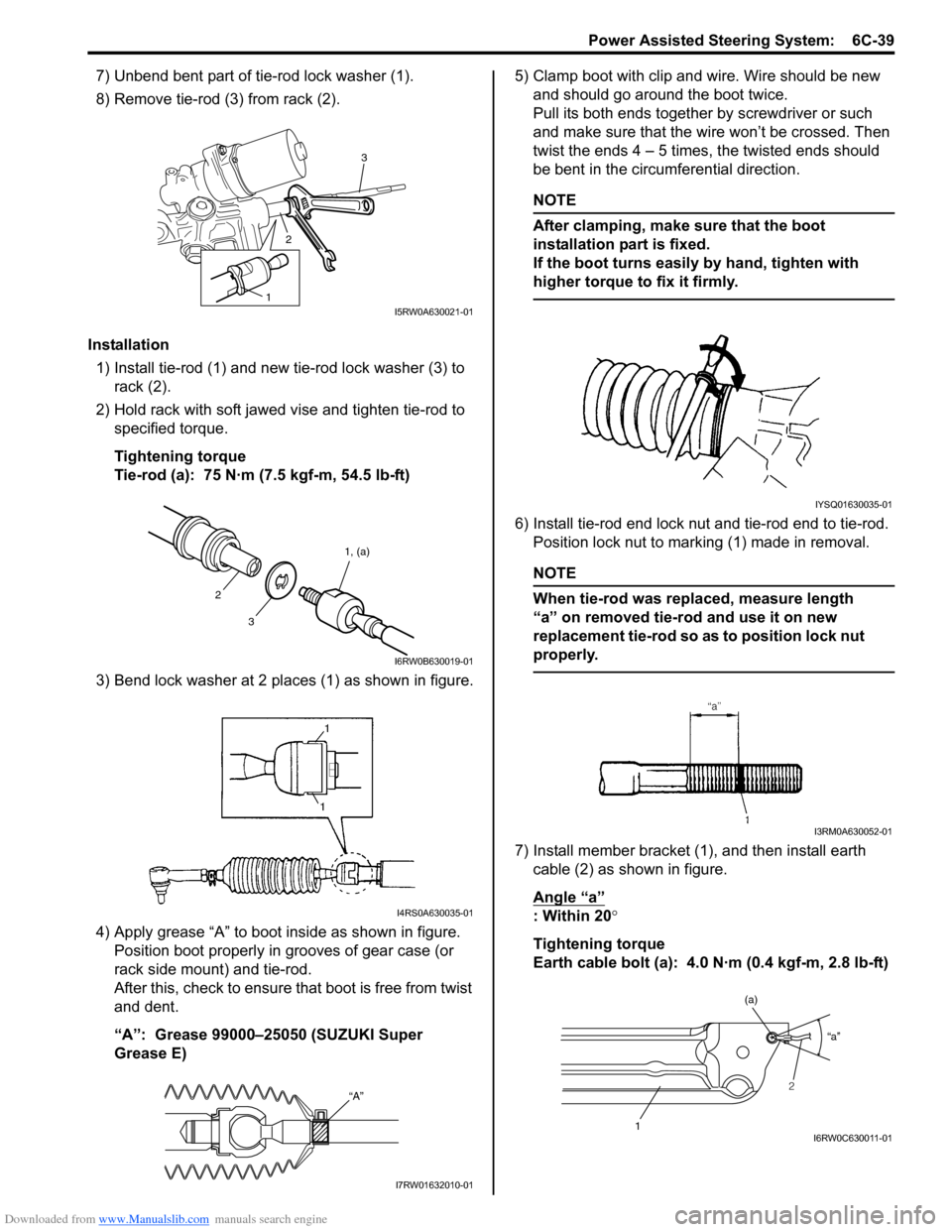
7) Unbend bent part of tie-rod lock washer (1).
8) Remove tie-rod (3) from rack (2).
Installation
1) Install tie-rod (1) and new tie-rod lock washer (3) to
rack (2).
2) Hold rack with soft jawed vise and tighten tie-rod to
specified torque.
Tightening torque
Tie-rod (a): 75 N·m (7.5 kgf-m, 54.5 lb-ft)
3) Bend lock washer at 2 places (1) as shown in figure.
4) Apply grease “A” to boot inside as shown in figure.
Position boot properly in grooves of gear case (or
rack side mount) and tie-rod.
After this, check to ensure that boot is free from twist
and dent.
“A”: Grease 99000–25050 (SUZUKI Super
Grease E) 5) Clamp boot with clip and wire. Wire should be new
and should go around the boot twice.
Pull its both ends together by screwdriver or such
and make sure that the wire won’t be crossed. Then
twist the ends 4 – 5 times, the twisted ends should
be bent in the circumferential direction.
NOTE
After clamping, make sure that the boot
installation part is fixed.
If the boot turns easily by hand, tighten with
higher torque to fix it firmly.
6) Install tie-rod end lock nut and tie-rod end to tie-rod.
Position lock nut to marking (1) made in removal.
NOTE
When tie-rod was replaced, measure length
“a” on removed tie-rod and use it on new
replacement tie-rod so as to position lock nut
properly.
7) Install member bracket (1), and then install earth
cable (2) as shown in figure.
Angle “a”
: Within 20°
Tightening torque
Earth cable bolt (a): 4.0 N·m (0.4 kgf-m, 2.8 lb-ft)
3
2
1I5RW0A630021-01
31, (a)
2
I6RW0B630019-01
I4RS0A630035-01
“A”
I7RW01632010-01
IYSQ01630035-01
I3RM0A630052-01
“a”
1
(a)
2
I6RW0C630011-01