seats SUZUKI SX4 2008 1.G User Guide
[x] Cancel search | Manufacturer: SUZUKI, Model Year: 2008, Model line: SX4, Model: SUZUKI SX4 2008 1.GPages: 278, PDF Size: 4.07 MB
Page 141 of 278
5-4
OTHER CONTROLS AND EQUIPMENT
80J21-03E
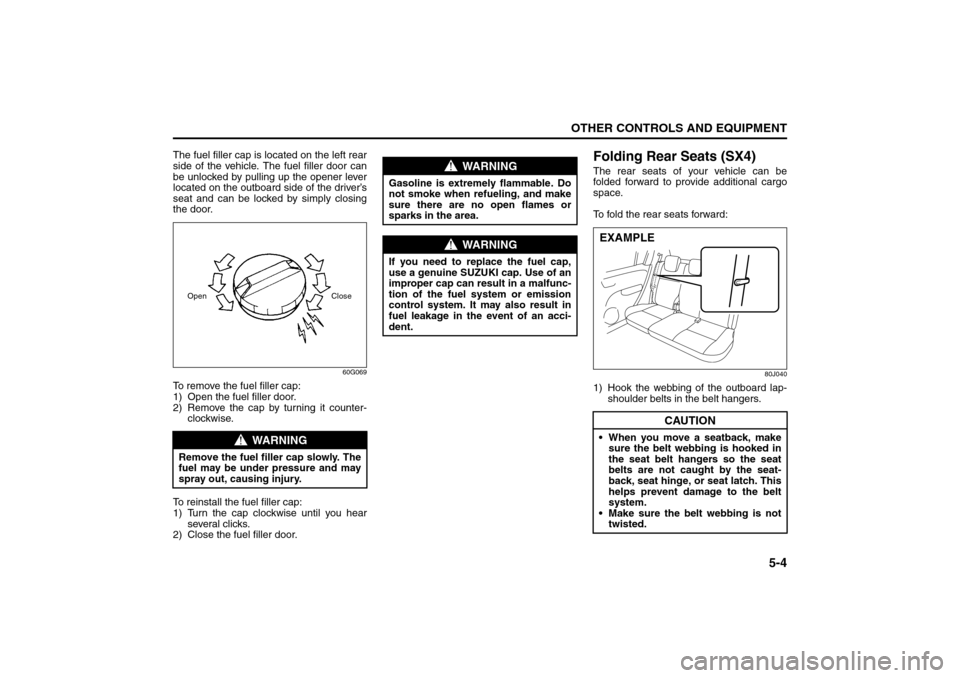
The fuel filler cap is located on the left rear
side of the vehicle. The fuel filler door can
be unlocked by pulling up the opener lever
located on the outboard side of the driver’s
seat and can be locked by simply closing
the door.
60G069
To remove the fuel filler cap:
1) Open the fuel filler door.
2) Remove the cap by turning it counter-
clockwise.
To reinstall the fuel filler cap:
1) Turn the cap clockwise until you hear
several clicks.
2) Close the fuel filler door.
Folding Rear Seats (SX4)The rear seats of your vehicle can be
folded forward to provide additional cargo
space.
To fold the rear seats forward:
80J040
1) Hook the webbing of the outboard lap-
shoulder belts in the belt hangers.
WARNING
Remove the fuel filler cap slowly. The
fuel may be under pressure and may
spray out, causing injury.Open Close
WARNING
Gasoline is extremely flammable. Do
not smoke when refueling, and make
sure there are no open flames or
sparks in the area.
WARNING
If you need to replace the fuel cap,
use a genuine SUZUKI cap. Use of an
improper cap can result in a malfunc-
tion of the fuel system or emission
control system. It may also result in
fuel leakage in the event of an acci-
dent.
CAUTION
When you move a seatback, make
sure the belt webbing is hooked in
the seat belt hangers so the seat
belts are not caught by the seat-
back, seat hinge, or seat latch. This
helps prevent damage to the belt
system.
Make sure the belt webbing is not
twisted.EXAMPLE
Fuel Filler Cap: 5
Folding Rear Seats: 3
Page 142 of 278
5-5OTHER CONTROLS AND EQUIPMENT
80J21-03E
79J213
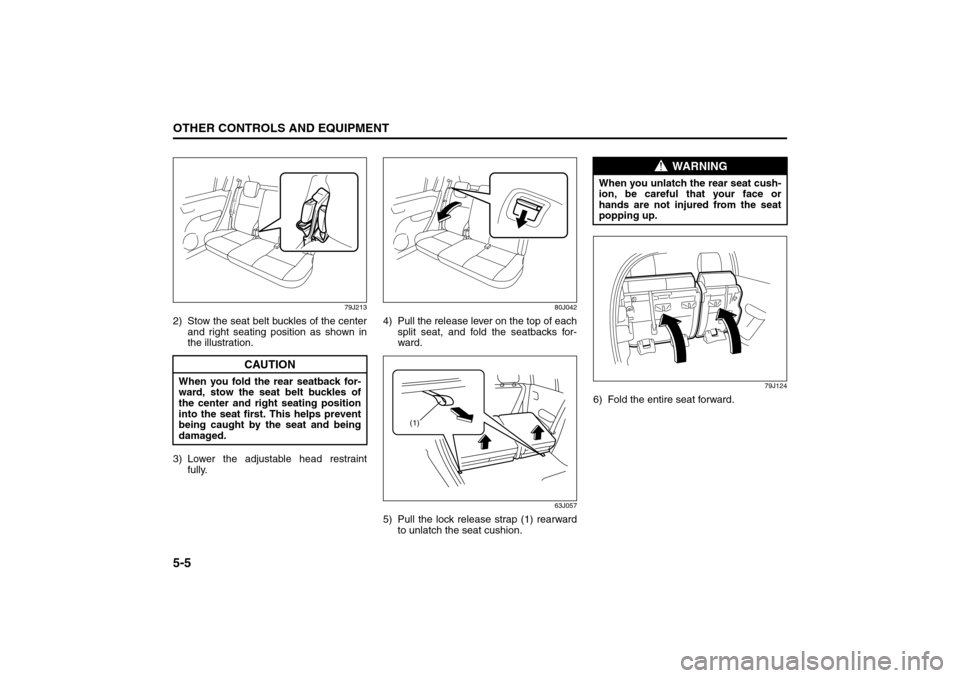
2) Stow the seat belt buckles of the center
and right seating position as shown in
the illustration.
3) Lower the adjustable head restraint
fully.
80J042
4) Pull the release lever on the top of each
split seat, and fold the seatbacks for-
ward.
63J057
5) Pull the lock release strap (1) rearward
to unlatch the seat cushion.
79J124
6) Fold the entire seat forward.
CAUTION
When you fold the rear seatback for-
ward, stow the seat belt buckles of
the center and right seating position
into the seat first. This helps prevent
being caught by the seat and being
damaged.
(1)
WARNING
When you unlatch the rear seat cush-
ion, be careful that your face or
hands are not injured from the seat
popping up.
Folding Rear Seats: 3
Page 143 of 278
5-6
OTHER CONTROLS AND EQUIPMENT
80J21-03E
80J043
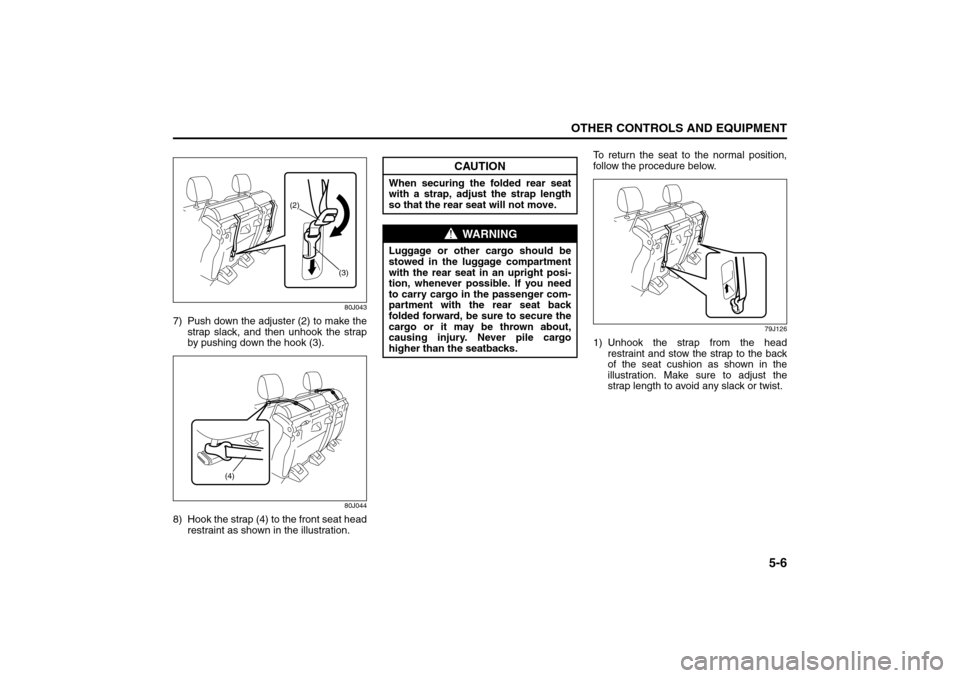
7) Push down the adjuster (2) to make the
strap slack, and then unhook the strap
by pushing down the hook (3).
80J044
8) Hook the strap (4) to the front seat head
restraint as shown in the illustration.To return the seat to the normal position,
follow the procedure below.
79J126
1) Unhook the strap from the head
restraint and stow the strap to the back
of the seat cushion as shown in the
illustration. Make sure to adjust the
strap length to avoid any slack or twist.
(2)
(3)
(4)
CAUTION
When securing the folded rear seat
with a strap, adjust the strap length
so that the rear seat will not move.
WARNING
Luggage or other cargo should be
stowed in the luggage compartment
with the rear seat in an upright posi-
tion, whenever possible. If you need
to carry cargo in the passenger com-
partment with the rear seat back
folded forward, be sure to secure the
cargo or it may be thrown about,
causing injury. Never pile cargo
higher than the seatbacks.
Folding Rear Seats: 3
Page 144 of 278
5-7OTHER CONTROLS AND EQUIPMENT
80J21-03E
79J129
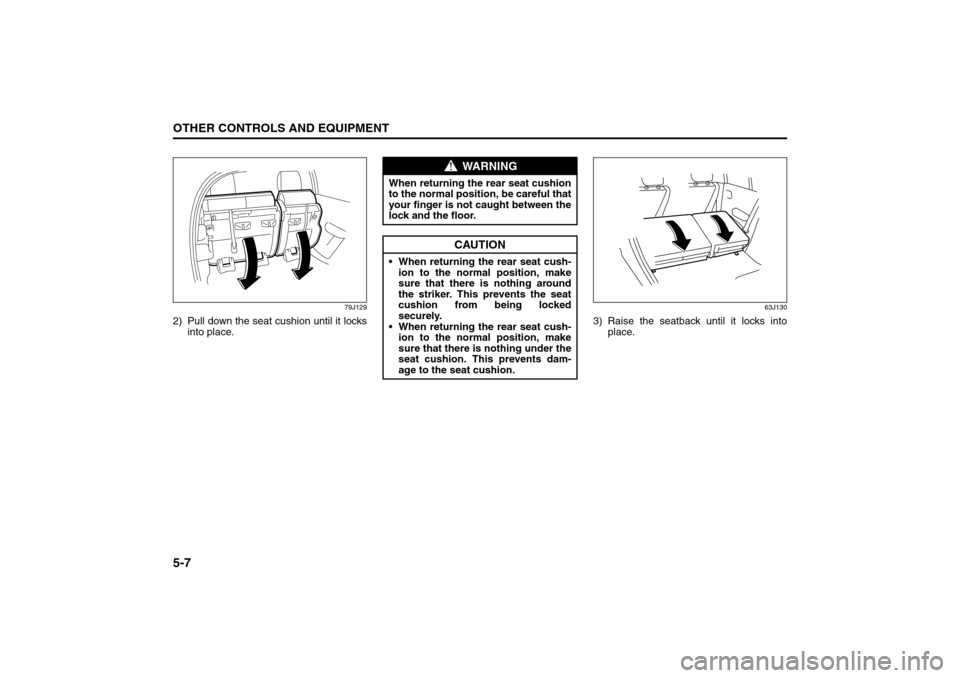
2) Pull down the seat cushion until it locks
into place.
63J130
3) Raise the seatback until it locks into
place.
WARNING
When returning the rear seat cushion
to the normal position, be careful that
your finger is not caught between the
lock and the floor.
CAUTION
When returning the rear seat cush-
ion to the normal position, make
sure that there is nothing around
the striker. This prevents the seat
cushion from being locked
securely.
When returning the rear seat cush-
ion to the normal position, make
sure that there is nothing under the
seat cushion. This prevents dam-
age to the seat cushion.
Folding Rear Seats: 3
Page 145 of 278
5-8
OTHER CONTROLS AND EQUIPMENT
80J21-03E
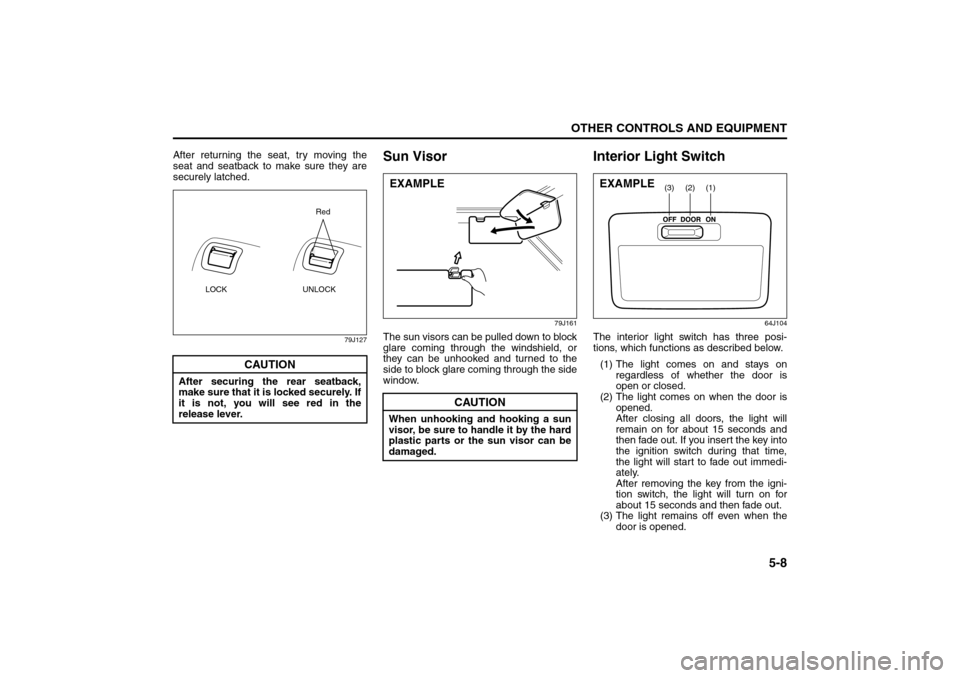
After returning the seat, try moving the
seat and seatback to make sure they are
securely latched.
79J127
Sun Visor
79J161
The sun visors can be pulled down to block
glare coming through the windshield, or
they can be unhooked and turned to the
side to block glare coming through the side
window.
Interior Light Switch
64J104
The interior light switch has three posi-
tions, which functions as described below.
(1) The light comes on and stays on
regardless of whether the door is
open or closed.
(2) The light comes on when the door is
opened.
After closing all doors, the light will
remain on for about 15 seconds and
then fade out. If you insert the key into
the ignition switch during that time,
the light will start to fade out immedi-
ately.
After removing the key from the igni-
tion switch, the light will turn on for
about 15 seconds and then fade out.
(3) The light remains off even when the
door is opened.
CAUTION
After securing the rear seatback,
make sure that it is locked securely. If
it is not, you will see red in the
release lever.
LOCK UNLOCKRed
CAUTION
When unhooking and hooking a sun
visor, be sure to handle it by the hard
plastic parts or the sun visor can be
damaged.EXAMPLE
(1)
(2)
(3)
EXAMPLE
Folding Rear Seats: 3
Page 146 of 278
5-9OTHER CONTROLS AND EQUIPMENT
80J21-03E
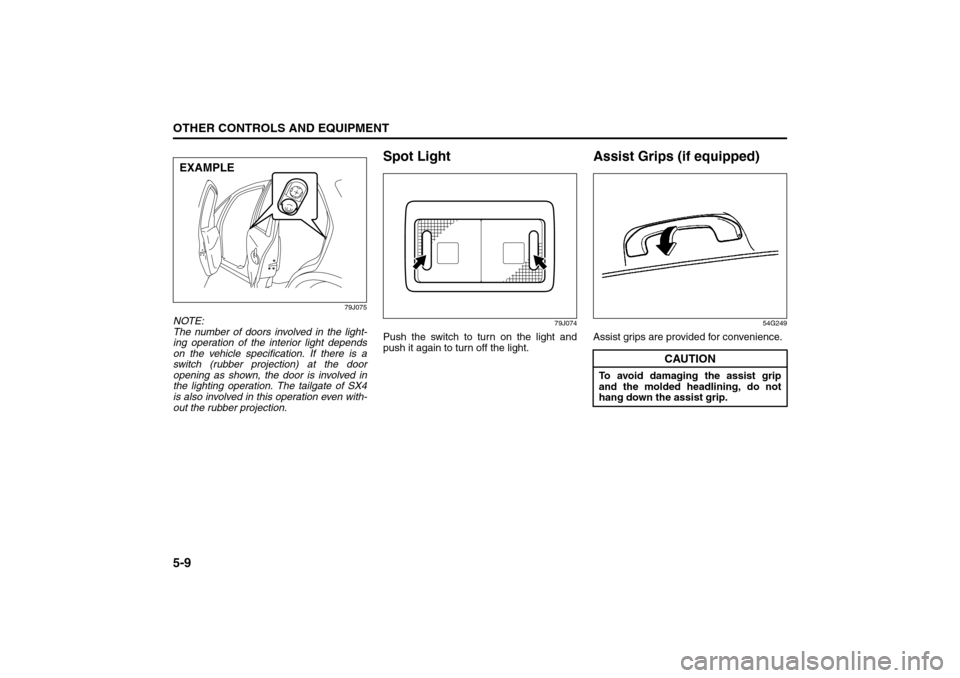
79J075
NOTE:
The number of doors involved in the light-
ing operation of the interior light depends
on the vehicle specification. If there is a
switch (rubber projection) at the door
opening as shown, the door is involved in
the lighting operation. The tailgate of SX4
is also involved in this operation even with-
out the rubber projection.
Spot Light
79J074
Push the switch to turn on the light and
push it again to turn off the light.
Assist Grips (if equipped)
54G249
Assist grips are provided for convenience.
EXAMPLE
CAUTION
To avoid damaging the assist grip
and the molded headlining, do not
hang down the assist grip.
Folding Rear Seats: 3
Armrest: 3
Page 205 of 278
9-16
INSPECTION AND MAINTENANCE
80J21-03E
Automatic Transaxle FluidSpecified FluidUse an automatic transaxle fluid equivalent
to DEXRON
®-III.
Fluid Level CheckYou must check the fluid level with the
automatic transaxle fluid at normal operat-
ing temperature.
To check the fluid level:
1) To warm up the transaxle fluid, drive the
vehicle or idle the engine until the tem-
perature gauge indicates normal oper-
ating temperature.
2) Then drive for ten more minutes.
NOTE:
Do not check the fluid level if you have just
driven the vehicle for a long time at high
speed, or if you have driven in city traffic in
hot weather. Wait until the fluid cools down
(about 30 minutes), or the fluid level indica-
tion will not be correct.
3) Park your vehicle on level ground.
4) Apply the parking brake and then start
the engine in “P” (Park). Let it idle for
two minutes and keep it running during
the fluid level check.5) With your foot on the brake pedal, move
the gearshift lever through each gear,
pausing for about three seconds in
each range. Then move it back to the
“P” (Park) position.
75F08654G317
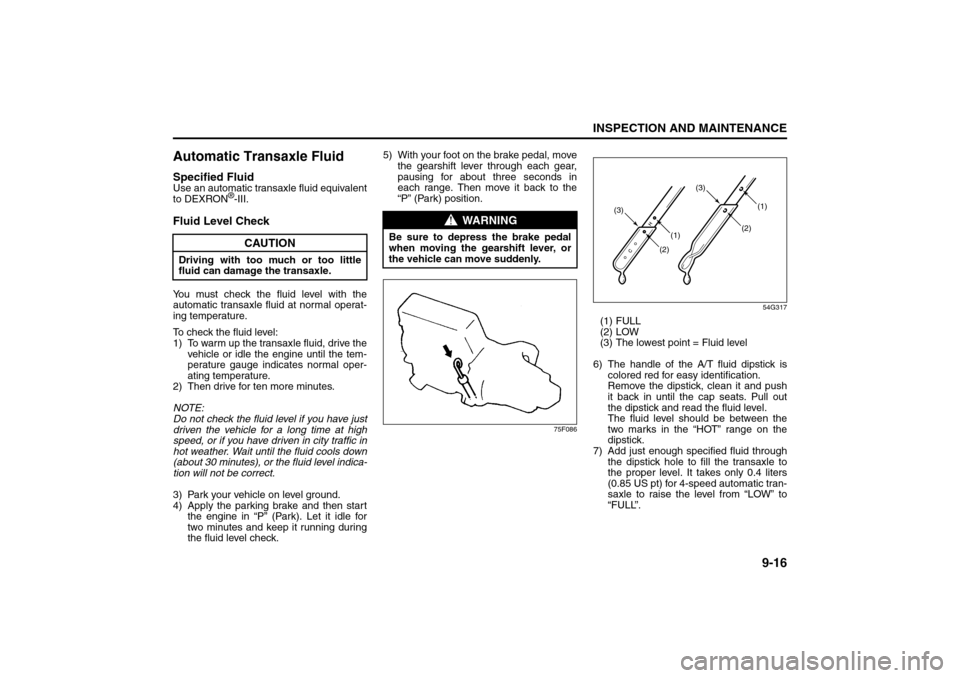
(1) FULL
(2) LOW
(3) The lowest point = Fluid level
6) The handle of the A/T fluid dipstick is
colored red for easy identification.
Remove the dipstick, clean it and push
it back in until the cap seats. Pull out
the dipstick and read the fluid level.
The fluid level should be between the
two marks in the “HOT” range on the
dipstick.
7) Add just enough specified fluid through
the dipstick hole to fill the transaxle to
the proper level. It takes only 0.4 liters
(0.85 US pt) for 4-speed automatic tran-
saxle to raise the level from “LOW” to
“FULL”.
CAUTION
Driving with too much or too little
fluid can damage the transaxle.
WARNING
Be sure to depress the brake pedal
when moving the gearshift lever, or
the vehicle can move suddenly.
(1)(2) (3)(1)
(2)(3)
Windshield Washer Fluid: 3
Air Cleaner: 1, 2
Page 221 of 278
9-32
INSPECTION AND MAINTENANCE
80J21-03E
GLOSSARY OF TIRE TERMINOL-
OGYAccessory Weight – the combined weight
(in excess of those standard items which
may be replaced) of automatic transaxle,
power steering, power brakes, power win-
dows, power seats, radio, and heater, to
the extent that these items are available as
factory-installed equipment (whether
installed or not).
Cold Tire Inflation Pressure – the pressure
in a tire that has been driven less than 1
mile or has been standing for three hours
or more.
Curb Weight – the weight of a motor vehi-
cle with standard equipment including the
maximum capacity of fuel, oil, and coolant,
and, if so equipped, air conditioning and
additional weight optional engine.
Intended Outboard Sidewall – (1) the side-
wall that contains a whitewall, bears white
lettering or bears manufacturer, brand,
and/or model name molding that is higher
or deeper than the same molding on the
other sidewall of the tire, or (2) the outward
facing sidewall of an asymmetrical tire that
has a particular side that must always face
outward when mounted on a vehicle.
Maximum Inflation Pressure – the maxi-
mum cold inflation pressure a tire is
designed to support in normal service.Maximum Loaded Vehicle Weight – the
sum of curb weight, accessory weight,
vehicle capacity weight (total load capac-
ity), and production options weight.
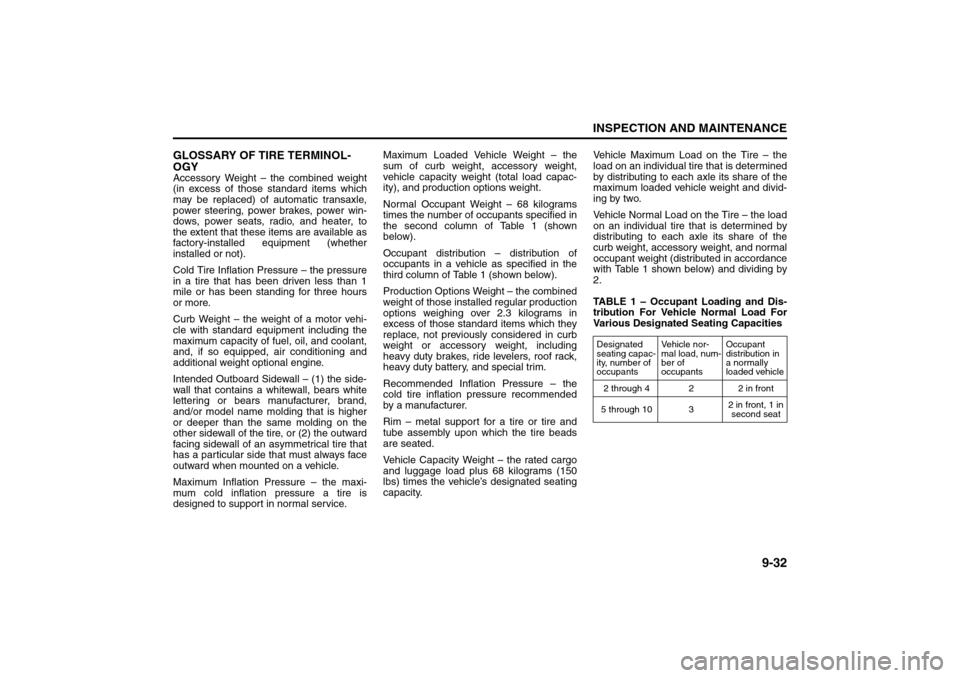
Normal Occupant Weight – 68 kilograms
times the number of occupants specified in
the second column of Table 1 (shown
below).
Occupant distribution – distribution of
occupants in a vehicle as specified in the
third column of Table 1 (shown below).
Production Options Weight – the combined
weight of those installed regular production
options weighing over 2.3 kilograms in
excess of those standard items which they
replace, not previously considered in curb
weight or accessory weight, including
heavy duty brakes, ride levelers, roof rack,
heavy duty battery, and special trim.
Recommended Inflation Pressure – the
cold tire inflation pressure recommended
by a manufacturer.
Rim – metal support for a tire or tire and
tube assembly upon which the tire beads
are seated.
Vehicle Capacity Weight – the rated cargo
and luggage load plus 68 kilograms (150
lbs) times the vehicle’s designated seating
capacity.Vehicle Maximum Load on the Tire – the
load on an individual tire that is determined
by distributing to each axle its share of the
maximum loaded vehicle weight and divid-
ing by two.
Vehicle Normal Load on the Tire – the load
on an individual tire that is determined by
distributing to each axle its share of the
curb weight, accessory weight, and normal
occupant weight (distributed in accordance
with Table 1 shown below) and dividing by
2.
TABLE 1 – Occupant Loading and Dis-
tribution For Vehicle Normal Load For
Various Designated Seating Capacities
Designated
seating capac-
ity, number of
occupantsVehicle nor-
mal load, num-
ber of
occupantsOccupant
distribution in
a normally
loaded vehicle
2 through 4 2 2 in front
5 through 10 32 in front, 1 in
second seat
Fuses: 7
Page 272 of 278
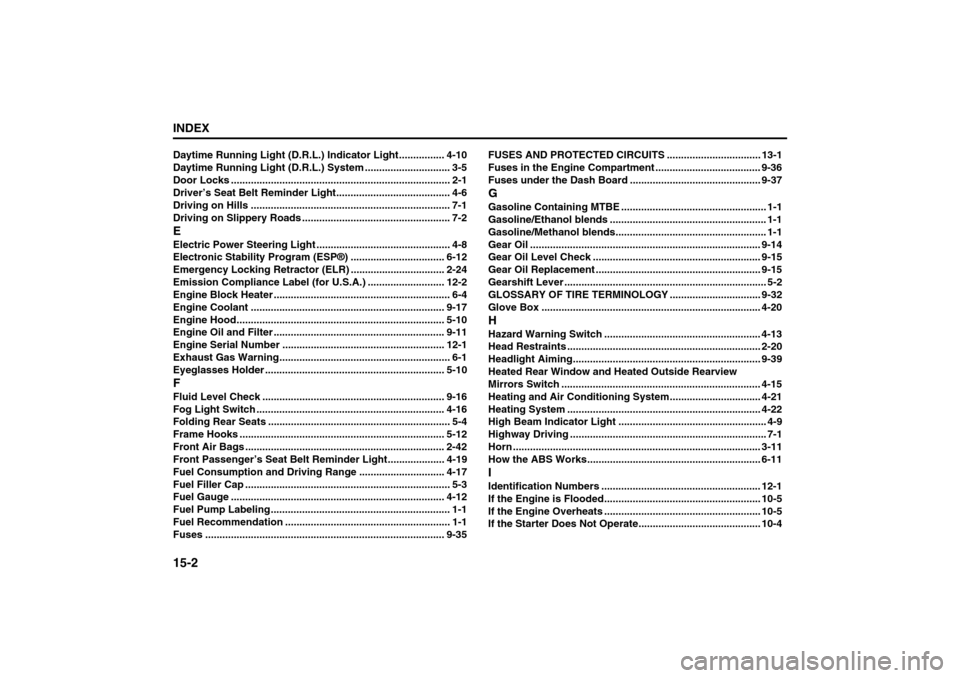
15-2INDEX
80J21-03E
Daytime Running Light (D.R.L.) Indicator Light................ 4-10
Daytime Running Light (D.R.L.) System .............................. 3-5
Door Locks ............................................................................. 2-1
Driver’s Seat Belt Reminder Light........................................ 4-6
Driving on Hills ...................................................................... 7-1
Driving on Slippery Roads .................................................... 7-2EElectric Power Steering Light ............................................... 4-8
Electronic Stability Program (ESP®) ................................. 6-12
Emergency Locking Retractor (ELR) ................................. 2-24
Emission Compliance Label (for U.S.A.) ........................... 12-2
Engine Block Heater .............................................................. 6-4
Engine Coolant .................................................................... 9-17
Engine Hood......................................................................... 5-10
Engine Oil and Filter ............................................................ 9-11
Engine Serial Number ......................................................... 12-1
Exhaust Gas Warning............................................................ 6-1
Eyeglasses Holder ............................................................... 5-10FFluid Level Check ................................................................ 9-16
Fog Light Switch .................................................................. 4-16
Folding Rear Seats ................................................................ 5-4
Frame Hooks ........................................................................ 5-12
Front Air Bags ...................................................................... 2-42
Front Passenger’s Seat Belt Reminder Light.................... 4-19
Fuel Consumption and Driving Range .............................. 4-17
Fuel Filler Cap ........................................................................ 5-3
Fuel Gauge ........................................................................... 4-12
Fuel Pump Labeling............................................................... 1-1
Fuel Recommendation .......................................................... 1-1
Fuses .................................................................................... 9-35FUSES AND PROTECTED CIRCUITS ................................. 13-1
Fuses in the Engine Compartment ..................................... 9-36
Fuses under the Dash Board .............................................. 9-37
GGasoline Containing MTBE ................................................... 1-1
Gasoline/Ethanol blends ....................................................... 1-1
Gasoline/Methanol blends..................................................... 1-1
Gear Oil ................................................................................. 9-14
Gear Oil Level Check ........................................................... 9-15
Gear Oil Replacement .......................................................... 9-15
Gearshift Lever ....................................................................... 5-2
GLOSSARY OF TIRE TERMINOLOGY ................................ 9-32
Glove Box ............................................................................. 4-20HHazard Warning Switch ....................................................... 4-13
Head Restraints .................................................................... 2-20
Headlight Aiming.................................................................. 9-39
Heated Rear Window and Heated Outside Rearview
Mirrors Switch ...................................................................... 4-15
Heating and Air Conditioning System................................ 4-21
Heating System .................................................................... 4-22
High Beam Indicator Light .................................................... 4-9
Highway Driving ..................................................................... 7-1
Horn ....................................................................................... 3-11
How the ABS Works............................................................. 6-11IIdentification Numbers ........................................................ 12-1
If the Engine is Flooded....................................................... 10-5
If the Engine Overheats ....................................................... 10-5
If the Starter Does Not Operate........................................... 10-4