tow SUZUKI SX4 2010 1.G Owner's Manual
[x] Cancel search | Manufacturer: SUZUKI, Model Year: 2010, Model line: SX4, Model: SUZUKI SX4 2010 1.GPages: 297, PDF Size: 4.51 MB
Page 194 of 297
5-53OTHER CONTROLS AND EQUIPMENT
80J23-03E
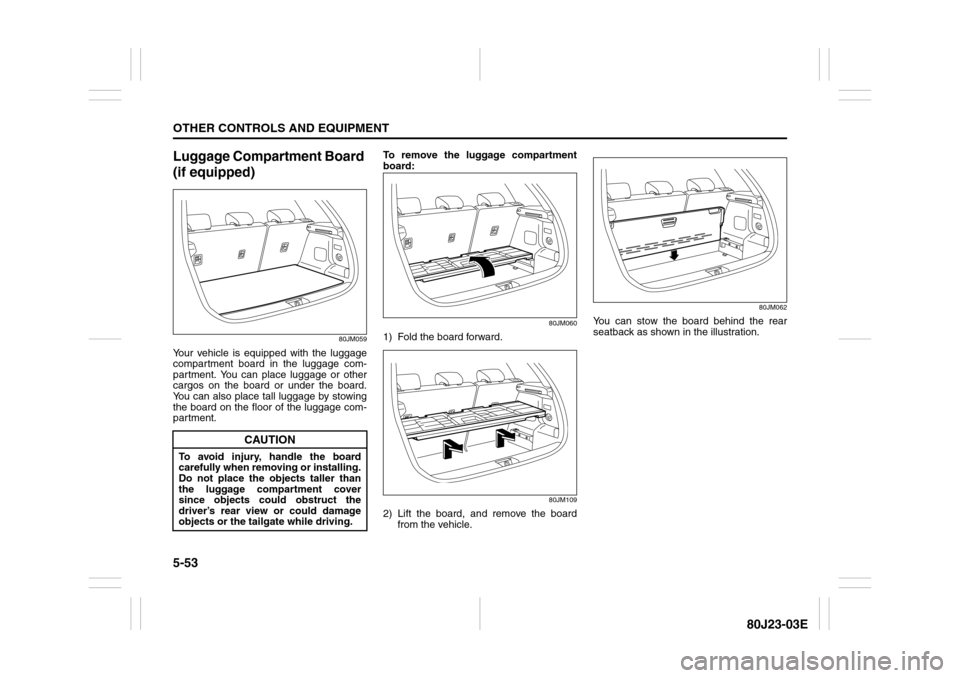
Luggage Compartment Board
(if equipped)
80JM059
Your vehicle is equipped with the luggage
compartment board in the luggage com-
partment. You can place luggage or other
cargos on the board or under the board.
You can also place tall luggage by stowing
the board on the floor of the luggage com-
partment.To remove the luggage compartment
board:
80JM060
1) Fold the board forward.
80JM109
2) Lift the board, and remove the board
from the vehicle.
80JM062
You can stow the board behind the rear
seatback as shown in the illustration.
CAUTION
To avoid injury, handle the board
carefully when removing or installing.
Do not place the objects taller than
the luggage compartment cover
since objects could obstruct the
driver’s rear view or could damage
objects or the tailgate while driving.
Page 196 of 297
5-55OTHER CONTROLS AND EQUIPMENT
80J23-03E
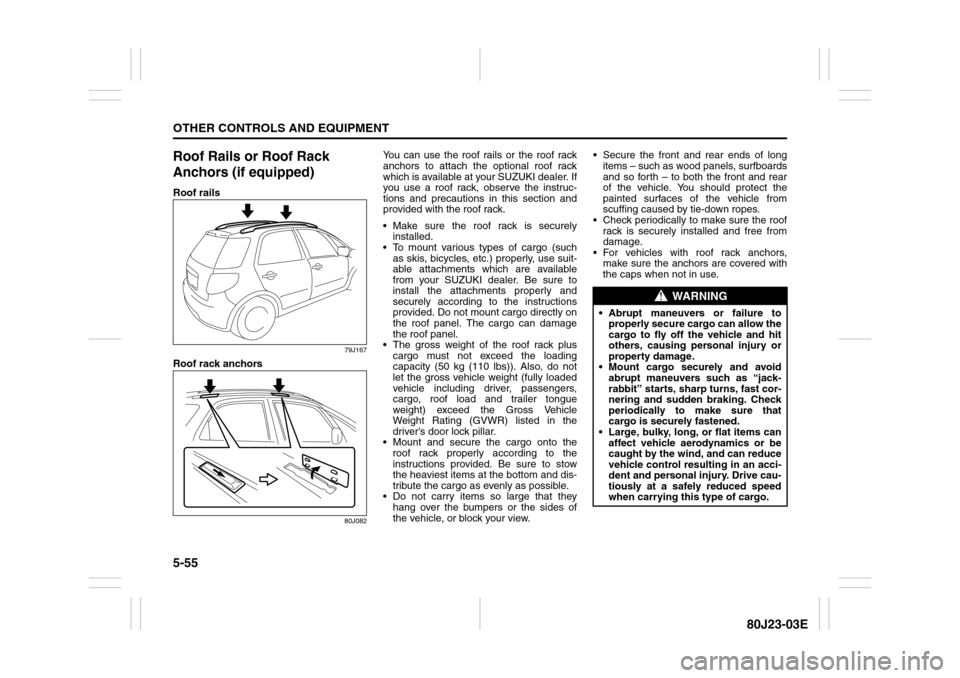
Roof Rails or Roof Rack
Anchors (if equipped)Roof rails
79J167
Roof rack anchors
80J082
You can use the roof rails or the roof rack
anchors to attach the optional roof rack
which is available at your SUZUKI dealer. If
you use a roof rack, observe the instruc-
tions and precautions in this section and
provided with the roof rack.
Make sure the roof rack is securely
installed.
To mount various types of cargo (such
as skis, bicycles, etc.) properly, use suit-
able attachments which are available
from your SUZUKI dealer. Be sure to
install the attachments properly and
securely according to the instructions
provided. Do not mount cargo directly on
the roof panel. The cargo can damage
the roof panel.
The gross weight of the roof rack plus
cargo must not exceed the loading
capacity (50 kg (110 lbs)). Also, do not
let the gross vehicle weight (fully loaded
vehicle including driver, passengers,
cargo, roof load and trailer tongue
weight) exceed the Gross Vehicle
Weight Rating (GVWR) listed in the
driver’s door lock pillar.
Mount and secure the cargo onto the
roof rack properly according to the
instructions provided. Be sure to stow
the heaviest items at the bottom and dis-
tribute the cargo as evenly as possible.
Do not carry items so large that they
hang over the bumpers or the sides of
the vehicle, or block your view. Secure the front and rear ends of long
items – such as wood panels, surfboards
and so forth – to both the front and rear
of the vehicle. You should protect the
painted surfaces of the vehicle from
scuffing caused by tie-down ropes.
Check periodically to make sure the roof
rack is securely installed and free from
damage.
For vehicles with roof rack anchors,
make sure the anchors are covered with
the caps when not in use.
WARNING
Abrupt maneuvers or failure to
properly secure cargo can allow the
cargo to fly off the vehicle and hit
others, causing personal injury or
property damage.
Mount cargo securely and avoid
abrupt maneuvers such as “jack-
rabbit” starts, sharp turns, fast cor-
nering and sudden braking. Check
periodically to make sure that
cargo is securely fastened.
Large, bulky, long, or flat items can
affect vehicle aerodynamics or be
caught by the wind, and can reduce
vehicle control resulting in an acci-
dent and personal injury. Drive cau-
tiously at a safely reduced speed
when carrying this type of cargo.
Page 197 of 297
5-56
OTHER CONTROLS AND EQUIPMENT
80J23-03E
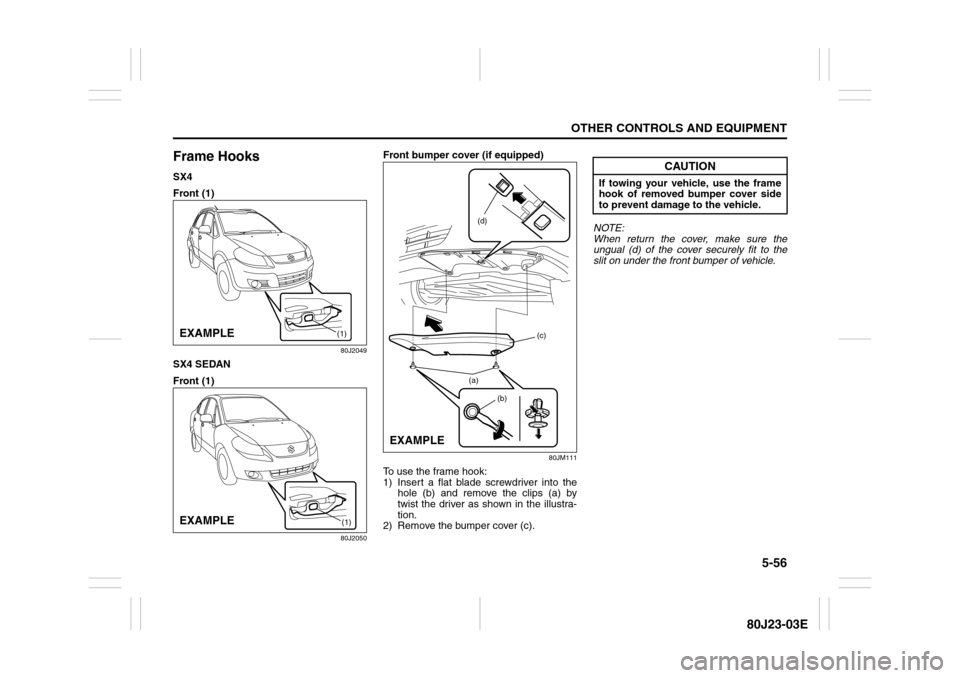
Frame HooksSX4
Front (1)
80J2049
SX4 SEDAN
Front (1)
80J2050
Front bumper cover (if equipped)
80JM111
To use the frame hook:
1) Insert a flat blade screwdriver into the
hole (b) and remove the clips (a) by
twist the driver as shown in the illustra-
tion.
2) Remove the bumper cover (c).NOTE:
When return the cover, make sure the
ungual (d) of the cover securely fit to the
slit on under the front bumper of vehicle.
(1)
EXAMPLE
(1)
EXAMPLE
(b)
(c)
(a)(d)
EXAMPLE
CAUTION
If towing your vehicle, use the frame
hook of removed bumper cover side
to prevent damage to the vehicle.
Page 198 of 297
5-57OTHER CONTROLS AND EQUIPMENT
80J23-03E
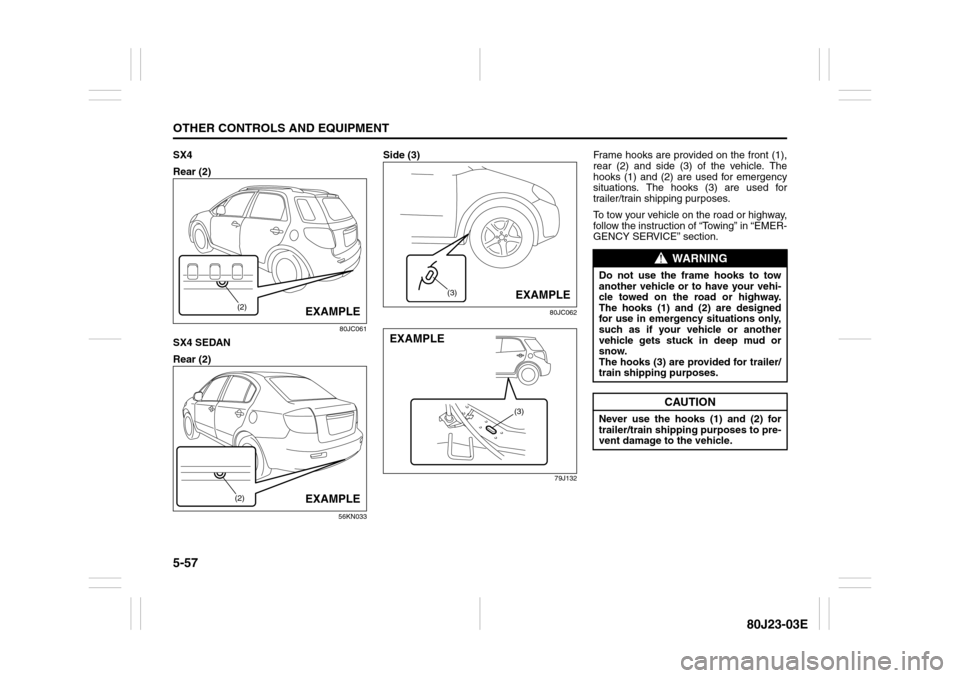
SX4
Rear (2)
80JC061
SX4 SEDAN
Rear (2)
56KN033
Side (3)
80JC062
79J132
Frame hooks are provided on the front (1),
rear (2) and side (3) of the vehicle. The
hooks (1) and (2) are used for emergency
situations. The hooks (3) are used for
trailer/train shipping purposes.
To tow your vehicle on the road or highway,
follow the instruction of “Towing” in “EMER-
GENCY SERVICE” section.
(2)
EXAMPLE
(2)
EXAMPLE
(3)
EXAMPLE(3)
EXAMPLE
WARNING
Do not use the frame hooks to tow
another vehicle or to have your vehi-
cle towed on the road or highway.
The hooks (1) and (2) are designed
for use in emergency situations only,
such as if your vehicle or another
vehicle gets stuck in deep mud or
snow.
The hooks (3) are provided for trailer/
train shipping purposes.
CAUTION
Never use the hooks (1) and (2) for
trailer/train shipping purposes to pre-
vent damage to the vehicle.
Page 199 of 297
VEHICLE LOADING AND TOWING
6
80J23-03E
54G215
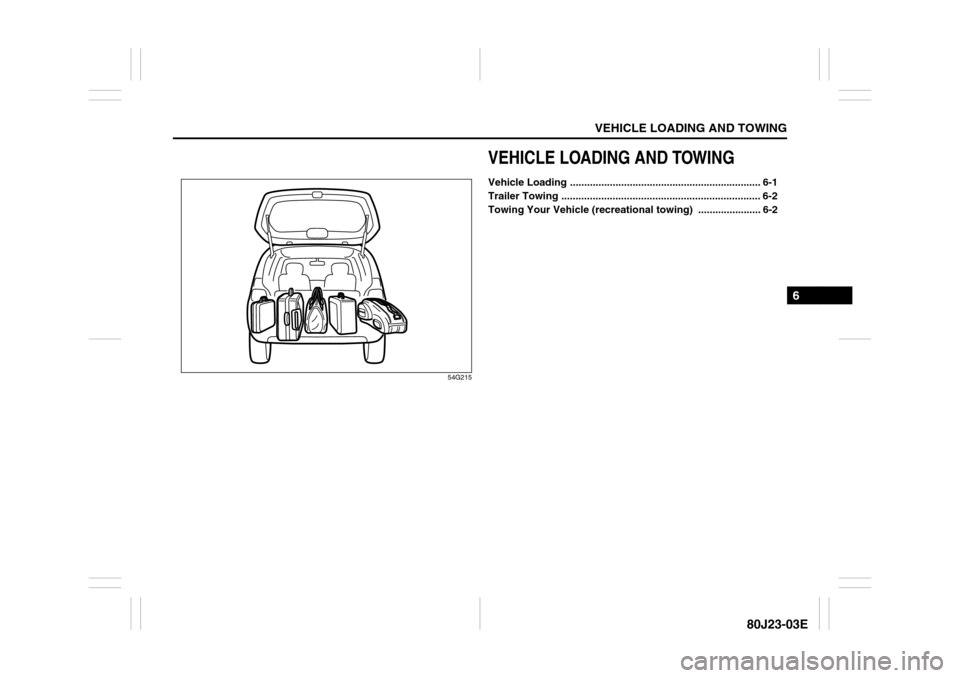
VEHICLE LOADING AND TOWINGVehicle Loading ................................................................... 6-1
Trailer Towing ...................................................................... 6-2
Towing Your Vehicle (recreational towing) ...................... 6-2
Page 200 of 297
6-1VEHICLE LOADING AND TOWING
80J23-03E
Vehicle Loading
80JS025
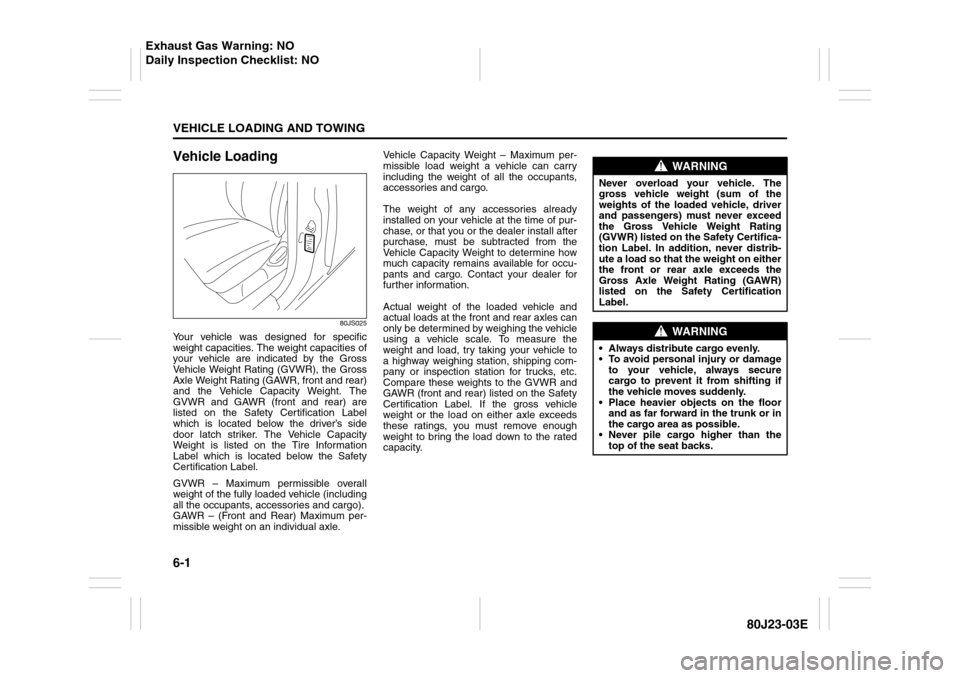
Your vehicle was designed for specific
weight capacities. The weight capacities of
your vehicle are indicated by the Gross
Vehicle Weight Rating (GVWR), the Gross
Axle Weight Rating (GAWR, front and rear)
and the Vehicle Capacity Weight. The
GVWR and GAWR (front and rear) are
listed on the Safety Certification Label
which is located below the driver’s side
door latch striker. The Vehicle Capacity
Weight is listed on the Tire Information
Label which is located below the Safety
Certification Label.
GVWR – Maximum permissible overall
weight of the fully loaded vehicle (including
all the occupants, accessories and cargo).
GAWR – (Front and Rear) Maximum per-
missible weight on an individual axle.Vehicle Capacity Weight – Maximum per-
missible load weight a vehicle can carry
including the weight of all the occupants,
accessories and cargo.
The weight of any accessories already
installed on your vehicle at the time of pur-
chase, or that you or the dealer install after
purchase, must be subtracted from the
Vehicle Capacity Weight to determine how
much capacity remains available for occu-
pants and cargo. Contact your dealer for
further information.
Actual weight of the loaded vehicle and
actual loads at the front and rear axles can
only be determined by weighing the vehicle
using a vehicle scale. To measure the
weight and load, try taking your vehicle to
a highway weighing station, shipping com-
pany or inspection station for trucks, etc.
Compare these weights to the GVWR and
GAWR (front and rear) listed on the Safety
Certification Label. If the gross vehicle
weight or the load on either axle exceeds
these ratings, you must remove enough
weight to bring the load down to the rated
capacity.
WARNING
Never overload your vehicle. The
gross vehicle weight (sum of the
weights of the loaded vehicle, driver
and passengers) must never exceed
the Gross Vehicle Weight Rating
(GVWR) listed on the Safety Certifica-
tion Label. In addition, never distrib-
ute a load so that the weight on either
the front or rear axle exceeds the
Gross Axle Weight Rating (GAWR)
listed on the Safety Certification
Label.
WARNING
Always distribute cargo evenly.
To avoid personal injury or damage
to your vehicle, always secure
cargo to prevent it from shifting if
the vehicle moves suddenly.
Place heavier objects on the floor
and as far forward in the trunk or in
the cargo area as possible.
Never pile cargo higher than the
top of the seat backs.
Exhaust Gas Warning: NO
Daily Inspection Checklist: NO
Page 201 of 297
6-2
VEHICLE LOADING AND TOWING
80J23-03E
Trailer Towing
54G639
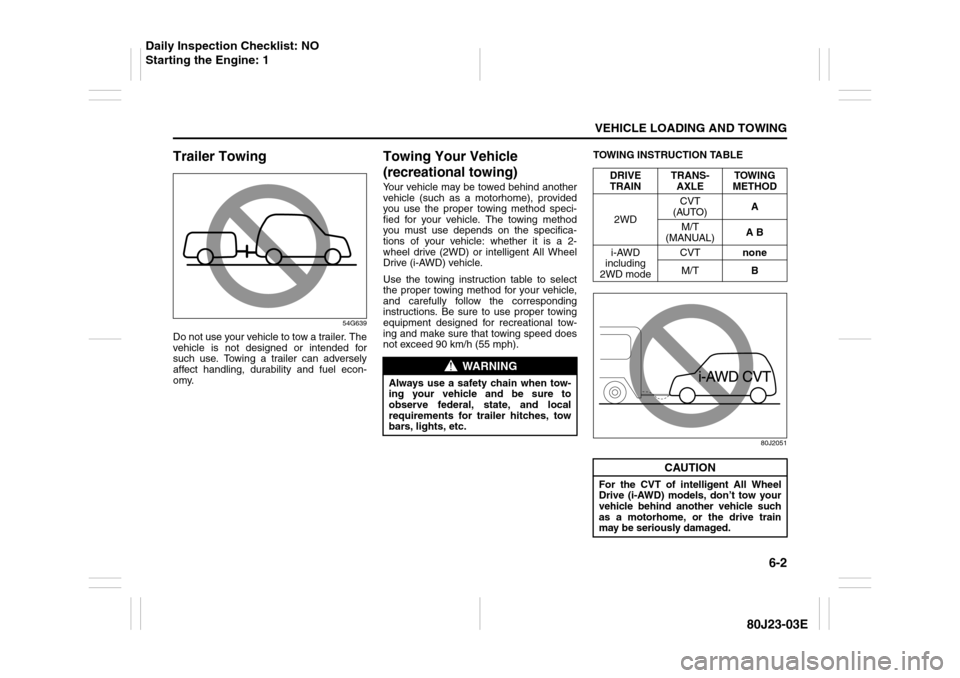
Do not use your vehicle to tow a trailer. The
vehicle is not designed or intended for
such use. Towing a trailer can adversely
affect handling, durability and fuel econ-
omy.
Towing Your Vehicle
(recreational towing)Your vehicle may be towed behind another
vehicle (such as a motorhome), provided
you use the proper towing method speci-
fied for your vehicle. The towing method
you must use depends on the specifica-
tions of your vehicle: whether it is a 2-
wheel drive (2WD) or intelligent All Wheel
Drive (i-AWD) vehicle.
Use the towing instruction table to select
the proper towing method for your vehicle,
and carefully follow the corresponding
instructions. Be sure to use proper towing
equipment designed for recreational tow-
ing and make sure that towing speed does
not exceed 90 km/h (55 mph).TOWING INSTRUCTION TABLE
80J2051
WARNING
Always use a safety chain when tow-
ing your vehicle and be sure to
observe federal, state, and local
requirements for trailer hitches, tow
bars, lights, etc.
DRIVE
TRAINTRANS-
AXLETOWING
METHOD
2WDCVT
(AUTO)A
M/T
(MANUAL)A B
i-AWD
including
2WD modeCVTnone
M/TB
CAUTION
For the CVT of intelligent All Wheel
Drive (i-AWD) models, don’t tow your
vehicle behind another vehicle such
as a motorhome, or the drive train
may be seriously damaged.
Daily Inspection Checklist: NO
Starting the Engine: 1
Page 202 of 297
6-3VEHICLE LOADING AND TOWING
80J23-03E
80J2052
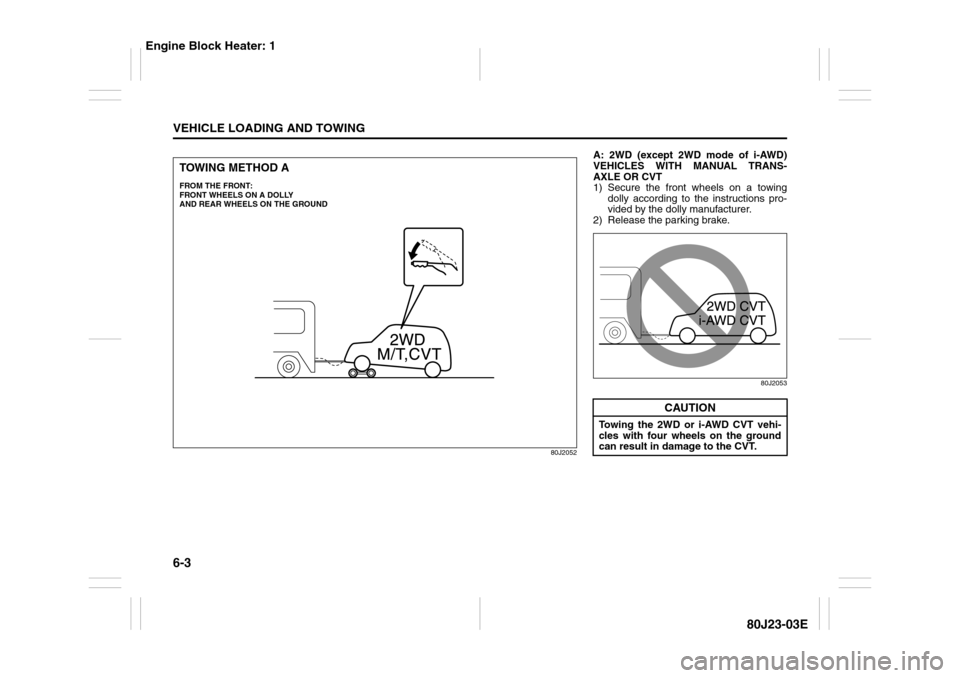
TOWING METHOD AFROM THE FRONT:
FRONT WHEELS ON A DOLLY
AND REAR WHEELS ON THE GROUND
A: 2WD (except 2WD mode of i-AWD)
VEHICLES WITH MANUAL TRANS-
AXLE OR CVT
1) Secure the front wheels on a towing
dolly according to the instructions pro-
vided by the dolly manufacturer.
2) Release the parking brake.
80J2053
CAUTION
Towing the 2WD or i-AWD CVT vehi-
cles with four wheels on the ground
can result in damage to the CVT.
Engine Block Heater: 1
Page 203 of 297
6-4
VEHICLE LOADING AND TOWING
80J23-03E
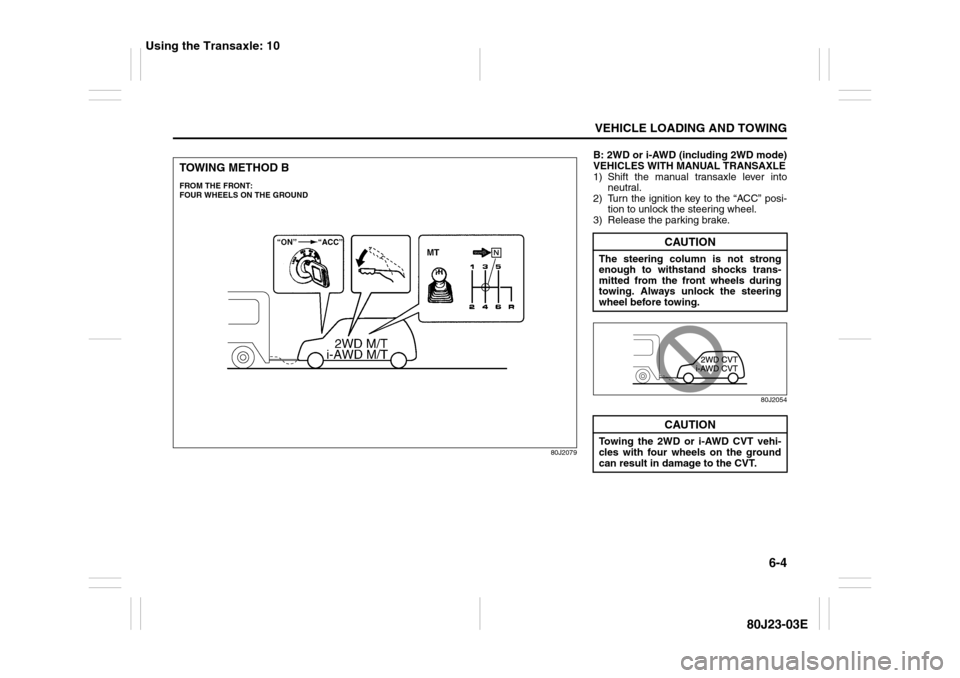
80J2079
TOWING METHOD BFROM THE FRONT:
FOUR WHEELS ON THE GROUND
B: 2WD or i-AWD (including 2WD mode)
VEHICLES WITH MANUAL TRANSAXLE
1) Shift the manual transaxle lever into
neutral.
2) Turn the ignition key to the “ACC” posi-
tion to unlock the steering wheel.
3) Release the parking brake.
80J2054
CAUTION
The steering column is not strong
enough to withstand shocks trans-
mitted from the front wheels during
towing. Always unlock the steering
wheel before towing.
CAUTION
Towing the 2WD or i-AWD CVT vehi-
cles with four wheels on the ground
can result in damage to the CVT.
Using the Transaxle: 10
Page 204 of 297
6-5VEHICLE LOADING AND TOWING
80J23-03E
MEMO
Using the Transaxle: 10