belt SUZUKI SX4 2010 1.G Workshop Manual
[x] Cancel search | Manufacturer: SUZUKI, Model Year: 2010, Model line: SX4, Model: SUZUKI SX4 2010 1.GPages: 297, PDF Size: 4.51 MB
Page 213 of 297
7-8
INSPECTION AND MAINTENANCE
80J23-03E
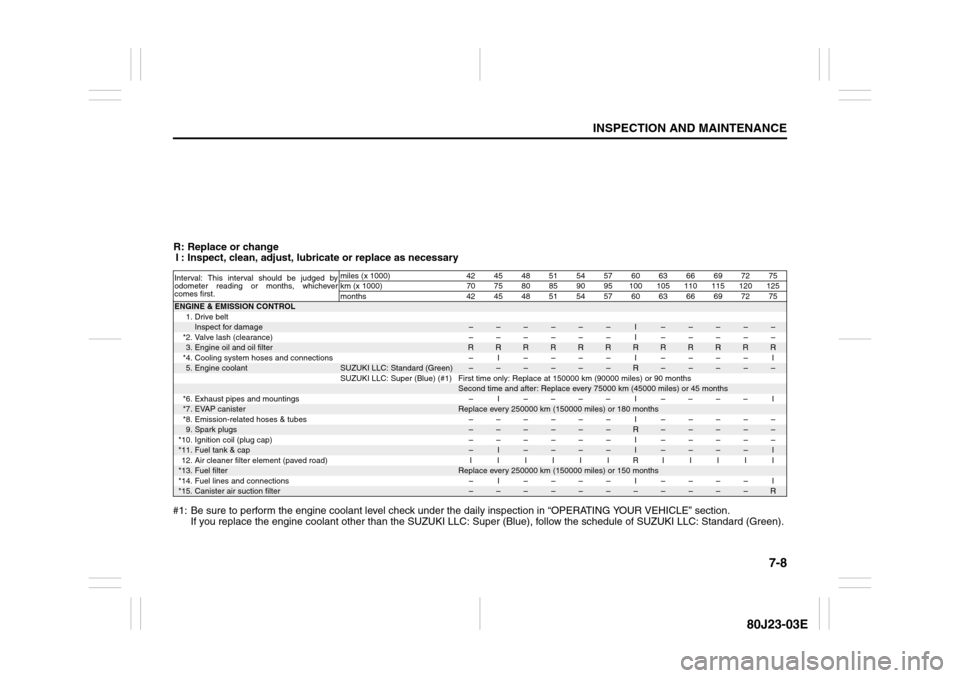
R: Replace or change
I : Inspect, clean, adjust, lubricate or replace as necessary
#1: Be sure to perform the engine coolant level check under the daily inspection in “OPERATING YOUR VEHICLE” section.
If you replace the engine coolant other than the SUZUKI LLC: Super (Blue), follow the schedule of SUZUKI LLC: Standard (Green).Interval: This interval should be judged by
odometer reading or months, whichever
comes first.miles (x 1000) 42 45 48 51 54 57 60 63 66 69 72 75
km (x 1000) 70 75 80 85 90 95 100 105 110 115 120 125
months 42 45 48 51 54 57 60 63 66 69 72 75ENGINE & EMISSION CONTROL
1. Drive belt
Inspect for damage
–
–
–
–
–
–
I
–
–
–
–
–
*2. Valve lash (clearance) – – – – – – I – – – – –
3.Engine oil and oil filter
R
R
R
R
R
R
R
R
R
R
R
R
*4. Cooling system hoses and connections – I – – – – I – – – – I
5.Engine coolant
SUZUKI LLC: Standard (Green)
–
–
–
–
–
–
R
–
–
–
–
–
SUZUKI LLC: Super (Blue) (#1) First time only: Replace at 150000 km (90000 miles) or 90 months
Second time and after: Replace every 75000 km (45000 miles) or 45 months
*6. Exhaust pipes and mountings – I – – – – I – – – – I
*7.
EVAP canister
Replace every 250000 km (150000 miles) or 180 months
*8. Emission-related hoses & tubes – – – – – – I – – – – –
9.Spark plugs
–
–
–
–
–
–
R
–
–
–
–
–
*10. Ignition coil (plug cap) – – – – – – I – – – – –
*11.
Fuel tank & cap
–
I
–
–
–
–
I
–
–
–
–
I
12. Air cleaner filter element (paved road) I I I I I I R I I I I I
*13.
Fuel filter
Replace every 250000 km (150000 miles) or 150 months
*14. Fuel lines and connections – I – – – – I – – – – I
*15.
Canister air suction filter
–
–
–
–
–
–
–
–
–
–
–
R
Page 216 of 297
7-11INSPECTION AND MAINTENANCE
80J23-03E
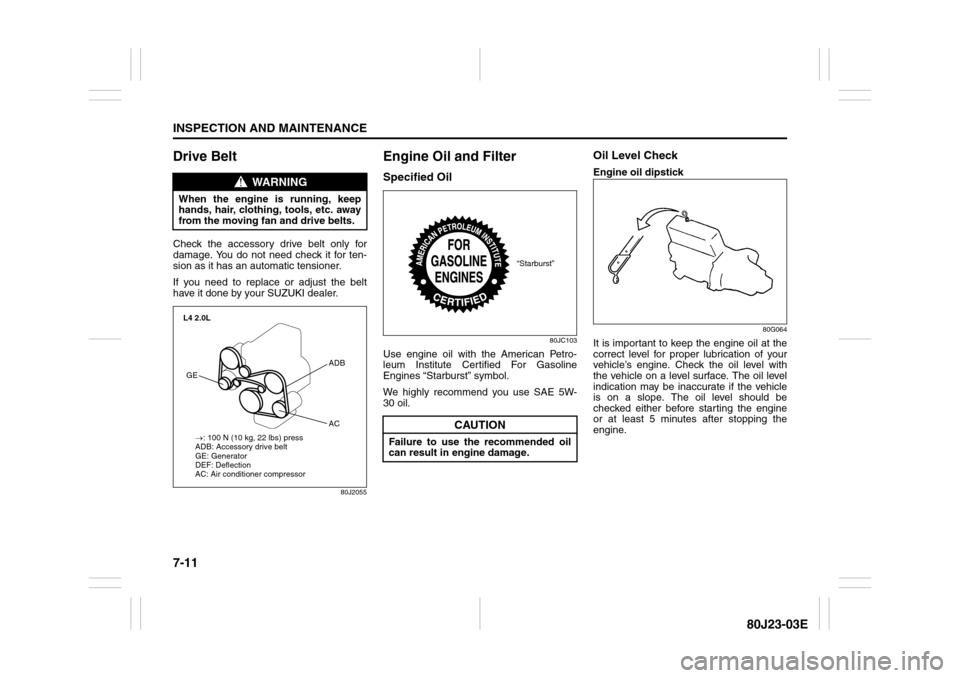
Drive Belt Check the accessory drive belt only for
damage. You do not need check it for ten-
sion as it has an automatic tensioner.
If you need to replace or adjust the belt
have it done by your SUZUKI dealer.
80J2055
Engine Oil and FilterSpecified Oil
80JC103
Use engine oil with the American Petro-
leum Institute Certified For Gasoline
Engines “Starburst” symbol.
We highly recommend you use SAE 5W-
30 oil.
Oil Level CheckEngine oil dipstick
80G064
It is important to keep the engine oil at the
correct level for proper lubrication of your
vehicle’s engine. Check the oil level with
the vehicle on a level surface. The oil level
indication may be inaccurate if the vehicle
is on a slope. The oil level should be
checked either before starting the engine
or at least 5 minutes after stopping the
engine.
WARNING
When the engine is running, keep
hands, hair, clothing, tools, etc. away
from the moving fan and drive belts.
→: 100 N (10 kg, 22 lbs) press
ADB: Accessory drive belt
GE: Generator
DEF: Deflection
AC: Air conditioner compressor L4 2.0LGEADB
AC
CAUTION
Failure to use the recommended oil
can result in engine damage.
“Starburst”
Page 231 of 297
7-26
INSPECTION AND MAINTENANCE
80J23-03E
D. Construction Code
This letter code is used to indicate
the type of ply construction in the
tire. The letter “R” means radial
ply tire construction, the letter “D”
means diagonal or bias ply con-
struction, and the letter “B” means
belted-bias ply construction.
E. Rim Diameter
This two-digit number is the wheel
or rim diameter in inches.Tire Inflation Pressure
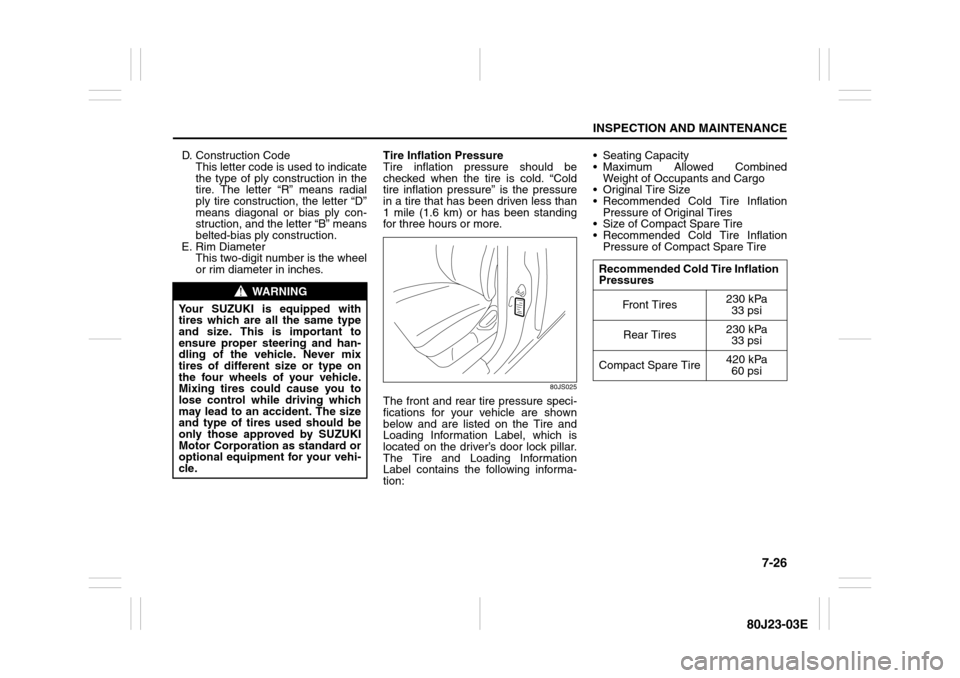
Tire inflation pressure should be
checked when the tire is cold. “Cold
tire inflation pressure” is the pressure
in a tire that has been driven less than
1 mile (1.6 km) or has been standing
for three hours or more.
80JS025
The front and rear tire pressure speci-
fications for your vehicle are shown
below and are listed on the Tire and
Loading Information Label, which is
located on the driver’s door lock pillar.
The Tire and Loading Information
Label contains the following informa-
tion: Seating Capacity
Maximum Allowed Combined
Weight of Occupants and Cargo
Original Tire Size
Recommended Cold Tire Inflation
Pressure of Original Tires
Size of Compact Spare Tire
Recommended Cold Tire Inflation
Pressure of Compact Spare Tire
WARNING
Your SUZUKI is equipped with
tires which are all the same type
and size. This is important to
ensure proper steering and han-
dling of the vehicle. Never mix
tires of different size or type on
the four wheels of your vehicle.
Mixing tires could cause you to
lose control while driving which
may lead to an accident. The size
and type of tires used should be
only those approved by SUZUKI
Motor Corporation as standard or
optional equipment for your vehi-
cle.
Recommended Cold Tire Inflation
Pressures
Front Tires230 kPa
33 psi
Rear Tires230 kPa
33 psi
Compact Spare Tire420 kPa
60 psi
Page 262 of 297
8-5EMERGENCY SERVICE
80J23-03E
Jump Starting Instructions
When jump starting your vehicle, use
the following procedure:
60A269
1) Use only a 12-volt battery to jump start
your vehicle. Position the good 12-volt
battery close to your vehicle so that the
jumper cables will reach both batteries.
When using a battery installed on
another vehicle, DO NOT LET THE
VEHICLES TOUCH. Set the parking
brakes fully on both vehicles.2) Turn off all vehicle accessories, except
those necessary for safety reasons (for
example, headlights or hazard lights).
54G079
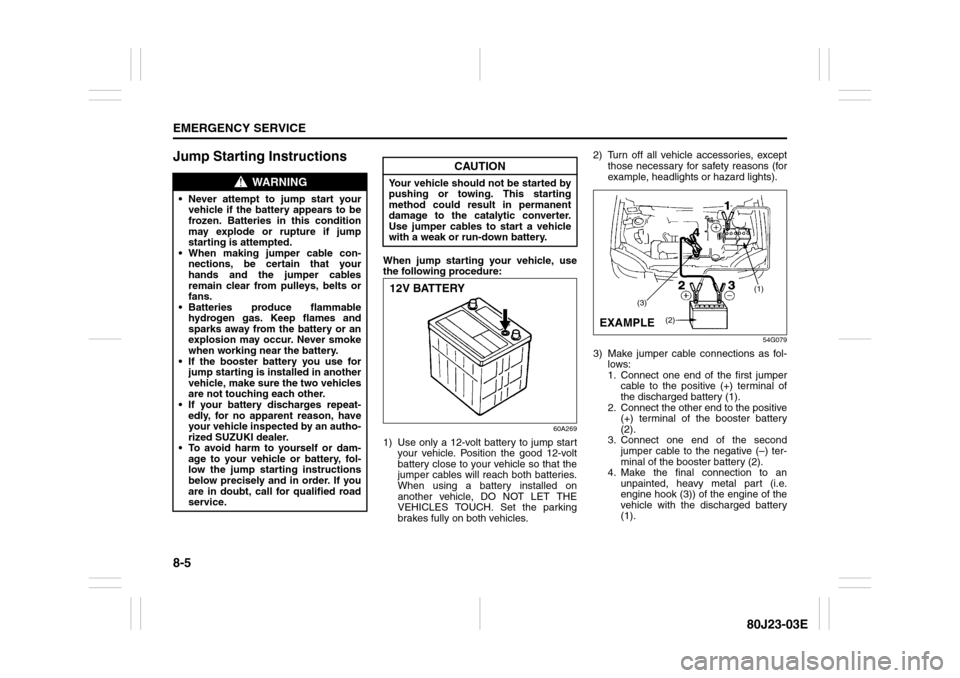
3) Make jumper cable connections as fol-
lows:
1. Connect one end of the first jumper
cable to the positive (+) terminal of
the discharged battery (1).
2. Connect the other end to the positive
(+) terminal of the booster battery
(2).
3. Connect one end of the second
jumper cable to the negative (–) ter-
minal of the booster battery (2).
4. Make the final connection to an
unpainted, heavy metal part (i.e.
engine hook (3)) of the engine of the
vehicle with the discharged battery
(1).
WARNING
Never attempt to jump start your
vehicle if the battery appears to be
frozen. Batteries in this condition
may explode or rupture if jump
starting is attempted.
When making jumper cable con-
nections, be certain that your
hands and the jumper cables
remain clear from pulleys, belts or
fans.
Batteries produce flammable
hydrogen gas. Keep flames and
sparks away from the battery or an
explosion may occur. Never smoke
when working near the battery.
If the booster battery you use for
jump starting is installed in another
vehicle, make sure the two vehicles
are not touching each other.
If your battery discharges repeat-
edly, for no apparent reason, have
your vehicle inspected by an autho-
rized SUZUKI dealer.
To avoid harm to yourself or dam-
age to your vehicle or battery, fol-
low the jump starting instructions
below precisely and in order. If you
are in doubt, call for qualified road
service.
CAUTION
Your vehicle should not be started by
pushing or towing. This starting
method could result in permanent
damage to the catalytic converter.
Use jumper cables to start a vehicle
with a weak or run-down battery.12V BATTERY
(1)
(3)
(2)
EXAMPLE
Page 264 of 297
8-7EMERGENCY SERVICE
80J23-03E
If the Engine is FloodedIf the engine is flooded with gasoline, it
may be hard to start. If this happens, press
the accelerator pedal all the way to the
floor and hold it there while cranking the
engine. (Do not operate the starter motor
for more than 15 seconds).
If the Engine OverheatsThe engine could overheat temporarily
under severe driving conditions. If the
engine coolant temperature gauge indi-
cates overheating during driving:
1) Turn off the air conditioner, if equipped.
2) Take the vehicle to a safe place and
park.
3) Let the engine run at normal idle speed
for a few minutes until the indicator is
within the normal, acceptable tempera-
ture range shown by the white band
between “H” and “C”.If the temperature indication does not
come down to within the normal, accept-
able range:
1) Turn off the engine and check that the
water pump belt and pulleys are not
damaged or slipping. If any abnormality
is found, correct it.
2) Check the coolant level in the reservoir.
If it is found to be lower than the “LOW”
line, look for leaks at the radiator, water
pump and radiator and heater hoses. If
you locate any leaks that may have
caused the overheating, do not run the
engine until these problems have been
corrected.
3) If you do not find a leak, carefully add
coolant to the reservoir and then the
radiator, if necessary. (Refer to “Engine
Coolant” in the “INSPECTION AND
MAINTENANCE” section.)
WARNING
If you see or hear escaping steam,
stop the vehicle in a safe place and
immediately turn off the engine to let
it cool. Do not open the hood when
steam is present. When the steam
can no longer be seen or heard, open
the hood to see if the coolant is still
boiling. If it is, you must wait until it
stops boiling before you proceed.
Also, be careful not to touch hot
engine parts (radiator, water hoses,
engine etc.).
Page 270 of 297
9-3APPEARANCE CARE
80J23-03E
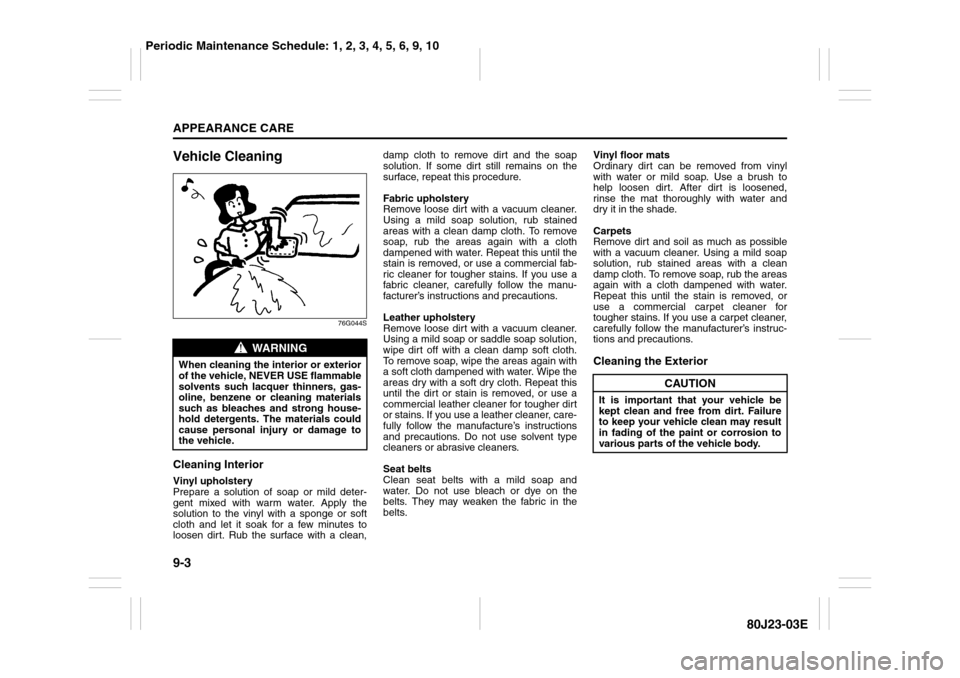
Vehicle Cleaning
76G044S
Cleaning InteriorVinyl upholstery
Prepare a solution of soap or mild deter-
gent mixed with warm water. Apply the
solution to the vinyl with a sponge or soft
cloth and let it soak for a few minutes to
loosen dirt. Rub the surface with a clean,damp cloth to remove dirt and the soap
solution. If some dirt still remains on the
surface, repeat this procedure.
Fabric upholstery
Remove loose dirt with a vacuum cleaner.
Using a mild soap solution, rub stained
areas with a clean damp cloth. To remove
soap, rub the areas again with a cloth
dampened with water. Repeat this until the
stain is removed, or use a commercial fab-
ric cleaner for tougher stains. If you use a
fabric cleaner, carefully follow the manu-
facturer’s instructions and precautions.
Leather upholstery
Remove loose dirt with a vacuum cleaner.
Using a mild soap or saddle soap solution,
wipe dirt off with a clean damp soft cloth.
To remove soap, wipe the areas again with
a soft cloth dampened with water. Wipe the
areas dry with a soft dry cloth. Repeat this
until the dirt or stain is removed, or use a
commercial leather cleaner for tougher dirt
or stains. If you use a leather cleaner, care-
fully follow the manufacture’s instructions
and precautions. Do not use solvent type
cleaners or abrasive cleaners.
Seat belts
Clean seat belts with a mild soap and
water. Do not use bleach or dye on the
belts. They may weaken the fabric in the
belts.Vinyl floor mats
Ordinary dirt can be removed from vinyl
with water or mild soap. Use a brush to
help loosen dirt. After dirt is loosened,
rinse the mat thoroughly with water and
dry it in the shade.
Carpets
Remove dirt and soil as much as possible
with a vacuum cleaner. Using a mild soap
solution, rub stained areas with a clean
damp cloth. To remove soap, rub the areas
again with a cloth dampened with water.
Repeat this until the stain is removed, or
use a commercial carpet cleaner for
tougher stains. If you use a carpet cleaner,
carefully follow the manufacturer’s instruc-
tions and precautions.
Cleaning the Exterior
WARNING
When cleaning the interior or exterior
of the vehicle, NEVER USE flammable
solvents such lacquer thinners, gas-
oline, benzene or cleaning materials
such as bleaches and strong house-
hold detergents. The materials could
cause personal injury or damage to
the vehicle.
CAUTION
It is important that your vehicle be
kept clean and free from dirt. Failure
to keep your vehicle clean may result
in fading of the paint or corrosion to
various parts of the vehicle body.
Periodic Maintenance Schedule: 1, 2, 3, 4, 5, 6, 9, 10
Page 276 of 297
10-3GENERAL INFORMATION
80J23-03E
On-Board Vehicle Computers
and Event Data RecordersYour vehicle is equipped with on-board
computer systems which monitor and
control several aspects of vehicle per-
formance, including the following:
Emission-related components and
engine parameters such as engine
speed and throttle position are moni-
tored to provide emissions control
and to provide optimum fuel econ-
omy. Your vehicle also has an on-
board diagnostic system which mon-
itors and records information about
emission-related malfunctions.
Signals from various sensors are
monitored to provide air bag deploy-
ment.
If your vehicle is equipped with
antilock brakes, conditions such as
vehicle speed and brake perfor-
mance are monitored, so that the
ABS system can provide effective
antilock braking. If your vehicle has
an Electronic Stability Program
(ESP
®) system, conditions such as
yaw rate, lateral acceleration, and
brake fluid pressure are monitored,
so that the ESP
® system can help
the driver control the vehicle in diffi-
cult driving situations.
Some information may be stored by
the on-board computers during normaloperation of the vehicle. This stored
information can assist technicians in
repairing the vehicle when malfunc-
tions occur. Other information is stored
only in the event of crash, by computer
systems that are commonly called
Event Data Recorders (EDRs).
In a crash event, EDRs such as the
Airbag Sensing and Diagnostic Mod-
ule (SDM) in your vehicle may record
information about the condition of the
vehicle and how it was operated, such
as data related to airbag readiness,
airbag performance, safety belt usage,
and the severity of the collision. These
data can help provide a better under-
standing of the circumstances in which
crashes and injuries occur and lead to
the designing of safer vehicles. The
SDM in your vehicle does not collect
or store personal information.
To read the stored information, special
equipment is needed and access to
the vehicle or storage device is
required. SUZUKI will not access infor-
mation about a crash event or share it
with others other than with the consent
of the vehicle owner or lessee, in
response to an official request from
the police or similar government office,
as part of SUZUKI’s defense of litiga-
tion through the discovery process, or
as required by law.In addition, once SUZUKI collects or
receives data, SUZUKI may use the
data for research conducted by
SUZUKI, make the data available for
outside research if need is shown and
confidentiality is assured, or make
summary data which does not identify
specific vehicles available for outside
research.
Others, such as law enforcement per-
sonnel, may have access to the spe-
cial equipment that can read the
information if they have access to the
vehicle or storage device.
Jacking Instructions: 5
Page 291 of 297
13-1
INDEX
13
80J23-03E
INDEXSymbols“CRUISE” Indicator Light.................................................... 2-66
“ESP OFF” Indicator Light ......................................... 2-63, 3-25
“ESP” (Electronic Stability Program) Warning Light ....... 2-63
“ESP” Warning Light ........................................................... 3-25
“SET” Indicator Light .......................................................... 2-66AAccelerator Pedal .................................................................. 3-8
Accessory Socket ................................................................ 5-47
Adding Coolant .................................................................... 7-15
Adjusting Seat Position ...................................................... 2-21
Adjusting Seatbacks ........................................................... 2-22
AIR BAG Light ...................................................................... 2-65
Air Cleaner............................................................................ 7-16
Air Conditioning System ..................................................... 7-50
All Seat Belts ........................................................................ 2-31
Anti-Lock Brake System (ABS) .......................................... 3-21
Anti-Lock Brake System (ABS) Warning Light ................. 2-62
Anti-Lock Braking System (ABS) ....................................... 3-24
Armrest ................................................................................. 5-51
Assist Grips.......................................................................... 5-48
Audio Systems ..................................................................... 5-15
Automatic Heating and Air Conditioning System
(Climate Control).................................................................... 5-9
Automatic Locking Retractor (ALR)................................... 2-30
Average fuel consumption.................................................. 2-72BBasic Operations ................................................................. 5-18
Battery .................................................................................. 7-35Brake Assist System............................................................ 3-21
Brake Fluid............................................................................ 7-21
Brake Pedal.................................................................... 3-8, 7-22
Brake System Warning Light .............................................. 2-61
Brakes ................................................................................... 7-21
Braking .................................................................................. 3-20
Break-In ................................................................................... 4-1
Bulb Replacement ................................................................ 7-40
CCatalytic Converter ................................................................ 4-1
Changing Engine Oil and Filter........................................... 7-12
Changing Wheels ................................................................... 8-4
Charging Light...................................................................... 2-64
Child Lock System (rear doors) ............................................ 2-3
Child Restraint Systems ...................................................... 2-36
Cigarette Lighter and Ashtray............................................. 5-47
Clock ..................................................................................... 2-75
Clutch Pedal .................................................................. 3-8, 7-19
Compact Spare Tire ............................................................. 7-31
Continuously Variable Transaxle (CVT) ............................. 3-11
Continuously Variable Transaxle (CVT) Fluid ................... 7-20
Coolant Level Check ............................................................ 7-15
Coolant Replacement .......................................................... 7-16
Corrosion Prevention ............................................................ 9-1
Cruise Control ...................................................................... 3-18
Cup Holder and Storage Area ............................................. 5-49DDaily Inspection Checklist..................................................... 3-1
Daytime Running Light (D.R.L.) Indicator Light ................ 2-68
Daytime Running Light (D.R.L.) System ............................ 2-76
Door Locks ............................................................................. 2-1
Page 292 of 297
13-2INDEX
80J23-03E
Drive Belt .............................................................................. 7-11
Driver’s Seat Belt Reminder Light...................................... 2-64
Driving on Hills ...................................................................... 4-3
Driving on Slippery Roads .................................................... 4-4
Driving range........................................................................ 2-72EElectronic Stability Program (ESP
®) .................................. 3-23
Emergency Locking Retractor (ELR) ................................. 2-30
Emission Compliance Label (for U.S.A.) ........................... 10-2
Engine Block Heater .............................................................. 3-9
Engine Coolant .................................................................... 7-14
Engine Hood......................................................................... 5-44
Engine Oil and Filter ............................................................ 7-11
Engine Serial Number ......................................................... 10-1
Exhaust Gas Warning............................................................ 3-1
FFloor Mats............................................................................. 5-51
Fluid Level Check ................................................................ 7-20
Folding Rear Seats .............................................................. 2-26
Frame Hooks ........................................................................ 5-56
Front Air Bags ...................................................................... 2-49
Front Fog Light Switch........................................................ 2-77
Front Seat Back Pocket....................................................... 5-50
Front Seat Heater ................................................................. 2-23
Front Seats ........................................................................... 2-21
Fuel Filler Cap ...................................................................... 5-43
Fuel Gauge ........................................................................... 2-69
Fuel Pump Labeling............................................................... 1-1
Fuel Recommendation .......................................................... 1-1
Full Wheel Cover.................................................................... 8-4
Fuses .................................................................................... 7-36FUSES AND PROTECTED CIRCUITS ................................. 11-1
Fuses in the Engine Compartment ..................................... 7-36
Fuses under the Dash Board .............................................. 7-38
GGasoline Containing MTBE ................................................... 1-1
Gasoline/Ethanol blends ....................................................... 1-1
Gasoline/Methanol blends..................................................... 1-1
Gear Oil ................................................................................. 7-18
Gear Oil Level Check ........................................................... 7-19
Gear Oil Replacement .......................................................... 7-19
GLOSSARY OF TIRE TERMINOLOGY ................................ 7-32
Glove Box ............................................................................. 5-49HHazard Warning Switch ....................................................... 2-78
Head Restraints ........................................................... 2-22, 2-24
Headlight Aiming.................................................................. 7-39
Heated Rear Window and Heated Outside Rearview
Mirrors Switch ...................................................................... 2-81
Heating and Air Conditioning System.................................. 5-1
Heating System ...................................................................... 5-2
High Beam Indicator Light .................................................. 2-67
Highway Driving ..................................................................... 4-3
Horn ....................................................................................... 2-81
How the ABS Works............................................................. 3-23IIdentification Numbers ........................................................ 10-1
If the Engine is Flooded......................................................... 8-7
If the Engine Overheats ......................................................... 8-7
If the Starter Does Not Operate............................................. 8-6
If You Cannot Shift CVT Gearshift Lever Out of
“P” (PARK)............................................................................ 3-15
Page 293 of 297
13-3
INDEX80J23-03E
If Your Vehicle Gets Stuck .................................................... 4-4
Ignition Key Reminder........................................................... 2-1
Ignition Switch ....................................................................... 3-2
Illumination control setting................................................. 2-74
Illumination Indicator Light................................................. 2-67
Improving Fuel Economy ...................................................... 4-2
Information display.............................................................. 2-70
Inside Rearview Mirror ........................................................ 2-19
Installation of Child Restraint with Top Strap ................... 2-44
Installation with Lap-Shoulder Seat Belts
(child restraint with no top strap)....................................... 2-38
Installation with the LATCH System .................................. 2-40
Instantaneous Fuel Consumption ...................................... 2-70
Instrument Cluster ............................................................... 2-59
intelligent All Wheel Drive (i-AWD) AUTO Indicator
Light ...................................................................................... 2-67
intelligent All Wheel Drive (i-AWD) LOCK Indicator
Light ...................................................................................... 2-68
Interior Light Switch ............................................................ 5-45JJacking Instructions .............................................................. 8-2
Jump Starting Instructions ................................................... 8-5KKeyless Entry System Transmitter .................................... 2-13
Keyless Start System Indicator Light ................................ 2-66
Keyless Start System Remote Controller ............................ 2-6
Keys ........................................................................................ 2-1LLap-Shoulder Belt ................................................................ 2-30
Lighting Control Lever ........................................................ 2-75
Lighting Operation............................................................... 2-76Lights “On” reminder .......................................................... 2-76
Listening to a CD.................................................................. 5-22
Listening to a CD from an External CD Changer
(Option) ................................................................................. 5-34
Listening to a XM Satellite Radio (Option)......................... 5-31
Listening to Audio for AUX (Option) .................................. 5-33
Listening to the Radio ......................................................... 5-20
Low Fuel Warning Light ...................................................... 2-66
Low Tire Pressure Warning Light .............................. 2-60, 3-26
Luggage Compartment Board ............................................ 5-53
Luggage Compartment Cover............................................. 5-52
Luggage Compartment Light .............................................. 5-46
MMaintenance Recommended under Severe Driving
Conditions .............................................................................. 7-7
Maintenance Schedule .......................................................... 7-2
Malfunction Indicator Light ................................................. 2-65
Manual Heating and Air Conditioning System .................... 5-5
Manual Transaxle ................................................................. 3-10
Mirrors ................................................................................... 2-19OOdometer .............................................................................. 2-74
Oil Level Check .................................................................... 7-11
Oil Pressure Light................................................................ 2-64
On-Board Vehicle Computers and Event Data
Recorders ............................................................................. 10-3
Open Door Warning Light ................................................... 2-66
Outside Rearview Mirrors.................................................... 2-20PParking Brake Lever ..................................................... 3-6, 7-23
Pedals...................................................................................... 3-7