cooling SUZUKI XL7 2007 2.G User Guide
[x] Cancel search | Manufacturer: SUZUKI, Model Year: 2007, Model line: XL7, Model: SUZUKI XL7 2007 2.GPages: 274, PDF Size: 6.12 MB
Page 199 of 274
5-15 SERVICE AND APPEARANCE CARE
78J00-03E
When the coolant level in the coolant
recovery tank is at the cold fill line, start the
vehicle.
If the overheat warning continues, there is
one more thing you can try. You can add
the proper coolant mixture directly to the
radiator, but be sure the system is cool
before you do it.How to Add Coolant to the Cooling Sys-
tem
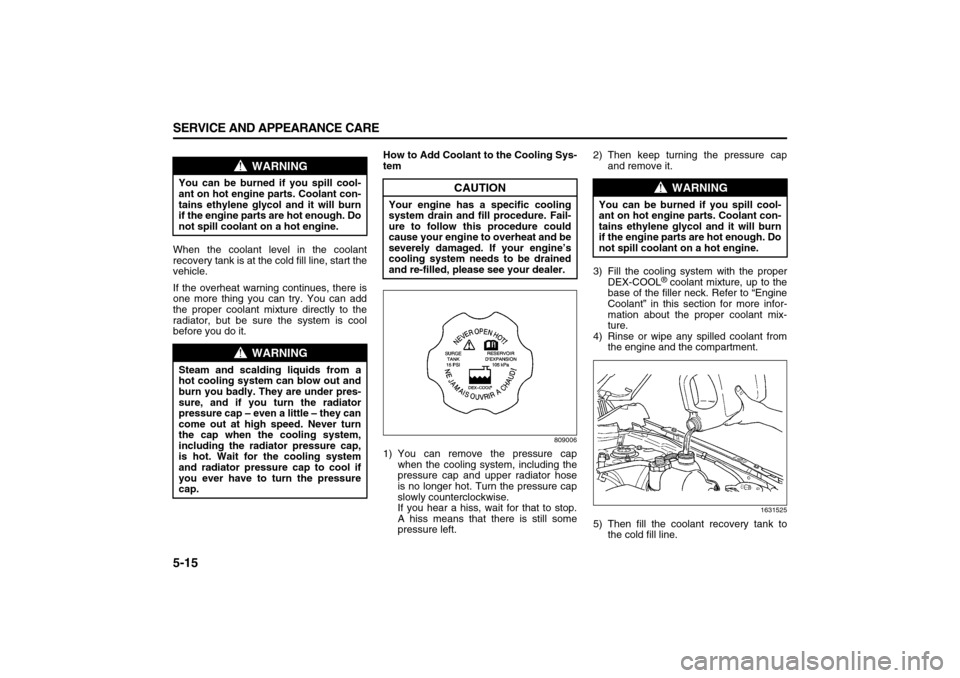
809006
1) You can remove the pressure cap
when the cooling system, including the
pressure cap and upper radiator hose
is no longer hot. Turn the pressure cap
slowly counterclockwise.
If you hear a hiss, wait for that to stop.
A hiss means that there is still some
pressure left.2) Then keep turning the pressure cap
and remove it.
3) Fill the cooling system with the proper
DEX-COOL
® coolant mixture, up to the
base of the filler neck. Refer to “Engine
Coolant” in this section for more infor-
mation about the proper coolant mix-
ture.
4) Rinse or wipe any spilled coolant from
the engine and the compartment.
1631525
5) Then fill the coolant recovery tank to
the cold fill line.
WARNING
You can be burned if you spill cool-
ant on hot engine parts. Coolant con-
tains ethylene glycol and it will burn
if the engine parts are hot enough. Do
not spill coolant on a hot engine.
WARNING
Steam and scalding liquids from a
hot cooling system can blow out and
burn you badly. They are under pres-
sure, and if you turn the radiator
pressure cap – even a little – they can
come out at high speed. Never turn
the cap when the cooling system,
including the radiator pressure cap,
is hot. Wait for the cooling system
and radiator pressure cap to cool if
you ever have to turn the pressure
cap.
CAUTION
Your engine has a specific cooling
system drain and fill procedure. Fail-
ure to follow this procedure could
cause your engine to overheat and be
severely damaged. If your engine’s
cooling system needs to be drained
and re-filled, please see your dealer.
WARNING
You can be burned if you spill cool-
ant on hot engine parts. Coolant con-
tains ethylene glycol and it will burn
if the engine parts are hot enough. Do
not spill coolant on a hot engine.
Page 221 of 274
5-37 SERVICE AND APPEARANCE CARE
78J00-03E
Wheel ReplacementReplace any wheel that is bent, cracked,
or badly rusted or corroded. If wheel nuts
keep coming loose, the wheel, wheel bolts,
and wheel nuts should be replaced. If the
wheel leaks air, replace it (except some
aluminum wheels, which can sometimes
be repaired). See your dealer if any of
these conditions exist.
Your dealer will know the kind of wheel you
need.
Each new wheel should have the same
load-carrying capacity, diameter, width,
offset, and be mounted the same way as
the one it replaces.
If you need to replace any of your wheels,
wheel bolts or wheel nuts, replace them
only with new original equipment parts.
This way, you will be sure to have the right
wheel, wheel bolts, and wheel nuts for
your vehicle.Refer to “Changing a Flat Tire” in this sec-
tion for more information.
Used Replacement Wheels
Tire Chains
If a Tire Goes FlatIt is unusual for a tire to blowout while you
are driving, especially if you maintain your
vehicle’s tires properly. If air goes out of a
tire, it is much more likely to leak out
slowly. But if you should ever have a blow-
out, here are a few tips about what to
expect and what to do:
WARNING
Using the wrong replacement wheels,
wheel bolts, or wheel nuts on your
vehicle can be dangerous. It could
affect the braking and handling of
your vehicle, make your tires lose air
and make you lose control. You
could have a collision in which you
or others could be injured. Always
use the correct wheel, wheel bolts,
and wheel nuts for replacement.
CAUTION
The wrong wheel can also cause
problems with bearing life, brake
cooling, speedometer or odometer
calibration, headlamp aim, bumper
height, vehicle ground clearance, and
tire or tire chain clearance to the
body and chassis.
WARNING
Putting a used wheel on your vehicle
is dangerous. You cannot know how
it has been used or how far it has
been driven. It could fail suddenly
and cause a crash. If you have to
replace a wheel, use a new original
equipment wheel.
WARNING
Do not use tire chains. There is not
enough clearance. Tire chains used
on a vehicle without the proper
amount of clearance can cause dam-
age to the brakes, suspension or
other vehicle parts. The area dam-
aged by the tire chains could cause
you to lose control of your vehicle
and you or others may be injured in a
crash.
Use another type of traction device
only if its manufacturer recommends
it for use on your vehicle and tire size
combination and road conditions.
Follow that manufacturer’s instruc-
tions. To help avoid damage to your
vehicle, drive slowly, readjust or
remove the device if it is contacting
your vehicle, and do not spin your
vehicle’s wheels. If you do find trac-
tion devices that will fit, install them
on the front tires.
Page 239 of 274
5-55 SERVICE AND APPEARANCE CARE
78J00-03E
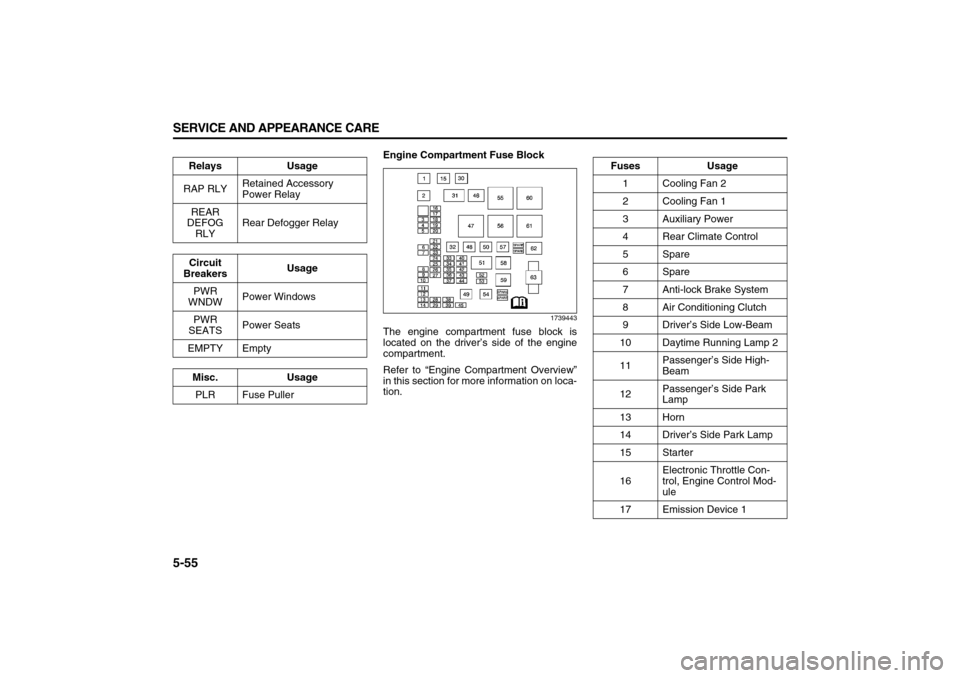
Engine Compartment Fuse Block
1739443
The engine compartment fuse block is
located on the driver’s side of the engine
compartment.
Refer to “Engine Compartment Overview”
in this section for more information on loca-
tion. Relays Usage
RAP RLYRetained Accessory
Power Relay
REAR
DEFOG
RLYRear Defogger Relay
Circuit
BreakersUsage
PWR
WNDWPower Windows
PWR
SEATSPower Seats
EMPTY Empty
Misc. Usage
PLR Fuse Puller
Fuses Usage
1 Cooling Fan 2
2 Cooling Fan 1
3 Auxiliary Power
4 Rear Climate Control
5 Spare
6 Spare
7 Anti-lock Brake System
8 Air Conditioning Clutch
9 Driver’s Side Low-Beam
10 Daytime Running Lamp 2
11Passenger’s Side High-
Beam
12Passenger’s Side Park
Lamp
13 Horn
14 Driver’s Side Park Lamp
15 Starter
16Electronic Throttle Con-
trol, Engine Control Mod-
ule
17 Emission Device 1
Page 241 of 274

5-57 SERVICE AND APPEARANCE CARE
78J00-03E
Capacities and SpecificationsThe following approximate capacities are given in English and metric conversions. Refer to “Recommended Fluids and Lubricants” in
“Maintenance Schedule” in the “Maintenance Schedule” section for more information.
Engine SpecificationsApplicationCapacities
English Metric
Air Conditioning Refrigerant R134aFor the air conditioning system refrigerant charge
amount, see the refrigerant caution label located under
the hood. See your dealer for more information.
Cooling System
Front Only Climate Control System 12.7 qt 12.0 L
Front and Rear Climate Control System 13.1 qt 12.4 L
Fuel Tank18.5 gal 70.0 L
Transaxle Fluid4.1 qt 3.9 L
Wheel Nut Torque 100 lb ft 140 N·m
All capacities are approximate. When adding, be sure to fill to the approximate level, as recommended in this manual.
Recheck fluid level after filling.
Engine VIN Code Transaxle Spark Plug Gap
3.6 L V6 7 Automatic 0.043 inches (1.10 mm)
Page 246 of 274

6-4 MAINTENANCE SCHEDULE
78J00-03E
Service Instruction Maintenance I Maintenance II
Inspect engine air cleaner fil-
ter. If necessary, replace filter. Refer to “Engine Air Cleaner/Filter” in “Checking Things Under the
Hood” in the “Service and Appearance Care” section.
If you drive regularly under dusty conditions, inspect the filter at
each engine oil change.•
Inspect suspension and steer-
ing components. Visually inspect front and rear suspension and steering system for
damaged, loose, or missing parts, signs of wear.
Inspect power steering cables for proper hook-up, binding,
cracks, chafing, etc. (if equipped).•
Inspect engine cooling sys-
tem. Visually inspect hoses and have them replaced if they are
cracked, swollen, or deteriorated.
Inspect all pipes, fittings and clamps; replace parts as needed.
To help ensure proper operation, a pressure test of the cooling
system and pressure cap and cleaning the outside of the radiator
and air conditioning condenser is recommended at least once a
year.•
Inspect wiper blades. Visually inspect wiper blades for wear or cracking.
Replace wiper blades that appear worn or damaged or that streak
or miss areas of the windshield.•
Inspect restraint system com-
ponents. Make sure the safety belt reminder light and all your belts, buck-
les, latch plates, retractors, and anchorages are working properly.
Look for any other loose or damaged safety belt system parts.
If you see anything that might keep a safety belt system from
doing its job, have it repaired.
Have any torn or frayed safety belts replaced.
Also look for any opened or broken airbag coverings, and have
them repaired or replaced.
The airbag system does not need regular maintenance.•
Page 249 of 274

6-7 MAINTENANCE SCHEDULE
78J00-03E
Service InstructionMiles (Kilometers)
25000
(40000)50000
(80000)75000
(120000)100000
(160000)125000
(200000)150000
(240000)
Engine cooling system service (or
every five years, whichever occurs
first). An Emission Control Ser-
vice. Drain, flush, and refill cooling
system.
This service can be complex;
you should have your dealer
perform this service.
Refer to “Engine Coolant” in
“Checking Things Under the
Hood” in the “Service and
Appearance Care” section for
what to use.
Inspect hoses.
Clean radiator, condenser, pres-
sure cap, and filler neck.
Pressure test the cooling system
and pressure cap.•
Inspect engine accessory drive
belt. An Emission Control Service. Visually inspect belt for fraying,
excessive cracks, or obvious
damage.
Replace belt if necessary.•
Page 251 of 274

6-9 MAINTENANCE SCHEDULE
78J00-03E
Service Instruction Maintenance
Inspect engine air cleaner fil-
ter. If necessary, replace filter. Refer to “Engine Air Cleaner/Filter” in “Checking Things Under the Hood” in the
“Service and Appearance Care” section.
If you drive regularly under dusty conditions, inspect the filter at each engine oil
change.•
Inspect suspension and steer-
ing components. Visually inspect front and rear suspension and steering system for damaged, loose,
or missing parts, signs of wear.
Inspect power steering cables for proper hook-up, binding, cracks, chafing, etc.
(if equipped).•
Inspect engine cooling sys-
tem. Visually inspect hoses and have them replaced if they are cracked, swollen, or
deteriorated.
Inspect all pipes, fittings and clamps; replace parts as needed.
To help ensure proper operation, a pressure test of the cooling system and pres-
sure cap and cleaning the outside of the radiator and air conditioning condenser is
recommended at least once a year.•
Inspect wiper blades. Visually inspect wiper blades for wear or cracking.
Replace wiper blades that appear worn or damaged or that streak or miss areas of
the windshield.•
Inspect restraint system com-
ponents. Make sure the safety belt reminder light and all your belts, buckles, latch plates,
retractors, and anchorages are working properly.
Look for any other loose or damaged safety belt system parts.
If you see anything that might keep a safety belt system from doing its job, have it
repaired.
Have any torn or frayed safety belts replaced.
Also look for any opened or broken airbag coverings, and have them repaired or
replaced.
The airbag system does not need regular maintenance.•
Page 254 of 274

6-12 MAINTENANCE SCHEDULE
78J00-03E
Service InstructionKilometers
40000 80000 120000 160000 200000 240000
Engine cooling system service (or
every five years, whichever occurs
first). An Emission Control Ser-
vice. Drain, flush, and refill cooling
system.
This service can be complex;
you should have your dealer
perform this service.
Refer to “Engine Coolant” in
“Checking Things Under the
Hood” in the “Service and
Appearance Care” section for
what to use.
Inspect hoses.
Clean radiator, condenser, pres-
sure cap, and filler neck.
Pressure test the cooling system
and pressure cap.•
Inspect engine accessory drive
belt. An Emission Control Service. Visually inspect belt for fraying,
excessive cracks, or obvious
damage.
Replace belt if necessary.•
Page 269 of 274

8-2 INDEX
78J00-03E
Child Restraints
...................................................................1-18
City Driving
..........................................................................4-11
Cleaning Exterior Lamps/Lenses
.......................................5-50
Cleaning the Inside of Your Vehicle ..................................5-48
Climate Controls
..................................................................3-10
Compact Spare Tire .............................................................5-47
Configurations for Use of Three Child Restraints
............1-25
Configurations for Use of Two Child Restraints
..............1-24
Control of a Vehicle
.............................................................4-3
Convenience Net
.................................................................2-23
Cooling System
...................................................................5-13
Cruise Control
......................................................................3-5
Cruise Control Light
............................................................3-24
Cupholder(s)
........................................................................2-21
DDaily Inspection Checklist
........................................ 2-11
, 2-12
Delayed Locking
..................................................................2-6
DIC Operation and Displays
...............................................3-27
DIC Vehicle Personalization ...............................................3-35
DIC Warnings and Messages .............................................3-30
Doing Your Own Service Work ...........................................5-1
Dome Lamp
..........................................................................3-8
Door Ajar Light ....................................................................3-25
Door Locks
...........................................................................2-5
Doors and Locks
.................................................................2-5
Driver Information Center (DIC)
.........................................3-27
Driver Position
.....................................................................1-11
Driver Seat Height Adjuster
................................................1-1
Driving at Night
....................................................................4-9
Driving in Rain and on Wet Roads
.....................................4-10
Drunken Driving
...................................................................4-1
EElectric Power Management
.............................................. 3-9
Electrical System
................................................................ 5-53
Electronic Stability Control
................................................ 4-5
Emission Compliance Label (for U.S.A.)
.......................... 7-2
Engine Air Cleaner/Filter
.................................................... 5-9
Engine Compartment Overview
......................................... 5-6
Engine Coolant
.................................................................... 5-11
Engine Coolant Heater
....................................................... 2-14
Engine Coolant Temperature Gage
................................... 3-21
Engine Coolant Temperature Warning Light
.................... 3-20
Engine Drive Belt Routing
.................................................. 6-17
Engine Exhaust
................................................................... 2-19
Engine Oil
............................................................................ 5-7
Engine Oil Life System
....................................................... 5-8
Engine Overheating
............................................................ 5-12
Engine Serial Number ......................................................... 7-1
FFabric/Carpet
....................................................................... 5-48
Filling a Portable Fuel Container
....................................... 5-4
Filling the Tank
.................................................................... 5-3
Finish Care
.......................................................................... 5-50
Finish Damage .................................................................... 5-51
Fog Lamp Light ................................................................... 3-24
Fog Lamps
........................................................................... 3-8
For CANADA Scheduled Maintenance
.............................. 6-8
Freeway Driving
.................................................................. 4-11
Front Seats
.......................................................................... 1-1
Fuel
....................................................................................... 5-2
Fuel Gage
............................................................................. 3-26
Fuels in Foreign Countries
................................................ 5-3