spare tire SUZUKI XL7 2007 2.G User Guide
[x] Cancel search | Manufacturer: SUZUKI, Model Year: 2007, Model line: XL7, Model: SUZUKI XL7 2007 2.GPages: 274, PDF Size: 6.12 MB
Page 224 of 274
5-40 SERVICE AND APPEARANCE CARE
78J00-03E
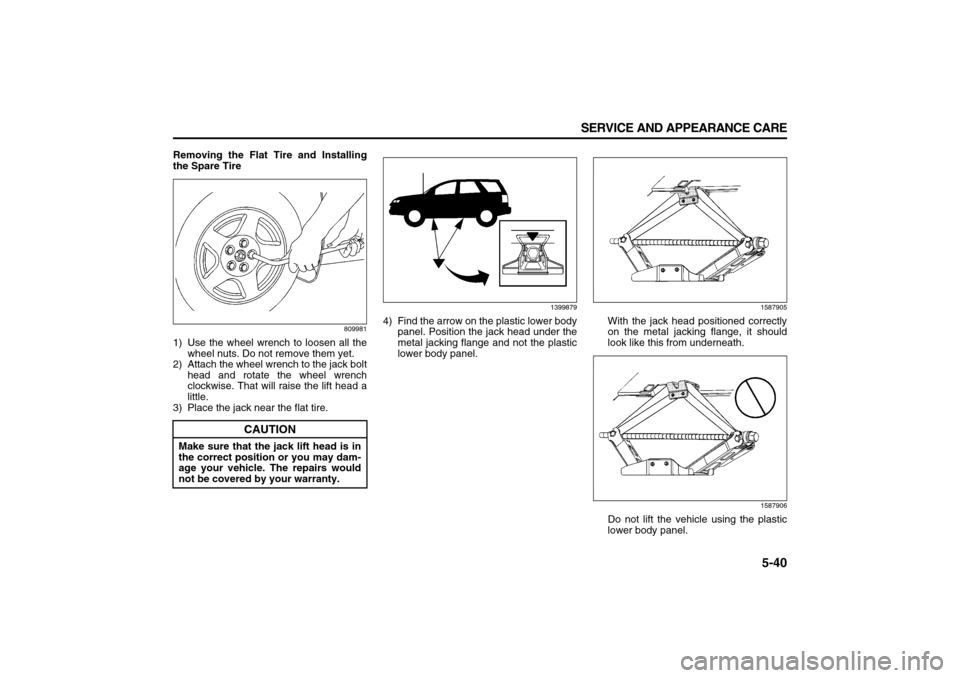
Removing the Flat Tire and Installing
the Spare Tire
809981
1) Use the wheel wrench to loosen all the
wheel nuts. Do not remove them yet.
2) Attach the wheel wrench to the jack bolt
head and rotate the wheel wrench
clockwise. That will raise the lift head a
little.
3) Place the jack near the flat tire.
1399879
4) Find the arrow on the plastic lower body
panel. Position the jack head under the
metal jacking flange and not the plastic
lower body panel.
1587905
With the jack head positioned correctly
on the metal jacking flange, it should
look like this from underneath.
1587906
Do not lift the vehicle using the plastic
lower body panel.
CAUTION
Make sure that the jack lift head is in
the correct position or you may dam-
age your vehicle. The repairs would
not be covered by your warranty.
Page 225 of 274
5-41 SERVICE AND APPEARANCE CARE
78J00-03E
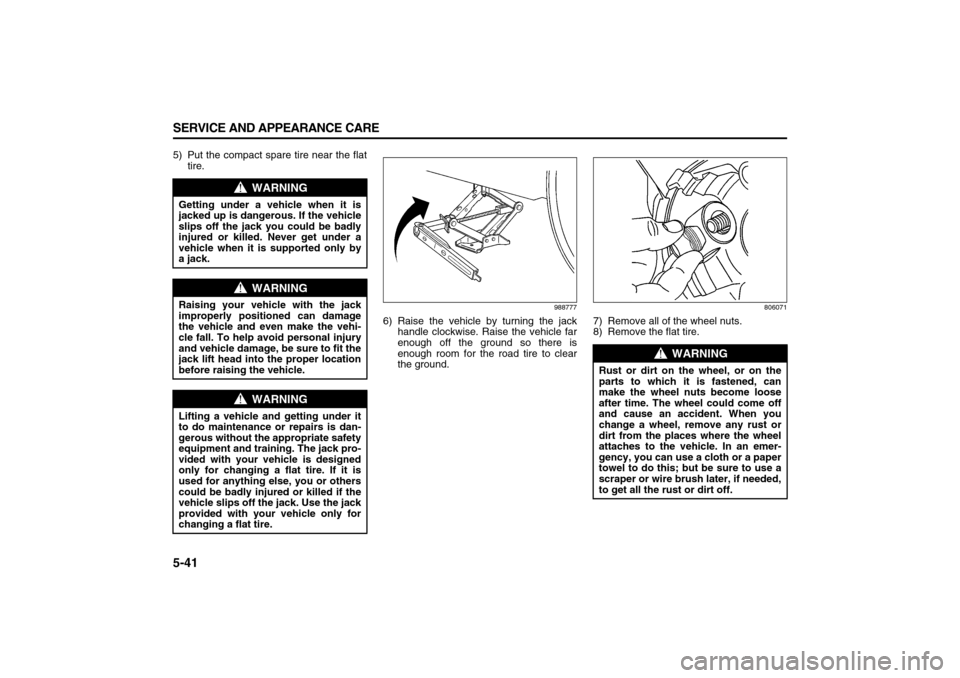
5) Put the compact spare tire near the flat
tire.
988777
6) Raise the vehicle by turning the jack
handle clockwise. Raise the vehicle far
enough off the ground so there is
enough room for the road tire to clear
the ground.
806071
7) Remove all of the wheel nuts.
8) Remove the flat tire.
WARNING
Getting under a vehicle when it is
jacked up is dangerous. If the vehicle
slips off the jack you could be badly
injured or killed. Never get under a
vehicle when it is supported only by
a jack.
WARNING
Raising your vehicle with the jack
improperly positioned can damage
the vehicle and even make the vehi-
cle fall. To help avoid personal injury
and vehicle damage, be sure to fit the
jack lift head into the proper location
before raising the vehicle.
WARNING
Lifting a vehicle and getting under it
to do maintenance or repairs is dan-
gerous without the appropriate safety
equipment and training. The jack pro-
vided with your vehicle is designed
only for changing a flat tire. If it is
used for anything else, you or others
could be badly injured or killed if the
vehicle slips off the jack. Use the jack
provided with your vehicle only for
changing a flat tire.
WARNING
Rust or dirt on the wheel, or on the
parts to which it is fastened, can
make the wheel nuts become loose
after time. The wheel could come off
and cause an accident. When you
change a wheel, remove any rust or
dirt from the places where the wheel
attaches to the vehicle. In an emer-
gency, you can use a cloth or a paper
towel to do this; but be sure to use a
scraper or wire brush later, if needed,
to get all the rust or dirt off.
Page 226 of 274
5-42 SERVICE AND APPEARANCE CARE
78J00-03E
811105
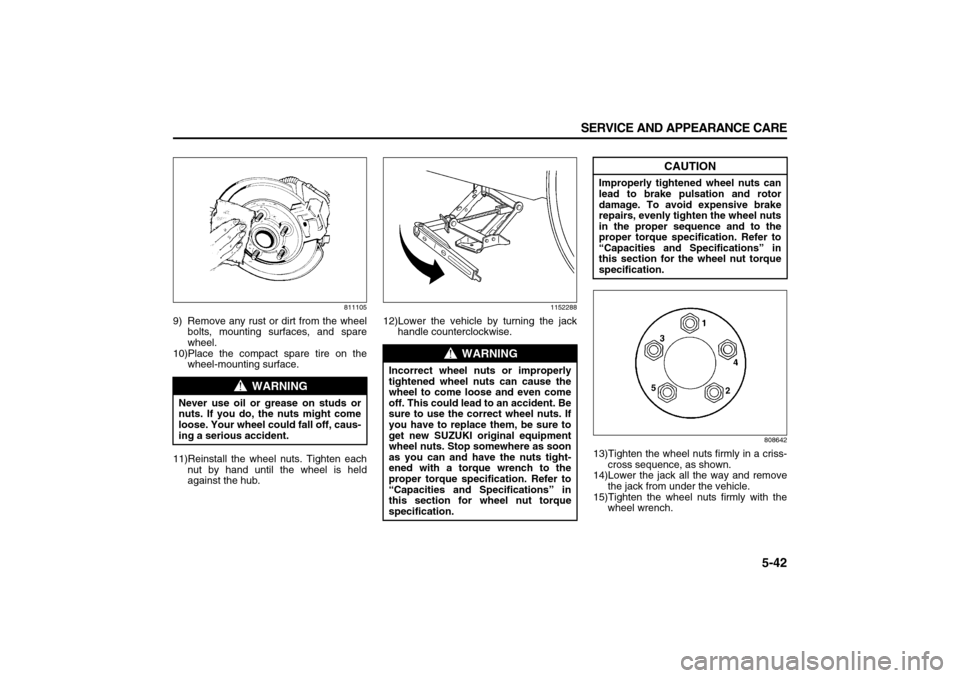
9) Remove any rust or dirt from the wheel
bolts, mounting surfaces, and spare
wheel.
10)Place the compact spare tire on the
wheel-mounting surface.
11)Reinstall the wheel nuts. Tighten each
nut by hand until the wheel is held
against the hub.
1152288
12)Lower the vehicle by turning the jack
handle counterclockwise.
808642
13)Tighten the wheel nuts firmly in a criss-
cross sequence, as shown.
14)Lower the jack all the way and remove
the jack from under the vehicle.
15)Tighten the wheel nuts firmly with the
wheel wrench.
WARNING
Never use oil or grease on studs or
nuts. If you do, the nuts might come
loose. Your wheel could fall off, caus-
ing a serious accident.
WARNING
Incorrect wheel nuts or improperly
tightened wheel nuts can cause the
wheel to come loose and even come
off. This could lead to an accident. Be
sure to use the correct wheel nuts. If
you have to replace them, be sure to
get new SUZUKI original equipment
wheel nuts. Stop somewhere as soon
as you can and have the nuts tight-
ened with a torque wrench to the
proper torque specification. Refer to
“Capacities and Specifications” in
this section for wheel nut torque
specification.
CAUTION
Improperly tightened wheel nuts can
lead to brake pulsation and rotor
damage. To avoid expensive brake
repairs, evenly tighten the wheel nuts
in the proper sequence and to the
proper torque specification. Refer to
“Capacities and Specifications” in
this section for the wheel nut torque
specification.
Page 227 of 274
5-43 SERVICE AND APPEARANCE CARE
78J00-03E
Secondary Latch System
Your vehicle has an underbody mounted
tire hoist assembly equipped with a sec-
ondary latch system. It is designed to stop
the compact spare tire from suddenly fall-
ing off your vehicle if the cable holding the
spare tire is damaged. For the secondary
latch to work, the tire must be stowed with
the valve stem pointing down. Refer to
“Storing a Flat or Spare Tire and Tools” in
this section for instructions on storing the
spare tire correctly.To release the spare tire from the second-
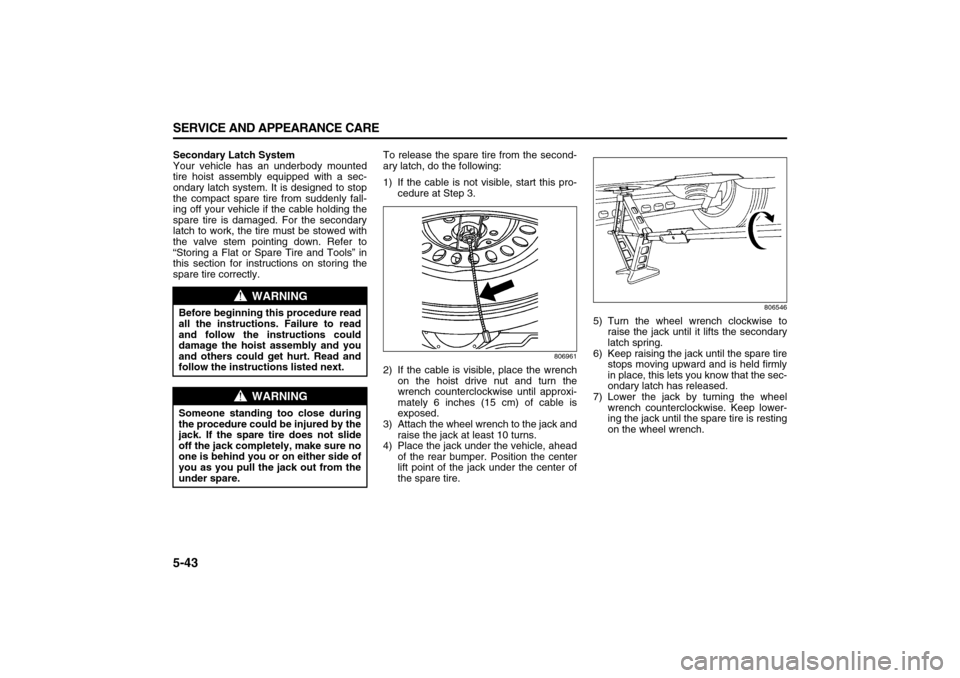
ary latch, do the following:
1) If the cable is not visible, start this pro-
cedure at Step 3.
806961
2) If the cable is visible, place the wrench
on the hoist drive nut and turn the
wrench counterclockwise until approxi-
mately 6 inches (15 cm) of cable is
exposed.
3) Attach the wheel wrench to the jack and
raise the jack at least 10 turns.
4) Place the jack under the vehicle, ahead
of the rear bumper. Position the center
lift point of the jack under the center of
the spare tire.
806546
5) Turn the wheel wrench clockwise to
raise the jack until it lifts the secondary
latch spring.
6) Keep raising the jack until the spare tire
stops moving upward and is held firmly
in place, this lets you know that the sec-
ondary latch has released.
7) Lower the jack by turning the wheel
wrench counterclockwise. Keep lower-
ing the jack until the spare tire is resting
on the wheel wrench.
WARNING
Before beginning this procedure read
all the instructions. Failure to read
and follow the instructions could
damage the hoist assembly and you
and others could get hurt. Read and
follow the instructions listed next.
WARNING
Someone standing too close during
the procedure could be injured by the
jack. If the spare tire does not slide
off the jack completely, make sure no
one is behind you or on either side of
you as you pull the jack out from the
under spare.
Page 228 of 274
5-44 SERVICE AND APPEARANCE CARE
78J00-03E
806548
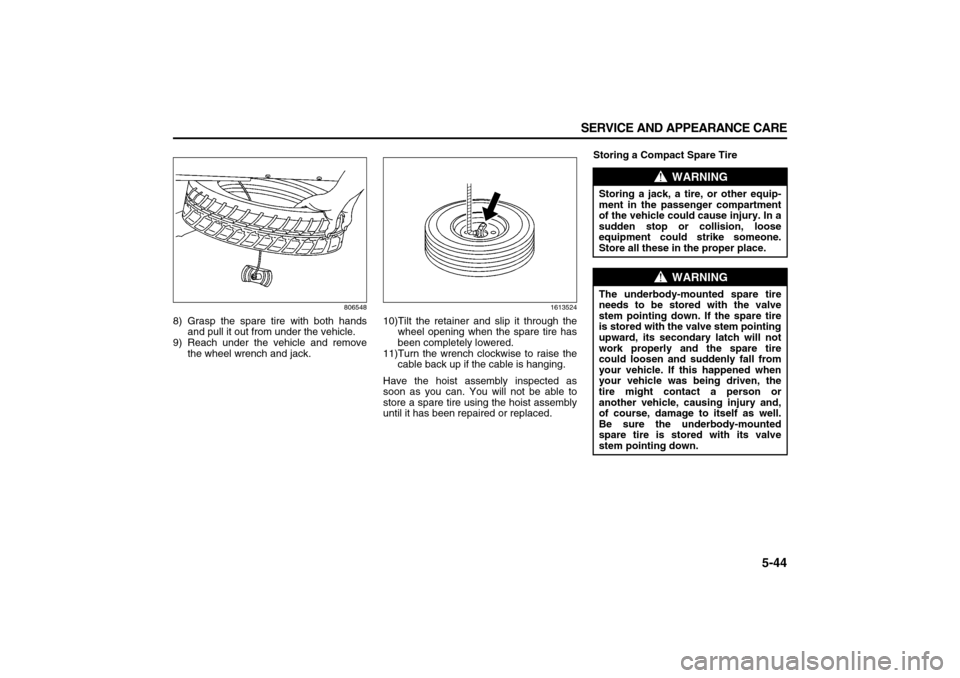
8) Grasp the spare tire with both hands
and pull it out from under the vehicle.
9) Reach under the vehicle and remove
the wheel wrench and jack.
1613524
10)Tilt the retainer and slip it through the
wheel opening when the spare tire has
been completely lowered.
11)Turn the wrench clockwise to raise the
cable back up if the cable is hanging.
Have the hoist assembly inspected as
soon as you can. You will not be able to
store a spare tire using the hoist assembly
until it has been repaired or replaced.Storing a Compact Spare Tire
WARNING
Storing a jack, a tire, or other equip-
ment in the passenger compartment
of the vehicle could cause injury. In a
sudden stop or collision, loose
equipment could strike someone.
Store all these in the proper place.
WARNING
The underbody-mounted spare tire
needs to be stored with the valve
stem pointing down. If the spare tire
is stored with the valve stem pointing
upward, its secondary latch will not
work properly and the spare tire
could loosen and suddenly fall from
your vehicle. If this happened when
your vehicle was being driven, the
tire might contact a person or
another vehicle, causing injury and,
of course, damage to itself as well.
Be sure the underbody-mounted
spare tire is stored with its valve
stem pointing down.
Page 229 of 274
5-45 SERVICE AND APPEARANCE CARE
78J00-03E
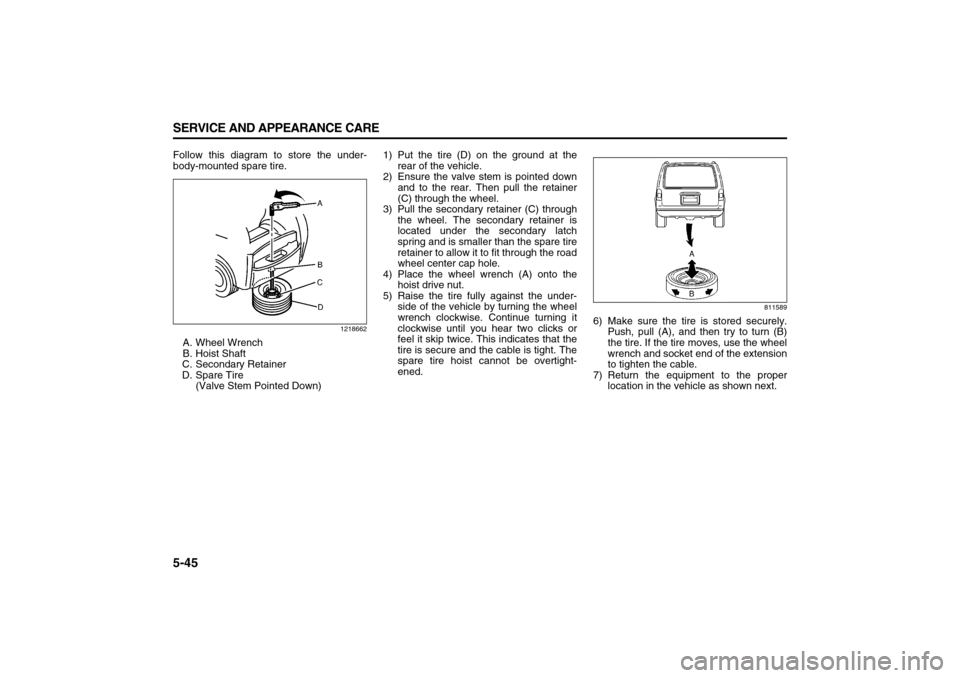
Follow this diagram to store the under-
body-mounted spare tire.
1218662
A. Wheel Wrench
B. Hoist Shaft
C. Secondary Retainer
D. Spare Tire
(Valve Stem Pointed Down)1) Put the tire (D) on the ground at the
rear of the vehicle.
2) Ensure the valve stem is pointed down
and to the rear. Then pull the retainer
(C) through the wheel.
3) Pull the secondary retainer (C) through
the wheel. The secondary retainer is
located under the secondary latch
spring and is smaller than the spare tire
retainer to allow it to fit through the road
wheel center cap hole.
4) Place the wheel wrench (A) onto the
hoist drive nut.
5) Raise the tire fully against the under-
side of the vehicle by turning the wheel
wrench clockwise. Continue turning it
clockwise until you hear two clicks or
feel it skip twice. This indicates that the
tire is secure and the cable is tight. The
spare tire hoist cannot be overtight-
ened.
811589
6) Make sure the tire is stored securely.
Push, pull (A), and then try to turn (B)
the tire. If the tire moves, use the wheel
wrench and socket end of the extension
to tighten the cable.
7) Return the equipment to the proper
location in the vehicle as shown next.
Page 231 of 274
5-47 SERVICE AND APPEARANCE CARE
78J00-03E
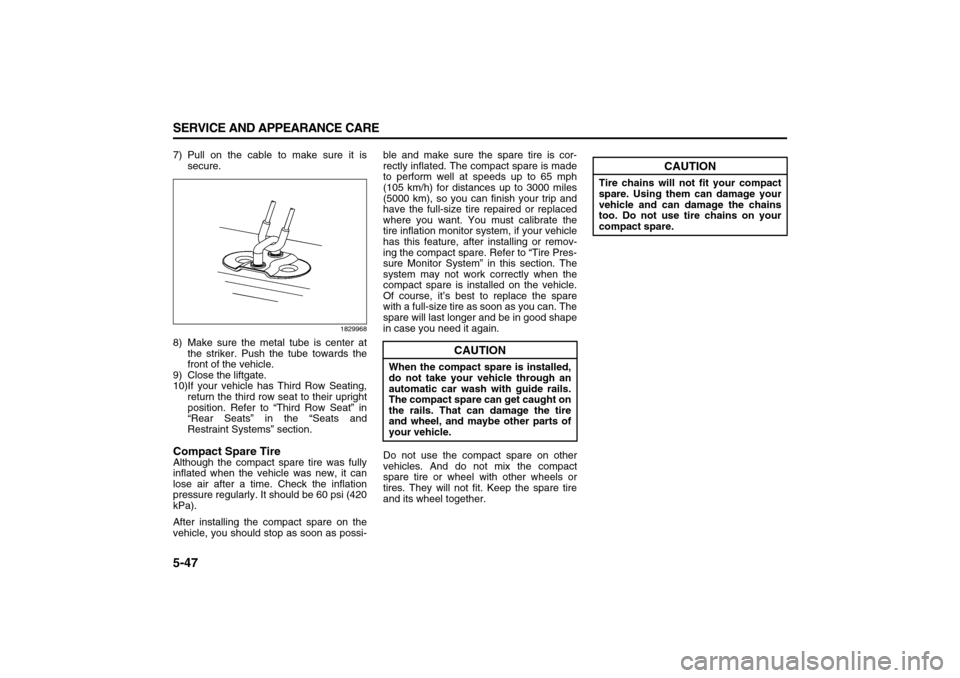
7) Pull on the cable to make sure it is
secure.
1829968
8) Make sure the metal tube is center at
the striker. Push the tube towards the
front of the vehicle.
9) Close the liftgate.
10)If your vehicle has Third Row Seating,
return the third row seat to their upright
position. Refer to “Third Row Seat” in
“Rear Seats” in the “Seats and
Restraint Systems” section.Compact Spare TireAlthough the compact spare tire was fully
inflated when the vehicle was new, it can
lose air after a time. Check the inflation
pressure regularly. It should be 60 psi (420
kPa).
After installing the compact spare on the
vehicle, you should stop as soon as possi-ble and make sure the spare tire is cor-
rectly inflated. The compact spare is made
to perform well at speeds up to 65 mph
(105 km/h) for distances up to 3000 miles
(5000 km), so you can finish your trip and
have the full-size tire repaired or replaced
where you want. You must calibrate the
tire inflation monitor system, if your vehicle
has this feature, after installing or remov-
ing the compact spare. Refer to “Tire Pres-
sure Monitor System” in this section. The
system may not work correctly when the
compact spare is installed on the vehicle.
Of course, it’s best to replace the spare
with a full-size tire as soon as you can. The
spare will last longer and be in good shape
in case you need it again.
Do not use the compact spare on other
vehicles. And do not mix the compact
spare tire or wheel with other wheels or
tires. They will not fit. Keep the spare tire
and its wheel together.
CAUTION
When the compact spare is installed,
do not take your vehicle through an
automatic car wash with guide rails.
The compact spare can get caught on
the rails. That can damage the tire
and wheel, and maybe other parts of
your vehicle.
CAUTION
Tire chains will not fit your compact
spare. Using them can damage your
vehicle and can damage the chains
too. Do not use tire chains on your
compact spare.
Page 256 of 274

6-14 MAINTENANCE SCHEDULE
78J00-03E
At Each Fuel FillIt is important to perform these underhood
checks at each fuel fill.
Engine Oil Level Check
Check the engine oil level and add the
proper oil if necessary. Refer to “Engine
Oil” in “Checking Things Under the Hood”
in the “Service and Appearance Care” sec-
tion for further details.
Engine Coolant Level Check
Check the engine coolant level and add
DEX-COOL
® coolant mixture if necessary.
Refer to “Engine Coolant” in “Checking
Things Under the Hood” in the “Service
and Appearance Care” section for further
details.
Windshield Washer Fluid Level Check
Check the windshield washer fluid level in
the windshield washer fluid reservoir and
add the proper fluid if necessary.
At Least Once a MonthTire Inflation Check
Visually inspect your vehicle’s tires and
make sure they are inflated to the correct
pressures. Do not forget to check the
spare tire. Open the driver’s door to find
the Tire Information Placard which lists the
recommended tire inflation pressures.
Check to make sure the spare tire is stored
securely. Refer to “Changing a Flat Tire” in
“Tires” in the “Service and Appearance
Care” section.
Tire Wear Inspection
Tire rotation may be required for high mile-
age highway drivers prior to the Engine Oil
Life System service notification. Check the
tires for wear and, if necessary, rotate the
tires. Refer to “Tire Inspection and Rota-
tion” in “Tires” in the “Service and Appear-
ance Care” section.
At Least Once a YearStarter Switch Check
1) Before you start, be sure you have
enough room around the vehicle.
2) Firmly apply both the parking brake and
the regular brake. Refer to “Parking
Brake” in “Starting and Operating Your
Vehicle” in the “Features and Controls”
section.
Do not use the accelerator pedal, and
be ready to turn off the engine immedi-
ately if it starts.
3) Try to start the engine in each gear.
The vehicle should start only in PARK
(P) or NEUTRAL (N). If the vehicle
starts in any other position, contact
your dealer for service.
CAUTION
It is important to check the engine oil
regularly and keep it at the proper
level. Failure to keep the engine oil at
the proper level can cause damage to
the engine not covered by your war-
ranty.
WARNING
When you are doing this inspection,
the vehicle could move suddenly. If
the vehicle moves, you or others
could be injured.
Page 269 of 274

8-2 INDEX
78J00-03E
Child Restraints
...................................................................1-18
City Driving
..........................................................................4-11
Cleaning Exterior Lamps/Lenses
.......................................5-50
Cleaning the Inside of Your Vehicle ..................................5-48
Climate Controls
..................................................................3-10
Compact Spare Tire .............................................................5-47
Configurations for Use of Three Child Restraints
............1-25
Configurations for Use of Two Child Restraints
..............1-24
Control of a Vehicle
.............................................................4-3
Convenience Net
.................................................................2-23
Cooling System
...................................................................5-13
Cruise Control
......................................................................3-5
Cruise Control Light
............................................................3-24
Cupholder(s)
........................................................................2-21
DDaily Inspection Checklist
........................................ 2-11
, 2-12
Delayed Locking
..................................................................2-6
DIC Operation and Displays
...............................................3-27
DIC Vehicle Personalization ...............................................3-35
DIC Warnings and Messages .............................................3-30
Doing Your Own Service Work ...........................................5-1
Dome Lamp
..........................................................................3-8
Door Ajar Light ....................................................................3-25
Door Locks
...........................................................................2-5
Doors and Locks
.................................................................2-5
Driver Information Center (DIC)
.........................................3-27
Driver Position
.....................................................................1-11
Driver Seat Height Adjuster
................................................1-1
Driving at Night
....................................................................4-9
Driving in Rain and on Wet Roads
.....................................4-10
Drunken Driving
...................................................................4-1
EElectric Power Management
.............................................. 3-9
Electrical System
................................................................ 5-53
Electronic Stability Control
................................................ 4-5
Emission Compliance Label (for U.S.A.)
.......................... 7-2
Engine Air Cleaner/Filter
.................................................... 5-9
Engine Compartment Overview
......................................... 5-6
Engine Coolant
.................................................................... 5-11
Engine Coolant Heater
....................................................... 2-14
Engine Coolant Temperature Gage
................................... 3-21
Engine Coolant Temperature Warning Light
.................... 3-20
Engine Drive Belt Routing
.................................................. 6-17
Engine Exhaust
................................................................... 2-19
Engine Oil
............................................................................ 5-7
Engine Oil Life System
....................................................... 5-8
Engine Overheating
............................................................ 5-12
Engine Serial Number ......................................................... 7-1
FFabric/Carpet
....................................................................... 5-48
Filling a Portable Fuel Container
....................................... 5-4
Filling the Tank
.................................................................... 5-3
Finish Care
.......................................................................... 5-50
Finish Damage .................................................................... 5-51
Fog Lamp Light ................................................................... 3-24
Fog Lamps
........................................................................... 3-8
For CANADA Scheduled Maintenance
.............................. 6-8
Freeway Driving
.................................................................. 4-11
Front Seats
.......................................................................... 1-1
Fuel
....................................................................................... 5-2
Fuel Gage
............................................................................. 3-26
Fuels in Foreign Countries
................................................ 5-3