warning lights SUZUKI XL7 2007 2.G Owner's Manual
[x] Cancel search | Manufacturer: SUZUKI, Model Year: 2007, Model line: XL7, Model: SUZUKI XL7 2007 2.GPages: 274, PDF Size: 6.12 MB
Page 186 of 274

5-2 SERVICE AND APPEARANCE CARE
78J00-03E
FuelUse of the recommended fuel is an impor-
tant part of the proper maintenance of your
vehicle. To help keep the engine clean and
maintain optimum vehicle performance, we
recommend the use of gasoline advertised
as TOP TIER Detergent Gasoline.Gasoline OctaneUse regular unleaded gasoline with a
posted octane rating of 87 or higher. If the
octane rating is less than 87, you may
notice an audible knocking noise when you
drive, commonly referred to as spark
knock. If this occurs, use a gasoline rated
at 87 octane or higher as soon as possible.
If you are using gasoline rated at 87
octane or higher and you hear heavy
knocking, your engine needs service.
Gasoline SpecificationsAt a minimum, gasoline should meet
ASTM specification D 4814 in the United
States or CAN/CGSB-3.5 in Canada.
Some gasolines contain an octane-
enhancing additive called methylcyclopen-
tadienyl manganese tricarbonyl (MMT).
We recommend against the use of gaso-
lines containing MMT. Refer to “Additives”
in this section for additional information.California FuelIf your vehicle is certified to meet California
Emissions Standards, it is designed to
operate on fuels that meet California spec-
ifications. See the underhood emission
control label. If this fuel is not available in
states adopting California emissions stan-
dards, your vehicle will operate satisfacto-
rily on fuels meeting federal specifications,
but emission control system performance
may be affected. The malfunction indicator
lamp may turn on and your vehicle may fail
a smog-check test. Refer to “Malfunction
Indicator Lamp” in “Warning Lights, Gages,
and Indicators” in the “Instrument Panel”
section. If this occurs, return to your autho-
rized dealer for diagnosis. If it is deter-
mined that the condition is caused by the
type of fuel used, repairs may not be cov-
ered by your warranty.
AdditivesTo provide cleaner air, all gasolines in the
United States are now required to contain
additives that will help prevent engine and
fuel system deposits from forming, allow-
ing your emission control system to work
properly. In most cases, you should not
have to add anything to your fuel. How-
ever, some gasolines contain only the min-
imum amount of additive required to meet
U.S. Environmental Protection Agency
regulations. To help keep fuel injectors and
intake valves clean, or if your vehicle expe-
riences problems due to dirty injectors or
valves, look for gasoline that is advertised
as TOP TIER Detergent Gasoline. Also,
your dealer has additives that will help cor-
rect and prevent most deposit-related
problems.
Gasolines containing oxygenates, such as
ethers and ethanol, and reformulated gas-
olines may be available in your area. We
recommend that you use these gasolines,
if they comply with the specifications
described earlier. However, E85 (85% eth-
anol) and other fuels containing more than
10% ethanol must not be used in vehicles
that were not designed for those fuels.
Page 188 of 274
5-4 SERVICE AND APPEARANCE CARE
78J00-03E
Be careful not to spill fuel. Do not top off or
overfill the tank and wait a few seconds
after you have finished pumping before
removing the nozzle. Clean fuel from
painted surfaces as soon as possible.
Refer to “Washing Your Vehicle” in this
section.
When replacing the fuel cap, turn it clock-
wise until it clicks. Make sure the cap is
fully installed. The diagnostic system can
determine if the fuel cap has been left off
or improperly installed. This would allow
fuel to evaporate into the atmosphere.
Refer to “Malfunction Indicator Lamp” in
“Warning Lights, Gages, and Indicators” in
the “Instrument Panel” section.
Filling a Portable Fuel Container
WARNING
If a fire starts while you are refueling,
do not remove the nozzle. Shut off
the flow of fuel by shutting off the
pump or by notifying the station
attendant. Leave the area immedi-
ately.
CAUTION
If you need a new fuel cap, be sure to
get the right type. Your dealer can get
one for you. If you get the wrong
type, it may not fit properly. This may
cause your malfunction indicator
lamp to light and may damage your
fuel tank and emissions system.
Refer to “Malfunction Indicator
Lamp” in “Warning Lights, Gages,
and Indicators” in the “Instrument
Panel” section.
WARNING
Never fill a portable fuel container
while it is in your vehicle. Static elec-
tricity discharge from the container
can ignite the gasoline vapor. You
can be badly burned and your vehicle
damaged if this occurs. To help avoid
injury to you and others:
Dispense gasoline only into
approved containers.
Do not fill a container while it is
inside a vehicle, in a vehicle’s
trunk, pickup bed, or on any sur-
face other than the ground.
Bring the fill nozzle in contact with
the inside of the fill opening before
operating the nozzle. Contact
should be maintained until the fill-
ing is complete.
Do not smoke while pumping gaso-
line.
Do not use a cellular phone while
pumping gasoline.
Page 193 of 274

5-9 SERVICE AND APPEARANCE CARE
78J00-03E
system to work properly, you must reset
the system every time the oil is changed.
When the system has calculated that oil
life has been diminished, it will indicate
that an oil change is necessary. A change
engine oil light and a CHANGE ENGINE
OIL SOON message will come on. Refer to
“Change Engine Oil Light” in “Warning
Lights, Gages, and Indicators” in the
“Instrument Panel” section and “DIC Warn-
ings and Messages” in “Driver Information
Center (DIC)” in the “Instrument Panel”
section. Change your oil as soon as possi-
ble within the next 600 miles (1000 km). It
is possible that, if you are driving under the
best conditions, the oil life system may not
indicate that an oil change is necessary for
over a year. However, your engine oil and
filter must be changed at least once a year
and at this time the system must be reset.
Your dealer has trained service people
who will perform this work and reset the
system. It is also important to check your
oil regularly and keep it at the proper level.
If the system is ever reset accidentally, you
must change your oil at 3000 miles (5000
km) since your last oil change. Remember
to reset the oil life system whenever the oil
is changed.
How to Reset the Engine Oil Life Sys-
tem
The Engine Oil Life System calculates
when to change your engine oil and filter
based on vehicle use. Anytime your oil ischanged, reset the system so it can calcu-
late when the next oil change is required. If
a situation occurs where you change your
oil prior to a change engine oil light or
CHANGE ENGINE OIL SOON message
being turned on, reset the system.
1) Turn the ignition key to RUN with the
engine off.
2) Fully press and release the accelerator
pedal three times within five seconds.
The change engine oil light will flash
while the system is resetting.
3) When the light stops flashing, turn the
key to LOCK.
If the light or message comes back on and
stays on when you start your vehicle, the
engine oil life system has not reset.
Repeat the procedure.
What to Do with Used Oil
Used engine oil contains certain elements
that may be unhealthy for your skin and
could even cause cancer. Do not let used
oil stay on your skin for very long. Clean
your skin and nails with soap and water, or
a good hand cleaner. Wash or properly
dispose of clothing or rags containing used
engine oil. See the manufacturer’s warn-
ings about the use and disposal of oil prod-
ucts.
Used oil can be a threat to the environ-
ment. If you change your own oil, be sure
to drain all the oil from the filter before dis-
posal. Never dispose of oil by putting it inthe trash, pouring it on the ground, into
sewers, or into streams or bodies of water.
Instead, recycle it by taking it to a place
that collects used oil. If you have a prob-
lem properly disposing of your used oil,
ask your dealer, a service station, or a
local recycling center for help.
Engine Air Cleaner/FilterThe engine air cleaner/filter is located in
the engine compartment on the passen-
ger’s side of the vehicle. Refer to “Engine
Compartment Overview” in this section for
more information on location.
When to Inspect the Engine Air Cleaner/
Filter
Inspect the air cleaner/filter at the Mainte-
nance II intervals and replace it at the first
oil change after each 50000 mile (83000
km) interval. Refer to “Scheduled Mainte-
nance” in “Maintenance Schedule” in the
“Maintenance Schedule” section for more
information. If you are driving in dusty/dirty
conditions, inspect the filter at each engine
oil change.
How to Inspect the Engine Air Cleaner/
Filter
To inspect the air cleaner/filter remove the
filter from the vehicle and lightly shake the
filter to release loose dust and dirt. If the fil-
ter remains caked with dirt, a new filter is
required.
Page 195 of 274
5-11 SERVICE AND APPEARANCE CARE
78J00-03E
Fluids and Lubricants” in “Maintenance
Schedule” in the “Maintenance Schedule”
section.Engine CoolantThe cooling system in your vehicle is filled
with DEX-COOL
® engine coolant. This
coolant is designed to remain in your vehi-
cle for five years or 150,000 miles (240
000 km), whichever occurs first, if you add
only DEX-COOL® extended life coolant.
The following explains your cooling system
and how to add coolant when it is low. If
you have a problem with engine overheat-
ing, refer to “Engine Overheating” in this
section.
A 50/50 mixture of clean, drinkable water
and DEX-COOL® coolant will:
Give freezing protection down to –34°F
(–37°C).
Give boiling protection up to 265°F
(129°C).
Protect against rust and corrosion. Help keep the proper engine tempera-
ture.
Let the warning lights and gages work as
they should.What to Use
Use a mixture of one-half clean, drinkable
water and one-half DEX-COOL
® coolant
which will not damage aluminum parts. If
you use this coolant mixture, you do not
need to add anything else.
CAUTION
Use of the incorrect automatic tran-
saxle fluid may damage your vehicle,
and the damages may not be covered
by your warranty. Always use the
automatic transaxle fluid listed in
“Recommended Fluids and Lubri-
cants” in “Maintenance Schedule” in
the “Maintenance Schedule” section.
CAUTION
Using coolant other than DEX-COOL
®
may cause premature engine, heater
core, or radiator corrosion. In addi-
tion, the engine coolant may require
changing sooner, at the first mainte-
nance service after each 30000 miles
(50000 km) or 24 months, whichever
occurs first. Any repairs would not be
covered by your warranty. Always
use DEX-COOL
® (silicate-free) cool-
ant in your vehicle.
WARNING
Adding only plain water to your cool-
ing system can be dangerous. Plain
water, or some other liquid such as
alcohol, can boil before the proper
coolant mixture will. Your vehicle’s
coolant warning system is set for the
proper coolant mixture. With plain
water or the wrong mixture, your
engine could get too hot but you
would not get the overheat warning.
Your engine could catch fire and you
or others could be burned. Use a 50/
50 mixture of clean, drinkable water
and DEX-COOL
® coolant.
CAUTION
If you use an improper coolant mix-
ture, your engine could overheat and
be badly damaged. The repair cost
would not be covered by your war-
ranty. Too much water in the mixture
can freeze and crack the engine, radi-
ator, heater core, and other parts.
Page 196 of 274
5-12 SERVICE AND APPEARANCE CARE
78J00-03E
If you have to add coolant more than four
times a year, have your dealer check your
cooling system.
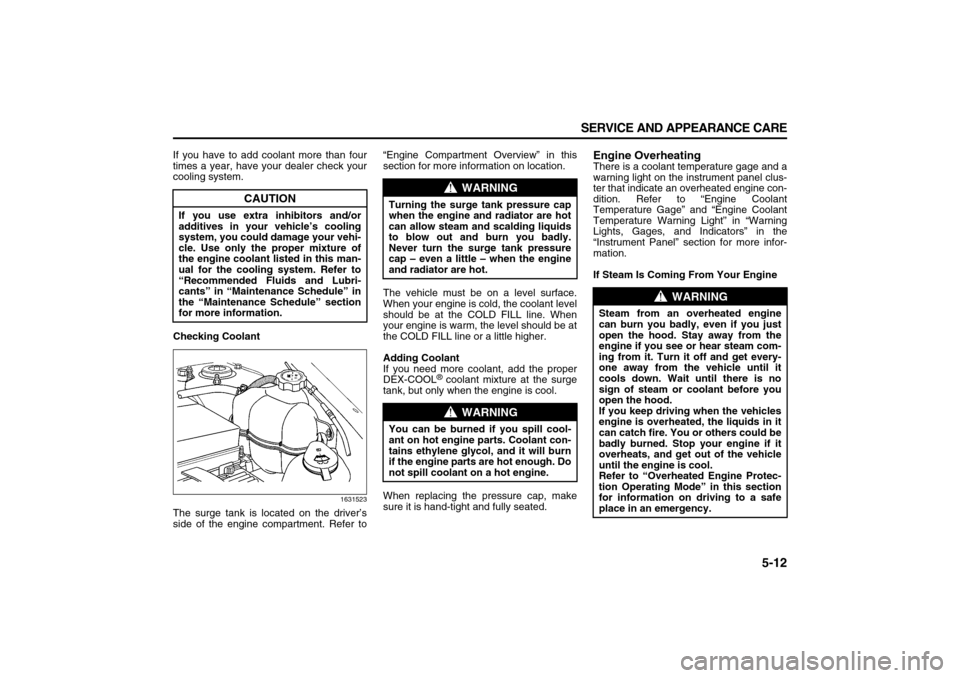
Checking Coolant
1631523
The surge tank is located on the driver’s
side of the engine compartment. Refer to“Engine Compartment Overview” in this
section for more information on location.
The vehicle must be on a level surface.
When your engine is cold, the coolant level
should be at the COLD FILL line. When
your engine is warm, the level should be at
the COLD FILL line or a little higher.
Adding Coolant
If you need more coolant, add the proper
DEX-COOL
® coolant mixture at the surge
tank, but only when the engine is cool.
When replacing the pressure cap, make
sure it is hand-tight and fully seated.
Engine OverheatingThere is a coolant temperature gage and a
warning light on the instrument panel clus-
ter that indicate an overheated engine con-
dition. Refer to “Engine Coolant
Temperature Gage” and “Engine Coolant
Temperature Warning Light” in “Warning
Lights, Gages, and Indicators” in the
“Instrument Panel” section for more infor-
mation.
If Steam Is Coming From Your Engine
CAUTION
If you use extra inhibitors and/or
additives in your vehicle’s cooling
system, you could damage your vehi-
cle. Use only the proper mixture of
the engine coolant listed in this man-
ual for the cooling system. Refer to
“Recommended Fluids and Lubri-
cants” in “Maintenance Schedule” in
the “Maintenance Schedule” section
for more information.
WARNING
Turning the surge tank pressure cap
when the engine and radiator are hot
can allow steam and scalding liquids
to blow out and burn you badly.
Never turn the surge tank pressure
cap – even a little – when the engine
and radiator are hot.
WARNING
You can be burned if you spill cool-
ant on hot engine parts. Coolant con-
tains ethylene glycol, and it will burn
if the engine parts are hot enough. Do
not spill coolant on a hot engine.
WARNING
Steam from an overheated engine
can burn you badly, even if you just
open the hood. Stay away from the
engine if you see or hear steam com-
ing from it. Turn it off and get every-
one away from the vehicle until it
cools down. Wait until there is no
sign of steam or coolant before you
open the hood.
If you keep driving when the vehicles
engine is overheated, the liquids in it
can catch fire. You or others could be
badly burned. Stop your engine if it
overheats, and get out of the vehicle
until the engine is cool.
Refer to “Overheated Engine Protec-
tion Operating Mode” in this section
for information on driving to a safe
place in an emergency.
Page 201 of 274
5-17 SERVICE AND APPEARANCE CARE
78J00-03E
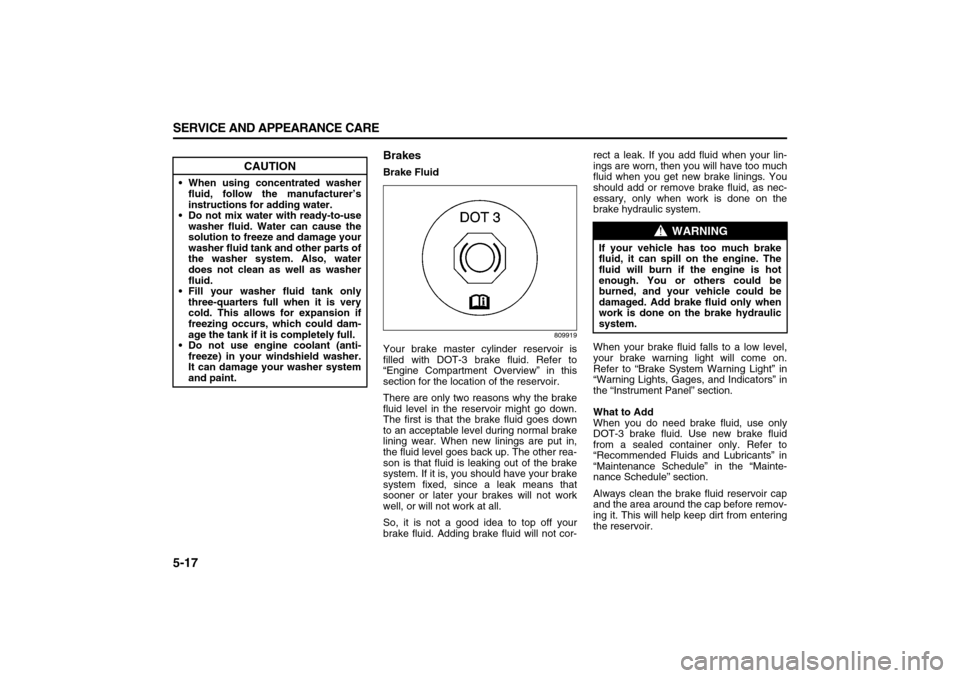
BrakesBrake Fluid
809919
Your brake master cylinder reservoir is
filled with DOT-3 brake fluid. Refer to
“Engine Compartment Overview” in this
section for the location of the reservoir.
There are only two reasons why the brake
fluid level in the reservoir might go down.
The first is that the brake fluid goes down
to an acceptable level during normal brake
lining wear. When new linings are put in,
the fluid level goes back up. The other rea-
son is that fluid is leaking out of the brake
system. If it is, you should have your brake
system fixed, since a leak means that
sooner or later your brakes will not work
well, or will not work at all.
So, it is not a good idea to top off your
brake fluid. Adding brake fluid will not cor-rect a leak. If you add fluid when your lin-
ings are worn, then you will have too much
fluid when you get new brake linings. You
should add or remove brake fluid, as nec-
essary, only when work is done on the
brake hydraulic system.
When your brake fluid falls to a low level,
your brake warning light will come on.
Refer to “Brake System Warning Light” in
“Warning Lights, Gages, and Indicators” in
the “Instrument Panel” section.
What to Add
When you do need brake fluid, use only
DOT-3 brake fluid. Use new brake fluid
from a sealed container only. Refer to
“Recommended Fluids and Lubricants” in
“Maintenance Schedule” in the “Mainte-
nance Schedule” section.
Always clean the brake fluid reservoir cap
and the area around the cap before remov-
ing it. This will help keep dirt from entering
the reservoir.
CAUTION
When using concentrated washer
fluid, follow the manufacturer’s
instructions for adding water.
Do not mix water with ready-to-use
washer fluid. Water can cause the
solution to freeze and damage your
washer fluid tank and other parts of
the washer system. Also, water
does not clean as well as washer
fluid.
Fill your washer fluid tank only
three-quarters full when it is very
cold. This allows for expansion if
freezing occurs, which could dam-
age the tank if it is completely full.
Do not use engine coolant (anti-
freeze) in your windshield washer.
It can damage your washer system
and paint.
WARNING
If your vehicle has too much brake
fluid, it can spill on the engine. The
fluid will burn if the engine is hot
enough. You or others could be
burned, and your vehicle could be
damaged. Add brake fluid only when
work is done on the brake hydraulic
system.
Page 273 of 274

8-6 INDEX
78J00-03E
Vehicle Identification
...........................................................5-52
Vehicle Identification Number
............................................7-1
Vehicle Identification Number (VIN)
...................................5-52
WWarning Lights, Gages, and Indicators
.............................3-15
Warranties
............................................................................7-2
Washing Your Vehicle
.........................................................5-49
Weatherstrips
.......................................................................5-49
What Makes an Airbag Inflate?
..........................................1-38
What Will You See After an Airbag Inflates?
....................1-38
Wheel Alignment and Tire Balance
....................................5-36
Wheel Replacement
.............................................................5-37
When It Is Time for New Tires
............................................5-34
When Should an Airbag Inflate? ........................................1-37
Where Are the Airbags?
......................................................1-35
Where to Put the Restraint .................................................1-24
Windows
...............................................................................2-8
Windshield and Wiper Blades
............................................5-50
Windshield Washer
.............................................................3-5
Windshield Washer Fluid
....................................................5-16
Windshield Wiper Blade Replacement
..............................5-25
Windshield Wiper Fuses
.....................................................5-53
Windshield Wipers
..............................................................3-4
Winter Driving
......................................................................4-14
YYour Driving, the Road, and Your Vehicle
........................4-1
Your Vehicle and the Environment
....................................6-1