lock SUZUKI XL7 2007 2.G Manual Online
[x] Cancel search | Manufacturer: SUZUKI, Model Year: 2007, Model line: XL7, Model: SUZUKI XL7 2007 2.GPages: 274, PDF Size: 6.12 MB
Page 199 of 274
5-15 SERVICE AND APPEARANCE CARE
78J00-03E
When the coolant level in the coolant
recovery tank is at the cold fill line, start the
vehicle.
If the overheat warning continues, there is
one more thing you can try. You can add
the proper coolant mixture directly to the
radiator, but be sure the system is cool
before you do it.How to Add Coolant to the Cooling Sys-
tem
809006
1) You can remove the pressure cap
when the cooling system, including the
pressure cap and upper radiator hose
is no longer hot. Turn the pressure cap
slowly counterclockwise.
If you hear a hiss, wait for that to stop.
A hiss means that there is still some
pressure left.2) Then keep turning the pressure cap
and remove it.
3) Fill the cooling system with the proper
DEX-COOL
® coolant mixture, up to the
base of the filler neck. Refer to “Engine
Coolant” in this section for more infor-
mation about the proper coolant mix-
ture.
4) Rinse or wipe any spilled coolant from
the engine and the compartment.
1631525
5) Then fill the coolant recovery tank to
the cold fill line.
WARNING
You can be burned if you spill cool-
ant on hot engine parts. Coolant con-
tains ethylene glycol and it will burn
if the engine parts are hot enough. Do
not spill coolant on a hot engine.
WARNING
Steam and scalding liquids from a
hot cooling system can blow out and
burn you badly. They are under pres-
sure, and if you turn the radiator
pressure cap – even a little – they can
come out at high speed. Never turn
the cap when the cooling system,
including the radiator pressure cap,
is hot. Wait for the cooling system
and radiator pressure cap to cool if
you ever have to turn the pressure
cap.
CAUTION
Your engine has a specific cooling
system drain and fill procedure. Fail-
ure to follow this procedure could
cause your engine to overheat and be
severely damaged. If your engine’s
cooling system needs to be drained
and re-filled, please see your dealer.
WARNING
You can be burned if you spill cool-
ant on hot engine parts. Coolant con-
tains ethylene glycol and it will burn
if the engine parts are hot enough. Do
not spill coolant on a hot engine.
Page 203 of 274
5-19 SERVICE AND APPEARANCE CARE
78J00-03E
For battery replacement, see your dealer
or the service manual.
Vehicle Storage
If you are not going to drive your vehicle
for 25 days or more, remove the black,
negative (–) cable from the battery. This
will help keep your battery from running
down.
You must close all doors and the liftgate
before reconnecting the battery. After
reconnecting the battery, you must press
the unlock button on the key transmitter.
Failure to follow this procedure may result
in sounding an alarm. Pressing unlock on
the key transmitter would stop the alarm.
Jump StartingIf your vehicle’s battery has run down, you
may want to use another vehicle and some
jumper cables to start your vehicle. Be
sure to use the following steps to do it
safely.
1) Check the other vehicle. It must have a
12-volt battery with a negative ground
system.2) Get the vehicles close enough so the
jumper cables can reach, but be sure
the vehicles are not touching each
other. If they are, it could cause a
ground connection you do not want.
You would not be able to start your
vehicle, and the bad grounding could
damage the electrical systems.
To avoid the possibility of the vehicles
rolling, set the parking brake firmly on
both vehicles involved in the jump start
procedure. Put an automatic transaxle
in PARK (P) or a manual transaxle in
NEUTRAL before setting the parking
brake.
WARNING
Battery posts, terminals, and related
accessories contain lead and lead
compounds, chemicals known to the
State of California to cause cancer
and reproductive harm. Wash hands
after handling.
WARNING
Batteries have acid that can burn you
and gas that can explode. You can be
badly hurt if you are not careful.
Refer to “Jump Starting” in this sec-
tion for tips on working around a bat-
tery without getting hurt.
WARNING
Batteries can hurt you. They can be
dangerous because:
They contain acid that can burn
you.
They contain gas that can explode
or ignite.
They contain enough electricity to
burn you.
If you do not follow these steps
exactly, some or all of these things
can hurt you.
CAUTION
Ignoring these steps could result in
costly damage to your vehicle that
would not be covered by your war-
ranty.
Trying to start your vehicle by push-
ing or pulling it will not work, and it
could damage your vehicle.
CAUTION
If the other vehicle’s system is not a
12-volt system with a negative
ground, both vehicles can be dam-
aged. Only use vehicles with 12-volt
systems with negative grounds to
jump start your vehicle.
CAUTION
If you leave your radio or other
accessories on during the jump start-
ing procedure, they could be dam-
aged. The repairs would not be
covered by your warranty. Always
turn off your radio and other acces-
sories when jump starting your vehi-
cle.
Page 204 of 274
5-20 SERVICE AND APPEARANCE CARE
78J00-03E
3) Turn off the ignition on both vehicles.
Unplug unnecessary accessories
plugged into the cigarette lighter or the
accessory power outlets. Turn off the
radio and all lamps that are not needed.
This will avoid sparks and help save
both batteries. And it could save the
radio!
4) Open the hood on the other vehicle and
locate the positive (+) and negative (–)
terminal locations on that vehicle.
You will not use your vehicle’s battery
for jump starting. It has a remote posi-
tive (+) jump starting terminal, located
on the underhood fuse block, for that
purpose. Refer to “Engine Compart-
ment Overview” in this section for more
information on location.
871917
To uncover the remote positive (+) ter-
minal, press the tab at the bottom of thefuse block and lift the cover up.
Always use the remote positive (+) ter-
minal instead of the positive (+) termi-
nal on the battery.
5) Check that the jumper cables do not
have loose or missing insulation. If they
do, you could get a shock. The vehicles
could be damaged too.
Before you connect the cables, here
are some basic things you should
know. Positive (+) will go to positive (+)
or to a remote positive (+) terminal if the
vehicle has one. Negative will go to a
heavy, unpainted metal engine part or
to a remote negative (–) terminal if the
vehicle has one.
WARNING
An electric fan can start up even
when the engine is not running and
can injure you. Keep hands, clothing
and tools away from any underhood
electric fan.
WARNING
Fans or other moving engine parts
can injure you badly. Keep your
hands away from moving parts once
the engine is running.
WARNING
Using a match near a battery can
cause battery gas to explode. People
have been hurt doing this, and some
have been blinded. Use a flashlight if
you need more light.
Be sure the battery has enough
water. You do not need to add water
to the battery installed in your new
vehicle. But if a battery has filler
caps, be sure the right amount of
fluid is there. If it is low, add water to
take care of that first. If you do not,
explosive gas could be present.
(Continued)
WARNING
(Continued)
Battery fluid contains acid that can
burn you. Do not get it on you. If you
accidentally get it in your eyes or on
your skin, flush the place with water
and get medical help immediately.
CAUTION
If you connect a negative cable to the
Engine Control Module (ECM), ECM
mounting bracket or any cables that
attach to the ECM bracket, you may
damage the ECM. Attach the negative
cable to a heavy, unpainted metal
engine part, other than the ECM, ECM
bracket or cables attached to the
ECM bracket.
Page 206 of 274
5-22 SERVICE AND APPEARANCE CARE
78J00-03E
To disconnect the jumper cables from both
vehicles, do the following:
1) Disconnect the black negative (–) cable
from the vehicle that had the dead bat-
tery.
2) Disconnect the black negative (–) cable
from the vehicle with the good battery.
3) Disconnect the red positive (+) cable
from the vehicle with the good battery.
4) Disconnect the red positive (+) cable
from the other vehicle.
5) Return the fuse block cover to its origi-
nalposition.
All-Wheel DriveIf you have an all-wheel-drive vehicle, be
sure to perform the lubricant checks
described in this section. However, there
are two additional systems that need lubri-
cation.Transfer Case (Power Transfer Unit)When to Check Lubricant
Refer to the Maintenance Schedule to
determine how often to check the lubricant.
Refer to “Scheduled Maintenance” in
“Maintenance Schedule” in the “Mainte-
nance Schedule” section.
How to Check Lubricant
1765710
A. Fill Plug
B. Drain PlugTo get an accurate reading, the vehicle
should be on a level surface.
If the level is below the bottom of the filler
plug hole, you’ll need to add some lubri-
cant. Add enough lubricant to raise the
level to the bottom of the filler plug hole.
What to Use
Refer to the Maintenance Schedule to
determine what kind of lubricant to use.
Refer to “Recommended Fluids and Lubri-
cants” in “Maintenance Schedule” in the
“Maintenance Schedule” section.
Carrier Assembly-Differential
(Rear Drive Module)When to Check and Change Lubricant
Refer to the Maintenance Schedule to
determine how often to check the lubricant
and when to change it. Refer to “Sched-
uled Maintenance” in “Maintenance
Schedule” in the “Maintenance Schedule”
section.
Page 207 of 274
5-23 SERVICE AND APPEARANCE CARE
78J00-03E
How to Check Lubricant
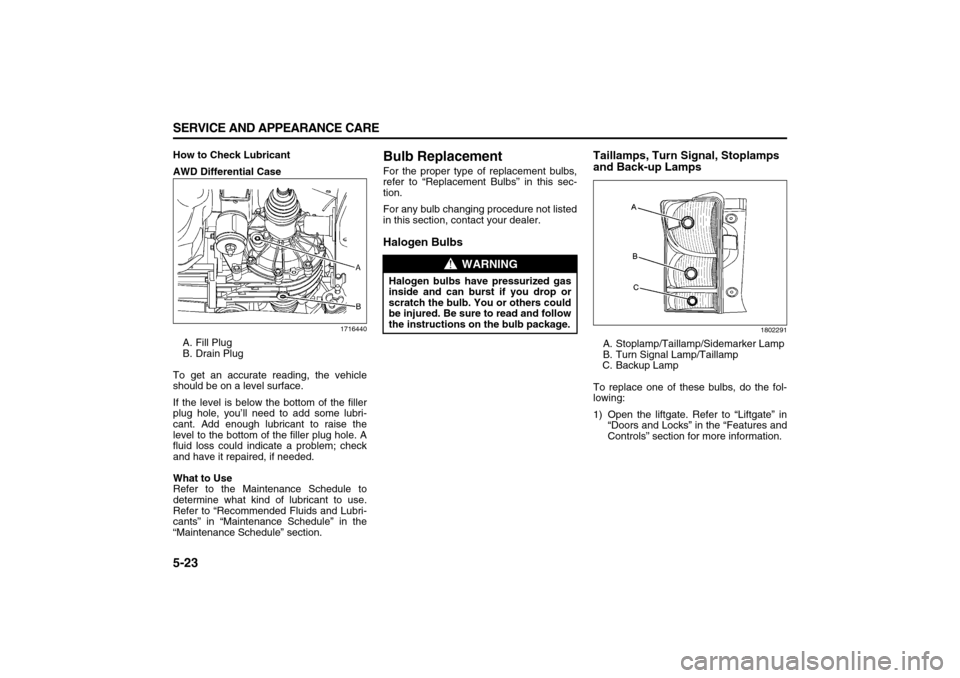
AWD Differential Case
1716440
A. Fill Plug
B. Drain Plug
To get an accurate reading, the vehicle
should be on a level surface.
If the level is below the bottom of the filler
plug hole, you’ll need to add some lubri-
cant. Add enough lubricant to raise the
level to the bottom of the filler plug hole. A
fluid loss could indicate a problem; check
and have it repaired, if needed.
What to Use
Refer to the Maintenance Schedule to
determine what kind of lubricant to use.
Refer to “Recommended Fluids and Lubri-
cants” in “Maintenance Schedule” in the
“Maintenance Schedule” section.
Bulb ReplacementFor the proper type of replacement bulbs,
refer to “Replacement Bulbs” in this sec-
tion.
For any bulb changing procedure not listed
in this section, contact your dealer.Halogen BulbsTaillamps, Turn Signal, Stoplamps
and Back-up Lamps
1802291
A. Stoplamp/Taillamp/Sidemarker Lamp
B. Turn Signal Lamp/Taillamp
C. Backup Lamp
To replace one of these bulbs, do the fol-
lowing:
1) Open the liftgate. Refer to “Liftgate” in
“Doors and Locks” in the “Features and
Controls” section for more information.
WARNING
Halogen bulbs have pressurized gas
inside and can burst if you drop or
scratch the bulb. You or others could
be injured. Be sure to read and follow
the instructions on the bulb package.
Page 208 of 274
5-24 SERVICE AND APPEARANCE CARE
78J00-03E
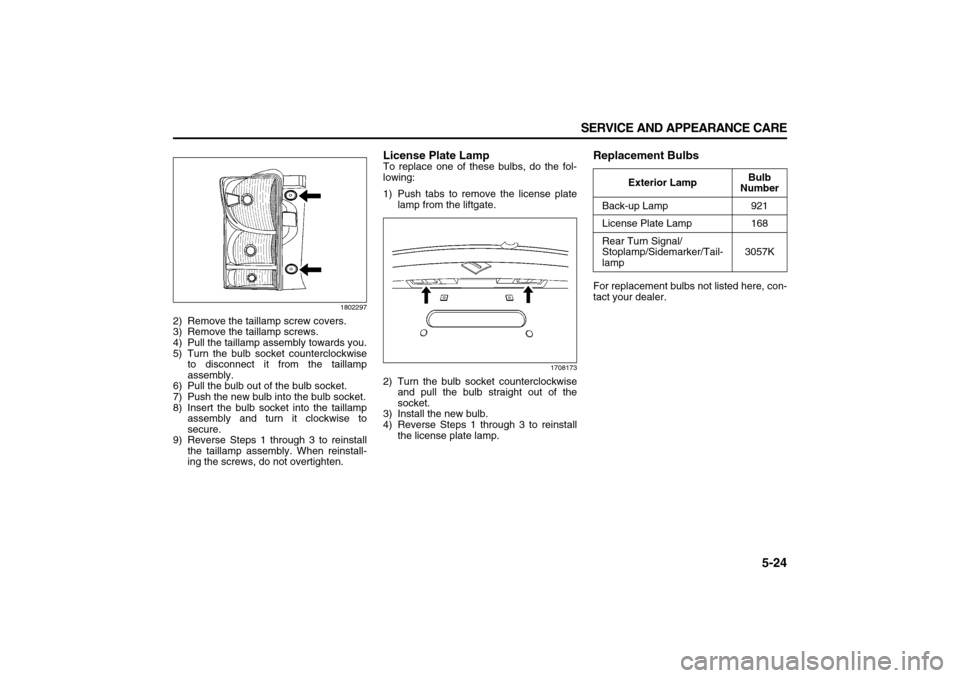
1802297
2) Remove the taillamp screw covers.
3) Remove the taillamp screws.
4) Pull the taillamp assembly towards you.
5) Turn the bulb socket counterclockwise
to disconnect it from the taillamp
assembly.
6) Pull the bulb out of the bulb socket.
7) Push the new bulb into the bulb socket.
8) Insert the bulb socket into the taillamp
assembly and turn it clockwise to
secure.
9) Reverse Steps 1 through 3 to reinstall
the taillamp assembly. When reinstall-
ing the screws, do not overtighten.
License Plate LampTo replace one of these bulbs, do the fol-
lowing:
1) Push tabs to remove the license plate
lamp from the liftgate.
1708173
2) Turn the bulb socket counterclockwise
and pull the bulb straight out of the
socket.
3) Install the new bulb.
4) Reverse Steps 1 through 3 to reinstall
the license plate lamp.
Replacement BulbsFor replacement bulbs not listed here, con-
tact your dealer.
Exterior LampBulb
Number
Back-up Lamp 921
License Plate Lamp 168
Rear Turn Signal/
Stoplamp/Sidemarker/Tail-
lamp3057K
Page 217 of 274
5-33 SERVICE AND APPEARANCE CARE
78J00-03E
The TPMS system is ready for the sen-
sor matching process to begin.
5) Start with the driver side front tire.
6) Remove the valve cap from the tire’s
valve stem. Activate the TPMS sensor
by increasing or decreasing the tire’s
air pressure for five seconds, or until a
horn chirp sounds. The horn chirp,
which may take up to 30 seconds to
sound, confirms that the sensor identifi-
cation code has been matched to the
tire/wheel position. To decrease the
tire’s air-pressure use the pointed end
of the valve cap, a pencil-style air pres-
sure gage, or a key.
7) Proceed to the passenger side front
tire, and repeat the procedure in Step 6.
8) Proceed to the passenger side rear tire,
and repeat the procedure in Step 6.
9) Proceed to the driver side rear tire, and
repeat the procedure in Step 6.
10)After hearing the confirming horn chirp
for the driver side rear tire, the tire
learning process ends. Turn the ignition
switch to LOCK.
11)Set all four tires to the recommended
air pressure level as indicated on the
tire and loading information label.
12)Put the valve caps back on the valve
stems.
Federal Communications Commission
(FCC) and Industry and Science Canada
The Tire Pressure Monitor System (TPMS)
operates on a radio frequency and com-
plies with Part 15 of the FCC Rules. Oper-ation is subject to the following two
conditions:
1) This device may not cause harmful
interference.
2) This device must accept any interfer-
ence received, including interference
that may cause undesired operation.
The Tire Pressure Monitor System (TPMS)
operates on a radio frequency and com-
plies with RSS-210 of Industry and Sci-
ence Canada. Operation is subject to the
following two conditions:
1) This device may not cause interfer-
ence.
2) This device must accept any interfer-
ence received, including interference
that may cause undesired operation of
the device.
Changes or modifications to this system by
other than an authorized service facility
could void authorization to use this equip-
ment.
Tire Inspection and RotationTires should be rotated every 5000 to 8000
miles (8000 to 13000 km).
Any time you notice unusual wear, rotate
your tires as soon as possible and check
wheel alignment. Also check for damaged
tires or wheels. Refer to “When It Is Time
for New Tires” and “Wheel Replacement”
in this section for more information.The purpose of regular rotation is to
achieve more uniform wear for all tires on
the vehicle. The first rotation is the most
important. Refer to “Scheduled Mainte-
nance” in “Maintenance Schedule” in the
“Maintenance Schedule” section for sched-
uled rotation intervals.
811106
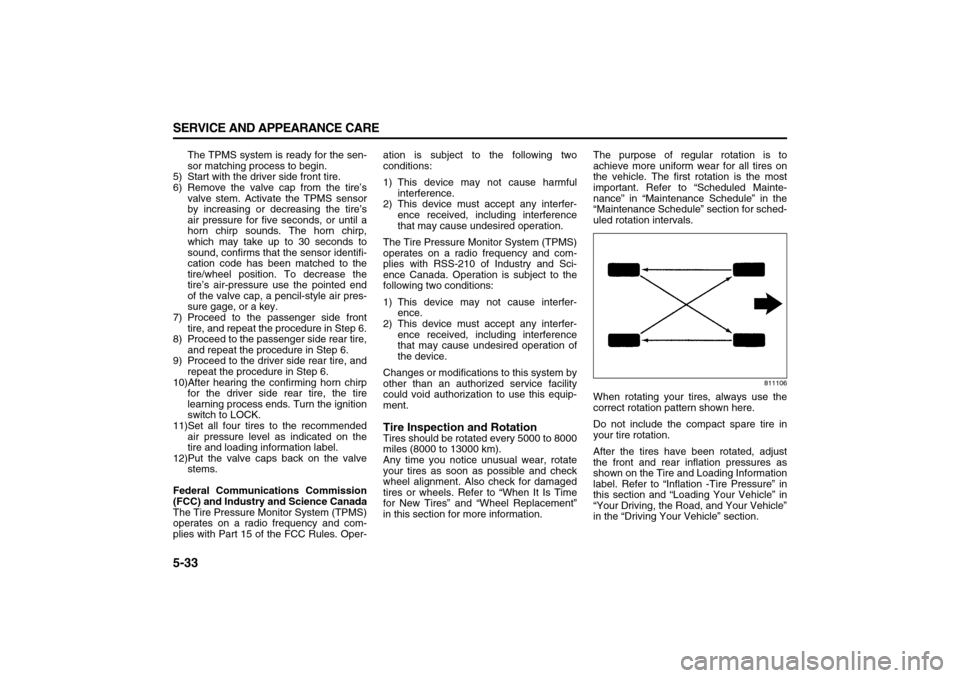
When rotating your tires, always use the
correct rotation pattern shown here.
Do not include the compact spare tire in
your tire rotation.
After the tires have been rotated, adjust
the front and rear inflation pressures as
shown on the Tire and Loading Information
label. Refer to “Inflation -Tire Pressure” in
this section and “Loading Your Vehicle” in
“Your Driving, the Road, and Your Vehicle”
in the “Driving Your Vehicle” section.
Page 219 of 274
5-35 SERVICE AND APPEARANCE CARE
78J00-03E
If you must replace your vehicle’s tires with
those that do not have a TPC Spec num-
ber, make sure they are the same size,
load range, speed rating, and construction
type (radial and bias-belted tires) as your
vehicle’s original tires.Vehicles that have a tire pressure monitor-
ing system may give an inaccurate low-
pressure warning if Non-TPC Spec rated
tires are installed on your vehicle. Non-
TPC Spec rated tires may give a low-pres-
sure warning that is higher or lower than
the proper warning level you would get
with TPC Spec rated tires. Refer to “Tire
Pressure Monitor System” in this section.
Your vehicle’s original equipment tires are
listed on the Tire and Loading Information
Label. This label is attached to the vehi-
cle’s center pillar (B-pillar). Refer to “Load-
ing Your Vehicle” in “Your Driving, the
Road, and Your Vehicle” in the “Driving
Your Vehicle” section, for more information
about the Tire and Loading Information
Label.
Different Size Tires and Wheels
If you add wheels or tires that are a differ-
ent size than your original equipment
wheels and tires, this may affect the way
your vehicle performs, including its brak-
ing, ride and handling characteristics, sta-
bility and resistance to rollover.
Additionally, if your vehicle has electronic
systems such as, anti-lock brakes, traction
control, and electronic stability control, the
performance of these systems can be
affected.Refer to “Buying New Tires” and “Accesso-
ries and Modifications” in this section for
additional information.
Uniform Tire Quality GradingQuality grades can be found where appli-
cable on the tire sidewall between tread
shoulder and maximum section width. For
example:
Treadwear 200 Traction AA Tempera-
ture A
The following information relates to the
system developed by the United States
National Highway Traffic Safety Adminis-
tration (NHTSA), which grades tires by
treadwear, traction, and temperature per-
formance. This applies only to vehicles
sold in the United States. The grades are
molded on the sidewalls of most passen-
ger car tires. The Uniform Tire Quality
Grading (UTQG) system does not apply to
WARNING
Mixing tires could cause you to lose
control while driving. If you mix tires
of different sizes, brands, or types
(radial and bias-belted tires), the
vehicle may not handle properly, and
you could have a crash. Using tires
of different sizes, brands, or types
may also cause damage to your vehi-
cle. Be sure to use the correct size,
brand, and type of tires on all wheels.
It is all right to drive with your com-
pact spare temporarily, as it was
developed for use on your vehicle.
Refer to “Compact Spare Tire” in this
section.
WARNING
If you use bias-ply tires on your vehi-
cle, the wheel rim flanges could
develop cracks after many miles of
driving. A tire and/or wheel could fail
suddenly, causing a crash. Use only
radial-ply tires with the wheels on
your vehicle.
WARNING
If you add different sized wheels,
your vehicle may not provide an
acceptable level of performance and
safety if tires not recommended for
those wheels are selected. You may
increase the chance that you will
crash and suffer serious injury. Only
use Suzuki specific wheel and tire
systems developed for your vehicle,
and have them properly installed by a
Suzuki certified technician.
Page 222 of 274
5-38 SERVICE AND APPEARANCE CARE
78J00-03E
If a front tire fails, the flat tire will create a
drag that pulls the vehicle toward that side.
Take your foot off the accelerator pedal
and grip the steering wheel firmly. Steer to
maintain lane position, and then gently
brake to a stop well out of the traffic lane.
A rear blowout, particularly on a curve,
acts much like a skid and may require the
same correction you would use in a skid. In
any rear blowout remove your foot from
the accelerator pedal. Get the vehicle
under control by steering the way you want
the vehicle to go. It may be very bumpy
and noisy, but you can still steer. Gently
brake to a stop, well off the road if possi-
ble.
If a tire goes flat, the next part shows how
to use the jacking equipment to change a
flat tire safely.
Changing a Flat TireIf a tire goes flat, avoid further tire and
wheel damage by driving slowly to a level
place. Turn on your vehicle’s hazard warn-
ing flashers. Refer to “Hazard Warning
Flashers” in “Instrument Panel Overview”
in the “Instrument Panel” section for more
information.
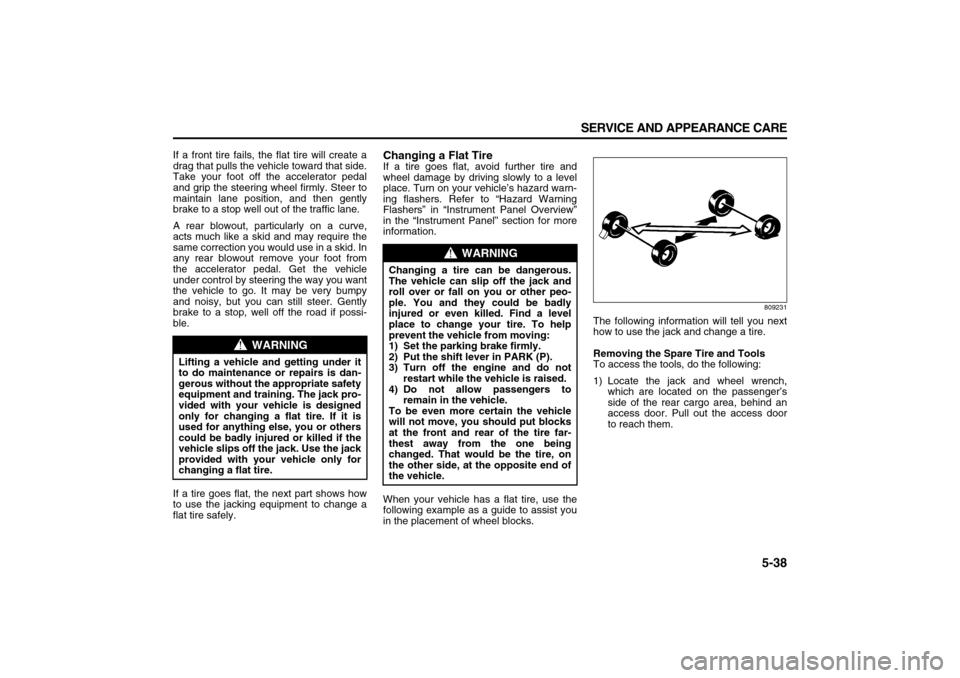
When your vehicle has a flat tire, use the
following example as a guide to assist you
in the placement of wheel blocks.
809231
The following information will tell you next
how to use the jack and change a tire.
Removing the Spare Tire and Tools
To access the tools, do the following:
1) Locate the jack and wheel wrench,
which are located on the passenger’s
side of the rear cargo area, behind an
access door. Pull out the access door
to reach them.
WARNING
Lifting a vehicle and getting under it
to do maintenance or repairs is dan-
gerous without the appropriate safety
equipment and training. The jack pro-
vided with your vehicle is designed
only for changing a flat tire. If it is
used for anything else, you or others
could be badly injured or killed if the
vehicle slips off the jack. Use the jack
provided with your vehicle only for
changing a flat tire.
WARNING
Changing a tire can be dangerous.
The vehicle can slip off the jack and
roll over or fall on you or other peo-
ple. You and they could be badly
injured or even killed. Find a level
place to change your tire. To help
prevent the vehicle from moving:
1) Set the parking brake firmly.
2) Put the shift lever in PARK (P).
3) Turn off the engine and do not
restart while the vehicle is raised.
4) Do not allow passengers to
remain in the vehicle.
To be even more certain the vehicle
will not move, you should put blocks
at the front and rear of the tire far-
thest away from the one being
changed. That would be the tire, on
the other side, at the opposite end of
the vehicle.
Page 223 of 274
5-39 SERVICE AND APPEARANCE CARE
78J00-03E
1399885
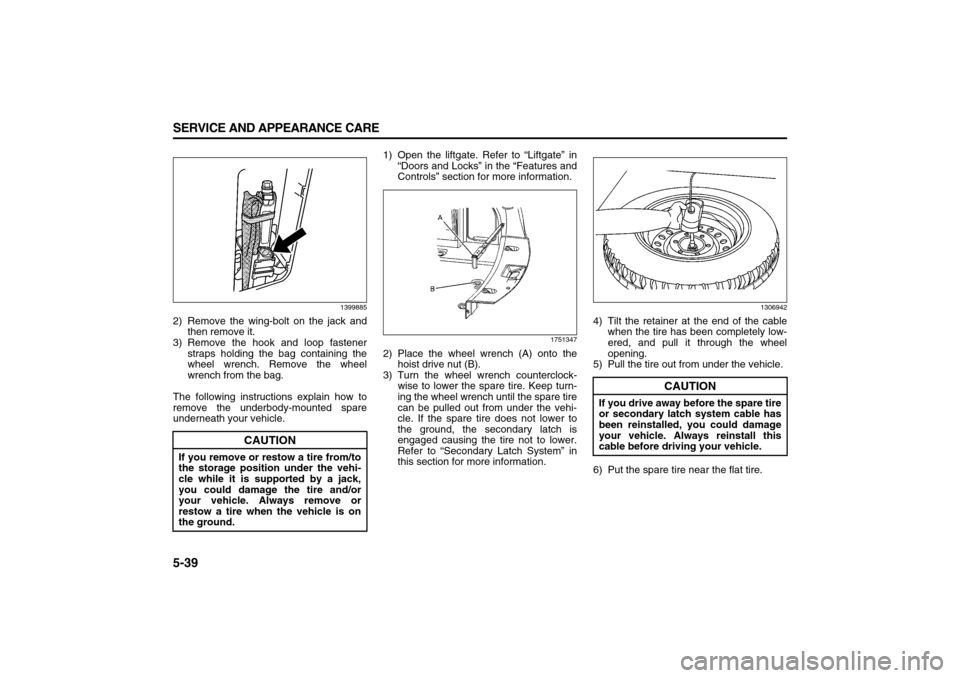
2) Remove the wing-bolt on the jack and
then remove it.
3) Remove the hook and loop fastener
straps holding the bag containing the
wheel wrench. Remove the wheel
wrench from the bag.
The following instructions explain how to
remove the underbody-mounted spare
underneath your vehicle.1) Open the liftgate. Refer to “Liftgate” in
“Doors and Locks” in the “Features and
Controls” section for more information.
1751347
2) Place the wheel wrench (A) onto the
hoist drive nut (B).
3) Turn the wheel wrench counterclock-
wise to lower the spare tire. Keep turn-
ing the wheel wrench until the spare tire
can be pulled out from under the vehi-
cle. If the spare tire does not lower to
the ground, the secondary latch is
engaged causing the tire not to lower.
Refer to “Secondary Latch System” in
this section for more information.
1306942
4) Tilt the retainer at the end of the cable
when the tire has been completely low-
ered, and pull it through the wheel
opening.
5) Pull the tire out from under the vehicle.
6) Put the spare tire near the flat tire.
CAUTION
If you remove or restow a tire from/to
the storage position under the vehi-
cle while it is supported by a jack,
you could damage the tire and/or
your vehicle. Always remove or
restow a tire when the vehicle is on
the ground.
CAUTION
If you drive away before the spare tire
or secondary latch system cable has
been reinstalled, you could damage
your vehicle. Always reinstall this
cable before driving your vehicle.