Button SUZUKI XL7 2007 2.G Owners Manual
[x] Cancel search | Manufacturer: SUZUKI, Model Year: 2007, Model line: XL7, Model: SUZUKI XL7 2007 2.GPages: 274, PDF Size: 6.12 MB
Page 16 of 274
1-4 SEATS AND RESTRAINT SYSTEMS
78J00-03E
Do not have a seatback reclined if your
vehicle is moving. Head Restraints
805677
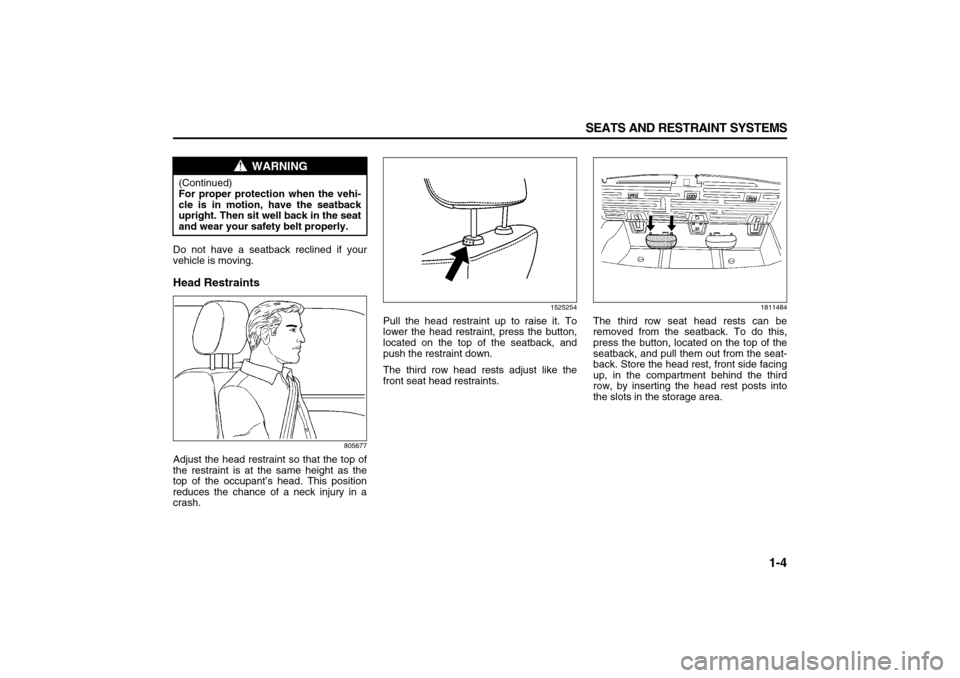
Adjust the head restraint so that the top of
the restraint is at the same height as the
top of the occupant’s head. This position
reduces the chance of a neck injury in a
crash.
1525254
Pull the head restraint up to raise it. To
lower the head restraint, press the button,
located on the top of the seatback, and
push the restraint down.
The third row head rests adjust like the
front seat head restraints.
1811484
The third row seat head rests can be
removed from the seatback. To do this,
press the button, located on the top of the
seatback, and pull them out from the seat-
back. Store the head rest, front side facing
up, in the compartment behind the third
row, by inserting the head rest posts into
the slots in the storage area.
WARNING
(Continued)
For proper protection when the vehi-
cle is in motion, have the seatback
upright. Then sit well back in the seat
and wear your safety belt properly.
Page 23 of 274
1-11 SEATS AND RESTRAINT SYSTEMS
78J00-03E
Question:
If I am a good driver, and I never drive
far from home, why should I wear safety
belts?
Answer:
You may be an excellent driver, but if you
are in an accident – even one that is not
your fault – you and your passengers can
be hurt. Being a good driver does not pro-
tect you from things beyond your control,
such as bad drivers.
Most accidents occur within 25 miles (40
km) of home. And the greatest number of
serious injuries and deaths occur at
speeds of less than 40 mph (65 km/h).
Safety belts are for everyone.How to Wear Safety Belts ProperlyThis part is only for people of adult size.
Be aware that there are special things to
know about safety belts and children. And
there are different rules for smaller children
and babies. If a child will be riding in your
vehicle, refer to “Older Children” or “Infants
and Young Children” in this section. Follow
those rules for everyone’s protection.
First, you will want to know which restraint
systems your vehicle has.
We will start with the driver position.
Driver PositionLap-Shoulder Belt
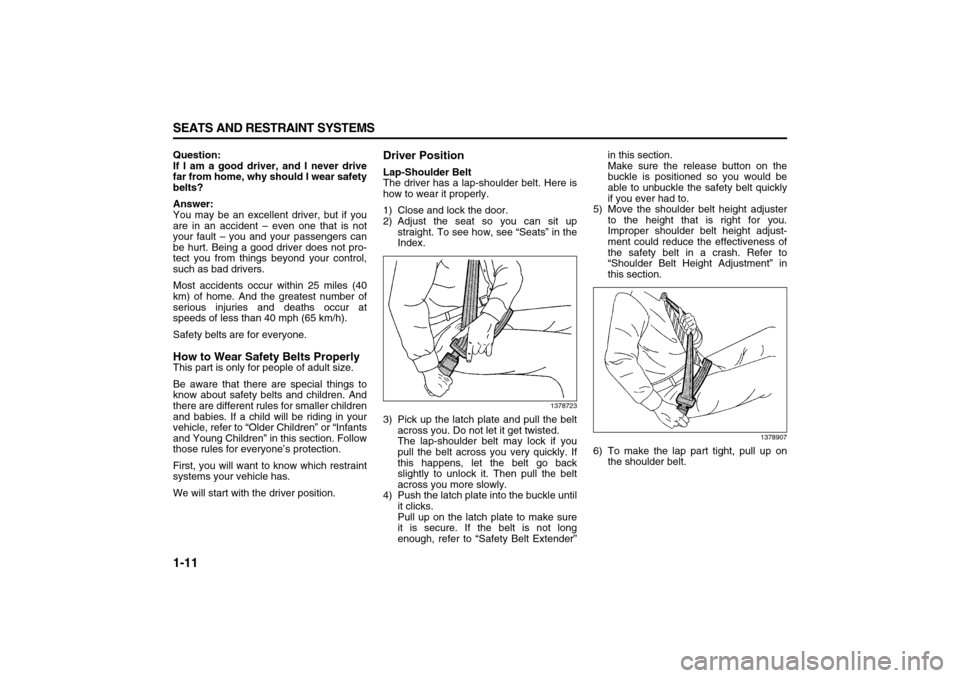
The driver has a lap-shoulder belt. Here is
how to wear it properly.
1) Close and lock the door.
2) Adjust the seat so you can sit up
straight. To see how, see “Seats” in the
Index.
1378723
3) Pick up the latch plate and pull the belt
across you. Do not let it get twisted.
The lap-shoulder belt may lock if you
pull the belt across you very quickly. If
this happens, let the belt go back
slightly to unlock it. Then pull the belt
across you more slowly.
4) Push the latch plate into the buckle until
it clicks.
Pull up on the latch plate to make sure
it is secure. If the belt is not long
enough, refer to “Safety Belt Extender”in this section.
Make sure the release button on the
buckle is positioned so you would be
able to unbuckle the safety belt quickly
if you ever had to.
5) Move the shoulder belt height adjuster
to the height that is right for you.
Improper shoulder belt height adjust-
ment could reduce the effectiveness of
the safety belt in a crash. Refer to
“Shoulder Belt Height Adjustment” in
this section.
1378907
6) To make the lap part tight, pull up on
the shoulder belt.
Page 26 of 274
1-14 SEATS AND RESTRAINT SYSTEMS
78J00-03E
1378915
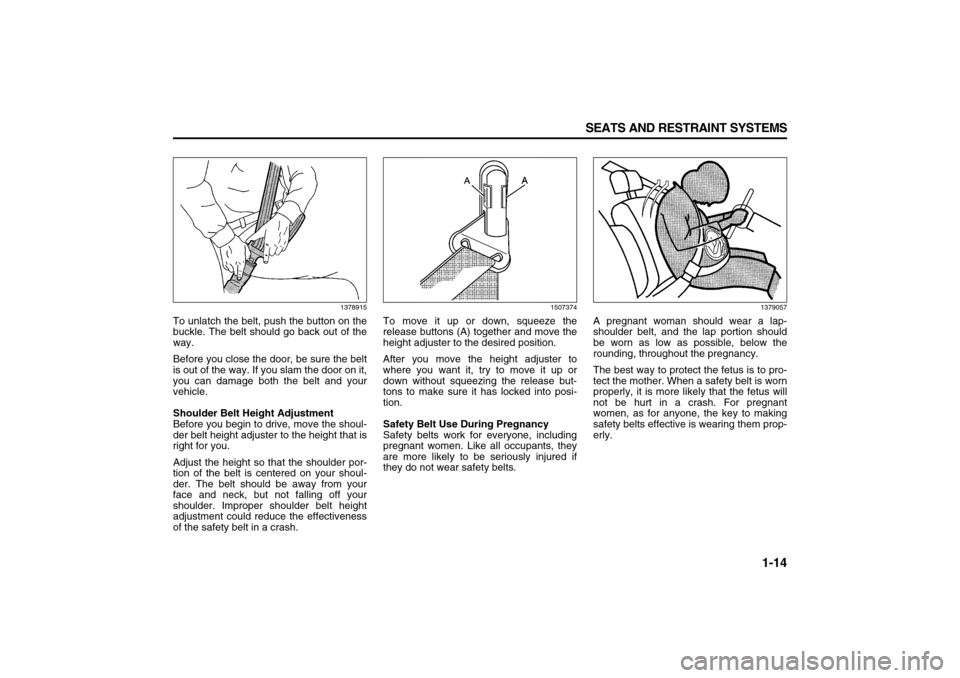
To unlatch the belt, push the button on the
buckle. The belt should go back out of the
way.
Before you close the door, be sure the belt
is out of the way. If you slam the door on it,
you can damage both the belt and your
vehicle.
Shoulder Belt Height Adjustment
Before you begin to drive, move the shoul-
der belt height adjuster to the height that is
right for you.
Adjust the height so that the shoulder por-
tion of the belt is centered on your shoul-
der. The belt should be away from your
face and neck, but not falling off your
shoulder. Improper shoulder belt height
adjustment could reduce the effectiveness
of the safety belt in a crash.
1507374
To move it up or down, squeeze the
release buttons (A) together and move the
height adjuster to the desired position.
After you move the height adjuster to
where you want it, try to move it up or
down without squeezing the release but-
tons to make sure it has locked into posi-
tion.
Safety Belt Use During Pregnancy
Safety belts work for everyone, including
pregnant women. Like all occupants, they
are more likely to be seriously injured if
they do not wear safety belts.
1379057
A pregnant woman should wear a lap-
shoulder belt, and the lap portion should
be worn as low as possible, below the
rounding, throughout the pregnancy.
The best way to protect the fetus is to pro-
tect the mother. When a safety belt is worn
properly, it is more likely that the fetus will
not be hurt in a crash. For pregnant
women, as for anyone, the key to making
safety belts effective is wearing them prop-
erly.
Page 27 of 274
1-15 SEATS AND RESTRAINT SYSTEMS
78J00-03E
Right Front Passenger PositionTo learn how to wear the right front pas-
senger’s safety belt properly, refer to
“Driver Position” in this section.
The right front passenger’s safety belt
works the same way as the driver’s safety
belt – except for the following.
If you ever pull the shoulder portion of the
belt out all the way, you will engage the
child restraint locking feature. If this hap-
pens, just let the belt go back all the way
and start again.
When the safety belt is not in use, slide the
latch plate up the safety belt webbing. The
latch plate should rest on the stitching on
the safety belt, near the guide loop.Rear Seat PassengersIt is very important for rear seat passen-
gers to buckle up! Accident statistics show
that unbelted people in the rear seat are
hurt more often in crashes than those who
are wearing safety belts.
Rear passengers who are not safety belted
can be thrown out of the vehicle in a crash.
And they can strike others in the vehicle
who are wearing safety belts.
Lap-Shoulder Belt
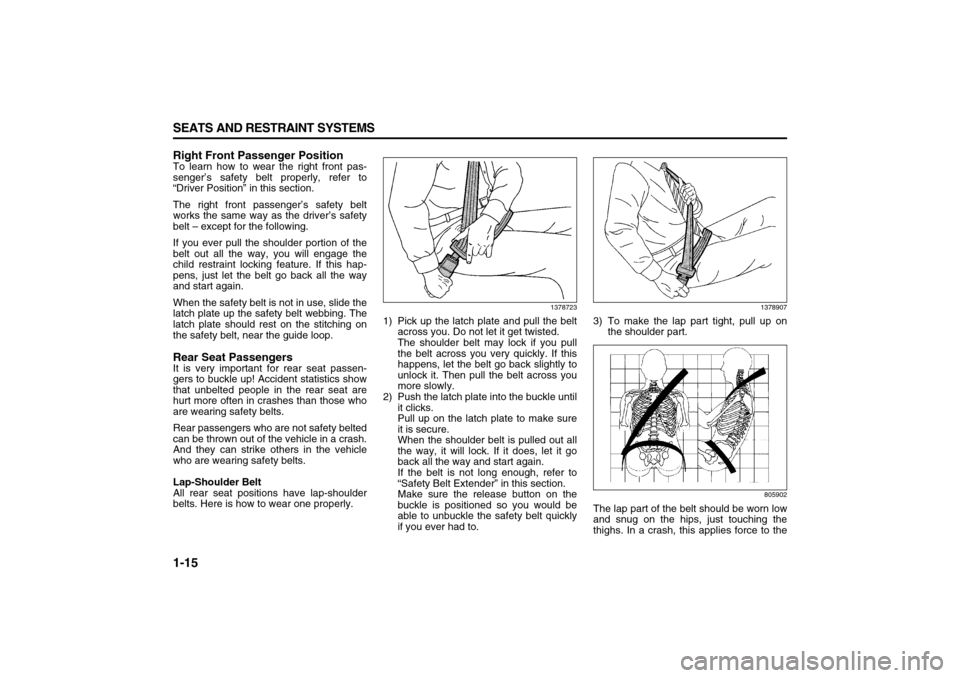
All rear seat positions have lap-shoulder
belts. Here is how to wear one properly.
1378723
1) Pick up the latch plate and pull the belt
across you. Do not let it get twisted.
The shoulder belt may lock if you pull
the belt across you very quickly. If this
happens, let the belt go back slightly to
unlock it. Then pull the belt across you
more slowly.
2) Push the latch plate into the buckle until
it clicks.
Pull up on the latch plate to make sure
it is secure.
When the shoulder belt is pulled out all
the way, it will lock. If it does, let it go
back all the way and start again.
If the belt is not long enough, refer to
“Safety Belt Extender” in this section.
Make sure the release button on the
buckle is positioned so you would be
able to unbuckle the safety belt quickly
if you ever had to.
1378907
3) To make the lap part tight, pull up on
the shoulder part.
805902
The lap part of the belt should be worn low
and snug on the hips, just touching the
thighs. In a crash, this applies force to the
Page 28 of 274
1-16 SEATS AND RESTRAINT SYSTEMS
78J00-03E
strong pelvic bones. And you would be
less likely to slide under the lap belt. If you
slid under it, the belt would apply force at
your abdomen. This could cause serious
or even fatal injuries. The shoulder belt
should go over the shoulder and across
the chest. These parts of the body are best
able to take belt restraining forces.
The safety belt locks if there is a sudden
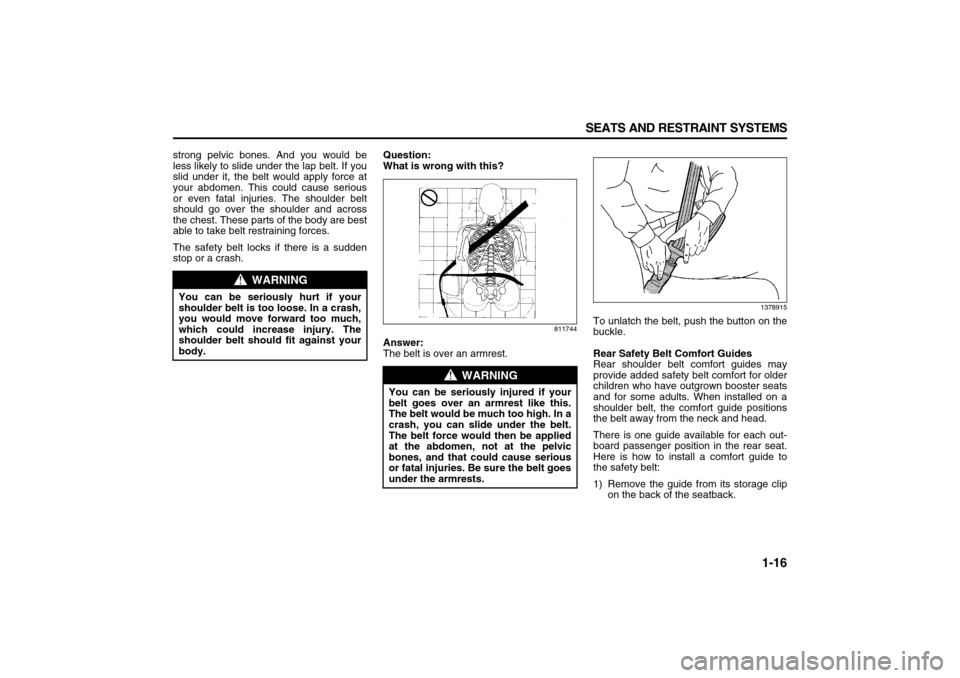
stop or a crash.Question:
What is wrong with this?
811744
Answer:
The belt is over an armrest.
1378915
To unlatch the belt, push the button on the
buckle.
Rear Safety Belt Comfort Guides
Rear shoulder belt comfort guides may
provide added safety belt comfort for older
children who have outgrown booster seats
and for some adults. When installed on a
shoulder belt, the comfort guide positions
the belt away from the neck and head.
There is one guide available for each out-
board passenger position in the rear seat.
Here is how to install a comfort guide to
the safety belt:
1) Remove the guide from its storage clip
on the back of the seatback.
WARNING
You can be seriously hurt if your
shoulder belt is too loose. In a crash,
you would move forward too much,
which could increase injury. The
shoulder belt should fit against your
body.
WARNING
You can be seriously injured if your
belt goes over an armrest like this.
The belt would be much too high. In a
crash, you can slide under the belt.
The belt force would then be applied
at the abdomen, not at the pelvic
bones, and that could cause serious
or fatal injuries. Be sure the belt goes
under the armrests.
Page 42 of 274
1-30 SEATS AND RESTRAINT SYSTEMS
78J00-03E
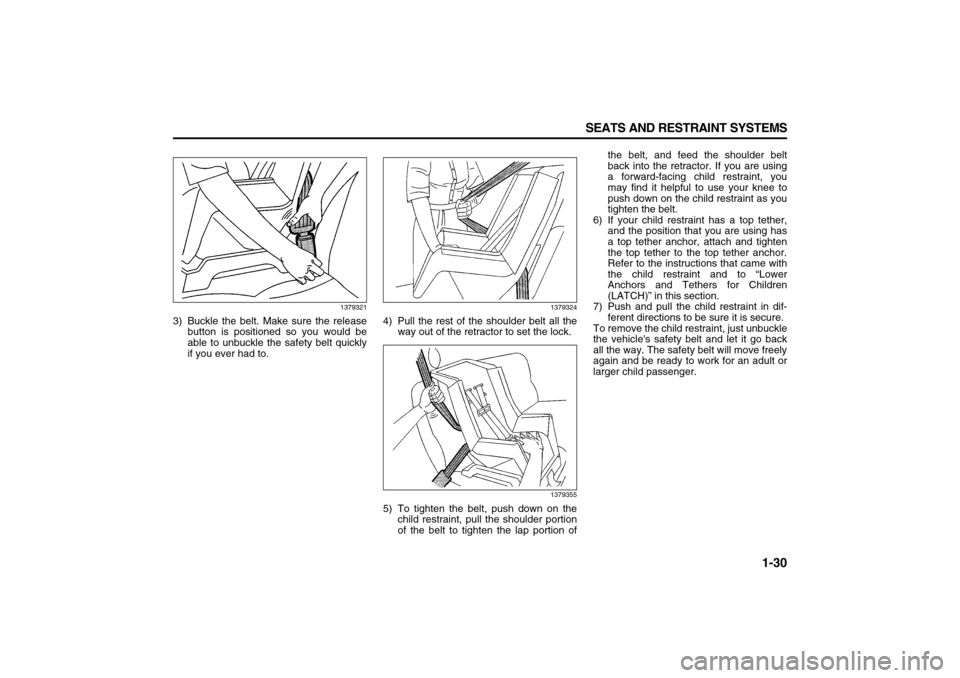
1379321
3) Buckle the belt. Make sure the release
button is positioned so you would be
able to unbuckle the safety belt quickly
if you ever had to.
1379324
4) Pull the rest of the shoulder belt all the
way out of the retractor to set the lock.
1379355
5) To tighten the belt, push down on the
child restraint, pull the shoulder portion
of the belt to tighten the lap portion ofthe belt, and feed the shoulder belt
back into the retractor. If you are using
a forward-facing child restraint, you
may find it helpful to use your knee to
push down on the child restraint as you
tighten the belt.
6) If your child restraint has a top tether,
and the position that you are using has
a top tether anchor, attach and tighten
the top tether to the top tether anchor.
Refer to the instructions that came with
the child restraint and to “Lower
Anchors and Tethers for Children
(LATCH)” in this section.
7) Push and pull the child restraint in dif-
ferent directions to be sure it is secure.
To remove the child restraint, just unbuckle
the vehicle's safety belt and let it go back
all the way. The safety belt will move freely
again and be ready to work for an adult or
larger child passenger.
Page 44 of 274
1-32 SEATS AND RESTRAINT SYSTEMS
78J00-03E
restraint. Refer to “Manual Seats” in this
section.
If your child restraint has the LATCH sys-
tem, refer to “Lower Anchors and Tethers
for Children (LATCH)” in this section.
There is no top tether anchor at the right
front seating position. Do not secure a
child seat in this position if a national or
local law requires that the top tether be
anchored or if the instructions that come
with the child restraint say that the top
tether must be anchored. Refer to “Lower
Anchors and Tethers for Children
(LATCH)” in this section if the child
restraint has a top tether.
You will be using the lap-shoulder belt to
secure the child restraint in this position.
Be sure to follow the instructions that came
with the child restraint. Secure the child in
the child restraint when and as the instruc-
tions say.
1) Your vehicle has a right front passen-
ger’s frontal airbag. Refer to “Passen-
ger Sensing System” in this section. We
recommend that rear-facing child
restraints be secured in a rear seat,
even if the airbag is off. If your child
restraint is for ward-facing, move the
seat as far back as it will go before
securing the child restraint in this seat.
Refer to “Manual Seats” in this section.
When the passenger sensing system
has turned off the right front passen-ger’s frontal airbag, the off indicator in
the passenger airbag status indicator
should light and stay lit when you turn
the ignition to RUN or START. Refer to
“Passenger Airbag Status Indicator” in
“Warning Lights, Gages, and Indica-
tors” in the “Instrument Panel” section.
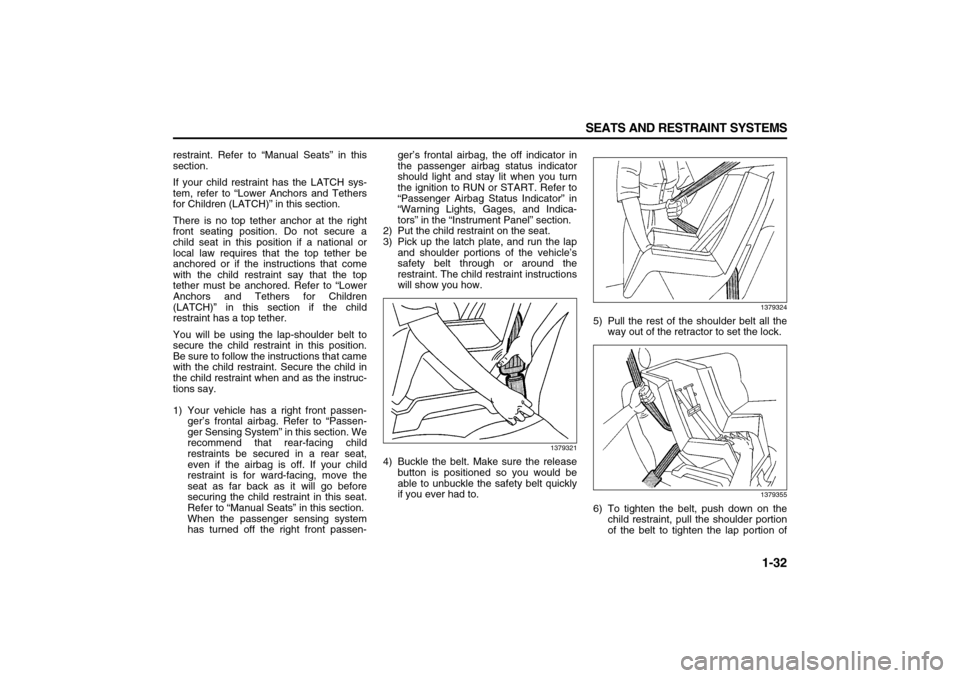
2) Put the child restraint on the seat.
3) Pick up the latch plate, and run the lap
and shoulder portions of the vehicle’s
safety belt through or around the
restraint. The child restraint instructions
will show you how.
1379321
4) Buckle the belt. Make sure the release
button is positioned so you would be
able to unbuckle the safety belt quickly
if you ever had to.
1379324
5) Pull the rest of the shoulder belt all the
way out of the retractor to set the lock.
1379355
6) To tighten the belt, push down on the
child restraint, pull the shoulder portion
of the belt to tighten the lap portion of
Page 58 of 274
2-2 FEATURES AND CONTROLS
78J00-03E
Remote Keyless Entry (RKE)
System OperationThe vehicle’s doors can be locked and
unlocked from about 3 feet (1 m) up to 65
feet (20 m) away with the Remote Keyless
Entry (RKE) transmitter.
If your vehicle has the remote start feature
you can also start your vehicle with the
RKE transmitter. Your RKE transmitter,
with the remote start button, provides an
increased range of 195 feet (60 m) away.
However, the range may be less while the
vehicle is running. As a result, you may
need to be closer to your vehicle to turn it
off than you were to turn it on.
There are other conditions which can
affect the performance of the transmitter.
Refer to “Remote Keyless Entry (RKE)
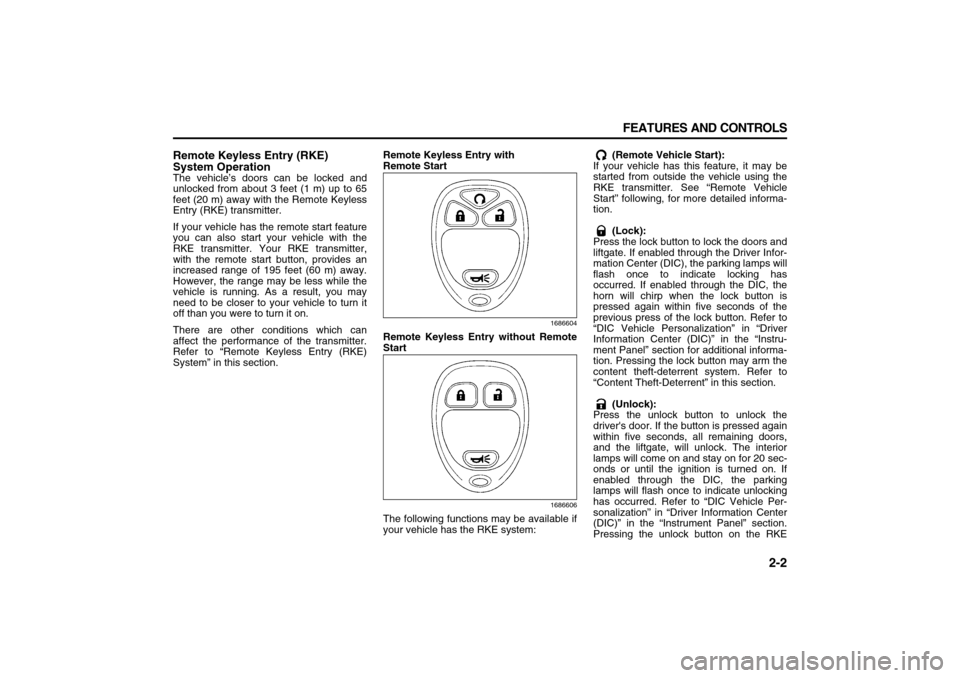
System” in this section.Remote Keyless Entry with
Remote Start
1686604
Remote Keyless Entry without Remote
Start
1686606
The following functions may be available if
your vehicle has the RKE system: (Remote Vehicle Start):
If your vehicle has this feature, it may be
started from outside the vehicle using the
RKE transmitter. See “Remote Vehicle
Start” following, for more detailed informa-
tion.
(Lock):
Press the lock button to lock the doors and
liftgate. If enabled through the Driver Infor-
mation Center (DIC), the parking lamps will
flash once to indicate locking has
occurred. If enabled through the DIC, the
horn will chirp when the lock button is
pressed again within five seconds of the
previous press of the lock button. Refer to
“DIC Vehicle Personalization” in “Driver
Information Center (DIC)” in the “Instru-
ment Panel” section for additional informa-
tion. Pressing the lock button may arm the
content theft-deterrent system. Refer to
“Content Theft-Deterrent” in this section.
(Unlock):
Press the unlock button to unlock the
driver's door. If the button is pressed again
within five seconds, all remaining doors,
and the liftgate, will unlock. The interior
lamps will come on and stay on for 20 sec-
onds or until the ignition is turned on. If
enabled through the DIC, the parking
lamps will flash once to indicate unlocking
has occurred. Refer to “DIC Vehicle Per-
sonalization” in “Driver Information Center
(DIC)” in the “Instrument Panel” section.
Pressing the unlock button on the RKE
Page 59 of 274
2-3 FEATURES AND CONTROLS
78J00-03E
transmitter will disarm the content theft-
deterrent system. Refer to “Content Theft-
Deterrent” in this section.
(Vehicle Locator/Panic Alarm):
Press and release this button to locate
your vehicle. The turn signal lamps will
flash and the horn will sound three times.
Press and hold this button for more than
two seconds to activate the panic alarm.
The turn signal lamps will flash and the
horn will sound repeatedly for 30 seconds.
The alarm will turn off when the ignition is
moved to RUN or the alarm button is
pressed again. The ignition must be in
LOCK for the panic alarm to work.
The RKE transmitter is used to arm/disarm
the content theft-deterrent system. Your
vehicle’s theft-deterrent system can be
programmed to three different modes.
Refer to “Content Theft-Deterrent” in this
section.
If you accidentally set off the alarm when
entering or exiting the vehicle, you can
shut it off by pressing the lock or unlock
button once or the panic alarm button
twice.
Matching Transmitter(s) to Your Vehicle
Each RKE transmitter is coded to prevent
another transmitter from unlocking your
vehicle. If a transmitter is lost or stolen, a
replacement can be purchased through
your dealer. Remember to bring any addi-
tional transmitters so they can also be re-coded to match the new transmitter. Once
your dealer has coded the new transmitter,
the lost transmitter will not unlock your
vehicle. The vehicle can have a maximum
of four transmitters matched to it. Or, refer
to “Relearn Remote Key” under “DIC Oper-
ation and Displays” in “Driver Information
Center (DIC)” in the “Instrument Panel”
section for instructions on how to match
RKE transmitters to your vehicle.
Battery Replacement
Under normal use, the battery in your RKE
transmitter should last about four years.
The battery is weak if the transmitter will
not work at the normal range in any loca-
tion. If you have to get close to your vehi-
cle before the transmitter works, it is
probably time to change the battery.
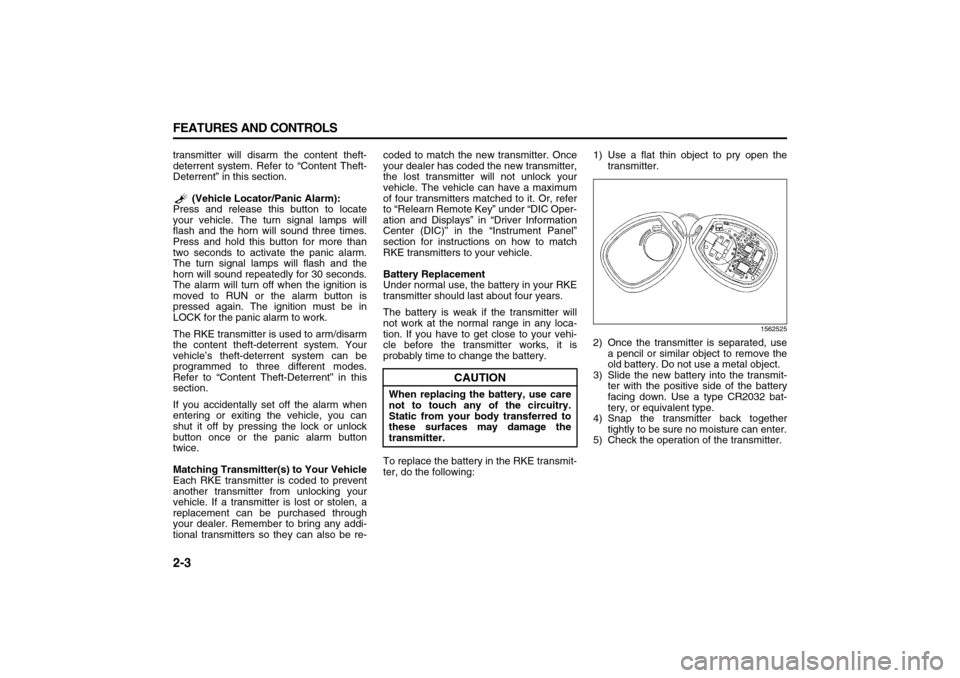
To replace the battery in the RKE transmit-
ter, do the following:1) Use a flat thin object to pry open the
transmitter.
1562525
2) Once the transmitter is separated, use
a pencil or similar object to remove the
old battery. Do not use a metal object.
3) Slide the new battery into the transmit-
ter with the positive side of the battery
facing down. Use a type CR2032 bat-
tery, or equivalent type.
4) Snap the transmitter back together
tightly to be sure no moisture can enter.
5) Check the operation of the transmitter.
CAUTION
When replacing the battery, use care
not to touch any of the circuitry.
Static from your body transferred to
these surfaces may damage the
transmitter.
Page 60 of 274

2-4 FEATURES AND CONTROLS
78J00-03E
Remote Vehicle StartYour vehicle may have the remote start
feature. This feature allows you to start the
engine from outside the vehicle. Refer to
“REMOTE START” under “DIC Vehicle
Personalization” in “Driver Information
Center (DIC)” in the “Instrument Panel”
section for instructions on how to enable
and disable this feature.
During a remote start, the climate control
system will turn on at the fan, temperature,
and mode settings the vehicle was set to
when the vehicle was last turned off and
will also turn on the rear window defogger.
Laws in some local communities may
restrict the use of remote starters. For
example, some laws may require a person
using remote start to have the vehicle in
view when doing so. Check local regula-
tions for any requirements on remote start-
ing of vehicles.
(Remote Vehicle Start):
Press and release the lock button and then
press and hold the remote start button to
start the vehicle.
Your RKE transmitter, with the remote start
button, provides an increased range of
operation. However, the range may be less
while the vehicle is running. As a result,
you may need to be closer to your vehicle
to turn it off, than you were to turn it on.If your vehicle is low on fuel, do not use the
remote start feature. The vehicle may run
out of fuel.
To start the engine using the remote start
feature, do the following:
1) Aim the RKE transmitter, that has a
remote vehicle start button, at the vehi-
cle.
2) Press and release the transmitter’s lock
button, then immediately press and
hold the remote vehicle start button
until the vehicle’s turn signal lamps
flash, or for at least four seconds, if the
vehicle’s lights are not visible. The vehi-
cle’s doors will be locked. Pressing the
remote start button again after the vehi-
cle has started will turn off the ignition.
3) When the vehicle’s engine starts, the
parking lamps will turn on and remain
on while the engine is running.
4) If it is your first remote start since last
driving, repeat these steps while the
engine is still running for a 10 minute
time extension.
When you enter the vehicle during a
remote start, and the engine is still running,
turn the key to the RUN position to drive
the vehicle
.After a remote start, the engine will auto-
matically shut off after 10 minutes unless a
time extension has been done or the vehi-
cle’s key is inserted into the ignition switch
and turned to RUN.The maximum number of remote starts or
remote start attempts between ignition
cycles with the key is two.
If the remote start procedure is used again
before the first 10 minute time frame has
ended, the first 10 minutes will immediately
expire and the second 10 minute time
frame will start.
For example, if the lock button and then
the remote start buttons are pressed again
after the vehicle has been running for five
minutes, 10 minutes are added, allowing
the engine to run for 15 minutes.
After your vehicle’s engine has been
started two times using the remote vehicle
start button, the vehicle’s ignition switch
must be turned to RUN and then back to
LOCK using the key before the remote
start procedure can be used again.
If you enter the vehicle after a remote start,
and the engine is running, insert the key
into the ignition switch and turn it to the
RUN position to drive the vehicle.
To manually shut off the engine after a
remote start, do any of the following:
Aim the RKE transmitter at the vehicle
and press the remote start button until
the parking lamps turn off.
Turn on the hazard warning flashers.
Insert the vehicle’s key into the ignition
switch and turn the switch to RUN and
then back to LOCK.