steering TATA SAFARI 2015 User Guide
[x] Cancel search | Manufacturer: TATA, Model Year: 2015, Model line: SAFARI, Model: TATA SAFARI 2015Pages: 161, PDF Size: 2.55 MB
Page 29 of 161
29
D R I V I N G C O N T R O L SSTEERING L STEERING LSTEERING L STEERING L
STEERING L
OCK & IGNITION SWIT OCK & IGNITION SWITOCK & IGNITION SWIT OCK & IGNITION SWIT
OCK & IGNITION SWIT
CH CHCH CH
CH
Steering Lock and Ignition Switch Steering Lock and Ignition SwitchSteering Lock and Ignition Switch Steering Lock and Ignition Switch
Steering Lock and Ignition Switch
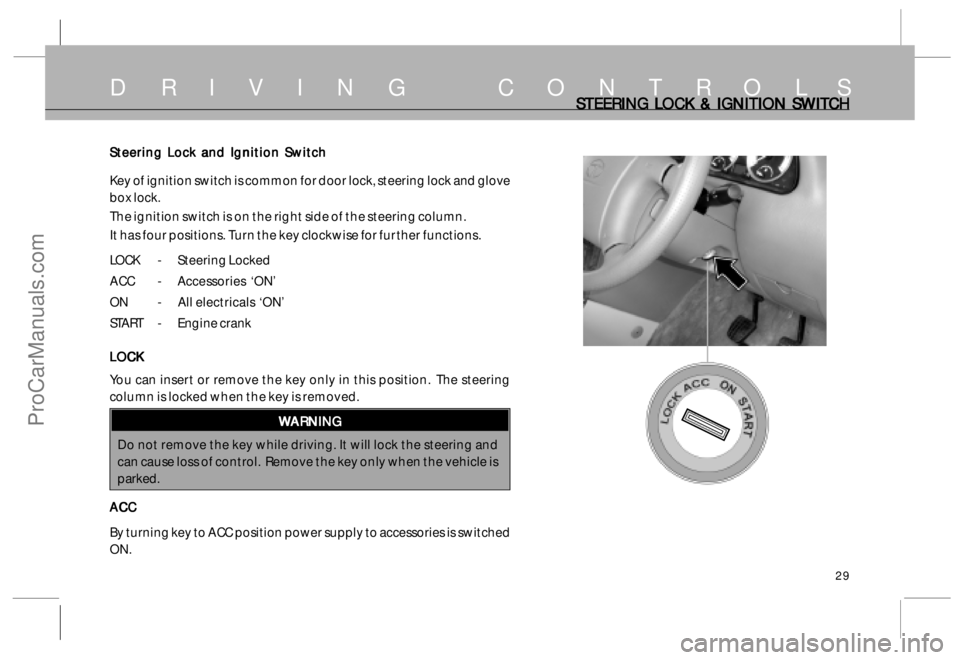
Key of ignition switch is common for door lock, steering lock and glove
box lock.
The ignition switch is on the right side of the steering column.
It has four positions. Turn the key clockwise for further functions.
LOCK - Steering Locked
ACC - Accessories ‘ON’
ON - All electricals ‘ON’
START - Engine crank
LOCK LOCKLOCK LOCK
LOCK
You can insert or remove the key only in this position. The steering
column is locked when the key is removed.
W WW W
W
ARNING ARNINGARNING ARNING
ARNING
Do not remove the key while driving. It will lock the steering and
can cause loss of control. Remove the key only when the vehicle is
parked.
ACC ACCACC ACC
ACC
By turning key to ACC position power supply to accessories is switched
ON.
ProCarManuals.com
Page 30 of 161
30
D R I V I N G C O N T R O L S
ON ONON ON
ON
By turning key to this position all the remaining electrical systems
become operative. The glow plug indicator lights up. After a few seconds
depending on the ambient temperature it goes off. The engine is ready
for cranking.
ST STST ST
ST
AR ARAR AR
AR
T TT T
T
Turn the key further clockwise to the START position (spring loaded) to
start the engine. As soon as the engine starts release the ignition key to
ON position.
NOTICE NOTICENOTICE NOTICE
NOTICE
Do not crank the engine more than 10 secs. continuously. If the
engine does not start wait for 30 secs. before cranking it again.
Release the key immediately after starting the engine otherwise
starter motor/ flywheel ring may get damaged.
By turning the ignition key from ON position to ACC or LOCK position,
engine can be stopped.
STEERING L STEERING LSTEERING L STEERING L
STEERING L
OCK AND IGNITION SWIT OCK AND IGNITION SWITOCK AND IGNITION SWIT OCK AND IGNITION SWIT
OCK AND IGNITION SWIT
CH CHCH CH
CH
ProCarManuals.com
Page 37 of 161
37
D R I V I N G C O N T R O L SSTEERING STEERING STEERING STEERING
STEERING
WHEEL POSITION ADJUST WHEEL POSITION ADJUSTWHEEL POSITION ADJUST WHEEL POSITION ADJUST
WHEEL POSITION ADJUST
MENT MENTMENT MENT
MENT
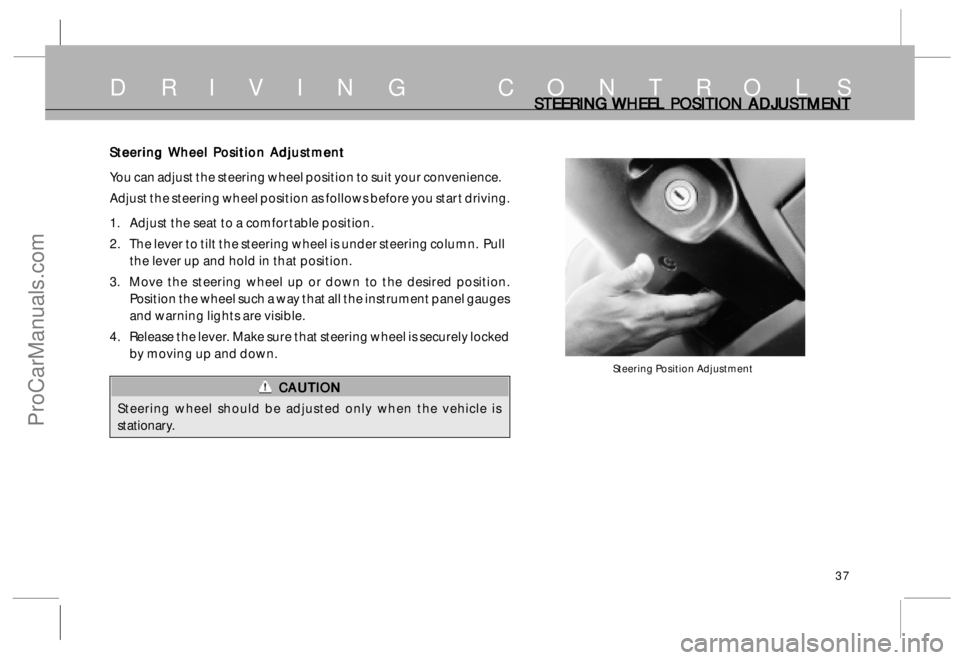
Steering Position Adjustment
Steering Wheel Position Adjustment Steering Wheel Position AdjustmentSteering Wheel Position Adjustment Steering Wheel Position Adjustment
Steering Wheel Position Adjustment
You can adjust the steering wheel position to suit your convenience.
Adjust the steering wheel position as follows before you start driving.
1. Adjust the seat to a comfortable position.
2. The lever to tilt the steering wheel is under steering column. Pull
the lever up and hold in that position.
3. Move the steering wheel up or down to the desired position.
Position the wheel such a way that all the instrument panel gauges
and warning lights are visible.
4. Release the lever. Make sure that steering wheel is securely locked
by moving up and down.
CAUTION CAUTIONCAUTION CAUTION
CAUTION
Steering wheel should be adjusted only when the vehicle is
stationary.
ProCarManuals.com
Page 71 of 161
71
P R I O R T O D R I V I N GCHECKS CHECKSCHECKS CHECKS
CHECKS
CHECK CHECKCHECK CHECK
CHECK
•Fuel level (Refer page No. 72)
•Coolant level (Refer page No. 73)
•Engine oil level (Refer page No. 72)
•Tyre pressure (Refer page No. 124)
•Brake & clutch fluid level
(Refer page No. 115)
ENSURE ENSUREENSURE ENSURE
ENSURE
•Gear shift lever in neutral
position
•All switches & lamps working
•SRS, ABS , Brake fluidlevel indicator
and Engine lamp goes off
•Parking brake released
ADJUST ADJUSTADJUST ADJUST
ADJUST
•Driver Seat (Refer page No. 56)
•Rear view mirrors (Refer page No. 60 & 63)
•Steering column (Refer page No. 37)
ProCarManuals.com
Page 76 of 161
76
D R I V I N GST STST ST
ST
AR ARAR AR
AR
TING AND ST TING AND STTING AND ST TING AND ST
TING AND ST
OPPING OPPING OPPING OPPING
OPPING
THE ENGINE THE ENGINETHE ENGINE THE ENGINE
THE ENGINE
Starting the Engine Starting the EngineStarting the Engine Starting the Engine
Starting the Engine
Before starting
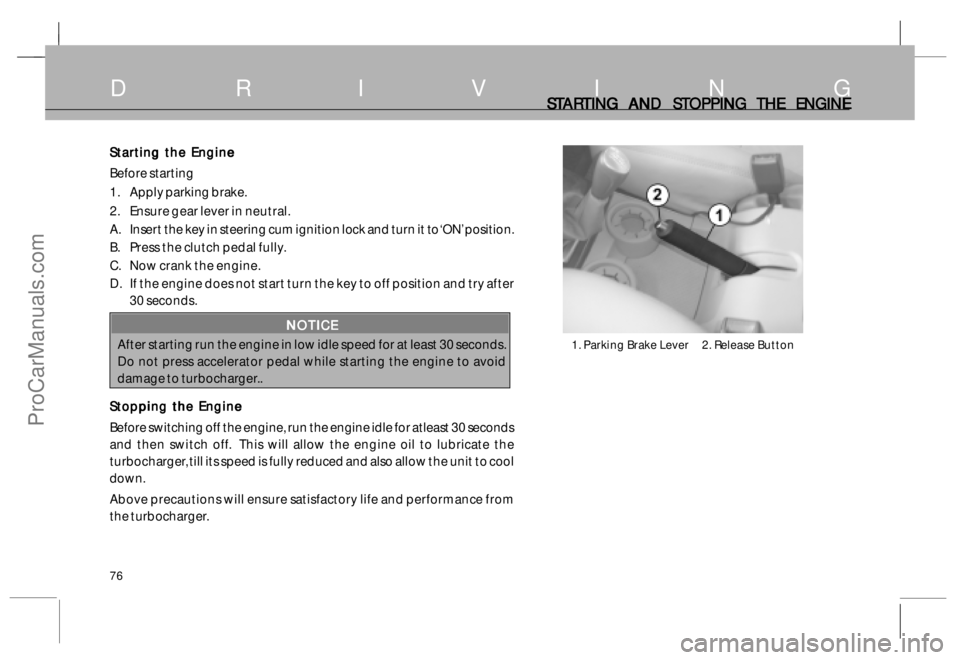
1. Apply parking brake.
2. Ensure gear lever in neutral.
A. Insert the key in steering cum ignition lock and turn it to ‘ON’ position.
B. Press the clutch pedal fully.
C. Now crank the engine.
D. If the engine does not start turn the key to off position and try after
30 seconds.
NOTICE NOTICENOTICE NOTICE
NOTICE
After starting run the engine in low idle speed for at least 30 seconds.
Do not press accelerator pedal while starting the engine to avoid
damage to turbocharger..
Stopping the Engine Stopping the EngineStopping the Engine Stopping the Engine
Stopping the Engine
Before switching off the engine, run the engine idle for atleast 30 seconds
and then switch off. This will allow the engine oil to lubricate the
turbocharger, till its speed is fully reduced and also allow the unit to cool
down.
Above precautions will ensure satisfactory life and performance from
the turbocharger.1. Parking Brake Lever 2. Release Button
ProCarManuals.com
Page 77 of 161
77
D R I V I N GPREP PREPPREP PREP
PREP
ARING ARING ARING ARING
ARING
T TT T
T
O DRIVE & R O DRIVE & RO DRIVE & R O DRIVE & R
O DRIVE & R
UNNING IN PERIOD UNNING IN PERIODUNNING IN PERIOD UNNING IN PERIOD
UNNING IN PERIOD
Preparing to Drive Preparing to DrivePreparing to Drive Preparing to Drive
Preparing to Drive
The following checks and adjustments should be done
before you start driving the vehicle.
1 . Ensure all mirrors, windows and outside lights are clean
and unobstructed. Remove dust, frost, snow or ice if
any, on these.
2 . Ensure bonnet is fully closed.
3 . Check that any items you may be carrying inside with
you are stored properly or fastened down securely.
4 . Check adjustment of seat. If required adjust to your
convenience.
5 . Check adjustment of all rear view mirrors.
6 . Check adjustment of steering wheel.
7 . If the doors are not properly closed you will get a audio
warning/indicator light as soon as you insert the ignition
key in the switch. Make sure all doors are properly closed
and locked.
8 . If the seat belts of driver & co-driver are not fastened you
will get an audio warning as soon as you turn the key to
ignition position. Fasten your seat belt, ensure co-driver
seat passenger has also fastened the seat belt (see
Your Safety).9 . Check and ensure that all the gauges and indicator lights
in the instrument panel are working.
Running-in Period Running-in PeriodRunning-in Period Running-in Period
Running-in Period
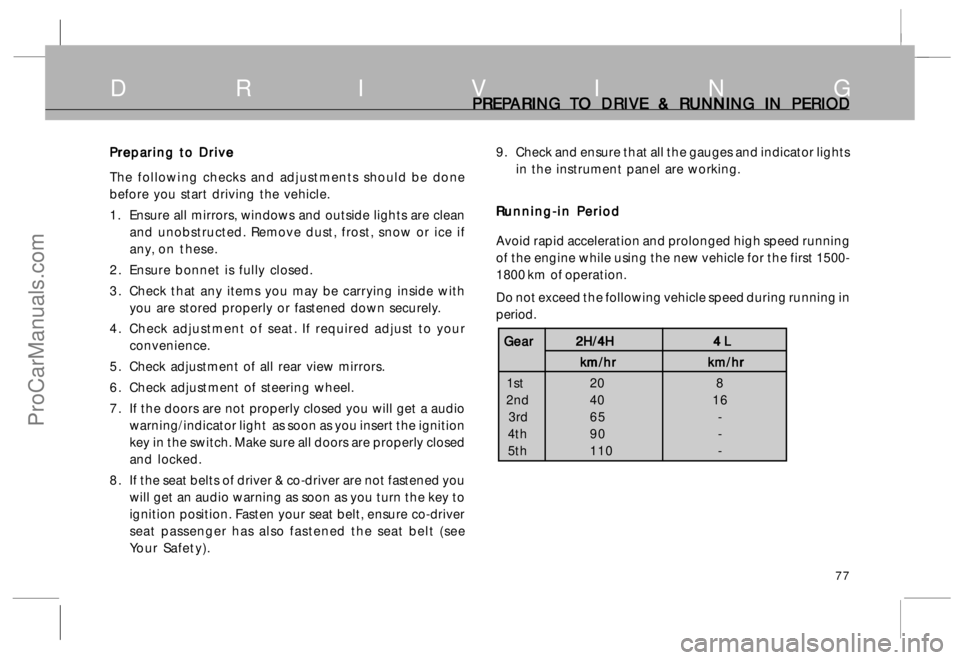
Avoid rapid acceleration and prolonged high speed running
of the engine while using the new vehicle for the first 1500-
1800 km of operation.
Do not exceed the following vehicle speed during running in
period.
Gear GearGear Gear
Gear
2H/4H 2H/4H 2H/4H 2H/4H
2H/4H
4 L 4 L 4 L 4 L
4 L
km/hr km/hr km/hr km/hr
km/hr
km/hr km/hr km/hr km/hr
km/hr
1st 20 8
2nd 40 16
3rd 65 -
4th 90 -
5th 110 -
ProCarManuals.com
Page 81 of 161
81
D R I V I N GANTI LOCK BRAKING SYSTEM ANTI LOCK BRAKING SYSTEMANTI LOCK BRAKING SYSTEM ANTI LOCK BRAKING SYSTEM
ANTI LOCK BRAKING SYSTEM
Electronic Brake Distribution (EBD) Electronic Brake Distribution (EBD)Electronic Brake Distribution (EBD) Electronic Brake Distribution (EBD)
Electronic Brake Distribution (EBD)
indicator indicatorindicator indicator
indicator
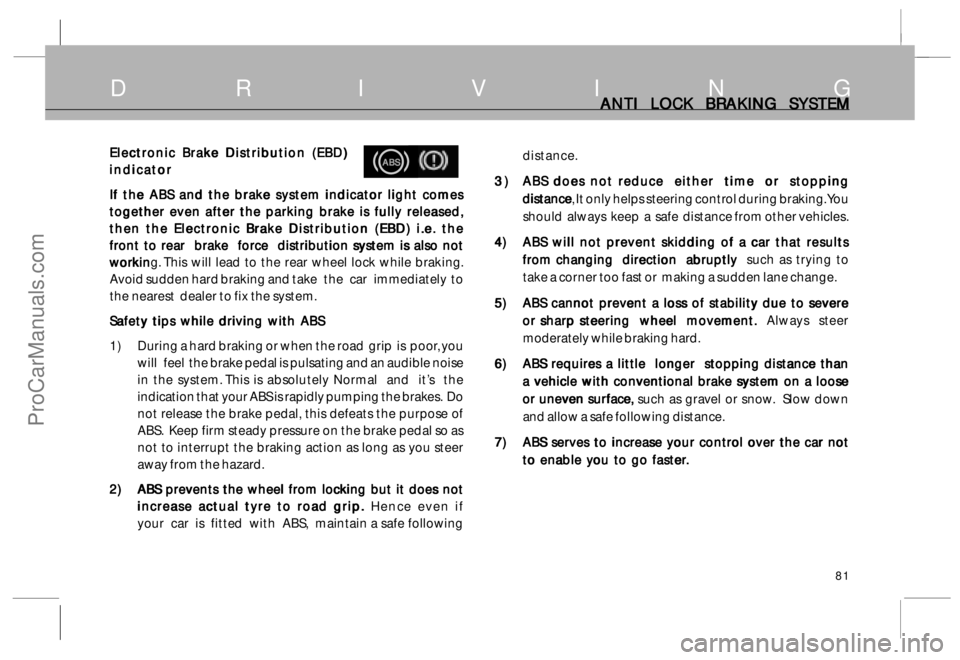
If the ABS and the brake system indicator light comes If the ABS and the brake system indicator light comesIf the ABS and the brake system indicator light comes If the ABS and the brake system indicator light comes
If the ABS and the brake system indicator light comes
together even after the parking brake is fully released, together even after the parking brake is fully released,together even after the parking brake is fully released, together even after the parking brake is fully released,
together even after the parking brake is fully released,
then the Electronic Brake Distribution (EBD) i.e. the then the Electronic Brake Distribution (EBD) i.e. thethen the Electronic Brake Distribution (EBD) i.e. the then the Electronic Brake Distribution (EBD) i.e. the
then the Electronic Brake Distribution (EBD) i.e. the
front to rear brake force distribution system is also not front to rear brake force distribution system is also notfront to rear brake force distribution system is also not front to rear brake force distribution system is also not
front to rear brake force distribution system is also not
w ww w
w
or oror or
or
k kk k
k
in inin in
ing. This will lead to the rear wheel lock while braking.
Avoid sudden hard braking and take the car immediately to
the nearest dealer to fix the system.
Safety tips while driving with ABS Safety tips while driving with ABSSafety tips while driving with ABS Safety tips while driving with ABS
Safety tips while driving with ABS
1) During a hard braking or when the road grip is poor, you
will feel the brake pedal is pulsating and an audible noise
in the system. This is absolutely Normal and it’s the
indication that your ABS is rapidly pumping the brakes. Do
not release the brake pedal, this defeats the purpose of
ABS. Keep firm steady pressure on the brake pedal so as
not to interrupt the braking action as long as you steer
away from the hazard.
2) 2)2) 2)
2)
ABS prevents the wheel from locking but it does not ABS prevents the wheel from locking but it does notABS prevents the wheel from locking but it does not ABS prevents the wheel from locking but it does not
ABS prevents the wheel from locking but it does not
increase actual tyre to road grip. increase actual tyre to road grip. increase actual tyre to road grip. increase actual tyre to road grip.
increase actual tyre to road grip. Hence even if
your car is fitted with ABS, maintain a safe followingdistance.
3) 3)3) 3)
3)
ABS does not reduce either time or stopping ABS does not reduce either time or stoppingABS does not reduce either time or stopping ABS does not reduce either time or stopping
ABS does not reduce either time or stopping
distanc distancdistanc distanc
distanc
e ee e
e, It only helps steering control during braking. You
should always keep a safe distance from other vehicles.
4) 4)4)
4)
4)
ABS will not prevent skidding of a car that results ABS will not prevent skidding of a car that resultsABS will not prevent skidding of a car that results ABS will not prevent skidding of a car that results
ABS will not prevent skidding of a car that results
from changing direction abruptly from changing direction abruptly from changing direction abruptly from changing direction abruptly
from changing direction abruptly such as trying to
take a corner too fast or making a sudden lane change.
5) 5)5) 5)
5)
ABS cannot prevent a loss of stability due to severe ABS cannot prevent a loss of stability due to severeABS cannot prevent a loss of stability due to severe ABS cannot prevent a loss of stability due to severe
ABS cannot prevent a loss of stability due to severe
or sharp steering wheel movement. or sharp steering wheel movement.or sharp steering wheel movement. or sharp steering wheel movement.
or sharp steering wheel movement. Always steer
moderately while braking hard.
6) 6)6) 6)
6)
ABS requires a little longer stopping distance than ABS requires a little longer stopping distance thanABS requires a little longer stopping distance than ABS requires a little longer stopping distance than
ABS requires a little longer stopping distance than
a vehicle with conventional brake system on a loose a vehicle with conventional brake system on a loosea vehicle with conventional brake system on a loose a vehicle with conventional brake system on a loose
a vehicle with conventional brake system on a loose
or une or uneor une or une
or une
v vv v
v
en sur en suren sur en sur
en sur
fac facfac fac
fac
e ee e
e
,, ,,
, such as gravel or snow. Slow down
and allow a safe following distance.
7) 7)7) 7)
7)
ABS ABSABS ABS
ABS
serves to increase your control over the car not serves to increase your control over the car not serves to increase your control over the car not serves to increase your control over the car not
serves to increase your control over the car not
t tt t
t
o enable y o enable yo enable y o enable y
o enable y
ou t ou tou t ou t
ou t
o go fast o go fasto go fast o go fast
o go fast
er erer er
er
.. ..
.
ABS ABSABS ABS
ABS
ProCarManuals.com
Page 86 of 161
86
D R I V I N GDRIVING IN ADVERSE CONDITIONS DRIVING IN ADVERSE CONDITIONSDRIVING IN ADVERSE CONDITIONS DRIVING IN ADVERSE CONDITIONS
DRIVING IN ADVERSE CONDITIONS
Driving Through Water Driving Through WaterDriving Through Water Driving Through Water
Driving Through Water
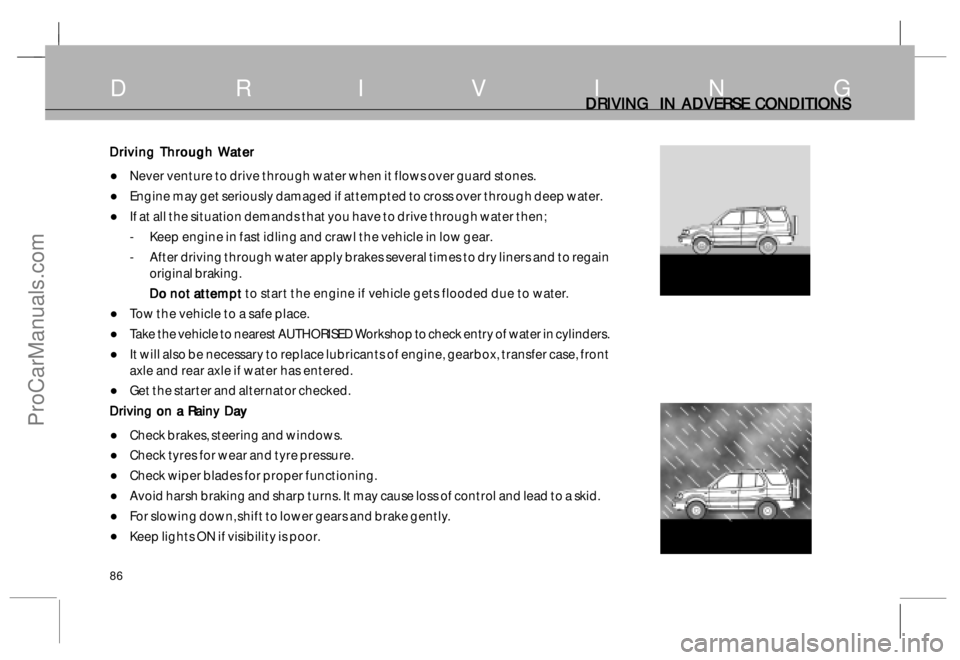
•Never venture to drive through water when it flows over guard stones.
•Engine may get seriously damaged if attempted to cross over through deep water.
•If at all the situation demands that you have to drive through water then;
- Keep engine in fast idling and crawl the vehicle in low gear.
- After driving through water apply brakes several times to dry liners and to regain
original braking.
D DD D
D
o not a o not ao not a o not a
o not a
tt tttt tt
tt
empt emptempt empt
empt to start the engine if vehicle gets flooded due to water.
•Tow the vehicle to a safe place.
•Take the vehicle to nearest AUTHORISED Workshop to check entry of water in cylinders.
•It will also be necessary to replace lubricants of engine, gearbox, transfer case, front
axle and rear axle if water has entered.
•Get the starter and alternator checked.
Driving on a Rainy Day Driving on a Rainy DayDriving on a Rainy Day Driving on a Rainy Day
Driving on a Rainy Day
•Check brakes, steering and windows.
•Check tyres for wear and tyre pressure.
•Check wiper blades for proper functioning.
•Avoid harsh braking and sharp turns. It may cause loss of control and lead to a skid.
•For slowing down, shift to lower gears and brake gently.
•Keep lights ON if visibility is poor.
ProCarManuals.com
Page 88 of 161
88
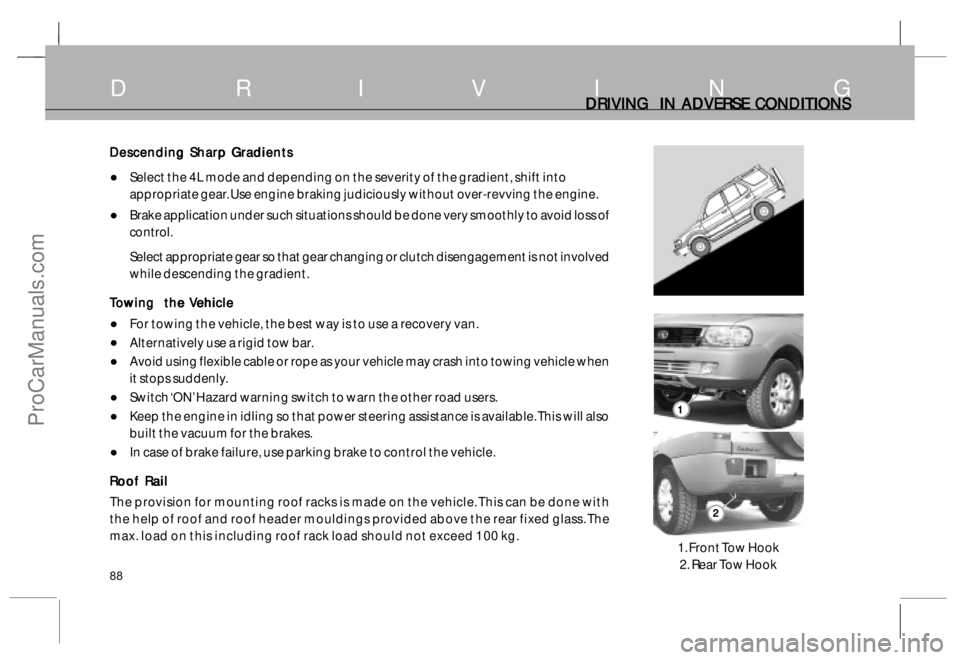
Descending Sharp Gradients Descending Sharp GradientsDescending Sharp Gradients Descending Sharp Gradients
Descending Sharp Gradients
•Select the 4L mode and depending on the severity of the gradient, shift into
appropriate gear. Use engine braking judiciously without over-revving the engine.
•Brake application under such situations should be done very smoothly to avoid loss of
control.
Select appropriate gear so that gear changing or clutch disengagement is not involved
while descending the gradient.
T TT T
T
o oo o
o
wing the wing the wing the wing the
wing the
V VV V
V
ehicle ehicleehicle ehicle
ehicle
•For towing the vehicle, the best way is to use a recovery van.
•Alternatively use a rigid tow bar.
•Avoid using flexible cable or rope as your vehicle may crash into towing vehicle when
it stops suddenly.
•Switch ‘ON’ Hazard warning switch to warn the other road users.
•Keep the engine in idling so that power steering assistance is available. This will also
built the vacuum for the brakes.
•In case of brake failure, use parking brake to control the vehicle.
Roof Rail Roof RailRoof Rail Roof Rail
Roof Rail
The provision for mounting roof racks is made on the vehicle. This can be done with
the help of roof and roof header mouldings provided above the rear fixed glass. The
max. load on this including roof rack load should not exceed 100 kg.
D R I V I N GDRIVING IN ADVERSE CONDITIONS DRIVING IN ADVERSE CONDITIONSDRIVING IN ADVERSE CONDITIONS DRIVING IN ADVERSE CONDITIONS
DRIVING IN ADVERSE CONDITIONS
1 11 1
1
2 22 2
2
1. Front Tow Hook
2. Rear Tow Hook
ProCarManuals.com
Page 93 of 161
93
FUEL, LUBRICANTS & COOLANTS
Lubricants and Oils Lubricants and OilsLubricants and Oils Lubricants and Oils
Lubricants and Oils
Recommended lubricants conform to the following
specifications :
1. 1.1. 1.
1.
Engine oil Engine oilEngine oil Engine oil
Engine oil -API-CH4 + MB 228.3 or higher
grade engine oil
2. 2.2. 2.
2.
Gear Box oil Gear Box oilGear Box oil Gear Box oil
Gear Box oil - 75W90 GL-4
3. 3.3. 3.
3.
Power Steering Power SteeringPower Steering Power Steering
Power Steering - ATF Type A, Suffix A
and and and and
and
T TT T
T
r rr r
r
ansf ansfansf ansf
ansf
er C er Cer C er C
er C
ase asease ase
ase
4. 4.4. 4.
4.
Rear & Front axle Rear & Front axleRear & Front axle Rear & Front axle
Rear & Front axle -M/Grade oil SAE 85W 140 GL5
Angolmol AG043 oil
* * * *
* Friction modifier 40819 (2-5%) to be added to oil for
Limited Slip Differential
5. 5.5. 5.
5.
Chassis and wheel Chassis and wheelChassis and wheel Chassis and wheel
Chassis and wheel -SS6805 bearing grease
bearing
bearingbearing bearing
bearing
Please use only recommended grades for good Please use only recommended grades for goodPlease use only recommended grades for good Please use only recommended grades for good
Please use only recommended grades for good
performance. performance.performance. performance.
performance.
DO NOT DO NOT DO NOT DO NOT
DO NOT mix grease of different brands and optional grades.
Replace old grease completely.
The oil change periods recommended in maintenance
schedule should be adhered to.
L LL L
L
UBRIC UBRICUBRIC UBRIC
UBRIC
ANT ANTANT ANT
ANT
S SS S
S
Engine EngineEngine Engine
Engine
Qty : 7.5 Litres Qty : 7.5 Litres Qty : 7.5 Litres Qty : 7.5 Litres
Qty : 7.5 Litres
Recommended grades of engine oil for range of ambient
temperature :
A AA A
A
mbien mbienmbien mbien
mbien
t t t t
t
T TT T
T
emp empemp emp
emp
er erer er
er
a aa a
a
tur turtur tur
tur
e e e e
e
0 00 0
0C CC C
C
Engine Oil Grade Engine Oil GradeEngine Oil Grade Engine Oil Grade
Engine Oil Grade
- 5 and above SAE 15W/40
- 10 to 0 SAE 5W30
- 20 and -10 SAE 0W30
Front live axle and rear axle oil (Spicer axles) Front live axle and rear axle oil (Spicer axles)Front live axle and rear axle oil (Spicer axles) Front live axle and rear axle oil (Spicer axles)
Front live axle and rear axle oil (Spicer axles)
Use Multigrade oil SAE 85W 140 Angolmol A6043 oil
Capacity : Capacity :Capacity : Capacity :
Capacity :
For Rear axle For Rear axleFor Rear axle For Rear axle
For Rear axle
- 2.2 litres - 2.2 litres- 2.2 litres - 2.2 litres
- 2.2 litres
For Front axle For Front axleFor Front axle For Front axle
For Front axle
- 1.2 litres - 1.2 litres- 1.2 litres - 1.2 litres
- 1.2 litres
Gear Box oil : Gear Box oil :Gear Box oil : Gear Box oil :
Gear Box oil :
Qty : 1.6 Litres Qty : 1.6 LitresQty : 1.6 Litres Qty : 1.6 Litres
Qty : 1.6 Litres
75W90, (Synthetic oil GL4)
ProCarManuals.com