warning TESLA MODEL S 2012 Owner Safety Information
[x] Cancel search | Manufacturer: TESLA, Model Year: 2012, Model line: MODEL S, Model: TESLA MODEL S 2012Pages: 28, PDF Size: 2.9 MB
Page 16 of 28

14OWNER SAFETY INFORMATIONREAR FACING CHILD SEATS
SEATING A CHILD IN THE TESLA REAR FACING CHILD SEATS
WARNING: The rear facing seats are child safety seats. They must only be used for children over 37 “ (94 cm) tall and weighing between 35 and 77 lbs (16.2
to 35.2 kg). Ensure the top of the child’s head can not contact the vehicle. Do not use supplemental child restraint systems in these seats. Follow all instructions
provided.
Releasing1. Release the seat belts by
pressing the button on the buckle.
2. Release the chest clip.
3. Separate the two halves of the
seat restraint.
Fastening1. Position the child in the
seat with arms through the
loops of the seat belts.
2. Connect the two halves
of the seat belt and latch
together.
3. Insert the seat belt tongue
latch into the buckle
and ensure it is securely
fastened.
4. Adjust the shoulder belts so that they run over the top of the child’s
shoulders and away from the face.
5. Connect the chest clip.
6. Pull the lower straps until the child is securely held in the seat.
Page 17 of 28

15OWNER SAFETY INFORMATION
BRAKING SYSTEMSModel S is equipped with an anti-lock braking system (ABS) that prevents
the wheels from locking when you apply maximum brake pressure. This
allows you to maintain steering control during heavy braking on most road
conditions.
During emergency braking conditions, the ABS constantly monitors the
speed of each wheel and varies the brake pressure according to the
grip available. The alteration of brake pressure can be felt as a pulsing
sensation through the brake pedal. This demonstrates that ABS is
operating and is no cause for concern. Keep firm and steady pressure on
the brake pedal while experiencing the pulsation.
Model S continuously monitors its brake systems and alerts you if a fault is
detected:
An ABS fault is detected. The brakes remain fully
operational and are not affected by an ABS failure.
However, braking distances may increase and wheels
may lock under heavy braking. Contact Tesla.A brake system fault is detected or the brake fluid
level is low. Contact Tesla immediately.
BRAKE WEARModel S brake pads are equipped with wear indicators. A wear indicator is
a thin metal strip attached to the brake pad that squeals as it rubs against
the rotor when the pad wears down. This squealing sound serves as a
reminder that you need to replace your brake pads. To stop the squealing,
contact Tesla to have your brakes inspected, and if necessary to have new
brake pads installed. If you don’t replace the brake pads, you will soon
hear a grinding sound. This metal on metal grinding can damage your
braking system, and in turn, create a braking hazard.
WARNINGS:
In an emergency, fully press the brake pedal. DO NOT pump the brake
pedal. ABS does this for you and by pumping the foot brake yourself, you
interfere with ABS operation, which can increase braking distance.
Contact Tesla if the movement of the brake pedal has increased, or if you
notice a significant loss of brake fluid. Driving under such conditions could
result in extended stopping distances or complete brake failure.
BRAKING SYSTEM
Page 19 of 28
17OWNER SAFETY INFORMATION
MAINTAIN PROPER TIRE PRESSURESCheck tire pressures monthly when tires are cold and Model S has been parked
for over three hours. Inflate tires to the Tesla recommended inflation pressures,
printed on the Tire and Loading Information Label (see page 16). These
recommended pressures provide optimum ride and handling characteristics.
WARNINGS:Under-inflation is the most common cause of tire failures and can cause a tire
to overheat, resulting in severe tire cracking, tread separation, or “blowout”,
which causes unexpected loss of vehicle control and increased risk of injury.
Under-inflation also reduces Battery range and tire tread life.
Check tire pressures using an accurate pressure gauge when tires are
cold. It takes only one mile of driving to warm up the tires sufficiently to
affect tire pressures. Parking the vehicle in direct sunlight or in high ambient
temperatures can also affect tire pressures. If you must check warm tires,
expect increased pressures. Don’t let air out of warm tires in an attempt
to match recommended cold tire pressures. A hot tire at or below the
recommended cold tire inflation pressure is dangerously under-inflated.
To check and adjust tire pressures1. Remove the valve cap, then firmly press the tire gauge onto the valve.
2. If required, add air to reach the recommended pressure.
3. Re-check pressure by removing and re-attaching the tire gauge.
4. If you added too much air, release air by pushing on the metal stem in the
center of the valve. Re-check and adjust if necessary.
5. Screw the valve cap back on to prevent dirt from entering (periodically
inspect the valve cap for damage such as cracking).TIRE PRESSURE MONITORING SYSTEM (TPMS)Each tire should be checked monthly when cold and inflated to the inflation
pressure recommended by the vehicle manufacturer on the vehicle placard or
tire inflation pressure label. (If your vehicle has tires of a different size than the
size indicated on the vehicle placard or tire inflation pressure label, you should
determine the proper tire inflation pressure for those tires.)As an added safety feature, your vehicle has been equipped with a tire
pressure monitoring system (TPMS) that illuminates a low tire pressure telltale
when one or more of your tires is significantly under-inflated.
Accordingly, when the low tire pressure telltale illuminates, you should stop and
check your tires as soon as possible, and inflate them to the proper pressure.
Driving on a significantly under-inflated tire causes the tire to overheat and can
lead to tire failure. Under-iinflation also reduces fuel efficiency and tire tread
life, and may affect the vehicle’s handling and stopping ability.
Please note that the TPMS is not a substitute for proper tire maintenance, and
it is the driver’s responsibility to maintain correct tire pressures, even if under-
inflation has not reached the level to trigger illumination of the TPMS low tire
pressure telltale.
Your vehicle has also been equipped with a TPMS malfunction indicator light
to indicate when the system is not operating properly.
The TPMS malfunction indicator light is combined with the low tire pressure
telltale. When the sytem detects a malfunction, the telltale flashes for
approximately one minute and then remain continuously illuminated. This
sequence will continue upon subsequent vehicle start-ups as long as the
malfunction exists.
When the malfunction indicator light is illuminated, the system may not be
able to detect or signal low tire pressure as intended. TPMS malfunctions
may occur for a variety of reasons, including the installation of replacement or
alternate tires or wheels on the vehicle that prevent the TPMS from functioning
properly. Always check the TPMS malfunction telltale after replacing one
or more tires or wheels on your vehicle to ensure that the replacement or
alternate tires and wheels allow the TPMS to continue to function properly.
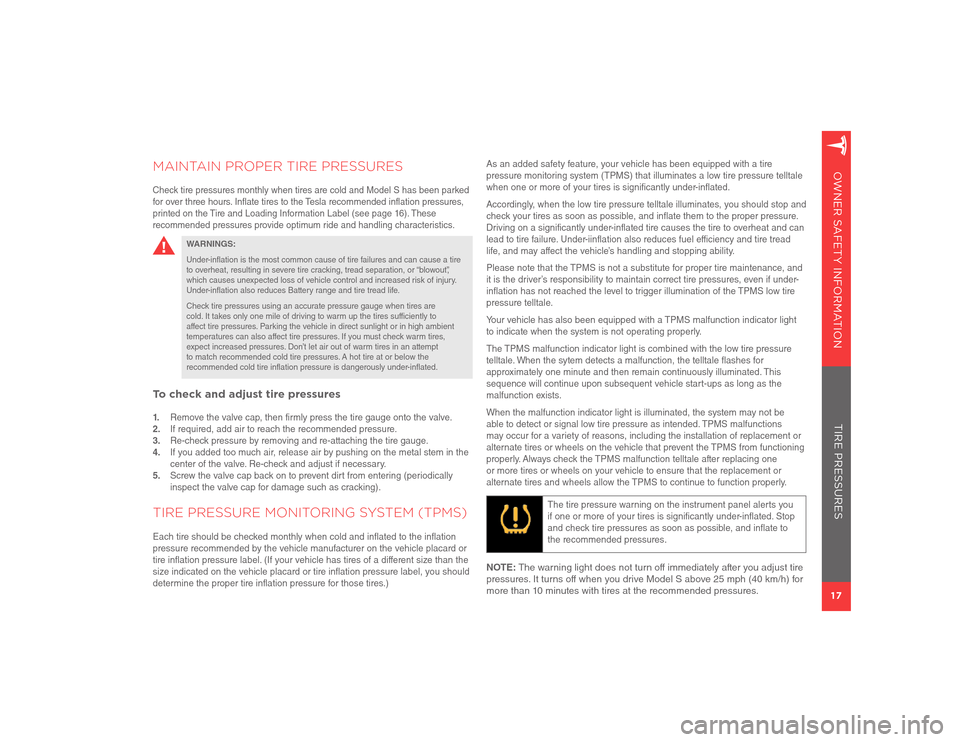
The tire pressure warning on the instrument panel alerts you
if one or more of your tires is significantly under-inflated. Stop
and check tire pressures as soon as possible, and inflate to
the recommended pressures
.
NOTE: The warning light does not turn off immediately after you adjust tire
pressures. It turns off when you drive Model S above 25 mph (40 km/h) for
more than 10 minutes with tires at the recommended pressures.
TIRE PRESSURES
Page 20 of 28
18OWNER SAFETY INFORMATION
Punctured tiresA puncture eventually causes the tire to lose pressure, which is why it’s
important to check tire pressures frequently. Permanently repair or replace
punctured or damaged tires as soon as possible. Don’t drive with a punctured
tire, even if it isn’t deflated. A punctured tire can deflate suddenly at any time.
Your tubeless tires may not leak when penetrated, provided the object remains
in the tire. If, however, you feel a sudden vibration or ride disturbance while
driving, or you suspect your tire or vehicle has been damaged, immediately
reduce your speed. Drive slowly, while avoiding heavy braking or sharp
steering and when safe to do so, stop the vehicle. Arrange to have the vehicle
transported to a tire repair center, or to Tesla, to have tires inspected and, if
necessary, repaired. Flat spotsIf the vehicle is stationary for a long period in high temperatures, tires can form
flat spots. When the vehicle is driven, these flat spots cause a vibration which
gradually disappears as the tires get warm and regain their original shape. To
minimize the flat spots during storage, inflate tires to the maximum pressure
indicated on the tire wall, then, before driving the vehicle, release air to adjust
tire pressure to the recommended levels. Driving In Low Ambient TemperaturesTire performance reduces in low ambient temperatures, resulting in less grip
and an increased susceptibility to damage from impacts. Performance tires
can temporarily harden when cold, causing you to hear rotational noise for
the first few miles until the tires warm up. Contact Tesla Motors for winter tire
recommendations.
WARNING: Defective tires are dangerous. Do not drive if a tire is damaged,
excessively worn, or is inflated to an incorrect pressure. The safety of the
vehicle and occupants will be adversely affected. Check tires regularly for wear
and to ensure there are no cuts, bulges or exposure of the ply/cord structure.
TEMPORARY TIRE REPAIRAs an option, you can purchase a tire repair kit from Tesla (this kit is included
only if you purchased your Model S in Maryland or Rhode Island). This kit is
designed to temporarily repair a small tire puncture just long enough for you to
drive slowly to the nearest tire repair location. Follow the instructions provided
on the kit and heed all warnings.
WARNING: Do not use any tire liquid or aerosol tire sealant other than a tire
repair kit purchased as an accessory from Tesla. Other types can cause tire
pressure sensors to malfunction.
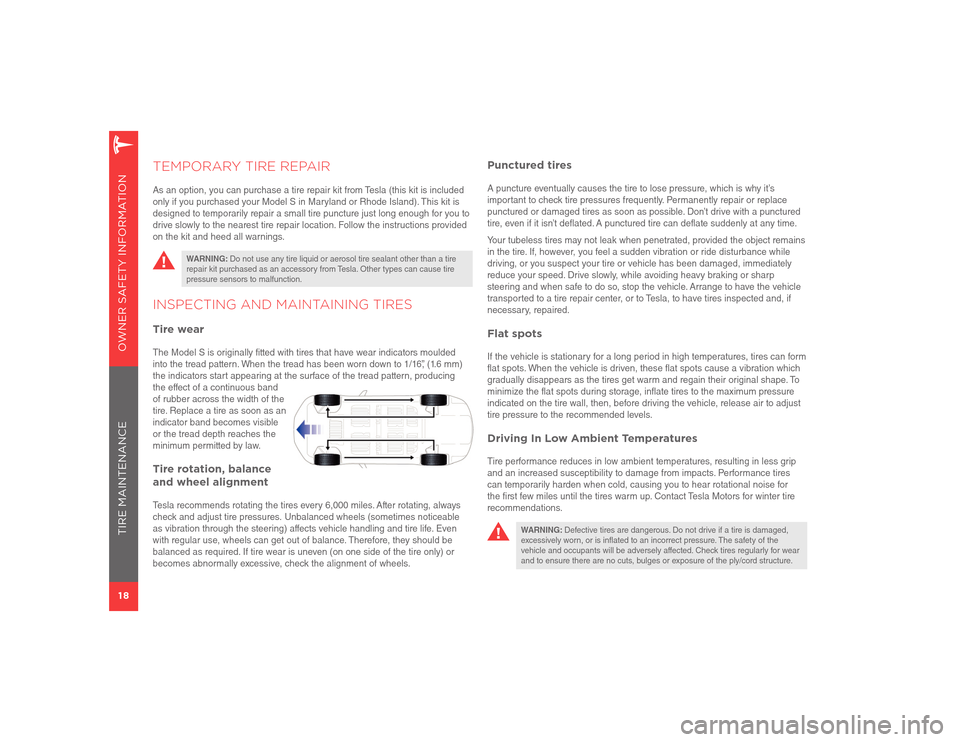
INSPECTING AND MAINTAINING TIRESTire wearThe Model S is originally fitted with tires that have wear indicators moulded
into the tread pattern. When the tread has been worn down to 1/16”, (1.6 mm)
the indicators start appearing at the surface of the tread pattern, producing
the effect of a continuous band
of rubber across the width of the
tire. Replace a tire as soon as an
indicator band becomes visible
or the tread depth reaches the
minimum permitted by law.Tire rotation, balance
and wheel alignmentTesla recommends rotating the tires every 6,000 miles. After rotating, always
check and adjust tire pressures.
Unbalanced wheels (sometimes noticeable
as vibration through the steering) affects vehicle handling and tire life. Even
with regular use, wheels can get out of balance. Therefore, they should be
balanced as required. If tire wear is uneven (on one side of the tire only) or
becomes abnormally excessive, check the alignment of wheels.
TIRE MAINTENANCE
Page 21 of 28
19OWNER SAFETY INFORMATION
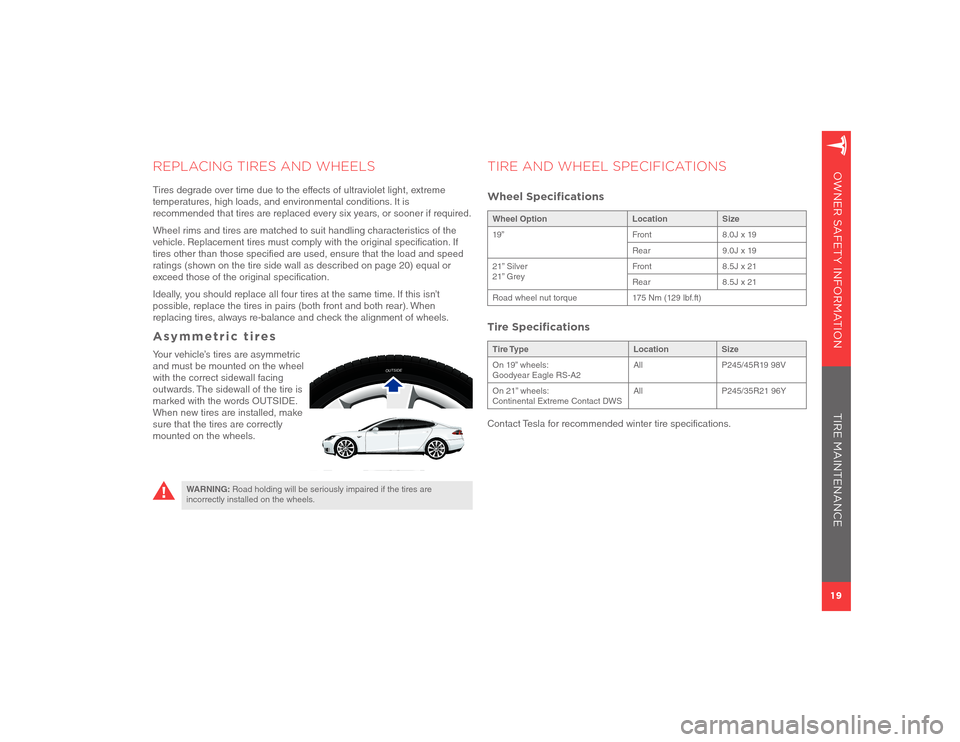
TIRE AND WHEEL SPECIFICATIONSWheel Specifi cationsWheel Option Location Size
19” Front 8.0J x 19
Rear 9.0J x 19
21” Silver
21” GreyFront 8.5J x 21
Rear 8.5J x 21
Road wheel nut torque 175 Nm (129 lbf.ft)Tire Specifi cationsTire Type Location Size
On 19” wheels:
Goodyear Eagle RS-A2All P245/45R19 98V
On 21” wheels:
Continental Extreme Contact DWSAll P245/35R21 96YContact Tesla for recommended winter tire specifications.
REPLACING TIRES AND WHEELSTires degrade over time due to the effects of ultraviolet light, extreme
temperatures, high loads, and environmental conditions. It is
recommended that tires are replaced every six years, or sooner if required.
Wheel rims and tires are matched to suit handling characteristics of the
vehicle. Replacement tires must comply with the original specification. If
tires other than those specified are used, ensure that the load and speed
ratings (shown on the tire side wall as described on page 20) equal or
exceed those of the original specification.
Ideally, you should replace all four tires at the same time. If this isn’t
possible, replace the tires in pairs (both front and both rear). When
replacing tires, always re-balance and check the alignment of wheels.Asymmetric tiresYour vehicle’s tires are asymmetric
and must be mounted on the wheel
with the correct sidewall facing
outwards. The sidewall of the tire is
marked with the words OUTSIDE.
When new tires are installed, make
sure that the tires are correctly
mounted on the wheels.
WARNING: Road holding will be seriously impaired if the tires are
incorrectly installed on the wheels.
OUTSIDE
TIRE MAINTENANCE
Page 23 of 28
21OWNER SAFETY INFORMATION
UNIFORM TIRE QUALITY GRADINGThe following information relates to the tire grading system developed by
the National Highway Traffic Safety Administration (NHTSA) which will
grade tires by tread wear, traction and temperature performance. Tires
that have deep tread, and winter tires, are exempt from these marking
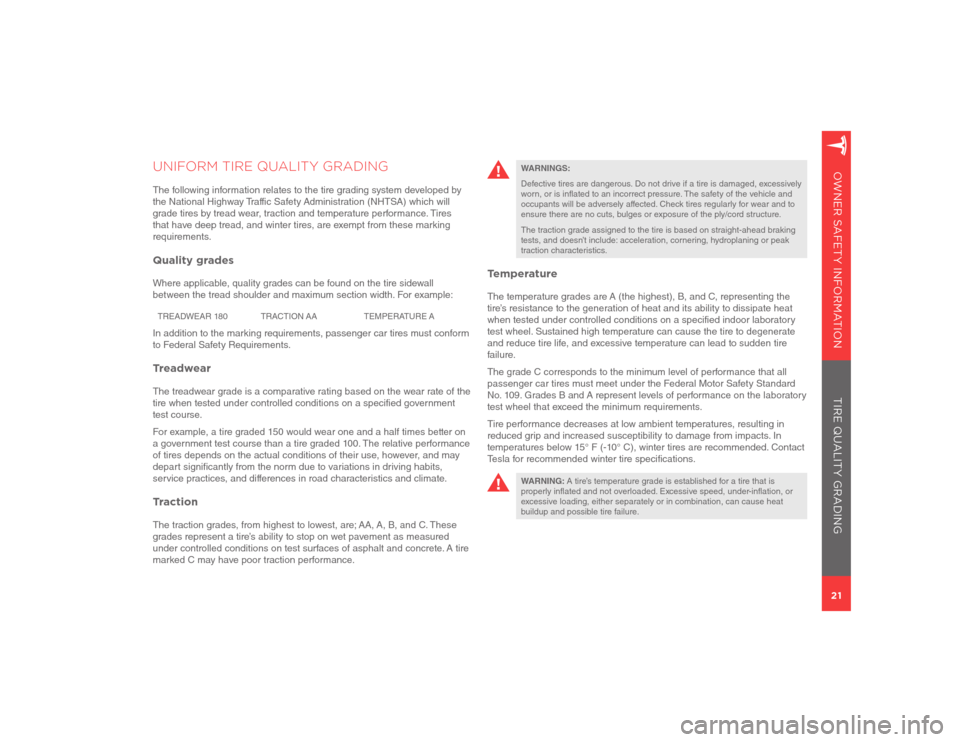
requirements.Quality gradesWhere applicable, quality grades can be found on the tire sidewall
between the tread shoulder and maximum section width. For example:TREADWEAR 180 TRACTION AA TEMPERATURE AIn addition to the marking requirements, passenger car tires must conform
to Federal Safety Requirements.TreadwearThe treadwear grade is a comparative rating based on the wear rate of the
tire when tested under controlled conditions on a specified government
test course.
For example, a tire graded 150 would wear one and a half times better on
a government test course than a tire graded 100. The relative performance
of tires depends on the actual conditions of their use, however, and may
depart significantly from the norm due to variations in driving habits,
service practices, and differences in road characteristics and climate.TractionThe traction grades, from highest to lowest, are; AA, A, B, and C. These
grades represent a tire’s ability to stop on wet pavement as measured
under controlled conditions on test surfaces of asphalt and concrete. A tire
marked C may have poor traction performance.
WARNINGS:
Defective tires are dangerous. Do not drive if a tire is damaged, excessively
worn, or is inflated to an incorrect pressure. The safety of the vehicle and
occupants will be adversely affected. Check tires regularly for wear and to
ensure there are no cuts, bulges or exposure of the ply/cord structure.
The traction grade assigned to the tire is based on straight-ahead braking
tests, and doesn’t include: acceleration, cornering, hydroplaning or peak
traction characteristics.
TemperatureThe temperature grades are A (the highest), B, and C, representing the
tire’s resistance to the generation of heat and its ability to dissipate heat
when tested under controlled conditions on a specified indoor laboratory
test wheel. Sustained high temperature can cause the tire to degenerate
and reduce tire life, and excessive temperature can lead to sudden tire
failure.
The grade C corresponds to the minimum level of performance that all
passenger car tires must meet under the Federal Motor Safety Standard
No. 109. Grades B and A represent levels of performance on the laboratory
test wheel that exceed the minimum requirements.
Tire performance decreases at low ambient temperatures, resulting in
reduced grip and increased susceptibility to damage from impacts. In
temperatures below 15° F (-10° C), winter tires are recommended. Contact
Tesla for recommended winter tire specifications.
WARNING: A tire’s temperature grade is established for a tire that is
properly inflated and not overloaded. Excessive speed, under-inflation, or
excessive loading, either separately or in combination, can cause heat
buildup and possible tire failure.
TIRE QUALITY GRADING
Page 25 of 28
23OWNER SAFETY INFORMATION
VEHICLE LOAD LIMIT
WARNINGS:
Overloading the vehicle will have an adverse effect on braking and
handling, which could compromise your safety or damage Model S.
Therefore you must understand how much weight your Model S can
safely carry. This weight is called the vehicle capacity weight and includes
the weight of all occupants, cargo and any additional equipment fitted to
Model S since it was manufactured.
Always ensure tires are inflated to their recommended levels. Doing so is
especially important when carrying heavy loads.
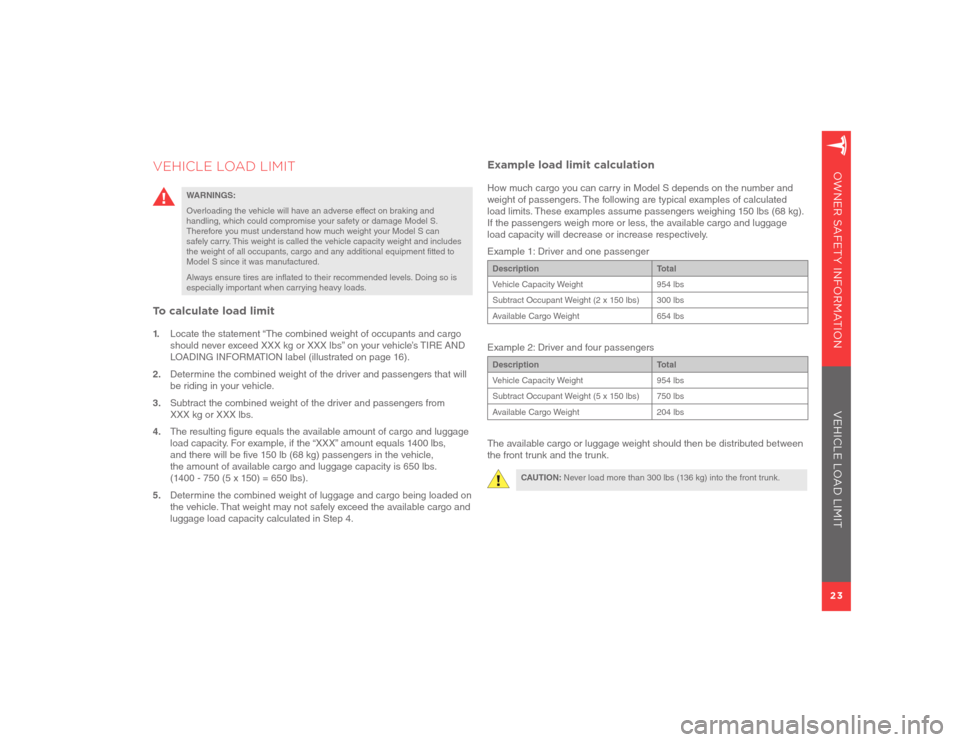
To calculate load limit1. Locate the statement “The combined weight of occupants and cargo
should never exceed XXX kg or XXX lbs” on your vehicle’s TIRE AND
LOADING INFORMATION label (illustrated on page 16).
2. Determine the combined weight of the driver and passengers that will
be riding in your vehicle.
3. Subtract the combined weight of the driver and passengers from
XXX kg or XXX lbs.
4. The resulting figure equals the available amount of cargo and luggage
load capacity. For example, if the “XXX” amount equals 1400 lbs,
and there will be five 150 lb (68 kg) passengers in the vehicle,
the amount of available cargo and luggage capacity is 650 lbs.
(1400 - 750 (5 x 150) = 650 lbs).
5. Determine the combined weight of luggage and cargo being loaded on
the vehicle. That weight may not safely exceed the available cargo and
luggage load capacity calculated in Step 4.
Example load limit calculationHow much cargo you can carry in Model S depends on the number and
weight of passengers. The following are typical examples of calculated
load limits. These examples assume passengers weighing 150 lbs (68 kg).
If the passengers weigh more or less, the available cargo and luggage
load capacity will decrease or increase respectively.
Example 1: Driver and one passengerDescription Total
Vehicle Capacity Weight 954 lbs
Subtract Occupant Weight (2 x 150 lbs) 300 lbs
Available Cargo Weight 654 lbsExample 2: Driver and four passengersDescription Total
Vehicle Capacity Weight 954 lbs
Subtract Occupant Weight (5 x 150 lbs) 750 lbs
Available Cargo Weight 204 lbsThe available cargo or luggage weight should then be distributed between
the front trunk and the trunk.
CAUTION: Never load more than 300 lbs (136 kg) into the front trunk.
VEHICLE LOAD LIMIT
Page 27 of 28
25OWNER SAFETY INFORMATION
CALIFORNIA PROPOSITION 65
WARNINGS:
Certain vehicle components contain or emit chemicals known to the State
of California to cause cancer and birth defects or other reproductive harm.
In addition, certain fluids contained in vehicles and certain products of
component wear contain or emit chemicals known to the State of California
to cause cancer and birth defects or other reproductive harm.
Certain components of this vehicle such as airbag modules and seat belt
pretensioners may contain Perchlorate Material. Special handling may be
required for service or vehicle end of life disposal. See:
http://www.dtsc.ca.gov/hazardouswaste/perchlorate.
Battery posts, terminals, and related accessories contain lead and lead
compounds. Wash hands after handling.
CONTACTING TESLAFor detailed information about your specific Model S, go to www.
teslamotors.com and log in as an owner. All information about your
Model S is available here.
If you have any further questions or concerns about your Model S, call
1-877-79TESLA (1-877-798-3752).
REPORTING SAFETY DEFECTSUnited StatesIf you believe that Model S has a defect which could cause a crash or
could cause injury or death, you should immediately inform the National
Highway Traffic Safety Administration (NHTSA) in addition to notifying
Tesla Motors.
If NHTSA receives similar complaints, it may open an investigation, and
if it finds that a safety defect exists in a group of vehicles, it may order a
recall and remedy campaign. However, NHTSA cannot become involved in
individual problems between you, your dealer, or Tesla Motors.
To contact NHTSA, you may call the Vehicle Safety Hotline toll-free at
1-888-327-4236 (TTY: 1-800-424-9153); go to http://www.safercar.gov; or
write to: Administrator, National Highway Traffic Safety, 1200 New Jersey
Avenue SE., Washington, DC 20590. You can also obtain other information
about motor vehicle safety from http://www.safercar.gov.CanadaIf you believe that your Model S has a defect which could cause a crash
or could cause injury or death, you should immediately inform Transport
Canada, in addition to notifying Tesla. To contact Transport Canada, call
their toll-free number: 1-800-333-0510.
CONTACT INFORMATION