warning light TESLA ROADSTER 2008 User Guide
[x] Cancel search | Manufacturer: TESLA, Model Year: 2008, Model line: ROADSTER, Model: TESLA ROADSTER 2008Pages: 115, PDF Size: 46.35 MB
Page 51 of 115
Instruments
6-13
Driving your vehicle
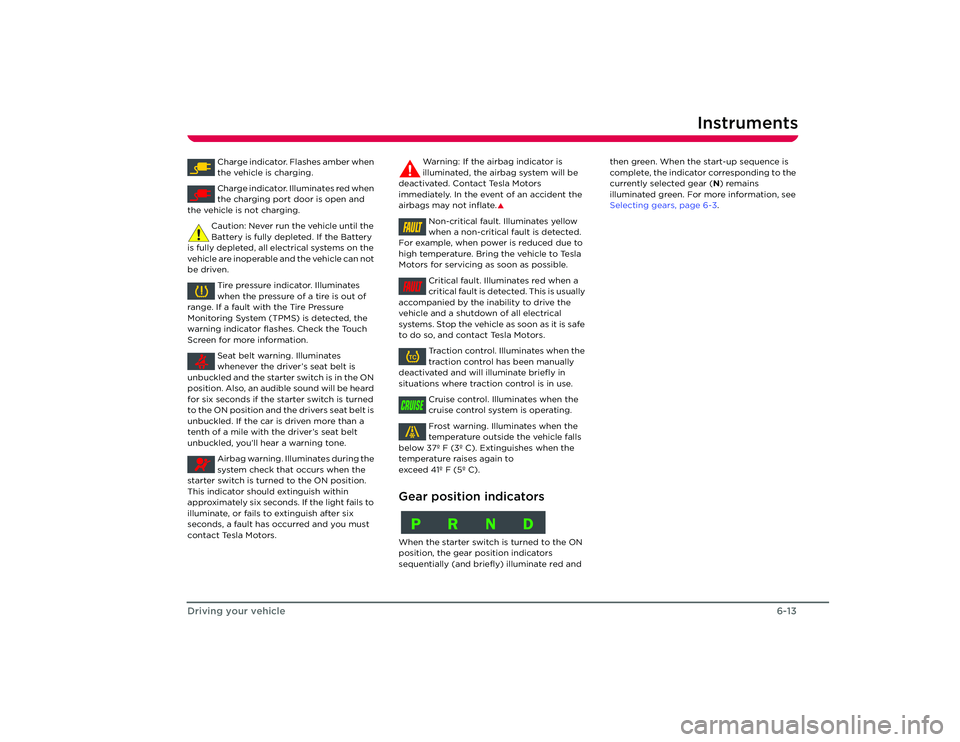
Charge indicator. Flashes amber when
the vehicle is charging.
Charge indicator. Illuminates red when
the charging port door is open and
the vehicle is not charging.
Caution: Never run the vehicle until the
Battery is fully depleted. If the Battery
is fully depleted, all electrical systems on the
vehicle are inoperable and the vehicle can not
be driven.
Tire pressure indicator. Illuminates
when the pressure of a tire is out of
range. If a fault with the Tire Pressure
Monitoring System (TPMS) is detected, the
warning indicator flas hes. Check the Touch
Screen for more information.
Seat belt warning. Illuminates
whenever the driver’s seat belt is
unbuckled and the starter switch is in the ON
position. Also, an audible sound will be heard
for six seconds if the starter switch is turned
to the ON position and the drivers seat belt is
unbuckled. If the car is driven more than a
tenth of a mile with the driver’s seat belt
unbuckled, you’ll hear a warning tone.
Airbag warning. Illu minates during the
system check that occurs when the
starter switch is turned to the ON position.
This indicator should extinguish within
approximately six seconds. If the light fails to
illuminate, or fails to extinguish after six
seconds, a fault has occurred and you must
contact Tesla Motors. Warning: If the airbag indicator is
illuminated, the airbag system will be
deactivated. Contact Tesla Motors
immediately. In the event of an accident the
airbags may not inflate.
S
Non-critical fault. Illuminates yellow
when a non-critical fault is detected.
For example, when power is reduced due to
high temperature. Bring the vehicle to Tesla
Motors for servicing as soon as possible.
Critical fault. Illuminates red when a
critical fault is detected. This is usually
accompanied by the inability to drive the
vehicle and a shutdown of all electrical
systems. Stop the vehicle as soon as it is safe
to do so, and contact Tesla Motors.
Traction control. Illuminates when the
traction control has been manually
deactivated and will il luminate briefly in
situations where traction control is in use.
Cruise control. Illuminates when the
cruise control system is operating.
Frost warning. Illuminates when the
temperature outside the vehicle falls
below 37º F (3º C). Extinguishes when the
temperature raises again to
exceed 41º F (5º C).
Gear position indicatorsWhen the starter switch is turned to the ON
position, the gear po sition indicators
sequentially (and briefly) illuminate red and then green. When the start-up sequence is
complete, the indicator corresponding to the
currently selected gear (
N) remains
illuminated green. For more information, see
Selecting gears, page 6-3 .FAULTFAULTTCCRUISEPRND
Roadster OHB.book Page 13 Thursday, October 2, 2008 8:59 AM
Page 55 of 115
Rear view mirrors
7-3
Comfort and convenience
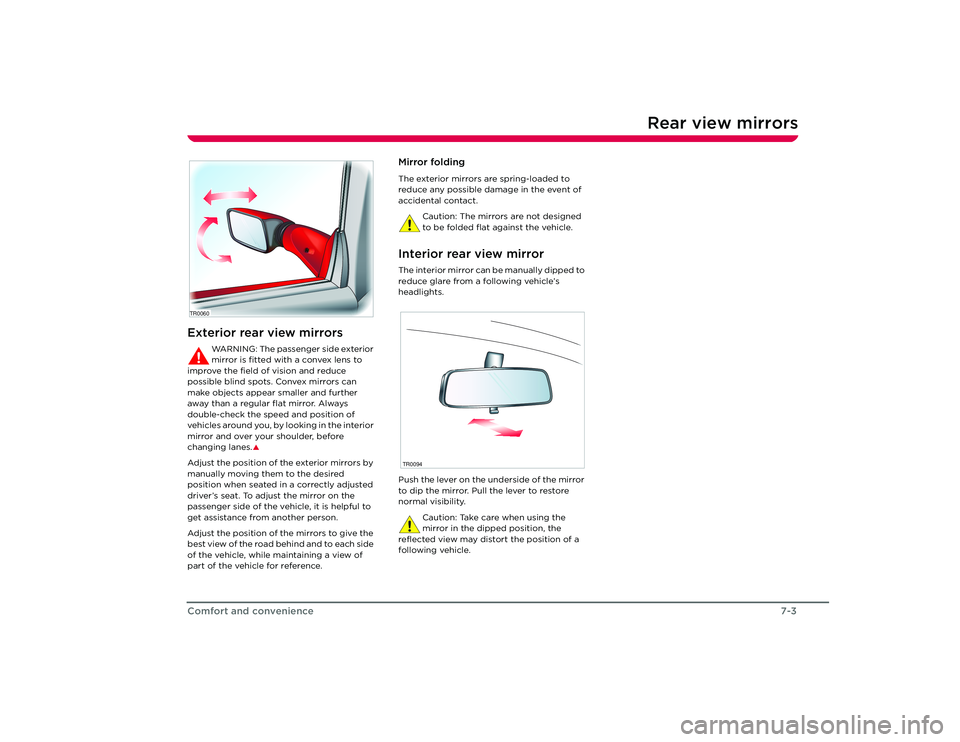
Rear view mirrorsExterior rear view mirrors
WARNING: The passenger side exterior
mirror is fitted with a convex lens to
improve the field of vision and reduce
possible blind spots. Convex mirrors can
make objects appear smaller and further
away than a regular flat mirror. Always
double-check the speed and position of
v e h i c l e s a r o u n d y o u , b y l o o k i n g i n t h e i n t e r i o r
mirror and over your shoulder, before
changing lanes.
S
Adjust the position of the exterior mirrors by
manually moving them to the desired
position when seated in a correctly adjusted
driver’s seat. To adjust the mirror on the
passenger side of the vehicle, it is helpful to
get assistance from another person.
Adjust the position of the mirrors to give the
best view of the road behind and to each side
of the vehicle, while maintaining a view of
part of the vehicle for reference.
Mirror foldingThe exterior mirrors are spring-loaded to
reduce any possible damage in the event of
accidental contact.
Caution: The mirrors are not designed
to be folded flat against the vehicle.Interior rear view mirrorThe interior mirror can be manually dipped to
reduce glare from a following vehicle’s
headlights.
Push the lever on the underside of the mirror
to dip the mirror. Pull the lever to restore
normal visibility.Caution: Take care when using the
mirror in the dipped position, the
reflected view may distort the position of a
following vehicle.
TR0060
TR0094
Roadster OHB.book Page 3 Th ursday, October 2, 2008 8:59 AM
Page 67 of 115
HomeLink®
7-15
Comfort and convenience
HomeLink
®
HomeLink
® Universal
Transceiver
Your vehicle is equipped with a HomeLink
®
Universal Transceiver that you can use to
operate most Radio Frequency (RF) devices
such as garage doors, gates, lights and
security systems. Your transceiver can be
programmed using the Touch Screen to
operate up to three individual devices.
Devices can be operated by touching a
button on the Touch Screen. You can also set
up the third button on the key fob to operate
a device. For details on how to program
HomeLink, refer to the Touch Screen Users
Manual, provided in your owners package.
For security purposes, when you sell your
vehicle, you should erase your HomeLink
settings.
WARNING: Do not use the HomeLink
Universal Transceiver with any garage
door opener that la cks safety stop and
reverse features as required by federal safety
standards. A garage door opener which
cannot detect an object in the path of a
closing garage door and then automatically
stop and reverse, does not meet current
federal safety standards. Using a garage door
opener without these features increases the
risk of injury or death.
S
You’re vehicle should be turned off
while programming the HomeLink
Universal Transceiver.
S
During programming, your garage
door or gate may open or close. Make
sure that people and objects are clear of the
garage door or gate that you are
programming.
S
FCC ComplianceThis device complies with Part 15 of the FCC
Rules. Operation is subject to the following
two conditions:
1. This device may not cause harmful interference, and
2. This device must accept any interference received, including interference that may
cause undesired operation.
Any unauthorized modification to this device
could void the user’s authority to operate the
equipment.
Roadster OHB.book Page 15 Thursday, October 2, 2008 8:59 AM
Page 70 of 115
Maintenance9-2
Maintenance and care
Maintenance and care
MaintenanceGeneral informationRegular maintenance is the key to ensuring
the continued reliability and efficiency of
your vehicle.
Maintenance is the owner's responsibility and
you must ensure that the appropriate
maintenance is carried out when required
and according to the recommendations
specified by Tesla Motors.Routine maintenanceTake your vehicle to Tesla Motors at the
regularly scheduled maintenance intervals of
every 12 months, or every 12,000 miles,
whichever comes first.
Maintenance and service must be performed
by Tesla-certified technicians. Damages or
failures caused by maintenance or repairs
performed by non-Tesla certified technicians
are not covered under the New Vehicle
Limited Warranty.
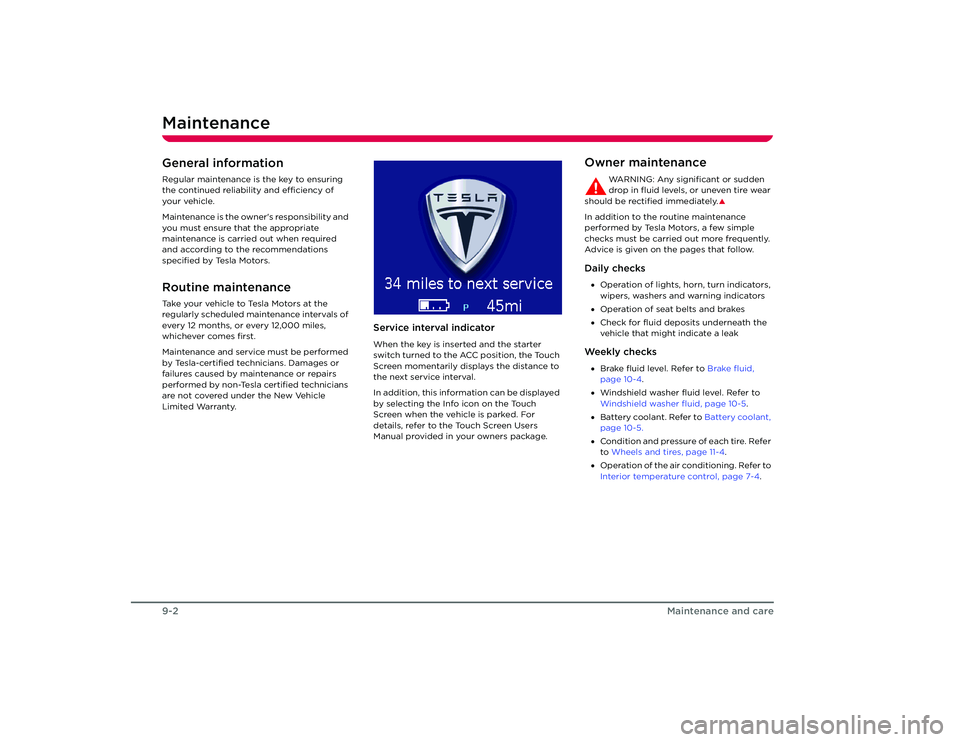
Service interval indicatorWhen the key is inserted and the starter
switch turned to the ACC position, the Touch
Screen momentarily displays the distance to
the next service interval.
In addition, this information can be displayed
by selecting the Info icon on the Touch
Screen when the vehicle is parked. For
details, refer to the Touch Screen Users
Manual provided in your owners package.
Owner maintenance
WARNING: Any significant or sudden
drop in fluid levels, or uneven tire wear
should be rectified immediately.
S
In addition to the routine maintenance
performed by Tesla Motors, a few simple
checks must be carried out more frequently.
Advice is given on the pages that follow.Daily checks• Operation of lights, horn, turn indicators,
wipers, washers and warning indicators
• Operation of seat belts and brakes
• Check for fluid deposits underneath the
vehicle that might indicate a leakWe e k l y c h e c k s•Brake fluid level. Refer to Brake fluid,
page 10-4 .
• Windshield washer fluid level. Refer to
Windshield washer fluid, page 10-5 .
• Battery coolant. Refer to Battery coolant,
page 10-5.
• Condition and pressure of each tire. Refer
to Wheels and tires, page 11-4 .
• Operation of the air conditioning. Refer to
Interior temperature control, page 7-4.
Roadster OHB.book Page 2 Th ursday, October 2, 2008 8:59 AM
Page 80 of 115
Tire repair10-4
Roadside emergencies
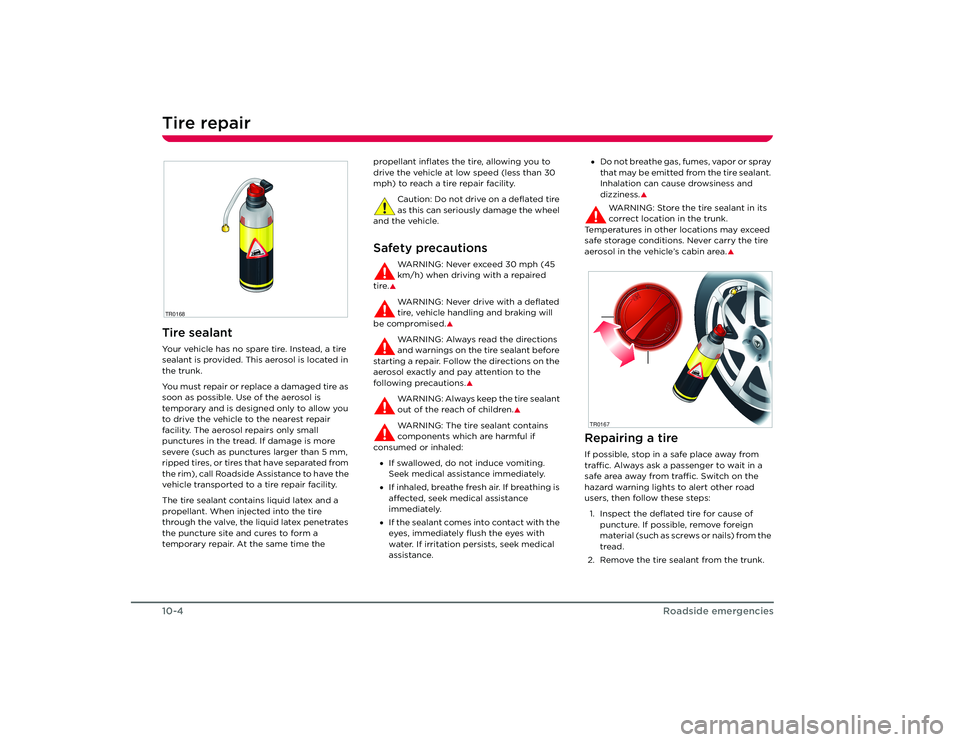
Tire repairTire sealantYour vehicle has no spare tire. Instead, a tire
sealant is provided. This aerosol is located in
the trunk.
You must repair or replace a damaged tire as
soon as possible. Use of the aerosol is
temporary and is designed only to allow you
to drive the vehicle to the nearest repair
facility. The aerosol repairs only small
punctures in the tread. If damage is more
severe (such as punctures larger than 5 mm,
ripped tires, or tires that have separated from
t h e r i m ) , c a l l R o a d s i d e A s s i s t a n c e t o h a ve t h e
vehicle transported to a tire repair facility.
The tire sealant contains liquid latex and a
propellant. When injected into the tire
through the valve, the liquid latex penetrates
the puncture site and cures to form a
temporary repair. At the same time the propellant inflates the tire, allowing you to
drive the vehicle at low speed (less than 30
mph) to reach a tire repair facility.
Caution: Do not drive on a deflated tire
as this can seriously damage the wheel
and the vehicle.
Safety precautions
WARNING: Never exceed 30 mph (45
km/h) when driving with a repaired
tire.SWARNING: Never drive with a deflated
tire, vehicle handling and braking will
be compromised.
S
WARNING: Always read the directions
and warnings on the tire sealant before
starting a repair. Follow the directions on the
aerosol exactly and pay attention to the
following precautions.
S
WARNING: Always keep the tire sealant
out of the reach of children.
S
WARNING: The tire sealant contains
components which are harmful if
consumed or inhaled:
• If swallowed, do not induce vomiting.
Seek medical assistance immediately.
• If inhaled, breathe fresh air. If breathing is
affected, seek medical assistance
immediately.
• If the sealant comes into contact with the
eyes, immediately flush the eyes with
water. If irritation persists, seek medical
assistance. •
Do not breathe gas, fumes, vapor or spray
that may be emitted from the tire sealant.
Inhalation can cause drowsiness and
dizziness.
S
WARNING: Store the tire sealant in its
correct location in the trunk.
Temperatures in other locations may exceed
safe storage conditions. Never carry the tire
aerosol in the vehicle’s cabin area.
S
Repairing a tireIf possible, stop in a safe place away from
traffic. Always ask a passenger to wait in a
safe area away from traffic. Switch on the
hazard warning lights to alert other road
users, then follow these steps:
1. Inspect the deflated tire for cause of puncture. If possible, remove foreign
material (such as screws or nails) from the
tread.
2. Remove the tire sealant from the trunk.
TR0168
TR0167
Roadster OHB.book Page 4 Th ursday, October 2, 2008 8:59 AM
Page 90 of 115
Vehicle recovery10-14
Roadside emergencies
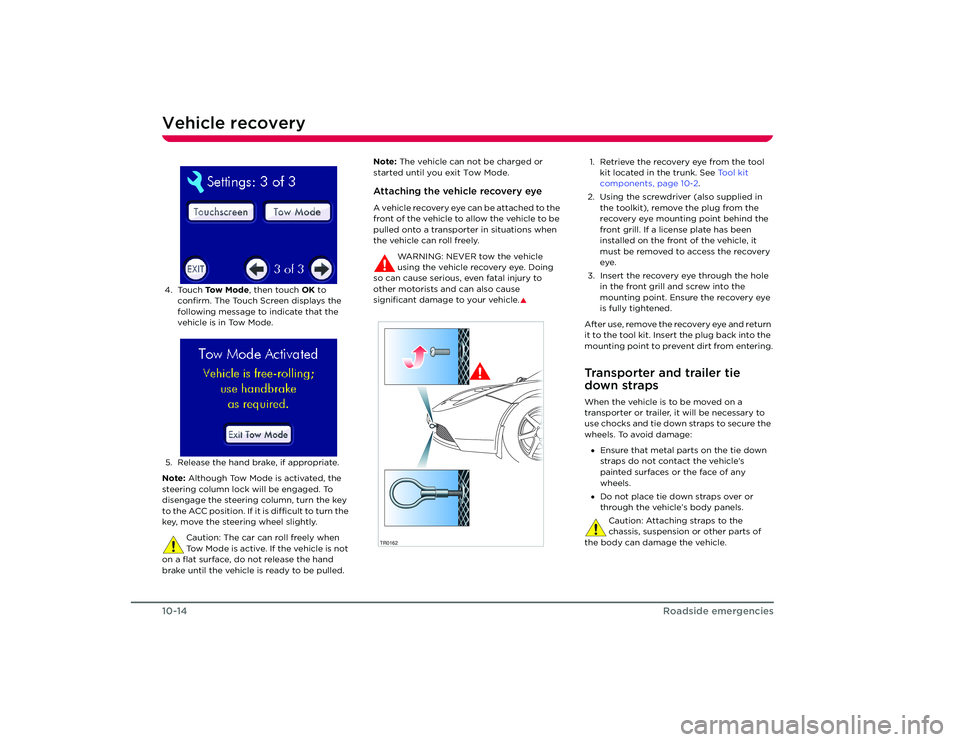
4. Touch To w M o d e , then touch OK to
confirm. The Touch Screen displays the
following message to indicate that the
vehicle is in Tow Mode.
5. Release the hand brake, if appropriate.
Note: Although Tow Mode is activated, the
steering column lock will be engaged. To
disengage the steering column, turn the key
to the ACC position. If it is difficult to turn the
key, move the steering wheel slightly.
Caution: The car can roll freely when
Tow Mode is active. If the vehicle is not
on a flat surface, do not release the hand
brake until the vehicle is ready to be pulled. Note:
The vehicle can not be charged or
started until you exit Tow Mode.
Attaching the vehicle recovery eyeA vehicle recovery eye can be attached to the
front of the vehicle to allow the vehicle to be
pulled onto a transporter in situations when
the vehicle can roll freely.
WARNING: NEVER tow the vehicle
using the vehicle recovery eye. Doing
so can cause serious, even fatal injury to
other motorists and can also cause
significant damage to your vehicle.
S
1. Retrieve the recovery eye from the tool kit located in the trunk. See Tool kit
components, page 10-2.
2. Using the screwdriver (also supplied in the toolkit), remove the plug from the
recovery eye mounting point behind the
front grill. If a license plate has been
installed on the front of the vehicle, it
must be removed to access the recovery
eye.
3. Insert the recovery eye through the hole in the front grill and screw into the
mounting point. Ensure the recovery eye
is fully tightened.
After use, remove the recovery eye and return
it to the tool kit. Insert the plug back into the
mounting point to prevent dirt from entering.Transporter and trailer tie
down strapsWhen the vehicle is to be moved on a
transporter or trailer, it will be necessary to
use chocks and tie down straps to secure the
wheels. To avoid damage: • Ensure that metal parts on the tie down
straps do not contact the vehicle’s
painted surfaces or the face of any
wheels.
• Do not place tie down straps over or
through the vehicle’s body panels.
Caution: Attaching straps to the
chassis, suspension or other parts of
the body can damage the vehicle.
TR0162
Roadster OHB.book Page 14 Thursday, October 2, 2008 8:59 AM
Page 98 of 115
Wheels and tires11-8Technical specificationsIn addition to the marking requirements,
passenger car tires must conform to Federal
Safety Requirements.
Note: Your vehicle is equipped with
directional tires. Therefore, you can see the
tire markings only on the outside of the
passenger tires. TreadwearThe treadwear grade is a comparative rating
based on the wear rate of the tire when
tested under controlled conditions on a
specified government test course.
For example; a tire graded 150 would wear
one and a half times as well on a government
test course as a tire graded 100. The relative
performance of tires depends on the actual
conditions of their use, however, and may
depart significantly from the norm due to
variations in driving habits, service practices,
and differences in road characteristics and
climate.Tra c t i o n
WARNING: The traction grade assigned
to this tire is based on straight-ahead
braking tests, and does not include;
acceleration, cornering, hydroplaning or peak
traction characteristics.
S
The traction grades, from highest to lowest,
are; AA, A, B, and C. These grades represent
a tire’s ability to stop on a wet pavement as
measured under controlled conditions on
specified government test surfaces of asphalt
and concrete. A tire marked C may have poor
traction performance.
Te m p e r a t u r e
WARNING: The temperature grade for
this tire is established for a tire that is
properly inflated and not overloaded.
Excessive speed, under-inflation, or excessive
loading, either separately or in combination,
can cause heat buildup and possible tire
failure.S
The temperature grades are A (the highest),
B, and C, representing the tire's resistance to
the generation of heat and its ability to
dissipate heat when tested under controlled
conditions on a specified indoor laboratory
test wheel.
Sustained high temperature can cause the
material of the tire to degenerate and reduce
tire life, and excessive temperature can lead
to sudden tire failure.
The grade C corresponds to a level of
performance which all passenger car tires
must meet under the Federal Motor Safety
Standard No. 109.
Grades B and A represent higher levels of
performance on the laboratory test wheel
than the minimum required by law.Tire care
WARNING: Defective tires are
dangerous. Do not drive if any tire is
damaged, is excessively worn, or is inflated to
an incorrect pressure.
S
Always consider tire conditions when driving,
and regularly inspect the tread and side walls
for any sign of distorti on (bulges), cuts or
wear.
The way you drive has a significant influence
on your safety and on the life of your tires.
Cultivate good habits for your own benefit:
• Observe posted speed limits.
• Avoid fast starts, stops and turns.
• Avoid potholes and objects in the road.
• Do not run over curbs or hit the tire
against the curb when parking.
Caution: Avoid contaminating tires with
vehicle fluids that can cause damage.Tire pressure information
WARNING: If the vehicle has been
parked in strong sunlight or used in high
ambient temperatures, do not reduce the tire
pressures. Move the vehicle into the shade and
allow the tires to cool before checking.
S
Correctly inflated tires will ensure that you
enjoy the best combination of vehicle range,
tire life, ride comfort and road handling.
Tire pressure should be checked when the
tires are cold. Inflate each tire to the pressure
recommended by Tesla Motors on the vehicle
placard, or tire inflation pressure label.
As an added safety feature, your
vehicle has been equipped with a tire
pressure monitoring system (TPMS) that
illuminates a tire pressure telltale when one or
more of your tires is significantly
under-inflated. Accordingly, when the low tire
Roadster OHB.book Page 8 Th ursday, October 2, 2008 8:59 AM
Page 100 of 115
Wheels and tires11-10
Technical specifications
Note: If tire wear is uneven (on one side of the
tire only) or becomes abnormally excessive,
the wheel alignment should be checked.Age degradationTires degrade over time due to the effects of
ultraviolet light, extreme temperatures, high
loads, and environmental conditions. It is
recommended that tires are replaced every
six years, or sooner if required.Punctured tiresYour vehicle is fitted with tubeless tires,
which may not leak when penetrated,
provided the object remains in the tire.
If, however, you feel a sudden vibration or ride
disturbance while driving, reduce your speed
and when safe to do so, stop and check for
the cause of the vibration.
A puncture will eventually cause the tire to
lose pressure, which is why frequent checking
of tire pressures is important. Punctured or
damaged tires must be permanently repaired
or replaced as soon as possible.
Directional tires
WARNING: Road holding will be
seriously impaired if directional tires
are incorrectly installed.
S
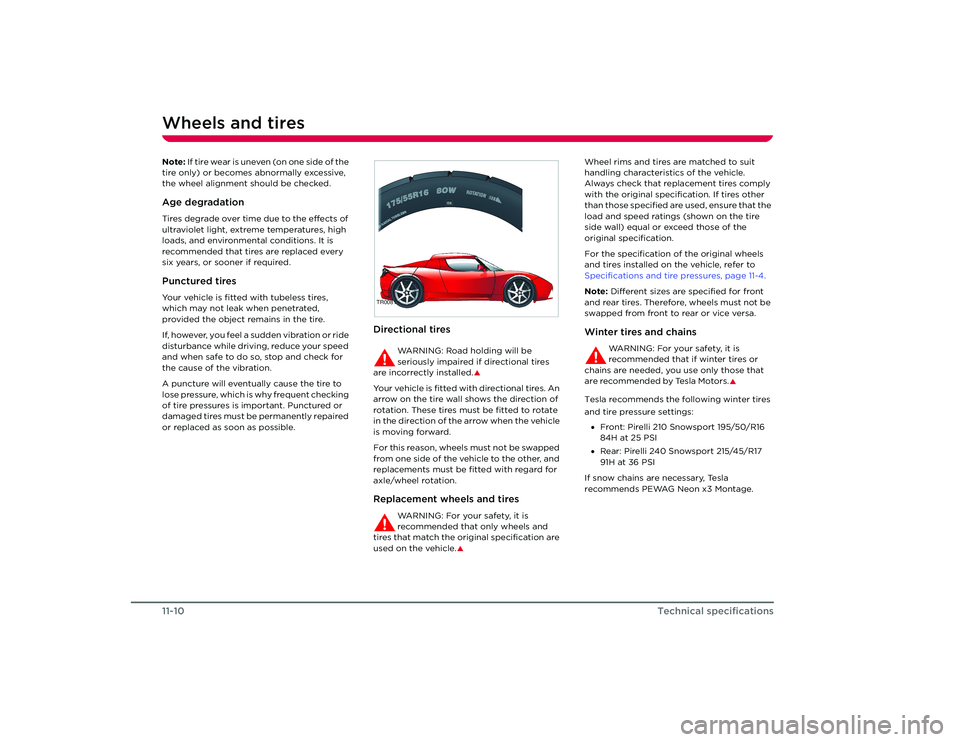
Your vehicle is fitted with directional tires. An
arrow on the tire wall shows the direction of
rotation. These tires must be fitted to rotate
in the direction of the arrow when the vehicle
is moving forward.
For this reason, wheels must not be swapped
from one side of the vehicle to the other, and
replacements must be fitted with regard for
axle/wheel rotation.Replacement wheels and tires
WARNING: For your safety, it is
recommended that only wheels and
tires that match the original specification are
used on the vehicle.
S
Wheel rims and tires are matched to suit
handling characteristics of the vehicle.
Always check that replacement tires comply
with the original specification. If tires other
than those specified are used, ensure that the
load and speed ratings (shown on the tire
side wall) equal or exceed those of the
original specification.
For the specification of the original wheels
and tires installed on the vehicle, refer to
Specifications and tire pressures, page 11-4.
Note: Different sizes are specified for front
and rear tires. Therefore, wheels must not be
swapped from front to rear or vice versa.Winter tires and chains
WARNING: For your safety, it is
recommended that if winter tires or
chains are needed, you use only those that
are recommended by Tesla Motors.
S
Tesla recommends the following winter tires
and tire pressure settings:
• Front: Pirelli 210 Snowsport 195/50/R16
84H at 25 PSI
• Rear: Pirelli 240 Snowsport 215/45/R17
91H at 36 PSI
If snow chains are necessary, Tesla
recommends PEWAG Neon x3 Montage.
ED RADIAL TUBELESS
G6
D
175/55R16 8OW ROTATION
ED RADIAL TUBELESS
G6
D
175/55R16 8OW ROTATION
ED RADIAL TUBELESS
G6
D
TR0081
Roadster OHB.book Page 10 Thursday, October 2, 2008 8:59 AM
Page 101 of 115
Wheels and tires
11-11
Technical specifications
Tire Pressure Monitoring
System
WARNING: The TPMS is not a substitute
for manually checking tire pressures.
The TPMS only provides a tire pressure
warning and does not re-inflate the tires.
S
WARNING: The TPMS cannot register
damage to a tire. Regularly check the
condition of your tires.
S
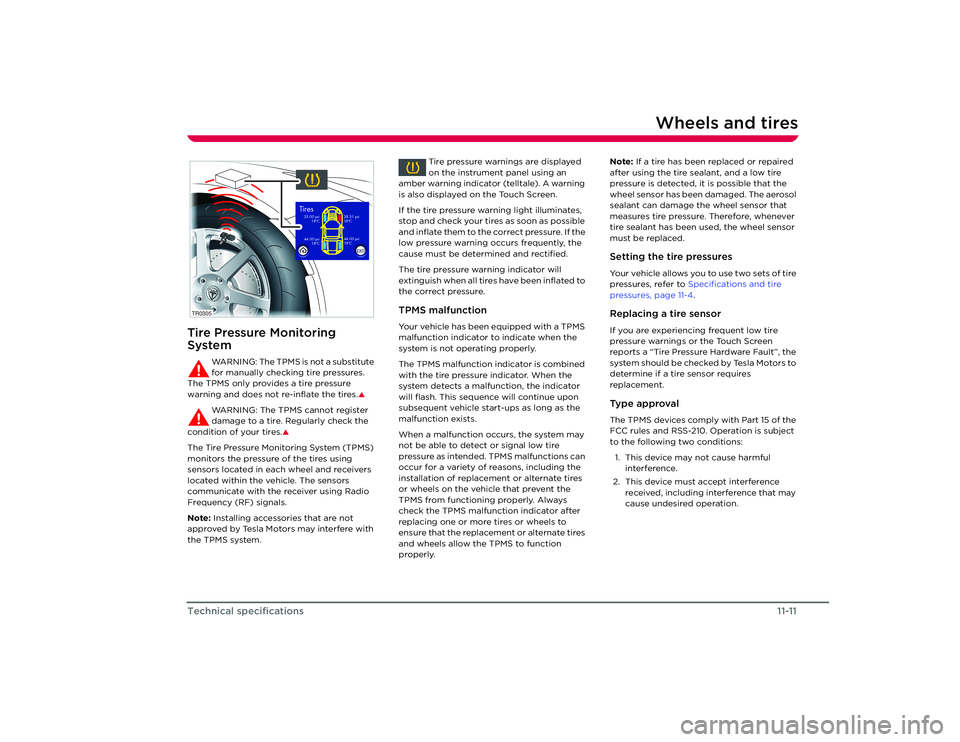
The Tire Pressure Monitoring System (TPMS)
monitors the pressure of the tires using
sensors located in each wheel and receivers
located within the vehicle. The sensors
communicate with the receiver using Radio
Frequency (RF) signals.
Note: Installing accessories that are not
approved by Tesla Motors may interfere with
the TPMS system. Tire pressure warnings are displayed
on the instrument panel using an
amber warning indicator (telltale). A warning
is also displayed on the Touch Screen.
If the tire pressure warning light illuminates,
stop and check your tires as soon as possible
and inflate them to the correct pressure. If the
low pressure warning occurs frequently, the
cause must be determined and rectified.
The tire pressure warning indicator will
extinguish when all tires have been inflated to
the correct pressure.
TPMS malfunctionYour vehicle has been equipped with a TPMS
malfunction indicator to indicate when the
system is not operating properly.
The TPMS malfunction indicator is combined
with the tire pressure indicator. When the
system detects a malfunction, the indicator
will flash. This sequence will continue upon
subsequent vehicle start-ups as long as the
malfunction exists.
When a malfunction occurs, the system may
not be able to detect or signal low tire
pressure as intended. TPMS malfunctions can
occur for a variety of reasons, including the
installation of replacement or alternate tires
or wheels on the vehicle that prevent the
TPMS from functioning properly. Always
check the TPMS malfunction indicator after
replacing one or more tires or wheels to
ensure that the replacement or alternate tires
and wheels allow the TPMS to function
properly. Note:
If a tire has been replaced or repaired
after using the tire sealant, and a low tire
pressure is detected, it is possible that the
wheel sensor has been damaged. The aerosol
sealant can damage the wheel sensor that
measures tire pressure. Therefore, whenever
tire sealant has been used, the wheel sensor
must be replaced.
Setting the tire pressuresYour vehicle allows you to use two sets of tire
pressures, refer to Specifications and tire
pressures, page 11-4 .Replacing a tire sensorIf you are experiencing frequent low tire
pressure warnings or the Touch Screen
reports a “Tire Pressure Hardware Fault”, the
system should be checked by Tesla Motors to
determine if a tire sensor requires
replacement.Type approvalThe TPMS devices comply with Part 15 of the
FCC rules and RSS-210. Operation is subject
to the following two conditions:
1. This device may not cause harmful interference.
2. This device must accept interference received, including interference that may
cause undesired operation.
TR0305
44.00 psi 18 Co33.00 psi18 Co
28.31 psi
18 Co44.00 psi
18 Co
Tires
EXIT
Roadster OHB.book Page 11 Thursday, October 2, 2008 8:59 AM
Page 110 of 115
Index
AAccessing your vehicle.................................... 4-2
Accessory power socket .................................7-7
Air conditioning.................................................. 7-4
Air distribution .................................................... 7-4
Air recirculation .................................................. 7-4
Air vents .................................................................7-5
AirbagsDeactivation ..................................................3-7
Deployment effects ................................... 3-6
Disposal information ................................. 3-8
General information .................................. 3-6
Obstruction of air bags .............................3-7
Safety information ..................................... 3-6
Service information ................................... 3-8
Warning indicator .......................................3-7
Warning labels..............................................3-7
Warnings ....................................................... 3-6
Alarm system Indicator light .............................................. 4-7
Operation ...................................................... 4-7
PIN code ........................................................ 4-8
Switching off ................................................ 4-7
Ammeter display................................................ 6-11
Antifreeze .................................................. 9-5, 11-14
Anti-lock Braking System (ABS) ................. 6-5
Anti-theft alarm .................................................. 4-7
Audio system ....................................................... 8-1BBattery ....................................................................5-2 Coolant ........................................................... 9-5
Environmental Note ...................................5-2
Fluid check and top-up ............................ 9-5
Preserving ..................................................... 5-3
Range .............................................................. 6-3
Specifications............................................. 11-19 Battery Life
Overview ........................................................ 5-2
Body Cleaning ......................................................... 9-7
Covering......................................................... 9-8
Polishing ......................................................... 9-8
Removing tar spots ................................... 9-7
Repairs ............................................................ 9-8
Brake warning indicator .................................. 6-5
Brake warning indicator light .......................6-12
Brakes Anti-Lock Braking System (ABS)......... 6-5
Emergency braking ................................... 6-6
Fluid specification .................................... 11-14
Fluid top-up .................................................. 9-4
Foot brake ..................................................... 6-5
Parking brake ............................................... 6-5
Regenerative braking................................ 6-5
Specifications ............................................. 11-18
Breakdown recovery ..................................... 10-13
Bulb replacement............................................. 10-9
Bulb specifications .......................................... 10-9
CCalifornia Proposition 65 ................................. 1-2
Car covers ............................................................. 9-8
Car washes ........................................................... 9-7
Cargo capacity.................................................... 11-7
Central door locking ......................................... 4-4
Chains ................................................................... 11-10
Change of ownership ........................................ 1-2
Charge level display.........................................6-12
Charging Charge level .................................................. 5-2
Charge settings ........................................... 5-4
Charge types ................................................ 5-4
Cost .................................................................. 5-5
Current limit.................................................. 5-4 High Power Connector ............................. 5-6
Performance setting .................................. 5-4
Range setting ............................................... 5-4
Standard setting ......................................... 5-4
Storage setting ............................................ 5-4
Storing your vehicle................................... 5-3
Charging indicator light ................................. 6-12
Charging port ...................................................... 5-6
Child passengers ................................................ 3-5
Child restraints .................................................... 3-5
Child seat air bag hazard ................................ 3-7
Child seats............................................................. 3-5
Cleaning Exterior ........................................................... 9-7
Interior............................................................. 9-8
Removing tar ................................................ 9-7
Roof.................................................................. 9-7
Underbody .................................................... 9-7
Wheels ............................................................ 9-8
Windshield, windows and mirrors ........ 9-8
Wiper blades ................................................ 9-8
Climate control.................................................... 7-4
Contacting NHTSA ............................................. 1-4
Coolant Battery ............................................................ 9-5
Specification ............................................... 11-14
Cost of charging ................................................. 5-5
Covering the vehicle ......................................... 9-8
Cruise control ...................................................... 6-9
Cruise control indicator lig ht ....................... 6-12
Cup holder ............................................................ 7-8
Current limit ......................................................... 5-4
DDashboard overview ......................................... 2-5
Data recording ..................................................... 1-2
Defrosting ............................................................. 7-5
Dimensions ......................................................... 11-15
Roadster OHB.book Page 1 Th ursday, October 2, 2008 8:59 AM