maintenance TESLA ROADSTER 2008 Owners Manual
[x] Cancel search | Manufacturer: TESLA, Model Year: 2008, Model line: ROADSTER, Model: TESLA ROADSTER 2008Pages: 115, PDF Size: 46.35 MB
Page 3 of 115
A WORD TO ROADSTER OWNERSThank you for choosing a Tesla Roadster. Not only have you chosen one of the finest sports cars on the road, you have also
chosen the most energy efficient sports car ever sold. You are participating in a revolution, demonstrating that kicking the oil
habit does not mean you have to give up performance and driving pleasure.
Take the time to get well acquainted with your Tesla Roadster by reading this manual. The more you know and understand
about your vehicle, the more safety and pleasure you’ll experience driving it.
Tesla’s cars are unique, and Tesla Motors knows your Tesla Roadster best. So when service or maintenance is required, Tesla
Motors is the place to go. Visit us regularly at www.teslamotors.com for more information about your Tesla Roadster. By signing
into the owners area of this web site, you can access all the information you need about your specific vehicle, including servi ce
information.
Enjoy your Tesla Roadster!
Te s l a M o t o r s
San Carlos, California, USA
Roadster OHB.book Page 1 Th ursday, October 2, 2008 8:59 AM
Page 4 of 115
Table of Contents
For information on how to use the Touch Screen, the High Power Connector, and the audio and
navigation systems, refer to the separate manuals provided in your owners package.Introduction and consumer information
Important notes about your vehicle 1-2
Important notes about this manual 1-3
Consumer information 1-4
Your vehicle at a glance Exterior 2-2
Interior 2-4
Seating an d safety restraints
Seats 3-2
Seat belts 3-3
Airbag system 3-6
Doors, locks, and s ecurity
Keys 4-2
Do ors
4-4
Trunk 4-6
Vehicle security 4-7
Charging your vehicle General information about charging 5-2
Charge settings 5-4
Charging components 5-6
Driving your vehicle Driving basics 6-2
Switches and controls 6-7
Instruments 6-11
Comfort and convenience Power windows 7-2
Rear view mirrors 7-3
Interior temperature control 7-4
Interior accessories 7-7
Removable roof 7-9
HomeLink® 7-15Audio and navigation systems
8-1
Maintenance and care Maintenance 9-2
Fluid reservoirs 9-4
Windshield wiper and washer 9-6
Cleaning and vehicle care 9-7
Roadside emergencies Tool kit 10-2
Energy Depletion 10-3
Tire repair 10-4
Wheels 10-6
Fuse replacement 10-7
Bulb replacement 10-9
Raising the vehicle 10-11
Vehicle recovery 10-13
Technical specifications Vehicle identification 11-2
Wheels and tires 11-4
Approved fluids and capacities 11-14
Vehicle dimensions and weights 11-15
Subsystem specifications 11-17
Roadster OHB.book Page 1 Thursday, October 2, 2008 8:59 AM
Page 69 of 115
9-1
Maintenance and careMaintenanceGeneral information 8-2
Routine maintenance 8-2
Owner maintenance 8-2
Opening and closing the hood 8-3
Fluid reservoirs Fluid reservoir locations 8-4
Brake fluid 8-4
Windshield washer fluid 8-5
Battery coolant 8-5
Windshield wiper and washer Checking the wiper blade 8-6
Replacing the wiper blade 8-6
Windshield washer jets 8-6
Cleaning and vehicle care Environmental precautions 8-7
Cleaning the vehicle exterior 8-7
Polishing the body 8-8
Using a car cover 8-8
Paint damage and rectification 8-8
Cleaning the vehicle interior 8-8
Roadster OHB.book Page 1 Th ursday, October 2, 2008 8:59 AM
Page 70 of 115
Maintenance9-2
Maintenance and care
Maintenance and care
MaintenanceGeneral informationRegular maintenance is the key to ensuring
the continued reliability and efficiency of
your vehicle.
Maintenance is the owner's responsibility and
you must ensure that the appropriate
maintenance is carried out when required
and according to the recommendations
specified by Tesla Motors.Routine maintenanceTake your vehicle to Tesla Motors at the
regularly scheduled maintenance intervals of
every 12 months, or every 12,000 miles,
whichever comes first.
Maintenance and service must be performed
by Tesla-certified technicians. Damages or
failures caused by maintenance or repairs
performed by non-Tesla certified technicians
are not covered under the New Vehicle
Limited Warranty.
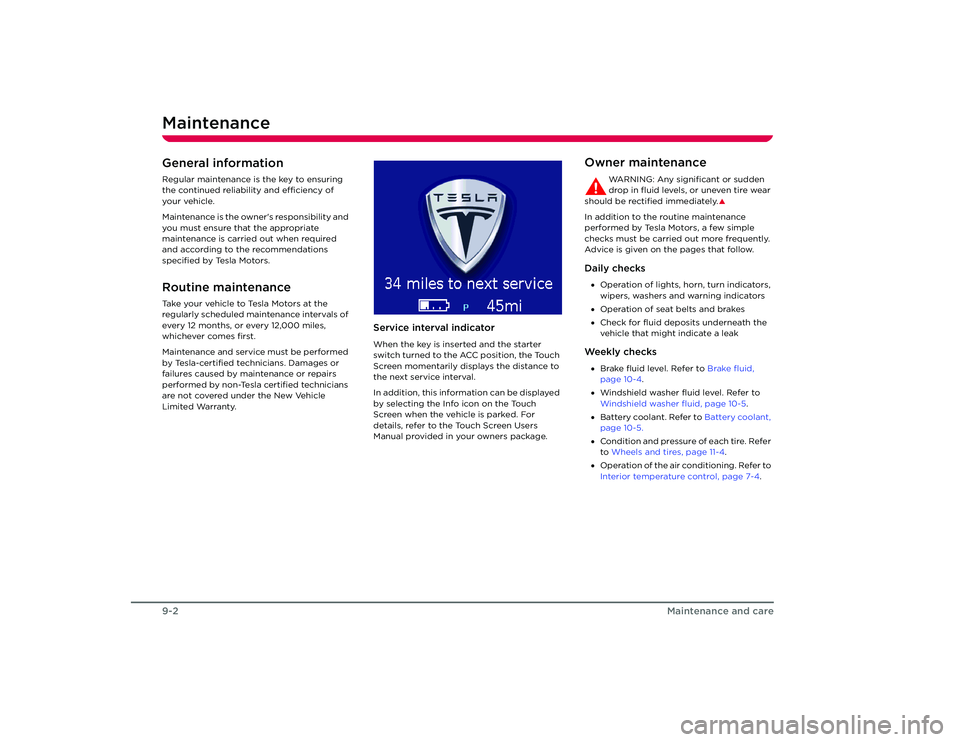
Service interval indicatorWhen the key is inserted and the starter
switch turned to the ACC position, the Touch
Screen momentarily displays the distance to
the next service interval.
In addition, this information can be displayed
by selecting the Info icon on the Touch
Screen when the vehicle is parked. For
details, refer to the Touch Screen Users
Manual provided in your owners package.
Owner maintenance
WARNING: Any significant or sudden
drop in fluid levels, or uneven tire wear
should be rectified immediately.
S
In addition to the routine maintenance
performed by Tesla Motors, a few simple
checks must be carried out more frequently.
Advice is given on the pages that follow.Daily checks• Operation of lights, horn, turn indicators,
wipers, washers and warning indicators
• Operation of seat belts and brakes
• Check for fluid deposits underneath the
vehicle that might indicate a leakWe e k l y c h e c k s•Brake fluid level. Refer to Brake fluid,
page 10-4 .
• Windshield washer fluid level. Refer to
Windshield washer fluid, page 10-5 .
• Battery coolant. Refer to Battery coolant,
page 10-5.
• Condition and pressure of each tire. Refer
to Wheels and tires, page 11-4 .
• Operation of the air conditioning. Refer to
Interior temperature control, page 7-4.
Roadster OHB.book Page 2 Th ursday, October 2, 2008 8:59 AM
Page 71 of 115
Maintenance
9-3
Maintenance and care
TR0043
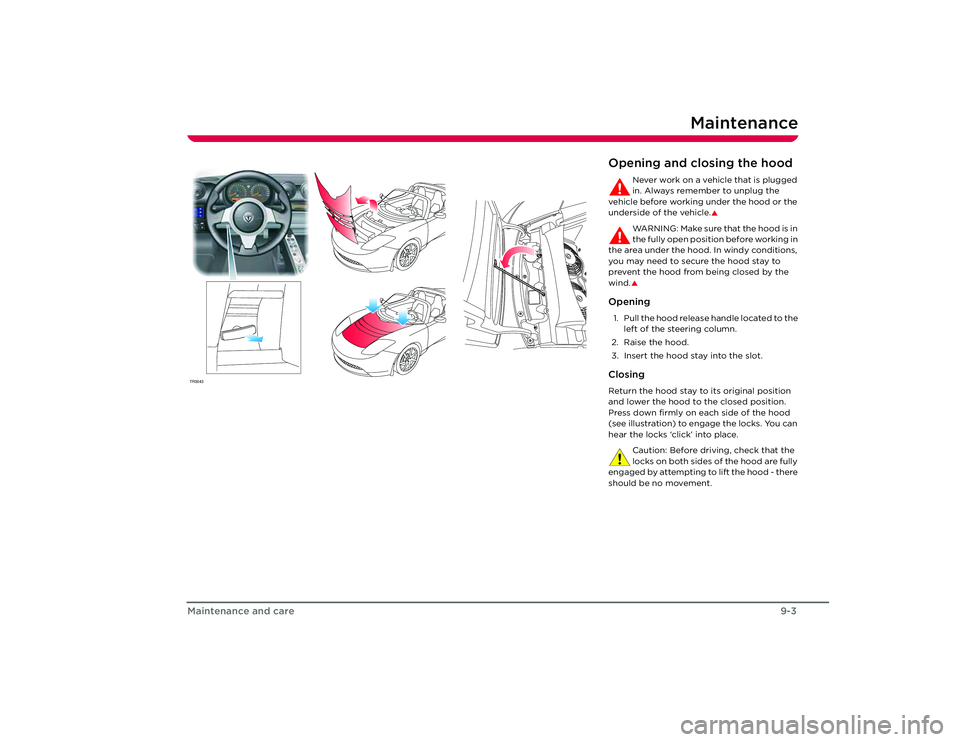
Opening and closing the hood
Never work on a vehicle that is plugged
in. Always remember to unplug the
vehicle before working under the hood or the
underside of the vehicle.
S
WA R N I N G : M a ke s u re t h a t t h e h o o d i s i n
the fully open position before working in
the area under the hood. In windy conditions,
you may need to secure the hood stay to
prevent the hood from being closed by the
wind.S
Opening1. Pull the hood release handle located to the left of the steering column.
2. Raise the hood.
3. Insert the hood stay into the slot.ClosingReturn the hood stay to its original position
and lower the hood to the closed position.
Press down firmly on ea ch side of the hood
(see illustration) to engage the locks. You can
hear the locks ‘click’ into place.
Caution: Before driving, check that the
locks on both sides of the hood are fully
engaged by attempting to lift the hood - there
should be no movement.
Roadster OHB.book Page 3 Th ursday, October 2, 2008 8:59 AM
Page 72 of 115
Fluid reservoirs9-4
Maintenance and care
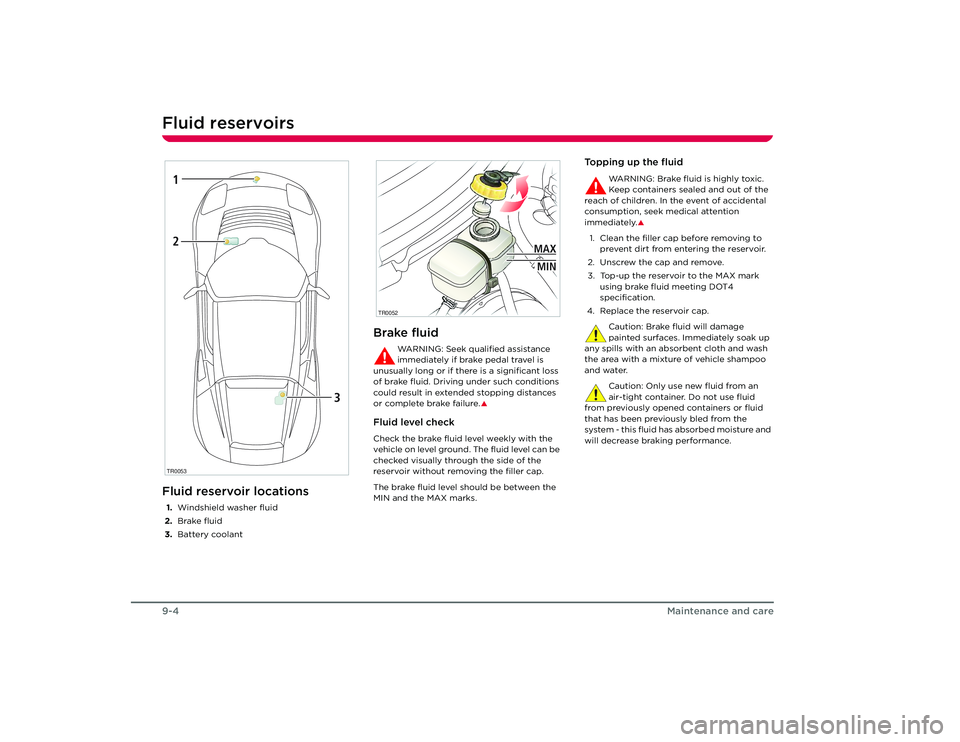
Fluid reservoirsFluid reservoir locations1.Windshield washer fluid
2. Brake fluid
3. Battery coolant
Brake fluid
WARNING: Seek qualified assistance
immediately if brake pedal travel is
unusually long or if there is a significant loss
of brake fluid. Driving under such conditions
could result in extended stopping distances
or complete brake failure.
S
Fluid level checkCheck the brake fluid level weekly with the
vehicle on level ground. The fluid level can be
checked visually through the side of the
reservoir without removing the filler cap.
The brake fluid level should be between the
MIN and the MAX marks.
Topping up the fluid
WARNING: Brake fluid is highly toxic.
Keep containers sealed and out of the
reach of children. In the event of accidental
consumption, seek medical attention
immediately.
S
1. Clean the filler cap before removing to prevent dirt from entering the reservoir.
2. Unscrew the cap and remove.
3. Top-up the reservoir to the MAX mark using brake fluid meeting DOT4
specification.
4. Replace the reservoir cap.
Caution: Brake fluid will damage
painted surfaces. Immediately soak up
any spills with an absorbent cloth and wash
the area with a mixtur e of vehicle shampoo
and water.
Caution: Only use new fluid from an
air-tight container. Do not use fluid
from previously opened containers or fluid
that has been previously bled from the
system - this fluid has absorbed moisture and
will decrease braking performance.
TR00531
2
3
TR0052
MAXMIN
Roadster OHB.book Page 4 Th ursday, October 2, 2008 8:59 AM
Page 73 of 115
Fluid reservoirs
9-5
Maintenance and care
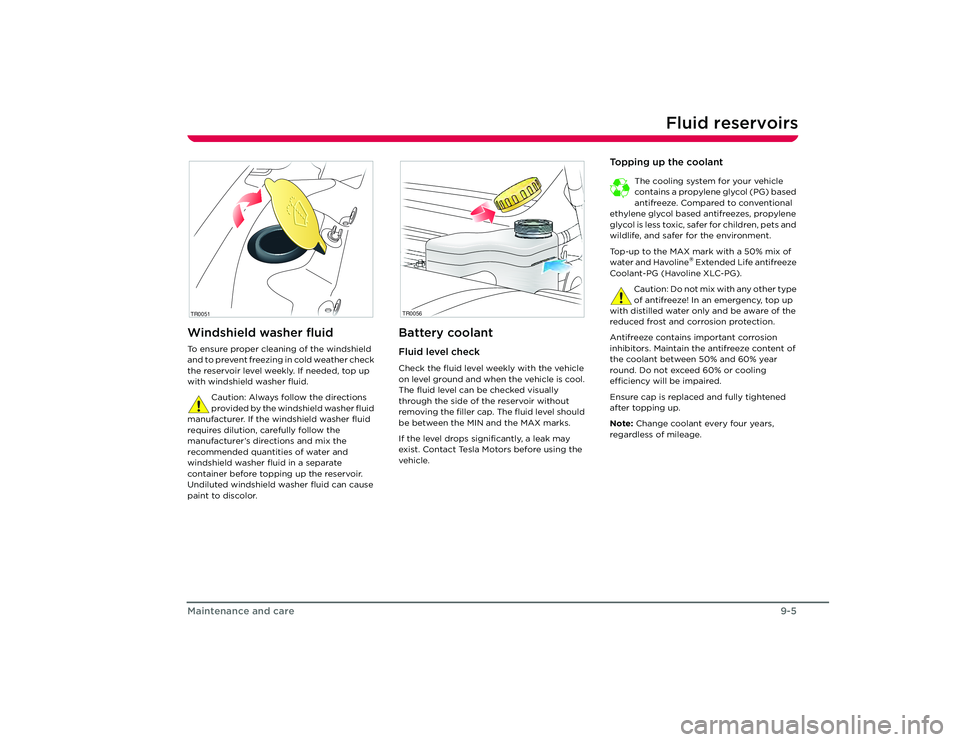
Windshield washer fluidTo ensure proper cleaning of the windshield
and to prevent freezing in cold weather check
the reservoir level weekly. If needed, top up
with windshield washer fluid.
Caution: Always follow the directions
provided by the windshield washer fluid
manufacturer. If the windshield washer fluid
requires dilution, carefully follow the
manufacturer’s directions and mix the
recommended quantities of water and
windshield washer fluid in a separate
container before topping up the reservoir.
Undiluted windshield washer fluid can cause
paint to discolor.
Battery coolantFluid level checkCheck the fluid level weekly with the vehicle
on level ground and when the vehicle is cool.
The fluid level can be checked visually
through the side of the reservoir without
removing the filler cap. The fluid level should
be between the MIN and the MAX marks.
If the level drops significantly, a leak may
exist. Contact Tesla Motors before using the
vehicle.
To p p i n g u p t h e c o o l a n t
The cooling system for your vehicle
contains a propylene glycol (PG) based
antifreeze. Compared to conventional
ethylene glycol based antifreezes, propylene
glycol is less toxic, sa fer for children, pets and
wildlife, and safer for the environment.
Top-up to the MAX mark with a 50% mix of
water and Havoline
® Extended Life antifreeze
Coolant-PG (Havoline XLC-PG).
Caution: Do not mix with any other type
of antifreeze! In an emergency, top up
with distilled water only and be aware of the
reduced frost and corrosion protection.
Antifreeze contains important corrosion
inhibitors. Maintain the antifreeze content of
the coolant between 50% and 60% year
round. Do not exceed 60% or cooling
efficiency will be impaired.
Ensure cap is replaced and fully tightened
after topping up.
Note: Change coolant every four years,
regardless of mileage.
TR0051
TR0056
Roadster OHB.book Page 5 Th ursday, October 2, 2008 8:59 AM
Page 74 of 115
Windshield wiper and washer9-6
Maintenance and care
Windshield wiper and washerChecking the wiper bladePeriodically check and clean the wiping edge
of the wiper blade.
Check the blade rubber for cracks, splits and
roughness. If any damage, wear or roughness
is detected, replace immediately to prevent
damage to the glass.
Clean the blade edge by wiping with a soft
cloth or sponge, using warm soapy water.
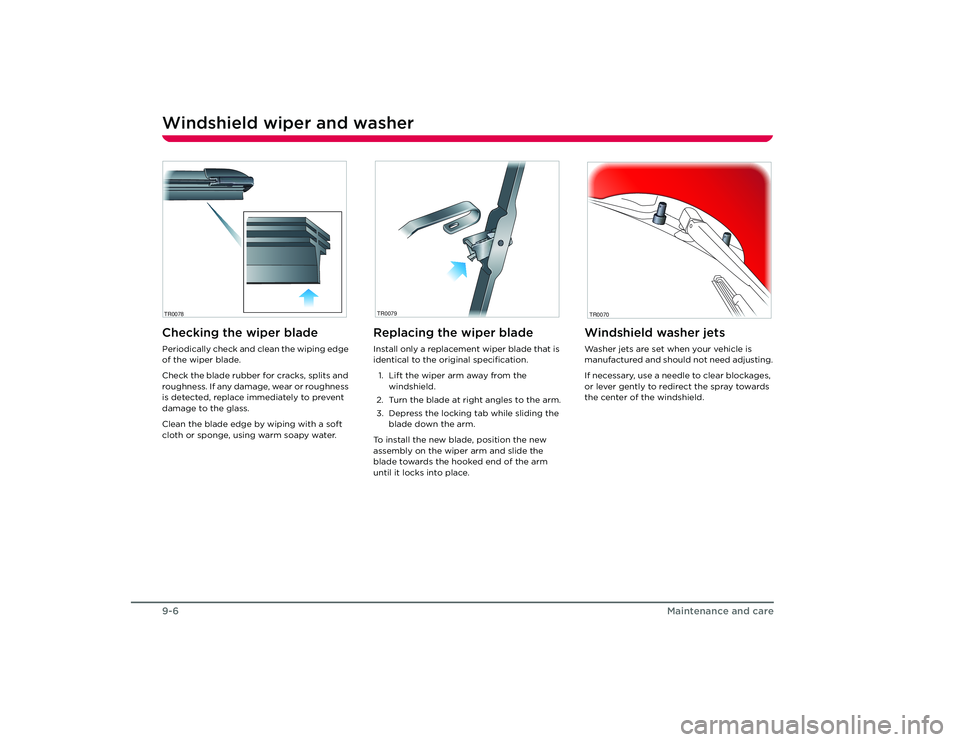
Replacing the wiper bladeInstall only a replacement wiper blade that is
identical to the original specification.1. Lift the wiper arm away from the windshield.
2. Turn the blade at right angles to the arm.
3. Depress the locking tab while sliding the blade down the arm.
To install the new blade, position the new
assembly on the wiper arm and slide the
blade towards the hooked end of the arm
until it locks into place.
Windshield washer jetsWasher jets are set when your vehicle is
manufactured and should not need adjusting.
If necessary, use a needle to clear blockages,
or lever gently to redirect the spray towards
the center of the windshield.
TR0078
TR0079
TR0070
Roadster OHB.book Page 6 Th ursday, October 2, 2008 8:59 AM
Page 75 of 115
Cleaning and vehicle care
9-7
Maintenance and care
Cleaning and vehicle careEnvironmental precautions
Some cleaning products contain
chemicals that are hazardous to the
environment. Always take precautions
to prevent fluids from spilling.
It is illegal to pollute drains, rivers and
waterways. Used toxic chemicals must be
disposed of at authorized waste disposal
sites only.
Cleaning the vehicle exteriorHand washing
Caution: Substances that are corrosive,
such as bird droppings, tree resin, dead
insects, tar spots, road salt and industrial
fall-out can damage the vehicle's paint.
Remove such deposits as soon as possible to
prevent damage. To preserve the paint finish, observe the
following:
• Before washing, use a hose to remove
heavy deposits of mud and dirt.
• Never wash a vehicle that is “hot to the
touch” or during exposure to strong,
direct sunlight.
• Wash the body using cold or lukewarm
water containing a good quality wash and
wax shampoo.
• Never use strong household detergents
or soap. These products can discolor and
spot painted surfaces.
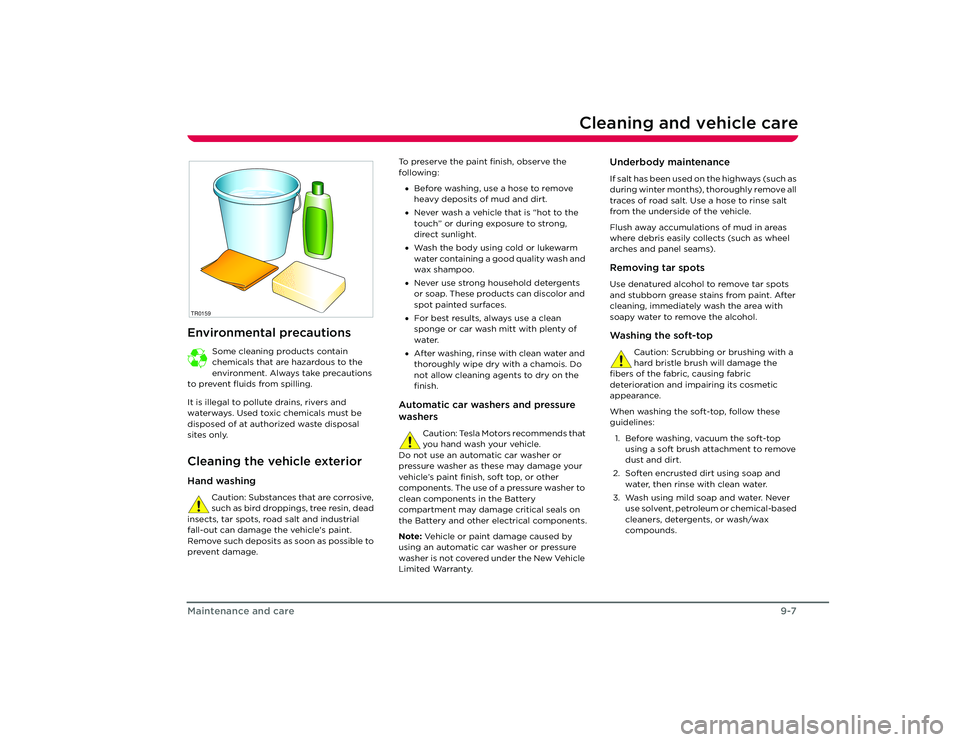
• For best results, always use a clean
sponge or car wash mitt with plenty of
water.
• After washing, rinse with clean water and
thoroughly wipe dry with a chamois. Do
not allow cleaning agents to dry on the
finish.
Automatic car washers and pressure
washers
Caution: Tesla Motors recommends that
you hand wash your vehicle.
Do not use an automatic car washer or
pressure washer as these may damage your
vehicle’s paint finish, soft top, or other
components. The use of a pressure washer to
clean components in the Battery
compartment may damage critical seals on
the Battery and other electrical components.
Note: Vehicle or paint damage caused by
using an automatic car washer or pressure
washer is not covered under the New Vehicle
Limited Warranty.
Underbody maintenanceIf salt has been used on the highways (such as
during winter months), thoroughly remove all
traces of road salt. Use a hose to rinse salt
from the underside of the vehicle.
Flush away accumulations of mud in areas
where debris easily collects (such as wheel
arches and panel seams).Removing tar spotsUse denatured alcohol to remove tar spots
and stubborn grease stains from paint. After
cleaning, immediately wash the area with
soapy water to remove the alcohol.Washing the soft-top
Caution: Scrubbing or brushing with a
hard bristle brush will damage the
fibers of the fabric, causing fabric
deterioration and impairing its cosmetic
appearance.
When washing the soft-top, follow these
guidelines:
1. Before washing, vacuum the soft-top using a soft brush attachment to remove
dust and dirt.
2. Soften encrusted dirt using soap and water, then rinse with clean water.
3. Wash using mild soap and water. Never use solvent, petroleum or chemical-based
cleaners, detergents, or wash/wax
compounds.
TR0159
Roadster OHB.book Page 7 Th ursday, October 2, 2008 8:59 AM
Page 76 of 115
Cleaning and vehicle care9-8
Maintenance and care
WheelsWash wheels with warm, fresh water
containing a good quality wash and wax
shampoo. Thoroughly rinse the wheels to
remove any soap residue.Windshield, windows and mirrorsRegularly clean all windows inside and out
using a window cleaning solution. An
automotive glass cleaner is recommended.
After washing the vehicle with wash/wax
products, clean the outside of the windshield
with glass cleaner.
Mirror glass is particularly susceptible to
damage. Do not use abrasive cleaning
compounds.Wiper bladesClean wiper blades using mild soap and warm
water only. Do not use petroleum or
alcohol-based cleaners.
Polishing the bodyTo preserve the cosmetic appearance of the
body, occasionally apply a good quality
polish. A good polish should contain a very
mild abrasive that removes surface
contamination without damaging the
surface, a mild filling compound to reduce the
appearance of scratches, and wax to provide
a barrier between the cleaned body surface
and airborne contaminants.
Do not use cutting paste, color restoration
compounds, or polishes containing a harsh
abrasive. These can scour the surface and
permanently degrade the body.Using a car coverTo preserve the cosmetic appearance of the
body, you may want to use a car cover. Only
an approved Tesla Motors car cover should be
used. DONOT use the car cover when
charging the vehicle. Doing so can interfere
with adequate cooling during charging.Paint damage and rectificationTreat chips and scratches to the paint using a
paint touch-up pen. Use the touch-up pen
after washing but before polishing or waxing.
More extensive repairs to the body should
only be carried out by a facility approved by
Tesla Motors. Contact Tesla Motors for a list of
approved body repair facilities.
Cleaning the vehicle interiorPlastic materials
Caution: Do not polish the upper
surfaces of the dashboard. Polished
surfaces are reflective and may interfere with
the driver's view.
Clean with diluted upholstery cleaner, then
wipe with a damp cloth.
Carpet and fabricsClean with diluted upholstery cleaner. Test a
concealed area first.LeatherClean with warm water and a non-detergent
soap. Dry and polish with a dry, clean,
lint-free cloth.Seat beltsExtend the belts and clean with warm, soapy,
fresh water only. Do not use any type of
detergent or chemical cleaning agent. Allow
the belts to dry naturally while extended,
preferably away from direct sunlight.Instruments and display screensClean the instrument panel, Touch Screen,
and audio system screen using a damp cloth.
Do not use cleaning co mpounds or solutions.
Roadster OHB.book Page 8 Th ursday, October 2, 2008 8:59 AM