brake light TOYOTA 4RUNNER 1996 User Guide
[x] Cancel search | Manufacturer: TOYOTA, Model Year: 1996, Model line: 4RUNNER, Model: TOYOTA 4RUNNER 1996Pages: 217, PDF Size: 4.49 MB
Page 76 of 217
73
While the vehicle is moving, never
attempt to move the selector lever
into Pº position under any circum-
stances. Serious mechanical dam-
age and loss of vehicle control mayresult.CAUTION
!
(f) Good driving practice If the transmission is repeatedly up-
shifted and downshifted between third
gear and overdrive when climbing a
gentle slope, the overdrive switch
should be turned off. Be sure to turn the switch on immediately afterward.
When towing a trailer, in order to main-
tain engine braking efficiency, do notuse overdrive.
Always keep your foot on the brake
pedal while stopped with the engine
running. This prevents the vehicle
from creeping. CAUTION
!
NOTICE
Do not hold the vehicle on an upgrade with the accelerator pedal.
It can cause the transmission tooverheat. Always use the brake pedal or parking brake.
(g) Driving in PWRº(Power) mode
In the PWRº mode, the transmission is shifted up and down at a higher vehicle
speed than in the NORMº (Normal) mode
and a more powerful acceleration is
achieved. To set the PWRº mode, push
in the driving pattern selector button. The
PWRº mode indicator light comes on.
For ordinary driving, Toyota recommends
using the NORMº mode to improve fuel
economy.
(h) If you cannot shift the selector lever
out of Pº position
If you cannot shift the selector lever from the Pº position even though the brake
pedal is depressed, use the shift lock
override lever. For instructions, see If you
cannot shift automatic transmission se- lector leverº in Part 4.
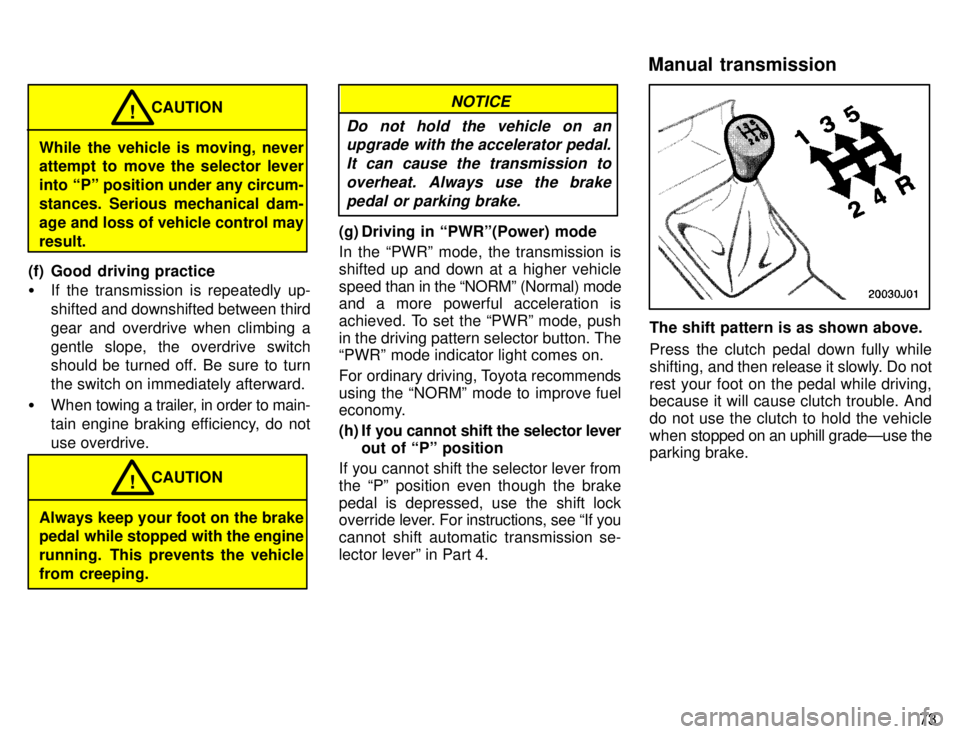
The shift pattern is as shown above.
Press the clutch pedal down fully while
shifting, and then release it slowly. Do not
rest your foot on the pedal while driving, because it will cause clutch trouble. And do not use the clutch to hold the vehicle
when stopped on an uphill gradeÐuse the
parking brake.
Manual transmission
Page 81 of 217
78SHIFTING BETWEEN H2º AND H4º
To shift from H2º to H4º
, move the
front drive control lever.
This can be done when the vehicle is stopped, or moving straight ahead at
speeds of 40 km/h (25 mph) or less. If you
have trouble shifting, depress or release the accelerator pedal momentarily while
pushing the front drive control lever.
Never move the front drive control
lever if wh eels are slipping. Stop the
slipping or spinning before shifting. CAUTION
!
To shift from H4º to H2º , simply move
the front drive control lever. This can be done at any vehicle speed.
If the indicator light does not go off when you shift the transfer into H2º, drive
straight ahead while accelerating or de-celerating, or drive in reverse. With A.D.D.
To shift from H2º to H4º
, reduce your
speed to less than 80 km/h (50 mph) and
move the front drive control lever.
If you have trouble shifting in cold weath-
er, reduce your speed or stop the vehicleand reshift.Never move the front drive control
lever if wheels are slipping. Stop the
slipping or spinning before shifting. CAUTION
!
To shift from H4º to H2º , simply move
the front drive control lever. This can be done at any vehicle speed.
If the indicator light does not go off when you shift the transfer into H2º, drive
straight ahead while accelerating or de- celerating, or drive in reverse. SHIFTING BETWEEN H4º AND L4º
To shift between H4º and L4º , stop
the vehicle and put the transmission in
Nº. With your foot holding down the brake
pedal, move the front drive control lever. SHIFTING BETWEEN H2º AND H4º
To shift from H2º to H4º
, reduce your
speed to less than 100 km/h (62 mph) and
push in the 4WDº button.
If the indicator light does not come on
when you push in the 4WDº button, drive
straight ahead while accelerating or de- celerating.
If the indicator light flashes and the buzzer
sounds when you push in the 4WDº but-
ton, reduce your speed or stop the vehicle
and reset.
Never push the 4WDº button if
wheels are slipping. Stop the slip-
ping or spinning before shifting. CAUTION
!
(c) Shifting procedure (lever/button type)
(c) Shifting procedure (levertype with automatic transmission)
Page 82 of 217

79
To shift from H4º to H2º
, push the
4WDº button again to turn it off. This can be done at any vehicle speed.
If the indicator light does not go off when you shift the transfer into H2º, drive
straight ahead while accelerating or de-celerating, or drive in reverse.
SHIFTING BETWEEN H2º OR H4º
AND L4º
To shift from H2º or H4º to L4º , stop
the vehicle and put the transmission in
Nº. With your foot holding down the brake
pedal, move the front drive control lever.
To shift from L4º to H2º or H4º , stop
the vehicle and put the transmission in
Nº. With your foot holding down the brake
pedal, move the front drive control lever.
When the 4WDº button is pushed in, the
transfer shifts into H4º; when the buttonis left out, the transfer shifts into H2º
If the indicator light does not go off when you shift the transfer into H2º, drive
straight ahead while accelerating or de- celerating, or drive in reverse.
The rear differential lock system is
provided for use only when wheel
spinning occurs in a ditch or on a slip-
pery or ragged surface.
This differential lock system is effective in case one of the rear wheels is spinning.
Before using the rear differential lock sys-
tem, first shift the front drive control into
L4º to see if it works. If this has no ef fect,
additionally use the rear differential lock system.
Do not use the rear differential lock
in the conditions other than above.
Large steering effort and careful
cornering control will be required. CAUTION
!
Rear differential lock system
Page 83 of 217
80
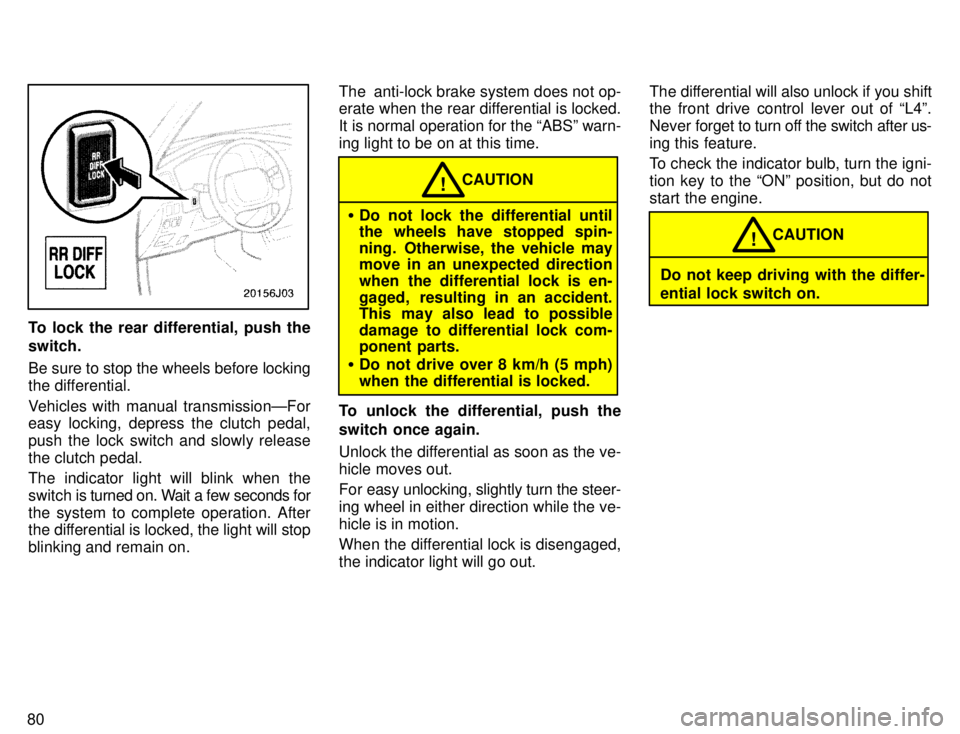
To lock the rear differential, push the switch.
Be sure to stop the wheels before locking
the differential.
Vehicles with manual transmissionÐFor
easy locking, depress the clutch pedal,
push the lock switch and slowly releasethe clutch pedal.
The indicator light will blink when the
switch is turned on. Wait a few seconds for
the system to complete operation. After
the differential is locked, the light will stop
blinking and remain on. The anti-lock brake system does not op-
erate when the rear differential is locked.
It is normal operation for the ABSº warn-
ing light to be on at this time.
Do not lock the differential until
the wheels have stopped spin-
ning. Otherwise, the vehicle may
move in an unexpected direction
when the differential lock is en-
gaged, resulting in an accident.
This may also lead to possible
damage to differential lock com-
ponent parts.
Do not drive over 8 km/h (5 mph)
when the differential is locked. CAUTION
!
To unlock the differential, push the
switch once again.
Unlock the differential as soon as the ve- hicle moves out.
For easy unlocking, slightly turn the steer-
ing wheel in either direction while the ve-hicle is in motion.
When the differential lock is disengaged, the indicator light will go out. The differential will also unlock if you shift
the front drive control lever out of L4º. Never
forget to turn off the switch after us-
ing this feature.
To check the indicator bulb, turn the igni-
tion key to the ONº position, but do not
start the engine.
Do not keep driving with the differ- ential lock switch on. CAUTION
!
Page 84 of 217
81
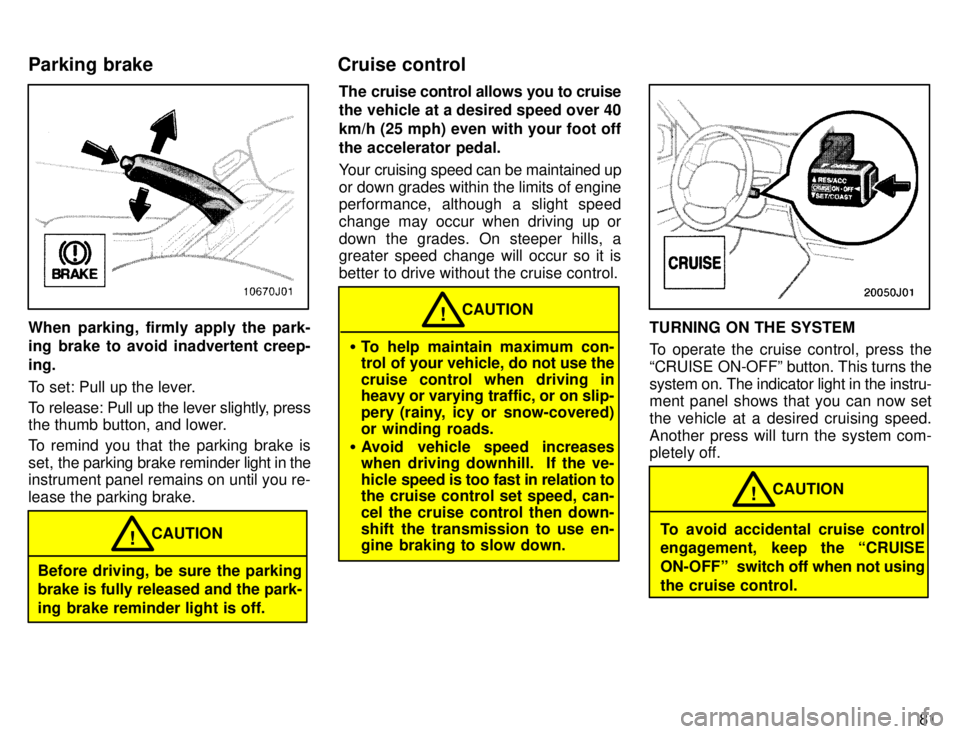
When parking, firmly apply the park-
ing brake to avoid inadvertent creep- ing.
To set: Pull up the lever.
To release: Pull up the lever slightly, press
the thumb button, and lower.
To remind you that the parking brake is
set, the parking brake reminder light in the
instrument panel remains on until you re-lease the parking brake.
Before driving, be sure the parking brake is fully released and the park-
ing brake reminder light is off. CAUTION
! The cruise control allows you to cruise
the vehicle at a desired speed over 40 km/h (25 mph) even with your foot offthe accelerator pedal.
Your cruising speed can be maintained up
or down grades within the limits of engine
performance, although a slight speed
change may occur when driving up or
down the grades. On steeper hills, a greater speed change will occur so it is
better to drive without the cruise control.
To help maintain maximum con-
trol of your vehicle, do not use the
cruise control when driving in heavy or varying traffic, or on slip-
pery (rainy, icy or snow-covered)
or winding roads.
Avoid vehicle speed increases
when driving downhill. If the ve-
hicle speed is too fast in relation to
the cruise control set speed, can-
cel the cruise control then down-
shift the transmission to use en-
gine braking to slow down. CAUTION
!TURNING ON THE SYSTEM
To operate the cruise control, press the
CRUISE ON-OFFº button. This turns thesystem on. The indicator light in the instru-
ment panel shows that you can now set
the vehicle at a desired cruising speed.
Another press will turn the system com-
pletely off.
To avoid accidental cruise control
engagement, keep the CRUISE
ON-OFFº
switch off when not using
the cruise control. CAUTION
!
Parking brake Cruise control
Page 86 of 217

83
On vehicles with automatic transmission,
even if you turn off the overdrive switch with the cruise control on, engine braking
will
not be applied because the cruise con-
trol is not cancelled. To decrease the ve-
hicle speed, reset to a slower speed with
the cruise control lever or depress the brake pedal. If you use the brake pedal, cruise control is cancelled. RESUMING THE PRESET SPEED
If the preset speed is cancelled by pulling
the control lever or by depressing the
brake pedal or clutch pedal, pushing the
lever up in the RES/ACCº direction will
restore the speed set prior to cancellation.
However, once the vehicle speed falls be-
low about 40 km/h (25 mph), the preset
speed will not be resumed.
CRUISE CONTROL FAILURE WARN- ING
If the CRUISEº indicator light in the in-
strument cluster flashes when using the
cruise control, press the CRUISE ON-
OFFº button to turn the system off and then press it again to turn it on. If any of the following conditions then oc-
curs, there is some trouble in the cruise control system.
The indicator light does not come on.
The indicator light flashes again.
The indicator light goes out after it
comes on.
If this is the case, contact your Toyota
dealer and have your vehicle inspected.
To crank the engine without depress- ing the clutch pedal, push the switch
with the ignition on.
The switch stays on as long as the ignition
is on. And it will automatically turn off
when the ignition is off.
This switch cancels the clutch start sys-
tem, which is designed to keep the starter
motor from operating if the clutch pedal is
not depressed all the way down.
The switch allows the vehicle to be driven
out of difficult situations by cranking the
engine with the clutch engaged.
Clutch start cancel switch (four-wheel drive modelswith manual transmission)
Page 136 of 217
133
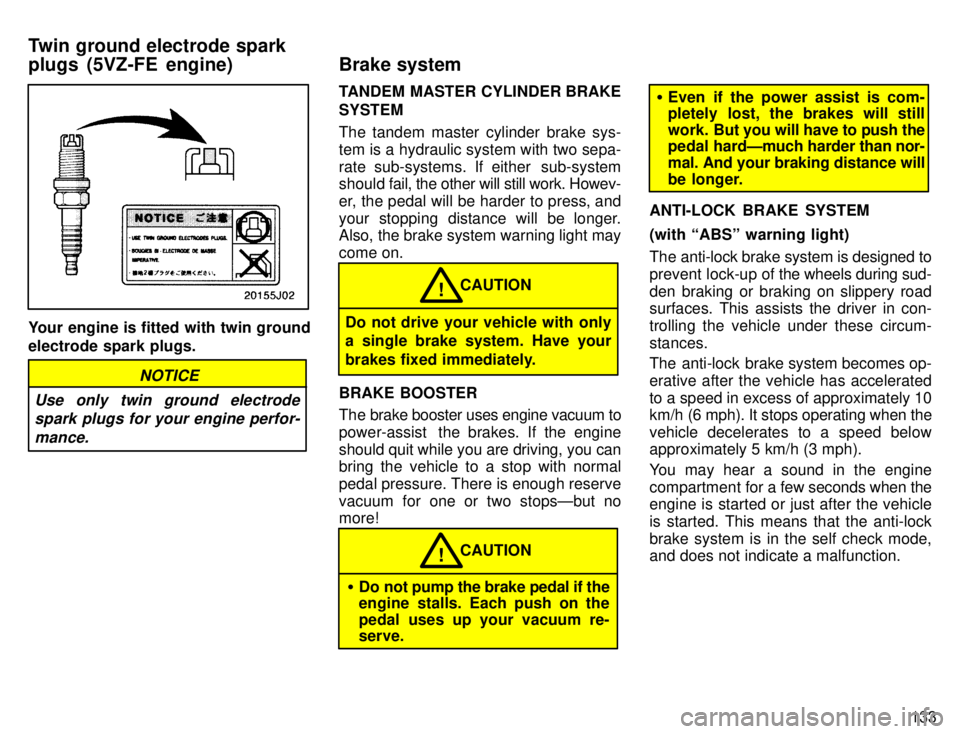
Your engine is fitted with twin ground electrode spark plugs.
NOTICE
Use only twin ground electrode spark plugs for your engine perfor-
mance.
TANDEM MASTER CYLINDER BRAKE SYSTEM
The tandem master cylinder brake sys-
tem is a hydraulic system with two sepa-
rate sub-systems. If either sub-system
should fa il, the other will still work. Howev-
er, the pedal will be harder to press, and
your stopping distance will be longer.
Also, the brake system warning light may come on.
CAUTION!
Do not drive your vehicle with only a single brake system. Have your
brakes fixed immediately.
BRAKE BOOSTER
The brake booster uses engine vacuum to
power-assist the brakes. If the engine
should quit while you are driving, you can
bring the vehicle to a stop with normal
pedal pressure. There is enough reservevacuum for one or two stopsÐbut no more!
CAUTION!
Do not pump the brake pedal if the
engine stalls. Each push on the
pedal uses up your vacuum re- serve.
Even if the power assist is com-
pletely lost, the brakes will still
work. But you will have to push the
pedal hardÐmuch harder than nor-
mal. And your braking distance will
be longer.
ANTI-LOCK BRAKE SYSTEM (with ABSº warning light)
The anti-lock brake system is designed to prevent lock-up of the wheels during sud-
den braking or braking on slippery road surfaces. This assists the driver in con-
trolling the vehicle under these circum-stances.
The anti-lock brake system becomes op- erative after the vehicle has accelerated
to a speed in excess of approximately 10
km/h (6 mph). It stops operating when the
vehicle decelerates to a speed below
approximately 5 km/h (3 mph).
You may hear a sound in the engine
compartment for a few seconds when the
engine is started or just after the vehicleis started. This means that the anti-lock
brake system is in the self check mode,
and does not indicate a malfunction.
Twin ground electrode spark
plugs (5VZ-FE engine) Brake system
Page 137 of 217
134
When the anti-lock brake system function is in action, you may feel the brake pedal
pulsating and hear a noise. In this situa-
tion, to let the anti-lock brake system work for you, just hold the brake pedal
down
more firmly. Do not pump the brake.
The brake pedal pulsation caused by the
anti-lock brake system may indicate haz- ardous road surface conditions. Althoughthe anti-lock brake system assists in pro-
viding vehicle control, it is still important to
drive with all due care, because the anti-
lock brake system cannot overcome the
laws of physics that act on your vehicle: Braking capab ility is dependent on tire
friction with the road surface.
Even though the anti-lock brake sys-
tem is operating, a driver cannot main- tain full control on certain slippery road
surfaces, when cornering at highspeeds, or in violent maneuvers.
Avoid high speeds on wet roads. The
anti-lock brake system cannot elimi-
nate the risk of hydroplaning and lossof tire friction. Always maintain a safe distance from the
vehicle in
front of you. Compared with ve-
hicles not fitted with an anti-lock brake
system, your vehicle may require a longer
stopping distance in the following cases: Driving on rough, gravel or snow-cov-
ered roads.
Driving with tire chains installed.
Driving on roads where the road sur-
face is pitted or has other differencesin surface height.
CAUTION!
Do not use tires other than the
manufacturer 's designated tires,
and do not mix tires or wheels of dif-
ferent sizes. You may prevent the an-
tilock brake system from operatingat full effectiveness.
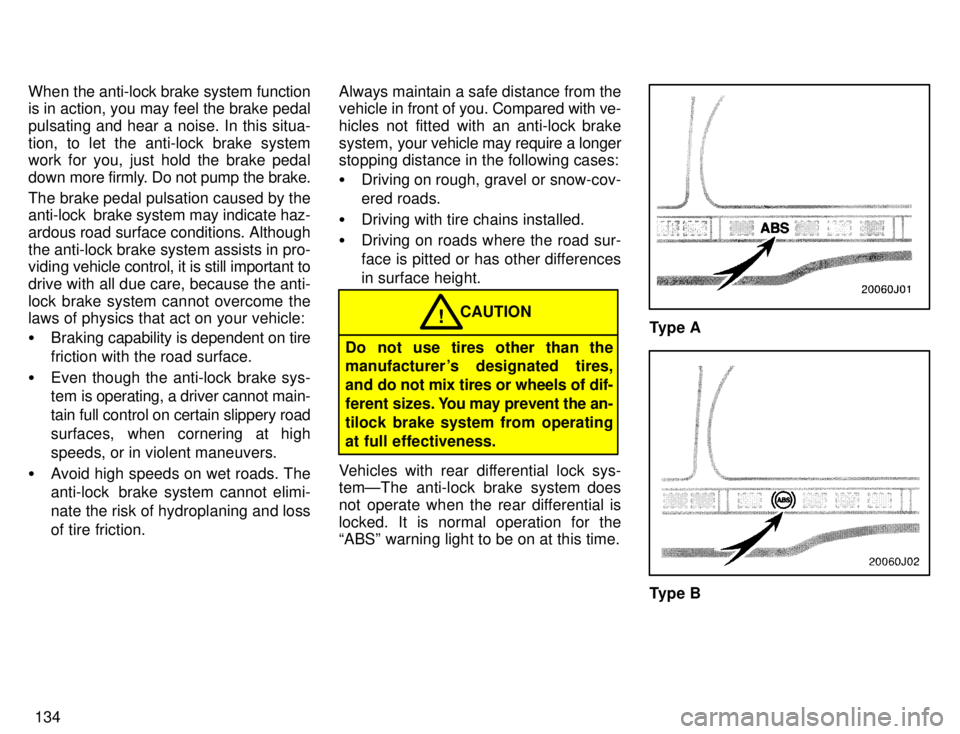
Vehicles with rear differential lock sys-
temÐThe anti-lock brake system does
not operate when the rear differential islocked. It is normal operation for the
ABSº warning light to be on at this time.Type A
Type B
Page 138 of 217
135
ABSº warning light
This light comes on when the ignition key is turned to the ONº position. After about
3 seconds, the light will go off.
When the light is on with the rear dif
feren-
tial locked, it indicates the anti-lock brake
system will not operate.
If either of the following conditions occurs, this indicates a malfunction somewhere inthe parts monitored by the warning light
system. Contact your Toyota dealer as
soon as possible to service the vehicle. The light does not come on as de-
scribed above, or remains on.
The light comes on while driving with
the rear differential unlocked.
The light does not come on with the
rear differential locked.
The light comes on while driving.
Even if the anti-lock brake system should
fail, the brake system will still operate con-
ventionally. Have your vehicle checked by
your Toyota dealer as soon as possible.
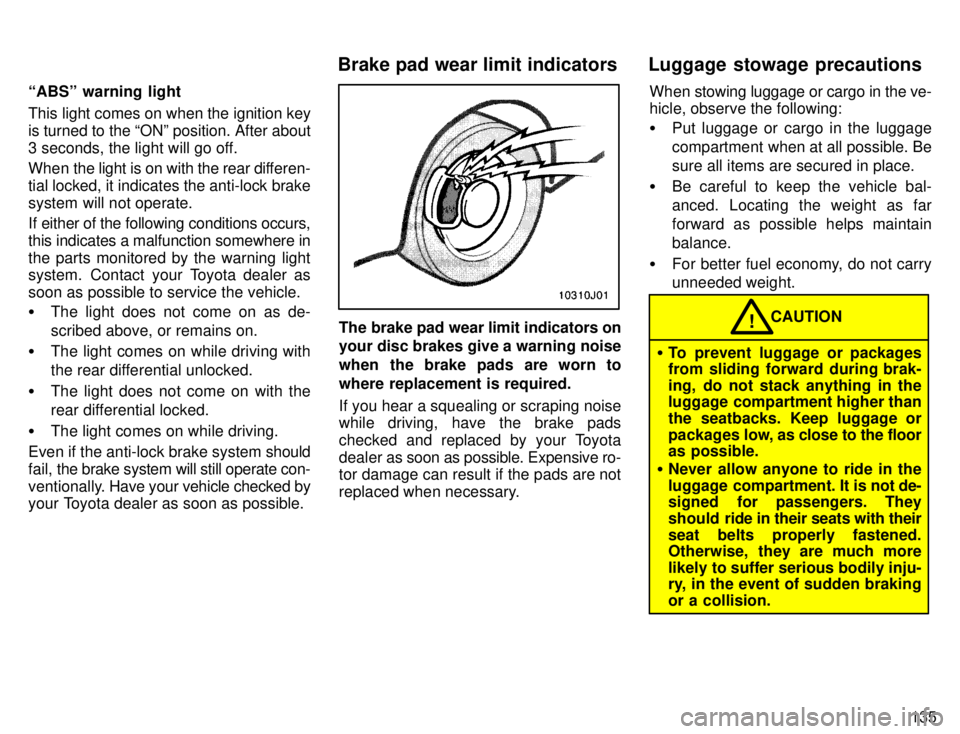
The brake pad wear limit indicators on your disc brakes give a warning noise
when the brake pads are worn to
where replacement is required.
If you hear a squealing or scraping noise
while driving, have the brake pads
checked and replaced by your Toyota
dealer as soon as possible. Expensive ro-
tor damage can result if the pads are not
replaced when necessary. When stowing luggage or cargo in the ve-
hicle, observe the following:
Put luggage or cargo in the luggage
compartment when at all possible. Besure all items are secured in place.
Be careful to keep the vehicle bal-anced. Locating the weight as far
forward as possible helps maintainbalance.
For better fuel economy, do not carry
unneeded weight.CAUTION!
To prevent luggage or packages
from sliding forward during brak-
ing, do not stack anything in the
luggage compartment higher than
the seatbacks. Keep luggage or
packages low, as close to the floor
as possible.
Never allow anyone to ride in the
luggage compartment. It is not de-
signed for passengers. They
should ride in their seats with their
seat belts properly fastened.
Otherwise, they are much more
likely to suffer serious bodily inju-
ry, in the event of sudden braking or a collision.
Brake pad wear limit indicators Luggage stowage precautions
Page 142 of 217

Part 3How to start the engineÐ
(a) Before cranking
Before starting the engine
139
STARTING AND DRIVING
Before starting the engine
How to start the engine
Tips for driving in various conditions
Off-road driving precautions
Winter driving tips
Trailer towing
How to save fuel and make your
vehicle last longer, too
1. Check the area around the vehicle be-
fore entering it.
2. Adjust seat position, seatback angle,
seat cushion angle, head restraint height and steering wheel angle.
3. Adjust inside and outside rear view mirrors.
4. Lock all doors.
5. Fasten seat belts.
1. Apply the parking brake firmly.
2. Turn off unnecessary lights and acces- sories. 3.
Manual transmission: Press the
clutch pedal to the floor and shift the trans-
mission into neutral. Hold the clutch pedal
to the floor until the engine is started. A
starter safety device will prevent the start-
er from operating if the clutch pedal is not fully depressed.
Automatic transmission: Put the selec-
tor lever in Pº. If you need to restart the
engine while the vehicle is moving, put the
selector lever in Nº. A starter safety de-vice will prevent the starter from operating
if the selector lever is in any drive position. 4. Automatic transmission only: De-
press the brake pedal and hold it to the
floor until driving off.