change time TOYOTA 4RUNNER 1996 User Guide
[x] Cancel search | Manufacturer: TOYOTA, Model Year: 1996, Model line: 4RUNNER, Model: TOYOTA 4RUNNER 1996Pages: 217, PDF Size: 4.49 MB
Page 135 of 217

132
FUNCTIONS OF ENGINE OIL
Engine oil has the primary functions of lu-
bricating and cooling the inside of the en-
gine,
and plays a major role in maintaining
the engine in proper working order. ENGINE OIL CONSUMPTION
It is normal that an engine should con-
sume some engine oil during normal
engine operation. The causes of oil
consumption in a normal engine are
as follows. Oil is used to lubricate pistons, piston
rings and cylinders. A thin film of oil isleft on the cylinder wall when a piston
moves downwards in the cylinder.
High negative pressure generated
when the vehicle is decelerating sucks
some of this oil into the combustion
chamber. This oil as well as some part
of the oil film left on the cylinder wall is
burned by the high temperature com-
bustion gases during the combustionprocess.
Oil is also used to lubricate the stems
of the intake valves. Some of this oil is
sucked into the combustion chamber
together with the intake air and is
burned along with the fuel. High tem-perature exhaust gases also burn the
oil used to lubricate the exhaust valve stems.
The amount of engine oil consumed
depends on the viscosity of the oil, the
quality of the oil and the conditions
the vehicle is driven under. More oil is consumed by high-speed driv-
ing and frequent acceleration and decel- eration.
A new engine consumes more oil, since
its pistons, piston rings and cylinder walls
have not become conditioned.
When judging the amount of oil con-
sumption, note that the oil may be-come diluted and make it difficult to
judge the true level accurately.
As an example, if a vehicle is used for re-
peated short trips, and consumes a nor- mal amount of oil, the dipstick may not
show any drop in the oil level at all, even after 1000 km (600 miles) or more. This is because the oil is gradually becoming
diluted with the fuel or moisture, making it
appear that the oil level has not changed. The diluting ingredients evaporate out
when the vehicle is then driven at high
speeds, as on an expressway, making itappear that oil is excessively consumed
after driving at high speeds.
IMPORTANCE OF ENGINE OIL LEVEL CHECK
One of the most important points in proper vehicle maintenance is to keep the engine
oil at the optimum level so that oil function
will
not be impaired. Therefore, it is essen-
tial that the oil level be checked regularly.
Toyota recommends that the oil level bechecked every time you refuel the vehicle.
NOTICE
Failure to check the oil level regular- ly could lead to serious engine
trouble due to insufficient oil.
For detailed information on the oil level
check, see Checking the engine oil levelº
in Chapter 7-2.
Facts about engine oil consumption
Page 179 of 217

176Automatic transmission Parkº
mech-
anism
Check the lock release button of the se-
lector lever for proper and smooth opera-
tion. On a safe incline, check that your ve-
hicle is held securely with the selectorlever in ºPº position and all brakes re-leased.
IN THE ENGINE COMPARTMENT Items listed below should be checked
from time to time , e.g. each time when
refueling.
Washer fluid
Make sure there is sufficient fluid in the
tank. See Chapter 7-3 for additional infor-
mation.
Engine coolant level Make sure the coolant level is between
the FULLº and LOWº lines on the see-
through reservoir. See Chapter 7-2 for
additional information. Battery electrolyte level Make sure the electrolyte level of all bat-
tery cells is between upper and lower level
lines on the case. Add only distilled water
when replenishing. See Chapter 7-3 for
additional information. Brake fluid level
Make sure the brake fluid level is correct. See Chapter 7-2 for additional informa-tion.
Engine oil level
Check the l
evel on the dipstick with the en-
gine turned off and the vehicle parked on
a level spot. See Chapter 7-2 for addition-
al information. Power steering fluid level Check the level through the reservoir. The
level should be in the HOTº or COLDº
range depending on the fluid t emperature.
See Chapter 7-2 for additional informa- tion.
Exhaust system
If you notice any change in the sound of
the exhaust or smell exhaust fumes, have the cause located and corrected immedi-
ately. (See engine exhaust cautions in
Part 2.) Be on the alert for changes in perfor-
mance, sounds, and visual tip-offs
that in-
dicate service is needed. Some important
clues are as follows: Engine missing, stumbling, or pinging
Appreciable loss of power
Strange engine noises
A leak under the vehicle (however, wa-
ter dripping from the air conditioning
after use is normal.)
Change in exhaust sound (This may
indicate a dangerous carbon monox-
ide leak. Drive with the windows open
and have the exhaust system checked
immediately.)
Flat-looking tire; excessive tire squeal
when cornering; uneven tire wear
Vehicle pulls to one side when driving straight on a level road
Strange noises related to suspensionmovement
Loss of brake effectiveness; spongy
feeling brake or clutch pedal; pedal al-
most touches floor; vehicle pulls to one
side when braking
Engine coolant temperature continual-
ly higher than normal
Does your vehicle needrepairing?
Page 195 of 217
192Check the tires regularly for damage
such as cuts, splits and cracks. If any damage is found, consult with a tech-
nician and have the tire repaired or re-placed. Even if the damage does not appear seri-
ous, a qualified technician should ex-
amine the damage. Objects which havepenetrated the tire may have caused in- ternal damage.
Any tires which are over six years old
must be checked by a qualified techni-
cian even if damage is not obvious.
Tires deteriorate with age even if they
have never or seldom been used.
This
also applies to the spare tire and tires
stored for future use.REPLACING YOUR TIRES
When replacing a tire, use only the
same size and construction as origi-
nally installed and with the same or
greater load capacity.
Using any other size or type of tire may se-
riously affect handling, ride, speedome-
ter/odometer calibration, ground clear-
ance, and clearance between the body
and tires or snow chains.
CAUTION!
Do not mix radial, bias belted, or
bias-ply tires on your vehicle. It
can cause dangerous handling
characteristics, resulting in loss
of control.
Do not use tires or wheels other
than the manufacturer's recom-
mended size.
Toyota recommends all four tires, or at
least both of the front or rear tires be
replaced at a time as a set.
See If you have a flat tireº in Part 4 for tire
change procedure.
When a tire is replaced, the wheel
should always be balanced.
An unbalanced wheel may affect vehicle
handling and tire life. Wheels can get out
of balance with regular use and should
therefore be balanced occasionally.
When replacing a tubeless tire, the air
valve should also be replaced with a
new one.
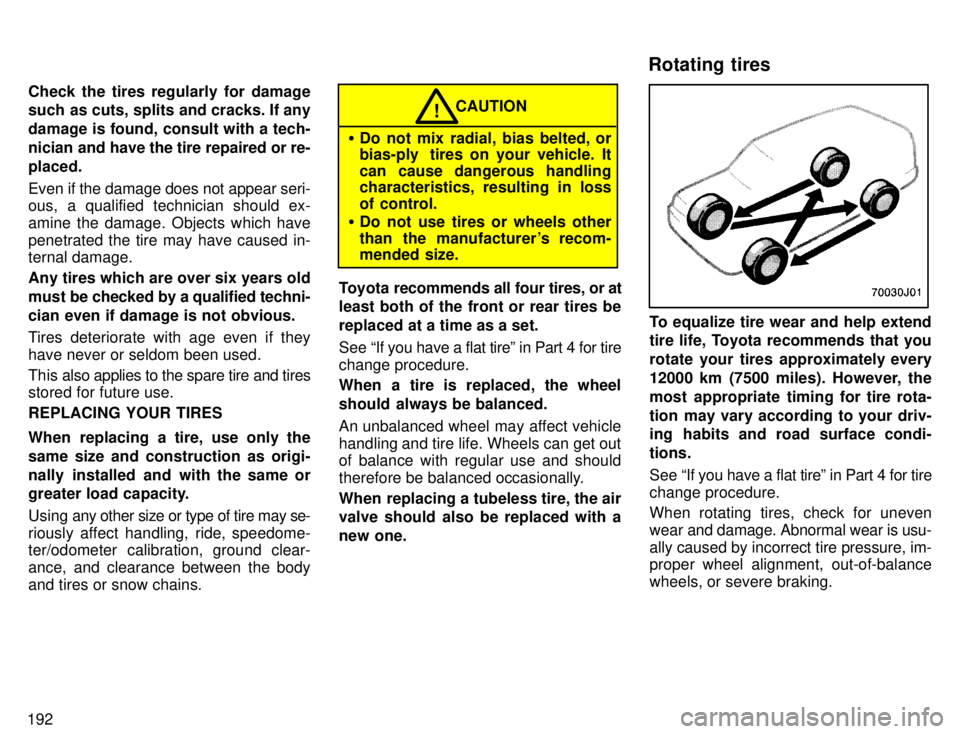
To equalize tire wear and help extend
tire life, Toyota recommends that you
rotate your tires approximately every
12000 km (7500 miles). However, the
most appropriate timing for tire rota-
tion may vary according to your driv-
ing habits and road surface condi- tions.
See If you have a flat tireº in Part 4 for tire
change procedure. When rotating tires, check for uneven
wear and damage. Abnormal wear is usu-
ally caused by incorrect tire pressure, im-
proper wheel alignment, out-of-balance
wheels, or severe braking.
Rotating tires