door lock TOYOTA 4RUNNER 1996 User Guide
[x] Cancel search | Manufacturer: TOYOTA, Model Year: 1996, Model line: 4RUNNER, Model: TOYOTA 4RUNNER 1996Pages: 217, PDF Size: 4.49 MB
Page 17 of 217
16
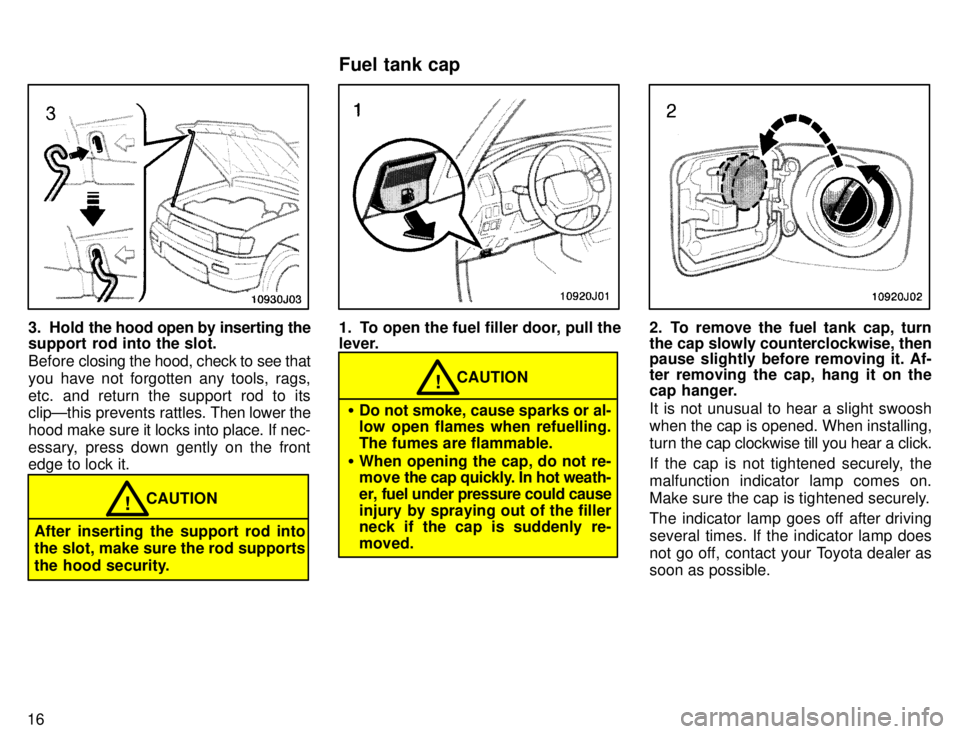
3. Hold the hood open by inserting the
support rod into the slot.
Before closing the hood, check to see that
you have not forgotten any tools, rags,
etc. and return the support rod to its clipÐthis prevents rattles. Then lower the
hood make sure it locks into place. If nec-
essary, press down gently on the front
edge to lock it.
CAUTION!
After inserting the support rod into
the slot, make sure the rod supports
the hood security.
1. To open the fuel filler door, pull the
lever.
CAUTION!
Do not smoke, cause sparks or al-
low open flames when refuelling.
The fumes are flammable.
When opening the cap, do not re-
move the cap quickly. In hot weath-
er, fuel under pressure could cause
injury by spraying out of the filler
neck if the cap is suddenly re- moved.
2. To remove the fuel tank cap, turn
the cap slowly counterclockwise, then
pause slightly before removing it. Af-
ter removing the cap, hang it on the
cap hanger.
It is not unusual to hear a slight swoosh
when the cap is opened. When installing,
turn the cap clockwise till you hear a click.
If the cap is not tightened securely, themalfunction indicator lamp comes on.
Make sure the cap is tightened securely.
The indicator lamp goes off after driving several times. If the indicator lamp does
not go off, contact your Toyota dealer as soon as possible.
Fuel tank cap
Page 30 of 217
28
CAUTION!
Persons should ride in their seats
properly wearing their seat belts
whenever the vehicle is moving.
Otherwise, they are much more like-
ly to suffer serious bodily injury in
the event of sudden braking or a col-lision.
When using the seat belts, observe
the following: Use the belt for only one person at
a time. Do not use a single belt for
two or more peopleÐeven chil- dren.
Avoid reclining the seatbacks too
much. The seat belts provide maxi-
mum protection when the seat-backs are in the upright position.(See the seat adjustment instruc- tions.)
Be careful not to damage the belt
webbing or hardware. Take care
that they do not get caught or
pinched in the seat or side doors.
Inspect the belt system periodical-
ly. Check for cuts, fraying, and
loose parts. Damaged parts should
be replaced. Do not disassemble or
modify the system.
Keep the belts clean and dry. If they
need cleaning, use a mild soap
solution or lukewarm water. Never
use bleach, dye, or abrasive clean-
ersÐthey may severely weaken the
belts.
Replace the belt assembly (includ-
ing bolts) If it has been used in a se-
vere impact. The entire assembly
should be replaced even if damage
is not obvious.
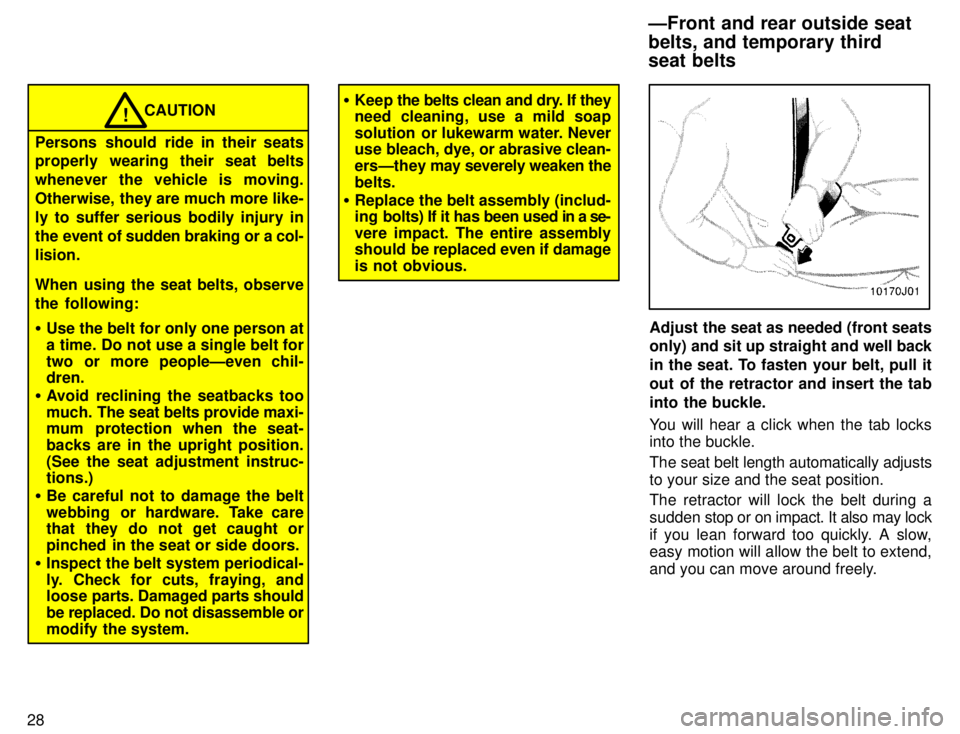
Adjust the seat as needed (front seats only) and sit up straight and well back
in the seat. To fasten your belt, pull it
out of the retractor and insert the tab
into the buckle.
You will hear a click when the tab locks into the buckle.
The seat belt length automatically adjusts
to your size and the seat position.
The retractor will lock the belt during a
sudden stop or on impact. It also may lock
if you lean forward too quickly. A slow, easy motion will allow the belt to extend,
and you can move around freely.
ÐFront and rear outside seat belts, and temporary third seat belts
Page 52 of 217

49
To change the steering wheel angle,
hold the steering wheel, pull up the
lock release lever, tilt the steering
wheel to the desired angle and release
the lever.
When the steering wheel is in a low posi-
tion, it will spring up as you release the
lock release lever.
Do not adjust the steering wheel
while the vehicle is moving.
After adjusting the steering wheel, try moving it up and down to make sure it is locked in position.
CAUTION!
Adjust the mirror so you can see the
side of your vehicle in the mirror. Be careful when judging the size or dis- tance of any object seen in the outside
rear view mirror on the passenger's side.
It is a convex mirror with a curved surface.
Any object seen in a convex mirror will
look smaller and farther away than when
seen in a flat mirror.With power window (door armrest)
Without power window (instrument panel)
Tilt steering wheel Outside rear view mirrorsÐ
ÐPower rear view mirrorcontrol
Page 54 of 217
Part 1Headlights and turn signals
51
OPERATION OF INSTRUMENTS AND CONTROLSÐ
Chapter 1-4
Lights, Wipers and Defogger
Headlights and turn signals
Emergency flashers
Instrument panel light control
Interior light
Personal lights
Luggage compartment light
Ignition switch light
Windshield wipers and washer
Back window wiper and washer
Back window defogger
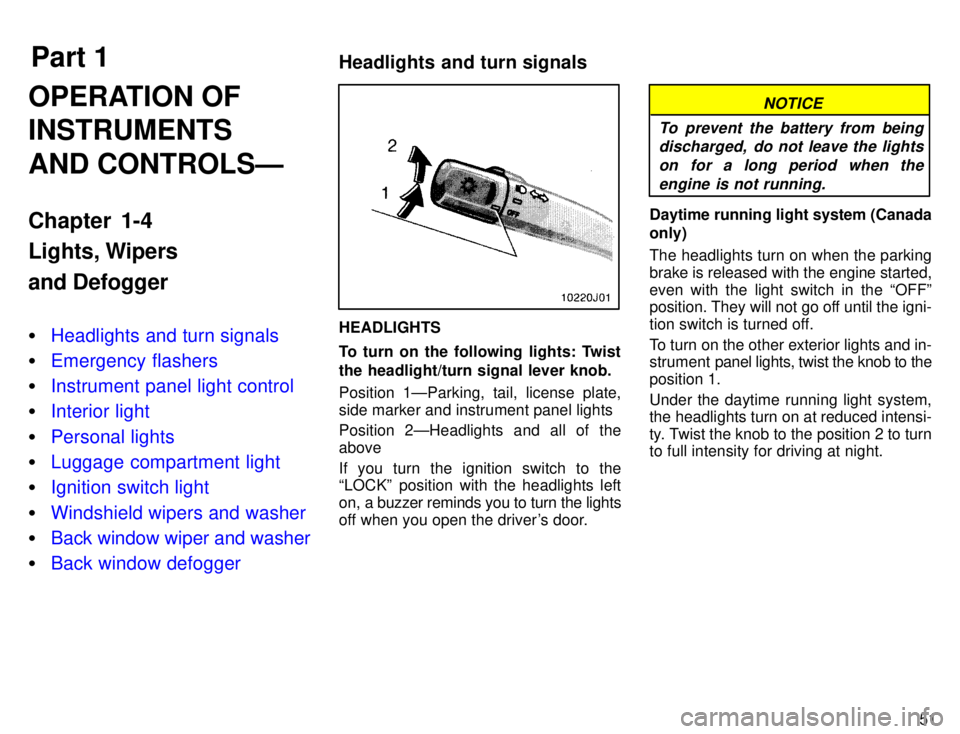
HEADLIGHTS
To turn on the following lights: Twist
the headlight/turn signal lever knob. Position 1ÐParking, tail, license plate,
side marker and instrument panel lights Position 2ÐHeadlights and all of the above If you turn the ignition switch to the
LOCKº position with the headlights left
on, a buzzer reminds you to turn the lights
off when you open the driver's door.
NOTICE
To prevent the battery from being discharged, do not leave the lights
on for a long period when theengine is not running.
Daytime running light system (Canada only)
The headlights turn on when the parking brake is released with the engine started,
even with the light switch in the OFFº
position. They will not go off until the igni-
tion switch is turned off.
To turn on the other exterior lights and in-
strument panel lights, twist the knob to the
position 1.
Under the daytime running light system,
the headlights turn on at reduced intensi-
ty. Twist the knob to the position 2 to turn
to full intensity for driving at night.
Page 66 of 217

63
NOTICE
Do not continue driving if the engine drive belt is broken or loose.
(d) Low Oil Pressure Warning Light
This light warns that the engine oil pres-
sure is too low.
If it flickers or stays on while you are driv-
ing, pull off the road to a safe place and
stop the engine immediately. Call a Toyota
dealer or qualified repair shop for assis- tance.
The light may occasionally flicker when
the engine is idling or it may come on brief-
ly after a hard stop. There is no cause for concern if it then goes out when the en-
gine is accelerated slightly.
The light may come on when the oil level
is extremely low. It is not designed to indi-cate low oil level, and the oil level must be checked using the level dipstick.
NOTICE
Do not drive the vehicle with the warning light onÐeven for one
block. It may ruin the engine.
(e) Malfunction Indicator Lamp
This lamp comes on in the following cases.
a. The fuel tank is completely empty. (See Fuel gaugeº in Chapter 1-5 for in- structions.)
b. The fuel tank cap is not tightened se-
curely. (See Fuel tank capº in Chapter
1-2 for instructions.)
c. There is a problem somewhere in your
engine or automatic transmission electri- cal system.
If it comes on while you are driving in case
c, have your vehicle checked/repaired by
your Toyota dealer as soon as possible.
(f) Low Fuel Level Warning Light
This light comes on when the fuel level in
the tank becomes nearly empty. Fill up the
tank as soon as possible.
(g) ABSº Warning Light
This light warns that there is a problem
somewhere in your anti-lock brake sys- tem.
If the light comes on while you are driving,
have your vehicle checked by your T oyota
dealer as soon as possible. The light will come on when the ignition key is turned to the ONº position. After
about 3 seconds, the light will go off. When the ABSº warning light is on (and
the brake system warning light is off), the brake system
operates conventionally but
without anti-lock function.
(h) Open Door Warning Light
This light remains on until all the doors
and back door are completely closed.
(i) SRS Airbag Warning Light
This light will come on when the igni-
tion key is turned to the ACCº or ONº
position. After about 6 seconds, the
light w ill go off. This means the airbag
system is operating properly.
The warning light system monitors the air-
bag sensor assembly, inflators, warning
light, interconnecting wiring and power sources.
If either of the following conditions occurs, this indicates a malfunction somewhere in the parts monitored by the warning light
system. Contact your Toyota dealer as
soon as possible to service the vehicle. The light does not come on when the
ignition key is turned to the ACCº or
ONº position or remains on.
The light comes on while driving.
Page 67 of 217
64(j) Light Reminder Buzzer
This buzzer will sound if the driver's door is opened while the ignition switch isturned to the LOCKº position with the
headlight
switch on. Removing the key will
not stop the buzzer as long as the head- light switch is on.
(k) Key Reminder Buzzer
This buzzer reminds you to remove the
key when you open the driver's door with the ignition key in the ACCº or LOCKº position.
(l) Unengaged Parkº Warning Light (vehicles with automatic transmis- sion)
This light warns that the transmission
Parkº mechanism is not engaged. If the
front drive control lever is in the Nº posi-
tion while the selector lever is in the Pº
position, the transmission will disengage
and the wheels will not lock.
To restore the park function, shift
the front drive control lever out of Nº. CAUTION
! (m) Automatic Transmission Fluid
Temperature Warning Light
This light warns that the automatic trans- mission fluid temperature is too high.
If this light comes on while you are driving,
slow down and pull off the road. Stop the
vehicle at a safe place and put the selector
lever in Pº. With the engine idling, wait
until the light goes off. If the light goes off,
you may start the vehicle again. If the light
does not go off, call a Toyota dealer or
qualified repair shop for assistance.
NOTICE
Continued driving with the warning light on may damage the automatic
transmission.
(n) Low Windshield Washer Fluid Lev- el Warning Light (Canada)
The light warns that the windshield wash-
er fluid level is too low. Add washer fluid at
your earliest opportunity. (For instruc-
tions, see Adding washer fluidº in Chap-ter 7-3.) CHECKING SERVICE REMINDER
INDI-
CATORS
1. Apply the parking brake.
2. Open one of the side doors or the back
door.
The open door warning light should come on.
3. Close the door. The open door warning light should go
off.
4. Turn ignition key to ACCº. The SRS airbag warning light should
come on. It goes off after about 6 sec-onds.
5. Turn the ignition key to ONº, but do not start the engine.
All the service reminder indicators ex-
cept the open door warning light and
SRS airbag warning light should come
on. The ABSº warning light goes off
after about 3 seconds.
If any service reminder indicator or warn-
ing buzzer does not function as described above, either the bulb is burned out or the
circuit is in need of repair. Have it checked
by your Toyota dealer as soon as pos-sible.
Page 68 of 217
Part 1Ignition switch with steering lock
65
OPERATION OF INSTRUMENTS AND CONTROLSÐ
Chapter 1-6 Ignition switch,
Transmissionand Parking brake
Ignition swi
tch with steering lock
Automatic transmission
Manual transmission
Four-wheel drive system
Rear differential lock system
Parking brake
Cruise control
Clutch start cancel switch
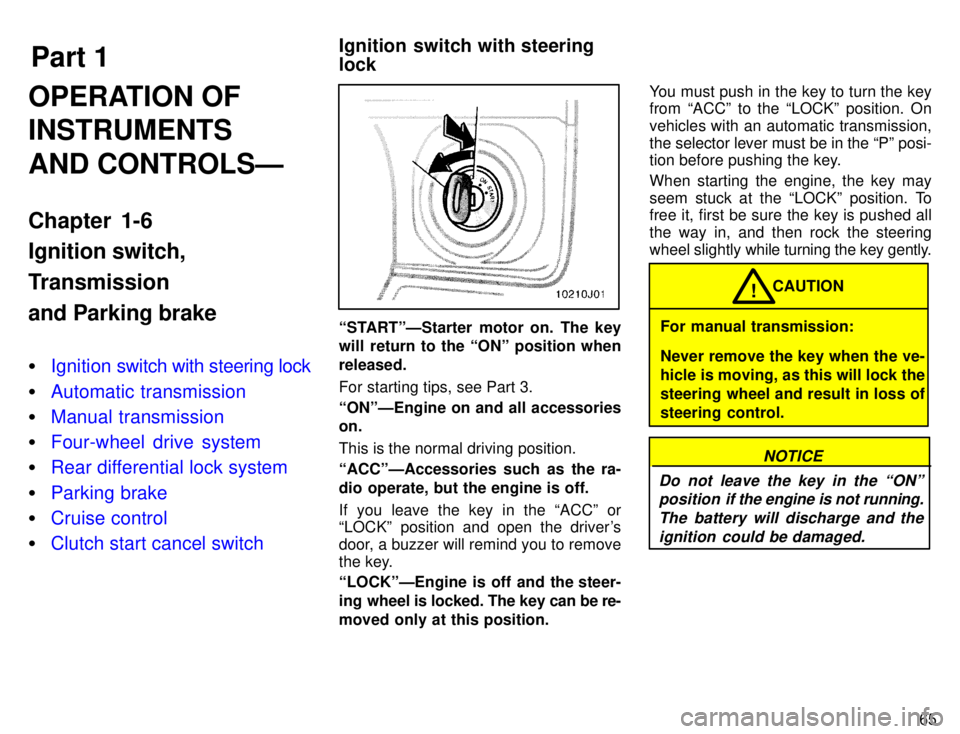
STARTºÐStarter motor on. The key
will return to the ONº position when released.
For starting tips, see Part 3. ONºÐEngine on and all accessories on. This is the normal driving position.
ACCºÐAccessories such as the ra-
dio operate, but the engine is off.
If you leave the key in the ACCº or
LOCKº position and open the driver's
door, a buzzer will remind you to remove
the key.
LOCKºÐEngine is off and the steer-
ing wheel is locked. The key can be re-
moved only at this position. You must push in the key to turn the key
from ACCº to the LOCKº position. On
vehicles with an automatic transmission,
the selector lever must be in the Pº posi-
tion before pushing the key. When starting the engine, the key may
seem stuck at the LOCKº position. To
free it, first be sure the key is pushed all
the way in, and then rock the steering
wheel slightly
while turning the key gently.For manual transmission: Never remove the key when the ve-
hicle is moving, as this will lock the
steering wheel and result in loss ofsteering control. CAUTION
!
NOTICE
Do not leave the key in the ONº position if the engine is not running.
The battery will discharge and the ignition could be damaged.
Page 125 of 217
122
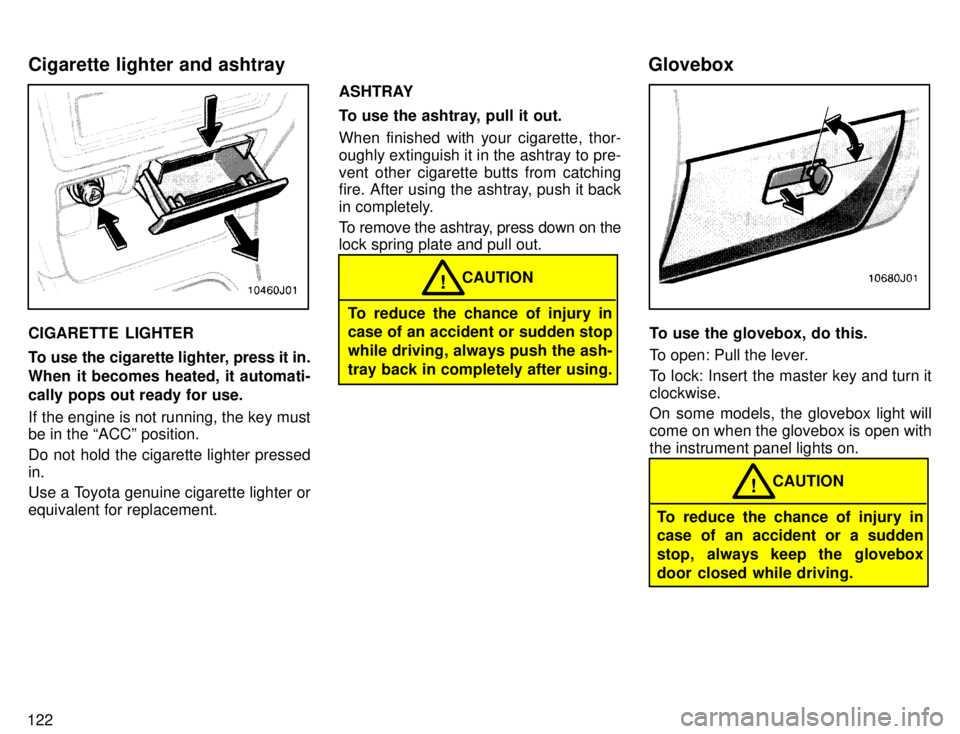
CIGARETTE LIGHTER
To use the cigarette lighter, press it in.
When it becomes heated, it automati-
cally pops out ready for use.
If the engine is not running, the key must be in the ACCº position.
Do not hold the cigarette lighter pressed in.
Use a Toyota genuine cigarette lighter or equivalent for replacement.ASHTRAY
To use the ashtray, pull it out. When finished with your cigarette, thor-
oughly extinguish it in the ashtray to pre-
vent other cigarette butts from catching
fire. After using the ashtray, push it back
in completely.
To remove the ashtray, press down on the lock spring plate and pull out.
To reduce the chance of injury in
case of an accident or sudden stop while driving, always push the ash-tray back in completely after using.
CAUTION
!
To use the glovebox, do this.
To open: Pull the lever.
To lock: Insert the master key and turn it clockwise.
On some models, the glovebox light will come on when the glovebox is open withthe instrument panel lights on.
To reduce the chance of injury in
case of an accident or a sudden
stop, always keep the glovebox
door closed while driving.
CAUTION
!
Cigarette lighter and ashtray
Glovebox
Page 142 of 217

Part 3How to start the engineÐ
(a) Before cranking
Before starting the engine
139
STARTING AND DRIVING
Before starting the engine
How to start the engine
Tips for driving in various conditions
Off-road driving precautions
Winter driving tips
Trailer towing
How to save fuel and make your
vehicle last longer, too
1. Check the area around the vehicle be-
fore entering it.
2. Adjust seat position, seatback angle,
seat cushion angle, head restraint height and steering wheel angle.
3. Adjust inside and outside rear view mirrors.
4. Lock all doors.
5. Fasten seat belts.
1. Apply the parking brake firmly.
2. Turn off unnecessary lights and acces- sories. 3.
Manual transmission: Press the
clutch pedal to the floor and shift the trans-
mission into neutral. Hold the clutch pedal
to the floor until the engine is started. A
starter safety device will prevent the start-
er from operating if the clutch pedal is not fully depressed.
Automatic transmission: Put the selec-
tor lever in Pº. If you need to restart the
engine while the vehicle is moving, put the
selector lever in Nº. A starter safety de-vice will prevent the starter from operating
if the selector lever is in any drive position. 4. Automatic transmission only: De-
press the brake pedal and hold it to the
floor until driving off.
Page 146 of 217

143
Make sure you have ethylene-glycol
antifreeze in the radiator.
NOTICE
Do not use alcohol type antifreeze.
Check the condition of the battery and cables. Cold temperatures reduce the capacity of
any battery, so it must be in top shape to provide enough power for winter starting.Chapter 7-3 tells you how to visually in-
spect the battery. Your Toyota dealer and
most service stations will be pleased tocheck the level of charge.
Make sure the engine oil viscosity is
suitable for the cold weather.
See Chapter 7-2 for recommended vis-
cosity. Leaving a heavy summer oil in your
vehicle during winter months may cause
harder starting. If you are not sure about
which oil to use, call your Toyota deal- erÐhe will be pleased to help. Keep the door locks from freezing. Squirt lock de-icer or glycerine into the
locks to keep them from freezing. To open
a frozen lock, try heating the key before in-serting it. Use a washer fluid containing an anti-
freeze solution.
This product is available at your Toyota
dealer and most auto parts stores. Follow
the manufacturer's directions for how
much to mix with water.
NOTICE
Do not use engine antifreeze or any other substitute because it may
damage your vehicle's paint.
Do not use your parking brake when there is a possibility it could freeze. When parking, put the transmission into
Pº (automatic) or into first or reverse
(manual) and block the rear wheels. Do
not use the parking brake, or snow or wa-
ter accumulated in and around the parkingbrake mechanism may freeze, making it
hard to release. Keep ice and snow from accumulating
under the fenders.
Ice and snow built up under your fenders
can make steering difficult. During bad winter driving, stop and check under the
fenders occasionally. Depending on where you are driving,
we recommend you carry some emer- gency equipment.
Some of
the things you might put in the ve-
hicle are tire chains, window scraper, bag of sand or salt, flares, small shovel, jump- er cables, etc.
Winter driving tips