light TOYOTA 4RUNNER 1996 User Guide
[x] Cancel search | Manufacturer: TOYOTA, Model Year: 1996, Model line: 4RUNNER, Model: TOYOTA 4RUNNER 1996Pages: 217, PDF Size: 4.49 MB
Page 27 of 217
26
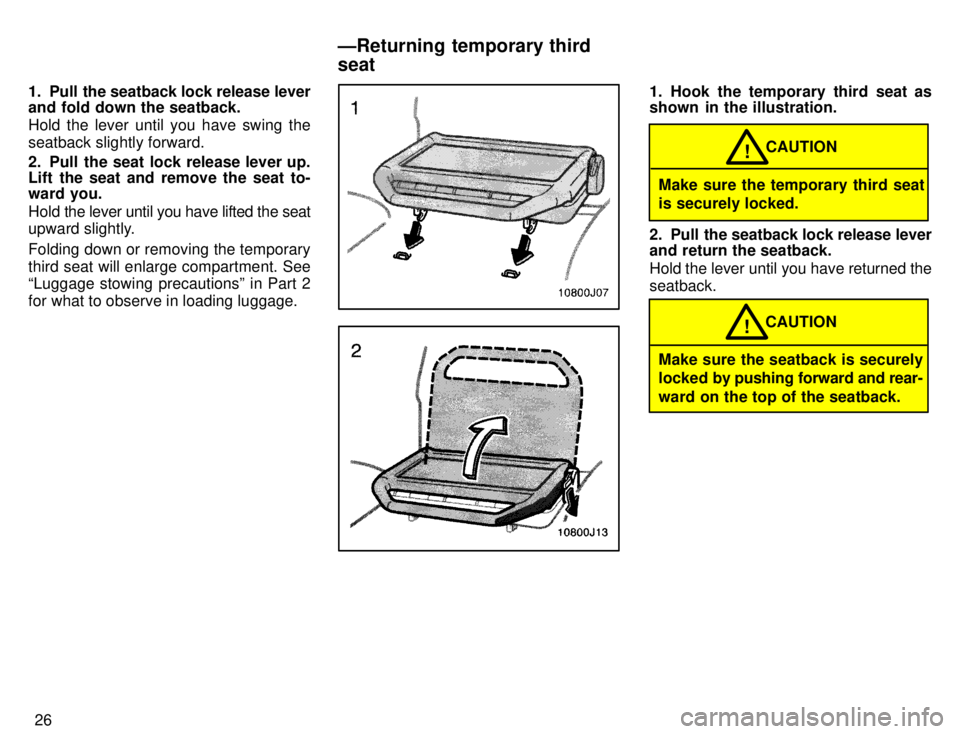
1. Pull the seatback lock release lever
and fold down the seatback.
Hold the lever until you have swing the
seatback slightly forward.
2. Pull the seat lock release lever up.
Lift the seat and remove the seat to-
ward you.
Hold
the lever until you have lifted the seat
upward slightly. Folding down or removing the temporary third seat will enlarge compartment. See
Luggage stowing precautionsº in Part 2
for what to observe in loading luggage.
1. Hook the temporary third seat as
shown in the illustration.
CAUTION!
Make sure the temporary third seat
is securely locked.
2. Pull the seatback lock release lever
and return the seatback.
Hold the lever until you have returned the seatback.
CAUTION!
Make sure the seatback is securely
locked by pushing forward and rear-
ward on the top of the seatback.
ÐReturning temporary third seat
Page 31 of 217
29
If the seat belt cannot be pulled out of the
retractor,
firmly pull the belt and release it.
You will then be able to smoothly pull the
belt out of the retractor.
When a passenger's shoulder belt is com-
pletely extended and is then retracted
even slightly, the belt is locked in that posi-
tion and cannot be extended. This feature
is used to hold the child restraint system
securely. (For details, see Child restraintº
in this chapter.) To free the belt again, fully
retract the belt and then pull the belt out
once more.
CAUTION!
After inserting the tab, make sure
the tab and buckle are locked and that the belt is not twisted.
Do not insert coins, clips, etc. in
the buckle as this may prevent you
from properly latching the tab andbuckle.
If the seat belt does not function
normally, i mmediately contact your
Toyota dealer.
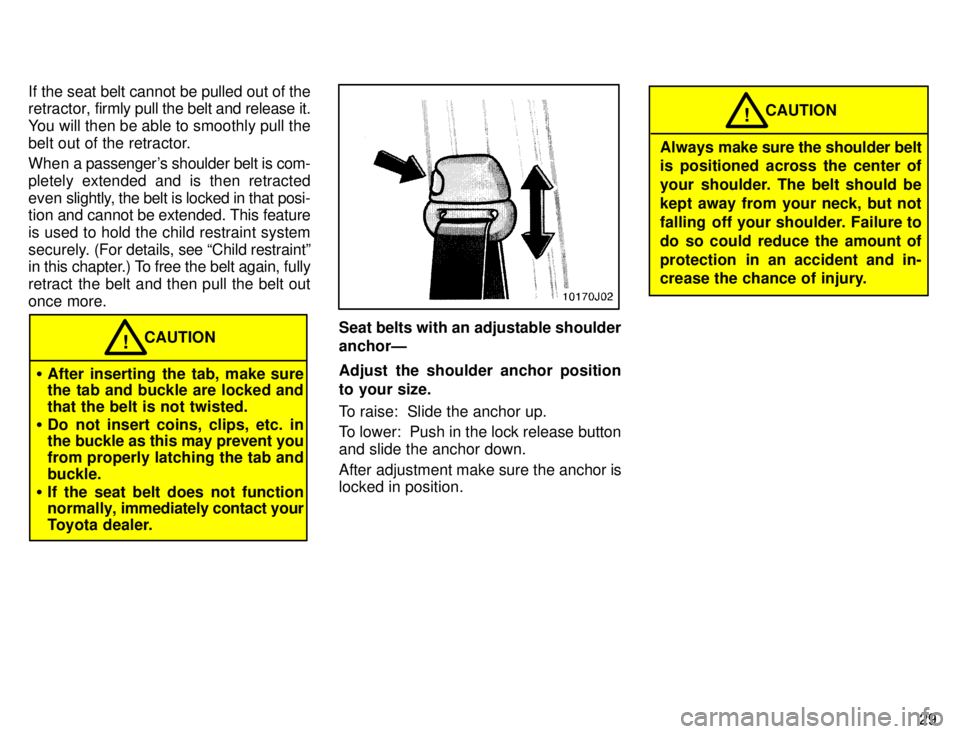
Seat belts with an adjustable shoulder anchorÐ
Adjust the shoulder anchor position
to your size.
To raise: Slide the anchor up.
To lower: Push in the lock release button
and slide the anchor down.
After adjustment make sure the anchor is
locked in position.
CAUTION!
Always make sure the shoulder belt
is positioned across the center of
your shoulder. The belt should be
kept away from your neck, but not
falling off your shoulder. Failure to
do so could reduce the amount of
protection in an accident and in-
crease the chance of injury.
Page 36 of 217

34
The SRS (Supplemental Restraint Sys-
tem) airbags are designed to provide
further protection to the driver and
front passenger when added to the pri-
mary protection provided by the seatbelts.
In response to a severe frontal impact, the
SRS airbags work together with the seatbelt to prevent or reduce injury by inflat- ing, in order to decrease the likelihood of
the driver's or front passenger's head or
chest directly hitting the steering wheel or dashboard. The passenger airbag is acti- vated even with no passenger in the frontseat.This indicator comes on when the
ignition key is turned to the ACCº or
ONº position. It goes off after about 6
seconds. This means the SRS airbags
are operating properly.
The SRS airbag warning light system
monitors the airbag sensor assembly, in-
flators, warning light, interconnecting wir-
ing and power sources.The SRS airbag system is designed to
activate in response to a severe frontal
impact within the shaded area be-
tween the arrows in the illustration.
The SRS airbags will deploy if the severity
of the impact is above the designed
threshold level, comparable to an approxi-
mate 20 km/h (14 mph) collision when im-
pacting straight into a fixed barrier that
does not move or deform.
If the severity of the impact is below the
above threshold level, the SRS airbags
may not deploy.
SRS airbags
Page 37 of 217

35
However, this threshold velocity will be
considerably higher if the vehicle strikes
an object, such as a parked vehicle or sign
pole, which can move or deform on im-
pact, or if it is
involved in an underride col-
lision (e.g. a collision in which the nose of
the vehicle underridesº, or goes under, the bed of a truck). It is possible with collision severity at the marginal level of airbag sensor detection
and activation that only one of your ve-
hicle's two airbags will deploy. For your safety of all occupants, be sure to always wear seat belts.
The SRS airbags are not designed to inflate if the vehicle is subjected to a
side or rear impact, if it rolls over, or if
it is involved in a low-speed frontalcollision.The SRS airbag system mainly consists
of the following components and their
locations are shown in the illustration.
1. SRS airbag warning light.
2. Steering wheel pad (airbag and inflat- or)
3. Passenger airbag module (airbag and inflator)
4. Airbag sensor assembly.
The airbag sensor assembly consists of a
safing sensor and airbag sensor.
Page 40 of 217
38
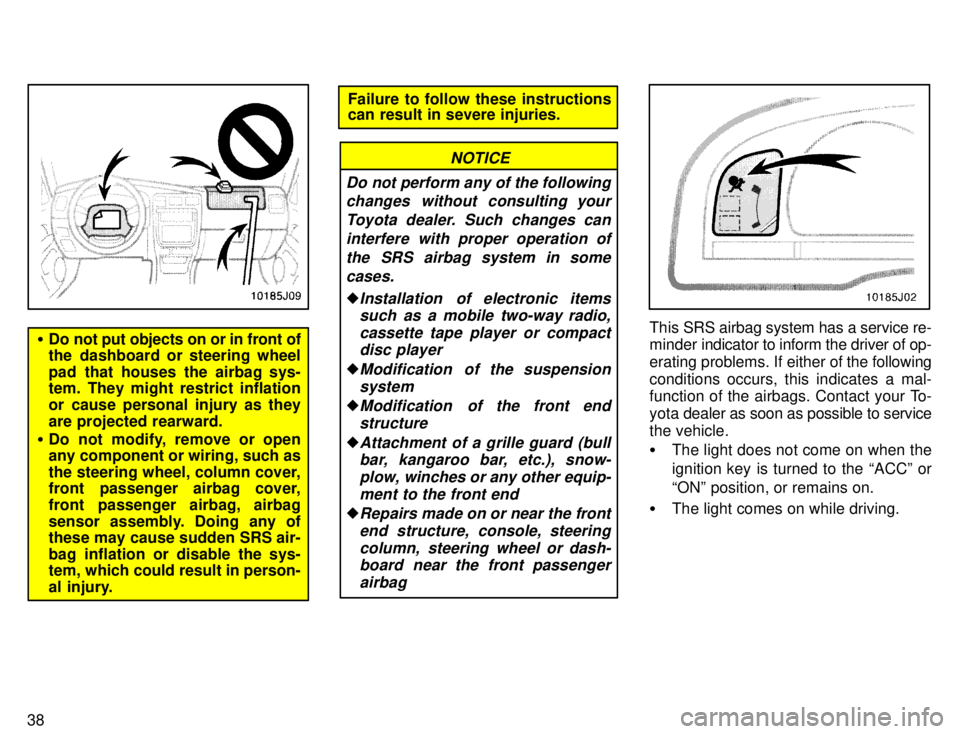
Do not put objects on or in front of
the dashboard or steering wheel
pad that houses the airbag sys-
tem. They might restrict inflation
or cause personal injury as they
are projected rearward.
Do not modify, remove or open
any component or wiring, such as
the steering wheel, column cover,
front passenger airbag cover,
front passenger airbag, airbag
sensor assembly. Doing any of
these may cause sudden SRS air-
bag inflation or disable the sys-
tem, which could result in person-
al injury.
Failure to follow these instructions can result in severe injuries.
NOTICE
Do not perform any of the following changes without consulting your
Toyota dealer. Such changes can interfere with proper operation ofthe SRS airbag system in some cases.
Installation of electronic itemssuch as a mobile two-way radio,
cassette tape player or compactdisc player
Modification of the suspension
system
Modification of the front endstructure
Attachment of a grille guard (bullbar, kangaroo bar, etc.), snow-
plow, winches or any other equip-
ment to the front end
Repairs made on or near the front end structure, console, steeringcolumn, steering wheel or dash-board near the front passenger
airbag
This SRS airbag system has a service re-
minder indicator to inf orm the driver of op-
erating problems. If either of the following
conditions occurs, this indicates a mal-
function of the airbags. Contact your To-
yota dealer as soon as possible to service
the vehicle. The light does not come on when the
ignition key is turned to the ACCº or
ONº position, or remains on.
The light comes on while driving.
Page 53 of 217

50To adjust a mirror, use the switches.
1. Master switchÐTo select the mirror to
be adjusted.
Place the switch at Lº (le
ft) or Rº (rightº).
2. Control switchÐTo move the mirror.Push the switch in the desired direction.
If the engine is not running, the key must be in the ACCº position.
NOTICE
If ice should jam the mirror, do not operate the control or scrape the
mirror face. Use a spray de-icer tofree the mirror.
The rear view mirrors can be folded
backward for parking in restricted areas.
To fold the rear view mirror, push back- ward.To reduce glare from the headlights of
the vehicle behind you during night
driving, operate the lever on the lower
edge of the mirror. Daylight drivingÐLever at position 1
The reflection in the mirror has greater
clarity at this position. Night drivingÐLever at position 2 Remember that by reducing glare you
also lose some rear view clarity.
ÐFolding rear view mirrors
Anti-glare inside rear view mirror
Page 54 of 217
Part 1Headlights and turn signals
51
OPERATION OF INSTRUMENTS AND CONTROLSÐ
Chapter 1-4
Lights, Wipers and Defogger
Headlights and turn signals
Emergency flashers
Instrument panel light control
Interior light
Personal lights
Luggage compartment light
Ignition switch light
Windshield wipers and washer
Back window wiper and washer
Back window defogger
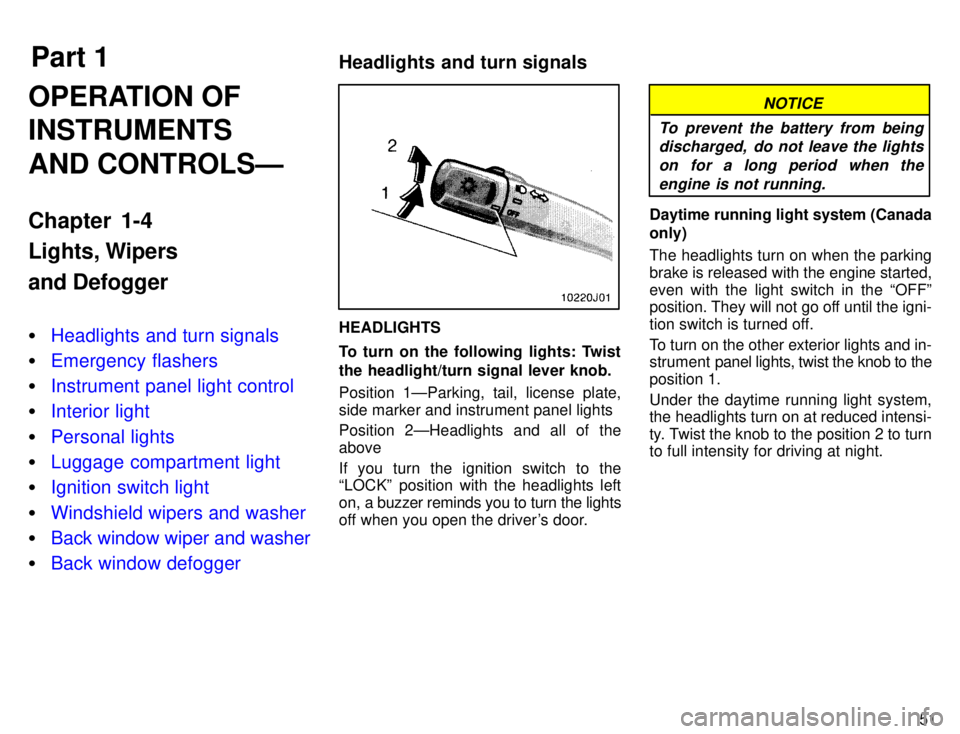
HEADLIGHTS
To turn on the following lights: Twist
the headlight/turn signal lever knob. Position 1ÐParking, tail, license plate,
side marker and instrument panel lights Position 2ÐHeadlights and all of the above If you turn the ignition switch to the
LOCKº position with the headlights left
on, a buzzer reminds you to turn the lights
off when you open the driver's door.
NOTICE
To prevent the battery from being discharged, do not leave the lights
on for a long period when theengine is not running.
Daytime running light system (Canada only)
The headlights turn on when the parking brake is released with the engine started,
even with the light switch in the OFFº
position. They will not go off until the igni-
tion switch is turned off.
To turn on the other exterior lights and in-
strument panel lights, twist the knob to the
position 1.
Under the daytime running light system,
the headlights turn on at reduced intensi-
ty. Twist the knob to the position 2 to turn
to full intensity for driving at night.
Page 55 of 217

52
High-Low beamsÐFor high beams,
turn the headlights on and push the lever away from you (position 1). Pull the lever
toward you (position 2) for low beams.
The headlight high beam indicator light
(blue light) on the instrument panel will tell
you that the high beams are on.
Flashing the high beam headlights
(position 3)ÐPull the lever all the way
back. The high beam headlights turn off
when you release the lever.
You can flash the high beam headlights with the knob turned to OFFº.TURN SIGNAL
To signal a turn, push the headlight/
turn signal lever up or down to posi-
tion 1. The key must be in the ONº position. The lever automatically returns after you make a turn, but you may have to returnit by hand after you change lanes.
To signal a lane change, move the lever
up or down to the pressure point (position2) and hold it.
If the turn signal indicator lights (green
lights) on the instrument panel flash faster
than normal, a front or rear turn signal bulb is burned out.To turn on the emergency flashers,
push the switch.
All the turn signal lights will flash. To turn
them off, push the switch once again.
Turn on the emergency flashers to warn other drivers if your vehicle must be
stopped where it might be a traf fic hazard.
Always pull as far off the road as possible.
The turn signal light switch will not work
when the emergency flashers are operat-ing.
Emergency flashers
Page 56 of 217

53
NOTICE
To prevent the battery from being discharged, do not leave the switch
on longer than necessary when the engine is not running.
To adjust the brightness of the instru-
ment panel lights, turn the knob.To turn on the interior light, slide the switch.
The interior light switch has the following positions: ONºÐKeeps the light on all the time.
OFFºÐTurns the light off. DOORºÐTurns the light on when any of
the side door is opened. The light goes off
when all the side door is closed.
Instrument panel light control Interior light
Page 57 of 217

54
To turn on the personal light, push the
switch. To turn the lights off, push the
switch once again.To turn on the luggage compartment
light, slide the switch.
The luggage compartment light switch has the following positions: ONºÐ Keeps the light on all the time.
OFFºÐ Turns the light off.
DOORºÐ Turns the light on when the
back door is opened. The light goes off
when the back door is closed.For easy access to the ignition switch,
the ignition switch light comes on
when the driver's door is opened.
The light remains on for some time after
the driver's door is closed.
Ignition switch light
Personal lights Luggage compartment light