fuel TOYOTA 4RUNNER 1996 Owner's Manual
[x] Cancel search | Manufacturer: TOYOTA, Model Year: 1996, Model line: 4RUNNER, Model: TOYOTA 4RUNNER 1996Pages: 217, PDF Size: 4.49 MB
Page 135 of 217

132
FUNCTIONS OF ENGINE OIL
Engine oil has the primary functions of lu-
bricating and cooling the inside of the en-
gine,
and plays a major role in maintaining
the engine in proper working order. ENGINE OIL CONSUMPTION
It is normal that an engine should con-
sume some engine oil during normal
engine operation. The causes of oil
consumption in a normal engine are
as follows. Oil is used to lubricate pistons, piston
rings and cylinders. A thin film of oil isleft on the cylinder wall when a piston
moves downwards in the cylinder.
High negative pressure generated
when the vehicle is decelerating sucks
some of this oil into the combustion
chamber. This oil as well as some part
of the oil film left on the cylinder wall is
burned by the high temperature com-
bustion gases during the combustionprocess.
Oil is also used to lubricate the stems
of the intake valves. Some of this oil is
sucked into the combustion chamber
together with the intake air and is
burned along with the fuel. High tem-perature exhaust gases also burn the
oil used to lubricate the exhaust valve stems.
The amount of engine oil consumed
depends on the viscosity of the oil, the
quality of the oil and the conditions
the vehicle is driven under. More oil is consumed by high-speed driv-
ing and frequent acceleration and decel- eration.
A new engine consumes more oil, since
its pistons, piston rings and cylinder walls
have not become conditioned.
When judging the amount of oil con-
sumption, note that the oil may be-come diluted and make it difficult to
judge the true level accurately.
As an example, if a vehicle is used for re-
peated short trips, and consumes a nor- mal amount of oil, the dipstick may not
show any drop in the oil level at all, even after 1000 km (600 miles) or more. This is because the oil is gradually becoming
diluted with the fuel or moisture, making it
appear that the oil level has not changed. The diluting ingredients evaporate out
when the vehicle is then driven at high
speeds, as on an expressway, making itappear that oil is excessively consumed
after driving at high speeds.
IMPORTANCE OF ENGINE OIL LEVEL CHECK
One of the most important points in proper vehicle maintenance is to keep the engine
oil at the optimum level so that oil function
will
not be impaired. Therefore, it is essen-
tial that the oil level be checked regularly.
Toyota recommends that the oil level bechecked every time you refuel the vehicle.
NOTICE
Failure to check the oil level regular- ly could lead to serious engine
trouble due to insufficient oil.
For detailed information on the oil level
check, see Checking the engine oil levelº
in Chapter 7-2.
Facts about engine oil consumption
Page 138 of 217
135
ABSº warning light
This light comes on when the ignition key is turned to the ONº position. After about
3 seconds, the light will go off.
When the light is on with the rear dif
feren-
tial locked, it indicates the anti-lock brake
system will not operate.
If either of the following conditions occurs, this indicates a malfunction somewhere inthe parts monitored by the warning light
system. Contact your Toyota dealer as
soon as possible to service the vehicle. The light does not come on as de-
scribed above, or remains on.
The light comes on while driving with
the rear differential unlocked.
The light does not come on with the
rear differential locked.
The light comes on while driving.
Even if the anti-lock brake system should
fail, the brake system will still operate con-
ventionally. Have your vehicle checked by
your Toyota dealer as soon as possible.
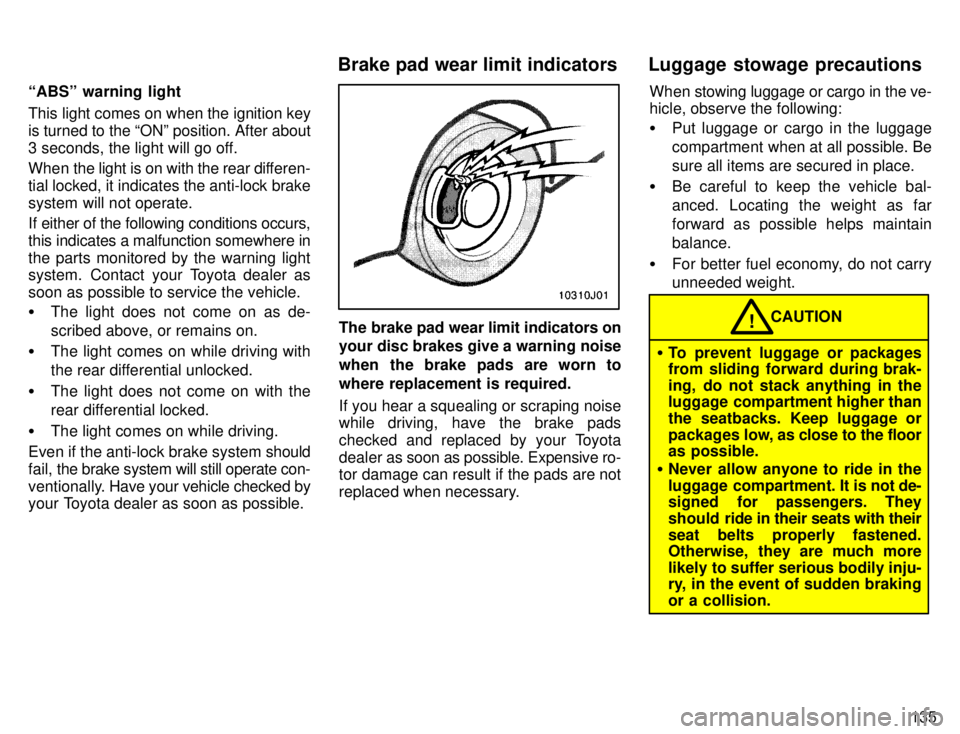
The brake pad wear limit indicators on your disc brakes give a warning noise
when the brake pads are worn to
where replacement is required.
If you hear a squealing or scraping noise
while driving, have the brake pads
checked and replaced by your Toyota
dealer as soon as possible. Expensive ro-
tor damage can result if the pads are not
replaced when necessary. When stowing luggage or cargo in the ve-
hicle, observe the following:
Put luggage or cargo in the luggage
compartment when at all possible. Besure all items are secured in place.
Be careful to keep the vehicle bal-anced. Locating the weight as far
forward as possible helps maintainbalance.
For better fuel economy, do not carry
unneeded weight.CAUTION!
To prevent luggage or packages
from sliding forward during brak-
ing, do not stack anything in the
luggage compartment higher than
the seatbacks. Keep luggage or
packages low, as close to the floor
as possible.
Never allow anyone to ride in the
luggage compartment. It is not de-
signed for passengers. They
should ride in their seats with their
seat belts properly fastened.
Otherwise, they are much more
likely to suffer serious bodily inju-
ry, in the event of sudden braking or a collision.
Brake pad wear limit indicators Luggage stowage precautions
Page 142 of 217
Part 3How to start the engineÐ
(a) Before cranking
Before starting the engine
139
STARTING AND DRIVING
Before starting the engine
How to start the engine
Tips for driving in various conditions
Off-road driving precautions
Winter driving tips
Trailer towing
How to save fuel and make your
vehicle last longer, too
1. Check the area around the vehicle be-
fore entering it.
2. Adjust seat position, seatback angle,
seat cushion angle, head restraint height and steering wheel angle.
3. Adjust inside and outside rear view mirrors.
4. Lock all doors.
5. Fasten seat belts.
1. Apply the parking brake firmly.
2. Turn off unnecessary lights and acces- sories. 3.
Manual transmission: Press the
clutch pedal to the floor and shift the trans-
mission into neutral. Hold the clutch pedal
to the floor until the engine is started. A
starter safety device will prevent the start-
er from operating if the clutch pedal is not fully depressed.
Automatic transmission: Put the selec-
tor lever in Pº. If you need to restart the
engine while the vehicle is moving, put the
selector lever in Nº. A starter safety de-vice will prevent the starter from operating
if the selector lever is in any drive position. 4. Automatic transmission only: De-
press the brake pedal and hold it to the
floor until driving off.
Page 143 of 217

140Before starting the engine, be sure to fol-
low the instructions in (a) Before crank- ingº.
Normal starting procedure
The multiport fuel injection system/se-
quential multiport fuel injection system in
your engine automatically controls the
proper air-fuel mixture for starting. You can start a cold or hot engine as follows:
1. With your foot off the accelerator ped- al, crank the engine by turning the key to
STARTº. Release it when the enginestarts.
2. After
the engine runs for about 10 sec-
onds, you are ready to drive.
If the weather is below freezing, let the en-
gine warm up for a few minutes before driving.
If the engine stalls...
Simply restart it, using the correct proce- dure given in normal starting. If the engine will not startÐ
See If your vehicle will not startº in Part 4.
NOTICE
Do not crank for more than 15 sec-
onds at a time. This may overheat
the starter and wiring systems.
Do not race a cold engine.
If the engine becomes difficult to
start or stalls frequently, have theengine checked immediately.
Always slow down in gusty cross- winds. This will allow you much better control.
Drive slowly onto curbs and, if pos-
sible, at a right angle. Avoid drivingonto high, sharp-edged objects and
other road hazards. Failure to do so
can lead to severe tire damage result-
ing in tire bursts.
When parking on a hill, turn the front
wheels until they touch the curb so that
the vehicle will not roll. Apply the park-
ing brake, and place the transmission in Pº (automatic) or in first or reverse
(manual). If necessary, block thewheels.
Washing your vehicle or driving
through deep water may get the
brakes wet. To see whether they are
wet, check that there is no traffic near
you, and then press the pedal lightly. If
you do not feel a normal braking force,
the brakes are probably wet. To dry
them, drive the vehicle cautiously
while lightly pressing the brake pedal
with the parking brake pulled. If they
still do not work safely, pull to the side
of the road and call a T oyota dealer for
assistance.
(b) Starting the engine
Tips for driving in variousconditions
Page 144 of 217
141
Four-wheel drive modelsÐToyota
recommends not using four-wheel
drive on dry hard-surfaced roads, be-
cause four-wheel driving will causeunnecessary noise and wear, and poor
fuel economy.
Four-wheel drive modelsÐIn cold
temperatures, noise may occur when
driving in two-wheel drive before the
transfer is warmed up. Therefore, first
drive in four-wheel drive until the
transfer is warmed up.
CAUTION!
Before driving off, make sure that
the parking brake is fully released
and the parking brake reminder
light is off.
Do not leave your vehicle unat- tended while the engine is run-ning.
Do not rest your foot on the brake
pedal while driving. It can cause
dangerous overheating, needless
wear, and poor fuel economy.
To drive down a long or steep hill,
reduce your speed and downshift.
Remember, if you ride the brakes
excessively, they may overheat
and not work properly.
Be careful when accelerating, up-
shifting, downshifting or braking
on a slippery surface. Sudden ac-
celeration or engine braking, could cause the vehicle to spin or skid.
Do not drive in excess of the speed
limit. Even if the legal speed limit
permits it, do not drive over 140
km/h (85 mph) unless your vehicle
has high-speed capability tires.
Driving over 140 km/h (85 mph)
may result in tire failure, loss of
control and possible injury. Be sure to consult a tire dealer to de-
termine whether the tires on your
vehicle are high-speed capability
tires or not before driving at such speeds.
Do not continue normal driving
when the brakes are wet. If they are
wet, your vehicle will require a lon-
ger stopping distance, and it may
pull to one side when the brakes
are applied. Also, the parking
brake will not hold the vehicle se-
curely. When driving your vehicle off-road,
please observe the following precautions
to ensure your driving enjoyment and to
help prevent the closure of areas to off-
road vehicles.
a. Drive your vehicle only in areas where
off-road vehicles are permitted to travel.
b. Respect private property. Get owner's
permission before entering private prop-
erty.
c. Do not enter areas that are closed.
Honor gates, barriers and signs that re-
strict travel.
d. Stay on established roads. When con- ditions are wet, driving techniques should
be changed or travel delayed to prevent
damage to roads.
For owners in U.S. mainland, Hawaii and Puerto Rico:
To obtain additional information pertaining
to driving your vehicle off-road, consultthe following organizations.
State and Local Parks and Recreation Departments
State Motor Vehicle Bureau
Recreational Vehicle Clubs
U.S. Forest Service and Bureau of
Land Management
Off-road driving precautions
Page 147 of 217
144Your vehicle is designed primarily as a
passenger - and - load - carrying vehicle.
Towing a trailer will have an adverse ef
fect
on handling, performance, braking, dura-
bility and driving economy (fuel consump-
tion, etc.). Your safety and satisfaction de-
pend on the proper use of correct
equipment and cautious driving habits.
For your safety and the safety of others,you must not overload your vehicle or
trailer. Ask your local T oyota dealer for fur-
ther details before towing. WEIGHT LIMITS
Before towing, make sure the total
trailer weight, gross combination
weight, gross vehicle weight, grossaxle weight and trailer tongue load are
all within the limits.
The total trailer weight and tongue load
can be measured with platform scales
found at a highway weighing station,
building supply company, trucking com-
pany, junk yard, etc.
CAUTION!
The total trailer weight (trailer
weight plus its cargo load) must
not exceed the following. Exceed-
ing this weight is dangerous. If
towing a trailer over 907 kg (2000lb.), it is necessary to use a sway
control device with a sufficient ca-
pacity.
3RZ-FE engine 1587 kg (3500 lb.)
5VZ-FE engine 2267 kg (5000 lb.)
The gross combination weight
(sum of your vehicle weight plus
its load and the total trailer weight)
must not exceed the following.
Two-wheel drive models 3RZ-FE engine3447 kg (7600 lb.)
5VZ-FE engine 3992 kg (8800 lb.)
Four-wheel drive models 3RZ-FE engine 3583 kg (7900 lb.)
5VZ-FE engine 4173 kg (9200 lb.)
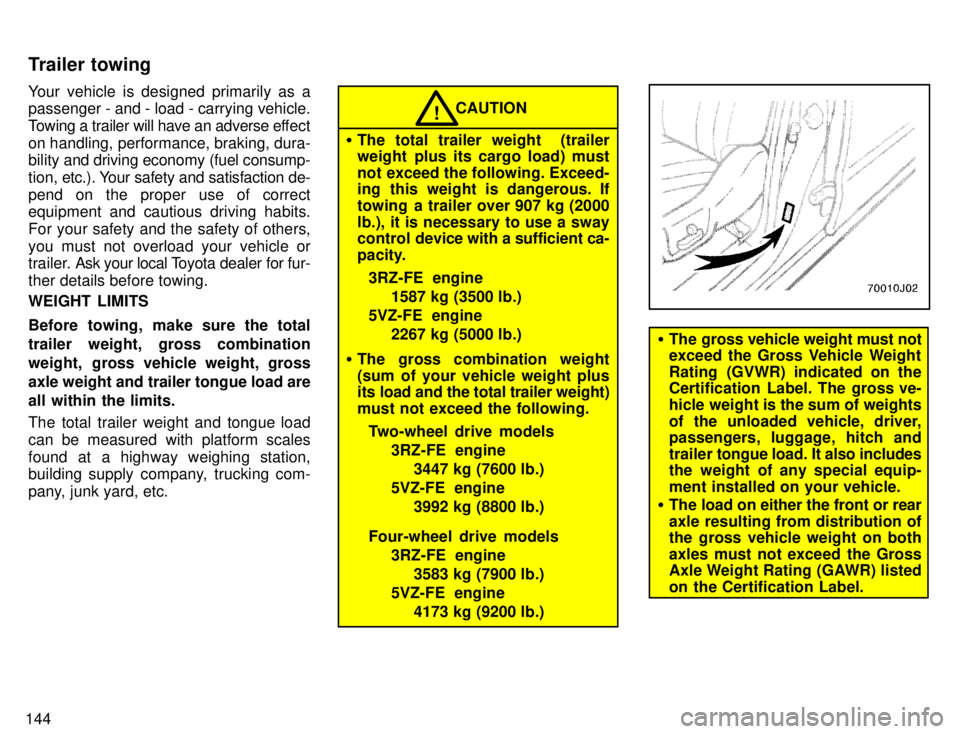
The gross vehicle weight must not
exceed the Gross Vehicle Weight
Rating (GVWR) indicated on the
Certification Label. The gross ve-
hicle weight is the sum of weights
of the unloaded vehicle, driver, passengers, luggage, hitch and
trailer tongue load. It also includes
the weight of any special equip-
ment installed on your vehicle.
The load on either the front or rear
axle resulting from distribution of
the gross vehicle weight on both
axles must not exceed the Gross
Axle Weight Rating (GAWR) listed
on the Certification Label.
Trailer towing
Page 151 of 217
148When restarting out after parking on a slope:
1. With the transmission in Pº position
(automatic) or
the clutch pedal depressed
(manual), start the engine. (With an auto-
matic transmission, be sure to keep thebrake pedal depressed.)
2. Shift into gear.
3. Release the parking brake (also foot
brake on automatic transmission ve-
hicles) and slowly pull or back away from
the wheel blocks. Stop and apply yourbrakes.
4. Have someone retrieve the blocks.
CAUTION!
Do not exceed 72 km/h (45 mph) or
the posted towing speed limit,
whichever is lower. Because in-
stability (swaying) of a towing ve-
hicle-trailer combination usually
increases as the speed increases,
exceeding 72 km/h (45 mph) maycause loss of control.
Slow down and downshift before
descending steep or long downhill
grades. Do not make suddendownshifts.
Avoid holding the brake pedal
down too long or too frequently.
This could cause the brakes to
overheat and result in reduced
braking efficiency. Getting
more kilometers/mileage from a li-
ter/gallon of fuel is easyÐjust take it easy.
It will help make your vehicle last longer,
too. Here are some specific tips on how to
save money on both fuel and repairs: Keep your tires inflated at the cor- rect pressure. Underinflation causes
tire wear and wastes fuel. See Chapter
7-2 for instructions.
Do not carry unneeded weight in
your vehicle. Excess weight puts a
heavier load on the engine, causinggreater fuel consumption.
Avoid lengthy warm-up idling.
Once the engine is running smoothly,
begin drivingÐbut gently. Remember,
however, that on cold winter days this
may take a little longer.
Accelerate slowly and smoothly.
Avoid jackrabbit starts. Get into high
gear as quickly as possible.
Avoid long engine idling. If you have
a long wait and you are not in traffic, it
is better to turn off the engine and start
again later.
Avoid engine lug or overrevving.
Use a gear position suitable for the
road on which you are travelling.
How to save fuel and make
your vehicle last longer, too
Page 152 of 217
149
Avoid continuous speeding up and
slowing down. Stop-and-go driving
wastes fuel.
Avoid unnecessary stopping and braking. Maintain a steady pace. Try
to time the traffic signals so you only
need to stop as little as possible or take
advantage of through streets to avoid
traffic lights. Keep a proper distance
from other vehicles to avoid suddenbraking. This will also reduce wear onyour brakes.
Avoid heavy traffic or traffic jams
whenever possible.
Do not rest your foot on the clutch
or brake pedal. This causes needless
wear, overheating and poor fuel econ-
omy.
Maintain a moderate speed on highways. The faster you drive, the
greater the fuel consumption. By re-
ducing your speed, you will cut down
on fuel consumption.
Keep the front wheels in properalignment. Avoid hitting the curb and
slow down on rough roads. Improper
alignment not only causes faster tire
wear but also puts an extra load on the
engine, which, in turn, wastes fuel.
Keep the bottom of your vehicle
free from mud, etc. This not only
lessens weight but also helps prevent corrosion.
Keep your vehicle tuned-up and in
top shape. A dirty air cleaner, improp-
er valve clearance, dirty plugs, dirty oil
and grease, brakes not adjusted, etc.
all lower engine performance and con-
tribute to poor fuel economy. For lon-
ger life of all parts and lower operating
costs, keep all maintenance work on
schedule, and if you often drive under severe conditions, see that your ve-
hicle receives more frequent mainte-
nance (For scheduled maintenance in-
formation, please refer to the separate
Owner 's Manual Supplement/Main-
tenance Scheduleº).
CAUTION!
Never turn off the engine to coast
down hills. Your power steering
and brake booster will not function
without the engine running. Also,
the emission control system oper-
ates properly only when the engine
is running.
Page 154 of 217
Part 4If your vehicle will not startÐ
(a) Simple checks
151
IN CASE OF AN EMERGENCY
If your vehicle will not start
If your engine stalls while driving
If your vehicle overheats
If you have a flat tire
If your vehicle needs to be towed
If you cannot shift automatic transmission selector lever
If you lose your keys
Before making these checks, make sure
you have followed the correct starting pro-
cedure given in How to start the engineº
in Part 3 and that you have sufficient fuel.
If the engine is not turning over or is
turning over too slowlyÐ
1. Check that the battery terminals are
tight and clean.
2. If the battery terminals are O.K., switch
on the interior light.
3. If the light is out, dim or goes out when the starter is cranked, the battery is dis-
charged. You may try jump starting. See
(c) Jump startingº for further instructions.
If the light is O.K., but the engine still will
not start, it needs adjustment or repair.
Call a Toyota dealer or qualified repair shop.
NOTICE
Do not pull- or push-start the ve- hicle. It may damage the vehicle or
cause a collision when the enginestarts. Also the three-way catalytic converter may overheat and be-come a fire hazard.
If the engine turns over at its normal
speed but will not startÐ
1. Check that all the push-on connectors are tight. (For example, connectors at thespark plugs)
2. If the connectors are O.K., the engine
may be flooded because of repeatedcranking. See (b) Starting a flooded en-
gineº for further instructions.
Page 178 of 217

175
Tire surface and wheel nuts Check the tires carefully
for cuts, damage
or excessive wear. See Chapter 7-2 for
additional information. When checking the tires, make sure no nuts are missing,
and check the nuts for looseness. T ighten
them if necessary.
Tire rotation
Rotate the tires every 12000 km (7500
miles). See Chapter 7-2 for additional in-formation.
Fluid leaks Check underneath for leaking fuel, oil, wa-
ter or other fluid after the vehicle has been
parked for a while. If you smell fuel fumes
or notice any leak, have the cause found
and corrected immediately. Doors and engine hood
Check that all doors including back door
operate smoothly and all latches lock se-
curely. M ake sure the engine hood secon-
dary latch secures the hood from opening
when the primary latch is released. INSIDE THE VEHICLE Items listed below should be checked
regularly, e.g. while performing peri-
odic services, cleaning the vehicle,etc. Lights Make sure the headlights, stop lights, tail lights, turn signal lights, and other lights are all working. Check headlight aim. Service reminder indicators and
warn-
ing buzzers Check that all service reminder indicators
and warning buzzers function properly. Steering wheel
Check that it has the specified freeplay.
Be alert for changes in steering condition,such as hard steering or strange noise. Seats Check that all seat controls such as seat
adjusters, seatback recliner, etc. operate
smoothly and that all latches lock securely
in any position. Check that the head re-
straints move up and down smoothly and
that the locks hold securely in any latched
position. For folding-down rear seat-
backs, swing-up rear seat cushions and
detachable temporary third seat, check
that the latches lock securely. Seat belts
Check that the seat belt system such as
buckles, retractors and anchors operate
properly
and smoothly. Make sure the belt
webbing is not cut, frayed, worn or dam-aged. Accelerator pedal Check the pedal for smooth operation and
uneven pedal effort or catching. Clutch pedal Check the pedal for smooth operation. Brake pedal Check the pedal for smooth operation and
that the pedal has the proper clearance. Check the brake booster function. Brakes
At a safe place, check that the brakes do not pull to one side when applied. Parking brake Check that the lever has the proper travel and that, on a safe incline, your vehicle is
held securely with only the parking brake applied.