belt TOYOTA 4RUNNER 1996 Owner's Guide
[x] Cancel search | Manufacturer: TOYOTA, Model Year: 1996, Model line: 4RUNNER, Model: TOYOTA 4RUNNER 1996Pages: 217, PDF Size: 4.49 MB
Page 66 of 217

63
NOTICE
Do not continue driving if the engine drive belt is broken or loose.
(d) Low Oil Pressure Warning Light
This light warns that the engine oil pres-
sure is too low.
If it flickers or stays on while you are driv-
ing, pull off the road to a safe place and
stop the engine immediately. Call a Toyota
dealer or qualified repair shop for assis- tance.
The light may occasionally flicker when
the engine is idling or it may come on brief-
ly after a hard stop. There is no cause for concern if it then goes out when the en-
gine is accelerated slightly.
The light may come on when the oil level
is extremely low. It is not designed to indi-cate low oil level, and the oil level must be checked using the level dipstick.
NOTICE
Do not drive the vehicle with the warning light onÐeven for one
block. It may ruin the engine.
(e) Malfunction Indicator Lamp
This lamp comes on in the following cases.
a. The fuel tank is completely empty. (See Fuel gaugeº in Chapter 1-5 for in- structions.)
b. The fuel tank cap is not tightened se-
curely. (See Fuel tank capº in Chapter
1-2 for instructions.)
c. There is a problem somewhere in your
engine or automatic transmission electri- cal system.
If it comes on while you are driving in case
c, have your vehicle checked/repaired by
your Toyota dealer as soon as possible.
(f) Low Fuel Level Warning Light
This light comes on when the fuel level in
the tank becomes nearly empty. Fill up the
tank as soon as possible.
(g) ABSº Warning Light
This light warns that there is a problem
somewhere in your anti-lock brake sys- tem.
If the light comes on while you are driving,
have your vehicle checked by your T oyota
dealer as soon as possible. The light will come on when the ignition key is turned to the ONº position. After
about 3 seconds, the light will go off. When the ABSº warning light is on (and
the brake system warning light is off), the brake system
operates conventionally but
without anti-lock function.
(h) Open Door Warning Light
This light remains on until all the doors
and back door are completely closed.
(i) SRS Airbag Warning Light
This light will come on when the igni-
tion key is turned to the ACCº or ONº
position. After about 6 seconds, the
light w ill go off. This means the airbag
system is operating properly.
The warning light system monitors the air-
bag sensor assembly, inflators, warning
light, interconnecting wiring and power sources.
If either of the following conditions occurs, this indicates a malfunction somewhere in the parts monitored by the warning light
system. Contact your Toyota dealer as
soon as possible to service the vehicle. The light does not come on when the
ignition key is turned to the ACCº or
ONº position or remains on.
The light comes on while driving.
Page 138 of 217
135
ABSº warning light
This light comes on when the ignition key is turned to the ONº position. After about
3 seconds, the light will go off.
When the light is on with the rear dif
feren-
tial locked, it indicates the anti-lock brake
system will not operate.
If either of the following conditions occurs, this indicates a malfunction somewhere inthe parts monitored by the warning light
system. Contact your Toyota dealer as
soon as possible to service the vehicle. The light does not come on as de-
scribed above, or remains on.
The light comes on while driving with
the rear differential unlocked.
The light does not come on with the
rear differential locked.
The light comes on while driving.
Even if the anti-lock brake system should
fail, the brake system will still operate con-
ventionally. Have your vehicle checked by
your Toyota dealer as soon as possible.
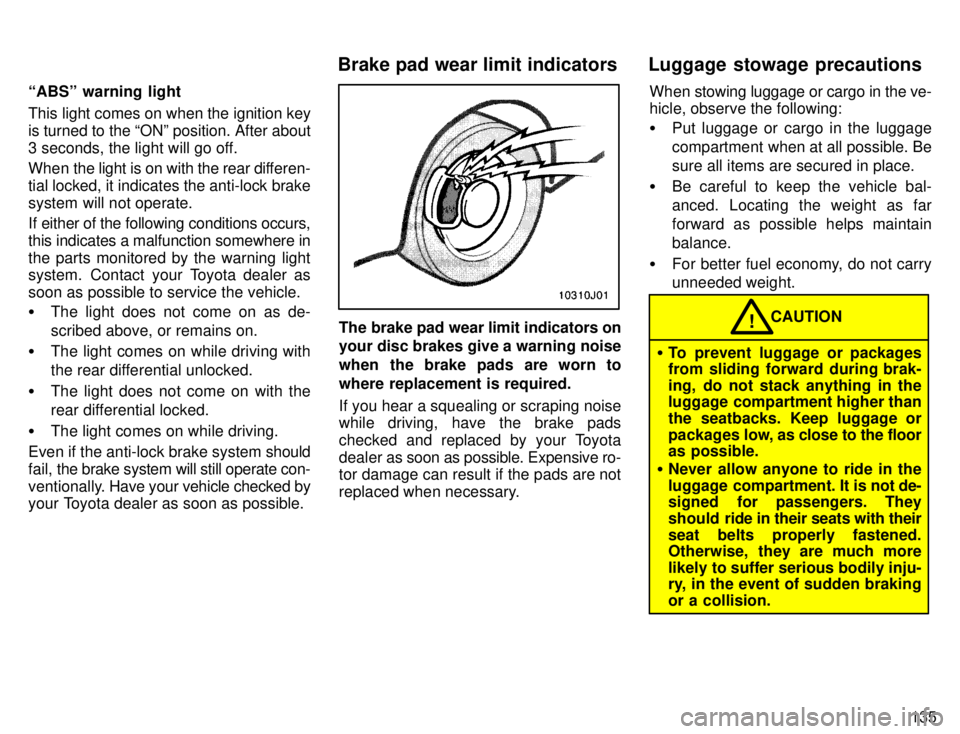
The brake pad wear limit indicators on your disc brakes give a warning noise
when the brake pads are worn to
where replacement is required.
If you hear a squealing or scraping noise
while driving, have the brake pads
checked and replaced by your Toyota
dealer as soon as possible. Expensive ro-
tor damage can result if the pads are not
replaced when necessary. When stowing luggage or cargo in the ve-
hicle, observe the following:
Put luggage or cargo in the luggage
compartment when at all possible. Besure all items are secured in place.
Be careful to keep the vehicle bal-anced. Locating the weight as far
forward as possible helps maintainbalance.
For better fuel economy, do not carry
unneeded weight.CAUTION!
To prevent luggage or packages
from sliding forward during brak-
ing, do not stack anything in the
luggage compartment higher than
the seatbacks. Keep luggage or
packages low, as close to the floor
as possible.
Never allow anyone to ride in the
luggage compartment. It is not de-
signed for passengers. They
should ride in their seats with their
seat belts properly fastened.
Otherwise, they are much more
likely to suffer serious bodily inju-
ry, in the event of sudden braking or a collision.
Brake pad wear limit indicators Luggage stowage precautions
Page 142 of 217
Part 3How to start the engineÐ
(a) Before cranking
Before starting the engine
139
STARTING AND DRIVING
Before starting the engine
How to start the engine
Tips for driving in various conditions
Off-road driving precautions
Winter driving tips
Trailer towing
How to save fuel and make your
vehicle last longer, too
1. Check the area around the vehicle be-
fore entering it.
2. Adjust seat position, seatback angle,
seat cushion angle, head restraint height and steering wheel angle.
3. Adjust inside and outside rear view mirrors.
4. Lock all doors.
5. Fasten seat belts.
1. Apply the parking brake firmly.
2. Turn off unnecessary lights and acces- sories. 3.
Manual transmission: Press the
clutch pedal to the floor and shift the trans-
mission into neutral. Hold the clutch pedal
to the floor until the engine is started. A
starter safety device will prevent the start-
er from operating if the clutch pedal is not fully depressed.
Automatic transmission: Put the selec-
tor lever in Pº. If you need to restart the
engine while the vehicle is moving, put the
selector lever in Nº. A starter safety de-vice will prevent the starter from operating
if the selector lever is in any drive position. 4. Automatic transmission only: De-
press the brake pedal and hold it to the
floor until driving off.
Page 145 of 217
142
CAUTION!
Always observe the following pre-
cautions to minimize the risk of seri-
ous personal injury or damage to
your vehicle: Drive carefully when off the road.
Do not take unnecessary risks by
driving in dangerous places.
Do not grip the steering wheel
spokes when driving off-road. A
bad bump could jerk the wheel and
injure your hands. Keep both
hands and especially your thumbs
on the outside of the rim.
Always check your brakes for ef- fectiveness immediately after driv-
ing in sand, mud, water or snow.
After driving through tall grass,
mud, rock, sand, rivers, etc., check
that there is no grass, bush, paper,
rags, stone, sand etc. adhering or
trapped on the underbody. Clear
off any such matter from the under-
body. If the vehicle is used with these materials trapped or adher-
ing to the underbody, a breakdown
or fire could occur.
The driver and all passengers
should fasten their seat belts
whenever the vehicle is moving.
NOTICE
If driving through water, such as
when crossing shallow streams,
first check the depth of the waterand the bottom of the river bed forfirmness. Drive slowly and avoid
deep water.
Take all necessary safety mea-sures to ensure that water damage
to the engine or other components does not occur.
Water entering the engine air in-take will cause severe engine dam-
age.
Water can wash the grease fromwheel bearings, causing rusting
and premature failure, and mayalso enter the differential, trans-
mission and transfer case, reduc- ing the gear oil's lubricating quali-ties.
Sand and mud that has accumu-lated in brake drums and around
brake discs may affect braking ef-ficiency and may damage brakesystem components.
Always perform a maintenance in-
spection after each day of off-road driving that has taken you
through rough terrain, sand, mud, or water. For scheduled mainte-nance information, refer to the
separate Owner's Manual Sup-
plement/Maintenance Scheduleº.
Page 158 of 217
155
If your engine coolant temperature
gauge indicates overheating, if you
experience a loss of power, or if you
hear a
loud knocking or pinging noise,
the engine has probably overheated.
You should follow this procedure 0
1. Pull safely off the road, stop the vehicle
and turn on your emergency flashers. Put
the transmission in Pº (automatic) or neu-
tral ( manual) and apply the parking brake.
Turn off the air conditioning if it is beingused.
2. If coolant or steam is boiling out of the
radiator or reservoir, stop the engine. Wait
until the steam subsides before opening
the hood. If there is no coolant boiling over or steam, leave the engine running.
To help avoid personal injury, keep
the hood closed until there is no steam. Escaping steam or coolant is
a sign of very high pressure. CAUTION
! 3. Visually
check to see if the engine drive
belt (fan belt) is broken or loose. Look for
obvious coolant leaks from the radiator,
hoses, and under the vehicle. However, note that water draining from the air condi-
tioning is normal if it has been used.
When the engine is running, keep
hands and clothing away from the
moving fan and engine drive belts. CAUTION
!
4. If the engine drive belt is broken or the
coolant is leaking, stop the engine imme-
diately. Call a Toyota dealer for assis-tance.
5. If the engine drive belt is O.K. and there are no obvious leaks, you may help
the engine cool down more quickly by run- ning it at about 1500 rpm for a few minutes with the accelerator pedal lightly de-pressed.
6. Check the coolant reservoir. If it is dry,
add coolant to the reservoir while the en-gine is running. Fill it about half full.
Do not attempt to remove the radia-
tor cap when the engine and radia-
tor are hot. Serious injury could re-
sult from scalding hot fluid and
steam blown out under pressure. CAUTION
!
7. After the engine coolant temperature
has cooled to normal, again check the
coolant level in the reservoir. If necessary,
bring it up to half full again. Serious cool- ant loss indicates a leak in the system.
You should have it checked as soon as
possible at your Toyota dealer.
If your vehicle overheats
Page 173 of 217
170
CAUTION!
Do not wash the vehicle floor with
water, or allow water to get onto the
floor when cleaning the vehicle in-
terior or exterior. Water may get into
audio components or other electri-
cal components above or under the
floor carpet (or mat) and cause a
malfunction; and it may cause body
corrosion.
Vinyl interior
The vinyl upholstery may be easily
cleaned with a mild soap or detergent
and water.
First vacuum over the upholstery to re-
move loose dirt. Then, using a sponge or
soft cloth, apply the soap solution to the vi-
nyl. After allowing it to soak in for a few
minutes to loosen the dirt, remove the dirt
and wipe off the soap with a clean damp
cloth. If all the dirt does not come off, re-
peat the procedure. Commercial foam-
ing-type vinyl cleaners are also available
which work well. Follow the manufactur-
er's instructions.Do not use solvent, thinner,
gasoline or window cleaner on the
interior.
NOTICE
Carpets
Use a good foam-type shampoo to
clean the carpets.
Begin by vacuuming thoroughly to re-
move as much dirt as possible. Several
types of foam cleaners are available; some are in aerosol cans and others are
powders or liquids which you mix with wa-
ter to produce a foam. To shampoo the
carpets, use a sponge or brush to applythe foam. Rub in overlapping circles. Do not apply waterÐthe best results are obtained by keeping the carpet as dry aspossible. Read the shampoo instructions
and follow them closely. Seat belts
The seat belts may be cleaned with
mild soap and water or with lukewarm
water.
Use a cloth or sponge. As you are clean-
ing, check the belts for excessive wear,
fraying, or cuts.
Do not use dye or bleach on the
beltsÐit may weaken them.
NOTICE
Windows
The windows may be cleaned with any
household window cleaner.
When cleaning the inside of the
windows, be careful not to scratch
or damage the heater wires on therear window.
NOTICE
Air conditioning control panel, car au-
dio, instrument panel, console panel,
and switches Use a soft damp cloth for cleaning.
Soak a clean soft cloth in water or luke-
warm water then lightly wipe off any dirt.
Cleaning the interior
Page 178 of 217

175
Tire surface and wheel nuts Check the tires carefully
for cuts, damage
or excessive wear. See Chapter 7-2 for
additional information. When checking the tires, make sure no nuts are missing,
and check the nuts for looseness. T ighten
them if necessary.
Tire rotation
Rotate the tires every 12000 km (7500
miles). See Chapter 7-2 for additional in-formation.
Fluid leaks Check underneath for leaking fuel, oil, wa-
ter or other fluid after the vehicle has been
parked for a while. If you smell fuel fumes
or notice any leak, have the cause found
and corrected immediately. Doors and engine hood
Check that all doors including back door
operate smoothly and all latches lock se-
curely. M ake sure the engine hood secon-
dary latch secures the hood from opening
when the primary latch is released. INSIDE THE VEHICLE Items listed below should be checked
regularly, e.g. while performing peri-
odic services, cleaning the vehicle,etc. Lights Make sure the headlights, stop lights, tail lights, turn signal lights, and other lights are all working. Check headlight aim. Service reminder indicators and
warn-
ing buzzers Check that all service reminder indicators
and warning buzzers function properly. Steering wheel
Check that it has the specified freeplay.
Be alert for changes in steering condition,such as hard steering or strange noise. Seats Check that all seat controls such as seat
adjusters, seatback recliner, etc. operate
smoothly and that all latches lock securely
in any position. Check that the head re-
straints move up and down smoothly and
that the locks hold securely in any latched
position. For folding-down rear seat-
backs, swing-up rear seat cushions and
detachable temporary third seat, check
that the latches lock securely. Seat belts
Check that the seat belt system such as
buckles, retractors and anchors operate
properly
and smoothly. Make sure the belt
webbing is not cut, frayed, worn or dam-aged. Accelerator pedal Check the pedal for smooth operation and
uneven pedal effort or catching. Clutch pedal Check the pedal for smooth operation. Brake pedal Check the pedal for smooth operation and
that the pedal has the proper clearance. Check the brake booster function. Brakes
At a safe place, check that the brakes do not pull to one side when applied. Parking brake Check that the lever has the proper travel and that, on a safe incline, your vehicle is
held securely with only the parking brake applied.
Page 186 of 217
183
When the engine is running, keep
hands, clothing, and tools away
from the moving fan and engine
drive belts. (Removing rings,
watches, and ties is advisable.)
Right after driving, the engine
compartmentÐthe engine, radia-
tor, exhaust manifold, power
steering fluid reservoir and spark
plug boots, etc.Ðwill be hot. So
be careful not to touch them. Oil,
fluids and spark plugs may also be
hot.
If the engine is hot, do not remove
the radiator cap or loosen the
drain plugs to prevent burning yourself.
Do not smoke, cause sparks or al-
low open flames around fuel or the
battery. Their fumes are flam- mable.
Be extremely cautious when work-
ing on the battery. It contains poi-
sonous and corrosive sulfuric acid.
Do not get under your vehicle with
just the body jack supporting it.
Always use automotive jack
stands or other solid supports. CAUTION
!
Use eye protection whenever you
work on or under your vehicle
where you may be exposed to fly-
ing or falling material, fluid spray, etc.
Used engine oil contains poten-
tially harmful contaminants which
may cause skin disorders such as
inflammation or skin cancer, so
care should be taken to avoid pro-
longed and repeated contact with
it. To remove used engine oil from
your skin, wash thoroughly with
soap and water.
Do not leave used oil within the reach of children.
Dispose of used oil and filter only
in a safe and acceptable manner.
Do not dispose of used oil and fil-
ter in household trash, in sewers
or onto the ground. Call your deal- er or a service station for informa-
tion concerning recycling or dis-posal.
Remember that battery and igni-
tion cables carry high currents or
voltages. Be careful of accidental-
ly causing a short circuit.
Add only demineralized or dis- tilled wa ter to fill the radiator. And
if you spill some of the coolant, be sure to wash it off with water to
prevent it from damaging the parts or paint.
Do not allow dirt or anything elseto fall through the spark plug
holes.
Do not pry the outer electrode of aspark plug against the center elec-
trode.
Use only spark plugs of the speci- fied type. Using other types willcause engine damage, loss of per-
formance or radio noise.
Do not overfill automatic trans-
mission fluid, or the transmissioncould be damaged.
NOTICE
Page 195 of 217
192Check the tires regularly for damage
such as cuts, splits and cracks. If any damage is found, consult with a tech-
nician and have the tire repaired or re-placed. Even if the damage does not appear seri-
ous, a qualified technician should ex-
amine the damage. Objects which havepenetrated the tire may have caused in- ternal damage.
Any tires which are over six years old
must be checked by a qualified techni-
cian even if damage is not obvious.
Tires deteriorate with age even if they
have never or seldom been used.
This
also applies to the spare tire and tires
stored for future use.REPLACING YOUR TIRES
When replacing a tire, use only the
same size and construction as origi-
nally installed and with the same or
greater load capacity.
Using any other size or type of tire may se-
riously affect handling, ride, speedome-
ter/odometer calibration, ground clear-
ance, and clearance between the body
and tires or snow chains.
CAUTION!
Do not mix radial, bias belted, or
bias-ply tires on your vehicle. It
can cause dangerous handling
characteristics, resulting in loss
of control.
Do not use tires or wheels other
than the manufacturer's recom-
mended size.
Toyota recommends all four tires, or at
least both of the front or rear tires be
replaced at a time as a set.
See If you have a flat tireº in Part 4 for tire
change procedure.
When a tire is replaced, the wheel
should always be balanced.
An unbalanced wheel may affect vehicle
handling and tire life. Wheels can get out
of balance with regular use and should
therefore be balanced occasionally.
When replacing a tubeless tire, the air
valve should also be replaced with a
new one.
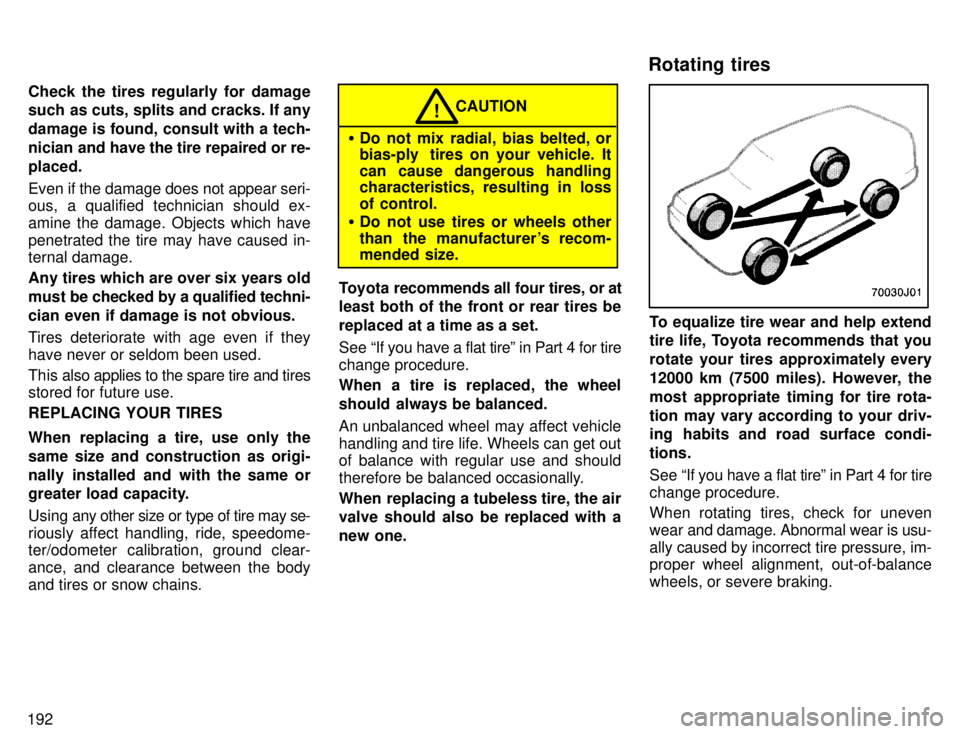
To equalize tire wear and help extend
tire life, Toyota recommends that you
rotate your tires approximately every
12000 km (7500 miles). However, the
most appropriate timing for tire rota-
tion may vary according to your driv-
ing habits and road surface condi- tions.
See If you have a flat tireº in Part 4 for tire
change procedure. When rotating tires, check for uneven
wear and damage. Abnormal wear is usu-
ally caused by incorrect tire pressure, im-
proper wheel alignment, out-of-balance
wheels, or severe braking.
Rotating tires
Page 209 of 217

+25 -15
206 Model:
3RZ-FE and 5VZ-FE
Type: 3RZ-FE engine4 cylinder in line, 4 cycle, gasoline
5VZ-FE engine 6 cylinder V type 4 cycle, gasoline
Bore and stroke, mm (in.):
3RZ-FE engine95.0 x 95.0 (3.74 x 3.74)
5VZ-FE engine
93.5 x 82.0 (3.68 x 3.23)
Displacement, cm 3
(cu. in.):
3RZ-FE engine
2694 (164.4)
5VZ-FE engine 3378 (206.1) Fuel type:
Unleaded gasoline, Research Octane
Number 91 (Octane Rating 87) or higher
Fuel tank capacity, L (gal., Imp. gal.): 70 (18.5, 15.4) ENGINE
Valve clearance (engine cold), mm (in.)
3RZ-FE engine
Intake 0.15 '0.25 (0.006 '0.010)
Exhaust 0.25 '0.35 (0.010 '0.014)
5VZ-FE engine
Intake 0.13 '0.23 (0.006 '0.009)
Exhaust 0.27 '0.37 (0.011 '0.014)
Spark plug type: 3RZ-FE engine
NIPPONDENSO K16R-U
NGK BKR5EYA
5VZ-FE engine
NIPPONDENSO K16TR11
NGK BKR5EKB-1 1
Spark plug gap, mm (in.):
3RZ-FE engine 0.8 (0.031)
5VZ-FE engine 1.1 (0.043)
Drive belt tension measured with Bor-
roughs drive belt tension gauge No.
BT-33-73F (used belt), lbf:
3RZ-FE engine
Generator belt 115 + 20
Air conditioning compressor belt 100 + 20
Power steering pump belt 100
Service specifications
Fuel
Engine