ECO mode TOYOTA 4RUNNER 1997 Owner's Manual
[x] Cancel search | Manufacturer: TOYOTA, Model Year: 1997, Model line: 4RUNNER, Model: TOYOTA 4RUNNER 1997Pages: 223, PDF Size: 4.66 MB
Page 170 of 223

173
TOWING PRECAUTIONS: Use a safety chain system for all towing,
and abide by the state/provincial and local
laws. The wheels and axle on the ground
must be in good condition. If they are
damaged, use a towing dolly.
Two-wheel drive modelsÐ
(a) Towing with wheel lift type truck From frontÐ
Manual transmission
We recommend using a towing dolly un-
der the rear wheels. If you do not use a
towing dolly, release the parking brake
and put the transmission in neutral. Automatic transmission:
Use a towing dolly under the rear wheels.
NOTICE
Never tow a vehicle with an automatic transmission from the
front with the rear wheels on theground, as this may cause serious damage to the transmission.
From rearÐ Place the ignition key in the
ACCº position.
NOTICE
When lifting wheels, take care to
ensure adequate ground clear-
ance for towing at the oppositeend of the raised vehicle. Other-wise, the bumper and/or under-
body of the towed vehicle will be damaged during towing.
Do not tow with the key removedor in the LOCKº position, as thesteering lock mechanism is notstrong enough to hold the front
wheels straight while towing.
(b) Using flat bed truck
(c) Towing with sling type truck from front
Follow the instructions for twoing from
front in (b) Towing with wheel lift type truckº. Four-wheel drive modelsÐ
(a) Towing with wheel lift type truck From frontÐ
Manual transmission:
We recommend using a towing dolly un-
der the rear wheels. If you do not use a
towing dolly, release the parking brake,
put the transmission in neutral and set the
transfer in H2º mode. Automatic transmission:
Use a towing dolly under the rear wheels.
NOTICE
Never tow a vehicle with an automatic transmission from the
rear with the front wheels on theground, as this may cause serious damage to the transmission.
From rearÐWe recommend using a tow-
ing dolly under the front wheels. If you do
not use a towing dolly, place the ignition key in the ACCº position, put the trans- mission in neutral and set the transfer inH2º.
Page 171 of 223

174
NOTICE
Do not tow with the key removed or in the LOCKº position when
towing from the rear without atowing dolly. The steering lock mechanism is not strong enough tohold the front wheels straight.
(b) Using flat bed truck
(c) Towing with sling type truck from front
Follow the instructions for towing from
front in (b) Towing with wheel lift type truckº.
All modelsÐ
(c) Towing with sling type truck from rear
NOTICE
Do not tow with sling type truck. This may cause body damage.
If towing is necessary, we recommend
you to have it done by your Toyota
dealer or a commercial tow truck ser- vice.
If towing service is not available in an
emergency, your vehicle may be tem-
porarily towed by a cable or chain se-
cured to one of the emergency towing
eyelets under the front of the vehicle.
Use extreme caution when towing the vehicle.
A driver must be in the vehicle to steer it and operate the brakes.
Towing in this manner may be done only
on hard-surfaced roads for a short dis-
tance and at low speeds. Also, the
wheels, axles, drive train, steering and brakes must all be in good condition.
ÐEmergency towing
Page 173 of 223
176
If the emergency towing hook is
used to get out when your vehicle
becomes stuck in the mud, sand or
other condition from which the
vehicle can not be driven out under
its own power, make sure to observe
the precautions mentioned below.
Otherwise, excessive stress will be
put on the hook and the towing
cable or chain may break, causing
serious injury or damage. If the towing vehicle can hardly
move, do not forcibly continue the
towing. Contact your Toyota deal-
er or a commercial tow truck ser- vice for assistance.
Tow the vehicle as straight ahead as possible.
Keep away from the vehicle during
towing. CAUTION
!
The following methods are effective to
use when your vehicle is stuck in the mud, sand or other condition from which the ve-
hicle cannot be driven out under its own
power. Use extreme caution when
towing
the vehicle. In addition, keep away from
the vehicles and towing cable or chain
when towing. Remove the soil and sand in the front and the back of the tires.
Place stones or wood under the tires.
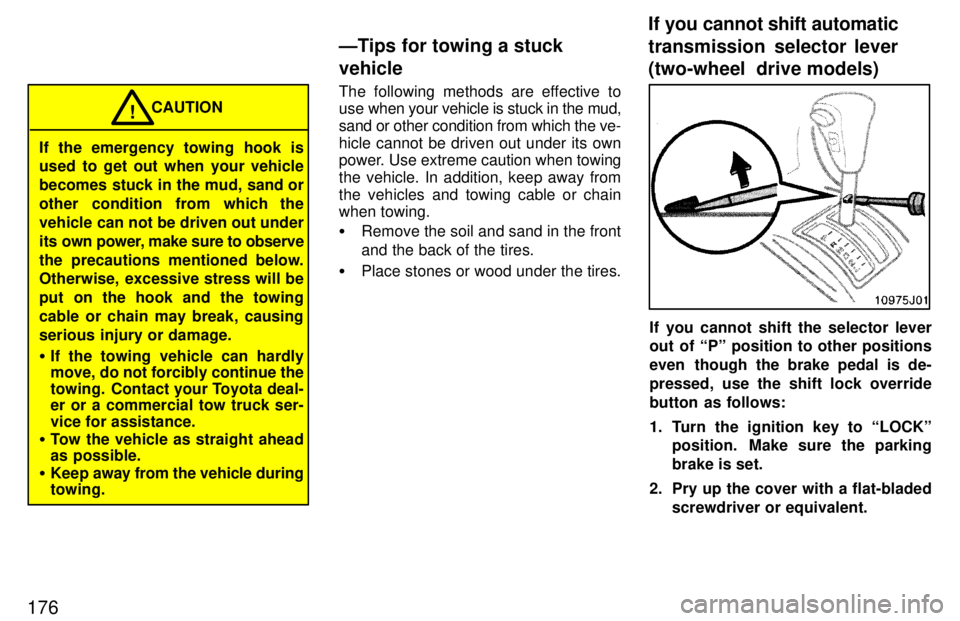
If you cannot shift the selector lever
out of Pº position to other positions
even though the brake pedal is de-pressed, use the shift lock override
button as follows:
1. Turn the ignition key to LOCKº
position. Make sure the parking brake is set.
2. Pry up the cover with a flat-bladed screwdriver or equivalent.
ÐTips for towing a stuck vehicle
If you cannot shift automatic
transmission selector lever
(two-wheel drive models)
Page 217 of 223

220
MANUAL TRANSMISSION
Oil capacity, L (qt., Imp. qt.):
3RZ-FE engineTwo-wheel drive models
2.6 (2.7, 2.3)
Four-wheel drive models 2.5 (2.6, 2.2)
5VZ-FE engine 2.2 (2.3, 1.9)
Oil type: Multipurpose gear oil API GL-4 or
GL-5
Recommended oil viscosity:
SAE 75W-90
AUTOMATIC TRANSMISSION Fluid capacity (drain and refill), L (qt., Imp. qt.):
Two-wheel drive models
Up to 1.6 (1.7, 1.4)
Four-wheel drive models Up to 2.0 (2.1, 1.8)
Fluid type: Automatic transmission fluid D-II or DEXRON [
III (DEXRON [
II) TRANSFER
Oil capacity, L (qt., lmp. qt.):
1.0 (1.1, 0.9)
Oil type: Multipurpose gear oil API GL-4 or
GL-5
Recommended oil viscosity: SAE 75W-90
DIFFERENTIAL
Oil capacity, L (qt., lmp. qt.): Two-wheel drive models2.75 (2.9, 2.4)
Four-wheel drive models FrontA.D.D.
1.15 (1.2, 1.0)
Except A.D.D. 1.1 (1.2, 1.0)
Rear With rear differential lock system2.75 (2.9, 2.4)
Without rear differential lock system
2.45 (2.6, 2.2) Oil type:
Hypoid gear oil API GL-5
Recommended oil viscosity: FrontA.D.D.
SAE 75W-90
Except A.D.D. Above -18 C (0 F)
SAE 90
Below -18 C (0 F)
SAE 80W or 80W-90
Rear Above -18 C (0 F)
SAE 90
Below -18 C (0 F)
SAE 80W or 80W-90
CHASSIS LUBRICATION Propeller shafts: SpidersLithium base chassis grease, NLGI No. 2
Slide yoke and double cardan joint Molybdenum-disulfide lithium basechassis grease, NLGI No. 2