transmission TOYOTA 4RUNNER 1997 Owner's Guide
[x] Cancel search | Manufacturer: TOYOTA, Model Year: 1997, Model line: 4RUNNER, Model: TOYOTA 4RUNNER 1997Pages: 223, PDF Size: 4.66 MB
Page 163 of 223
1661. Reduce
your speed gradually, keeping
a straight line. Move cautiously off the
road to a safe place well away from the
traf fic. Avoid stopping on the center di-
vider of a highway. Park on a level spotwith firm ground.
2. Stop the engine and turn on your emergency flashers.
3. Firmly set the parking brake and put the transmission in Pº (automatic) or reverse (manual).
4. Have everyone get out of the vehicle on the side away from traffic.
5. Read the following instructions thor- oughly.
When jacking, be sure to observe
the following to reduce the poss- ibility of personal injury: Follow jacking instructions.
Use the jack only for lifting your
vehicle during wheel changing.
Never get beneath the vehicle
when supported by the jack.
Do not start or run the engine
while your vehicle is supported bya jack. CAUTION
!
NOTICE
Do not continue driving with a deflated tire. Driving even a short
distance can damage a tire beyondrepair.
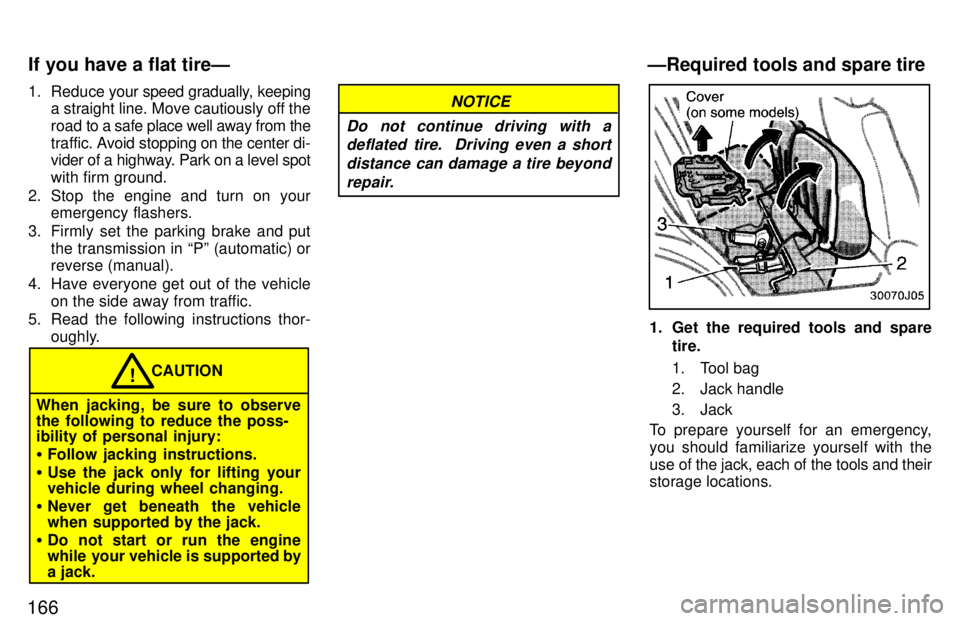
1. Get the required tools and spare tire.
1. Tool bag
2. Jack handle
3. Jack
To prepare yourself for an emergency, you should familiarize yourself with the
use of the jack, each of the tools and their storage locations.
If you have a flat tireÐ
ÐRequired tools and spare tire
Page 170 of 223
173
TOWING PRECAUTIONS: Use a safety chain system for all towing,
and abide by the state/provincial and local
laws. The wheels and axle on the ground
must be in good condition. If they are
damaged, use a towing dolly.
Two-wheel drive modelsÐ
(a) Towing with wheel lift type truck From frontÐ
Manual transmission
We recommend using a towing dolly un-
der the rear wheels. If you do not use a
towing dolly, release the parking brake
and put the transmission in neutral. Automatic transmission:
Use a towing dolly under the rear wheels.
NOTICE
Never tow a vehicle with an automatic transmission from the
front with the rear wheels on theground, as this may cause serious damage to the transmission.
From rearÐ Place the ignition key in the
ACCº position.
NOTICE
When lifting wheels, take care to
ensure adequate ground clear-
ance for towing at the oppositeend of the raised vehicle. Other-wise, the bumper and/or under-
body of the towed vehicle will be damaged during towing.
Do not tow with the key removedor in the LOCKº position, as thesteering lock mechanism is notstrong enough to hold the front
wheels straight while towing.
(b) Using flat bed truck
(c) Towing with sling type truck from front
Follow the instructions for twoing from
front in (b) Towing with wheel lift type truckº. Four-wheel drive modelsÐ
(a) Towing with wheel lift type truck From frontÐ
Manual transmission:
We recommend using a towing dolly un-
der the rear wheels. If you do not use a
towing dolly, release the parking brake,
put the transmission in neutral and set the
transfer in H2º mode. Automatic transmission:
Use a towing dolly under the rear wheels.
NOTICE
Never tow a vehicle with an automatic transmission from the
rear with the front wheels on theground, as this may cause serious damage to the transmission.
From rearÐWe recommend using a tow-
ing dolly under the front wheels. If you do
not use a towing dolly, place the ignition key in the ACCº position, put the trans- mission in neutral and set the transfer inH2º.
Page 172 of 223
175
CAUTION!
Use extreme caution when towing
vehicles. Avoid sudden starts or
erratic driving maneuvers which
would place excessive stress on the
emergency towing hook and towing
cable or chain. The hook and towing
cable or chain may break and cause
serious injury or damage.
NOTICE
Use only a cable or chain specific- ally intended for use in towing
vehicles. Securely fasten the cableor chain to the towing eyelet provided.
Before towing, release the parking brake
and put the transmission in neutral
(manual) or Nº (automatic)And transfer in
H2º (four-wheel drive models). The key
must be in ACCº (engine off) or ONº (en-
gine running).
CAUTION!
If the engine is not running, the
power assist for the brakes and
steering will not work so steering
and braking will be much harder
than usual.
Before emergency towing, check that
the hook is not broken or damaged and
that the installation bolts are not loose.
Fasten the towing cable or chain se-curely to the hook.
Do not jerk the hook. Apply steady and
even force.
To avoid damaging the hook, do not
pull from the side or at a vertical angle.
Always pull straight ahead.
ÐEmergency towing hook precautions
Page 173 of 223
176
If the emergency towing hook is
used to get out when your vehicle
becomes stuck in the mud, sand or
other condition from which the
vehicle can not be driven out under
its own power, make sure to observe
the precautions mentioned below.
Otherwise, excessive stress will be
put on the hook and the towing
cable or chain may break, causing
serious injury or damage. If the towing vehicle can hardly
move, do not forcibly continue the
towing. Contact your Toyota deal-
er or a commercial tow truck ser- vice for assistance.
Tow the vehicle as straight ahead as possible.
Keep away from the vehicle during
towing. CAUTION
!
The following methods are effective to
use when your vehicle is stuck in the mud, sand or other condition from which the ve-
hicle cannot be driven out under its own
power. Use extreme caution when
towing
the vehicle. In addition, keep away from
the vehicles and towing cable or chain
when towing. Remove the soil and sand in the front and the back of the tires.
Place stones or wood under the tires.
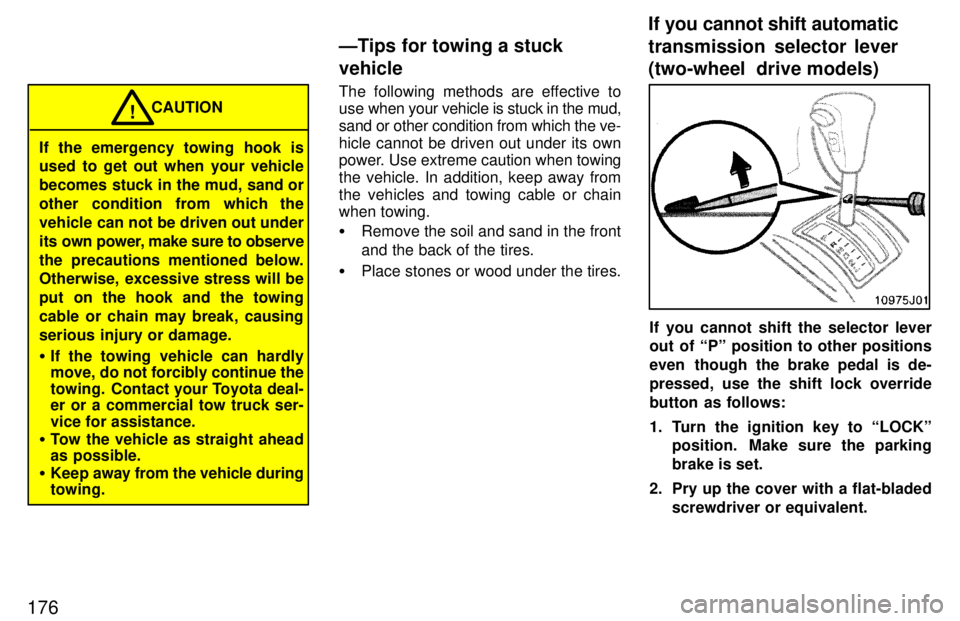
If you cannot shift the selector lever
out of Pº position to other positions
even though the brake pedal is de-pressed, use the shift lock override
button as follows:
1. Turn the ignition key to LOCKº
position. Make sure the parking brake is set.
2. Pry up the cover with a flat-bladed screwdriver or equivalent.
ÐTips for towing a stuck vehicle
If you cannot shift automatic
transmission selector lever
(two-wheel drive models)
Page 174 of 223

177
3. Insert the screwdriver or equivalent
into the hole to push up the shift
lock override button. You can shift
out of Pº position only while push-
ing the button.
4. Shift into Nº position.
5. Insert the cover.
6. Start the engine. For your safety, keep the brake pedal depressed.
Be sure to have the system checked by
your Toyota dealer as soon as possible.If you cannot shift the selector lever
out of Pº position to other positions
even though the brake pedal is de-pressed, use the shift lock override
button as follows:
1. Turn the ignition key to LOCKº position. Make sure the parking brake is set.
2. Pry up the cover with a flat-bladed screwdriver or equivalent.3. Insert your finger into the hole tomove the shift lock override lever
backward. You can shift out of Pº
position only while holding back
the lever.
4. Shift into Nº position.
5. Insert the cover.
6. Start the engine. For your safety, keep the brake pedal depressed.
Be sure to have the system checked by
your Toyota dealer as soon as possible.
If you cannot shift automatic
transmission selector lever
(four-wheel drive models)
Page 185 of 223

188Automatic transmission Parkº
mech-
anism
Check the lock release button of the se-
lector lever for proper and smooth opera-
tion. On a safe incline, check that your ve-
hicle is held securely with the selector lever in ºPº position and all brakes re- leased.
IN THE ENGINE COMPARTMENT Items listed below should be checked
from time to time , e.g. each time when
refueling.
Washer fluid
Make sure there is sufficient fluid in the
tank. See Chapter 7-3 for additional infor-
mation.
Engine coolant level Make sure the coolant level is between
the FULLº and LOWº lines on the see-
through reservoir when the engine is cold.
See Chapter 7-2 for additional informa-tion.
Battery electrolyte level Make sure the electrolyte level of all bat-
tery cells is between upper and lower level
lines on the case. Add only distilled water
when replenishing. See Chapter 7-3 for
additional information. Brake fluid level
Make sure the brake fluid level is correct. See Chapter 7-2 for additional informa- tion.
Engine oil level
Check the l
evel on the dipstick with the en-
gine turned off and the vehicle parked on
a level spot. See Chapter 7-2 for addition-
al information. Power steering fluid level Check the level through the reservoir. The
level should be in the HOTº or COLDº
range depending on the fluid t emperature.
See Chapter 7-2 for additional informa- tion.
Exhaust system
If you notice any change in the sound of
the exhaust or smell exhaust fumes, have the cause located and corrected immedi-
ately. (See engine exhaust cautions in
Part 2.) Be on the alert for changes in perfor-
mance, sounds, and visual tip-offs
that in-
dicate service is needed. Some important
clues are as follows: Engine missing, stumbling, or pinging
Appreciable loss of power
Strange engine noises
A leak under the vehicle (however, wa-
ter dripping from the air conditioning
after use is normal.)
Change in exhaust sound (This may
indicate a dangerous carbon monox-
ide leak. Drive with the windows open
and have the exhaust system checked
immediately.)
Flat-looking tire; excessive tire squeal
when cornering; uneven tire wear
Vehicle pulls to one side when drivingstraight on a level road
Strange noises related to suspensionmovement
Loss of brake effectiveness; spongy
feeling brake or clutch pedal; pedal al-
most touches floor; vehicle pulls to one
side when braking
Engine coolant temperature continual-
ly higher than normal
Does your vehicle need repairing?
Page 192 of 223
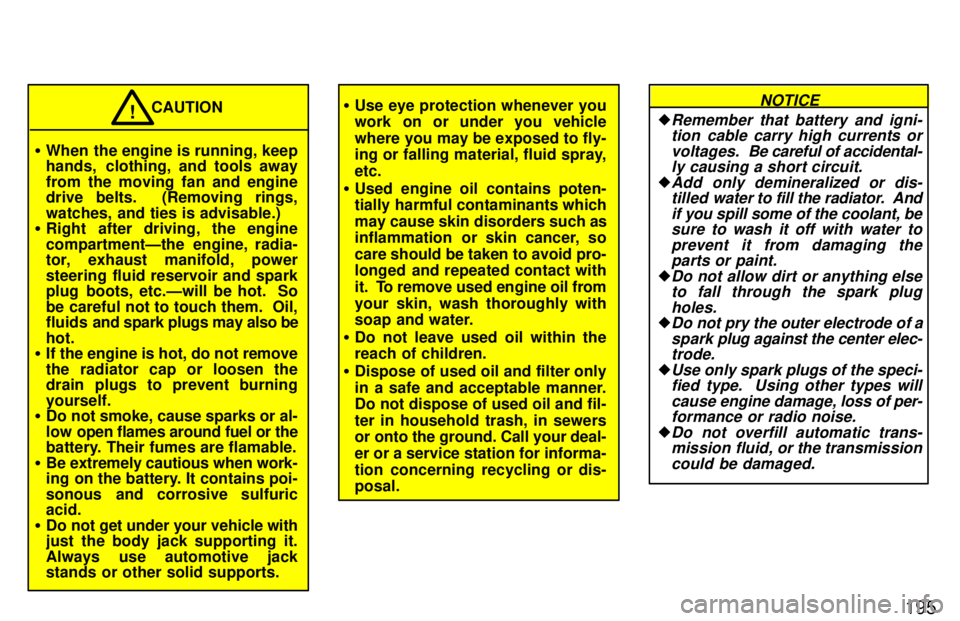
195
When the engine is running, keep
hands, clothing, and tools away
from the moving fan and engine
drive belts. (Removing rings,
watches, and ties is advisable.)
Right after driving, the engine
compartmentÐthe engine, radia-
tor, exhaust manifold, power
steering fluid reservoir and spark
plug boots, etc.Ðwill be hot. So
be careful not to touch them. Oil,
fluids and spark plugs may also be
hot.
If the engine is hot, do not remove
the radiator cap or loosen the
drain plugs to prevent burning yourself.
Do not smoke, cause sparks or al-
low open flames around fuel or the
battery. Their fumes are flamable.
Be extremely cautious when work-
ing on the battery. It contains poi-
sonous and corrosive sulfuric acid.
Do not get under your vehicle with
just the body jack supporting it.
Always use automotive jack
stands or other solid supports. CAUTION
!
Use eye protection whenever you
work on or under you vehicle
where you may be exposed to fly-
ing or falling material, fluid spray, etc.
Used engine oil contains poten-
tially harmful contaminants which
may cause skin disorders such as
inflammation or skin cancer, so
care should be taken to avoid pro-
longed and repeated contact with
it. To remove used engine oil from
your skin, wash thoroughly with
soap and water.
Do not leave used oil within thereach of children.
Dispose of used oil and filter only
in a safe and acceptable manner.
Do not dispose of used oil and fil-
ter in household trash, in sewers
or onto the ground. Call your deal- er or a service station for informa-
tion concerning recycling or dis- posal. Remember that battery and igni-
tion cable carry high currents or
voltages. Be careful of accidental-
ly causing a short circuit.
Add only demineralized or dis- tilled water to fill the radiator. And
if you spill some of the coolant, be sure to wash it off with water to
prevent it from damaging theparts or paint.
Do not allow dirt or anything else
to fall through the spark plug
holes.
Do not pry the outer electrode of a
spark plug against the center elec-
trode.
Use only spark plugs of the speci- fied type. Using other types will
cause engine damage, loss of per-
formance or radio noise.
Do not overfill automatic trans-
mission fluid, or the transmission
could be damaged.
NOTICE
Page 193 of 223

196
Do not drive with the air cleaner fil-
ter removed, or excessive engine
wear could result. Also backfiringcould cause a fire in the enginecompartment
Be careful not to scratch the glass
surface with the wiper frame.
When closing the engine hood,check to see that you have not for-
gotten any tools, rags, etc.
Here is a list of parts and tools you will
need on performing do-it-yourself main-
tenance. Remember all Toyota parts are
designed in metric sizes, so your tools
must be metric. Checking the engine oil level Parts (if level is low): Engine oil API SH, Energy-Conserv-
ing IIº multigrade or ILSAC multigrade
having viscosity proper for your cli- mate
Tools: Rag or paper towel
Funnel (only for adding oil)
Checking the engine coolant level Parts (if level is low): Ethylene-glycol antifreeze
Demineralized or distilled water
Tools: Funnel (only for adding coolant)
Checking brake fluid Parts (if level is low): SAE J1703 or FMVSS No. 116 DOT 3 brake fluid
Tools: Rag or paper towel
Funnel (only for adding fluid) Checking power steering fluid Parts (if level is low):
Automatic transmission fluid DEX- RON [
-II or III
Tools: Rag or paper towel
Funnel (only for adding fluid)
Checking battery condition Non-maintenance batteriesÐ
Tools: Warm water
Baking soda
Grease
Conventional wrench (for terminal clamp bolts)
Maintenance batteriesÐ Parts (if level is low): Distilled water
Tools: Warm water
Baking soda
Grease
Conventional wrench (for terminal clamp bolts)
Coin (for vent plugs)
Funnel (only for adding distilled water)
Parts and tools
Page 217 of 223

220
MANUAL TRANSMISSION
Oil capacity, L (qt., Imp. qt.):
3RZ-FE engineTwo-wheel drive models
2.6 (2.7, 2.3)
Four-wheel drive models 2.5 (2.6, 2.2)
5VZ-FE engine 2.2 (2.3, 1.9)
Oil type: Multipurpose gear oil API GL-4 or
GL-5
Recommended oil viscosity:
SAE 75W-90
AUTOMATIC TRANSMISSION Fluid capacity (drain and refill), L (qt., Imp. qt.):
Two-wheel drive models
Up to 1.6 (1.7, 1.4)
Four-wheel drive models Up to 2.0 (2.1, 1.8)
Fluid type: Automatic transmission fluid D-II or DEXRON [
III (DEXRON [
II) TRANSFER
Oil capacity, L (qt., lmp. qt.):
1.0 (1.1, 0.9)
Oil type: Multipurpose gear oil API GL-4 or
GL-5
Recommended oil viscosity: SAE 75W-90
DIFFERENTIAL
Oil capacity, L (qt., lmp. qt.): Two-wheel drive models2.75 (2.9, 2.4)
Four-wheel drive models FrontA.D.D.
1.15 (1.2, 1.0)
Except A.D.D. 1.1 (1.2, 1.0)
Rear With rear differential lock system2.75 (2.9, 2.4)
Without rear differential lock system
2.45 (2.6, 2.2) Oil type:
Hypoid gear oil API GL-5
Recommended oil viscosity: FrontA.D.D.
SAE 75W-90
Except A.D.D. Above -18 C (0 F)
SAE 90
Below -18 C (0 F)
SAE 80W or 80W-90
Rear Above -18 C (0 F)
SAE 90
Below -18 C (0 F)
SAE 80W or 80W-90
CHASSIS LUBRICATION Propeller shafts: SpidersLithium base chassis grease, NLGI No. 2
Slide yoke and double cardan joint Molybdenum-disulfide lithium basechassis grease, NLGI No. 2
Page 218 of 223

P265/70R16 200 (2.2, 32) 220 (2.2, 32) 7J x 16J*1
7JJX16 *2
P225/75R15 200 (2.0, 29) 200 (2.0, 29) 7J x 15 *1
7JJ x 15 *2
Tire size
Tire pressure
kPa (kgf/cm 2
or bar, psi)
Front Rear Wheel size
Wheel nut torque, N
m (kg fm, ft lbf):
110 (11.5, 83)
* 1:
Vehicles with steel wheels
* 2:
Vehicles with aluminum wheel
221
BRAKES Minimum pedal clearance when de-pressed with the pressure of 490 N (50
kgf, 110 lbf) with the engine running, mm (in.):
72 (2.9)
Pedal freeplay, mm (in.):
3' 6 (0.12 '0.24)
Pad wear limit, mm (in.):
1.0 (0.04)
Lining wear limit, mm (in.):
1.0 (0.04)
Parking brake adjustment when pulled with the force of 196 N (20 kgf, 44 lbf): 7' 9 clicks
Fluid type: SAE J1703 or FMVSS No. 116 DOT 3
STEERING Wheel freeplay:
Less than 30 mm (1.2 in.)
Power steering fluid type:
Automatic transmission fluid DEXRON [
II or III Tires