lock TOYOTA 4RUNNER 1997 Manual PDF
[x] Cancel search | Manufacturer: TOYOTA, Model Year: 1997, Model line: 4RUNNER, Model: TOYOTA 4RUNNER 1997Pages: 223, PDF Size: 4.66 MB
Page 174 of 223

177
3. Insert the screwdriver or equivalent
into the hole to push up the shift
lock override button. You can shift
out of Pº position only while push-
ing the button.
4. Shift into Nº position.
5. Insert the cover.
6. Start the engine. For your safety, keep the brake pedal depressed.
Be sure to have the system checked by
your Toyota dealer as soon as possible.If you cannot shift the selector lever
out of Pº position to other positions
even though the brake pedal is de-pressed, use the shift lock override
button as follows:
1. Turn the ignition key to LOCKº position. Make sure the parking brake is set.
2. Pry up the cover with a flat-bladed screwdriver or equivalent.3. Insert your finger into the hole tomove the shift lock override lever
backward. You can shift out of Pº
position only while holding back
the lever.
4. Shift into Nº position.
5. Insert the cover.
6. Start the engine. For your safety, keep the brake pedal depressed.
Be sure to have the system checked by
your Toyota dealer as soon as possible.
If you cannot shift automatic
transmission selector lever
(four-wheel drive models)
Page 175 of 223

178Many Toyota dealers can make a new
key if you can give them the key num-
ber. See the suggestion given in Keysº in Chapter 1-2.
If your keys are locked in the vehicle and
you cannot get a duplicate, many Toyota
dealers
can still open the door for you, us-
ing their special tools. If you must break a
window to get in, we suggest breaking the
smallest side window because it is the least expensive to replace. Be extremely cautious to avoid cuts from the glass.
If you lose your keys
Page 184 of 223

187
Tire surface and wheel nuts Check the tires carefully
for cuts, damage
or excessive wear. See Chapter 7-2 for
additional information. When checking the tires, make sure no nuts are missing,
and check the nuts for looseness. T ighten
them if necessary.
Tire rotation
Rotate the tires every 12000 km (7500
miles). See Chapter 7-2 for additional in- formation.
Fluid leaks Check underneath for leaking fuel, oil, wa-
ter or other fluid after the vehicle has been
parked for a while. If you smell fuel fumes
or notice any leak, have the cause found
and corrected immediately. Doors and engine hood
Check that all doors including back door
operate smoothly and all latches lock se-
curely. M ake sure the engine hood secon-
dary latch secures the hood from opening
when the primary latch is released. INSIDE THE VEHICLE Items listed below should be checked
regularly, e.g. while performing peri-
odic services, cleaning the vehicle, etc. Lights Make sure the headlights, stop lights, tail lights, turn signal lights, and other lights are all working. Check headlight aim. Service reminder indicators and
warn-
ing buzzers Check that all service reminder indicators
and warning buzzers function properly. Steering wheel
Check that it has the specified freeplay.
Be alert for changes in steering condition, such as hard steering or strange noise. Seats Check that all seat controls such as seat
adjusters, seatback recliner, etc. operate
smoothly and that all latches lock securely
in any position. Check that the head re-
straints move up and down smoothly and
that the locks hold securely in any latched
position. For folding-down rear seat-
backs, swing-up rear seat cushions and
detachable temporary third seat, check
that the latches lock securely. Seat belts
Check that the seat belt system such as
buckles, retractors and anchors operate
properly
and smoothly. Make sure the belt
webbing is not cut, frayed, worn or dam-aged. Accelerator pedal Check the pedal for smooth operation and
uneven pedal effort or catching. Clutch pedal Check the pedal for smooth operation. Brake pedal Check the pedal for smooth operation and
that the pedal has the proper clearance. Check the brake booster function. Brakes
At a safe place, check that the brakes do not pull to one side when applied. Parking brake Check that the lever has the proper travel and that, on a safe incline, your vehicle is
held securely with only the parking brake applied.
Page 185 of 223

188Automatic transmission Parkº
mech-
anism
Check the lock release button of the se-
lector lever for proper and smooth opera-
tion. On a safe incline, check that your ve-
hicle is held securely with the selector lever in ºPº position and all brakes re- leased.
IN THE ENGINE COMPARTMENT Items listed below should be checked
from time to time , e.g. each time when
refueling.
Washer fluid
Make sure there is sufficient fluid in the
tank. See Chapter 7-3 for additional infor-
mation.
Engine coolant level Make sure the coolant level is between
the FULLº and LOWº lines on the see-
through reservoir when the engine is cold.
See Chapter 7-2 for additional informa-tion.
Battery electrolyte level Make sure the electrolyte level of all bat-
tery cells is between upper and lower level
lines on the case. Add only distilled water
when replenishing. See Chapter 7-3 for
additional information. Brake fluid level
Make sure the brake fluid level is correct. See Chapter 7-2 for additional informa- tion.
Engine oil level
Check the l
evel on the dipstick with the en-
gine turned off and the vehicle parked on
a level spot. See Chapter 7-2 for addition-
al information. Power steering fluid level Check the level through the reservoir. The
level should be in the HOTº or COLDº
range depending on the fluid t emperature.
See Chapter 7-2 for additional informa- tion.
Exhaust system
If you notice any change in the sound of
the exhaust or smell exhaust fumes, have the cause located and corrected immedi-
ately. (See engine exhaust cautions in
Part 2.) Be on the alert for changes in perfor-
mance, sounds, and visual tip-offs
that in-
dicate service is needed. Some important
clues are as follows: Engine missing, stumbling, or pinging
Appreciable loss of power
Strange engine noises
A leak under the vehicle (however, wa-
ter dripping from the air conditioning
after use is normal.)
Change in exhaust sound (This may
indicate a dangerous carbon monox-
ide leak. Drive with the windows open
and have the exhaust system checked
immediately.)
Flat-looking tire; excessive tire squeal
when cornering; uneven tire wear
Vehicle pulls to one side when drivingstraight on a level road
Strange noises related to suspensionmovement
Loss of brake effectiveness; spongy
feeling brake or clutch pedal; pedal al-
most touches floor; vehicle pulls to one
side when braking
Engine coolant temperature continual-
ly higher than normal
Does your vehicle need repairing?
Page 189 of 223

1921. Windshield and back window washer
fluid tank
2. Engine oil filler cap
3. Brake fluid reservoir
4. Fuse block
5. Battery
6. Engine coolant reservoir
7. Power steering fluid reservoir
8. Engine oil level dipstick
Engine compartment overview
3RZ-FE engine
Page 190 of 223

193
1. Windshield and back window washer
fluid tank
2. Power steering fluid reservoir
3. Engine oil filler cap
4. Brake fluid reservoir
5. Fuse block
6. Battery
7. Engine coolant reservoir
8. Engine oil level dipstick
5VZ-FE engine
Page 199 of 223
202Remove and replace the reservoir cover by hand.
Use only newly opened brake fluid. Once
opened, brake fluid absorbs moisture
from the air, and excess moisture can cause a dangerous loss of braking.
CAUTION!
Take care when filling the reservoir
because brake fluid can harm your
eyes and damage painted surfaces. If
fluid gets in your eyes, flush your
eyes with clean water.
If you spill the fluid, be sure to wash
it off with water to prevent it from
damaging the parts or paint.
NOTICE
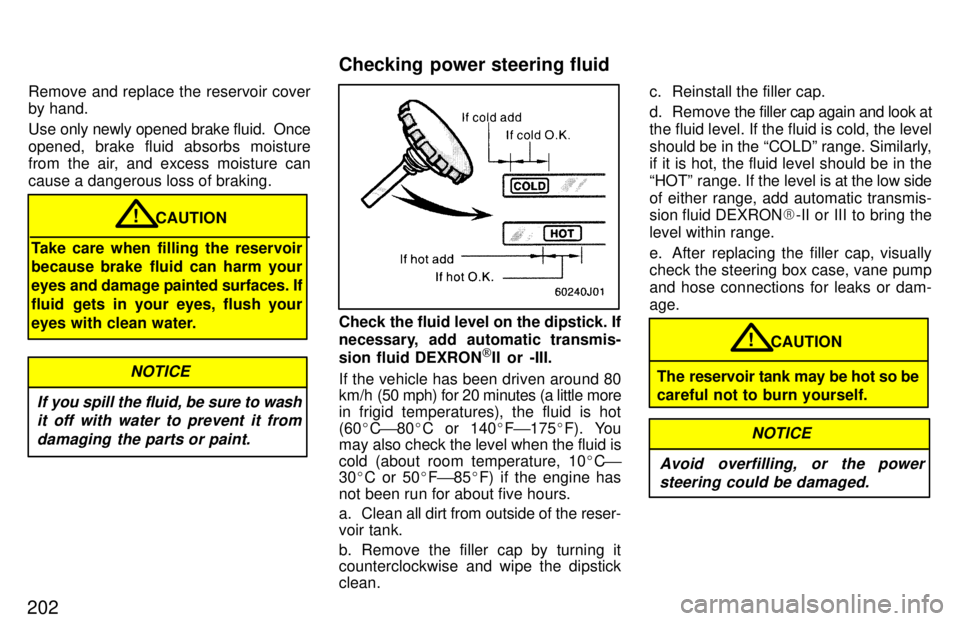
Check the fluid level on the dipstick. If
necessary, add automatic transmis-
sion fluid DEXRON [
II or -III.
If the vehicle has been driven around 80
km/h (50 mph) for 20 minutes (a little more
in frigid temperatures), the fluid is hot (60 C ' 80 C or 140 F ' 175 F). You
may also check the level when the fluid is
cold (about room temperature, 10 C '
30 C or 50 F ' 85 F) if the engine has
not been run for about five hours.
a. Clean all dirt from outside of the reser-
voir tank.
b. Remove the filler cap by turning it
counterclockwise and wipe the dipstick clean. c. Reinstall the filler cap.
d. Remove the filler cap again and look at the fluid level. If the fluid is cold, the level
should be in the COLDº range. Similarly, if it is hot, the fluid level should be in the
HOTº range. If the level is at
the low side
of either range, add automatic transmis-
sion fluid DEXRON -II or III to bring the
level within range.
e. After replacing the filler cap, visually check the steering box case, vane pump
and hose connections for leaks or dam-age.
CAUTION!
The reservoir tank may be hot so be
careful not to burn yourself.
Avoid overfilling, or the power steering could be damaged.
NOTICE
Checking power steering fluid
Page 202 of 223
205
WHEN TO USE SNOW TIRES OR CHAINS
Snow tires or chains are recom-
mended when driving on snow or ice.
On wet or dry roads, conventional tires
provide better traction than snow tires. SNOW TIRE SELECTION
If you need snow tires, select tires of
the same size, construction and load capacity as the original tires on your
Toyota.
Do not use tires other than those men-
tioned above. Do not install studded tires
without first checking local regulations for
possible restrictions.
SNOW TIRE INSTALLATION
Snow tires should be installed on all wheels. Installing snow tires on the front wheels
only can lead to an excessive difference
in road grip capability between the front
and rear tires which would cause loss of
vehicle control.
When storing removed tires, you should
store them in a cool dry place.
Mark the direction of rotation and be sure to install them in the same direction when replacing.
CAUTION!
Do not drive with the snow tires in- correctly inflated.
Never drive over 120 km/h (75
mph) with any type of snow tires.
TIRE CHAIN SELECTION
Use the tire chains of correct size and type.
Regulations regarding the use of tire
chains vary according to location or
type of road, so always check then be-
fore installing chains.
CHAIN INSTALLATION
Install the chains on the rear tires as
tightly as possible. Do not use tire
chains on the front tires. Retighten
chains after driving 0.5 '1.0 km
(1/4 '1/2 mile).
When installing chains on your tires, care- fully follow the instructions of the chain
manufacturer.
If wheel covers are used, they will be
scratched by the chain band, so remove the covers before putting on the chains.
Do not exceed 50 km/h (30 mph)
or the chain manufacturer's rec-
ommended speed limit, which-
ever is lower.
Drive carefully avoiding bumps,
holes, and sharp turns, which
may cause the vehicle to bounce.
Avoid sharp turns or
locked-wheel braking, as use of
chains may adversely affect
vehicle handling.
CAUTION!
Installing snow tires and chains
Page 217 of 223

220
MANUAL TRANSMISSION
Oil capacity, L (qt., Imp. qt.):
3RZ-FE engineTwo-wheel drive models
2.6 (2.7, 2.3)
Four-wheel drive models 2.5 (2.6, 2.2)
5VZ-FE engine 2.2 (2.3, 1.9)
Oil type: Multipurpose gear oil API GL-4 or
GL-5
Recommended oil viscosity:
SAE 75W-90
AUTOMATIC TRANSMISSION Fluid capacity (drain and refill), L (qt., Imp. qt.):
Two-wheel drive models
Up to 1.6 (1.7, 1.4)
Four-wheel drive models Up to 2.0 (2.1, 1.8)
Fluid type: Automatic transmission fluid D-II or DEXRON [
III (DEXRON [
II) TRANSFER
Oil capacity, L (qt., lmp. qt.):
1.0 (1.1, 0.9)
Oil type: Multipurpose gear oil API GL-4 or
GL-5
Recommended oil viscosity: SAE 75W-90
DIFFERENTIAL
Oil capacity, L (qt., lmp. qt.): Two-wheel drive models2.75 (2.9, 2.4)
Four-wheel drive models FrontA.D.D.
1.15 (1.2, 1.0)
Except A.D.D. 1.1 (1.2, 1.0)
Rear With rear differential lock system2.75 (2.9, 2.4)
Without rear differential lock system
2.45 (2.6, 2.2) Oil type:
Hypoid gear oil API GL-5
Recommended oil viscosity: FrontA.D.D.
SAE 75W-90
Except A.D.D. Above -18 C (0 F)
SAE 90
Below -18 C (0 F)
SAE 80W or 80W-90
Rear Above -18 C (0 F)
SAE 90
Below -18 C (0 F)
SAE 80W or 80W-90
CHASSIS LUBRICATION Propeller shafts: SpidersLithium base chassis grease, NLGI No. 2
Slide yoke and double cardan joint Molybdenum-disulfide lithium basechassis grease, NLGI No. 2
Page 219 of 223

222
Engine compartment (U.S.A.) Fuses (type A)
1. DEFOG 15 A: Back window defogger
2. STOP 10 A: Stop lights, high-
mounted stoplight
3. ALT-S 7.5 A: Charging system
4. OBD 7.5 A: On-board diagnosis sys-
tem
5. EFI 15 A: Multiport fuel injection sys-
tem/sequential multiport fuel injection systemEngine compartment (Canada)
6. HORN 15 A: Horns
7. DOME 15 A: Interior lights, personal
lights, luggage compartment light
8. TAIL 10 A: Tail lights, parking lights, li-
cense plate lights
9. A.C. 10 A: Air conditioning control
system
10. RR HTR 10 A: Rear air conditioning
control system
11. HEAD (RH) 10 A: Right-hand head-
light
12. HEAD (LH) 10 A: Left-hand headlightInstrument panel
13. DRL 7.5 A: Daytime running light sys-
tem
14. HEAD (HI RH) 10 A: Right-hand
headlight (high beam)
15. HEAD (HI LH) 10 A: Left-hand head-
light (high beam)
16. HEAD 10 A: Right-hand headlight
(low beam)
17. HEAD 10 A: Left-hand headlight (low
beam)
18. ACC 15 A: Car audio system, power
antenna, clock, power rear view mirror
control
Fuses