battery TOYOTA 4RUNNER 1998 User Guide
[x] Cancel search | Manufacturer: TOYOTA, Model Year: 1998, Model line: 4RUNNER, Model: TOYOTA 4RUNNER 1998Pages: 350, PDF Size: 2.25 MB
Page 256 of 350

4RUNNER (1998)
JUMP STARTING PROCEDURE
1. If the booster battery is installed in another vehicle, make sure the ve-
hicles are not touching. Turn off all
unnecessary lights and accesso-
ries.
2. If required, remove all the vent plugs from the booster and dis-
charged batteries. Lay a cloth over
the open vents on the batteries.
(This helps reduce the explosion
hazard, personal injuries and
burns.)
3. If the engine in the vehicle with the booster battery is not running, start
it and let it run for a few minutes.
During jump starting run the engine
at about 2000 rpm with the accel-
erator pedal lightly depressed.
Page 257 of 350
4RUNNER (1998)
Booster battery
Positive terminal (º+º mark)
Positive terminal (º+º mark)
Jumper cable Discharged battery
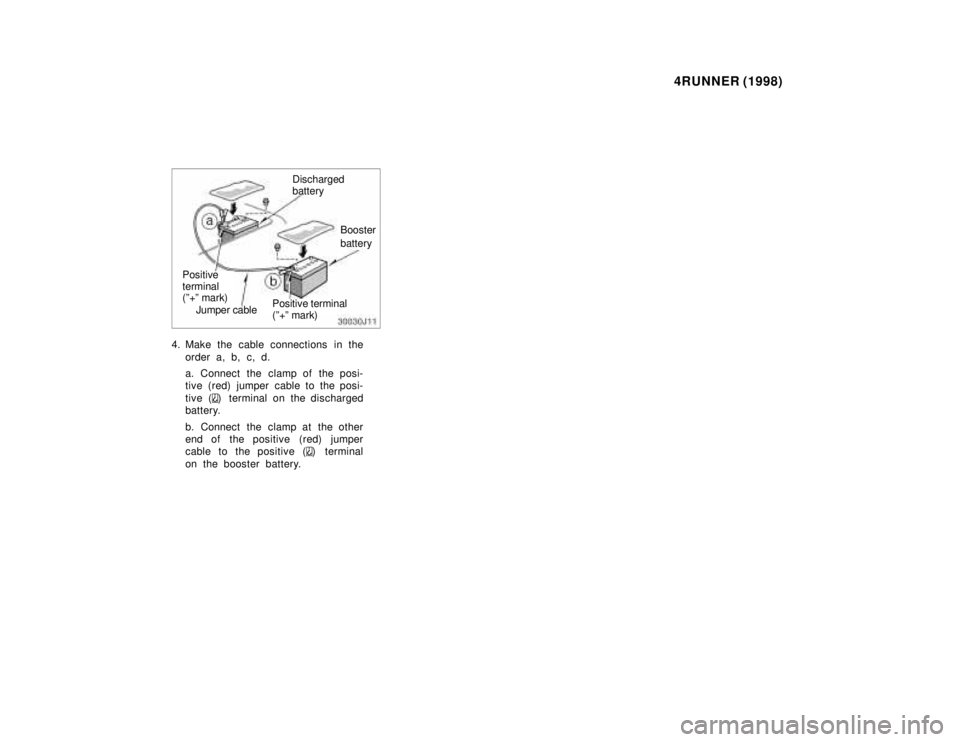
4. Make the cable connections in the order a, b, c, d.
a. Connect the clamp of the posi-
tive (red) jumper cable to the posi-
tive (
) terminal on the discharged
battery.
b. Connect the clamp at the other
end of the positive (red) jumper
cable to the positive (
) terminal
on the booster battery.
Page 258 of 350
4RUNNER (1998)
Discharged battery Jumper cable
Negative terminal
(º-º mark)
Booster battery
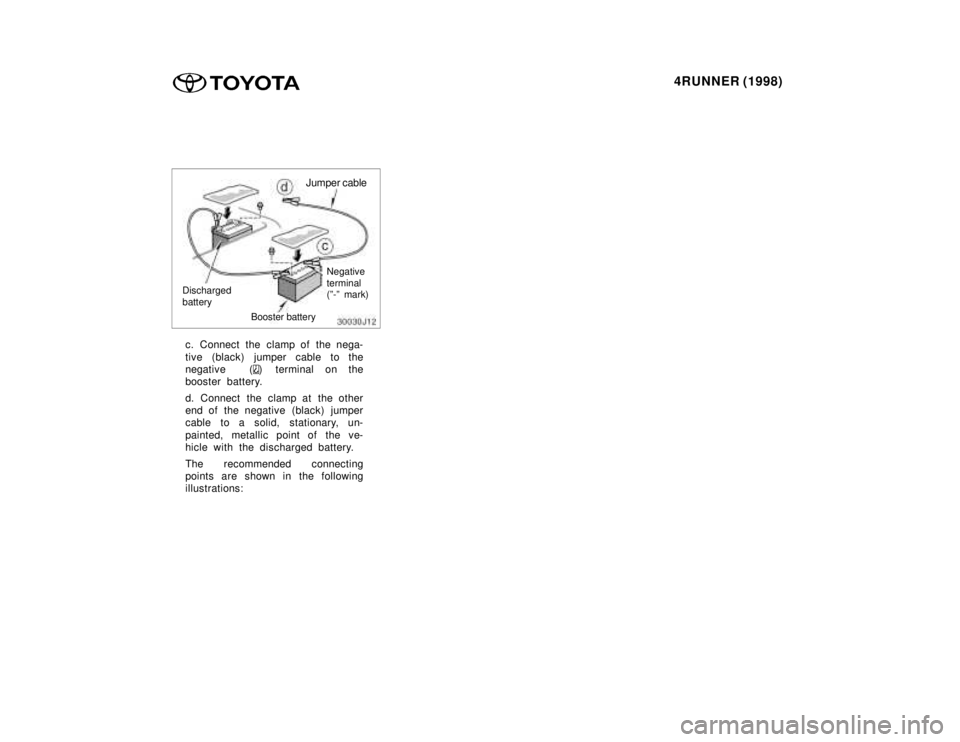
c. Connect the clamp of the nega-
tive (black) jumper cable to the
negative (
) terminal on the
booster battery.
d. Connect the clamp at the other
end of the negative (black) jumper
cable to a solid, stationary, un-
painted, metallic point of the ve-
hicle with the discharged battery.
The recommended connecting
points are shown in the following
illustrations:
Page 260 of 350
4RUNNER (1998)
CAUTION
When making the connections, to
avoid serious injury, do not lean
over the battery or accidentally
let the jumper cables or clamps
touch anything except the correct
battery terminals or the ground.
5. Start your engine in the normal
way. After starting, run it at about
2000 rpm for several minutes with
the accelerator pedal lightly de-
pressed.
6. Carefully disconnect the cables in the exact reverse order: the nega-
tive cable and then the positive
cable.
7. Carefully dispose of the battery cover clothsÐthey may now con-
tain sulfuric acid.
8. If removed, replace all the battery vent plugs.
If the cause of your battery discharg-
ing is not apparent (for example,
lights left on), you should have it
checked. If your engine stalls while driving...
1. Reduce your speed gradually, keep- ing a straight line. Move cautiously
off the road to a safe place.
2. Turn on your emergency flashers.
3. Try starting the engine again.
If the engine will not start, see ºIf
your vehicle will not startº.
CAUTION
If the engine is not running, the
power assist for the brakes and
steering will not work so steering
and braking will be much harder
than usual.
If your vehicle overheats
If your engine coolant temperature
gauge indicates overheating, if you
experience a loss of power, or if
you hear a loud knocking or ping-
ing noise, the engine has probably
overheated. You should follow this
procedure... 1. Pull safely off the road, stop the vehicle and turn on your emergen-
cy flashers. Put the transmission in
ºPº (automatic) or neutral (manual)
and apply the parking brake. Turn
off the air conditioning if it is being
used.
2. If coolant or steam is boiling out of the radiator or reservoir, stop the
engine. Wait until the steam sub-
sides before opening the hood. If
there is no coolant boiling over or
steam, leave the engine running.
CAUTION
To help avoid personal injury,
keep the hood closed until there
is no steam. Escaping steam or
coolant is a sign of very high
pressure.
If your engine stalls while
driving
Page 295 of 350

4RUNNER (1998)
Automatic transmission ºParkº mech- anism
Check the lock release button of the
selector lever for proper and smooth
operation. On a safe incline, check
that your vehicle is held securely with
the selector lever in ºPº position and
all brakes released.
IN THE ENGINE COMPARTMENT
Items listed below should be
checked from time to time, e.g.
each time when refueling.
Washer fluid
Make sure there is sufficient fluid in
the tank. See Chapter 7- 3 for addi-
tional information.
Engine coolant level
Make sure the coolant level is be-
tween the ºFULLº and ºLOWº lines on
the see- through reservoir when the
engine is cold. See Chapter 7- 2 for
additional information.
Battery electrolyte level
Make sure the electrolyte level of all
battery cells is between upper and
lower level lines on the case. Add
only distilled water when replenishing.
See Chapter 7- 3 for additional in-
formation. Brake fluid level
Make sure the brake fluid level is cor-
rect. See Chapter 7- 2 for additional
information.
Engine oil level
Check the level on the dipstick with
the engine turned off and the vehicle
parked on a level spot. See Chapter
7- 2 for additional information.
Power steering fluid level
Check the level through the reservoir.
The level should be in the ºHOTº or
ºCOLDº range depending on the fluid
temperature. See Chapter 7- 2 for
additional information.
Exhaust system
If you notice any change in the sound
of the exhaust or smell exhaust
fumes, have the cause located and
corrected immediately. (See engine ex-
haust cautions in Part 2.)
Be on the alert for changes in perfor-
mance, sounds, and visual tip- offs
that indicate service is needed. Some
important clues are as follows:
Engine missing, stumbling, or ping-
ing
Appreciable loss of power
Strange engine noises
A leak under the vehicle (however,
water dripping from the air condi-
tioning after use is normal.)
Change in exhaust sound (This
may indicate a dangerous carbon
monoxide leak. Drive with the win-
dows open and have the exhaust
system checked immediately.)
Flat- looking tire; excessive tire
squeal when cornering; uneven tire wear
Vehicle pulls to one side when
driving straight on a level road
Strange noises related to suspen-
sion movement
Loss of brake effectiveness;
spongy feeling brake or clutch ped-
al; pedal almost touches floor; ve-
hicle pulls to one side when brak-
ing
Engine coolant temperature continu-
ally higher than normal
Does your vehicle need
repairing?
Page 299 of 350
4RUNNER (1998)
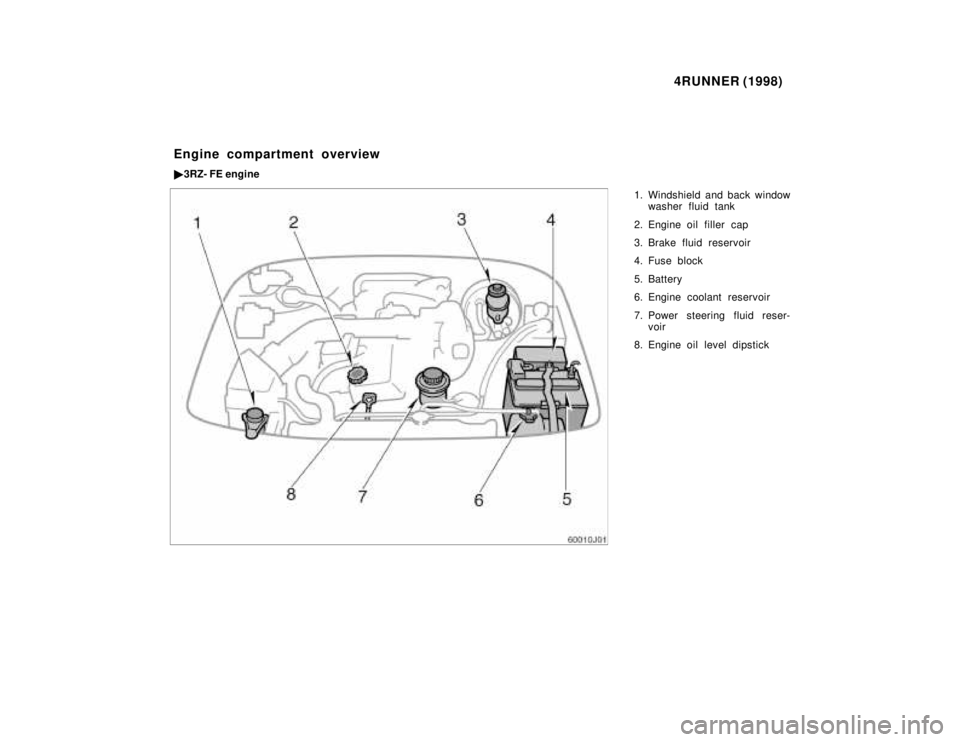
1. Windshield and back window washer fluid tank
2. Engine oil filler cap
3. Brake fluid reservoir
4. Fuse block
5. Battery
6. Engine coolant reservoir
7. Power steering fluid reser- voir
8. Engine oil level dipstick
Engine compartment overview
3RZ- FE engine
Page 300 of 350
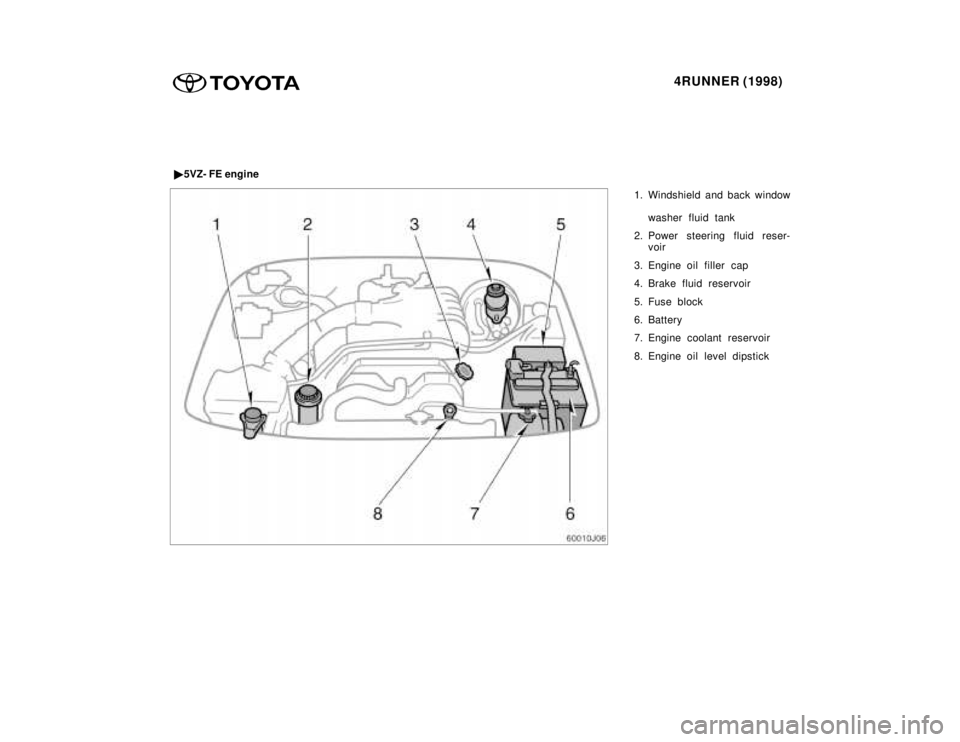
4RUNNER (1998)
1. Windshield and back window
washer fluid tank
2. Power steering fluid reser- voir
3. Engine oil filler cap
4. Brake fluid reservoir
5. Fuse block
6. Battery
7. Engine coolant reservoir
8. Engine oil level dipstick
5VZ- FE engine
Page 303 of 350
4RUNNER (1998)
If you perform maintenance by
yourself, be sure to follow the cor-
rect procedure given in this part.
You should be aware that improper or
incomplete servicing may result in op-
erating problems.
Performing do- it- yourself maintenance
during the warranty period may affect
your warranty coverage. Read the
separate Toyota Warranty statement
for details and suggestions.
This part gives instructions only for
those items that are relatively easy
for an owner to perform. As explained
in Part 6, there are still a number of
items that must be done by a qualified
technician with special tools.
For information on tools and parts for
do- it- yourself maintenance, see ºParts
and toolsº.
Utmost care should be taken when
working on your vehicle to prevent
accidental injury. Here are a few pre-
cautions that you should be especially
careful to observe:
CAUTION
When the engine is running,
keep hands, clothing, and tools
away from the moving fan and
engine drive belts. (Removing
rings, watches, and ties is ad-
visable.)
Right after driving, the engine
compartmentÐthe engine, radia-
tor, exhaust manifold, power
steering fluid reservoir and
spark plug boots, etc.Ðwill be
hot. So be careful not to touch
them. Oil, fluids and spark
plugs may also be hot.
If the engine is hot, do not re-
move the radiator cap or loosen
the drain plugs to prevent burn-
ing yourself.
Do not smoke, cause sparks or
allow open flames around fuel
or the battery. Their fumes are
flammable.
Be extremely cautious when
working on the battery. It con-
tains poisonous and corrosive
sulfuric acid.
Do not get under your vehicle
with just the body jack support-
ing it. Always use automotive
jack stands or other solid sup-
ports.
Do- it- yourself service
precautions
Page 304 of 350
4RUNNER (1998)
Use eye protection whenever
you work on or under your ve-
hicle where you may be ex-
posed to flying or falling mate-
rial, fluid spray, etc.
Used engine oil contains poten-
tially harmful contaminants
which may cause skin disorders
such as inflammation or skin
cancer, so care should be taken
to avoid prolonged and repeated
contact with it. To remove used
engine oil from your skin, wash
thoroughly with soap and water.
Do not leave used oil within the
reach of children.
Dispose of used oil and filter
only in a safe and acceptable
manner. Do not dispose of used
oil and filter in household
trash, in sewers or onto the
ground. Call your dealer or a
service station for information
concerning recycling or dispos-
al.NOTICE
Remember that battery and igni-
tion cables carry high currentsor voltages. Be careful of acci-dentally causing a short circuit.
Add only demineralized or dis-tilled water to fill the radiator.And if you spill some of the
coolant, be sure to wash it offwith water to prevent it from
damaging the parts or paint.
Do not allow dirt or anythingelse to fall through the spark
plug holes.
Do not pry the outer electrode
of a spark plug against the cen-ter electrode.
Use only spark plugs of the
specified type. Using othertypes will cause engine damage,loss of performance or radio
noise.
Do not overfill automatic trans-mission fluid, or the transmis-sion could be damaged.
Do not drive with the air clean-
er filter removed, or excessiveengine wear could result. Alsobackfiring could cause a fire in
the engine compartment.
Be careful not to scratch theglass surface with the wiper
frame.
When closing the engine hood,check to see that you have notforgotten any tools, rags, etc.
Page 305 of 350

4RUNNER (1998)
Parts and tools
Here is a list of parts and tools you
will need on performing do- it- yourself
maintenance. Remember all Toyota
parts are designed in metric sizes, so
your tools must be metric.
Checking the engine oil level
Parts (if level is low): Engine oil API grade SH, ºEnergy-
Conserving IIº or SJ, ºEnergy-
Conservingº multigrade or ILSAC
multigrade having viscosity proper
for your climate
Tools: Rag or paper towel
Funnel (only for adding oil)
Checking the engine coolant level
Parts (if level is low): Ethylene- glycol antifreeze
Demineralized or distilled water
Tools: Funnel (only for adding coolant)
Checking brake fluid
Parts (if level is low): SAE J1703 or FMVSS No. 116
DOT 3 brake fluid
Tools: Rag or paper towel
Funnel (only for adding fluid) Checking power steering fluid
Parts (if level is low):
Automatic transmission fluid DEXRON II or III
Tools: Rag or paper towel
Funnel (only for adding fluid)
Checking battery condition
Tools: Warm water
Baking soda
Grease
Conventional wrench (for terminal
clamp bolts)
Checking and replacing fuses
Parts (if replacement is necessary): Fuse with same amperage rating
as original
Tools: Conventional wrench (for instrument
lower panel nut)
Adding washer fluid
Parts: Water
Washer fluid containing antifreeze
(for winter use)
Tools: Funnel Replacing light bulbs
Parts:
Bulb with same number and watt-
age rating as original (See charts
in ºReplacing light bulbsº in Chap-
ter 7- 3.)
Tools: Screwdriver