lights TOYOTA 4RUNNER 1998 Owner's Manual
[x] Cancel search | Manufacturer: TOYOTA, Model Year: 1998, Model line: 4RUNNER, Model: TOYOTA 4RUNNER 1998Pages: 350, PDF Size: 2.25 MB
Page 294 of 350

4RUNNER (1998)
Tire surface and wheel nuts
Check the tires carefully for cuts,
damage or excessive wear. See Chap-
ter 7- 2 for additional information.
When checking the tires, make sure
no nuts are missing, and check the
nuts for looseness. Tighten them if
necessary.
Tire rotation
Rotate the tires every 12000 km (7500
miles). See Chapter 7- 2 for additional
information.
Fluid leaks
Check underneath for leaking fuel, oil,
water or other fluid after the vehicle
has been parked for a while. If you
smell fuel fumes or notice any leak,
have the cause found and corrected
immediately.
Doors and engine hood
Check that all doors including back
door operate smoothly and all latches
lock securely. Make sure the engine
hood secondary latch secures the
hood from opening when the primary
latch is released. INSIDE THE VEHICLE
Items listed below should be
checked regularly, e.g. while per-
forming periodic services, cleaning
the vehicle, etc.
Lights
Make sure the headlights, stop lights,
tail lights, turn signal lights, and other
lights are all working. Check headlight
aim.
Service reminder indicators and
warning buzzers
Check that all service reminder indica-
tors and warning buzzers function
properly.
Steering wheel
Check that it has the specified free-
play. Be alert for changes in steering
condition, such as hard steering or
strange noise.
Seats
Check that all seat controls such as
seat adjusters, seatback recliner, etc.
operate smoothly and that all latches
lock securely in any position. Check
that the head restraint move up and
down smoothly and that the locks hold
securely in any latched position. For
folding- down rear seatbacks, swing- up
rear seat cushions and detachable
temporary third seat, check that the
latches lock securely.Seat belts
Check that the seat belt system such
as buckles, retractors and anchors op-
erate properly and smoothly. Make
sure the belt webbing is not cut,
frayed, worn or damaged.
Accelerator pedal
Check the pedal for smooth operation
and uneven pedal effort or catching.
Clutch pedal
Check the pedal for smooth operation.
Brake pedal
Check the pedal for smooth operation
and that the pedal has the proper
clearance. Check the brake booster
function.
Brakes
At a safe place, check that the brakes
do not pull to one side when applied.
Parking brake
Check that the lever has the proper
travel and that, on a safe incline, your
vehicle is held securely with only the
parking brake applied.
Page 325 of 350
4RUNNER (1998)
If the headlights or other electrical
components do not work, check the
fuses. If any of the fuses are blown,
they must be replaced.
See ºFuse locationsº in Chapter 7- 1
for locations of the fuses.
Turn the ignition switch and inop-
erative component off. Pull a sus-
pected fuse straight out and check it.
Determine which fuse may be causing
the problem. The lid of the fuse box
shows the name of the circuit for
each fuse. See Part 8 of this manual
for the functions controlled by each
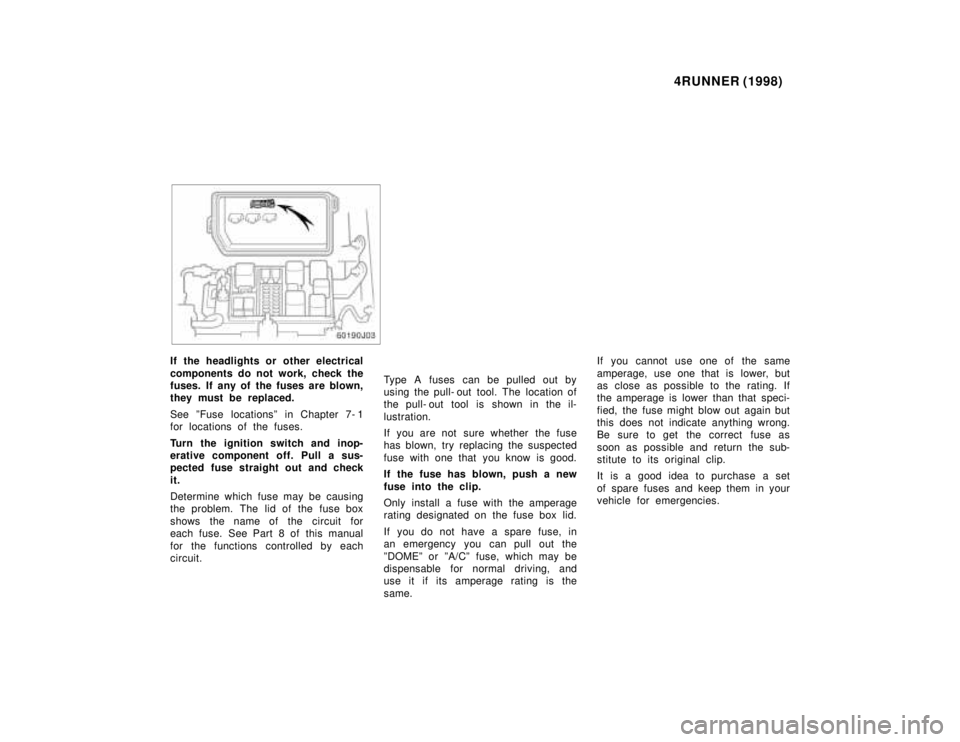
circuit. Type A fuses can be pulled out by
using the pull- out tool. The location of
the pull- out tool is shown in the il-
lustration.
If you are not sure whether the fuse
has blown, try replacing the suspected
fuse with one that you know is good.
If the fuse has blown, push a new
fuse into the clip.
Only install a fuse with the amperage
rating designated on the fuse box lid.
If you do not have a spare fuse, in
an emergency you can pull out the
ºDOMEº or ºA/Cº fuse, which may be
dispensable for normal driving, and
use it if its amperage rating is the
same.If you cannot use one of the same
amperage, use one that is lower, but
as close as possible to the rating. If
the amperage is lower than that speci-
fied, the fuse might blow out again but
this does not indicate anything wrong.
Be sure to get the correct fuse as
soon as possible and return the sub-
stitute to its original clip.
It is a good idea to purchase a set
of spare fuses and keep them in your
vehicle for emergencies.
Page 327 of 350

4RUNNER (1998)
Light bulbs
Bulb No.WTy p e
Headlight'60/5 5A
Parking and front side
marker lights'5C
Front turn signal lights115627B
Rear turn signal lights'21C
Stop and tail lights'21/5C
Back- up lights'21C
License plate lightÐ5C
High mounted
stop light92118C
Interior lightÐ8D
Personal lightsÐ8D
Glovebox lightÐ1.4C
Luggage compartment
lightÐ8D
A: HB2 halogen bulbs
B: Single end bulbs
C: Wedge base bulbs
D: Double end bulbs ÐHeadlights
Page 329 of 350
4RUNNER (1998)
2. Release the bulb retaining spring and remove the bulb. Install a
new bulb and the bulb retaining
spring.
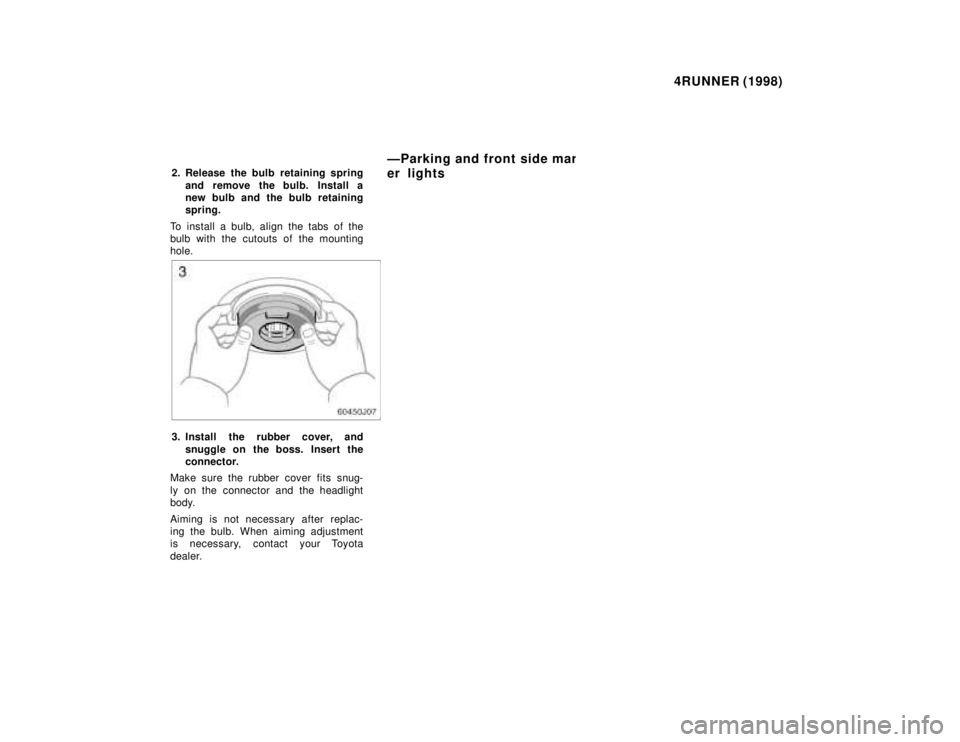
To install a bulb, align the tabs of the
bulb with the cutouts of the mounting
hole.
3. Install the rubber cover, and snuggle on the boss. Insert the
connector.
Make sure the rubber cover fits snug-
ly on the connector and the headlight
body.
Aiming is not necessary after replac-
ing the bulb. When aiming adjustment
is necessary, contact your Toyota
dealer. ÐParking and front side ma
r
er lights
Page 332 of 350
4RUNNER (1998)
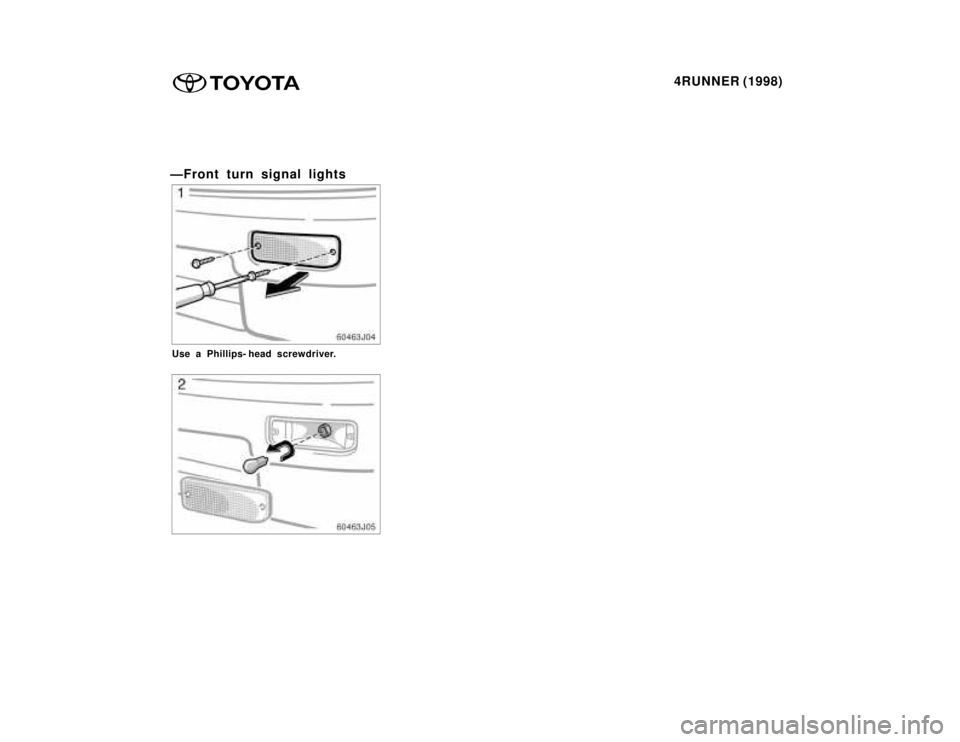
ÐFront turn signal lights
Use a Phillips- head screwdriver.
Page 333 of 350
4RUNNER (1998)
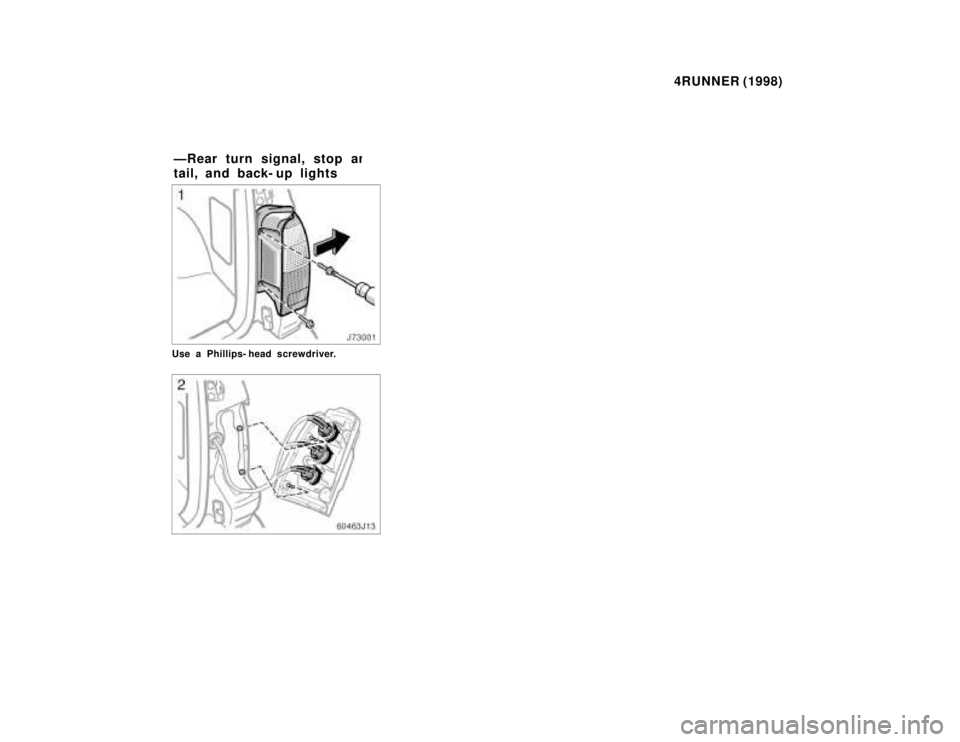
Use a Phillips- head screwdriver.
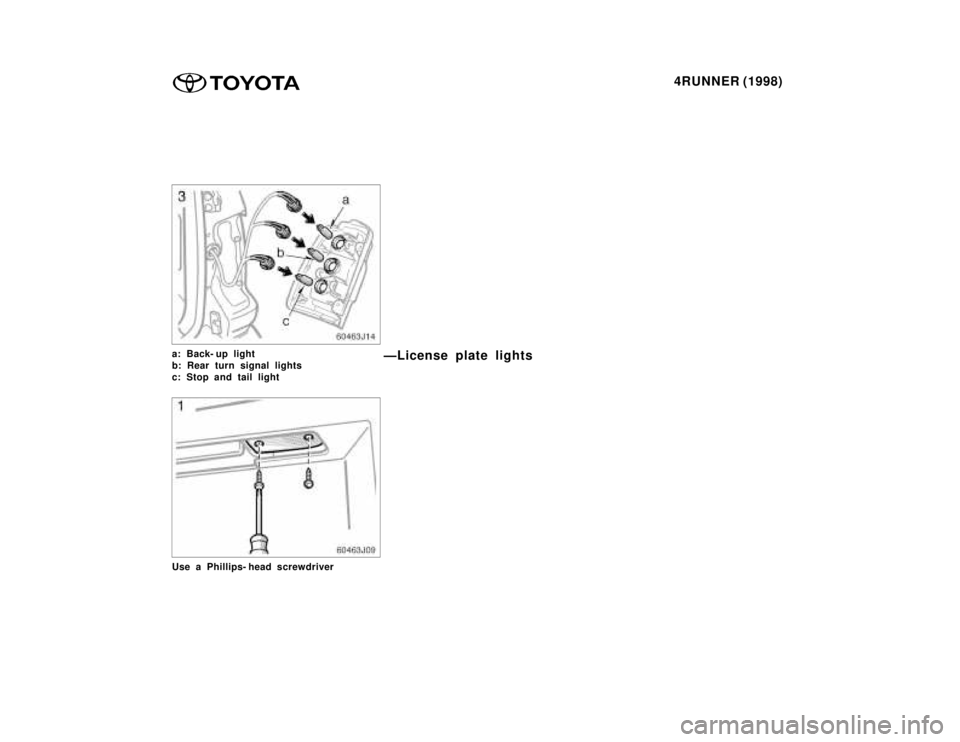
ÐRear turn signal, stop an
tail, and back- up lights
Page 334 of 350
4RUNNER (1998)
a: Back- up light
b: Rear turn signal lights
c: Stop and tail light ÐLicense plate lights
Use a Phillips- head screwdriver
Page 341 of 350
4RUNNER (1998)
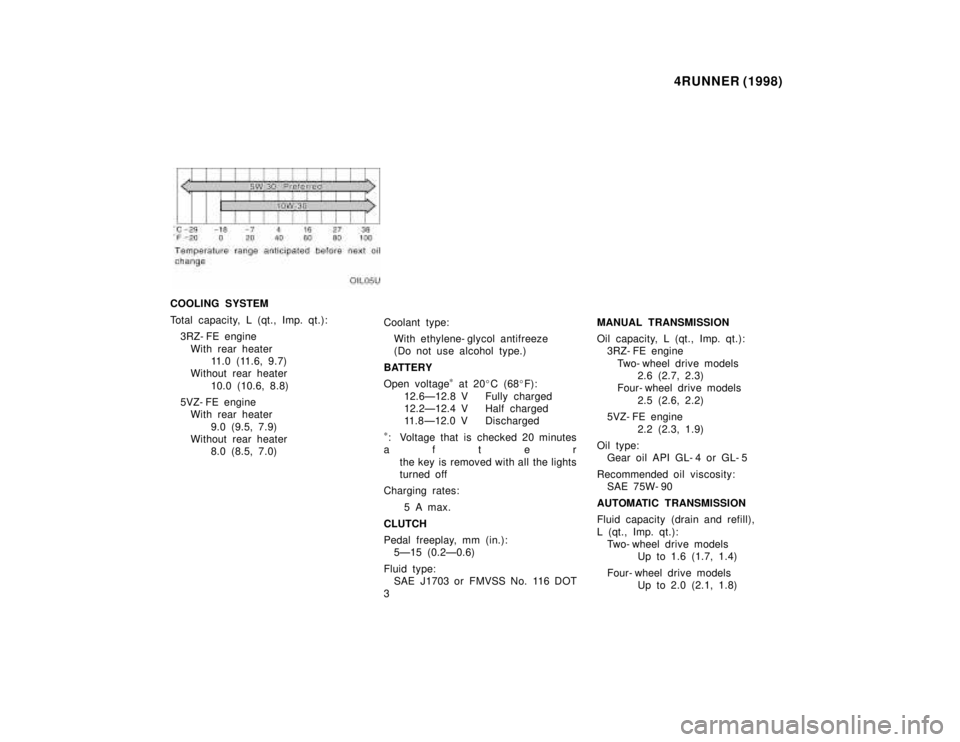
COOLING SYSTEM
Total capacity, L (qt., Imp. qt.):
3RZ- FE engineWith rear heater 11.0 (11.6, 9.7)
Without rear heater
10.0 (10.6, 8.8)
5VZ- FE engine With rear heater
9.0 (9.5, 7.9)
Without rear heater
8.0 (8.5, 7.0) Coolant type:
With ethylene- glycol antifreeze
(Do not use alcohol type.)
BATTERY
Open voltage *
at 20 C (68 F):
12.6Ð12.8 V Fully charged
12.2Ð12.4 V Half charged
11.8 Ð12.0 V Discharged
* : Voltage that is checked 20 minutes
after
the key is removed with all the lights
turned off
Charging rates:
5 A max.
CLUTCH
Pedal freeplay, mm (in.): 5Ð15 (0.2Ð0.6)
Fluid type: SAE J1703 or FMVSS No. 116 DOT
3 MANUAL TRANSMISSION
Oil capacity, L (qt., Imp. qt.):
3RZ- FE engine
Two- wheel drive models 2.6 (2.7, 2.3)
Four- wheel drive models
2.5 (2.6, 2.2)
5VZ- FE engine 2.2 (2.3, 1.9)
Oil type: Gear oil API GL- 4 or GL- 5
Recommended oil viscosity: SAE 75W- 90
AUTOMATIC TRANSMISSION
Fluid capacity (drain and ref ill),
L (qt., Imp. qt.): Two- wheel drive models Up to 1.6 (1.7, 1.4)
Four- wheel drive models Up to 2.0 (2.1, 1.8)
Page 344 of 350
4RUNNER (1998)
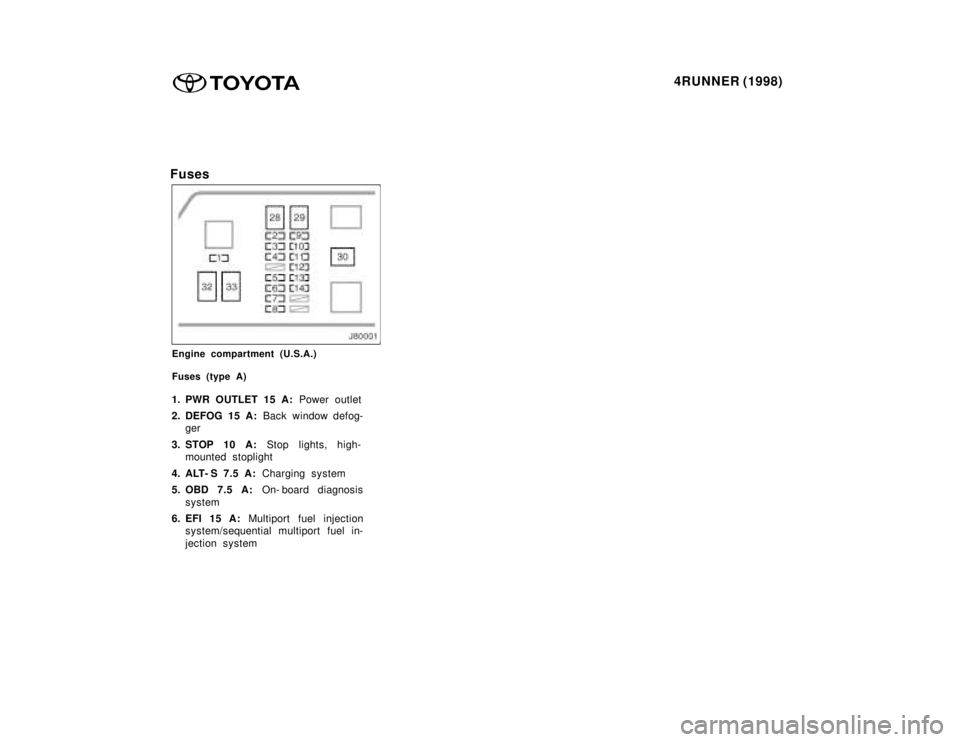
Fuses
J80001
Engine compartment (U.S.A.)
Fuses (type A)
1. PWR OUTLET 15 A: Power outlet
2. DEFOG 15 A: Back window defog-
ger
3. STOP 10 A: Stop lights, high-
mounted stoplight
4. ALT- S 7.5 A: Charging system
5. OBD 7.5 A: On- board diagnosis
system
6. EFI 15 A: Multiport fuel injection
system/s equential multiport fuel in-
jection system
Page 345 of 350
4RUNNER (1998)
J80002
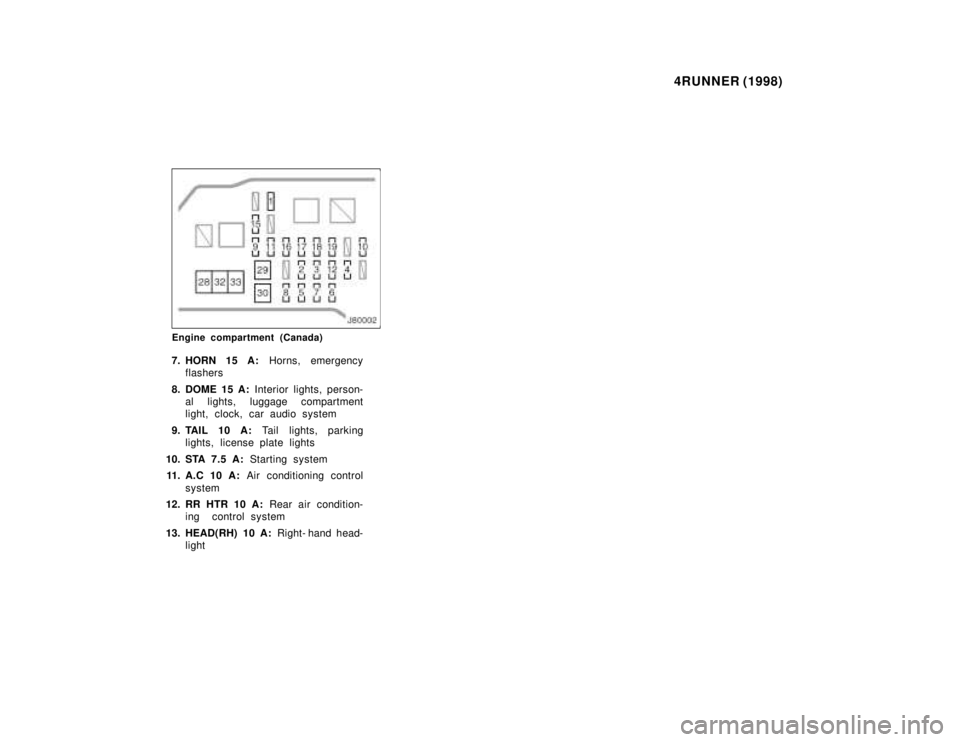
Engine compartment (Canada)
7. HORN 15 A: Horns, emergency
flashers
8. DOME 15 A: Interior lights, person-
al lights, luggage compartment
light, clock, car audio system
9. TAIL 10 A: Tail lights, parking
lights, license plate lights
10. STA 7.5 A: Starting system
11. A.C 10 A: Air conditioning control
system
12. RR HTR 10 A: Rear air condition-
ing control system
13. HEAD(RH) 10 A: Right- hand head-
light