ECU TOYOTA 4RUNNER 1998 Owner's Guide
[x] Cancel search | Manufacturer: TOYOTA, Model Year: 1998, Model line: 4RUNNER, Model: TOYOTA 4RUNNER 1998Pages: 350, PDF Size: 2.25 MB
Page 273 of 350
4RUNNER (1998)
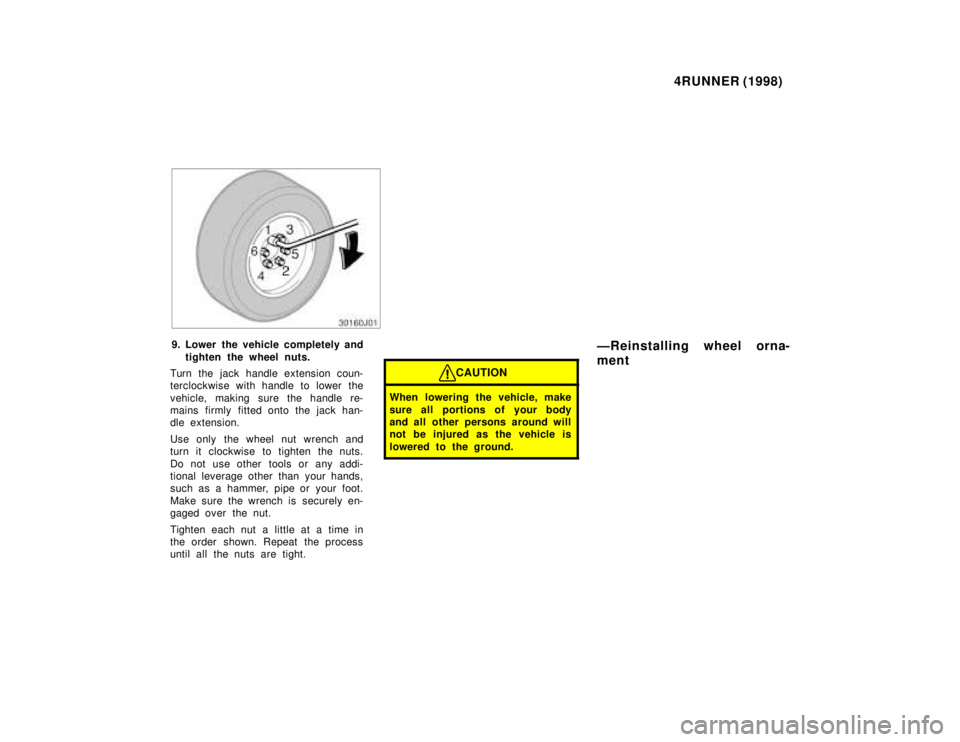
9. Lower the vehicle completely and
tighten the wheel nuts.
Turn the jack handle extension coun-
terclockwise with handle to lower the
vehicle, making sure the handle re-
mains firmly fitted onto the jack han-
dle extension.
Use only the wheel nut wrench and
turn it clockwise to tighten the nuts.
Do not use other tools or any addi-
tional leverage other than your hands,
such as a hammer, pipe or your foot.
Make sure the wrench is securely en-
gaged over the nut.
Tighten each nut a little at a time in
the order shown. Repeat the process
until all the nuts are tight.
CAUTION
When lowering the vehicle, make
sure all portions of your body
and all other persons around will
not be injured as the vehicle is
lowered to the ground.
ÐReinstalling wheel orna-
ment
Page 274 of 350
4RUNNER (1998)
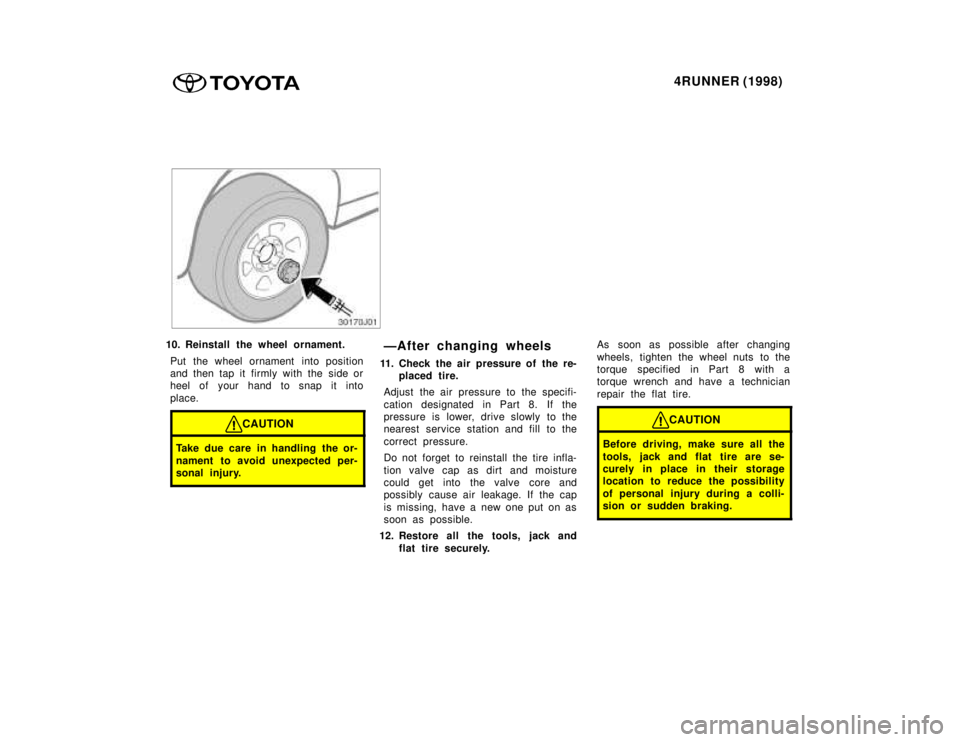
10. Reinstall the wheel ornament.
Put the wheel ornament into position
and then tap it firmly with the side or
heel of your hand to snap it into
place.
CAUTION
Take due care in handling the or-
nament to avoid unexpected per-
sonal injury.
ÐAfter changing wheels
11. Check the air pressure of the re- placed tire.
Adjust the air pressure to the specifi-
cation designated in Part 8. If the
pressure is lower, drive slowly to the
nearest service station and fill to the
correct pressure.
Do not forget to reinstall the tire infla-
tion valve cap as dirt and moisture
could get into the valve core and
possibly cause air leakage. If the cap
is missing, have a new one put on as
soon as possible.
12. Restore all the tools, jack and flat tire securely. As soon as possible after changing
wheels, tighten the wheel nuts to the
torque specified in Part 8 with a
torque wrench and have a technician
repair the flat tire.
CAUTION
Before driving, make sure all the
tools, jack and flat tire are se-
curely in place in their storage
location to reduce the possibility
of personal injury during a colli-
sion or sudden braking.
Page 280 of 350
4RUNNER (1998)
If towing is necessary, we recom-
mend you to have it done by your
Toyota dealer or a commercial tow
truck service.
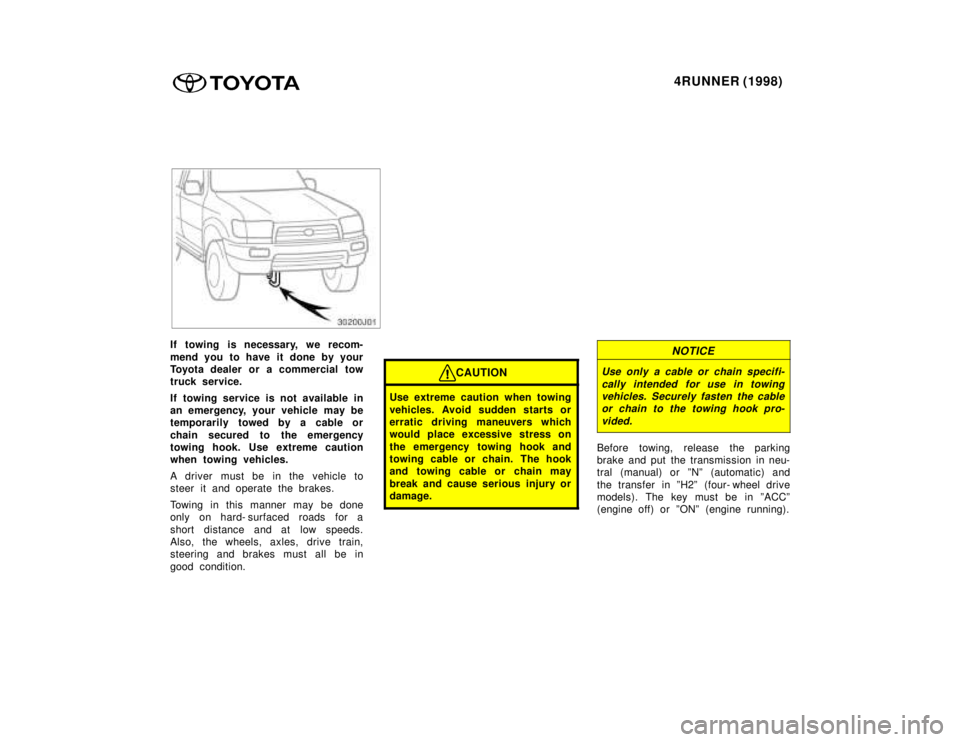
If towing service is not available in
an emergency, your vehicle may be
temporarily towed by a cable or
chain secured to the emergency
towing hook. Use extreme caution
when towing vehicles.
A driver must be in the vehicle to
steer it and operate the brakes.
Towing in this manner may be done
only on hard- surfaced roads for a
short distance and at low speeds.
Also, the wheels, axles, drive train,
steering and brakes must all be in
good condition.
CAUTION
Use extreme caution when towing
vehicles. Avoid sudden starts or
erratic driving maneuvers which
would place excessive stress on
the emergency towing hook and
towing cable or chain. The hook
and towing cable or chain may
break and cause serious injury or damage.
NOTICE
Use only a cable or chain specifi-
cally intended for use in towingvehicles. Securely fasten the cableor chain to the towing hook pro-
vided.
Before towing, release the parking
brake and put the transmission in neu-
tral (manual) or ºNº (automatic) and
the transfer in ºH2º (four- wheel drive
models). The key must be in ºACCº
(engine off) or ºONº (engine running).
Page 281 of 350
4RUNNER (1998)
CAUTION
If the engine is not running, the
power assist for the brakes and
steering will not work so steering
and braking will be much harder
than usual.
Before emergency towing, check
that the hook is not broken or
damaged and that the installation
bolts are not loose.
Fasten the towing cable or chain
securely to the hook.
Do not jerk the hook. Apply steady
and even force.
To avoid damaging the hook, do
not pull from the side or at a verti-
cal angle. Always pull straight ahead.CAUTION
If the emergency towing eyelet is
used to get out when your vehicle
becomes struck in mud, sand or
other condition from which the
vehicle cannot be driven out un-
der its own power, make sure to
observe the precautions men-
tioned below. Otherwise, exces-
sive stress will be put on the
eyelet and the towing cable or
chain may break, causing serious
injury or damage. If the towing vehicle can hardly
move, do not forcibly continue
the towing. Contact your Toyota
dealer or a commercial tow
truck service for assistance.
Tow the vehicle as straight
ahead as possible.
Keep away from the vehicle
during towing.
ÐEmergency towing hook pr
cautions
Page 294 of 350

4RUNNER (1998)
Tire surface and wheel nuts
Check the tires carefully for cuts,
damage or excessive wear. See Chap-
ter 7- 2 for additional information.
When checking the tires, make sure
no nuts are missing, and check the
nuts for looseness. Tighten them if
necessary.
Tire rotation
Rotate the tires every 12000 km (7500
miles). See Chapter 7- 2 for additional
information.
Fluid leaks
Check underneath for leaking fuel, oil,
water or other fluid after the vehicle
has been parked for a while. If you
smell fuel fumes or notice any leak,
have the cause found and corrected
immediately.
Doors and engine hood
Check that all doors including back
door operate smoothly and all latches
lock securely. Make sure the engine
hood secondary latch secures the
hood from opening when the primary
latch is released. INSIDE THE VEHICLE
Items listed below should be
checked regularly, e.g. while per-
forming periodic services, cleaning
the vehicle, etc.
Lights
Make sure the headlights, stop lights,
tail lights, turn signal lights, and other
lights are all working. Check headlight
aim.
Service reminder indicators and
warning buzzers
Check that all service reminder indica-
tors and warning buzzers function
properly.
Steering wheel
Check that it has the specified free-
play. Be alert for changes in steering
condition, such as hard steering or
strange noise.
Seats
Check that all seat controls such as
seat adjusters, seatback recliner, etc.
operate smoothly and that all latches
lock securely in any position. Check
that the head restraint move up and
down smoothly and that the locks hold
securely in any latched position. For
folding- down rear seatbacks, swing- up
rear seat cushions and detachable
temporary third seat, check that the
latches lock securely.Seat belts
Check that the seat belt system such
as buckles, retractors and anchors op-
erate properly and smoothly. Make
sure the belt webbing is not cut,
frayed, worn or damaged.
Accelerator pedal
Check the pedal for smooth operation
and uneven pedal effort or catching.
Clutch pedal
Check the pedal for smooth operation.
Brake pedal
Check the pedal for smooth operation
and that the pedal has the proper
clearance. Check the brake booster
function.
Brakes
At a safe place, check that the brakes
do not pull to one side when applied.
Parking brake
Check that the lever has the proper
travel and that, on a safe incline, your
vehicle is held securely with only the
parking brake applied.
Page 295 of 350

4RUNNER (1998)
Automatic transmission ºParkº mech- anism
Check the lock release button of the
selector lever for proper and smooth
operation. On a safe incline, check
that your vehicle is held securely with
the selector lever in ºPº position and
all brakes released.
IN THE ENGINE COMPARTMENT
Items listed below should be
checked from time to time, e.g.
each time when refueling.
Washer fluid
Make sure there is sufficient fluid in
the tank. See Chapter 7- 3 for addi-
tional information.
Engine coolant level
Make sure the coolant level is be-
tween the ºFULLº and ºLOWº lines on
the see- through reservoir when the
engine is cold. See Chapter 7- 2 for
additional information.
Battery electrolyte level
Make sure the electrolyte level of all
battery cells is between upper and
lower level lines on the case. Add
only distilled water when replenishing.
See Chapter 7- 3 for additional in-
formation. Brake fluid level
Make sure the brake fluid level is cor-
rect. See Chapter 7- 2 for additional
information.
Engine oil level
Check the level on the dipstick with
the engine turned off and the vehicle
parked on a level spot. See Chapter
7- 2 for additional information.
Power steering fluid level
Check the level through the reservoir.
The level should be in the ºHOTº or
ºCOLDº range depending on the fluid
temperature. See Chapter 7- 2 for
additional information.
Exhaust system
If you notice any change in the sound
of the exhaust or smell exhaust
fumes, have the cause located and
corrected immediately. (See engine ex-
haust cautions in Part 2.)
Be on the alert for changes in perfor-
mance, sounds, and visual tip- offs
that indicate service is needed. Some
important clues are as follows:
Engine missing, stumbling, or ping-
ing
Appreciable loss of power
Strange engine noises
A leak under the vehicle (however,
water dripping from the air condi-
tioning after use is normal.)
Change in exhaust sound (This
may indicate a dangerous carbon
monoxide leak. Drive with the win-
dows open and have the exhaust
system checked immediately.)
Flat- looking tire; excessive tire
squeal when cornering; uneven tire wear
Vehicle pulls to one side when
driving straight on a level road
Strange noises related to suspen-
sion movement
Loss of brake effectiveness;
spongy feeling brake or clutch ped-
al; pedal almost touches floor; ve-
hicle pulls to one side when brak-
ing
Engine coolant temperature continu-
ally higher than normal
Does your vehicle need
repairing?
Page 346 of 350
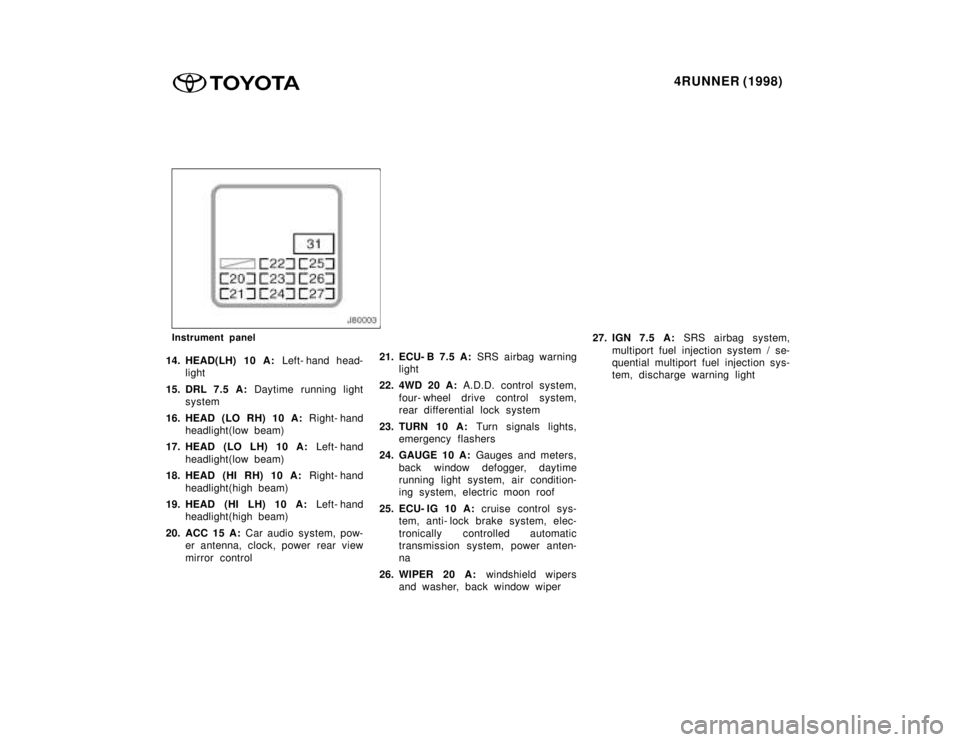
4RUNNER (1998)
J80003
Instrument panel
14. HEAD(LH) 10 A: Left- hand head-
light
15. DRL 7.5 A: Daytime running light
system
16. HEAD (LO RH) 10 A: Right- hand
headlight(low beam)
17. HEAD (LO LH) 10 A: Left- hand
headlight(low beam)
18. HEAD (HI RH) 10 A: Right- hand
headlight(high beam)
19. HEAD (HI LH) 10 A: Left- hand
headlight(high beam)
20. ACC 15 A: Car audio system, pow-
er antenna, clock, power rear view
mirror control 21. ECU- B 7.5 A:
SRS airbag warning
light
22. 4WD 20 A: A.D.D. control system,
four- wheel drive control system,
rear differential lock system
23. TURN 10 A: Turn signals lights,
emergency flashers
24. GAUGE 10 A: Gauges and meters,
back window defogger, daytime
running light system, air condition-
ing system, electric moon roof
25. ECU- IG 10 A: cruise control sys-
tem, anti- lock brake system, elec-
tronically controlled automatic
transmission system, power anten-na
26. WIPER 20 A: windshield wipers
and washer, back window wiper 27. IGN 7.5 A:
SRS airbag system,
multiport fuel injection system / se-
quential multiport fuel injection sys-
tem, discharge warning light