tow TOYOTA 4RUNNER 1998 Owner's Guide
[x] Cancel search | Manufacturer: TOYOTA, Model Year: 1998, Model line: 4RUNNER, Model: TOYOTA 4RUNNER 1998Pages: 350, PDF Size: 2.25 MB
Page 255 of 350
4RUNNER (1998)
(b) Starting a flooded engine
If the engine will not start, your
engine may be flooded because of
repeated cranking.
If this happens, turn the key to
ºSTARTº with the accelerator pedal
held down. Keep the key and acceler-
ator pedal so for 15 seconds and re-
lease them. Then try starting the en-
gine with your foot off the accelerator
pedal.
If the engine does not start after 15
seconds of cranking, release the key,
wait a few minutes and try again.
If the engine still will not start, it
needs adjustment or repair. Call a
Toyota dealer or qualified repair shop
for assistance.
NOTICE
Do not crank for more than 30 seconds at a time. This may over-heat the starter and wiring sys-tems.
(c) Jump starting
To avoid serious personal injury
and damage to your vehicle which
might result from battery explosion,
acid burns, electrical burns, or dam-
aged electronic components, these
instructions must be followed pre-
cisely.
If you are unsure about how to follow
this procedure, we strongly recom-
mend that you seek the help of a
competent mechanic or towing service.
CAUTION
Batteries contain sulfuric acid
which is poisonous and corro-
sive. Wear protective safety
glasses when jump starting, and
avoid spilling acid on your skin, clothing, or vehicle.
If you should accidentally get
acid on yourself or in your
eyes, remove any contaminated
clothing and flush the affected
area with water immediately.
Then get immediate medical
attention. If possible, continue
to apply water with a sponge or
cloth while en route to the med-
ical office.
The gas normally produced by
a battery will explode if a flame
or spark is brought near. Use
only standardized jumper cables
and do not smoke or light a
match while jump starting.
NOTICE
The battery used for boosting
must be 12 V. Do not jump startunless you are sure that thebooster battery is correct.
Page 275 of 350
4RUNNER (1998)
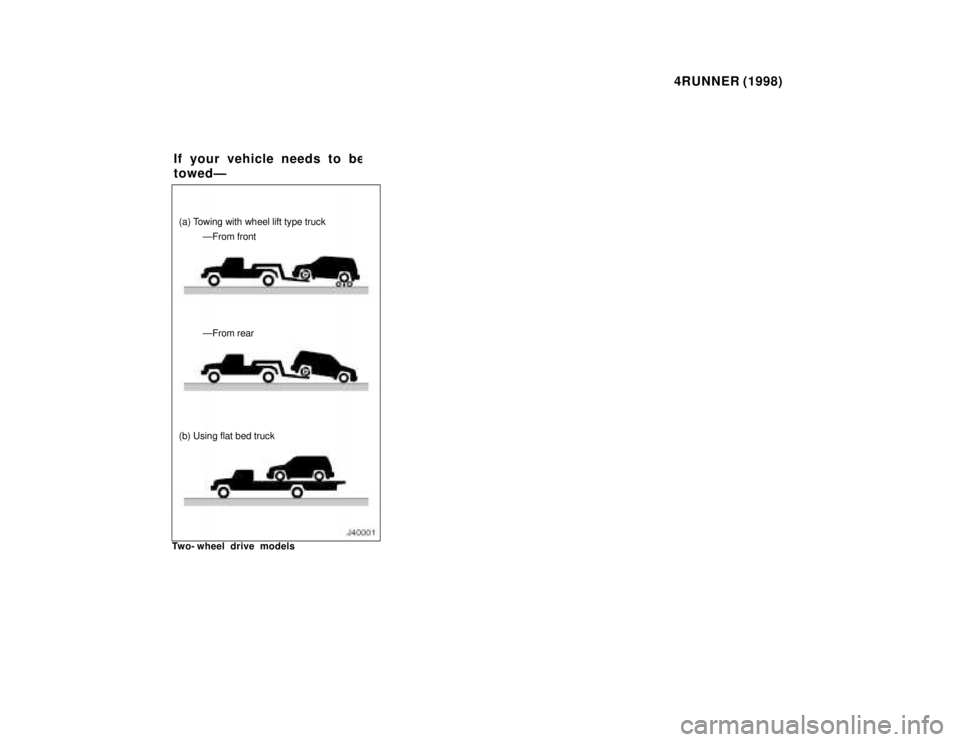
(a) Towing with wheel lift type truck
ÐFrom front ÐFrom rear
(b) Using flat bed truck
Two- wheel drive models If your vehicle needs to b
e
towedÐ
Page 276 of 350
4RUNNER (1998)
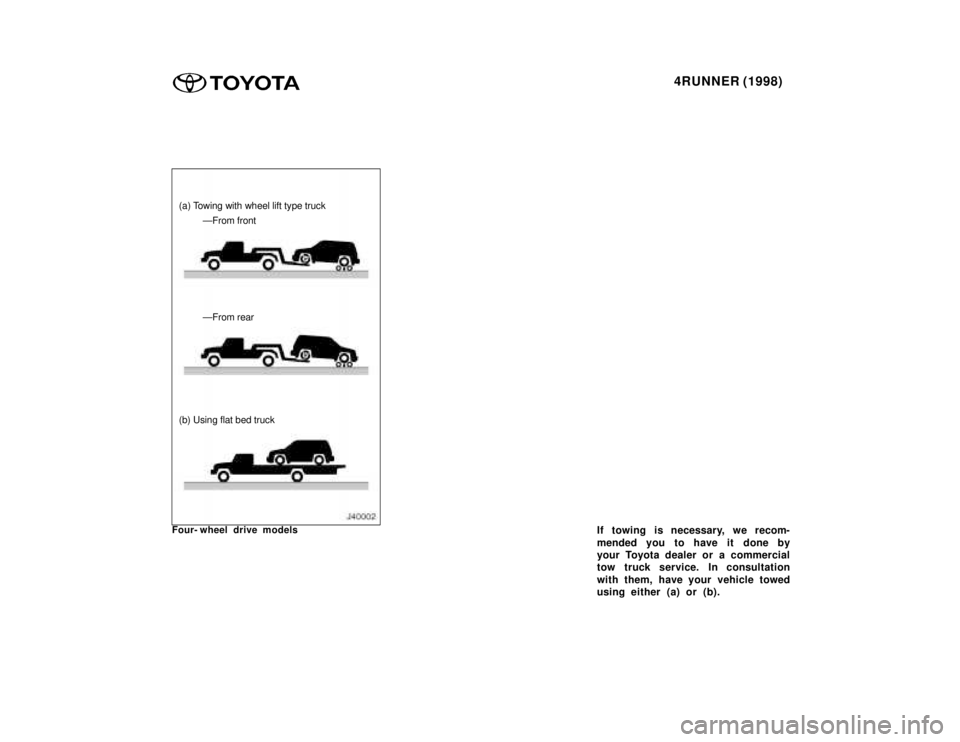
(a) Towing with wheel lift type truck
ÐFrom front ÐFrom rear
(b) Using flat bed truck
Four- wheel drive models If towing is necessary, we recom-
mended you to have it done by
your Toyota dealer or a commercial
tow truck service. In consultation
with them, have your vehicle towed
using either (a) or (b).
Page 277 of 350
4RUNNER (1998)
Only when you cannot receive a
towing service from a Toyota dealer
or commercial tow truck service,
tow your vehicle carefully in accor-
dance with the instructions given in
ºÐEmergency towingº in this Part.
Proper equipment will help ensure that
your vehicle is not damaged while be-
ing towed. Commercial operators are
generally aware of the state/provincial
and local laws pertaining to towing.
Your vehicle can be damaged if it is
towed incorrectly. Although most oper-
ators know the correct procedure, it is
possible to make a mistake. To avoid
damage to your vehicle, make sure
the following few precautions are ob-
served. If necessary, show this page
to the tow truck driver. TOWING PRECAUTIONS:
Use a safety chain system for all tow-
ing, and abide by the state/provincial
and local laws. The wheels and axle
on the ground must be in good condi-
tion. If they are damaged, use a tow-
ing dolly.
Two- wheel drive modelsÐ
(a) Towing with wheel lift type
truck
From frontÐ Manual transmission:
We recommend using a towing dolly
under the rear wheels. If you do not
use a towing dolly, release the park-
ing brake and put the transmission
in neutral.
Automatic transmission:
Use a towing dolly under the rear
wheels.
NOTICE
Never tow a vehicle with an auto-
matic transmission from the frontwith the rear wheels on theground, as this may cause serious
damage to the transmission.
From rearÐ Place the ignition key in
the ºACCº position.
NOTICE
When lifting wheels, take care
to ensure adequate groundclearance for towing at the op-posite end of the raised vehicle.
Otherwise, the bumper and/orunderbody of the towed vehiclewill be damaged during towing.
Do not tow with the key re-moved or in the ºLOCKº posi-tion, as the steering lock mech-
anism is not strong enough tohold the front wheels straight
while towing.
(b) Using flat bed truck
Page 278 of 350
4RUNNER (1998)
Four-wheel drive modelsÐ
(a) Towing with wheel lift type truck From frontÐ
Manual transmission:
We recommend using a towing dol-
ly under the rear wheels. If you do
not use a towing dolly, release the
parking brake, put the transmission
in neutral and the transfer in ºH2º.
Automatic transmission:
Use a towing dolly under the rear
wheels.
NOTICE
Never tow a vehicle with an auto-
matic transmission from the frontwith the rear wheels on the
ground, as this may cause serious
damage to the transmission.
From rearÐ We recommend using a
towing dolly under the front wheels. If
you do not use a towing dolly, place
the ignition key in the ºACCº position,
put the transmission in neutral and the
transfer in ºH2º.
NOTICE
Do not tow with the key removed
or in the ºLOCKº position whentowing from the rear without atowing dolly. The steering lock
mechanism is not strong enoughto hold the front wheels straight.
(b) Using flat bed truck
Page 279 of 350
4RUNNER (1998)
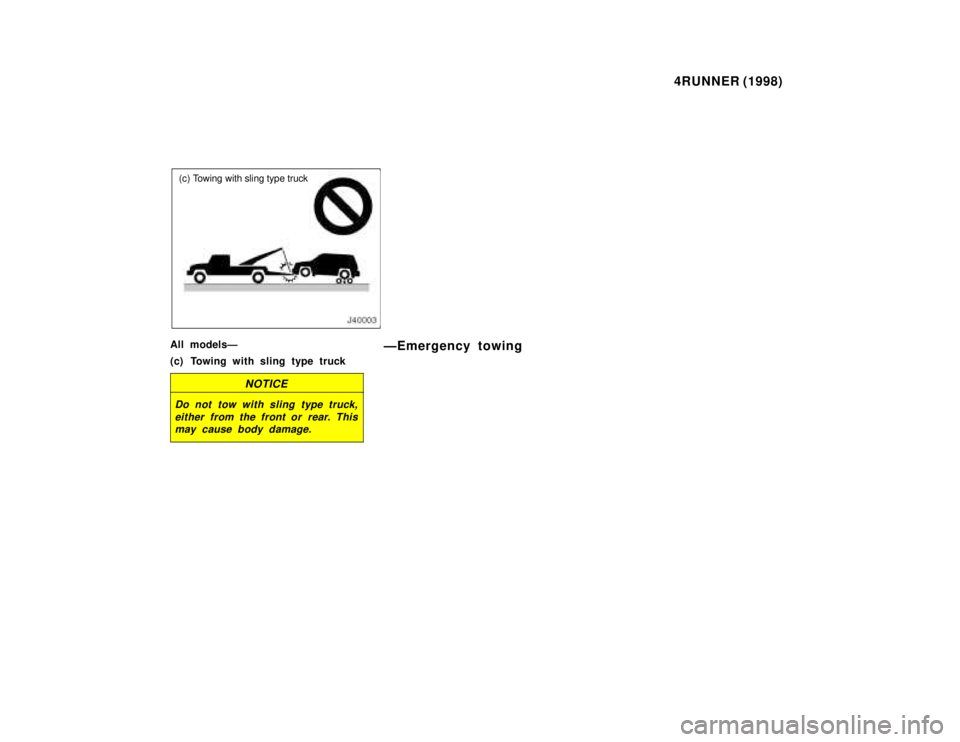
(c) Towing with sling type truck
All modelsÐ
(c) Towing with sling type truck
NOTICE
Do not tow with sling type truck, either from the front or rear. Thismay cause body damage.
ÐEmergency towing
Page 280 of 350
4RUNNER (1998)
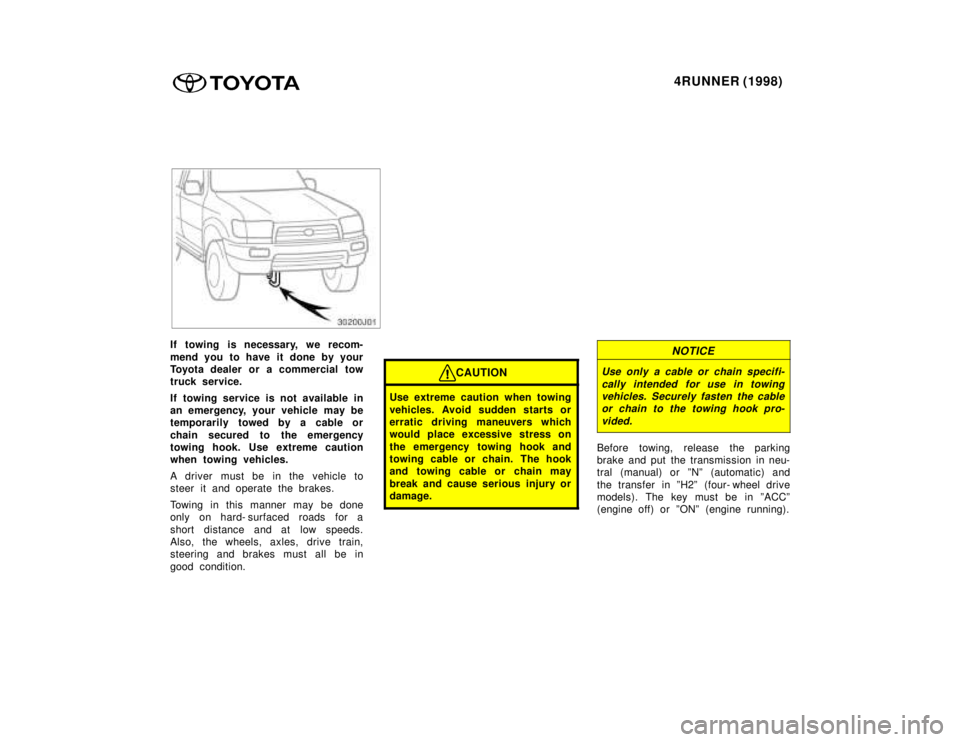
If towing is necessary, we recom-
mend you to have it done by your
Toyota dealer or a commercial tow
truck service.
If towing service is not available in
an emergency, your vehicle may be
temporarily towed by a cable or
chain secured to the emergency
towing hook. Use extreme caution
when towing vehicles.
A driver must be in the vehicle to
steer it and operate the brakes.
Towing in this manner may be done
only on hard- surfaced roads for a
short distance and at low speeds.
Also, the wheels, axles, drive train,
steering and brakes must all be in
good condition.
CAUTION
Use extreme caution when towing
vehicles. Avoid sudden starts or
erratic driving maneuvers which
would place excessive stress on
the emergency towing hook and
towing cable or chain. The hook
and towing cable or chain may
break and cause serious injury or damage.
NOTICE
Use only a cable or chain specifi-
cally intended for use in towingvehicles. Securely fasten the cableor chain to the towing hook pro-
vided.
Before towing, release the parking
brake and put the transmission in neu-
tral (manual) or ºNº (automatic) and
the transfer in ºH2º (four- wheel drive
models). The key must be in ºACCº
(engine off) or ºONº (engine running).
Page 281 of 350
4RUNNER (1998)
CAUTION
If the engine is not running, the
power assist for the brakes and
steering will not work so steering
and braking will be much harder
than usual.
Before emergency towing, check
that the hook is not broken or
damaged and that the installation
bolts are not loose.
Fasten the towing cable or chain
securely to the hook.
Do not jerk the hook. Apply steady
and even force.
To avoid damaging the hook, do
not pull from the side or at a verti-
cal angle. Always pull straight ahead.CAUTION
If the emergency towing eyelet is
used to get out when your vehicle
becomes struck in mud, sand or
other condition from which the
vehicle cannot be driven out un-
der its own power, make sure to
observe the precautions men-
tioned below. Otherwise, exces-
sive stress will be put on the
eyelet and the towing cable or
chain may break, causing serious
injury or damage. If the towing vehicle can hardly
move, do not forcibly continue
the towing. Contact your Toyota
dealer or a commercial tow
truck service for assistance.
Tow the vehicle as straight
ahead as possible.
Keep away from the vehicle
during towing.
ÐEmergency towing hook pr
cautions
Page 282 of 350
4RUNNER (1998)
The following methods are effective to
get out when your vehicle is struck in
mud, sand or other condition from
which the vehicle cannot be driven out
under its own power. Use extreme
caution when towing vehicles. In addi-
tion, keep away from the vehicles and
towing cable or chain when towing.
Remove the soil and sand in the
front and the back of the tires.
Place a stone or wood under the
tires.
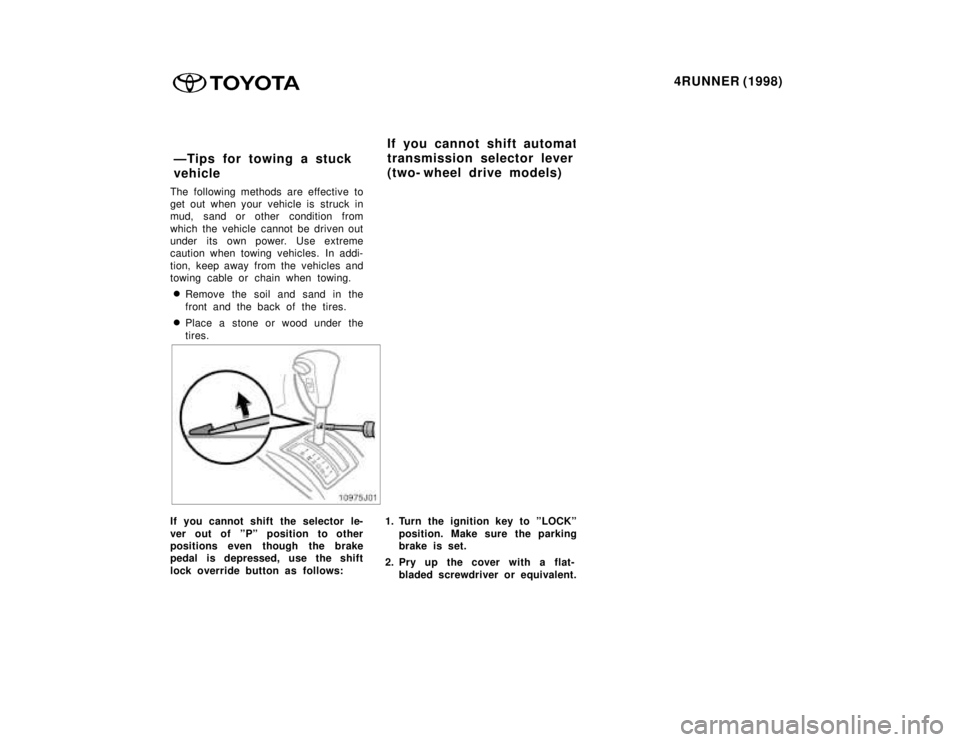
If you cannot shift the selector le-
ver out of ºPº position to other
positions even though the brake
pedal is depressed, use the shift
lock override button as follows: 1. Turn the ignition key to ºLOCKº
position. Make sure the parking
brake is set.
2. Pry up the cover with a flat- bladed screwdriver or equivalent.
ÐTips for towing a stuck
vehicle
If you cannot shift automa
t
transmission selector lever
(two- wheel drive models)
Page 288 of 350
4RUNNER (1998)
1. Rinse off loose dirt with a hose.
Remove any mud or road salt from
the underside of the vehicle or in
the wheel wells.
2. Wash with a mild car- wash soap, mixed according to the manufactur-
er's instructions. Use a soft cotton
mitt and keep it wet by dipping it
frequently into the wash water. Do
not rub hardÐlet the soap and wa-
ter remove the dirt.
Aluminum wheels: Use only a mild
soap or neutral detergent.
Road tar: Remove with turpentine or
cleaners that are marked safe for
painted surfaces.
NOTICE
Do not use gasoline or strong solvents, which may be toxic orcause damage.
3. Rinse thoroughlyÐdried soap can
cause streaking. In hot weather
you may need to rinse each sec-
tion right after you wash it.
4. To prevent water spots, dry the ve- hicle using a clean soft cotton tow-
el. Do not rub or press hardÐyou
might scratch the paint. Automatic car wash
Your vehicle may be washed in an
automatic car wash, but remember
that the paint can be scratched by
some type of brushes, unfiltered
washing water, or the washing process
itself. Scratching reduces paint dura-
bility and gloss, especially on darker
colors. The manager of the car wash
should be able to advise you whether
the process is safe for the paint on
your vehicle.
NOTICE
To prevent damage to the anten-
na, make sure it is retracted be-fore driving your Toyota throughan automatic car wash. On mod-
els with detachable antenna, re-move the antenna before using an automatic car wash.
Waxing your Toyota
Polishing and waxing is recom-
mended to maintain the original
beauty of your Toyota's finish.
Once a month or if the vehicle does
not repel water well, apply wax.
1. Always wash and dry the vehicle before you begin waxing, even if
you are using a combined cleaner
and wax.
2. Use a good quality polish and wax. If the finish has become extremely
weathered, use a car- cleaning pol-
ish, followed by a separate wax.
Carefully follow the manufacturer 's
instructions and precautions. Be
sure to polish and wax the chrome
trim as well as the paint.
3. Wax the vehicle again when water does not bead but remains on the
surface in large patches.