hood release TOYOTA 4RUNNER 1998 Owners Manual
[x] Cancel search | Manufacturer: TOYOTA, Model Year: 1998, Model line: 4RUNNER, Model: TOYOTA 4RUNNER 1998Pages: 350, PDF Size: 2.25 MB
Page 2 of 350
4RUNNER (1998)
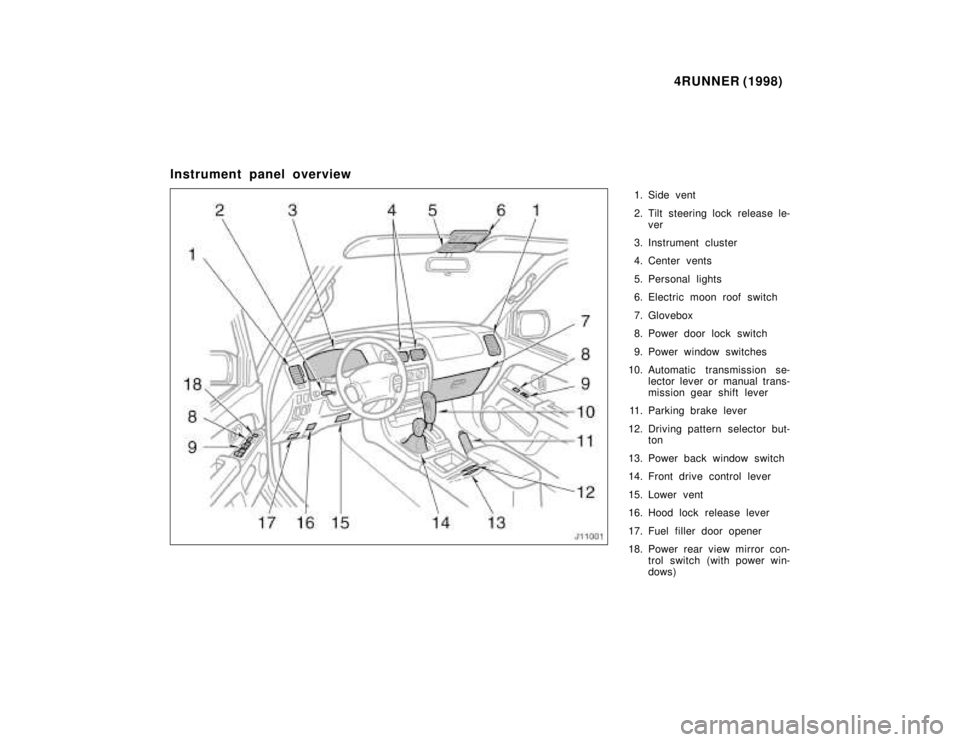
Instrument panel overview 1. Side vent
2. Tilt steering lock release le-ver
3. Instrument cluster
4. Center vents
5. Personal lights
6. Electric moon roof switch
7. Glovebox
8. Power door lock switch
9. Power window switches
10. Automatic transmission se- lector lever or manual trans-
mission gear shift lever
11. Parking brake lever
12. Driving pattern selector but- ton
13. Power back window switch
14. Front drive control lever
15. Lower vent
16. Hood lock release lever
17. Fuel filler door o pener
18. Power rear view mirror con- trol switch (with power win-
dows)
Page 28 of 350
4RUNNER (1998)
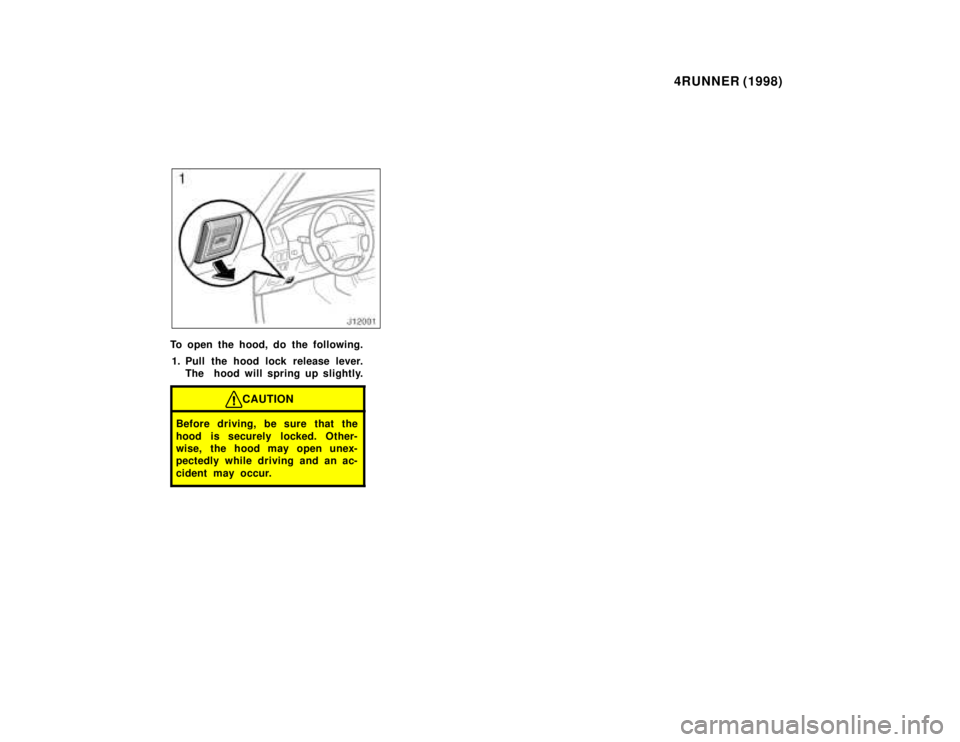
To open the hood, do the following.
1. Pull the hood lock release lever. The hood will spring up slightly.
CAUTION
Before driving, be sure that the
hood is securely locked. Other-
wise, the hood may open unex-
pectedly while driving and an ac-
cident may occur.
Page 294 of 350

4RUNNER (1998)
Tire surface and wheel nuts
Check the tires carefully for cuts,
damage or excessive wear. See Chap-
ter 7- 2 for additional information.
When checking the tires, make sure
no nuts are missing, and check the
nuts for looseness. Tighten them if
necessary.
Tire rotation
Rotate the tires every 12000 km (7500
miles). See Chapter 7- 2 for additional
information.
Fluid leaks
Check underneath for leaking fuel, oil,
water or other fluid after the vehicle
has been parked for a while. If you
smell fuel fumes or notice any leak,
have the cause found and corrected
immediately.
Doors and engine hood
Check that all doors including back
door operate smoothly and all latches
lock securely. Make sure the engine
hood secondary latch secures the
hood from opening when the primary
latch is released. INSIDE THE VEHICLE
Items listed below should be
checked regularly, e.g. while per-
forming periodic services, cleaning
the vehicle, etc.
Lights
Make sure the headlights, stop lights,
tail lights, turn signal lights, and other
lights are all working. Check headlight
aim.
Service reminder indicators and
warning buzzers
Check that all service reminder indica-
tors and warning buzzers function
properly.
Steering wheel
Check that it has the specified free-
play. Be alert for changes in steering
condition, such as hard steering or
strange noise.
Seats
Check that all seat controls such as
seat adjusters, seatback recliner, etc.
operate smoothly and that all latches
lock securely in any position. Check
that the head restraint move up and
down smoothly and that the locks hold
securely in any latched position. For
folding- down rear seatbacks, swing- up
rear seat cushions and detachable
temporary third seat, check that the
latches lock securely.Seat belts
Check that the seat belt system such
as buckles, retractors and anchors op-
erate properly and smoothly. Make
sure the belt webbing is not cut,
frayed, worn or damaged.
Accelerator pedal
Check the pedal for smooth operation
and uneven pedal effort or catching.
Clutch pedal
Check the pedal for smooth operation.
Brake pedal
Check the pedal for smooth operation
and that the pedal has the proper
clearance. Check the brake booster
function.
Brakes
At a safe place, check that the brakes
do not pull to one side when applied.
Parking brake
Check that the lever has the proper
travel and that, on a safe incline, your
vehicle is held securely with only the
parking brake applied.