park assist TOYOTA 4RUNNER 1998 Owners Manual
[x] Cancel search | Manufacturer: TOYOTA, Model Year: 1998, Model line: 4RUNNER, Model: TOYOTA 4RUNNER 1998Pages: 350, PDF Size: 2.25 MB
Page 130 of 350
4RUNNER (1998)
(a) Brake System Warning Light
This light has the following functions:
Parking brake reminder
If this light is on, make sure the park-
ing brake is fully released. The light
should go off.
Low brake fluid level warning
If this light comes on and stays on
while you are driving, slow down and
pull off the road. Then stop the ve-
hicle carefully. There may be a prob-
lem somewhere in the brake system.
Check the fluid level of the see-
through reservoir.
To make sure the parking brake has
not caused the warning light to come
on, check to see that the parking
brake is fully released.
If the brake fluid level is low...
At a safe place, test your brakes by
starting and stopping.
If you judge that the brakes still
work adequately, drive cautiously to
your nearest dealer or shop for re-
pairs.
If the brakes are not working, have
the vehicle towed in for repairs.
(For towing information, see Part
4.)CAUTION
It is dangerous to continue driv-
ing normally when the brake fluid
level is low.
If the brake fluid level is correct...
Have the warning system checked by
your Toyota dealer.
(b) Seat Belt Reminder Light and
Buzzer
Once the ignition key is turned to
ºONº or ºSTARTº, the reminder light
and buzzer come on if the driver's
seat belt is not fastened. Unless the
driver fastens the belt, the light keeps
on flickering and the buzzer sounds
for about 4 to 8 seconds.
(c) Discharge Warning Light
This light warns that the battery is
being discharged.
If it comes on while you are driving,
there is a problem somewhere in the
charging system.
The engine ignition will continue to
operate, however, until the battery is
discharged. Turn off the air condition-
ing, blower, radio, etc., and drive di-
rectly to the nearest Toyota dealer or
repair shop.
NOTICE
Do not continue driving if the en- gine drive belt is broken or loose.
(d) Low Oil Pressure Warning Light
This light warns that the engine oil
pressure is too low.
If it flickers or stays on while you are
driving, pull off the road to a safe
place and stop the engine immediate-
ly. Call a Toyota dealer or qualified
repair shop for assistance.
The light may occasionally flicker
when the engine is idling or it may
come on briefly after a hard stop.
There is no cause for concern if it
then goes out when the engine is ac-
celerated slightly.
The light may come on when the oil
level is extremely low. It is not de-
signed to indicate low oil level, and
the oil level must be checked using
the level dipstick.
NOTICE
Do not drive the vehicle with thewarning light onÐeven for oneblock. It may ruin the engine.
Page 227 of 350
4RUNNER (1998)
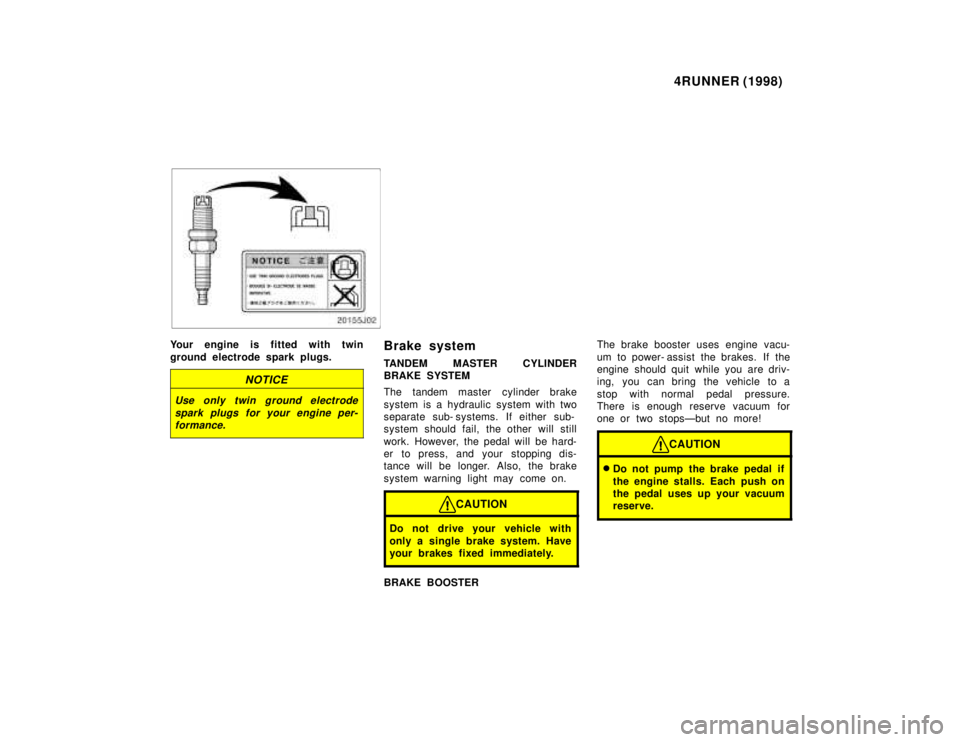
Your engine is fitted with twin
ground electrode spark plugs.
NOTICE
Use only twin ground electrode
spark plugs for your engine per-formance.
Brake system
TANDEM MASTER CYLINDER
BRAKE SYSTEM
The tandem master cylinder brake
system is a hydraulic system with two
separate sub- systems. If either sub-
system s hould fail, the other will still
work. However, the pedal will be hard-
er to press, and your stopping dis-
tance will be longer. Also, the brake
system warning light may come on.
CAUTION
Do not drive your vehicle with
only a single brake system. Have
your brakes fixed immediately.
BRAKE BOOSTER The brake booster uses engine vacu-
um to power- assist the brakes. If the
engine should quit while you are driv-
ing, you can bring the vehicle to a
stop with normal pedal pressure.
There is enough reserve vacuum for
one or two stopsÐbut no more!
CAUTION
Do not pump the brake pedal if
the engine stalls. Each push on
the pedal uses up your vacuum
reserve.
Page 240 of 350
4RUNNER (1998)
(b) Starting the engine
Before starting the engine, be sure to
follow the instructions in º(a) Before
crankingº.
Normal starting procedure
The multiport fuel injection system/se-
quential multiport fuel injection system
in your engine automatically controls
the proper air- fuel mixture for starting.
You can start a cold or hot engine as
follows:
1. With your foot off the accelerator
pedal, crank the engine by turning the
key to ºSTARTº. Release it when the
engine starts.
2. After the engine runs for about 10
seconds, you are ready to drive.
If the weather is below freezing, let
the engine warm up for a few minutes
before driving.
If the engine stalls...
Simply restart it, using the correct
procedure given in normal starting.
If the engine will not startÐ
See ºIf your vehicle will not startº in
Part 4.
NOTICE
Do not crank for more than 30 seconds at a time. This mayoverheat the starter and wiringsystems.
Do not race a cold engine.
If the engine becomes difficult
to start or stalls frequently,have the engine checked im-mediately.
Always slow down in gusty cross-
winds. This will allow you much
better control.
Drive slowly onto curbs and, if
possible, at a right angle. Avoid
driving onto high, sharp- edged ob-
jects and other road hazards. Fail-
ure to do so can lead to severe
tire damage resulting in tire bursts.
When parking on a hill, turn the
front wheels until they touch the
curb so that the vehicle will not
roll. Apply the parking brake, and
place the transmission in ºPº (auto-
matic) or in first or reverse (manu-
al). If necessary, block the wheels.
Washing your vehicle or driving
through deep water may get the
brakes wet. To see whether they
are wet, check that there is no
traffic near you, and then press the
pedal lightly. If you do not feel a
normal braking force, the brakes
are probably wet. To dry them,
drive the vehicle cautiously while
lightly pressing the brake pedal
with the parking brake pulled. If
they still do not work safely, pull to
the side of the road and call a
Toyota dealer for assistance.
Tips for driving in various
conditions
Page 255 of 350
4RUNNER (1998)
(b) Starting a flooded engine
If the engine will not start, your
engine may be flooded because of
repeated cranking.
If this happens, turn the key to
ºSTARTº with the accelerator pedal
held down. Keep the key and acceler-
ator pedal so for 15 seconds and re-
lease them. Then try starting the en-
gine with your foot off the accelerator
pedal.
If the engine does not start after 15
seconds of cranking, release the key,
wait a few minutes and try again.
If the engine still will not start, it
needs adjustment or repair. Call a
Toyota dealer or qualified repair shop
for assistance.
NOTICE
Do not crank for more than 30 seconds at a time. This may over-heat the starter and wiring sys-tems.
(c) Jump starting
To avoid serious personal injury
and damage to your vehicle which
might result from battery explosion,
acid burns, electrical burns, or dam-
aged electronic components, these
instructions must be followed pre-
cisely.
If you are unsure about how to follow
this procedure, we strongly recom-
mend that you seek the help of a
competent mechanic or towing service.
CAUTION
Batteries contain sulfuric acid
which is poisonous and corro-
sive. Wear protective safety
glasses when jump starting, and
avoid spilling acid on your skin, clothing, or vehicle.
If you should accidentally get
acid on yourself or in your
eyes, remove any contaminated
clothing and flush the affected
area with water immediately.
Then get immediate medical
attention. If possible, continue
to apply water with a sponge or
cloth while en route to the med-
ical office.
The gas normally produced by
a battery will explode if a flame
or spark is brought near. Use
only standardized jumper cables
and do not smoke or light a
match while jump starting.
NOTICE
The battery used for boosting
must be 12 V. Do not jump startunless you are sure that thebooster battery is correct.
Page 260 of 350
4RUNNER (1998)
CAUTION
When making the connections, to
avoid serious injury, do not lean
over the battery or accidentally
let the jumper cables or clamps
touch anything except the correct
battery terminals or the ground.
5. Start your engine in the normal
way. After starting, run it at about
2000 rpm for several minutes with
the accelerator pedal lightly de-
pressed.
6. Carefully disconnect the cables in the exact reverse order: the nega-
tive cable and then the positive
cable.
7. Carefully dispose of the battery cover clothsÐthey may now con-
tain sulfuric acid.
8. If removed, replace all the battery vent plugs.
If the cause of your battery discharg-
ing is not apparent (for example,
lights left on), you should have it
checked. If your engine stalls while driving...
1. Reduce your speed gradually, keep- ing a straight line. Move cautiously
off the road to a safe place.
2. Turn on your emergency flashers.
3. Try starting the engine again.
If the engine will not start, see ºIf
your vehicle will not startº.
CAUTION
If the engine is not running, the
power assist for the brakes and
steering will not work so steering
and braking will be much harder
than usual.
If your vehicle overheats
If your engine coolant temperature
gauge indicates overheating, if you
experience a loss of power, or if
you hear a loud knocking or ping-
ing noise, the engine has probably
overheated. You should follow this
procedure... 1. Pull safely off the road, stop the vehicle and turn on your emergen-
cy flashers. Put the transmission in
ºPº (automatic) or neutral (manual)
and apply the parking brake. Turn
off the air conditioning if it is being
used.
2. If coolant or steam is boiling out of the radiator or reservoir, stop the
engine. Wait until the steam sub-
sides before opening the hood. If
there is no coolant boiling over or
steam, leave the engine running.
CAUTION
To help avoid personal injury,
keep the hood closed until there
is no steam. Escaping steam or
coolant is a sign of very high
pressure.
If your engine stalls while
driving
Page 261 of 350
4RUNNER (1998)
3. Visually check to see if the engine drive belt (fan belt) is broken or
loose. Look for obvious coolant
leaks from the radiator, hoses, and
under the vehicle. However, note
that water draining from the air
conditioning is normal if it has
been used.
CAUTION
When the engine is running, keep
hands and clothing away from the
moving fan and engine drive
belts.
4. If the engine drive belt is brokenor the coolant is leaking, stop the
engine immediately. Call a Toyota
dealer for assistance.
5. If the engine drive belt is O.K. and there are no obvious leaks, you
may help the engine cool down
more quickly by running it at about
1500 rpm for a few minutes with
the accelerator pedal lightly de-
pressed.
6. Check the coolant reservoir. If it is dry, add coolant to the reservoir
while the engine is running. Fill it
about half full.
CAUTION
Do not attempt to remove the ra-
diator cap when the engine and
radiator are hot. Serious injury
could result from scalding hot
fluid and steam blown out under
pressure.
7. After the engine coolant tempera-ture has cooled to normal, again
check the coolant level in the res-
ervoir. If necessary, bring it up to
half full again. Serious coolant loss
indicates a leak in the system. You
should have it checked as soon as
possible at your Toyota dealer. If you have a flat tireÐ
1. Reduce your speed gradually, keep- ing a straight line. Move cautiously
off the road to a safe place well
away from the traffic. Avoid stop-
ping on the center divider of a
highway. Park on a level spot with
firm ground.
2. Stop the engine and turn on your emergency flashers.
3. Firmly set the parking brake and put the transmission in ºPº (auto-
matic) or reverse (manual).
4. Have everyone get out of the ve- hicle on the side away from traffic.
5. Read the following instructions thoroughly.
CAUTION
When jacking, be sure to observe
the following to reduce the possi-
bility of personal injury: Follow jacking instructions.
Do not start or run the engine
while your vehicle is supported
by the jack.
Page 287 of 350
4RUNNER (1998)
High pressure water or steam is
effective for cleaning the vehicle's
underside and wheel housings. Pay
particular attention to these areas
as it is difficult to see all the mud
and dirt. It will do more harm than
good to simply wet the mud and
debris without removing them. The
lower edge of doors, rocker panels
and frame members have drain
holes which should not be allowed
to clog with dirt as trapped water
in these areas can cause corro-
sion.
Wash the underside of the vehicle
thoroughly when winter is over.
See ºWashing and waxing your Toyo-
taº for more tips.
Check the condition of your ve-
hicle's paint and trim. If you find any
chips or scratches in the paint, touch
them up immediately to prevent corro-
sion from starting. If the chips or
scratches have gone through the bare
metal, have a qualified body shop
make the repair. Check the interior of your vehicle.
Water and dirt can accumulate under
the floor mats and could cause corro-
sion. Occasionally check under the
mats to make sure the area is dry. Be
particularly careful when transporting
chemicals, cleansers, fert
ilizers, salt,
etc; these should be transported in
proper containers. If a spill or leak
should occur, immediately clean and
dry the area.
Use mud shields on your wheels. If
you drive on salted or gravel roads,
mud shields help protect your vehicle.
Full- size shields, which come as near
to the ground as possible, are the
best. We recommend that the fittings
and the area where the shields are
installed be treated to resist corrosion.
Your Toyota dealer will be happy to
assist in supplying and insta lling the
shields if they are recommended for
your area.
Keep your vehicle in a well venti-
lated garage or a roofed place. Do
not park your vehicle in a damp,
poorly ventilated garage. If you wash
your vehicle in the garage, or if you
drive it in covered with water or snow,
your garage may be so damp it will
cause corrosion. Even if your garage
is heated, a wet vehicle can corrode
if the ventilation is poor. Washing your Toyota
Keep your vehicle clean by regular
washing.
The following cases may cause weak-
ness to the paint or corrosion to the
body and parts. Wash your vehicle as
soon as possible.
When driving in a coastal area
When driving on a road sprinkled
with antifreeze
When having stuck of coal tar, tree
sap, bird droppings and carcass of
an insect
when driving in the areas where
there are a lot of smoke, soot,
dust, iron dust and chemical sub-
stance
When the vehicle becomes remark-
ably dirty with dust and mud
Hand- washing your Toyota
Work in the shade and wait until
the vehicle body is not hot to the
touch.
CAUTION
When cleaning under floor or
chassis, be careful not to injure
your hands.
Washing and waxing your
To y o t a