fuel TOYOTA 4RUNNER 2011 N280 / 5.G Owners Manual
[x] Cancel search | Manufacturer: TOYOTA, Model Year: 2011, Model line: 4RUNNER, Model: TOYOTA 4RUNNER 2011 N280 / 5.GPages: 680, PDF Size: 12.58 MB
Page 2 of 680
TABLE OF CONTENTSIndex
4RUNNER_U
2
1-1. Key informationKeys ..................................... 30
1-2. Opening, closing and
locking the doors
Smart key system................. 33
Wireless remote control ....... 47
Side doors ............................ 51
Back door ............................. 56
1-3. Adjustable components
(seats, mirrors,
steering wheel)
Front seats ........................... 61
Rear seats ............................ 65
Head restraints ..................... 76
Seat belts ............................. 79
Steering wheel ..................... 86
Inside rear view mirror.......... 87
Outside rear view mirrors ..... 89
1-4. Opening and closing the windows and moon roof
Power windows .................... 91
Power back window ............. 94
Moon roof ............................. 98
1-5. Refueling Opening the fuel tank cap ................................... 102 1-6. Theft deterrent system
Engine immobilizer system .............................. 106
Alarm .................................. 109
Theft prevention labels (for U. S. A.) ..................... 112
1-7. Safety information Correct driving posture ....... 113
SRS airbags ....................... 115
Front passenger occupant classification system ......... 130
Child restraint systems ....... 136
Installing child restraints ..... 140
2-1. Driving procedures Driving the vehicle .............. 154
Engine (ignition) switch (vehicles without a smart
key system) ...................... 164
Engine (ignition) switch (vehicles with a
smart key system) ............ 167
Automatic transmission ...... 173
Turn signal lever ................. 179
Parking brake ..................... 180
Horn .................................... 181
2-2. Instrument cluster Gauges and meters ............ 182
Indicators and warning lights ................................. 189
Accessory meter ................. 194
1Before driving
2When driving
Page 5 of 680

1
2
3
4
5
6
7
4RUNNER_U
5
4-1. Maintenance and careCleaning and protecting the vehicle exterior............ 478
Cleaning and protecting the vehicle interior............. 481
4-2. Maintenance Maintenance requirements ..................... 484
General maintenance.......... 486
Emission inspection and maintenance (I/M)
programs........................... 490
4-3. Do-it-yourself maintenance
Do-it-yourself service precautions ....................... 491
Hood ................................... 494
Engine compartment ........... 495
Tires .................................... 514
Tire inflation pressure ......... 520
Wheels ................................ 524
Air conditioning filter............ 526
Wireless remote control/ electronic key battery ........ 528
Checking and replacing fuses ................................. 531
Light bulbs........................... 541 5-1. Essential information
Emergency flashers............ 554
If your vehicle needs to be towed................................ 555
If you think something is wrong ............................... 561
Fuel pump shut off system .............................. 562
Event data recorder ............ 563
5-2. Steps to take in an emergency
If a warning light turns on or a warning buzzer
sounds.............................. 565
If you have a flat tire ........... 578
If the engine will not start.... 591
If the shift lever cannot be shifted from P ................... 593
If you lose your keys........... 595
If you cannot operate back door opener ............. 596
If the electronic key does not operate properly ......... 597
If the vehicle battery is discharged........................ 599
If your vehicle overheats .... 604
If the vehicle becomes stuck ................................. 607
If your vehicle has to be stopped in an
emergency ....................... 608
4Maintenance and care5When trouble arises
Page 6 of 680

TABLE OF CONTENTSIndex
4RUNNER_U
6
6-1. SpecificationsMaintenance data (fuel, oil level, etc.) ........... 612
Fuel information ................. 625
Tire information .................. 628
6-2. Customization Customizable features ....... 640
6-3. Initialization Items to initialize................. 646
Reporting safety defects for U.S. owners ................ 648
Seat belt instructions for Canadian owners
(in French) ........................ 649
SRS airbag instructions for Canadian owners
(in French) ........................ 651
Abbreviation list........................ 664
Alphabetical index .................... 666
What to do if... .......................... 677
6Vehicle specifications
7For owners
Index
Page 9 of 680
4RUNNER_U
9
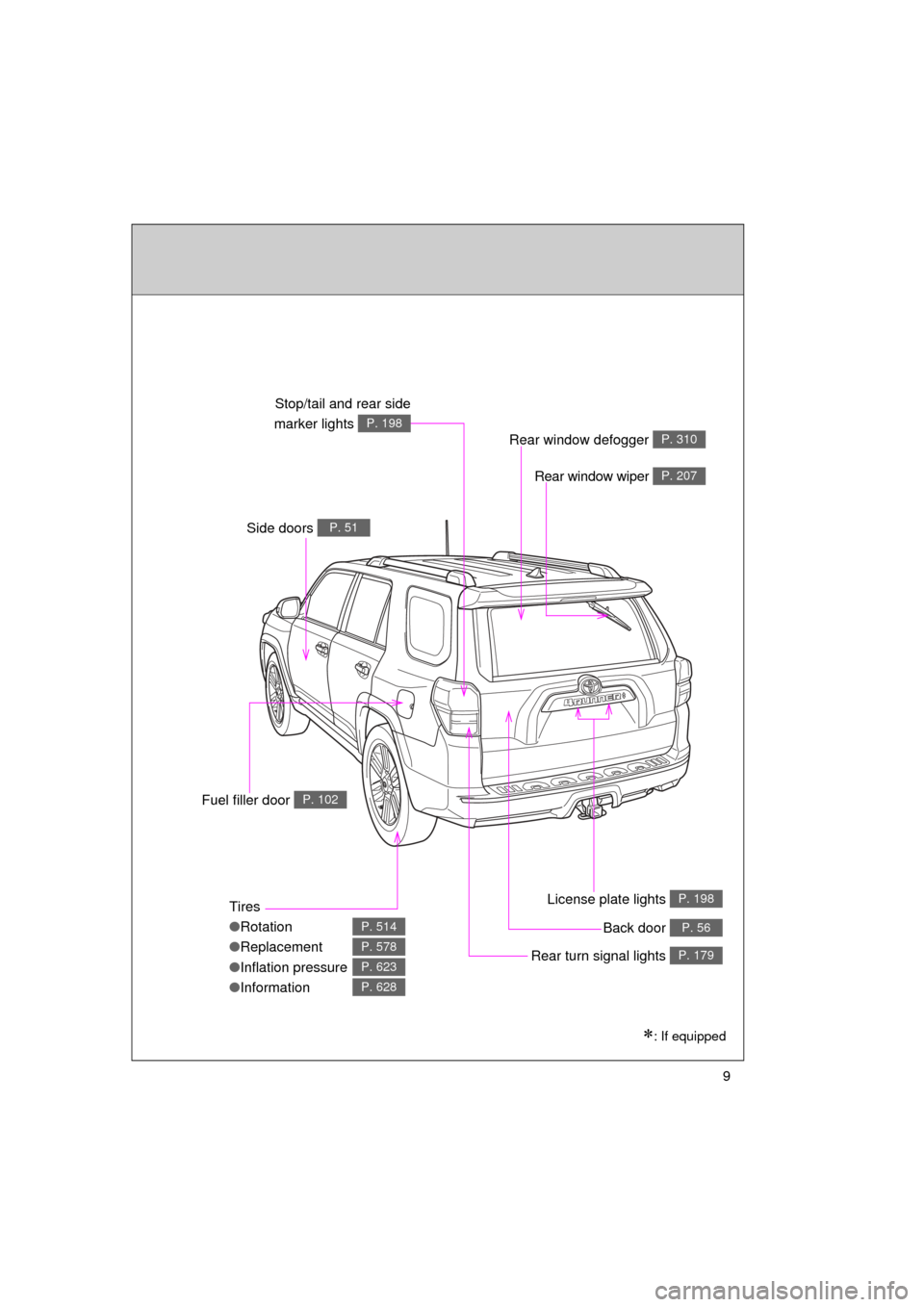
Tires
●Rotation
● Replacement
● Inflation pressure
● Information
P. 514
P. 578
P. 623
P. 628
Rear window defogger P. 310
Rear window wiper P. 207
Side doors P. 51
Rear turn signal lights P. 179
License plate lights P. 198
Back door P. 56
: If equipped
Stop/tail and rear side
marker lights
P. 198
Fuel filler door P. 102
Page 24 of 680

4RUNNER_U
24
For your information
Main Owner’s Manual
Please note that this manual applies to all models and all equipment, includ-
ing options. Therefore, you may find some explanations for equipment not
installed on your vehicle.
All specifications provided in this manual are current at the time of printing.
However, because of the Toyota policy of continual product improvement, we
reserve the right to make changes at any time without notice.
Depending on specifications, the vehicle shown in the illustrations may differ
from your vehicle in terms of equipment.
Noise from under vehicle after turning off the engine
Approximately five hours after the engine is turned off, you may hear sound
coming from under the vehicle for several minutes. This is the sound of a fuel
evaporation leakage check and, it does not indicate a malfunction.
Accessories, spare parts and modification of your Toyota
A wide variety of non-genuine spare parts and accessories for Toyota vehi-
cles are currently available on the market. You should know that Toyota does
not warrant these products and is not responsible for their performance,
repair, or replacement, or for any damage they may cause to, or adverse
effect they may have on, your Toyota vehicle.
This vehicle should not be modified with non-genuine Toyota products. Mod-
ification with non-genuine Toyota products could affect its performance,
safety or durability, and may even violate governmental regulations. In addi-
tion, damage or performance problems resulting from the modification may
not be covered under warranty.
Page 25 of 680

4RUNNER_U
25
Installation of a mobile two-way radio system
As the installation of a mobile two-way radio system in your vehicle may
affect electronic systems such as the multi-port fuel injection system/sequen-
tial multi-port fuel injection system, cruise control system, anti-lock brake
system, SRS airbag system and seat belt pretensioner system, be sure to
check with your Toyota dealer for precautionary measures or special instruc-
tions regarding installation.
Scrapping of your Toyota
The SRS airbag and seat belt pretensioner devices in your Toyota contain
explosive chemicals. If the vehicle is scrapped with the airbags and seat belt
pretensioners left as they are, this may cause an accident such as fire. Be
sure to have the systems of the SRS airbag and seat belt pretensioner
removed and disposed of by a qualified service shop or by your Toyota
dealer before you scrap your vehicle.
Perchlorate Material
Special handling may apply, See www.dtsc.ca.gov/hazardouswaste/perchlorate.
Your vehicle has components that may contain perchlorate. These compo-
nents may include airbag, seat belt pretensioners, and wireless remote con-
trol batteries.
Page 29 of 680
Before driving1
29
4RUNNER_U
1-1. Key informationKeys ................................... 30
1-2. Opening, closing and locking the doors
Smart key system .............. 33
Wireless remote control ..... 47
Side doors .......................... 51
Back door ........................... 56
1-3. Adjustable components (seats, mirrors,
steering wheel)
Front seats ......................... 61
Rear seats.......................... 65
Head restraints................... 76
Seat belts ........................... 79
Steering wheel ................... 86
Inside rear view mirror ....... 87
Outside rear view mirrors.............................. 89
1-4. Opening and closing the windows and moon roof
Power windows .................. 91
Power back window ........... 94
Moon roof ........................... 98 1-5. Refueling
Opening the fuel tank cap ................................. 102
1-6. Theft deterrent system Engine immobilizer system ........................... 106
Alarm................................ 109
Theft prevention labels (for U. S. A.) ................... 112
1-7. Safety information Correct driving posture..... 113
SRS airbags ..................... 115
Front passenger occupant classification
system ........................... 130
Child restraint systems..... 136
Installing child restraints ........................ 140
Page 102 of 680
102
4RUNNER_U
1-5. Refueling
Opening the fuel tank cap
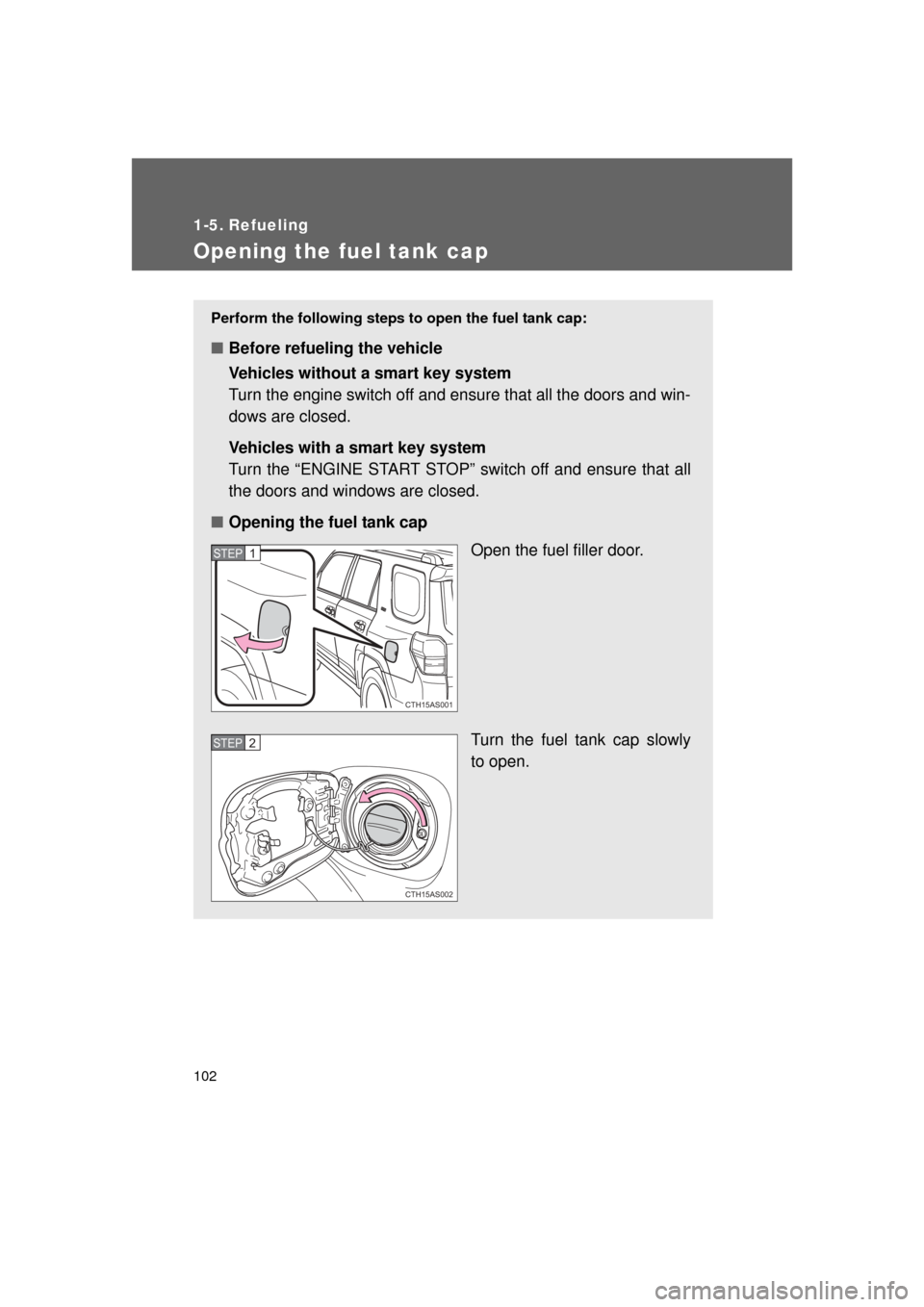
Perform the following steps to open the fuel tank cap:
■Before refueling the vehicle
Vehicles without a smart key system
Turn the engine switch off and ensure that all the doors and win-
dows are closed.
Vehicles with a smart key system
Turn the “ENGINE START STOP” switch off and ensure that all
the doors and windows are closed.
■ Opening the fuel tank cap
Open the fuel filler door.
Turn the fuel tank cap slowly
to open.
CTH15AS001
STEP 1
CTH15AS002
STEP 2
Page 103 of 680

103
1-5. Refueling
1
Before driving
4RUNNER_U
Closing the fuel tank cap
After refueling, turn the fuel tank
cap until you hear a click. Once
the cap is released, it will turn
slightly in the opposite direction.
Hang the fuel tank cap on the
back of the fuel filler door.
CTH15AS003
STEP 3
CTH15AS004
Page 104 of 680

104 1-5. Refueling
4RUNNER_U
CAUTION
■When refueling the vehicle
Observe the following precautions while refueling the vehicle. Failure to do
so may result in death or serious injury.
● After exiting the vehicle and before opening the fuel door, touch an
unpainted metal surface to discharge any static electricity. It is important to
discharge static electricity before refueling because sparks resulting from
static electricity can cause fuel vapors to ignite while refueling.
● Always hold the grips on the fuel tank cap and turn it slowly to remove it.
A whooshing sound may be heard when the fuel tank cap is loosened.
Wait until the sound cannot be heard before fully removing the cap. In hot
weather, pressurized fuel may spray out the filler neck and cause injury.
● Do not allow anyone that has not discharged static electricity from their
body to come close to an open fuel tank.
● Do not inhale vaporized fuel.
Fuel contains substances that are harmful if inhaled.
● Do not smoke while refueling the vehicle.
Doing so may cause the fuel to ignite and cause a fire.
● Do not return to the vehicle or touch any person or object that is statically
charged.
This may cause static electricity to build up, resulting in a possible ignition
hazard.
■ When refueling
Securely insert the fuel nozzle into the fuel filler neck. If fuel is added with
the nozzle slightly lifted away from the fuel filler neck, the automatic shut off
function may not operate, resulting in fuel overflowing from the tank.
■ When replacing the fuel cap
Do not use anything but a genuine Toyota fuel tank cap designed for your
vehicle. Doing so may cause a fire or other incident which may result in
death or serious injury.