overheating TOYOTA 4RUNNER 2011 N280 / 5.G Owners Manual
[x] Cancel search | Manufacturer: TOYOTA, Model Year: 2011, Model line: 4RUNNER, Model: TOYOTA 4RUNNER 2011 N280 / 5.GPages: 680, PDF Size: 12.58 MB
Page 161 of 680
161
2-1. Driving procedures
2
When driving
4RUNNER_U
CAUTION
■
When taking a nap in the vehicle
Always turn the engine off. Otherwise, if you accidentally move the shift lever
or depress the accelerator pedal, this could cause an accident or fire due to
engine overheating. Additionally, if the vehicle is parked in a poorly venti-
lated area, exhaust gases may collect and enter the vehicle, leading to
death or a serious health hazard.
■ When braking
● When the brakes are wet, drive more cautiously.
Braking distance increases when the brakes are wet, and this may cause
one side of the vehicle to brake differently than the other side. Also, the
parking brake may not securely hold the vehicle.
● If the power brake assist function does not operate, do not follow other
vehicles closely and avoid hills or sharp turns that require braking.
In this case, braking is still possible, but the brake pedal should be
depressed more firmly than usual. Also, the braking distance will increase.
● Do not pump the brake pedal if the engine stalls.
Each push on the brake pedal uses up the reserve for the power-assisted
brakes.
● The brake system consists of 2 individual hydraulic systems; if one of the
systems fails, the other will still operate. In this case, the brake pedal
should be depressed more firmly than usual and the braking distance will
increase.
If this happens, do not continue to drive the vehicle. Have your brakes
fixed immediately.
Page 170 of 680
170 2-1. Driving procedures
4RUNNER_U
■If the engine does not start
The engine immobilizer system may not have been deactivated. ( P. 106)
■ Steering lock
After turning the “ENGINE START STOP” switch off and opening and closing
the doors, the steering wheel will be locked due to the steering lock function.
Operating the “ENGINE START STOP” switch again automatically cancels
the steering lock.
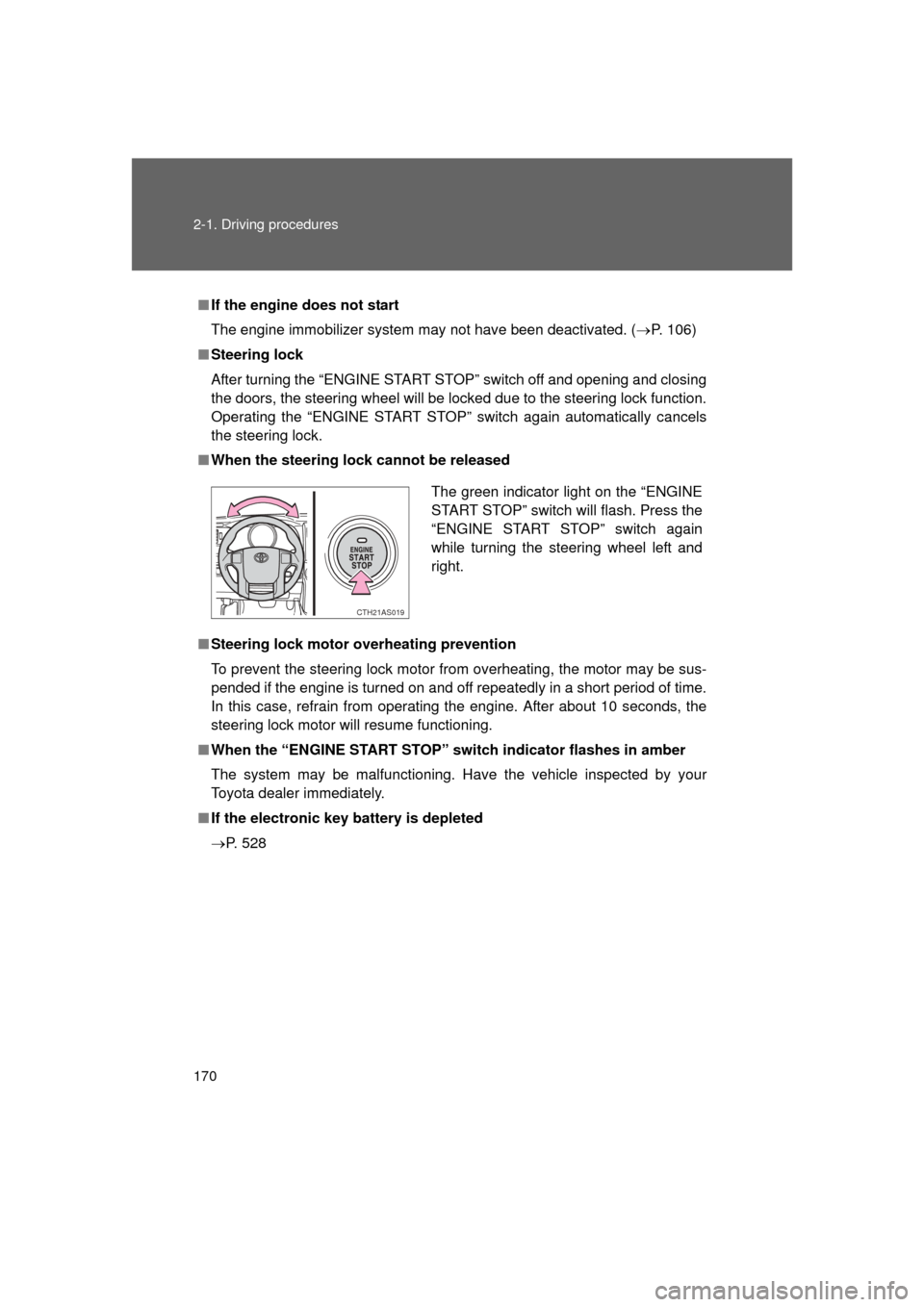
■ When the steering lock cannot be released
■ Steering lock motor overheating prevention
To prevent the steering lock motor from overheating, the motor may be sus-
pended if the engine is turned on and off repeatedly in a short period of time.
In this case, refrain from operating the engine. After about 10 seconds, the
steering lock motor will resume functioning.
■ When the “ENGINE START STOP” switch indicator flashes in amber
The system may be malfunctioning. Have the vehicle inspected by your
Toyota dealer immediately.
■ If the electronic key battery is depleted
P. 528
The green indicator light on the “ENGINE
START STOP” switch will flash. Press the
“ENGINE START STOP” switch again
while turning the steering wheel left and
right.
CTH21AS019
Page 180 of 680
180
2-1. Driving procedures
4RUNNER_U
Parking brake
■Usage in winter time
See “Winter driving tips” for parking brake usage in winter time. ( P. 275)
NOTICE
■Before driving
Fully release the parking brake.
Driving the vehicle with the parking brake set will lead to brake components
overheating, which may affect braking performance and increase brake
wear.
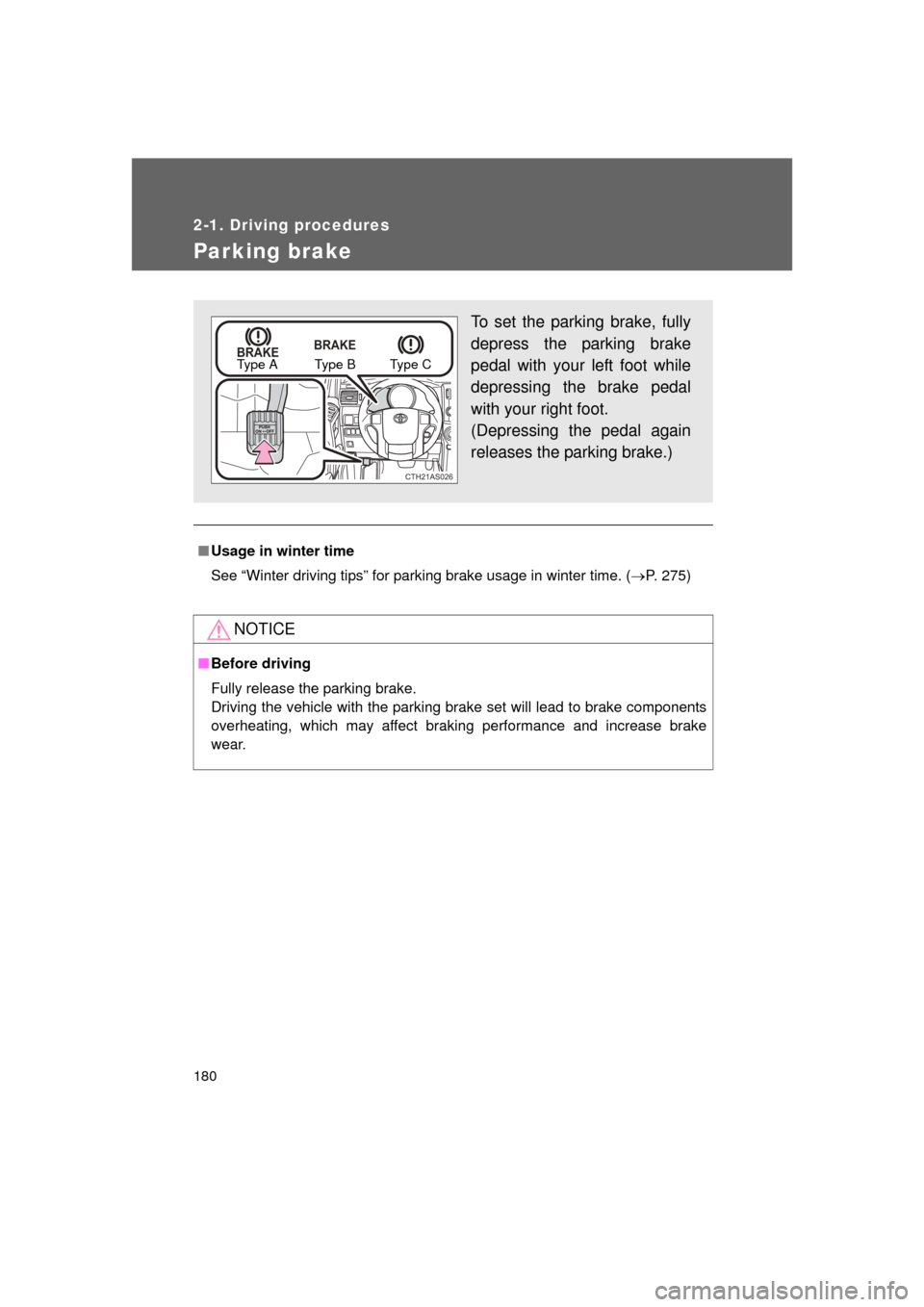
To set the parking brake, fully
depress the parking brake
pedal with your left foot while
depressing the brake pedal
with your right foot.
(Depressing the pedal again
releases the parking brake.)
BRAKE BRAKE
CTH21AS026
Type A Type B Type C
Page 188 of 680

188 2-2. Instrument cluster
4RUNNER_U
■The meters and display illuminate when (Optitron type meter)
Vehicles without a smart key system:
The engine switch is in the “ON” position.
Vehicles with a smart key system:
The “ENGINE START STOP” switch is in IGNITION ON mode.
■ Eco Driving Indicator operates when
The vehicle is being driven with the shift lever in D.
■ When the average fuel consumption is reset
The average fuel consumption displayed on the accessory meter and “Past
Record” screen of the navigation system (if equipped) will be reset at the
same time.
■ The brightness of the instrument panel lights (Optitron type meter)
When the headlight switch is turned to on, the brightness will be reduced
slightly unless the control dial is turned fully upward.
NOTICE
■ To prevent damage to the engine and its components
● Do not let the indicator needle of the tachometer enter the red zone, which
indicates the maximum engine speed.
● The engine may be overheating if the engine coolant temperature gauge is
in the red zone (H). In this case, immediately stop the vehicle in a safe
place, and check the engine after it has cooled completely. ( P. 604)
■ While driving (Optitron type meter)
When the voltmeter indicates more than 19 V or less than 9 V, the battery
may be malfunctioning. Have your vehicle checked at your Toyota dealer.
Page 251 of 680
251
2-4. Using other
driving systems
2
When driving
4RUNNER_U
■Multi-terrain Select is temporarily canceled when
The front-wheel drive control lever is shifted to H4 when Multi-terrain Select
is in ROCK, MOGUL or LOOSE ROCK mode. The mode indicator will flash
until the lever is shifted back to L4.
■ If the Multi-terrain Select indicator continues to flash
This may indicate a malfunction in the Multi-terrain Select system.
In this case, Multi-terrain Select is automatically canceled. Have your vehicle
inspected by your Toyota dealer.
■ If the Multi-terrain Select indicator goes off while Multi-terrain Select is
operating
● One of the vehicle systems related to Multi-terrain Select may be mal-
functioning.
Have your vehicle inspected by your Toyota dealer.
●
The brake actuator may be at risk of overheating.
A buzzer will sound, the “A-TRAC” indicator will go off and the “TRAC
OFF (TRC OFF)” indicator will come on. Stop the vehicle in a safe place.
Refrain from using Multi-terrain Se lect until the “A-TRAC” indicator
comes back on and the “TRAC OFF (TRC OFF)” indicator goes off. (The
vehicle can still be driven, even if Multi-terrain Select is inoperative.)
In the above cases, Multi-terrain Select is automatically canceled.
Page 287 of 680

287
2-5. Driving information
2
When driving
4RUNNER_U
●
Note that when making a turn, th e trailer wheels will be closer than
the vehicle wheels to the inside of the turn. Compensate by making
a larger than normal turning radius.
● Crosswinds and rough roads will adversely affect handling of your
vehicle and trailer, causing sway . Periodically check the rear to
prepare for being passed by large trucks or buses, which may
cause your vehicle and trailer to sway. If swaying occurs, firmly grip
the steering wheel, reduce speed immediately but gradually, and
steer straight ahead. Never increase speed. If you make no
extreme correction with the stee ring or brakes, your vehicle and
trailer will stabilize.
● Take care when passing other vehicles. Passing requires consider-
able distance. After passing a vehicle, do not forget the length of
your trailer, and be sure you hav e plenty of room before changing
lanes.
● In order to maintain engine braking efficiency when driving on a
long steep downgrade, do not use overdrive. Transmission shift
range position must be in 3 (standard type), or “4”, in the S mode
(multi-mode type).
● Due to the added load of the trailer, your vehicle’s engine may
overheat on hot days (at temperatures over 85°F [30°C]) when
driving up a long or steep grade. If the engine coolant temperature
gauge indicates overheating, immedi ately turn off the air condition-
ing (if in use), pull your vehicle off the road and stop in a safe spot.
( P. 604)
Page 447 of 680
447
3-7. Other interior features
3
Interior features
4RUNNER_U
CAUTION
■
Burns
● Use caution when seating the following persons in a seat with the seat
heater on to avoid the possibility of burns:
• Babies, small children, the elderly, the sick and the physically chal-
lenged
• Persons with sensitive skin
• Persons who are fatigued
• Persons who have taken alcohol or drugs that induce sleep (sleeping drugs, cold remedies, etc.)
● Do not cover the seat with anything when using the seat heater.
Using the seat heater with a blanket or cushion increases the temperature
of the seat and may lead to overheating.
● Do not use the seat heater more than necessary. Doing so may cause
minor burns or overheating.
NOTICE
■To prevent seat heater damage
Do not put heavy objects that have an uneven surface on the seat and do
not stick sharp objects (needles, nails, etc.) into the seat.
■ To prevent battery discharge
Turn the seat heaters off when the engine is not running.
Page 605 of 680

5
When trouble arises
605
5-2. Steps to take in an emergency
4RUNNER_U
■
Overheating
If you observe the following, your vehicle may be overheating:
● The engine coolant temperature gauge enters the red zone or a loss of
power is experienced.
● Steam comes out from under the hood.
CAUTION
■To prevent an accident or injury when inspecting under the hood of
your vehicle
● If steam is seen coming from under the hood, do not open the hood until
the steam has subsided. The engine compartment may be very hot, caus-
ing serious injuries such as burns.
● Keep hands and clothing away from the fan and drive belt while the engine
is running.
● Do not loosen the radiator cap, or coolant reservoir cap while the engine
and radiator are hot.
Serious injury, such as burns, may result from hot coolant and steam
released under pressure.
Add engine coolant if neces-
sary.
Water can be used in an emer-
gency if engine coolant is
unavailable.
( P. 618)
Have the vehicle inspected at the nearest Toyota dealer as soon as
possible.
CTH52AS033
STEP 6
Page 668 of 680

668 Alphabetical index
4RUNNER_U
Child safetyAirbag precautions ................122
Battery precautions ....... 511, 603
Child-protectors ....................... 53
Child restraint system............136
How your child should wear the seat belt ..........................82
Installing child restraints ........ 140
Moon roof precautions .......... 101
Power window lock switch....... 91
Power window precautions .....93
Removed key battery precautions .........................530
Seat belt extender precautions ...........................84
Seat belt precautions ..............83
Seat heater precautions ........ 446
Cleaning
Exterior .................................. 478
Interior ...................................481
Seat belts ..............................482
Clock ......................................... 431
Coin holder ............................... 419
Compass ...................................450
Condenser ................................504
Console box ............................. 418
Cooling system Engine overheating ............... 604
Crawl Control ...........................241
Cruise control...........................209
Cup holder ................................423
Curtain shield airbags ............. 115
Customizable features............. 640 Daytime running light
system .................................... 202
Defogger
Rear window ......................... 310
Side mirrors........................... 310
Dimension ................................ 612
Dinghy towing .......................... 293
Display Trip information ..................... 195
Do-it-yourself maintenance .... 491
Door courtesy lights Door courtesy lights .............. 413
Wattage................................. 624
Door lock Back door .......................... 33, 56
Side door........................... 33, 51
Wireless remote control .......... 47
Doors
Back door .......................... 33, 56
Door windows ......................... 91
Side door........................... 33, 51
Side mirrors............................. 89
Downhill assist control system .................................... 238
Driver’s seat belt reminder
light ......................................... 568D
Page 669 of 680

669
Alphabetical index
4RUNNER_U
Driving
Break-in tips ......................... 155
Correct posture..................... 113
Driving assist systems .......... 253
Off-road precautions............. 262
Procedures ........................... 154
Winter driving tips ................. 275
Electronic key If your electronic key battery is depleted...... 528, 597
Emergency flashers Switch ................................... 554
Emergency, in case of
If the electronic key does not operate properly ........... 597
If the engine will not start...... 591
If the shift lever cannot be
shifted from P ..................... 593
If the vehicle has a discharged battery ............ 599
If the warning buzzer sounds ............................... 565
If the warning light
turns on .............................. 565
If you cannot operate back door opener........................ 596
If you have a flat tire ............ 578
If you lose your keys............. 595
If you think something is wrong ................................. 561
If your vehicle becomes stuck................................... 607
If your vehicle has to be stopped in an emergency... 608
If your vehicle needs to be
towed ................................. 555
If your vehicle overheats ...... 604 Engine
Compartment ........................495
Engine switch ................164, 167
Hood......................................494
How to start the engine ...................164, 167
Identification number .............613
If the engine will not start ......591
Ignition switch................164, 167
Overheating...........................604
Engine compartment cover.....497
Engine coolant Capacity ................................618
Checking ...............................503
Preparing and checking before winter .......................275
Engine coolan t temperature
gauge ......................................182
Engine immobilizer system.....106
Engine oil Capacity ................................616
Checking ...............................498
Preparing and checking before winter .......................275
Engine oil maintenance
data .........................................501
Engine switch ...................164, 167
Event data recorder .................563
E