towing TOYOTA 4RUNNER 2016 N280 / 5.G Owners Manual
[x] Cancel search | Manufacturer: TOYOTA, Model Year: 2016, Model line: 4RUNNER, Model: TOYOTA 4RUNNER 2016 N280 / 5.GPages: 528, PDF Size: 12.12 MB
Page 3 of 528
3
1
8 7
6
5
4
3
2
9
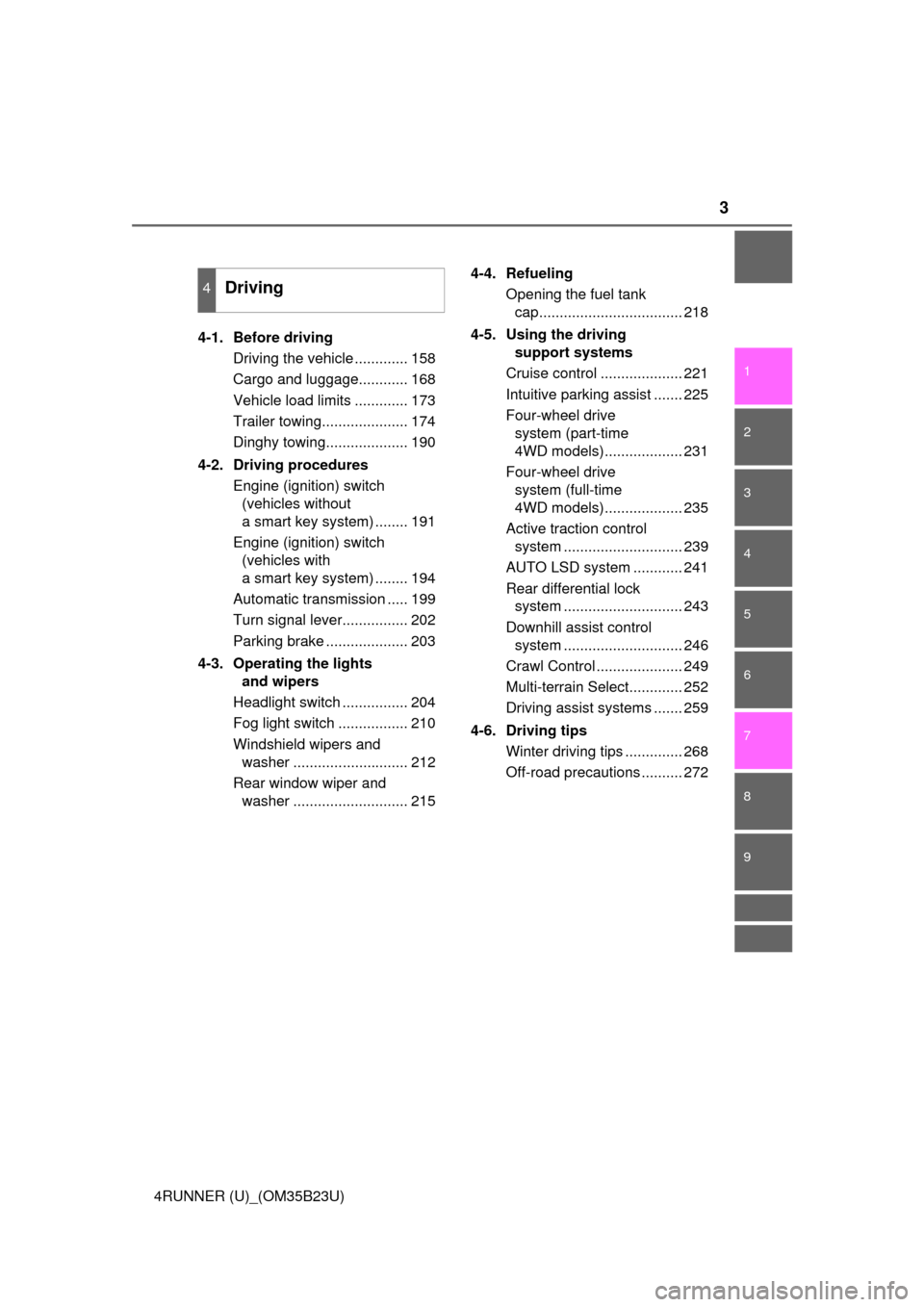
4RUNNER (U)_(OM35B23U)4-1. Before driving
Driving the vehicle ............. 158
Cargo and luggage............ 168
Vehicle load limits ............. 173
Trailer towing..................... 174
Dinghy towing.................... 190
4-2. Driving procedures
Engine (ignition) switch
(vehicles without
a smart key system) ........ 191
Engine (ignition) switch
(vehicles with
a smart key system) ........ 194
Automatic transmission ..... 199
Turn signal lever................ 202
Parking brake .................... 203
4-3. Operating the lights
and wipers
Headlight switch ................ 204
Fog light switch ................. 210
Windshield wipers and
washer ............................ 212
Rear window wiper and
washer ............................ 2154-4. Refueling
Opening the fuel tank
cap................................... 218
4-5. Using the driving
support systems
Cruise control .................... 221
Intuitive parking assist ....... 225
Four-wheel drive
system (part-time
4WD models)................... 231
Four-wheel drive
system (full-time
4WD models)................... 235
Active traction control
system ............................. 239
AUTO LSD system ............ 241
Rear differential lock
system ............................. 243
Downhill assist control
system ............................. 246
Crawl Control ..................... 249
Multi-terrain Select............. 252
Driving assist systems ....... 259
4-6. Driving tips
Winter driving tips .............. 268
Off-road precautions .......... 272
4Driving
Page 16 of 528
16Pictorial index
4RUNNER (U)_(OM35B23U)
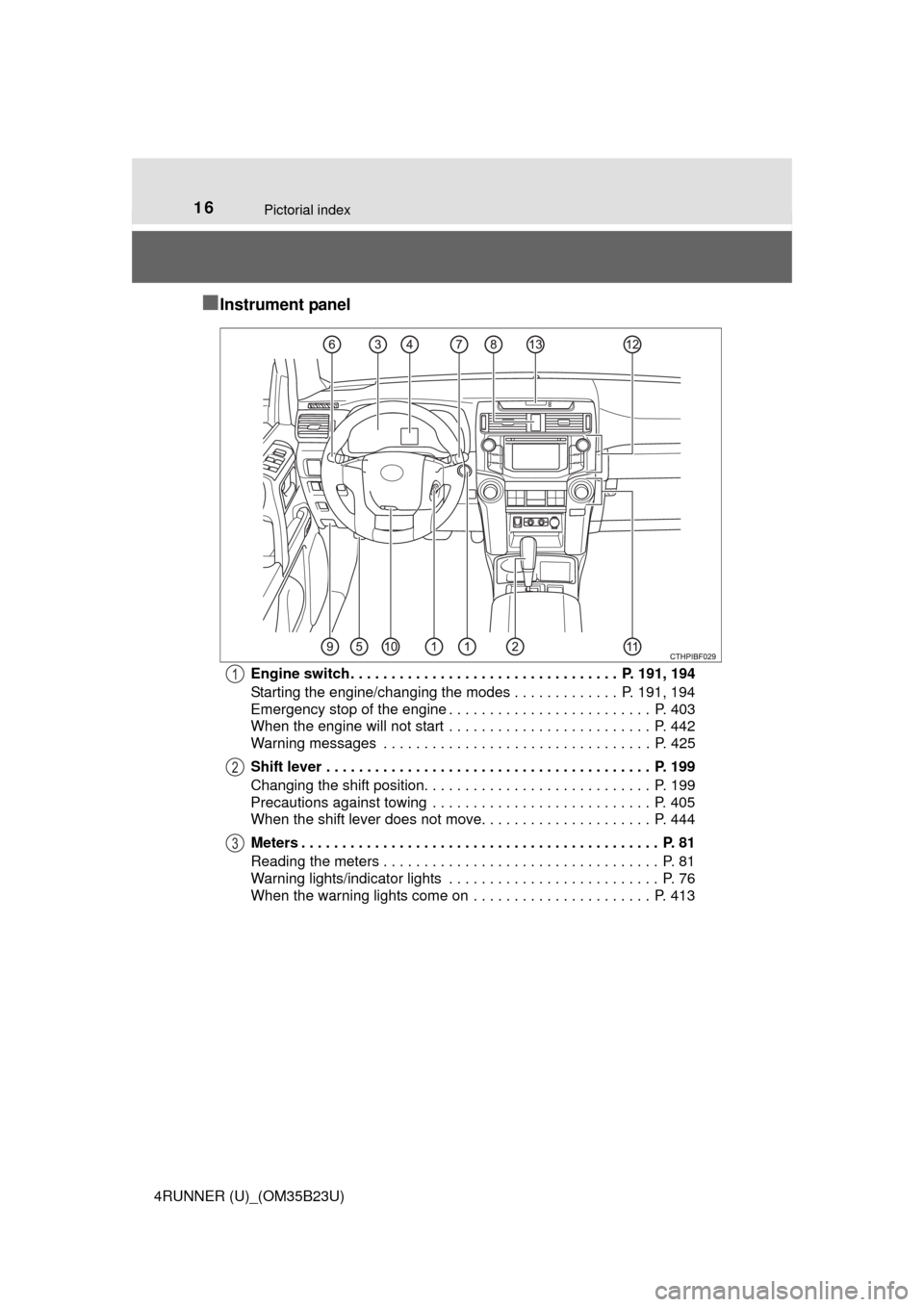
■Instrument panel
Engine switch . . . . . . . . . . . . . . . . . . . . . . . . . . . . . . . . . P. 191, 194
Starting the engine/changing the modes . . . . . . . . . . . . . P. 191, 194
Emergency stop of the engine . . . . . . . . . . . . . . . . . . . . . . . . . P. 403
When the engine will not start . . . . . . . . . . . . . . . . . . . . . . . . . P. 442
Warning messages . . . . . . . . . . . . . . . . . . . . . . . . . . . . . . . . . P. 425
Shift lever . . . . . . . . . . . . . . . . . . . . . . . . . . . . . . . . . . . . . . . . P. 199
Changing the shift position. . . . . . . . . . . . . . . . . . . . . . . . . . . . P. 199
Precautions against towing . . . . . . . . . . . . . . . . . . . . . . . . . . . P. 405
When the shift lever does not move. . . . . . . . . . . . . . . . . . . . . P. 444
Meters . . . . . . . . . . . . . . . . . . . . . . . . . . . . . . . . . . . . . . . . . . . . P. 81
Reading the meters . . . . . . . . . . . . . . . . . . . . . . . . . . . . . . . . . . P. 81
Warning lights/indicator lights . . . . . . . . . . . . . . . . . . . . . . . . . . P. 76
When the warning lights come on . . . . . . . . . . . . . . . . . . . . . . P. 4131
2
3
Page 131 of 528
1313-3. Adjusting the seats
3
Operation of each component
4RUNNER (U)_(OM35B23U)
CAUTION
■When folding the rear seatbacks down
Observe the following precautions. Failure to do so may result in death or
serious injury.
●Do not fold the seatbacks down while driving.
●Stop the vehicle on level ground, set the parking brake and shift the shift
lever to P.
●Do not allow anyone to sit on a folded seatback or in the luggage compart-
ment while driving.
●Do not allow children to enter the luggage compartment.
■Seat adjustment
●To reduce the risk of sliding under the lap belt during a collision, do not
recline the seat more than necessary.
If the seat is too reclined, the lap belt may slide past the hips and apply
restraint forces directly to the abdomen, or your neck may contact the
shoulder belt, increasing the risk of death or serious injury in the event of
an accident.
Adjustments should not be made while driving as the seat may unexpect-
edly move and cause the driver to lose control of the vehicle.
●Take care when adjusting the seat position to ensure that other passen-
gers are not injured by the moving seat.
●Do not put your hands under the seat or near the moving parts to avoid
injury.
Fingers or hands may become jammed in the seat mechanism.
■After returning the rear seatback to the upright position
Observe the following precautions. Failure to do so may result in death or
serious injury.
●Make sure the seatback is securely locked by pushing it forward and rear-
ward on the top.
●Check that the seat belts are not twisted or caught in the seatback.
NOTICE
■Stowing the seat belts
The seat belts and the buckles must be stowed before you fold down the
rear seatbacks.
Page 157 of 528
157
Driving4
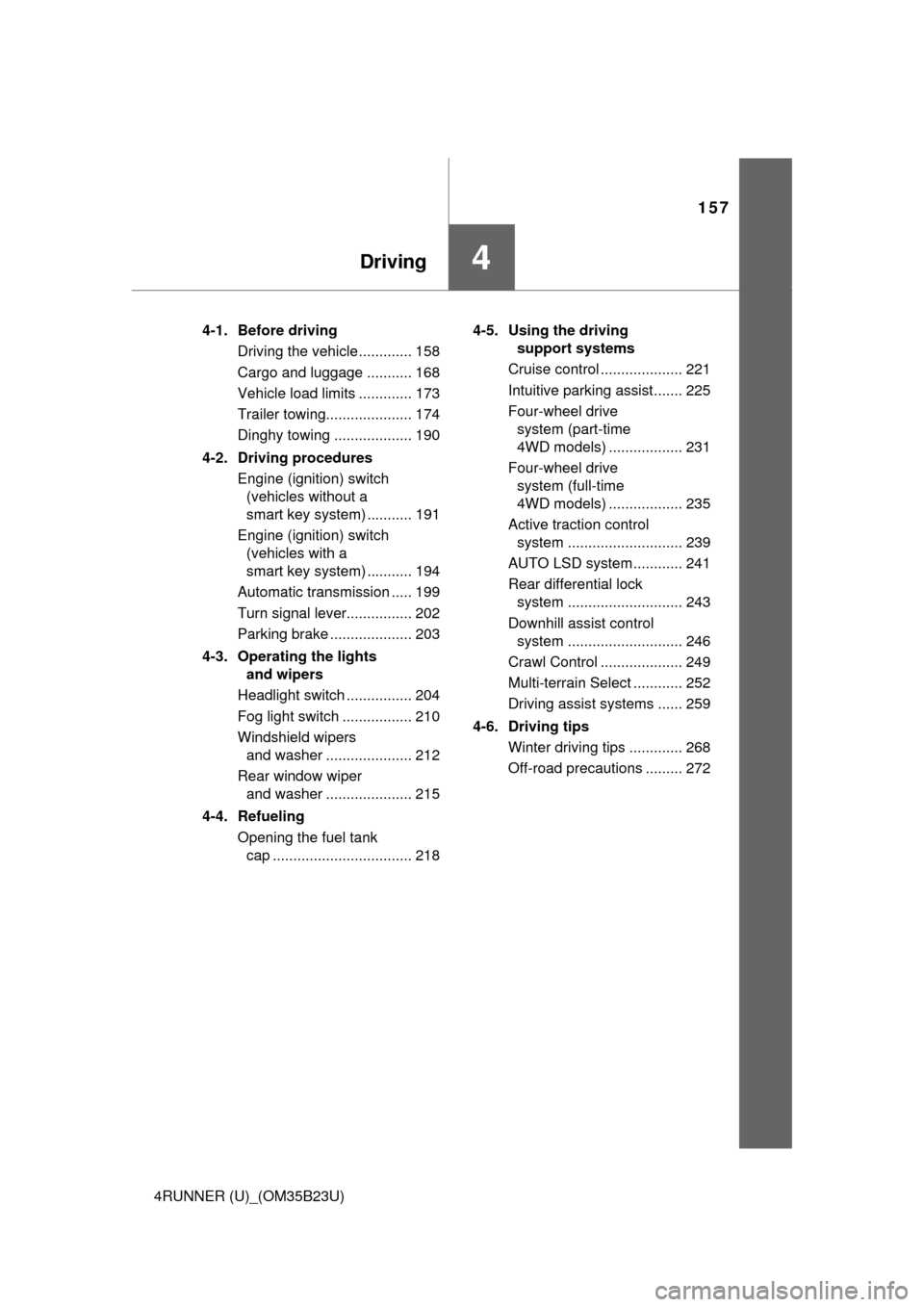
4RUNNER (U)_(OM35B23U)4-1. Before driving
Driving the vehicle ............. 158
Cargo and luggage ........... 168
Vehicle load limits ............. 173
Trailer towing..................... 174
Dinghy towing ................... 190
4-2. Driving procedures
Engine (ignition) switch
(vehicles without a
smart key system) ........... 191
Engine (ignition) switch
(vehicles with a
smart key system) ........... 194
Automatic transmission ..... 199
Turn signal lever................ 202
Parking brake .................... 203
4-3. Operating the lights
and wipers
Headlight switch ................ 204
Fog light switch ................. 210
Windshield wipers
and washer ..................... 212
Rear window wiper
and washer ..................... 215
4-4. Refueling
Opening the fuel tank
cap .................................. 2184-5. Using the driving
support systems
Cruise control .................... 221
Intuitive parking assist....... 225
Four-wheel drive
system (part-time
4WD models) .................. 231
Four-wheel drive
system (full-time
4WD models) .................. 235
Active traction control
system ............................ 239
AUTO LSD system............ 241
Rear differential lock
system ............................ 243
Downhill assist control
system ............................ 246
Crawl Control .................... 249
Multi-terrain Select ............ 252
Driving assist systems ...... 259
4-6. Driving tips
Winter driving tips ............. 268
Off-road precautions ......... 272
Page 169 of 528

1694-1. Before driving
4
Driving
4RUNNER (U)_(OM35B23U)
Cargo capacity depends on the total weight of the occupants.
(Cargo capacity) = (Total load capacity) — (Total weight of occupants)
Steps for Determining Correct Load Limit —
(1) Locate the statement “The combined weight of occupants and
cargo should never exceed XXX kg or XXX lbs.” on your vehicle’s
placard.
(2) Determine the combined weight of the driver and passengers that
will be riding in your vehicle.
(3) Subtract the combined weight of the driver and passengers from
XXX kg or XXX lbs.
(4) The resulting figure equals the available amount of cargo and lug-
gage load capacity.
For example, if the “XXX” amount equals 1400 lbs. and there will be
five 150 lb passengers in your vehicle, the amount of available
cargo and luggage load capacity is 650 lbs. (1400 750 (5150) =
650 lbs.)
(5) Determine the combined weight of luggage and cargo being loaded
on the vehicle. That weight may not safely exceed the available
cargo and luggage load capacity calculated in Step 4.
(6) If your vehicle will be towing a trailer, load from your trailer will be
transferred to your vehicle. Consult this manual to determine how
this reduces the available cargo and luggage load capacity of your
vehicle.
(P. 458)
Capacity and distribution
Page 174 of 528
1744-1. Before driving
4RUNNER (U)_(OM35B23U)
Trailer towing
Your vehicle is designed primarily as a passenger-and-load-car-
rying vehicle. Towing a trailer can have an adverse impact on
handling, performance, braking, durability, and fuel consump-
tion. For your safety and the safety of others, you must not over-
load your vehicle or trailer. You must also ensure that you are
using appropriate towing equipment, that the towing equipment
has been installed correctly and used properly, and that you
employ the requisite driving habits.
Vehicle-trailer stability and braking performance are affected by
trailer stability, brake performance and setting, trailer brakes,
the hitch and hitch systems (if equipped).
To tow a trailer safely, use extreme care and drive the vehicle in
accordance with your trailer’s characteristics and operating
conditions.
Toyota warranties do not apply to damage or malfunction
caused by towing a trailer for commercial purposes.
Contact your Toyota dealer for further information about addi-
tional requirements such as a towing kit, etc.
Page 175 of 528
1754-1. Before driving
4
Driving
4RUNNER (U)_(OM35B23U)■
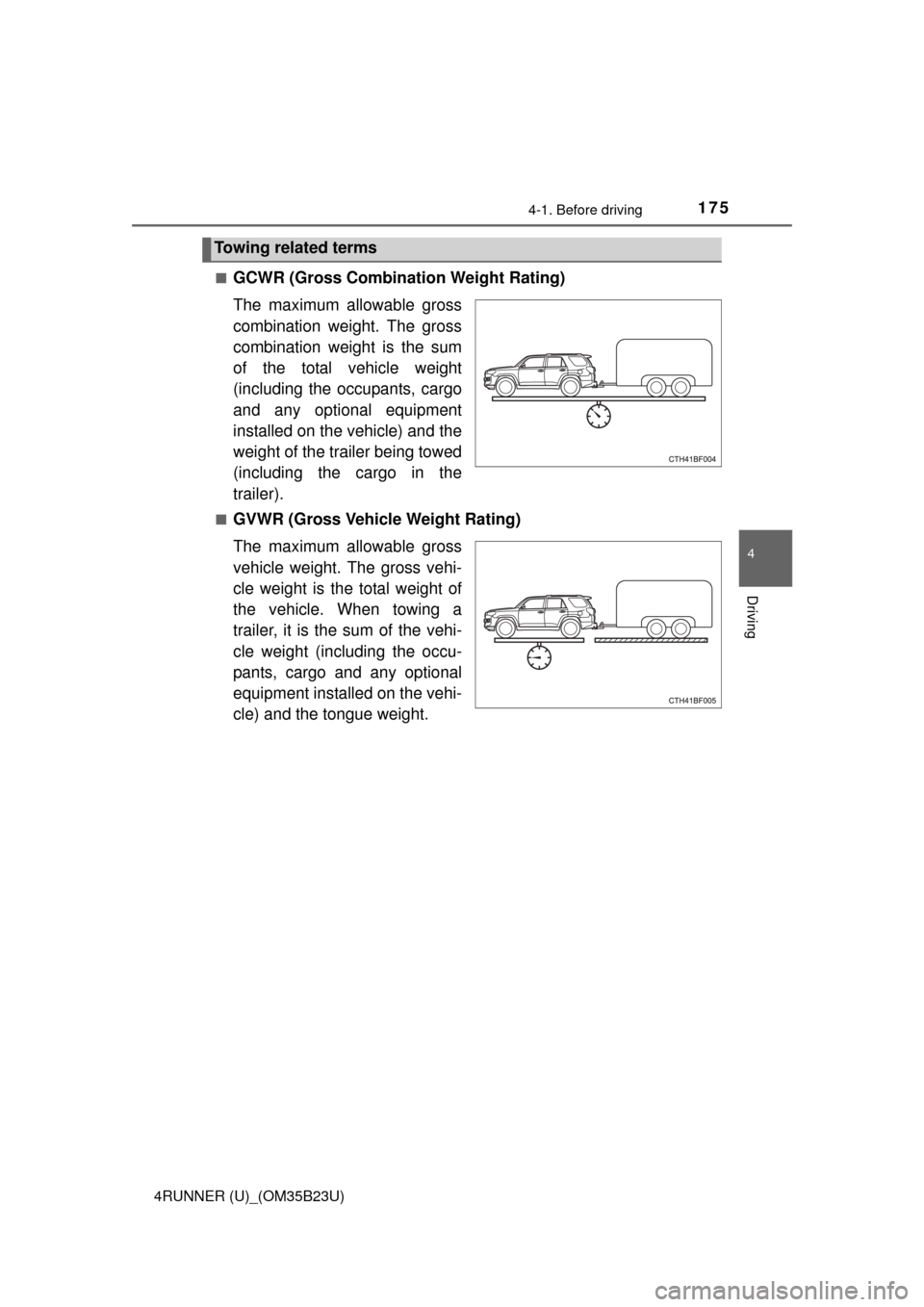
GCWR (Gross Combination Weight Rating)
The maximum allowable gross
combination weight. The gross
combination weight is the sum
of the total vehicle weight
(including the occupants, cargo
and any optional equipment
installed on the vehicle) and the
weight of the trailer being towed
(including the cargo in the
trailer).
■GVWR (Gross Vehicle Weight Rating)
The maximum allowable gross
vehicle weight. The gross vehi-
cle weight is the total weight of
the vehicle. When towing a
trailer, it is the sum of the vehi-
cle weight (including the occu-
pants, cargo and any optional
equipment installed on the vehi-
cle) and the tongue weight.
Towing related terms
Page 176 of 528
1764-1. Before driving
4RUNNER (U)_(OM35B23U)■
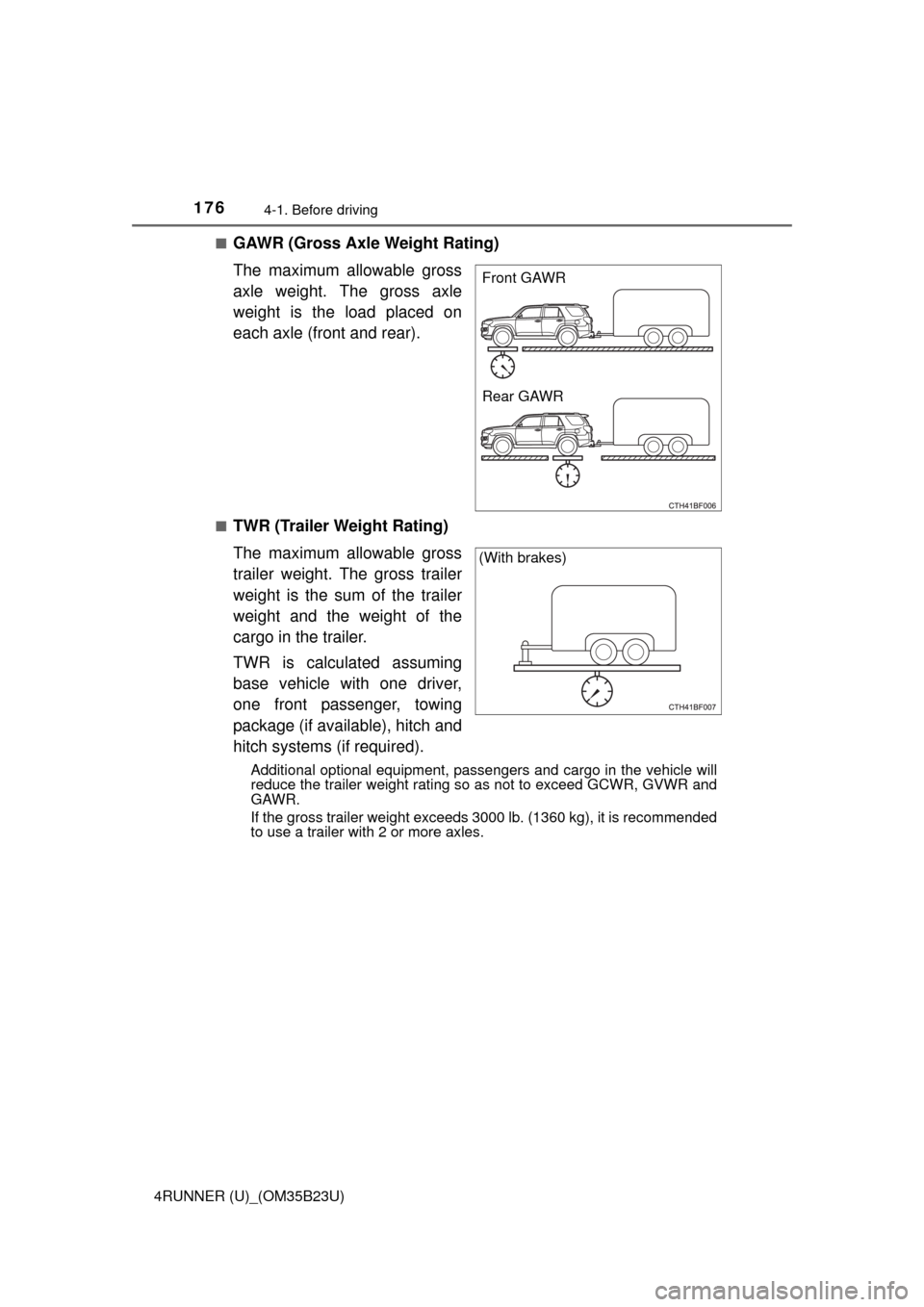
GAWR (Gross Axle Weight Rating)
The maximum allowable gross
axle weight. The gross axle
weight is the load placed on
each axle (front and rear).
■TWR (Trailer Weight Rating)
The maximum allowable gross
trailer weight. The gross trailer
weight is the sum of the trailer
weight and the weight of the
cargo in the trailer.
TWR is calculated assuming
base vehicle with one driver,
one front passenger, towing
package (if available), hitch and
hitch systems (if required).
Additional optional equipment, passengers and cargo in the vehicle will
reduce the trailer weight rating so as not to exceed GCWR, GVWR and
GAWR.
If the gross trailer weight exceeds 3000 lb. (1360 kg), it is recommended
to use a trailer with 2 or more axles.
Front GAWR
Rear GAWR
(With brakes)
Page 179 of 528
1794-1. Before driving
4
Driving
4RUNNER (U)_(OM35B23U)
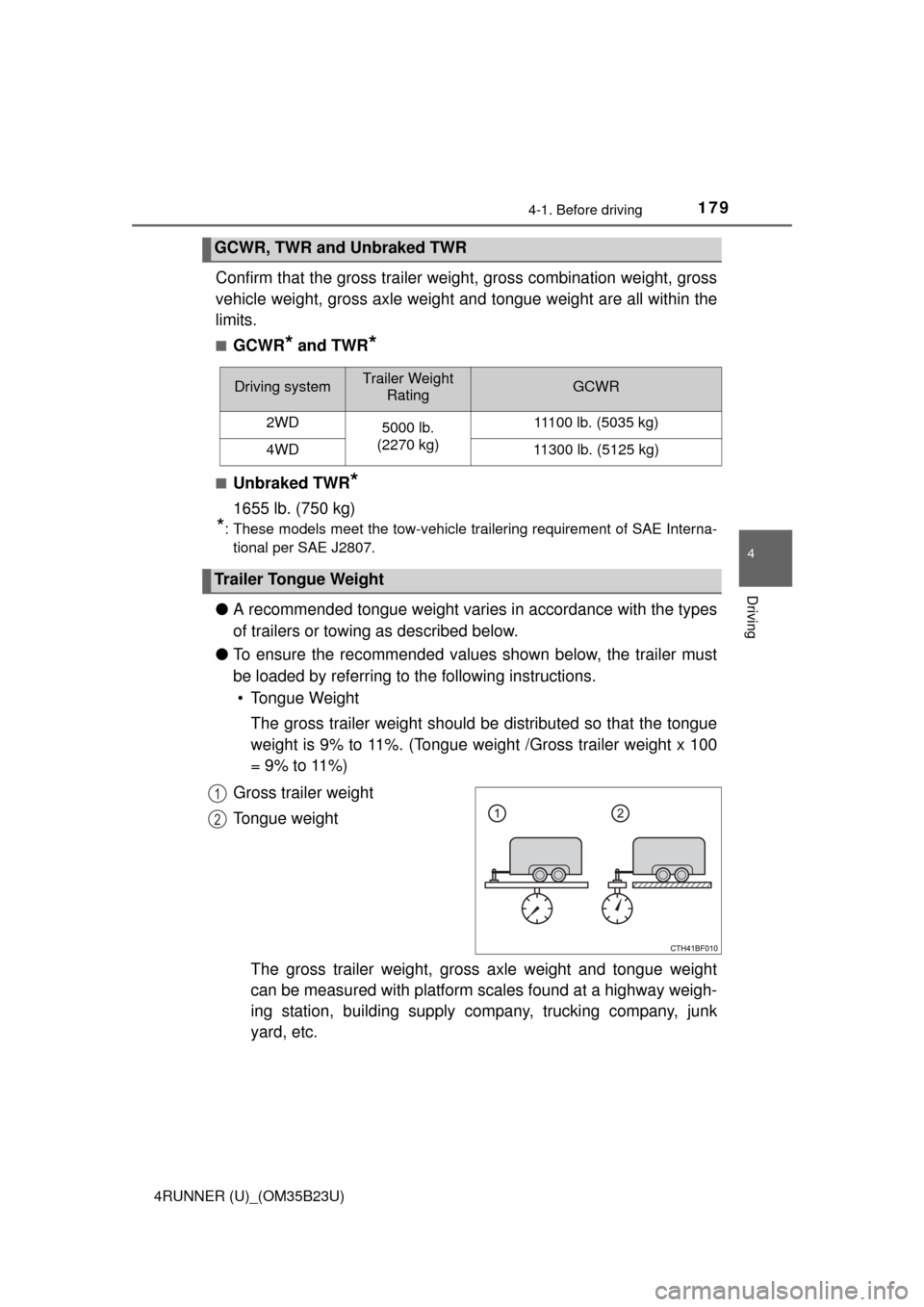
Confirm that the gross trailer weight, gross combination weight, gross
vehicle weight, gross axle weight and tongue weight are all within the
limits.
■GCWR* and TWR*
■Unbraked TWR*
1655 lb. (750 kg)
*: These models meet the tow-vehicle trailering requirement of SAE Interna-
tional per SAE J2807.
●A recommended tongue weight varies in accordance with the types
of trailers or towing as described below.
●To ensure the recommended values shown below, the trailer must
be loaded by referring to the following instructions.
• Tongue Weight
The gross trailer weight should be distributed so that the tongue
weight is 9% to 11%. (Tongue weight /Gross trailer weight x 100
= 9% to 11%)
Gross trailer weight
Tongue weight
The gross trailer weight, gross axle weight and tongue weight
can be measured with platform scales found at a highway weigh-
ing station, building supply company, trucking company, junk
yard, etc.
GCWR, TWR and Unbraked TWR
Driving systemTrailer Weight
RatingGCWR
2WD
5000 lb.
(2270 kg)11100 lb. (5035 kg)
4WD11300 lb. (5125 kg)
Trailer Tongue Weight
1
2
Page 180 of 528

1804-1. Before driving
4RUNNER (U)_(OM35B23U)
Trailer hitch assemblies have different weight capacities. Toyota rec-
ommends the use of Toyota hitch/bracket for your vehicle. For details,
contact your Toyota dealer.
●If you wish to install a trailer hitch, contact your Toyota dealer.
●Use only a hitch that conforms to the gross trailer weight require-
ment of your vehicle.
●Follow the directions supplied by the hitch manufacturer.
●Lubricate the hitch ball with a light coating of grease.
●Remove the trailer hitch whenever you are not towing a trailer. After
removing the hitch, seal any mounting hole in the vehicle body to
prevent entry of any substances into the vehicle.
Hitch