towing TOYOTA 4RUNNER 2021 (in English) Owner's Manual
[x] Cancel search | Manufacturer: TOYOTA, Model Year: 2021, Model line: 4RUNNER, Model: TOYOTA 4RUNNER 2021Pages: 592, PDF Size: 13.3 MB
Page 363 of 592
3635-3. Using the storage features
5
Interior features
4RUNNER (U)
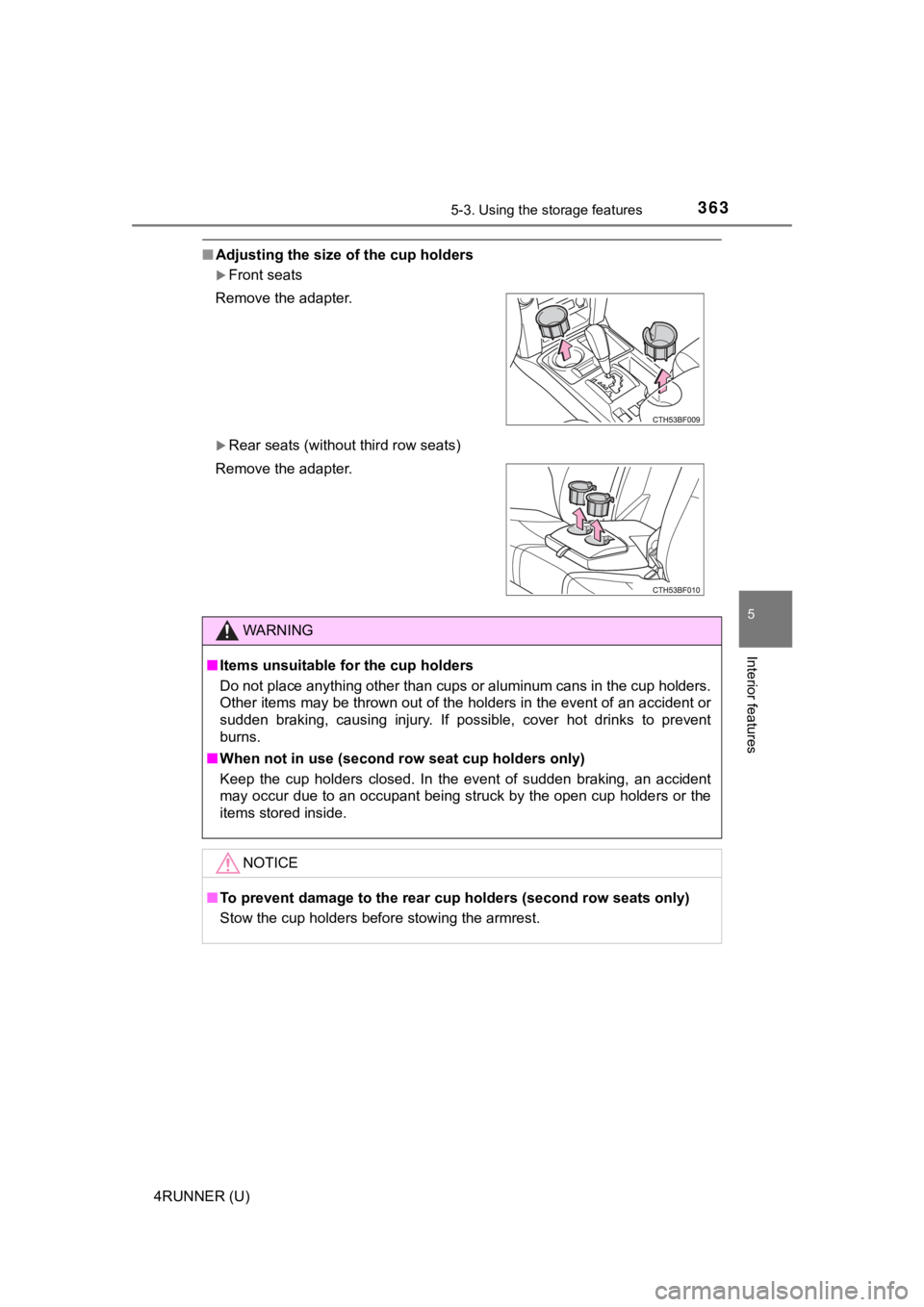
■Adjusting the size of the cup holders
Front seats
Rear seats (without third row seats)
Remove the adapter.
Remove the adapter.
WARNING
■
Items unsuitable f or the cup holders
Do not place anything other than cups or aluminum cans in the c up holders.
Other items may be thrown out of the holders in the event of an accident or
sudden braking, causing injury. If possible, cover hot drinks t o prevent
burns.
■ When not in use (second row seat cup holders only)
Keep the cup holders closed. In the event of sudden braking, an accident
may occur due to an occupant being struck by the open cup holde rs or the
items stored inside.
NOTICE
■ To prevent damage to the rear cup holders (second row seats onl y)
Stow the cup holders before stowing the armrest.
Page 366 of 592
3665-3. Using the storage features
4RUNNER (U)
■When using the bottle holder
●When storing a bottle, close the cap.
● The bottle may not be stored depending on its size or shape.
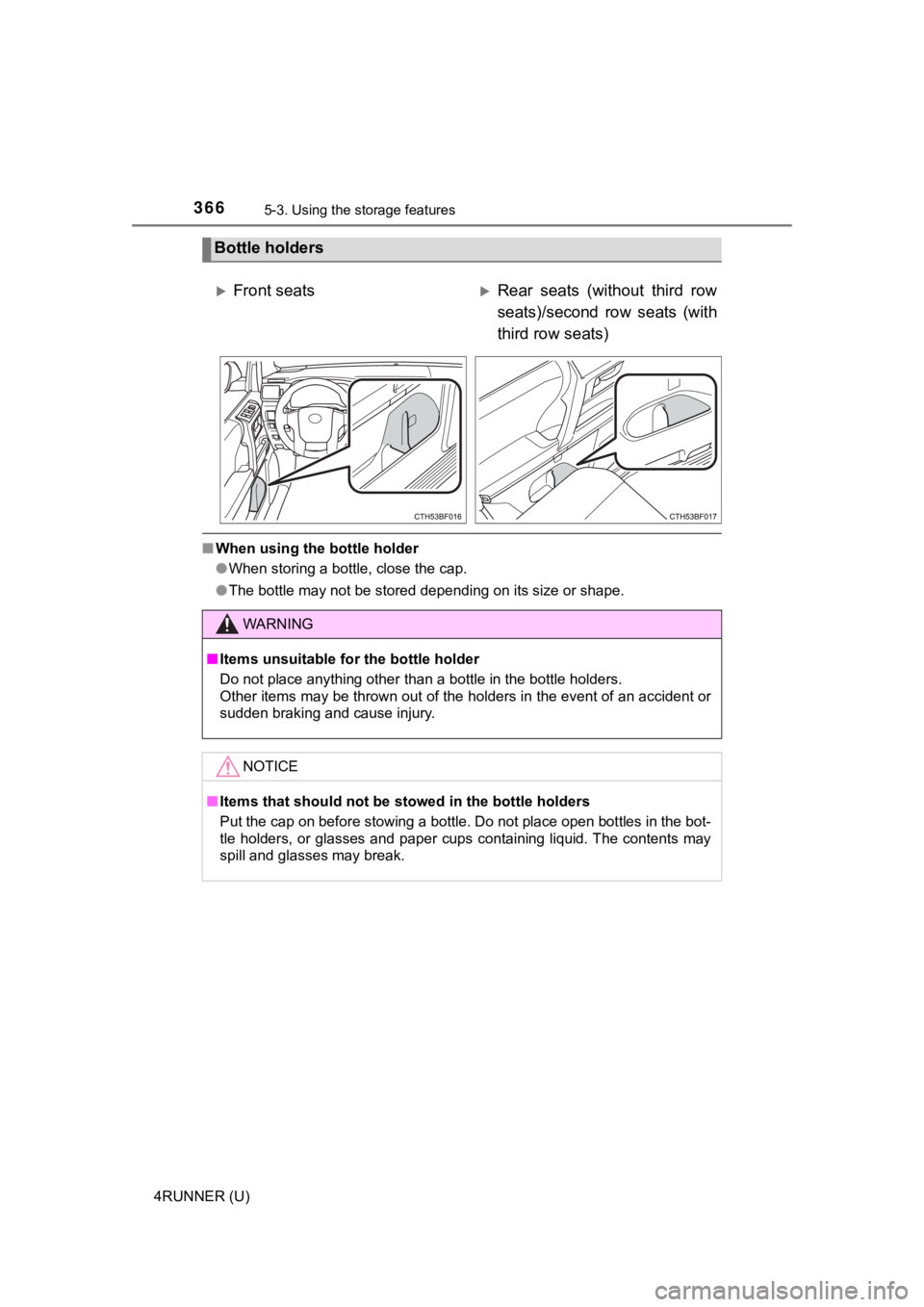
Bottle holders
Front seatsRear seats (without third row
seats)/second row seats (with
third row seats)
WARNING
■Items unsuitable for the bottle holder
Do not place anything other than a bottle in the bottle holders .
Other items may be thrown out of the holders in the event of an accident or
sudden braking and cause injury.
NOTICE
■ Items that should not be st owed in the bottle holders
Put the cap on before stowing a bottle. Do not place open bottl es in the bot-
tle holders, or glasses and paper cups containing liquid. The c ontents may
spill and glasses may break.
Page 466 of 592
466
4RUNNER (U)
7-2. Steps to take in an emergency
If your vehicle needs to be towed
If towing is necessary, we recommend having your vehicle
towed by your Toyota dealer or commercial towing service,
using a wheel-lift type t ruck or flatbed truck.
Use a safety chain system for all towing, and abide by all stat e/
provincial and local laws.
WARNING
Observe the following precautions.
Failure to do so may result in death or serious injury.
■ When towing the vehicle
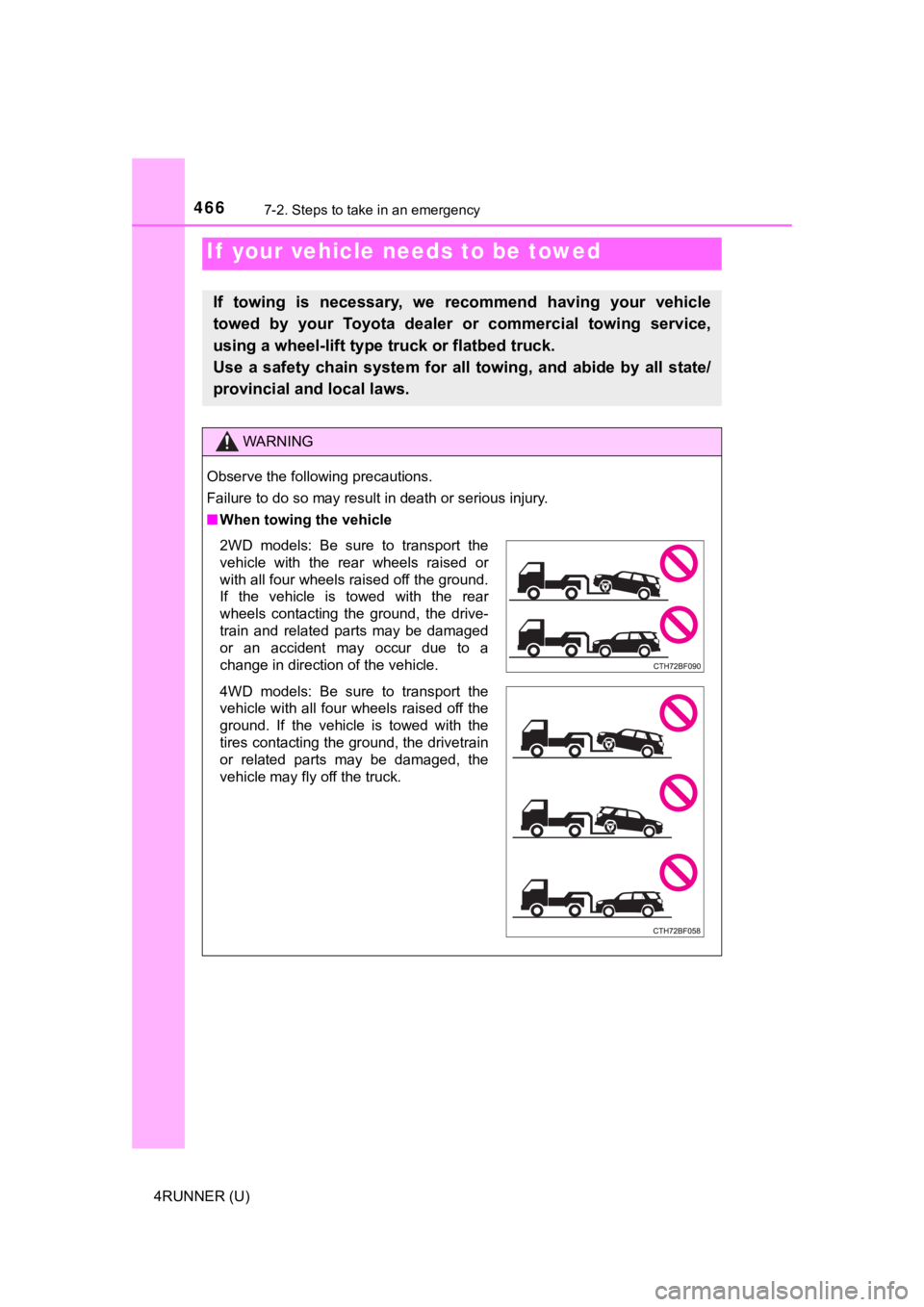
2WD models: Be sure to transport the
vehicle with the rear wheels raised or
with all four wheels raised off the ground.
If the vehicle is towed with the rear
wheels contacting the ground, the drive-
train and related parts may be damaged
or an accident may occur due to a
change in direction of the vehicle.
4WD models: Be sure to transport the
vehicle with all four wheels raised off the
ground. If the vehicle is towed with the
tires contacting the ground, the drivetrain
or related parts may be damaged, the
vehicle may fly off the truck.
Page 467 of 592
4677-2. Steps to take in an emergency
7
When trouble arises
4RUNNER (U)
WARNING
■While towing
● When towing using cables or chains, avoid sudden starts, etc. w hich place
excessive stress on the towing eyelets, cables or chains. The towing eye-
lets, cables or chains may become damaged, broken debris may hit peo-
ple, and cause serious damage.
● Vehicles with a smart key system: Do not turn the engine switch off.
There is a possibility that the steering wheel is locked and ca nnot be oper-
ated.
● Vehicles without a smart key system: Do not turn the engine switch to the
“LOCK” position.
There is a possibility that the steering wheel is locked and ca nnot be oper-
ated.
NOTICE
■ To prevent damage to the vehicle when towing using a wheel-lift type
truck
● Vehicles with a smart key system: Do not tow the vehicle from the rear
when the engine switch is off. The steering lock mechanism is n ot strong
enough to hold the front wheels straight.
● Vehicles without a smart key system: Do not tow the vehicle fro m the rear
when the engine switch is in the “LOCK” position or the key is removed.
The steering lock mechanism is not strong enough to hold the front wheels
straight.
● When raising the vehicle, ensure adequate ground clearance for towing at
the opposite end of the raised vehicle. Without adequate clearance, the
vehicle could be damaged while being towed.
■ To prevent damage to the vehicle when towing with a sling-type truck
Do not tow with a sling-type truck, either from the front or re ar.
■ To prevent damage to the vehic le during emergency towing
Do not secure cables or chains to the suspension components.
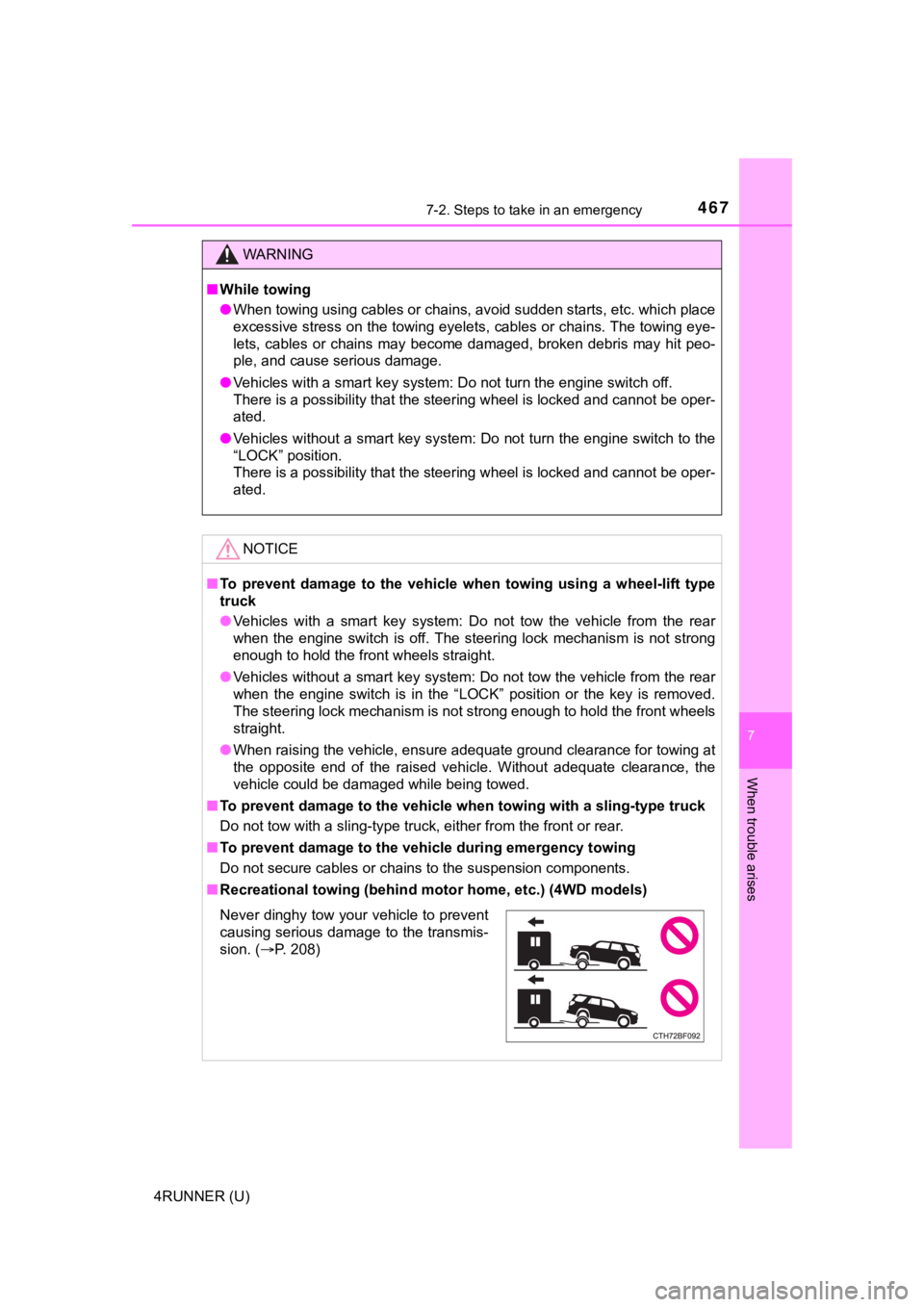
■ Recreational towing (behind mo tor home, etc.) (4WD models)
Never dinghy tow your vehicle to prevent
causing serious damage to the transmis-
sion. (P. 208)
Page 468 of 592
4687-2. Steps to take in an emergency
4RUNNER (U)
The following may indicate a problem with your transmission. Contact
your Toyota dealer or commercial towing service before towing.
● The engine is running but t he vehicle does not move.
● The vehicle makes an abnormal sound.
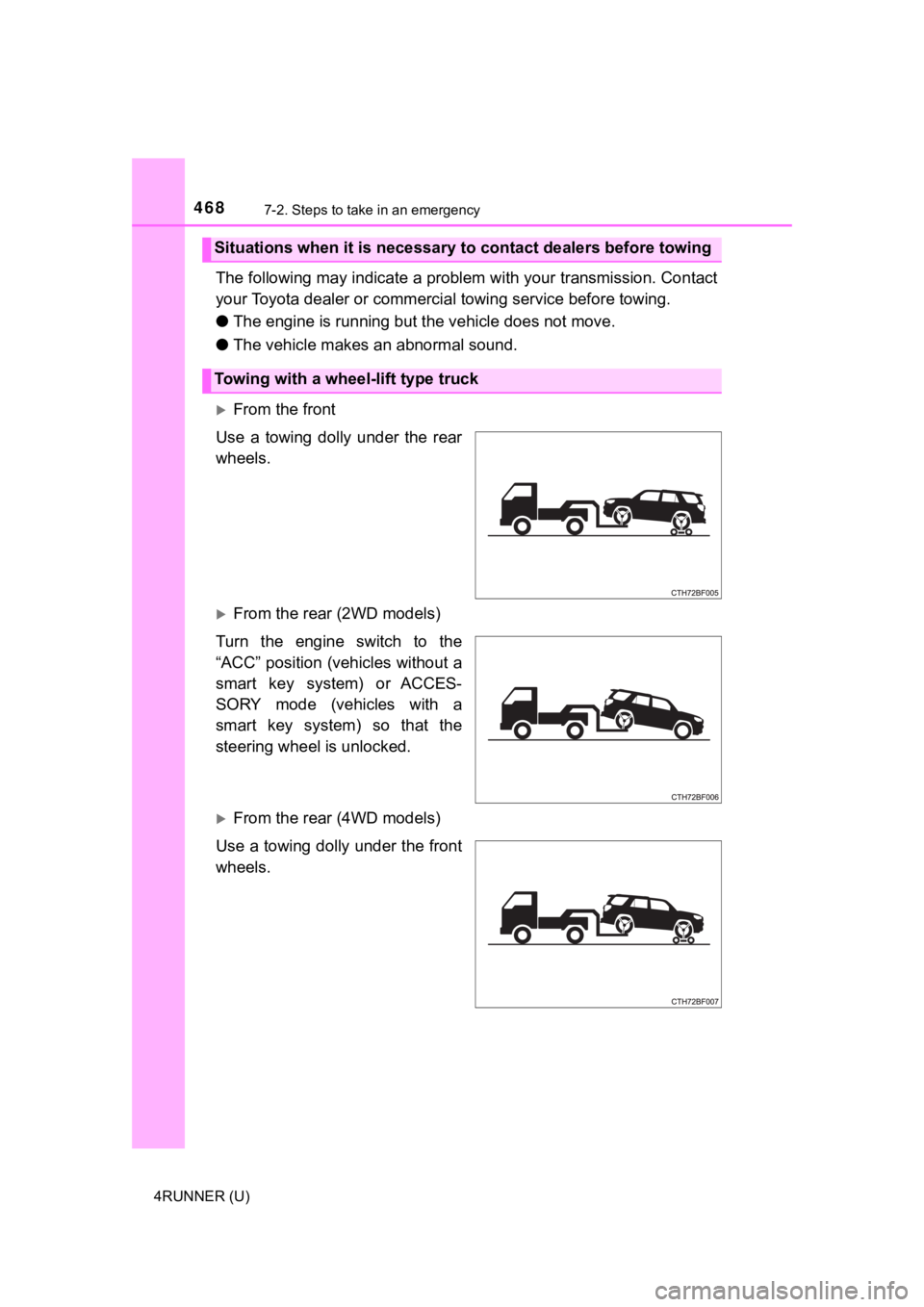
From the front
Use a towing dolly under the rear
wheels.
From the rear (2WD models)
Turn the engine switch to the
“ACC” position (vehicles without a
smart key system) or ACCES-
SORY mode (vehicles with a
smart key system) so that the
steering wheel is unlocked.
From the rear (4WD models)
Use a towing dolly under the front
wheels.
Situations when it is necessary to contact dealers before towing
Towing with a wheel-lift type truck
Page 469 of 592
4697-2. Steps to take in an emergency
7
When trouble arises
4RUNNER (U)
When using a flat-bed truck to transport the vehicle, use tire strapping
belts. Refer to the owner's manual of the flat-bed truck for th e tire
strapping method.
Vehicles with a smart key system: In order to suppress vehicle move-
ment during transportation, set the parking brake and turn the engine
switch off.
Vehicles without a smart key system: In order to suppress vehic le
movement during transportation, set the parking brake and turn the
engine switch to the “LOCK” position.
If a tow truck is not available in an emergency, your vehicle m ay be
temporarily towed using cables or chains secured to the emergen cy
towing hooks. This should only be attempted on hard surfaced roads
for at most 80 km (50 miles) at under 30 km/h (18 mph).
A driver must be in the vehicle to steer and operate the brakes . The
vehicle’s wheels, drive train, a xles, steering and brakes must be in
good condition.
NOTICE
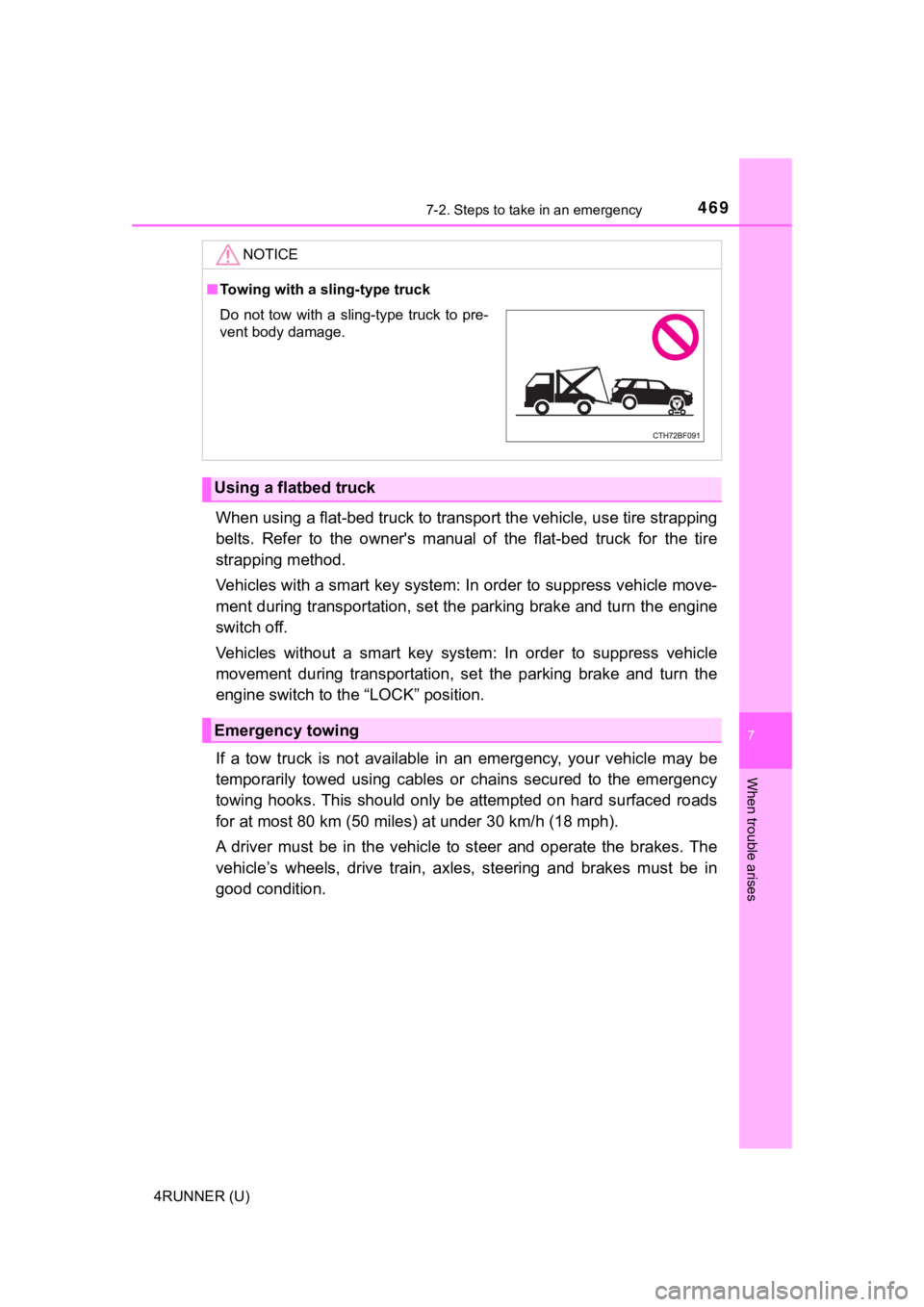
■ Towing with a sling-type truck
Using a flatbed truck
Emergency towing
Do not tow with a sling-type truck to pre-
vent body damage.
Page 470 of 592
4707-2. Steps to take in an emergency
4RUNNER (U)
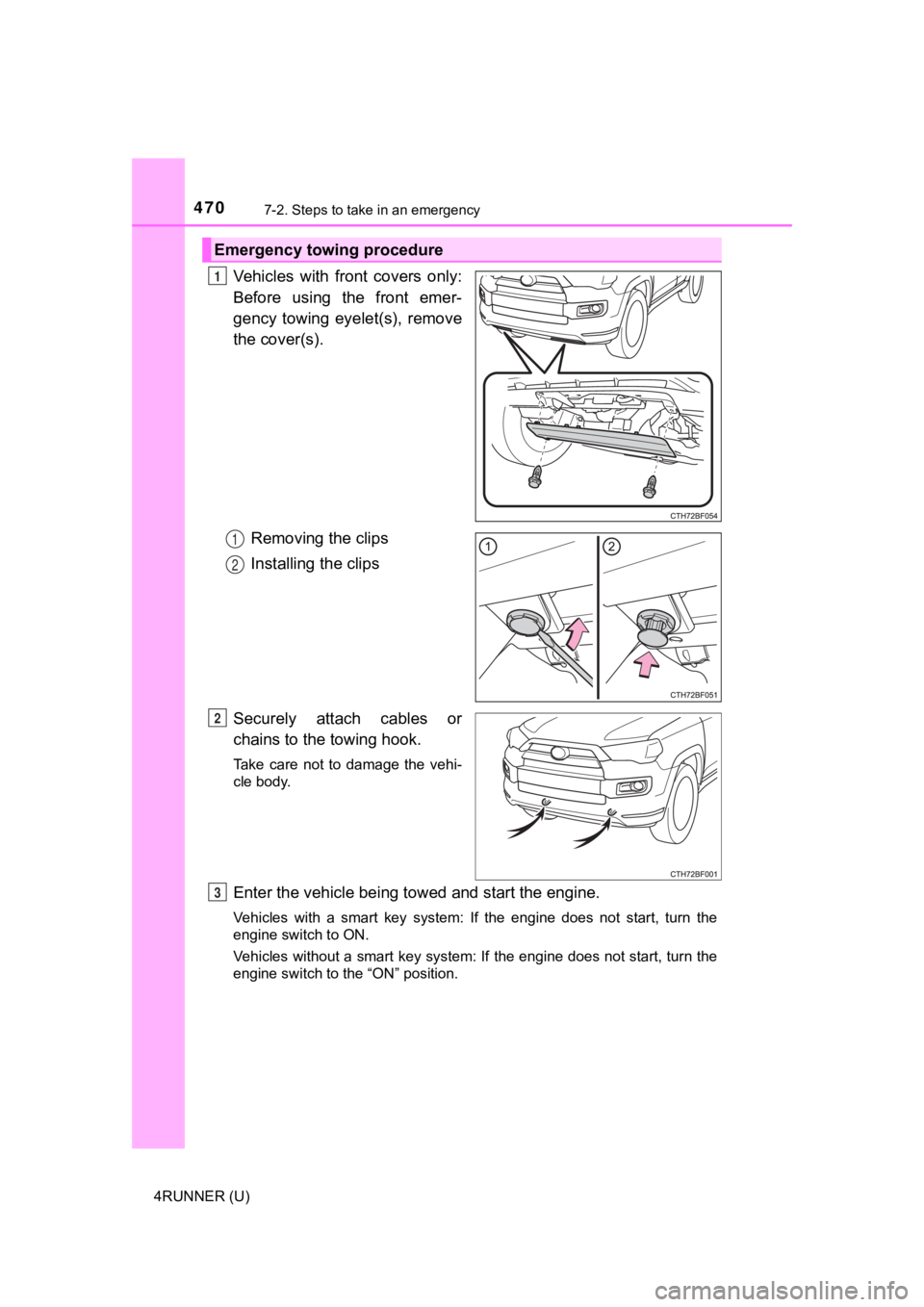
Vehicles with front covers only:
Before using the front emer-
gency towing eyelet(s), remove
the cover(s).Removing the clips
Installing the clips
Securely attach cables or
chains to the towing hook.
Take care not to damage the vehi-
cle body.
Enter the vehicle being towed and start the engine.
Vehicles with a smart key system: If the engine does not start, turn the
engine switch to ON.
Vehicles without a smart key system: If the engine does not sta rt, turn the
engine switch to the “ON” position.
Emergency towing procedure
1
1
2
2
3
Page 471 of 592
4717-2. Steps to take in an emergency
7
When trouble arises
4RUNNER (U)
Part-time 4WD models:
Ty p e A
Shift the front-wheel drive control lever to H2.
Ty p e B
Push the “UNLOCK” button and turn the front-wheel drive control
switch to H2.
Full-time 4WD models: Push the “UNLOCK” button and turn the
four-wheel drive control switch to H4F. (The center differentia l is
unlocked.)
Shift the shift lever to N and release the parking brake.
When the shift lever cannot be shifted: P. 2 2 1
■While towing
If the engine is not running, the power assist for the brakes a nd steering will
not function, making steering and braking more difficult.
4
5
Page 501 of 592
5017-2. Steps to take in an emergency
7
When trouble arises
4RUNNER (U)
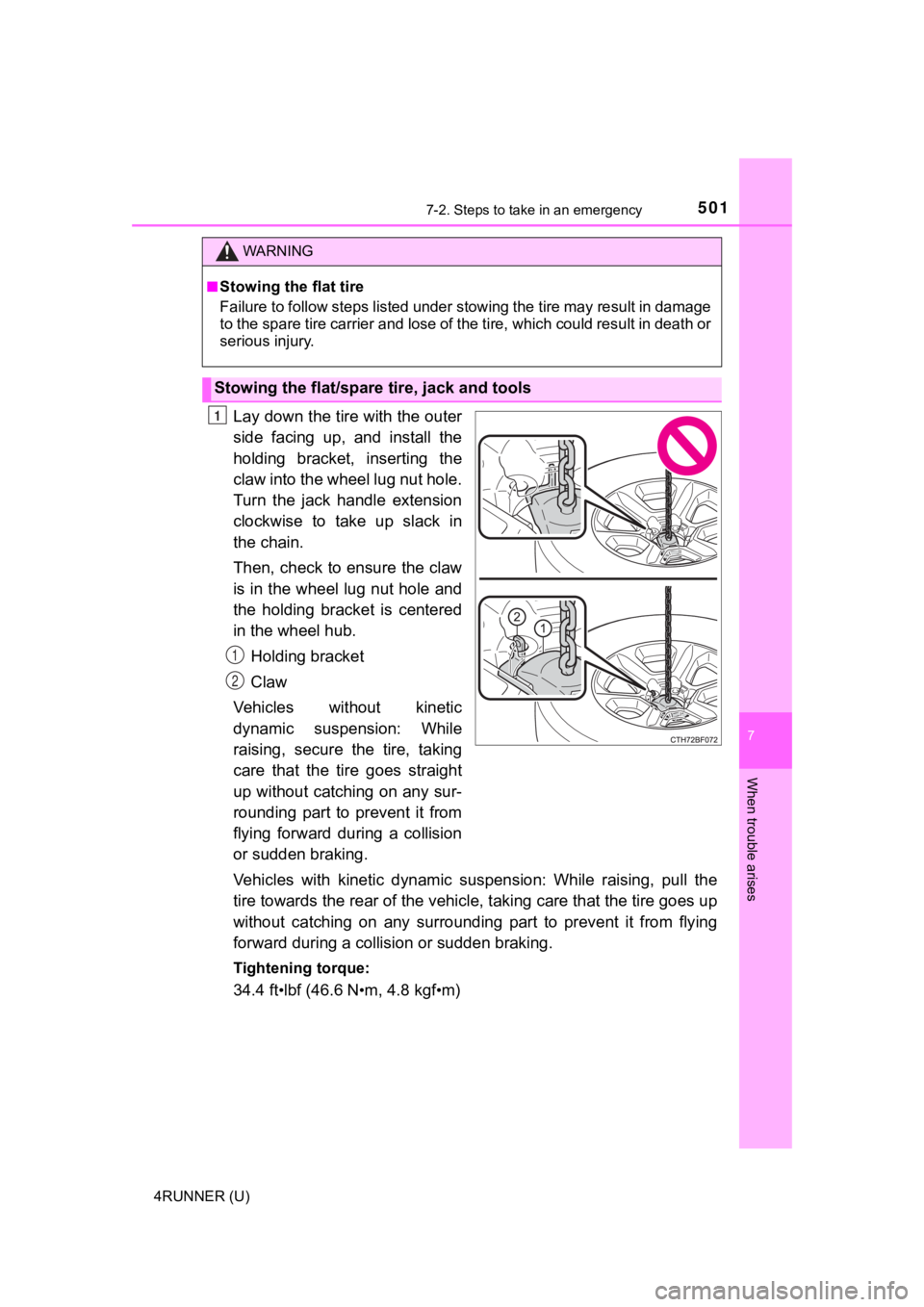
Lay down the tire with the outer
side facing up, and install the
holding bracket, inserting the
claw into the wheel lug nut hole.
Turn the jack handle extension
clockwise to take up slack in
the chain.
Then, check to ensure the claw
is in the wheel lug nut hole and
the holding bracket is centered
in the wheel hub.
Holding bracket
Claw
Vehicles wit hout kinetic
dynamic suspension: While
raising, secure the tire, taking
care that the tire goes straight
up without catching on any sur-
rounding part to prevent it from
flying forward during a collision
or sudden braking.
Vehicles with kinetic dynamic su spension: While raising, pull the
tire towards the rear of the vehi cle, taking care that the tire goes up
without catching on any surrounding part to prevent it from fly ing
forward during a collis ion or sudden braking.
Tightening torque:
34.4 ft•lbf (46.6 N•m, 4.8 kgf•m)
WARNING
■Stowing the flat tire
Failure to follow steps listed under stowing the tire may resul t in damage
to the spare tire carrier and lose of the tire, which could res ult in death or
serious injury.
Stowing the flat/spare tire, jack and tools
1
1
2
Page 503 of 592
5037-2. Steps to take in an emergency
7
When trouble arises
4RUNNER (U)
NOTICE
■Do not drive the vehicle with a flat tire
Do not continue driving with a flat tire.
Driving even a short distance with a flat tire can damage the tire and the
wheel beyond repair.
■When stowing the flat tire
Ensure that there is no object c aught between the tire and the vehicle
underbody.
■When replacing the tires
●When removing or fitting the wheels, tires or the tire pressure warning
valve and transmitter, contact your Toyota dealer as the tire p ressure
warning valve and transmitter may be damaged if not handled cor -
rectly.
●Replace the grommets for the tire pressure warning valves and t rans-
mitters as well.
■To avoid damage to the tire pressure warning valves and transmi t-
ters
When a tire is repaired with liqui d sealants, the tire pressure warning
valve and transmitter may not operate properly. If a liquid sea lant is
used, contact your Toyota dealer or other qualified service shop as soon
as possible. Make sure to replac e the tire pressure warning valve and
transmitter when replacing the tire. ( P. 4 2 5 )