wheel TOYOTA 4RUNNER 2022 Owners Manual
[x] Cancel search | Manufacturer: TOYOTA, Model Year: 2022, Model line: 4RUNNER, Model: TOYOTA 4RUNNER 2022Pages: 616, PDF Size: 12.01 MB
Page 476 of 616

4767-1. Essential information
4RUNNER (U)
WARNING
■If the engine has to be turned off while driving
● Power assist for the brakes and steering wheel will be lost, making the
brake pedal harder to depress and the steering wheel heavier to turn.
Decelerate as much as possible before turning off the engine.
● Vehicles without a smart key system:
Never attempt to remove the key, as doing so will lock the stee ring wheel.
Page 478 of 616
478
4RUNNER (U)
7-2. Steps to take in an emergency
If your vehicle needs to be towed
If towing is necessary, we recommend having your vehicle
towed by your Toyota dealer or commercial towing service,
using a wheel-lift type t ruck or flatbed truck.
Use a safety chain system for all towing, and abide by all stat e/
provincial and local laws.
WARNING
Observe the following precautions.
Failure to do so may result in death or serious injury.
■ When towing the vehicle
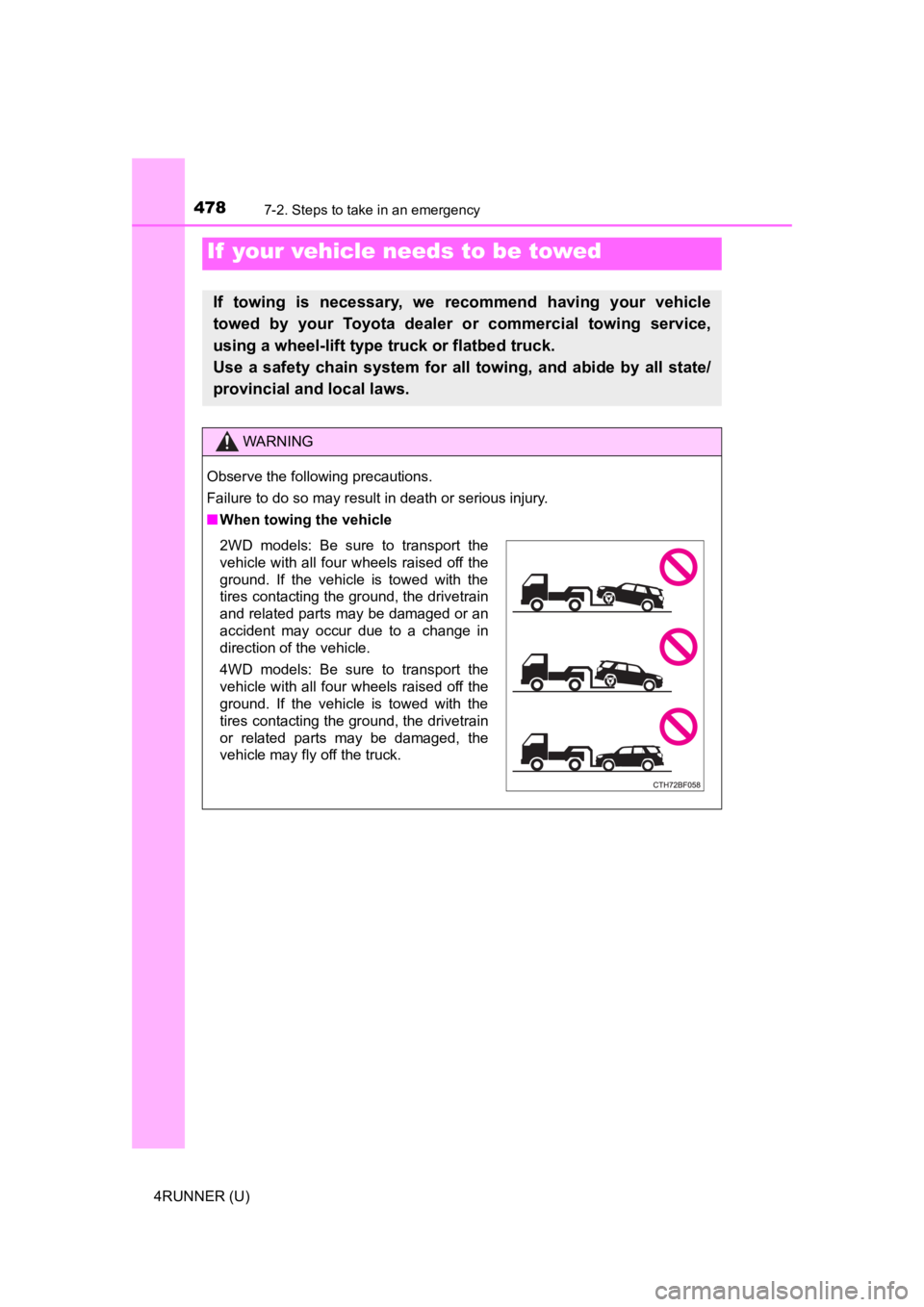
2WD models: Be sure to transport the
vehicle with all four wheels raised off the
ground. If the vehicle is towed with the
tires contacting the ground, the drivetrain
and related parts may be damaged or an
accident may occur due to a change in
direction of the vehicle.
4WD models: Be sure to transport the
vehicle with all four wheels raised off the
ground. If the vehicle is towed with the
tires contacting the ground, the drivetrain
or related parts may be damaged, the
vehicle may fly off the truck.
Page 479 of 616
4797-2. Steps to take in an emergency
7
When trouble arises
4RUNNER (U)
WARNING
■While towing
● When towing using cables or chains, avoid sudden starts, etc. w hich place
excessive stress on the towing eyelets, cables or chains. The t owing eye-
lets, cables or chains may become damaged, broken debris may hit peo-
ple, and cause serious damage.
● Vehicles without a smart key system: Do not turn the engine swi tch to the
“LOCK” position.
There is a possibility that the steering wheel is locked and ca nnot be oper-
ated.
NOTICE
■ To prevent damage to the vehicle when towing using a wheel-lift type
truck
● Vehicles with a smart key system: Do not tow the vehicle from the rear
when the engine switch is off.
● Vehicles without a smart key system: Do not tow the vehicle from the rear
when the engine switch is in the “LOCK” position or the key is removed.
The steering lock mechanism is not strong enough to hold the front wheels
straight.
● When raising the vehicle, ensure adequate ground clearance for towing at
the opposite end of the raised vehicle. Without adequate clearance, the
vehicle could be damaged while being towed.
■ To prevent damage to the vehicle when towing with a sling-type truck
Do not tow with a sling-type truck, either from the front or re a r.
■ To prevent damage to the vehicle during emergency towing
Do not secure cables or chains to the suspension components.
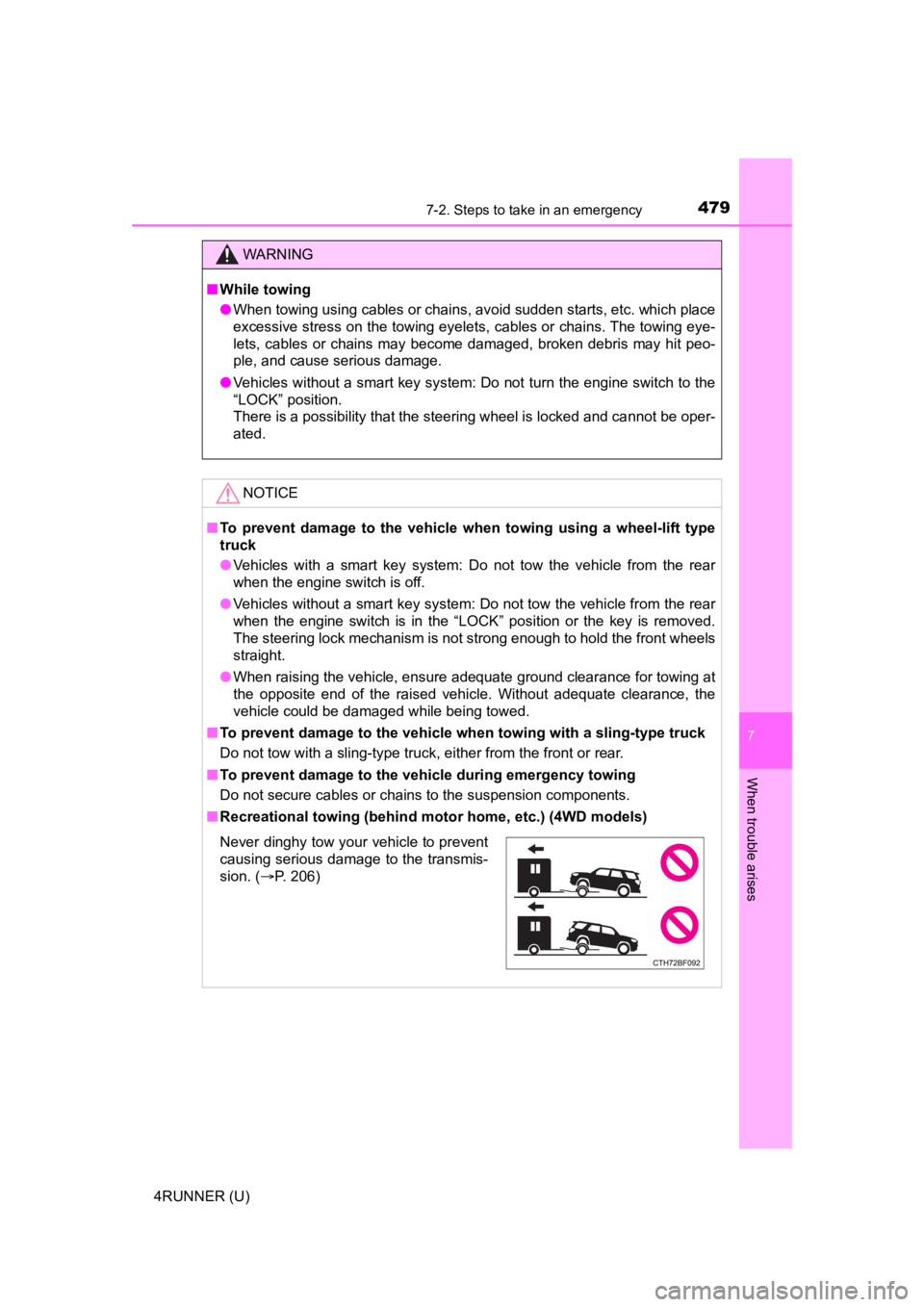
■ Recreational towing (behind motor home, etc.) (4WD models)
Never dinghy tow your vehicle to prevent
causing serious damage to the transmis-
sion. ( P. 206)
Page 480 of 616
4807-2. Steps to take in an emergency
4RUNNER (U)
The following may indicate a problem with your transmission. Contact
your Toyota dealer or commercial towing service before towing.
● The engine is running but t he vehicle does not move.
● The vehicle makes an abnormal sound.
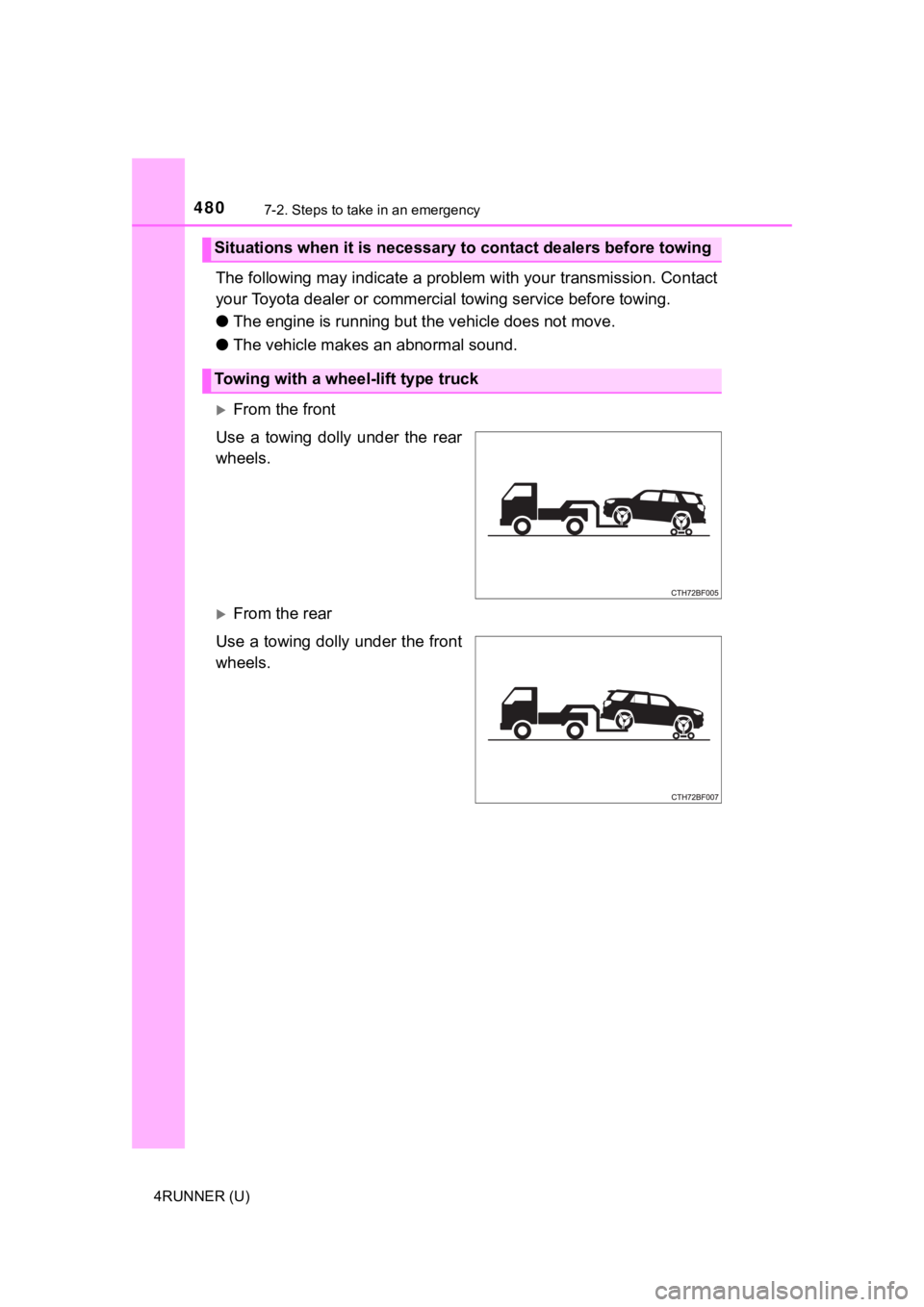
From the front
Use a towing dolly under the rear
wheels.
From the rear
Use a towing dolly under the front
wheels.
Situations when it is necessary to contact dealers before towing
Towing with a wheel-lift type truck
Page 481 of 616
4817-2. Steps to take in an emergency
7
When trouble arises
4RUNNER (U)
When using a flat-bed truck to transport the vehicle, use tire strapping
belts. Refer to the owner's manual of the flat-bed truck for the tire
strapping method.
Vehicles with a smart key system: In order to suppress vehicle move-
ment during transportation, set the parking brake and turn the engine
switch off.
Vehicles without a smart key system: In order to suppress vehic le
movement during transportation, set the parking brake and turn the
engine switch to the “LOCK” position.
If a tow truck is not available in an emergency, your vehicle m ay be
temporarily towed using cables or chains secured to the emergen cy
towing hooks. This should only be attempted on hard surfaced roads
for at most 80 km (50 miles) at under 30 km/h (18 mph).
A driver must be in the vehicle to steer and operate the brakes . The
vehicle’s wheels, drive train, axles, steering and brakes must be in
good condition.
NOTICE
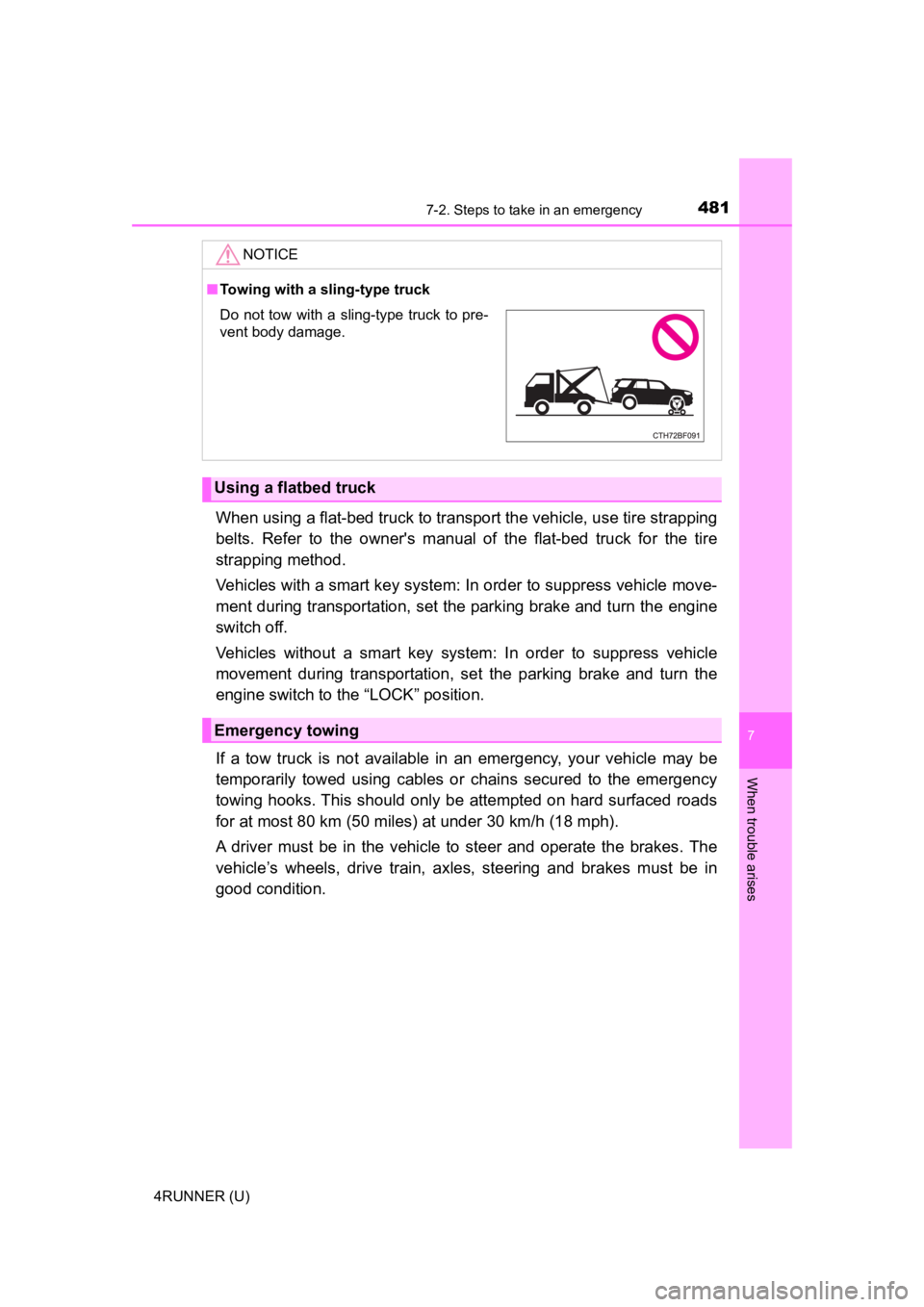
■ Towing with a sling-type truck
Using a flatbed truck
Emergency towing
Do not tow with a sling-type truck to pre-
vent body damage.
Page 483 of 616

4837-2. Steps to take in an emergency
7
When trouble arises
4RUNNER (U)
Part-time 4WD models:
Ty p e A
Shift the front-wheel drive control lever to H2.
Ty p e B
Push the “UNLOCK” button and turn the front-wheel drive control
switch to H2.
Full-time 4WD models: Push the “UNLOCK” button and turn the
four-wheel drive control switch to H4F. (The center differentia l is
unlocked.)
Shift the shift lever to N and release the parking brake.
When the shift lever cannot be shifted: P. 2 1 9
■While towing
If the engine is not running, the power assist for the brakes a nd steering will
not function, making steering and braking more difficult.
4
5
Page 488 of 616
4887-2. Steps to take in an emergency
4RUNNER (U)
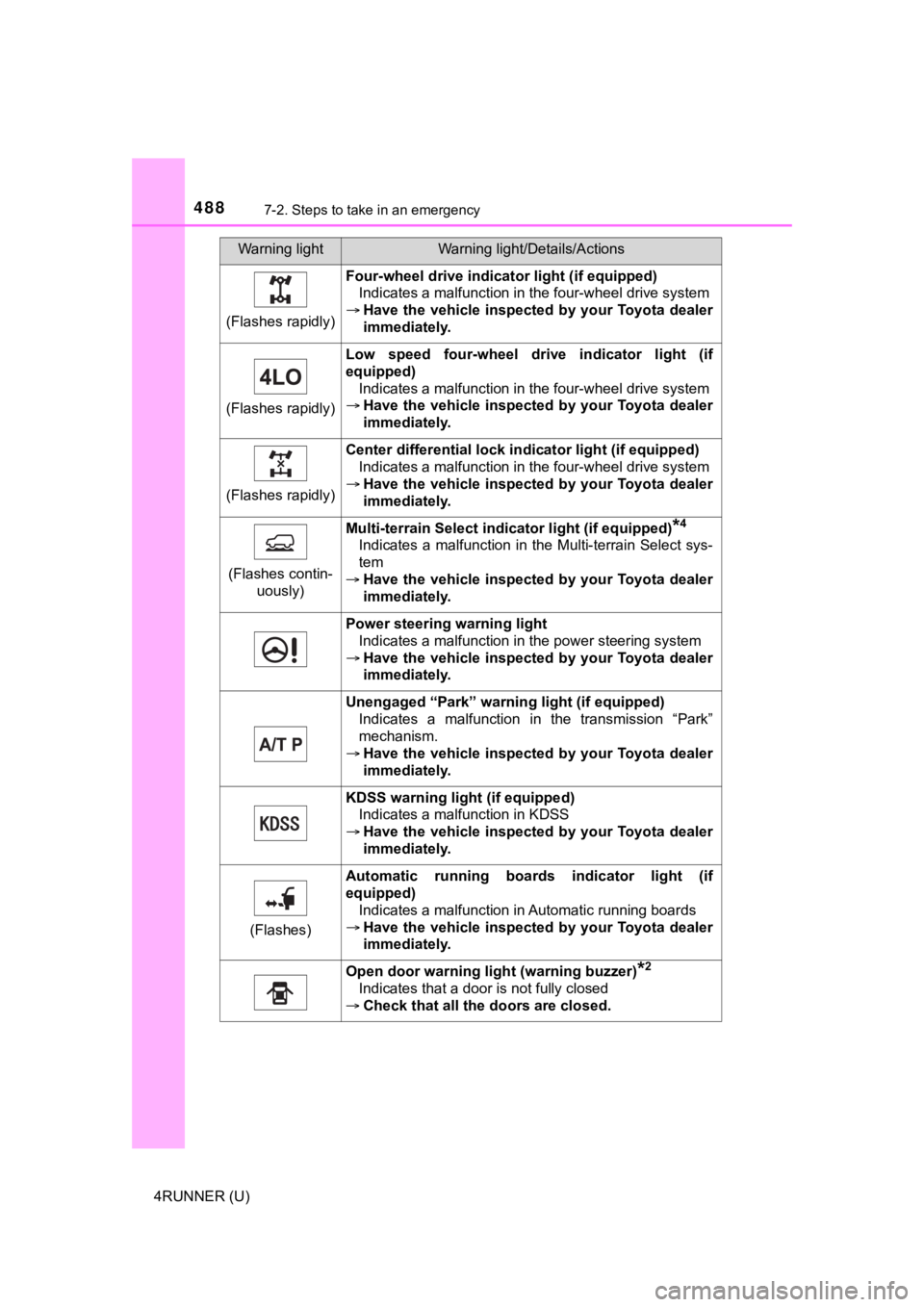
(Flashes rapidly)
Four-wheel drive indicator light (if equipped)
Indicates a malfunction in the four-wheel drive system
Have the vehicle inspected by your Toyota dealer
immediately.
(Flashes rapidly)
Low speed four-wheel dri ve indicator light (if
equipped) Indicates a malfunction in the four-wheel drive system
Have the vehicle inspected by your Toyota dealer
immediately.
(Flashes rapidly)
Center differential lock indicator light (if equipped)
Indicates a malfunction in the four-wheel drive system
Have the vehicle inspected by your Toyota dealer
immediately.
(Flashes contin-
uously)
Multi-terrain Select ind icator light (if equipped)*4
Indicates a malfunction in the Multi-terrain Select sys-
tem
Have the vehicle inspected by your Toyota dealer
immediately.
Power steering warning light
Indicates a malfunction in the power steering system
Have the vehicle inspected by your Toyota dealer
immediately.
Unengaged “Park” warning light (if equipped)
Indicates a malfunction in the transmission “Park”
mechanism.
Have the vehicle inspected by your Toyota dealer
immediately.
KDSS warning light (if equipped)
Indicates a malfunction in KDSS
Have the vehicle inspected by your Toyota dealer
immediately.
(Flashes)
Automatic running boards indicator light (if
equipped)
Indicates a malfunction in Automatic running boards
Have the vehicle inspected by your Toyota dealer
immediately.
Open door warning light (warning buzzer)*2
Indicates that a door is not fully closed
Check that all the doors are closed.
Warning lightWarning light/Details/Actions
Page 494 of 616

4947-2. Steps to take in an emergency
4RUNNER (U)■
If the tire pressure warning system is not functioning
The tire pressure warning syst
em will be disabled in the follow ing condi-
tions:
(When the condition becomes normal, the system will work properly.)
●If tires not equipped with tire pressure warning valves and tra nsmitters
are used
●If the ID code on the tire pressure warning valves and transmit ters is not
registered in the tire pr essure warning computer
●If the tire inflation pressure is 73 psi (500 kPa, 5.1 kgf/cm2 or bar) or
higher
The tire pressure warning system may be disabled in the followi ng condi-
tions:
(When the condition becomes normal, the system will work properly.)
●If electronic devices or facilitie s using similar radio wave frequencies are
nearby
●If a radio set at a similar frequency is in use in the vehicle
●If a window tint that affects the radio wave signals is installed
●If there is a lot of snow or ice on the vehicle, particularly around the
wheels or wheel housings
●If non-genuine Toyota wheels are used (Even if you use Toyota wheels,
the tire pressure warning system may not work properly with som e types
of tires.)
●If tire chains are used
●Vehicles with P245/60R20 tires: If the spare tire is in a locat ion subject
to poor radio wave signal reception
●Vehicles with P245/60R20 tires : If a large metallic object whic h can
interfere with signal reception is put in the luggage compartme nt
■If the tire pressure warning light frequently comes on after bl inking
for 1 minute
If the tire pressure warning light frequently comes on after bl inking for 1
minute when the engine switch is turned on, have it checked by your
Toyota dealer.
■ Customization that can be configured at Toyota dealer
The vehicle speed linked seat belt reminder buzzer can be disab led.
(Customizable features P. 557) However, Toyota recommends that the seat
belt reminder buzzer be operational to alert the driver and fro nt passenger
when seat belts are not fastened.
Page 495 of 616
4957-2. Steps to take in an emergency
7
When trouble arises
4RUNNER (U)
WARNING
■If the tire pressure warning light comes on
Be sure to observe the following precautions. Failure to do so could
cause a loss of vehicle control and result in death or serious injury.
●Stop your vehicle in a safe place as soon as possible. Adjust the tire
inflation pressure immediately.
●If the tire pressure warning light comes on even after tire inf lation pres-
sure adjustment, it is probable that you have a flat tire. Chec k the tires.
If a tire is flat, change it with the spare tire and have the flat tire
repaired by the nearest Toyota dealer.
●Avoid abrupt maneuvering and braking. If the vehicle tires dete riorate,
you could lose control of the steering wheel or the brakes.
■If a blowout or sudden air leakage should occur
The tire pressure warning system may not activate immediately.
■Maintenance of the tires
Each tire, including the spare (if provided), should be checked monthly
when cold and inflated to the inflation pressure recommended by the
vehicle manufacturer on the vehicle placard or tire inflation p ressure
label (tire and load information label). (If your vehicle has t ires of a dif-
ferent size than the size indicated on the vehicle placard or t ire inflation
pressure label [tire and load information label], you should de termine
the proper tire inflation p ressure for those tires.)
As an added safety feature, your vehicle has been equipped with a tire
pressure monitoring system (TPMS -tire pressure warning system) that
illuminates a low tire pressure telltale (tire pressure warning light) when
one or more of your tires is significantly under-inflated. Acco rdingly,
when the low tire pressure telltale (tire pressure warning ligh t) illumi-
nates, you should stop and check your tires as soon as possible , and
inflate them to the proper pressure. Driving on a significantly under-
inflated tire causes the tire to overheat and can lead to tire failure.
Under-inflation also reduces fuel efficiency and tire tread lif e, and may
affect the vehicle’s handling and stopping ability.
Please note that the TPMS (tire pressure warning system) is not a sub-
stitute for proper tire maintenance, and it is the driver’s res ponsibility to
maintain correct tire pressure, even if under-inflation has not reached
the level to trigger illumination of the TPMS low tire pressure telltale (tire pressure warning light).
Page 496 of 616

4967-2. Steps to take in an emergency
4RUNNER (U)
WARNING
Your vehicle has also been equipped with a TPMS (tire pressure warn-
ing system) malfunction indicato r to indicate when the system is not
operating properly. The TPMS (tire pressure warning system) mal func-
tion indicator is combined with the low tire pressure telltale (tire pressure
warning light). When the system detects a malfunction, the tell tale will
flash for approximately one minute and then remain continuously illumi-
nated. This sequence will continue upon subsequent vehicle star t-ups
as long as the malfunction exists . When the malfunction indicator is illu-
minated, the system may not be able to detect or signal low tir e pres-
sure as intended.
TPMS (tire pressure warning system) malfunctions may occur for a vari-
ety of reasons, including the installation of replacement or alternate tires
or wheels on the vehicle that prevent the TPMS (tire pressure w arning
system) from functioning properly. Always check the TPMS (tire pres-
sure warning system) malfunction telltale after replacing one or more
tires or wheels on your vehicle to ensure that the replacement or alter-
nate tires and wheels allow the TPMS (tire pressure warning system) to
continue to function properly.
NOTICE
■To ensure the tire pressure warning system operates properly
Do not install tires with differ ent specifications or makers, a s the tire
pressure warning system may not operate properly.