wheel TOYOTA 4RUNNER 2023 Owners Manual
[x] Cancel search | Manufacturer: TOYOTA, Model Year: 2023, Model line: 4RUNNER, Model: TOYOTA 4RUNNER 2023Pages: 608, PDF Size: 11.8 MB
Page 504 of 608

5047-2. Steps to take in an emergency
4RUNNER (U)
WARNING
■Replacing a flat tire
●Observe the following precautions.
Failure to do so may result in serious injury:
• Lower the spare tire completely to the ground before removing it
from under the vehicle.
• Do not try to remove the wheel ornament by hand. Take due care in
handling the ornament to avoi d unexpected personal injury.
• Do not attach a heavily damaged wheel ornament, as it may fly off
the wheel while the vehicle is moving.
• Do not touch the disc wheels or the area around the brakes imm edi-
ately after the vehicle has been driven.
After the vehicle has been driven the disc wheels and the area
around the brakes will be extremely hot. Touching these areas w ith
hands, feet or other body parts while changing a tire, etc. may result
in burns.
●Failure to follow these precautions could cause the wheel nuts to
loosen and the t ire to fall off, resulting in death or serious injury.
• Have the wheel nuts tightened with a torque wrench to 83 ft•lb f (112
N•m, 11.4 kgf•m) steel wheels, 7 6 ft•lbf (103 N•m, 10.5 kgf•m) alumi-
num wheels, as soon as possible after changing wheels.
• When installing a tire, only use wheel nuts that have been spe cifi-
cally designed for that wheel.
• If there are any cracks or deformations in the bolt screws, nu t
threads or bolt holes of the wheel, have the vehicle inspected by
your Toyota dealer.
• When installing the wheel nuts, be sure to install them with t he
tapered ends facing inward.
Page 505 of 608
5057-2. Steps to take in an emergency
7
When trouble arises
4RUNNER (U)
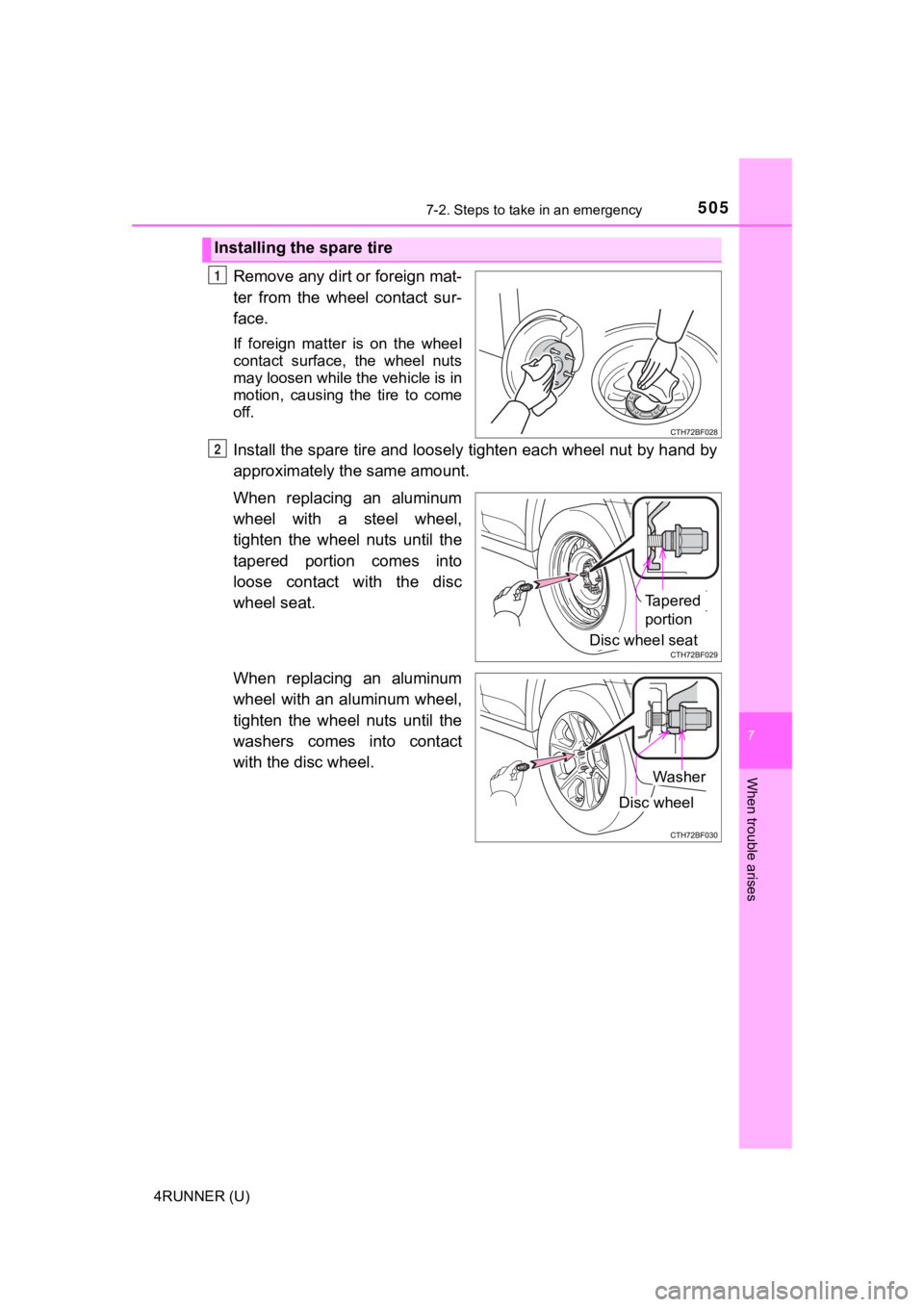
Remove any dirt or foreign mat-
ter from the wheel contact sur-
face.
If foreign matter is on the wheel
contact surface, the wheel nuts
may loosen while the vehicle is in
motion, causing the tire to come
off.
Install the spare tire and loosely tighten each wheel nut by hand by
approximately the same amount.
When replacing an aluminum
wheel with a steel wheel,
tighten the wheel nuts until the
tapered portion comes into
loose contact with the disc
wheel seat.
When replacing an aluminum
wheel with an aluminum wheel,
tighten the wheel nuts until the
washers comes into contact
with the disc wheel.
Installing the spare tire
1
2
Tapered
portion
Disc wheel seat
Washer
Disc wheel
Page 506 of 608
5067-2. Steps to take in an emergency
4RUNNER (U)
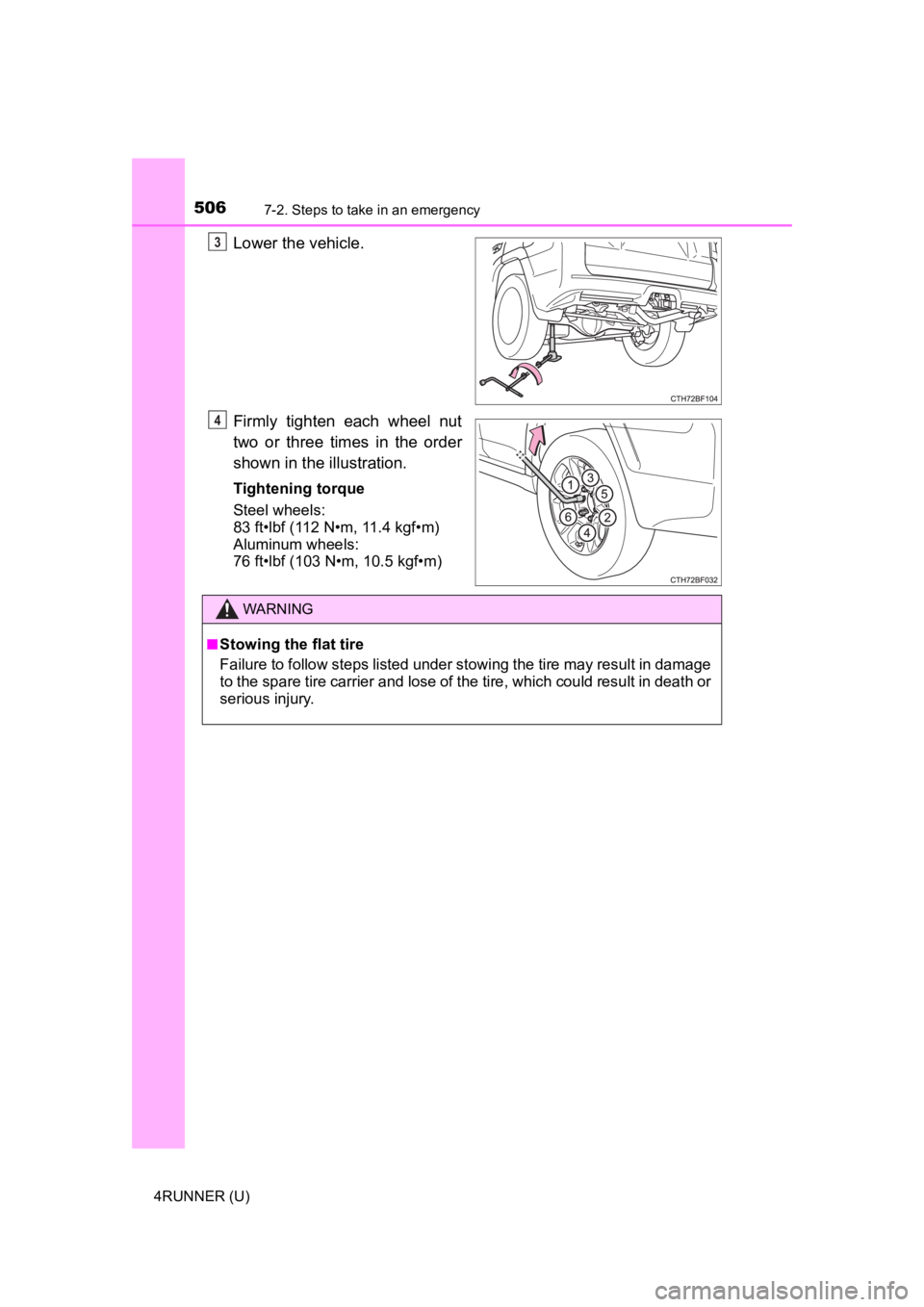
Lower the vehicle.
Firmly tighten each wheel nut
two or three times in the order
shown in the illustration.
Tightening torque
Steel wheels:
83 ft•lbf (112 N•m, 11.4 kgf•m)
Aluminum wheels:
76 ft•lbf (103 N•m, 10.5 kgf•m)
3
4
WARNING
■Stowing the flat tire
Failure to follow steps listed under stowing the tire may result in damage
to the spare tire carrier and lose of the tire, which could res ult in death or
serious injury.
Page 507 of 608
5077-2. Steps to take in an emergency
7
When trouble arises
4RUNNER (U)
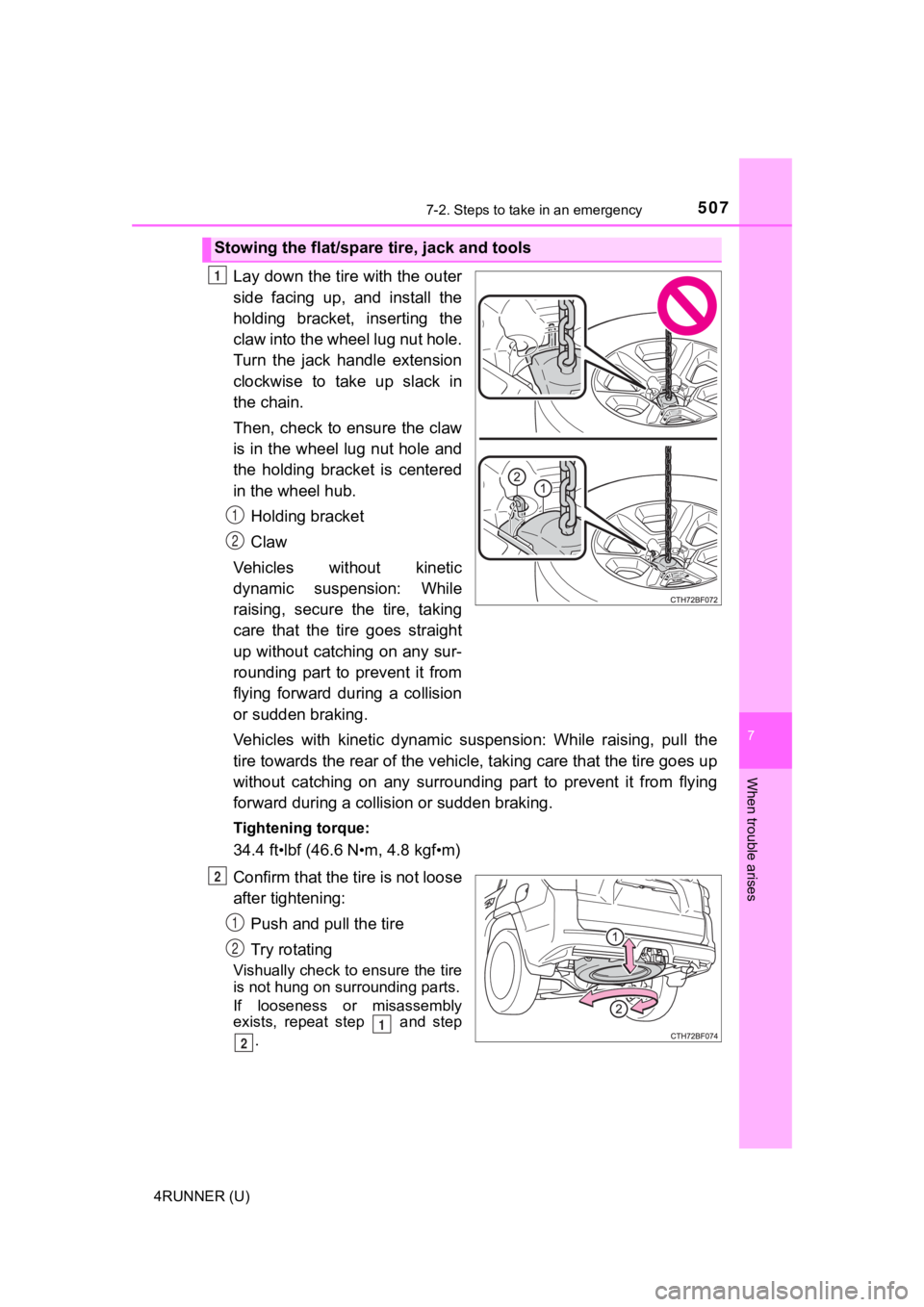
Lay down the tire with the outer
side facing up, and install the
holding bracket, inserting the
claw into the wheel lug nut hole.
Turn the jack handle extension
clockwise to take up slack in
the chain.
Then, check to ensure the claw
is in the wheel lug nut hole and
the holding bracket is centered
in the wheel hub.
Holding bracket
Claw
Vehicles wit hout kinetic
dynamic suspension: While
raising, secure the tire, taking
care that the tire goes straight
up without catching on any sur-
rounding part to prevent it from
flying forward during a collision
or sudden braking.
Vehicles with kinetic dynamic su spension: While raising, pull the
tire towards the rear of the vehi cle, taking care that the tire goes up
without catching on any surrounding part to prevent it from fly ing
forward during a collis ion or sudden braking.
Tightening torque:
34.4 ft•lbf (46.6 N•m, 4.8 kgf•m)
Confirm that the tire is not loose
after tightening: Push and pull the tire
Try rotating
Vishually check to ensure the tire
is not hung on su rrounding parts.
If looseness or misassembly
exists, repeat step and step .
Stowing the flat/spare tire, jack and tools
1
1
2
2
1
2
1
2
Page 508 of 608

5087-2. Steps to take in an emergency
4RUNNER (U)
Repeat step any time the tire is lowered or disturbed.
Stow the tools and jack securely.
■After completing the tire change
The tire pressure warni ng system must be reset. ( P. 430)
■When using the spare tire (veh icles without P245/60R20 tires)
As the spare tire is not equipped with a tire pressure warning valve and
transmitter, low inflation pressure of the spare tire will not be indicated by
the tire pressure warning system. Also, if you replace the spar e tire after
the tire pressure wa rning light comes on, the light remains on.
NOTICE
■Do not drive the vehicle with a flat tire
Do not continue driving with a flat tire.
Driving even a short distance wit h a flat tire can damage the tire and the
wheel beyond repair.
■When stowing the flat tire
Ensure that there is no object c aught between the tire and the vehicle
underbody.
■When replacing the tires
●When removing or fitting the wheels, tires or the tire pressure warning
valve and transmitter, contact your Toyota dealer as the tire p ressure
warning valve and transmitter may be damaged if not handled cor -
rectly.
●Replace the grommets for the tire pressure warning valves and trans-
mitters as well.
■To avoid damage to the tire pressure warning valves and transmi t-
ters
When a tire is repaired with liquid sealants, the tire pressure warning valve and transmitter may not operate properly. If a liquid sea lant is
used, contact your Toyota dealer or other qualified service shop as soon
as possible. Make sure to replace the tire pressure warning valve and
transmitter when replacing the tire. ( P. 430)
32
4
Page 522 of 608
5227-2. Steps to take in an emergency
4RUNNER (U)
Stop the engine. Set the parking brake and shift the shift lever to P.
Remove the mud, snow or sand from around the stuck tire.
Place wood, stones or some other material under the tires to help
provide traction.
Restart the engine.
Shift the shift lever to D or R position and carefully apply th e accel-
erator to free the vehicle.
Turn off TRAC and VSC if these functions are hampering your attempts to
free the vehicle. ( P. 324)
If the vehicle becomes stuck
Carry out the following procedures if the tires spin or the vehicle
becomes stuck in mud, dirt or snow:
WARNING
■When attempting to f ree a stuck vehicle
If you choose to push the vehicle back and forth to free it, make sure the
surrounding area is clear to avoid striking other vehicles, obj ects or people.
The vehicle may also lunge forward or lunge back suddenly as it becomes
free. Use extreme caution.
■ When shifting the shift lever
Be careful not to shift the shift lever with the accelerator pedal depressed.
This may lead to unexpected rapid acceleration of the vehicle t hat may
cause an accident resulting in death or serious injury.
NOTICE
■ To avoid damaging the transmission and other components
● Avoid spinning the wheels and depressing the accelerator pedal more
than necessary.
● If the vehicle remains stuck even after these procedures are pe rformed,
the vehicle may require towing to be freed.
● When a warning message for the automatic transmission fluid tem perature
is displayed while attempting to free a stuck vehicle, immediat ely remove
your foot from the accelerator pedal and wait until the warning message
disappears. Otherwise, the transmission may become damaged.
(
P. 488)
1
2
3
4
5
Page 524 of 608
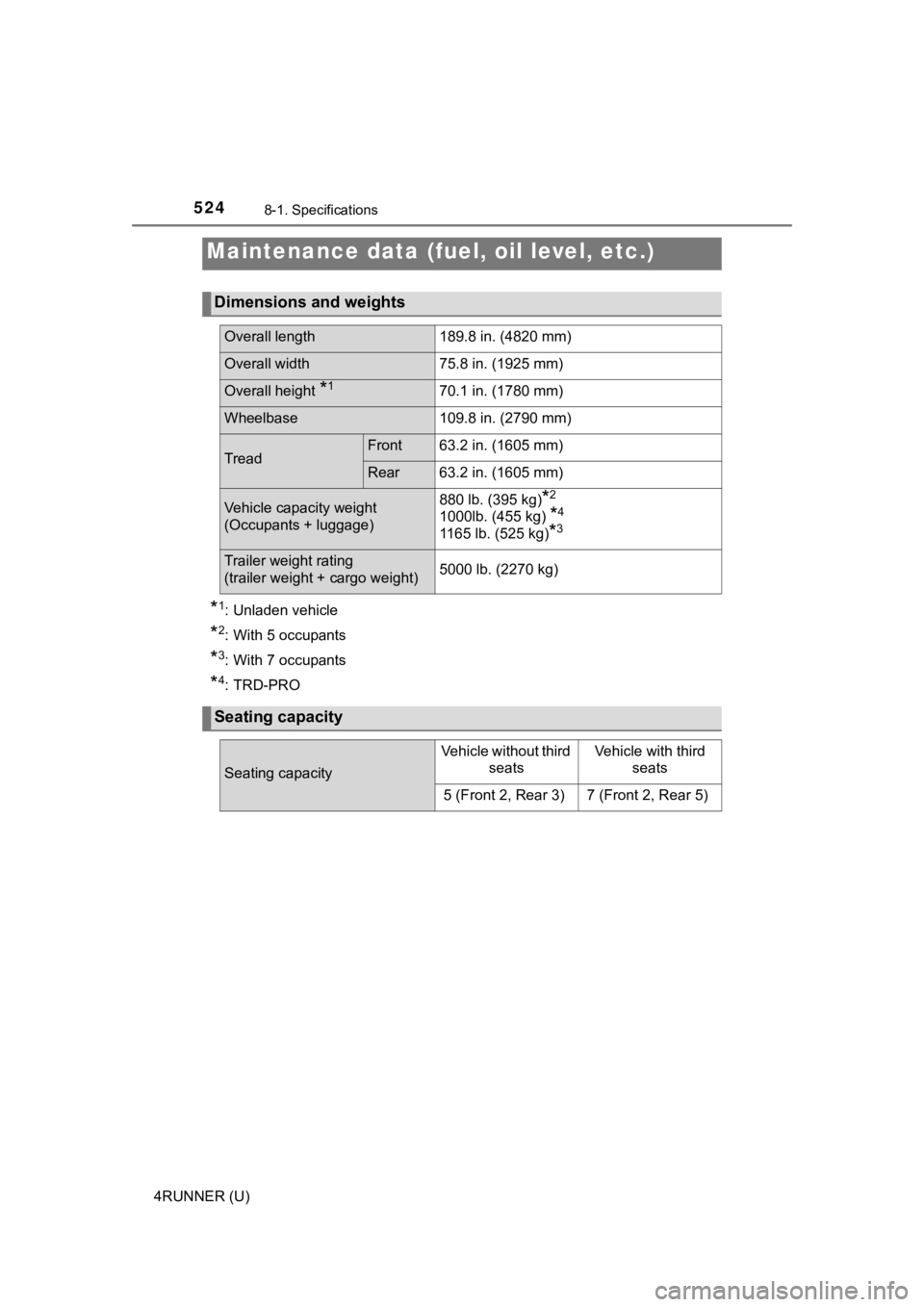
524
4RUNNER (U)
8-1. Specifications
*1: Unladen vehicle
*2: With 5 occupants
*3: With 7 occupants
*4: TRD-PRO
Maintenance data (fuel, oil level, etc.)
Dimensions and weights
Overall length189.8 in. (4820 mm)
Overall width75.8 in. (1925 mm)
Overall height *170.1 in. (1780 mm)
Wheelbase109.8 in. (2790 mm)
TreadFront63.2 in. (1605 mm)
Rear63.2 in. (1605 mm)
Vehicle capacity weight
(Occupants + luggage)880 lb. (395 kg)*2
1000lb. (455 kg) *4
1165 lb. (525 kg)*3
Trailer weight rating
(trailer weight + cargo weight)5000 lb. (2270 kg)
Seating capacity
Seating capacity
Vehicle without third seatsVehicle with third seats
5 (Front 2, Rear 3) 7 (Front 2, Rear 5)
Page 532 of 608
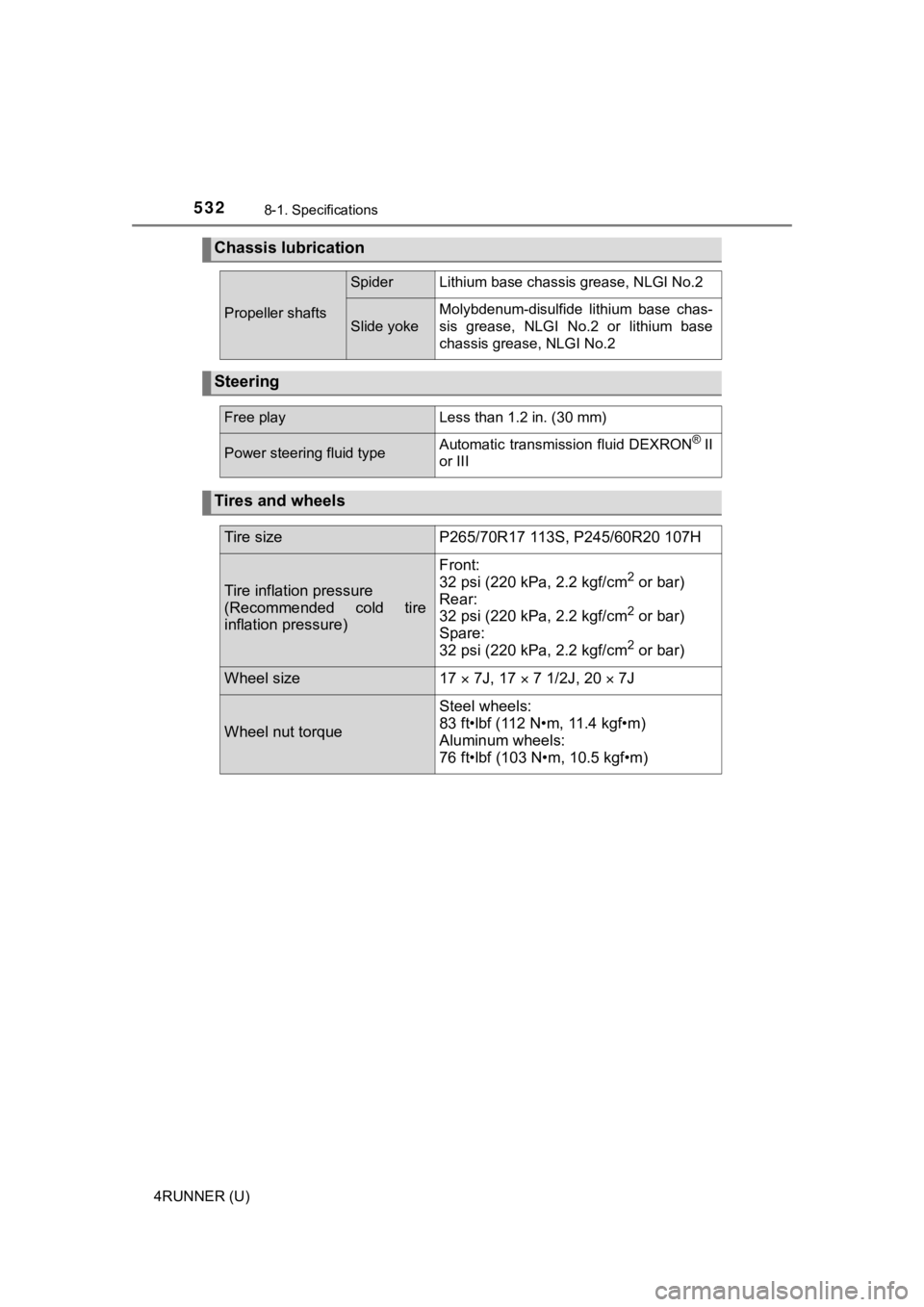
5328-1. Specifications
4RUNNER (U)
Chassis lubrication
Propeller shafts
SpiderLithium base chassis grease, NLGI No.2
Slide yoke
Molybdenum-disulfide lithium base chas-
sis grease, NLGI No.2 or lithium base
chassis grease, NLGI No.2
Steering
Free playLess than 1.2 in. (30 mm)
Power steering fluid typeAutomatic transmission fluid DEXRON® II
or III
Tires and wheels
Tire sizeP265/70R17 113S, P245/60R20 107H
Tire inflation pressure
(Recommended cold tire
inflation pressure)
Front:
32 psi (220 kPa, 2.2 kgf/cm2 or bar)
Rear:
32 psi (220 kPa, 2.2 kgf/cm
2 or bar)
Spare:
32 psi (220 kPa, 2.2 kgf/cm
2 or bar)
Wheel size17 7J, 17 7 1/2J, 20 7J
Wheel nut torque
Steel wheels:
83 ft•lbf (112 N•m, 11.4 kgf•m)
Aluminum wheels:
76 ft•lbf (103 N•m, 10.5 kgf•m)
Page 539 of 608
5398-1. Specifications
8
Vehicle specifications
4RUNNER (U)■
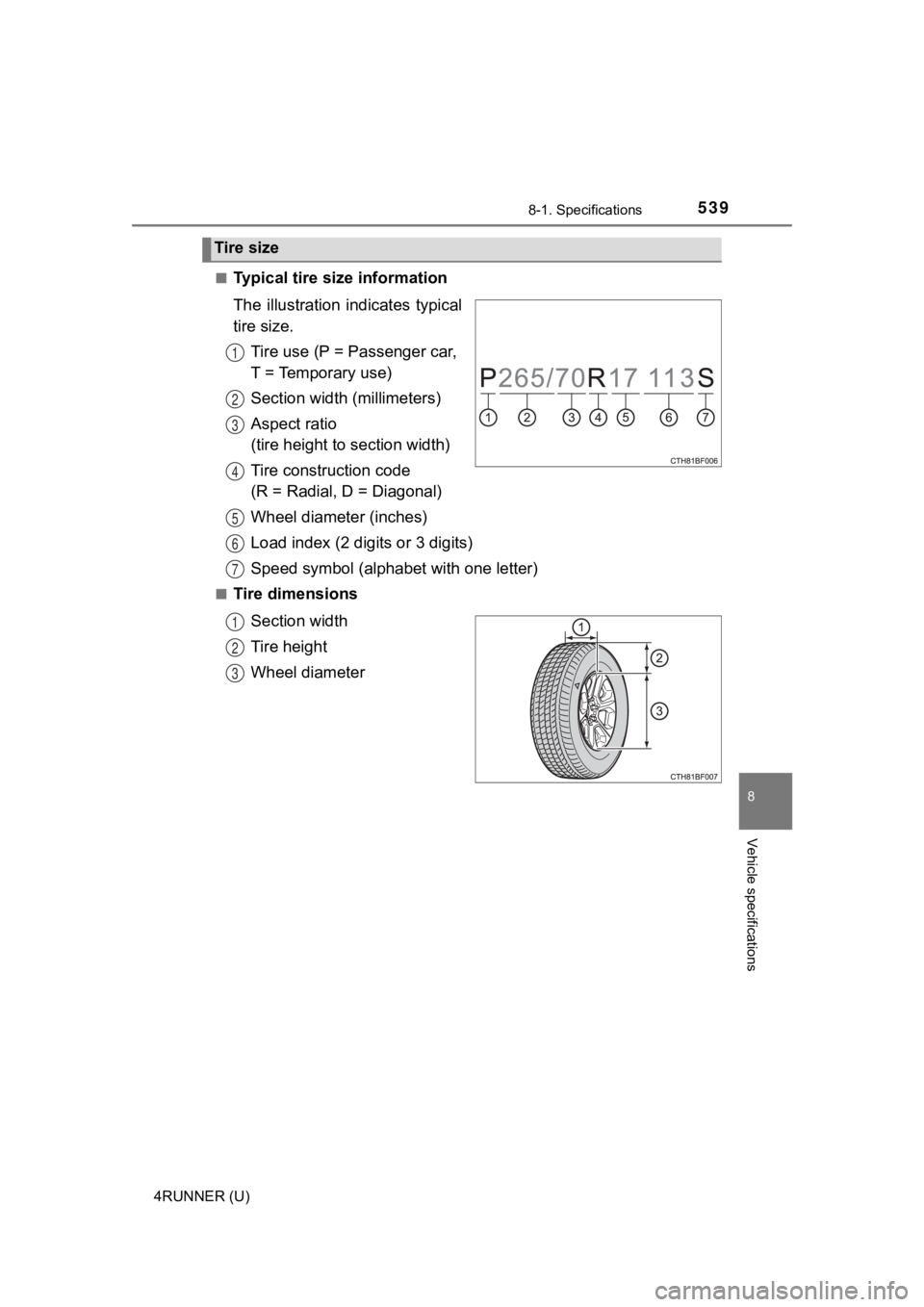
Typical tire size information
The illustration i
ndicates typical
tire size.
Tire use (P = Passenger car,
T = Temporary use)
Section widt h (millimeters)
Aspect ratio
(tire height to section width)
Tire construction code
(R = Radial, D = Diagonal)
Wheel diameter (inches)
Load index (2 digits or 3 digits)
Speed symbol (alphabet with one letter)
■Tire dimensions
Section width
Tire height
Wheel diameter
Tire size
1
2
3
4
5
6
7
1
2
3
Page 542 of 608

5428-1. Specifications
4RUNNER (U)■
Temperature A, B, C
The temperature grades are A (
the highest), B, and C, representing
the tire’s resistance to the ge neration of heat and its ability to dissi-
pate heat when tested under contr olled conditions on a specified
indoor laboratory test wheel.
Sustained high temperature can c ause the material of the tire to
degenerate and reduce tire life, and excessive temperature can lead
to sudden tire failure.
Grade C corresponds to a level of performance which all passeng er
car tires must meet under the Fe deral Motor Vehicle Safety Stan-
dard No. 109.
Grades B and A represent higher levels of performance on the labo-
ratory test wheel than the minimum required by law.
Warning: The temperature grades of a tire assume that it is pro perly
inflated and not overloaded.
Excessive speed, underinflation, or excessive loading, either sepa-
rately or in combination, can c ause heat buildup and possible t ire
failure.