engine coolant TOYOTA 86 2018 User Guide
[x] Cancel search | Manufacturer: TOYOTA, Model Year: 2018, Model line: 86, Model: TOYOTA 86 2018Pages: 532, PDF Size: 6.48 MB
Page 335 of 532
335
4-3. Do-it-yourself maintenance
4
Maintenance and care
Engine coolant
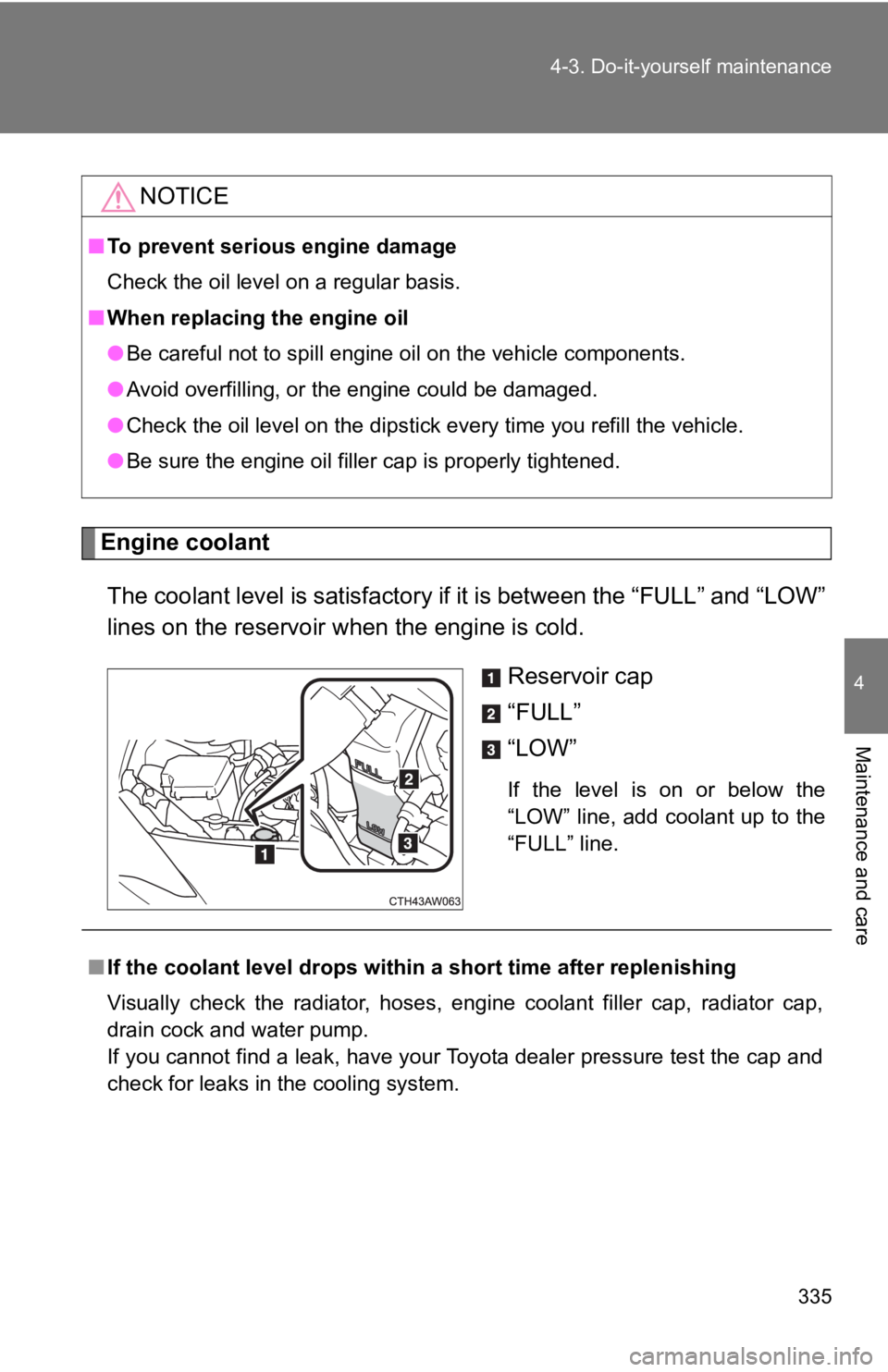
The coolant level is satisfactory if it is between the “FULL” a nd “LOW”
lines on the reservoir w hen the engine is cold.
Reservoir cap
“FULL”
“LOW”
If the level is on or below the
“LOW” line, add coolant up to the
“FULL” line.
NOTICE
■To prevent serious engine damage
Check the oil level on a regular basis.
■ When replacing the engine oil
●Be careful not to spill engine oil on the vehicle components.
● Avoid overfilling, or the engine could be damaged.
● Check the oil level on the dipstick every time you refill the v ehicle.
● Be sure the engine oil filler cap is properly tightened.
■If the coolant level drops within a short time after replenishi ng
Visually check the radiator, hoses, engine coolant filler cap, radiator cap,
drain cock and water pump.
If you cannot find a leak, have your Toyota dealer pressure test the cap and
check for leaks in the cooling system.
Page 336 of 532
336 4-3. Do-it-yourself maintenance
■Coolant selection
Only use “TOYOTA Genuine 50/50 Pre-mixed Super Long Life Coolan t
BLUE” or similar high-quality ethylene glycol-based non-silicat e, non-amine,
non-nitrite, and non-borate coolant with long-life hybrid organic acid technol-
ogy.
“TOYOTA Genuine 50/50 Pre-mixed Super Long Life Coolant BLUE” i s a
mixture of 50% coolant and 50% deionized water. (Enabled: -31 F [-35 C])
For more details about engine coolant, contact your Toyota deal er.
WARNING
■When the engine is hot
Do not remove the radiator cap.
The cooling system may be under pressure and may spray hot coolant if the
cap is removed, causing serious injuries, such as burns.
NOTICE
■When adding engine coolant
Coolant is neither plain water nor straight antifreeze. The correct mixture of
water and antifreeze must be used to provide proper lubrication , corrosion
protection and cooling. Be sure to read the antifreeze or coola nt label.
■ If you spill coolant
Be sure to wash it off with water to prevent it from damaging p arts or paint.
Page 393 of 532
5
When trouble arises
393
5-1. Essential information
If you think something is wrong
If you notice any of the following symptoms, your vehicle proba bly
needs adjustment or repair. Cont act your Toyota dealer as soon as
possible.
■ Visible symptoms
●Fluid leaks under the vehicle
(Water dripping from t he air conditioning after use is normal.)
● Flat-looking tires or uneven tire wear
● Vehicles with a monochrome multi-information display: The
engine coolant temperature gauge needle continually points
higher than normal
● Vehicles with a color multi-information display: The high
engine coolant temperature wa rning light flashes or illumi-
nates
■ Audible symptoms
●Changes in exhaust sound
● Excessive tire squeal when cornering
● Strange noises related to the suspension system
● Pinging or other noises related to the engine
■ Operational symptoms
●Engine missing, stumbling or running rough
● Appreciable loss of power
● Vehicle pulls heavily to one side when braking
● Vehicle pulls heavily to one side when driving on a level road
● Loss of brake effectiveness, s pongy feeling, pedal almost
touches the floor
Page 396 of 532
396 5-2. Steps to take in an emergency
Stop the vehicle immediately.The following warning indicates the possibility of damage to th e vehi-
cle that may lead to an acciden t. Immediately stop the vehicle in a
safe place and contact your Toyota dealer.
Warning lightWarning light/Details
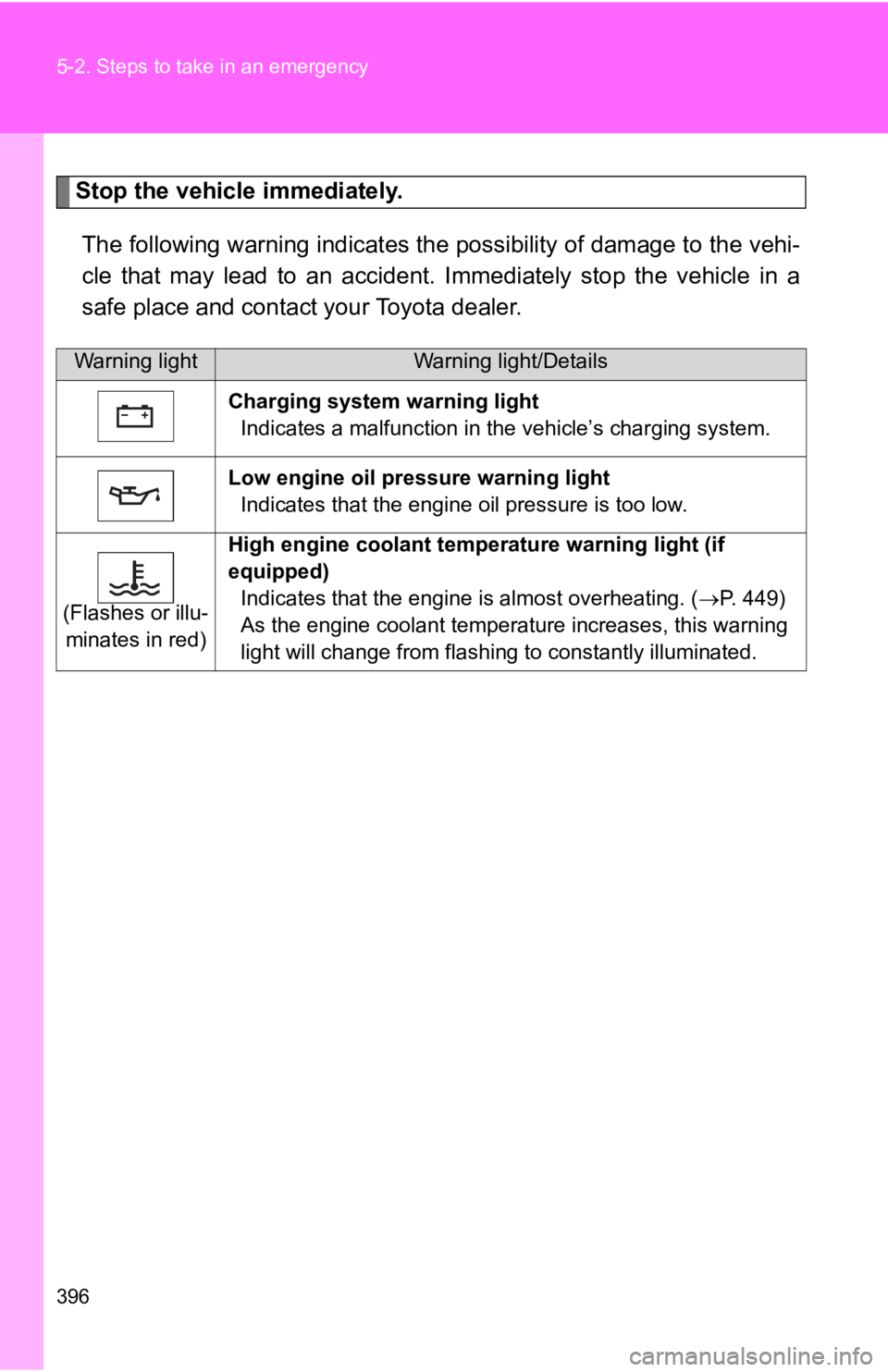
Charging system warning light Indicates a malfunction in the vehicle’s charging system.
Low engine oil pressure warning light Indicates that the engine oil pressure is too low.
(Flashes or illu- minates in red) High engine coolant temper
ature warning light (if
equipped) Indicates that the engine is almost overheating. ( P. 449)
As the engine coolant temperature increases, this warning
light will change from flashing to constantly illuminated.
Page 449 of 532
5
When trouble arises
449
5-2. Steps to take in an emergency
If your vehicle overheats
Correction proceduresStop the vehicle in a safe place and turn off the air condition -
ing system, and then stop the engine.
If you see steam:
Carefully lift the hood after the steam subsides.
If you do not see steam:
Carefully lift the hood.
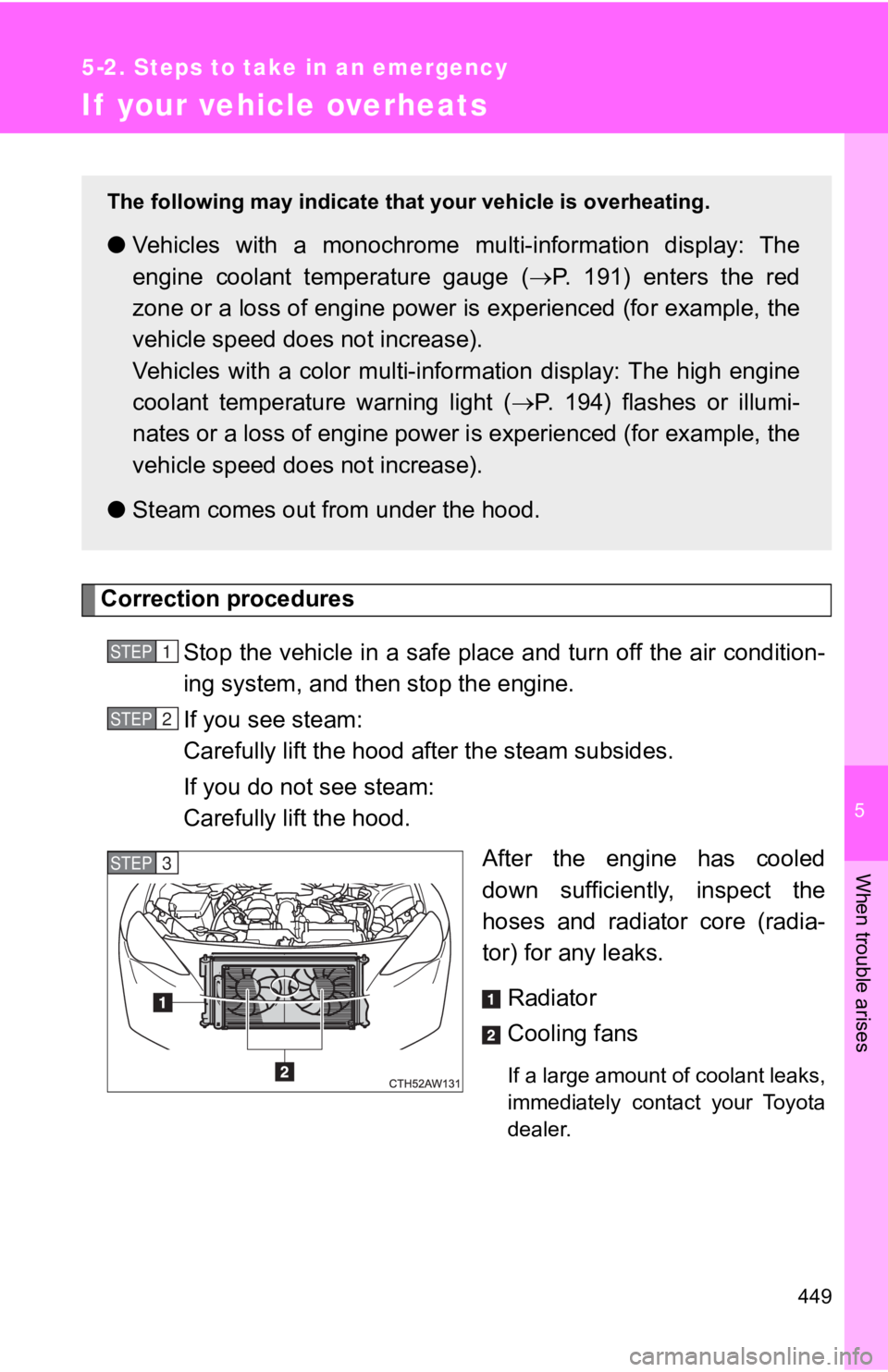
After the engine has cooled
down sufficiently, inspect the
hoses and radiator core (radia-
tor) for any leaks.
Radiator
Cooling fans
If a large amount of coolant leaks,
immediately contact your Toyota
dealer.
The following may indicate that your vehicle is overheating.
●Vehicles with a monochrome mu lti-information display: The
engine coolant temperature gauge ( P. 191) enters the red
zone or a loss of engine power is experienced (for example, the
vehicle speed does not increase).
Vehicles with a color multi-information display: The high engin e
coolant temperature warning light ( P. 194) flashes or illumi-
nates or a loss of engine power i s experienced (for example, the
vehicle speed does not increase).
● Steam comes out from under the hood.
STEP 1
STEP 2
STEP 3
Page 450 of 532
450 5-2. Steps to take in an emergency
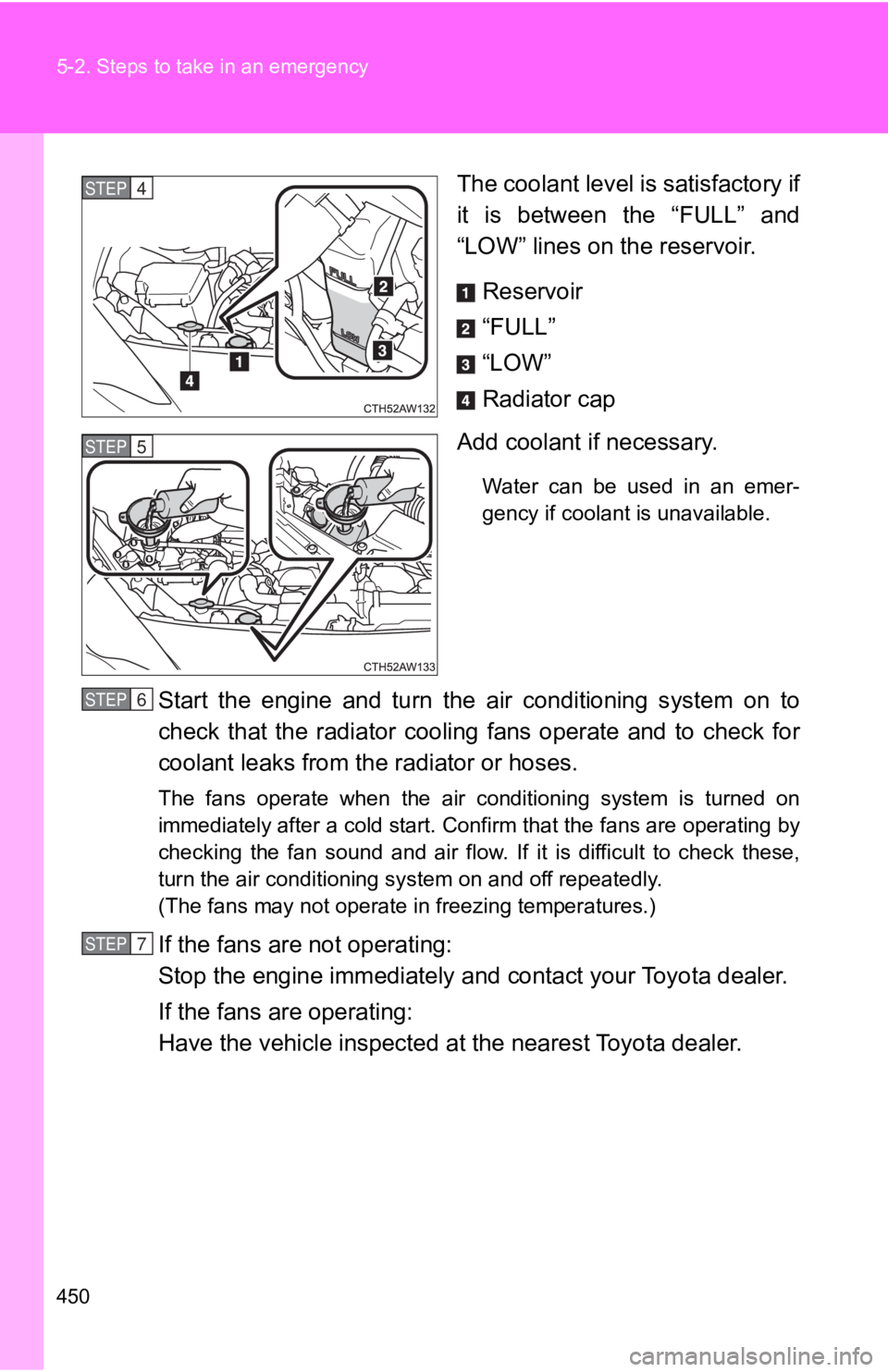
The coolant level is satisfactory if
it is between the “FULL” and
“LOW” lines on the reservoir.Reservoir
“FULL”
“LOW”
Radiator cap
Add coolant if necessary.
Water can be used in an emer-
gency if coolant is unavailable.
Start the engine and turn the air conditioning system on to
check that the radiator cooling fans operate and to check for
coolant leaks from the radiator or hoses.
The fans operate when the air conditioning system is turned on
immediately after a cold start. Confirm that the fans are operating by
checking the fan sound and air flow. If it is difficult to check these,
turn the air conditioning system on and off repeatedly.
(The fans may not operate in freezing temperatures.)
If the fans are not operating:
Stop the engine immediately and contact your Toyota dealer.
If the fans are operating:
Have the vehicle in spected at the neare st Toyota dealer.
STEP 4
STEP 5
STEP 6
STEP 7
Page 451 of 532
5
When trouble arises
451
5-2. Steps to take in an emergency
WARNING
■
To prevent an accident or injury when inspecting under the hood of
your vehicle
● If steam is seen coming from under the hood, do not open the ho od until
the steam has subsided. The engine compartment may be very hot, caus-
ing serious injuries such as burns.
● Keep hands and clothing (especially a tie, a scarf or a muffler ) away from
the fans and belts. Failure to do so may cause the hands or clothing to be
caught, resulting in serious injury.
● Do not loosen the radiator cap and the coolant reservoir cap wh ile the
engine and radiator are hot.
Serious injury, such as burns, may result from hot coolant and steam
released under pressure.
NOTICE
■ When adding engine coolant
Wait until the engine has cooled down before adding engine cool ant.
When adding coolant, do so slowly. Adding cool coolant to a hot engine too
quickly can cause damage to the engine.
■ To prevent damage t o the cooling system
Observe the following precautions:
● Avoid contaminating the coolant with foreign matter (such as sa nd or dust
etc.).
● Do not use any coolant additives.
Page 464 of 532
464 6-1. Specifications
Cooling system
Ignition system
CapacityVehicles with an automatic transmission
7.9 qt. (7.5 L, 6.6 Imp. qt.)
Vehicles with a manual transmission 7.6 qt. (7.2 L, 6.3 Imp. qt.)
Coolant type Use either of the following.
• “TOYOTA Genuine 50/50 Pre-mixed Super Long Life Coolant BLUE”
• Similar high-quality ethylene glycol-based non- silicate, non-amine, non-nitrite, and non-borate
coolant with long-life hybrid organic acid technol-
ogy
Do not use plain water alone.
Spark plug
Make
Gap DENSO ZXE27HBR8
0.031 in. (0.8 mm)
NOTICE
■
Iridium-tipped spark plugs
Use only iridium-tipped spark plugs. Do not adjust gap when tun ing engine.
Page 480 of 532

480 6-1. Specifications
Warning: The temperature grades of a tire assume that it is properly
inflated and not overloaded.
Excessive speed, underinflation, or excessive loading, either s epa-
rately or in combination, can cause heat buildup and possible t ire fail-
ure.
Glossary of tire terminology
Tire related termMeaning
Cold tire inflation
pressure Tire pressure when the vehicle has been
parked for three hours or more, or has not
been driven more than 1
mile or 1.5 km under
that condition
Maximum inflation
pressure The maximum cold inflated pressure to which a
tire may be inflated, shown on the sidewall of
the tire
Recommended
inflation pressure Cold tire inflation pressure recommended by a
manufacturer.
Accessory weight The combined weight (i
n excess of those stan-
dard items which may be replaced) of auto-
matic transmission, po wer steering, power
brakes, power windows, power seats, radio
and heater, to the exten t that these items are
available as factory-installed equipment
(whether installed or not)
Curb weight The weight of a
motor vehicle with standard
equipment, including th e maximum capacity of
fuel, oil and coolant, and if so equipped, air
conditioning and additional weight optional
engine
Maximum loaded
vehicle weight The sum of:
(a) Curb weight
(b) Accessory weight
(c) Vehicle capacity weight
(d) Production options weight
Page 522 of 532

522 Alphabetical index
Brake assist .............................. 245
Break-in tips ............................. 155
Brightness controlInstrument panel light control ................................. 192
Care Alcantara
®............................. 316
Aluminum wheels .................. 309
Exterior .................................. 308
Interior ................................... 312
Seat belts .............................. 313
Cargo capacity ......................... 256
Chains ....................................... 263
Child restraint system Booster seats,
definition ............................. 137
Booster seats, installation ........................... 141
Convertible seats, definition ............................. 137
Convertible seats,
installation ........................... 141
Front passenger occupant classification system ........... 128
Infant seats, definition ............................. 137
Infant seats,
installation ........................... 141
Installing CRS with LATCH anchors .................. 142
Installing CRS with seat belts ............................ 144
Installing CRS with
top tether straps .................. 147 Child safety
Airbag precautions ................ 120
Battery precautions ....... 342, 447
Child restraint system ........... 137
How your child should
wear the seat belt ................. 62
Installing child restraints........ 141
Power window lock switch ...... 72
Power window precautions ........................... 74
Removed key battery
precautions ......................... 365
Seat belt guide ........................ 61
Seat belt precautions .............. 64
Seat heater precautions ........ 302
Trunk precautions ................... 49
Cleaning
Alcantara
®............................. 316
Aluminum wheels .................. 309
Exterior.................................. 308
Interior ................................... 312
Seat belts .............................. 313
Clock ......................................... 298
Condenser ................................ 337
Console tray ............................. 294
Coolant
Capacity ................................ 464
Checking ............................... 335
Cooling system
Engine overheating ............... 449
Cruise control .......................... 232
Cup holders .............................. 294
Curtain shield airbags ............... 89
Customizable features ............ 487
Daytime running light system .................................... 224
Defogger Rear window ......................... 284
Side mirror ............................ 284
C
D