fuel TOYOTA 86 2018 User Guide
[x] Cancel search | Manufacturer: TOYOTA, Model Year: 2018, Model line: 86, Model: TOYOTA 86 2018Pages: 532, PDF Size: 6.48 MB
Page 77 of 532
77
1-5. Refueling
1
Before driving
WARNING
■
Refueling the vehicle
Observe the following precautions while refueling the vehicle.
Failure to do so may result in death or serious injury.
●Do not handle fuel indoors.
● After exiting the vehicle and before opening the fuel door, touch an
unpainted metal surface to discharge any static electricity. It is important to
discharge static electricity before refueling because sparks re sulting from
static electricity can cause fuel vapors to ignite while refuel ing.
● Always hold the grips on the fuel tank cap and turn it slowly t o remove it.
A whooshing sound may be heard when the fuel tank cap is loosen ed.
Wait until the sound cannot be heard before fully removing the cap.
In hot weather, pressurized fuel may spray out of the filler ne ck and cause
injury.
● Do not allow anyone that has not discharged static electricity from their
body to come close to an open fuel tank.
● Do not allow anyone to approach the area of the vehicle near th e fuel filler
pipe while refueling is in progress.
● Do not inhale vaporized fuel.
Fuel contains substances that are harmful if inhaled.
● Do not smoke while refueling the vehicle.
Doing so may cause the fuel to ignite and cause a fire.
● Do not return to the vehicle or touch any person or object that is statically
charged.
This may cause static electricity to build up, resulting in a p ossible ignition
hazard.
Page 78 of 532
78 1-5. Refueling
WARNING
■When refueling
Observe the following precautions to prevent fuel overflowing f rom the fuel
tank:
● Securely insert the fuel nozzle into the fuel filler neck
● Stop filling the tank after the fuel nozzle automatically click s off
● Do not top off the fuel tank
● Observe other precautions that are posted at the service statio n.
● Turn the cap to the right until it clicks to ensure that it is fully tightened. If
the cap is not securely tightened, fuel spillage could occur in the event of
an accident, creating a fire hazard.
■ When replacing the fuel cap
Do not use anything but a genuine Toyota fuel tank cap designed for your
vehicle. Doing so may cause a fire or other incident which may result in
death or serious injury.
NOTICE
■ Refueling
●Do not spill fuel during refueling.
Doing so may damage the vehicle, such as causing the emission c ontrol
system to operate abnormally or damaging fuel system components or the
vehicle's painted surface.
● Never add any cleaning agents to the fuel tank. The addition of a cleaning
agent may cause damage to the fuel system.
● Immediately put fuel in the tank whenever the low fuel warning light illumi-
nates. Engine misfires as a result of an empty tank could cause damage to
the engine.
Page 156 of 532
156 2-1. Driving procedures
■After the engine starts
In order to secure a rich exhaust sound when starting the vehicle and envi-
ronmental performance, air intake and exhaust sounds become lou d and
vibrations may increase for a little while after the engine starts. This is not a
malfunction.
■ Operating your vehicle in a foreign country
Comply with the relevant vehicle registration laws and confirm the availability
of the correct fuel. ( P. 461)
■ REV indicator
WARNING
■When starting the vehicle (vehicl es with an automatic transmission)
● Always keep your foot on the brake pedal while stopped with the engine
running. This prevents the vehicle from creeping.
● Firmly depress the brake pedal because engine speed may increas e
immediately after starting the engine, when the air conditionin g system is
operating, when turning the steering wheel, etc., thereby causi ng creeping
to become stronger. Apply the parking brake as necessary.
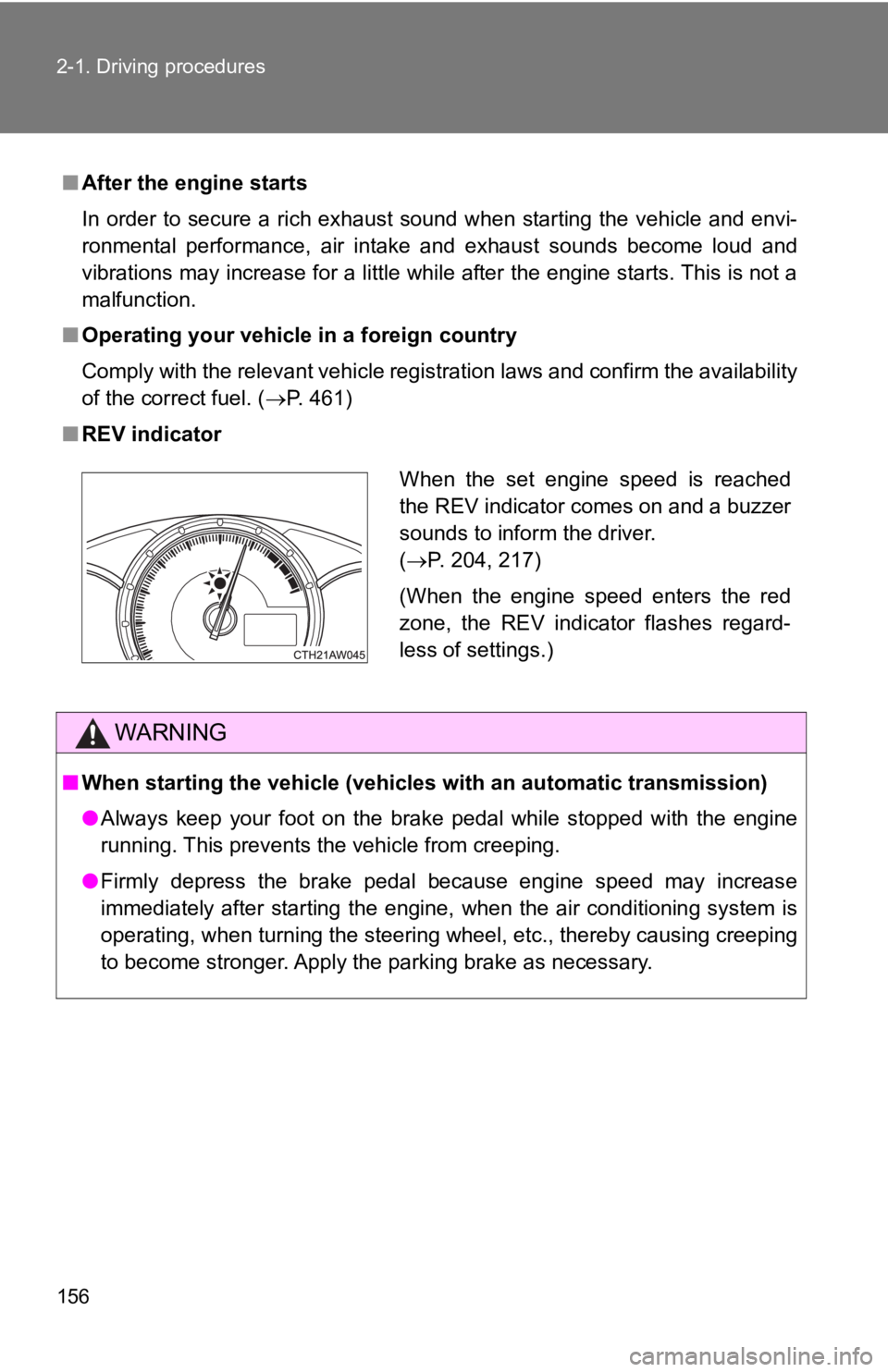
When the set engine speed is reached
the REV indicator comes on and a buzzer
sounds to inform the driver.
( P. 204, 217)
(When the engine speed enters the red
zone, the REV indicator flashes regard-
less of settings.)
Page 186 of 532
186 2-1. Driving procedures
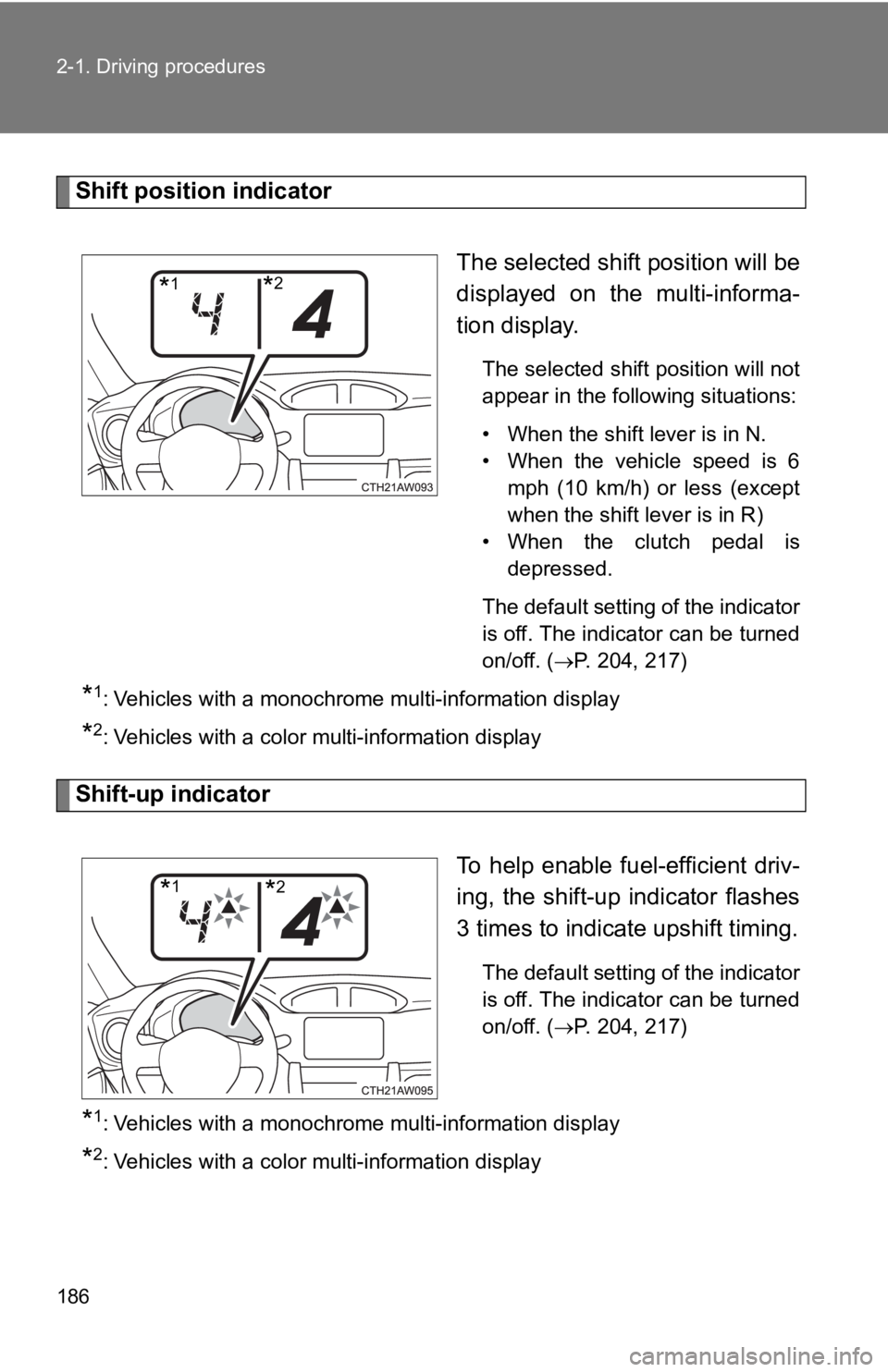
Shift position indicatorThe selected shift position will be
displayed on the multi-informa-
tion display.
The selected shift position will not
appear in the following situations:
• When the shift lever is in N.
• When the vehicle speed is 6mph (10 km/h) or less (except
when the shift lever is in R)
• When the clutch pedal is depressed.
The default setting of the indicator
is off. The indicator can be turned
on/off. (
P. 204, 217)
*1: Vehicles with a monochrome multi-information display
*2: Vehicles with a color multi-information display
Shift-up indicator
To help enable fuel-efficient driv-
ing, the shift-up indicator flashes
3 times to indicate upshift timing.
The default setting of the indicator
is off. The indicator can be turned
on/off. (
P. 204, 217)
*1: Vehicles with a monochrome multi-information display
*2: Vehicles with a color multi-information display
*1*2
*1*2
Page 191 of 532
191
2
When driving
2-2. Instrument cluster
Gauges and meters
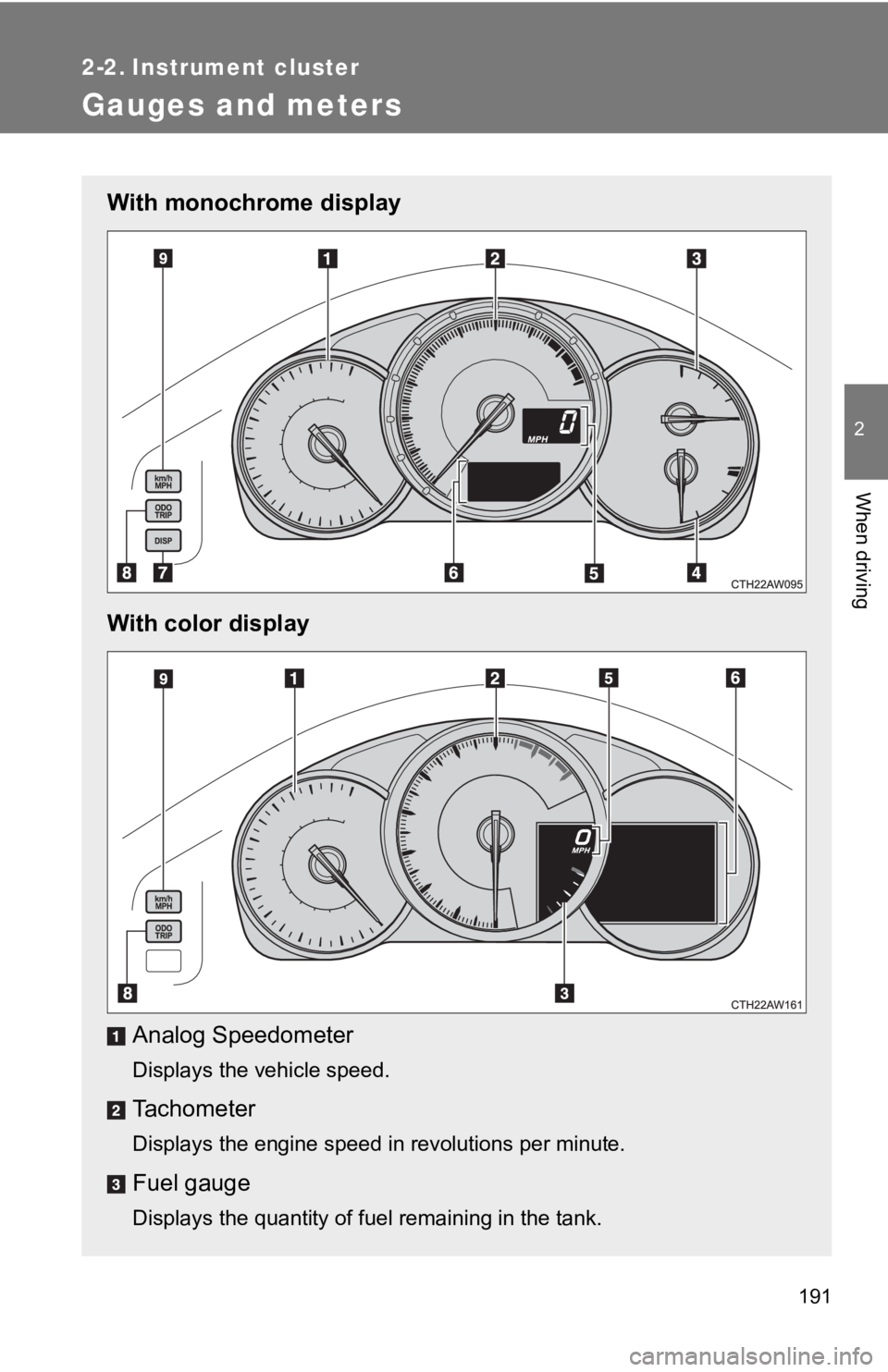
With monochrome display
With color displayAnalog Speedometer
Displays the vehicle speed.
Tachometer
Displays the engine speed in revolutions per minute.
Fuel gauge
Displays the quantity of fuel remaining in the tank.
Page 200 of 532
200
2-2. Instrument cluster
Multi-information display (monochrome display)
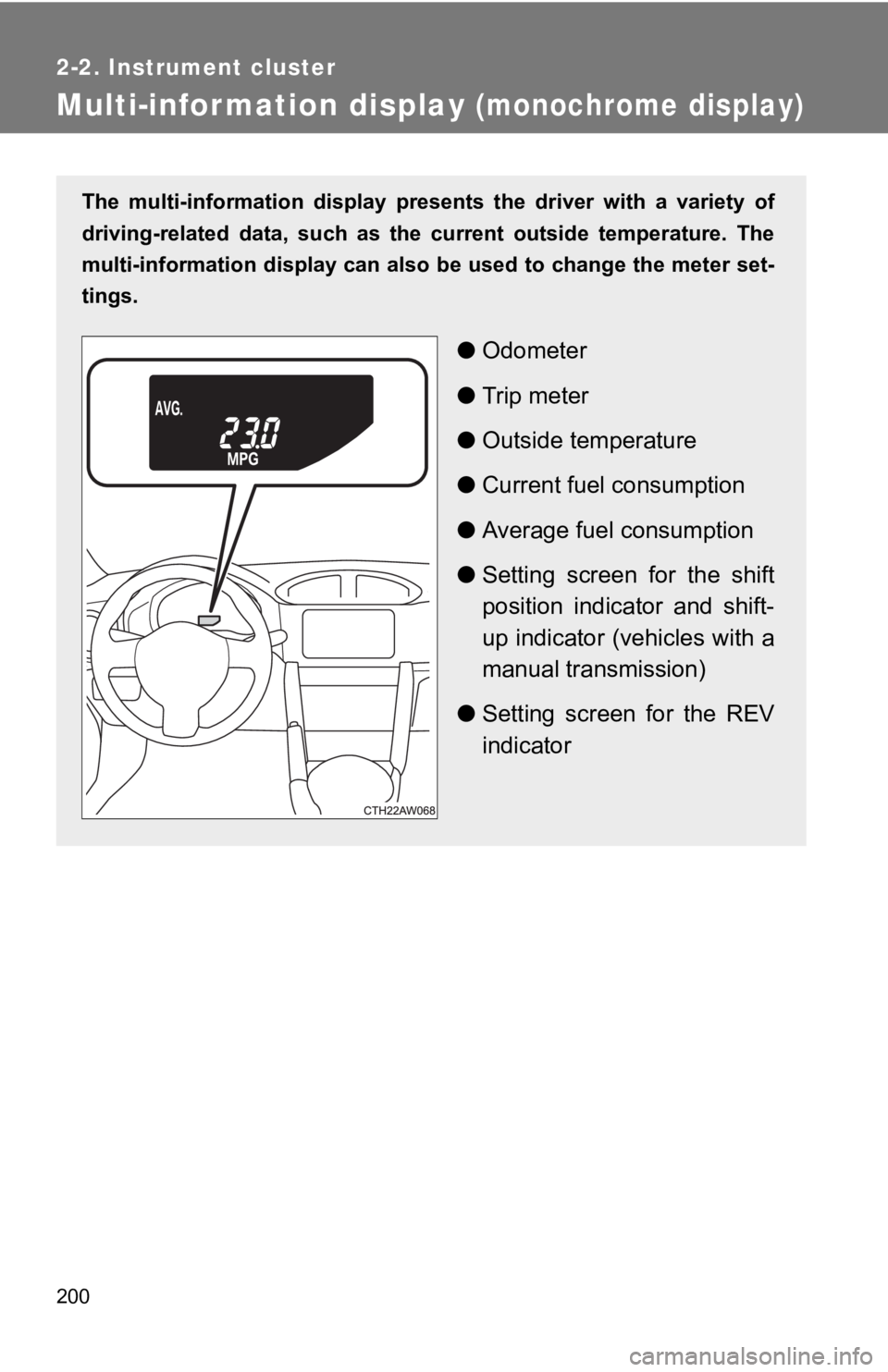
The multi-information display presents the driver with a variety of
driving-related data, such as th e current outside temperature. The
multi-information display can als o be used to change the meter set-
tings.
● Odometer
● Trip meter
● Outside temperature
● Current fuel consumption
● Average fuel consumption
● Setting screen for the shift
position indicator and shift-
up indicator (vehicles with a
manual transmission)
● Setting screen for the REV
indicator
Page 201 of 532
201
2-2. Instrument cluster
2
When driving
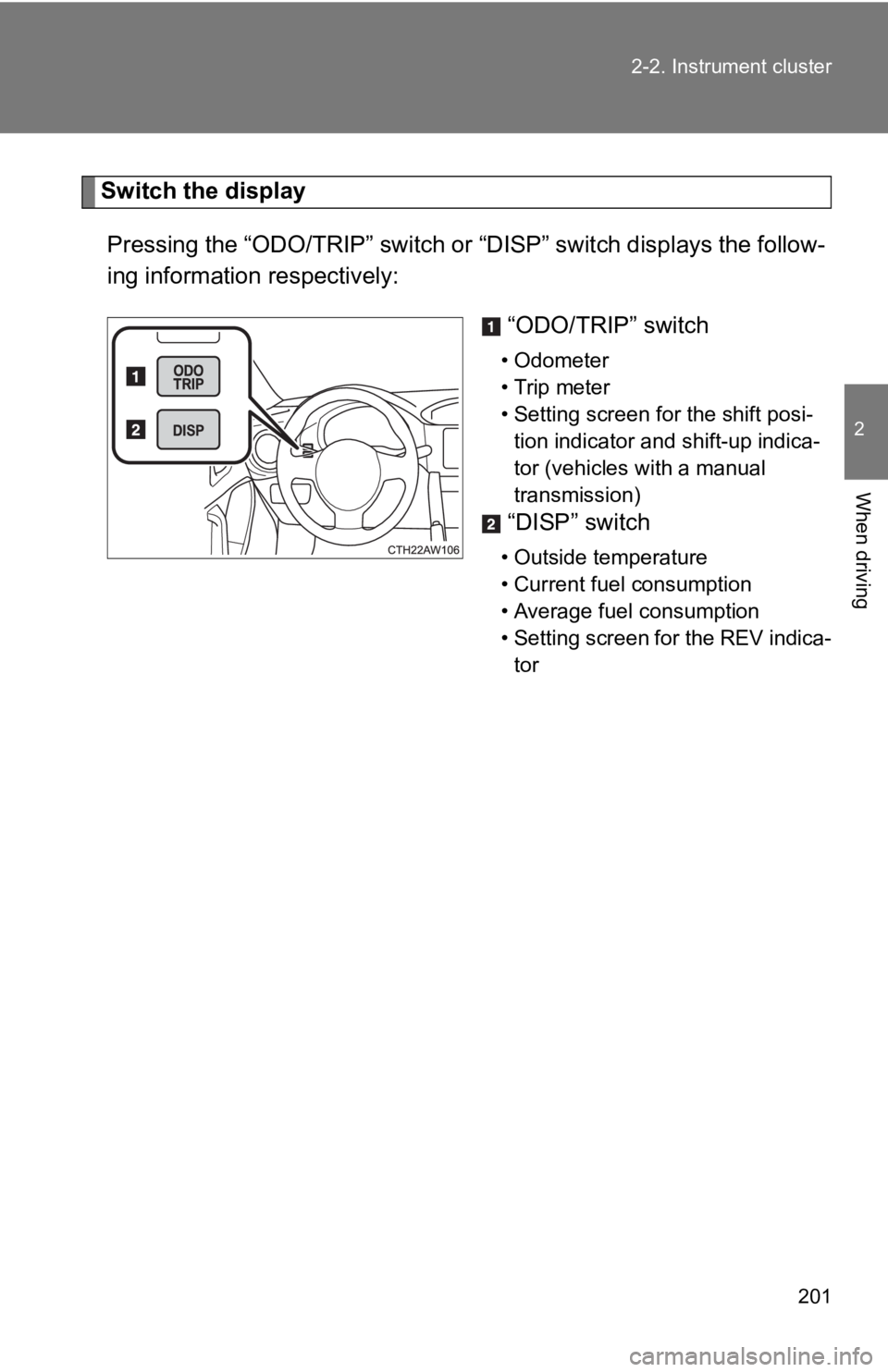
Switch the display
Pressing the “ODO/TRIP” switch or “DISP” switch displays the fo llow-
ing information respectively:
“ODO/TRIP” switch
• Odometer
• Trip meter
• Setting screen for the shift posi-tion indicator and shift-up indica-
tor (vehicles with a manual
transmission)
“DISP” switch
• Outside temperature
• Current fuel consumption
• Average fuel consumption
• Setting screen for the REV indica-tor
Page 203 of 532
203
2-2. Instrument cluster
2
When driving
■
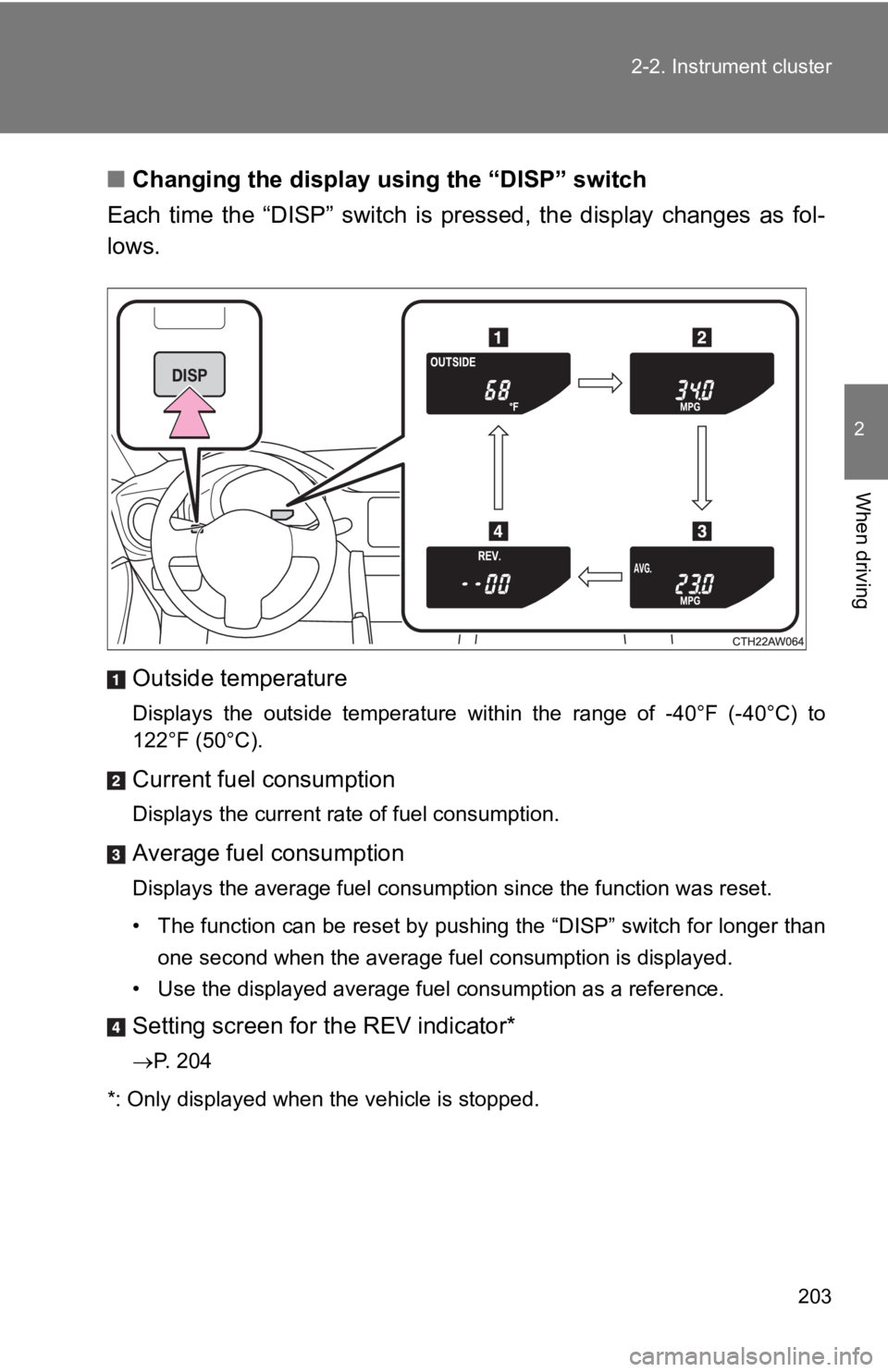
Changing the display using the “DISP” switch
Each time the “DISP” switch is pressed, the display changes as fol-
lows.
Outside temperature
Displays the outside temperature within the range of -40°F (-40 °C) to
122°F (50°C).
Current fuel consumption
Displays the current rate of fuel consumption.
Average fuel consumption
Displays the average fuel consumption since the function was reset.
• The function can be reset by pushing the “DISP” switch for longer than
one second when the average fuel consumption is displayed.
• Use the displayed average fuel consumption as a reference.
Setting screen for the REV indicator*
P. 204
*: Only displayed when the vehicle is stopped.
Page 210 of 532
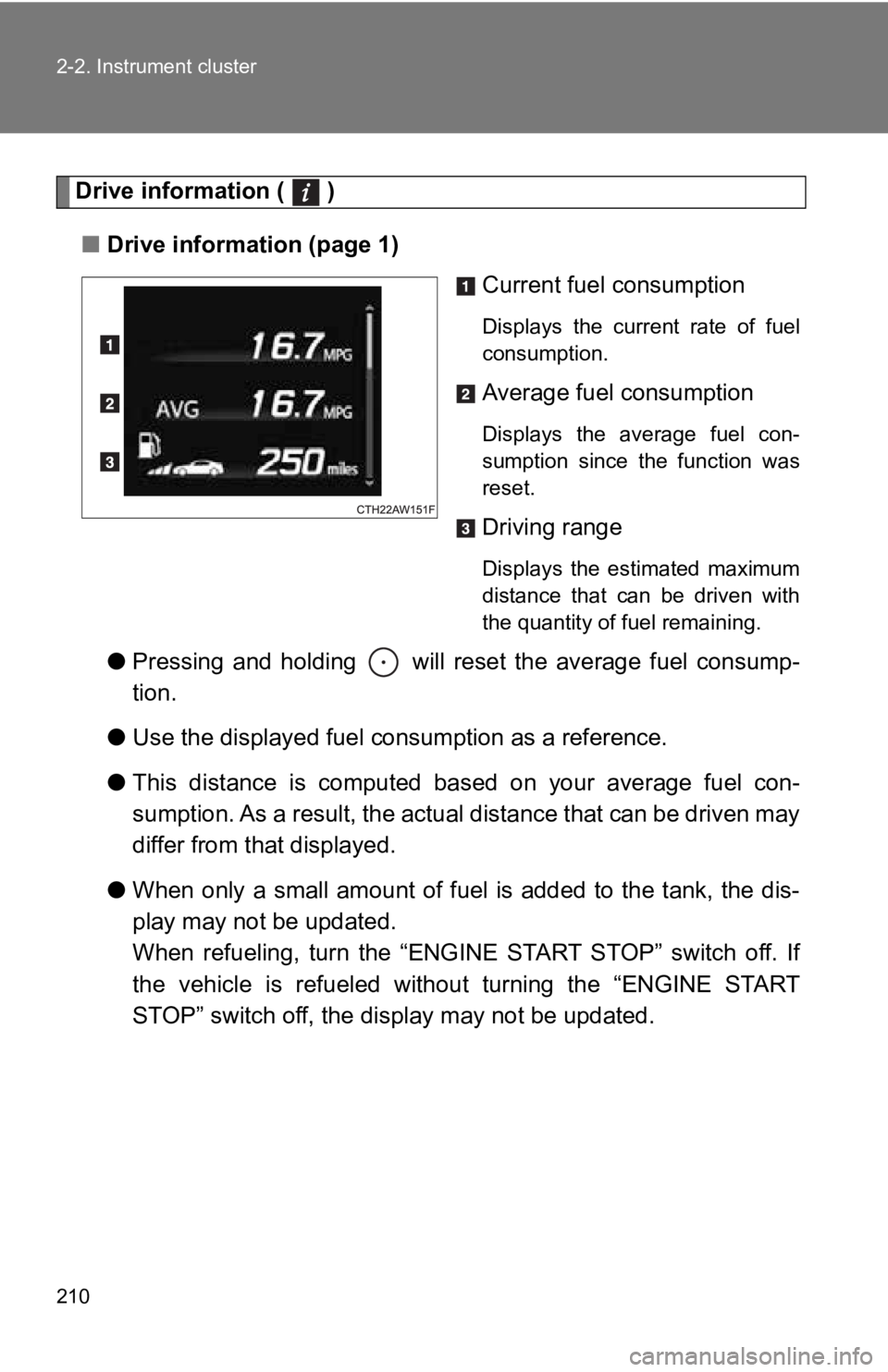
210 2-2. Instrument cluster
Drive information ( )■ Drive information (page 1)
Current fuel consumption
Displays the current rate of fuel
consumption.
Average fuel consumption
Displays the average fuel con-
sumption since the function was
reset.
Driving range
Displays the estimated maximum
distance that can be driven with
the quantity of fuel remaining.
●Pressing and holding will reset the average fuel consump-
tion.
● Use the displayed fuel con sumption as a reference.
● This distance is computed base d on your average fuel con-
sumption. As a result, the actual distance that can be driven m ay
differ from that displayed.
● When only a small amount of fuel is added to the tank, the dis-
play may not be updated.
When refueling, turn the “ENGINE START STOP” switch off. If
the vehicle is refueled withou t turning the “ENGINE START
STOP” switch off, the display may not be updated.
Page 224 of 532

224 2-3. Operating the lights and windshield wipers
■Daytime running light system
●The daytime running lights illuminate using the same lights as the parking
lights and illuminate brighter than the parking lights.
● To make your vehicle more visible to other drivers during dayti me driving,
the daytime running lights turn on automatically when all of th e following
conditions are met. (The daytime running lights are not designe d for use
at night.)
• The engine is running
• The shift lever is shifted out of P (Vehicles with an automati c transmis-
sion)
• The parking brake is released
• The headlight switch is off or in the “AUTO”
* position
*: When the surroundings are bright
The daytime running lights remain on after they illuminate even if the parking
brake is set again.
● When the turn signal indicators are flashing, the daytime runni ng light on
the side that the turn signals are flashing will turn off.
● When the emergency flashers are flashing, both daytime running lights
will turn off.
● Compared to turning on the headlights, the daytime running ligh t system
offers greater durability and consumes less electricity, so it can help
improve fuel economy.