radio TOYOTA 86 2018 User Guide
[x] Cancel search | Manufacturer: TOYOTA, Model Year: 2018, Model line: 86, Model: TOYOTA 86 2018Pages: 532, PDF Size: 6.48 MB
Page 42 of 532

42 1-2. Opening, closing and locking the doors and trunk
■When the electronic key battery is fully depleted
P. 363
■ Confirmation of the registered key number (vehicles with a smar t key
system)
The number of keys already registered to the vehicle can be con firmed. Ask
your Toyota dealer for details.
■ Customization that can be conf igured at your Toyota dealer
Settings (e.g. wireless remote control system) can be changed.
(Customizable features P. 487)
■ Certification for wir eless remote control
For vehicles sold in the U.S.A.
FCC ID: HYQ23AAC FCC ID: HYQ12BEL
NOTE:
This device complies with part 15 of the FCC Rules. Operation i s subject to
the following two conditions: (1) This device may not cause har mful interfer-
ence, and (2) this device must accept any interference received, including
interference that may cause undesired operation.
FCC WARNING:
Changes or modifications not expressly approved by the party re sponsible
for compliance could void the user's authority to operate the equipment.
For vehicles sold in Canada
NOTE:
This device complies with Industry Canada’s licence-exempt RSSs . Opera-
tion is subject to the following two conditions: (1) This devic e may not cause
interference; and (2) This device must accept any interference, including
interference that may cause undesired operation of the device.
NOTE:
Le présent appareil est conforme aux CNR d’Industrie Canada app licables
aux appareils radio exempts de licence. L’exploitation est auto risée aux
deux conditions suivantes: (1) l’appareil ne doit pas produire de brouillage;
(2) l’utilisateur de l’appareil doit accepter tout brouillage r adioélectrique subi,
même si le brouillage est susceptible d’en compromettre le fonc tionnement.
Page 48 of 532
48 1-2. Opening, closing and locking the doors and trunk
■Trunk light
The trunk light turns on when the trunk is opened.
■ Function to prevent the trunk be ing locked with the electronic key
inside (vehicles with a smart key system)
● When all doors are being locked, closing the trunk lid with the electronic
key left inside the trunk will sound an alarm.
In this case, the trunk lid can be opened using the entry funct ion.
● Even when the spare electronic key is put in the trunk with all the doors
locked, the key confinement prevention function can be activate d so the
trunk can be opened. In order to prevent theft, take all electr onic keys
with you when leaving the vehicle.
● Even when the electronic key is put in the trunk with all the d oors are
locked, the key may not be detected depending on the places and the
surrounding radio wave conditions. In this case, the key confinement pre-
vention function cannot be activated, causing the doors to lock when the
trunk is closed. Make sure to check where the key is before clo sing the
trunk.
● The key confinement prevention function cannot be activated if any one
of the doors is unlocked. In this case, open the trunk using th e trunk
opener.
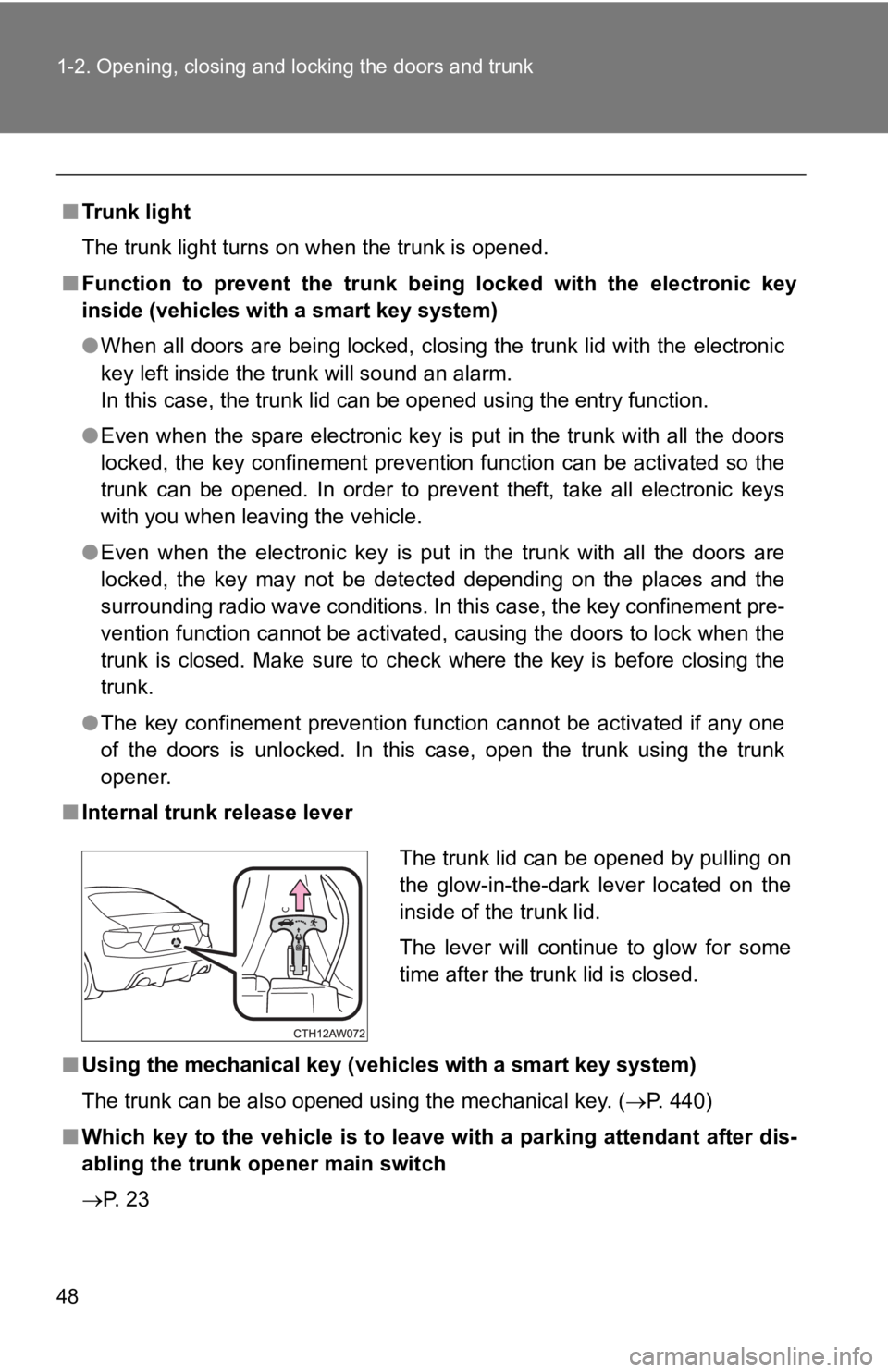
■ Internal trunk release lever
■ Using the mechanical key (vehicles with a smart key system)
The trunk can be also opened using the mechanical key. ( P. 440)
■ Which key to the vehicle is to leave with a parking attendant a fter dis-
abling the trunk opener main switch
P. 23
The trunk lid can be opened by pulling on
the glow-in-the-dark lever located on the
inside of the trunk lid.
The lever will continue to glow for some
time after the trunk lid is closed.
Page 80 of 532

80 1-6. Theft deterrent system
■When the vehicle cannot be star ted with the registered key (vehicles
without a smart key system)
Remove the key and try again.
■ System maintenance
The vehicle has a maintenance-free type engine immobilizer syst em.
■ Conditions that may cause the system to malfunction
● If the key is in contact with a metallic object
● If the key is in close proximity to or touching a key to the security system
(key with a built-in transponder chip) of another vehicle
■ Certification for engine immob ilizer system (vehicles without a smart
key system)
For vehicles sold in the U.S.A.
FCC ID: MOZRI-38BFH
This device complies with part 15 of the FCC Rules. Operation i s subject to
the following two conditions: (1) This device may not cause har mful interfer-
ence, and (2) this device must accept any interference received, including
interference that may cause undesired operation.
FCC WARNING
Changes or modifications not expressly approved by the party re sponsible
for compliance could void the user’s authority to operate the equipment.
For vehicles sold in Canada
NOTE:
This device complies with Industry Canada’s licence-exempt RSSs . Opera-
tion is subject to the following two conditions: (1) This devic e may not cause
interference; and (2) This device must accept any interference, including
interference that may cause undesired operation of the device.
NOTE:
Le présent appareil est conforme aux CNR d’Industrie Canada app licables
aux appareils radio exempts de licence. L’exploitation est auto risée aux
deux conditions suivantes: (1) l’appareil ne doit pas produire de brouillage;
(2) l’utilisateur de l’appareil doit accepter tout brouillage r adioélectrique subi,
même si le brouillage est susceptible d’en compromettre le fonc tionnement.
Page 81 of 532

81
1-6. Theft deterrent system
1
Before driving
■
Certification for engine immobilizer system (vehicles with a sm art key
system)
For vehicles sold in the U.S.A.
FCC ID: Y8PSSPIMB03
This device complies with part 15 of the FCC Rules. Operation i s subject to
the following two conditions: (1) This device may not cause har mful interfer-
ence, and (2) this device must accept any interference received, including
interference that may cause undesired operation.
FCC WARNING
Changes or modifications not expressly approved by the party re sponsible
for compliance could void the user’s authority to operate the e quipment.
For vehicles sold in Canada
NOTE:
This device complies with Industry Canada’s licence-exempt RSSs . Opera-
tion is subject to the following two conditions: (1) This devic e may not cause
interference; and (2) This device must accept any interference, including
interference that may cause undesired operation of the device.
NOTE:
Le présent appareil est conforme aux CNR d’Industrie Canada app licables
aux appareils radio exempts de licence. L’exploitation est auto risée aux
deux conditions suivantes: (1) l’appareil ne doit pas produire de brouillage;
(2) l’utilisateur de l’appareil doit accepter tout brouillage r adioélectrique subi,
même si le brouillage est susceptible d’en compromettre le fonctionnement.
NOTICE
■ To ensure the system operates correctly
Do not modify or remove the system. If modified or removed, the proper
operation of the system cannot be guaranteed.
Page 124 of 532

124 1-7. Safety information
WARNING
■SRS airbag precautions
●Do not touch any of the component parts immediately after the S RS air-
bags have deployed (inflated) as they may be hot.
● If breathing becomes difficult after the SRS airbag has deploye d, open a
door or window to allow fresh air in, or leave the vehicle if i t is safe to do
so. Wash off any residue as soon as possible to prevent skin ir ritation.
● If the areas where the SRS airbags are stored, such as the stee ring wheel
pad and front and rear pillar garnishes, are damaged or cracked, have
them replaced by your Toyota dealer.
■ Modification and disposal of SRS airbag system components
Do not dispose of your vehicle or perform any of the following modifications
without consulting your Toyota dealer.
The SRS airbags may malfunction or deploy (inflate) accidentall y, causing
death or serious injury.
● Installation, removal, disassem bly and repair of the SRS airbag s.
● Repairs, modifications, removal or replacement of the steering wheel,
instrument panel, dashboard, seats or seat upholstery, front, side and rear
pillars or roof side rails.
● Repairs or modifications of the front fender, front bumper, or side of the
occupant compartment.
● Installation of a grille guard (bull bars, kangaroo bar, etc.), snow plows,
winches.
● Modifications to the vehicle's suspension system.
● Installation of electronic devices such as mobile two-way radio s and CD
players.
● Modifications to your vehicle for a person with a physical disa bility.
Page 349 of 532

349
4-3. Do-it-yourself maintenance
4
Maintenance and care
■Initializing the tire p
ressure warning system
Initialize the system with the ti re inflation pressure adjusted to the speci-
fied level.
■Routine tire infla tion pressure checks
The tire pressure warning system does not replace routine tire inflation
pressure checks. Make sure to check tire inflation pressure as part of
your routine of daily vehicle checks.
■Tire pressure warning system certification (vehicles without a
smart key system)
MODEL/FCC IDs:
Transmitter: PAXPMVC010
Receiver: HYQ23AAC
For vehicles sold in the U.S.A.
This device complies with part 15 of the FCC Rules. Operation is subject
to the following two conditions: (1) This device may not cause harmful
interference, and (2) this device must accept any interference received,
including interference that may cause undesired operation.
FCC WARNING:
Changes or modifications not expressly approved by the party re sponsi-
ble for compliance could void the user's authority to operate t he equip-
ment.
For vehicles sold in Canada
NOTE:
This device complies with Industr y Canada’s licence-exempt RSSs.
Operation is subject to the following two conditions: (1) This device may
not cause interference; and (2) This device must accept any int erfer-
ence, including interference that may cause undesired operation of the
device.
NOTE:
Le présent appareil est conforme aux CNR d’Industrie Canada applica-
bles aux appareils radio exempts de licence. L’exploitation est autorisée
aux deux conditions suivantes: (1) l’appareil ne doit pas produ ire de
brouillage; (2) l’utilisateur de l’appareil doit accepter tout brouillage
radioélectrique subi, même si le brouillage est susceptible d’en compro-
mettre le fonctionnement.
Page 350 of 532

350 4-3. Do-it-yourself maintenance
■Tire pressure warning system certification (vehicles with a smart
key system)
MODEL/FCC IDs:
Transmitter: PAXPMVC010
Receiver: HYQ23AAE
For vehicles sold in the U.S.A.
This device complies with part 15 of the FCC Rules. Operation is subject
to the following two conditions: (1) This device may not cause harmful
interference, and (2) this device must accept any interference received,
including interference that may cause undesired operation.
FCC WARNING:
Changes or modifications not expressly approved by the party re sponsi-
ble for compliance could void the user's authority to operate t he equip-
ment.
For vehicles sold in Canada
NOTE:
This device complies with Industry Canada’s licence-exempt RSSs .
Operation is subject to the following two conditions: (1) This device may
not cause interference; and (2) This device must accept any int erfer-
ence, including interference that may cause undesired operation of the
device.
NOTE:
Le présent appareil est conforme aux CNR d’Industrie Canada app lica-
bles aux appareils radio exempts de licence. L’exploitation est autorisée
aux deux conditions suivantes: (1) l’appareil ne doit pas produ ire de
brouillage; (2) l’utilisateur de l’appareil doit accepter tout brouillage
radioélectrique subi, même si le brouillage est susceptible d’en compro-
mettre le fonctionnement.
Page 373 of 532
373
4-3. Do-it-yourself maintenance
4
Maintenance and care
■
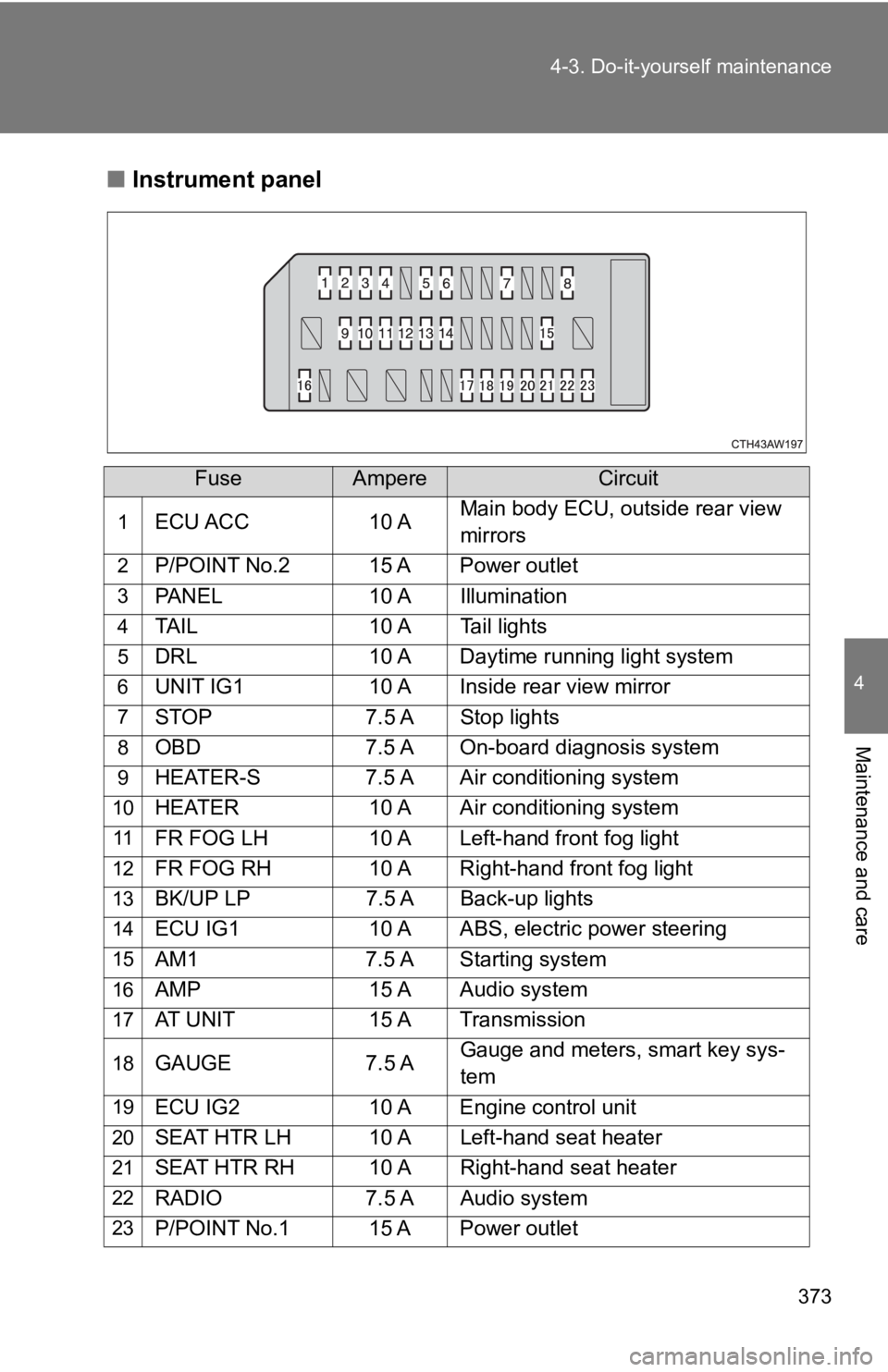
Instrument panel
FuseAmpereCircuit
1ECU ACC 10 AMain body ECU, outside rear view
mirrors
2P/POINT No.2 15 A Power outlet
3PANEL
10 A Illumination
4TAIL10 A Tail lights
5DRL10 A Daytime running light system
6UNIT IG110 A Inside rear view mirror
7STOP7.5 A Stop lights
8OBD7.5 A On-board diagnosis system
9HEATER-S 7.5 A Air conditioning system
10HEATER 10 A Air conditioning system
11FR FOG LH 10 A Left-hand front fog light
12FR FOG RH 10 A Right-hand front fog light
13BK/UP LP7.5 A Back-up lights
14ECU IG1 10 A ABS, electric power steering
15AM17.5 A Starting system
16AMP 15 A Audio system
17AT UNIT 15 A Transmission
18GAUGE7.5 AGauge and meters, smart key sys-
tem
19ECU IG2
10 A Engine control unit
20SEAT HTR LH 10 A Left-hand seat heater
21SEAT HTR RH 10 A Right-hand seat heater
22RADIO7.5 A Audio system
23P/POINT No.1 15 A Power outlet
Page 403 of 532

5
When trouble arises
403
5-2. Steps to take in an emergency
■If the tire pressure warn
ing system is inoperative
The tire pressure warning system will be disabled in the following condi-
tions:
(When the condit ion becomes normal, the system will work properly.)
●If tires not equipped with tire pressure warning valves and tra nsmit-
ters are used.
●If the ID code on the tire pressure warning valves and transmit ters is
not registered in the tire pressure warning computer.
●If the tire inflation pressure is 55 psi (380 kPa, 3.87 kgf/cm2 or bar) or
higher.
The tire pressure warning system may be disabled in the followi ng condi-
tions:
(When the condit ion becomes normal, the system will work properly.)
●If electronic devices or facilities using similar radio wave fr equencies
are nearby.
●If a radio set at similar frequen cies is in use in the vehicle.
●If a window tint that affects the radio wave signals is install ed.
●If there is a lot of snow or ice on the vehicle, in particular around the
wheels or wheel housings.
●If non-genuine Toyota wheels are used. (Even if you use Toyota
wheels, the tire pressure warning system may not work properly with
some types of tires.)
●If tire chains are used.
●If a large metallic object which can interfere with signal reception is
put in the trunk.
■If the tire pressure warning light frequently comes on after bl inking
for approximately one minute
If the tire pressure warning light frequently comes on after bl inking for
approximately one minute when the “ENGINE START STOP” switch is
turned to IGNITION ON mode (vehicles with a smart key system) o r the
engine switch is turned to the “ON” position (vehicles without a smart key
system), have it check ed your Toyota dealer.
Page 480 of 532

480 6-1. Specifications
Warning: The temperature grades of a tire assume that it is properly
inflated and not overloaded.
Excessive speed, underinflation, or excessive loading, either s epa-
rately or in combination, can cause heat buildup and possible t ire fail-
ure.
Glossary of tire terminology
Tire related termMeaning
Cold tire inflation
pressure Tire pressure when the vehicle has been
parked for three hours or more, or has not
been driven more than 1
mile or 1.5 km under
that condition
Maximum inflation
pressure The maximum cold inflated pressure to which a
tire may be inflated, shown on the sidewall of
the tire
Recommended
inflation pressure Cold tire inflation pressure recommended by a
manufacturer.
Accessory weight The combined weight (i
n excess of those stan-
dard items which may be replaced) of auto-
matic transmission, po wer steering, power
brakes, power windows, power seats, radio
and heater, to the exten t that these items are
available as factory-installed equipment
(whether installed or not)
Curb weight The weight of a
motor vehicle with standard
equipment, including th e maximum capacity of
fuel, oil and coolant, and if so equipped, air
conditioning and additional weight optional
engine
Maximum loaded
vehicle weight The sum of:
(a) Curb weight
(b) Accessory weight
(c) Vehicle capacity weight
(d) Production options weight