tow TOYOTA 86 2018 User Guide
[x] Cancel search | Manufacturer: TOYOTA, Model Year: 2018, Model line: 86, Model: TOYOTA 86 2018Pages: 532, PDF Size: 6.48 MB
Page 234 of 532
234 2-4. Using other driving systems
■Cruise control can be set when
Vehicles with an automatic transmission
●The shift lever is in D or M and the vehicle is in the 2
nd gear or higher.
● Vehicle speed is above approximately 25 mph (40 km/h).
Vehicles with a manual transmission
● The vehicle is in the 2
nd gear or higher.
● Vehicle speed is above approximately 25 mph (40 km/h).
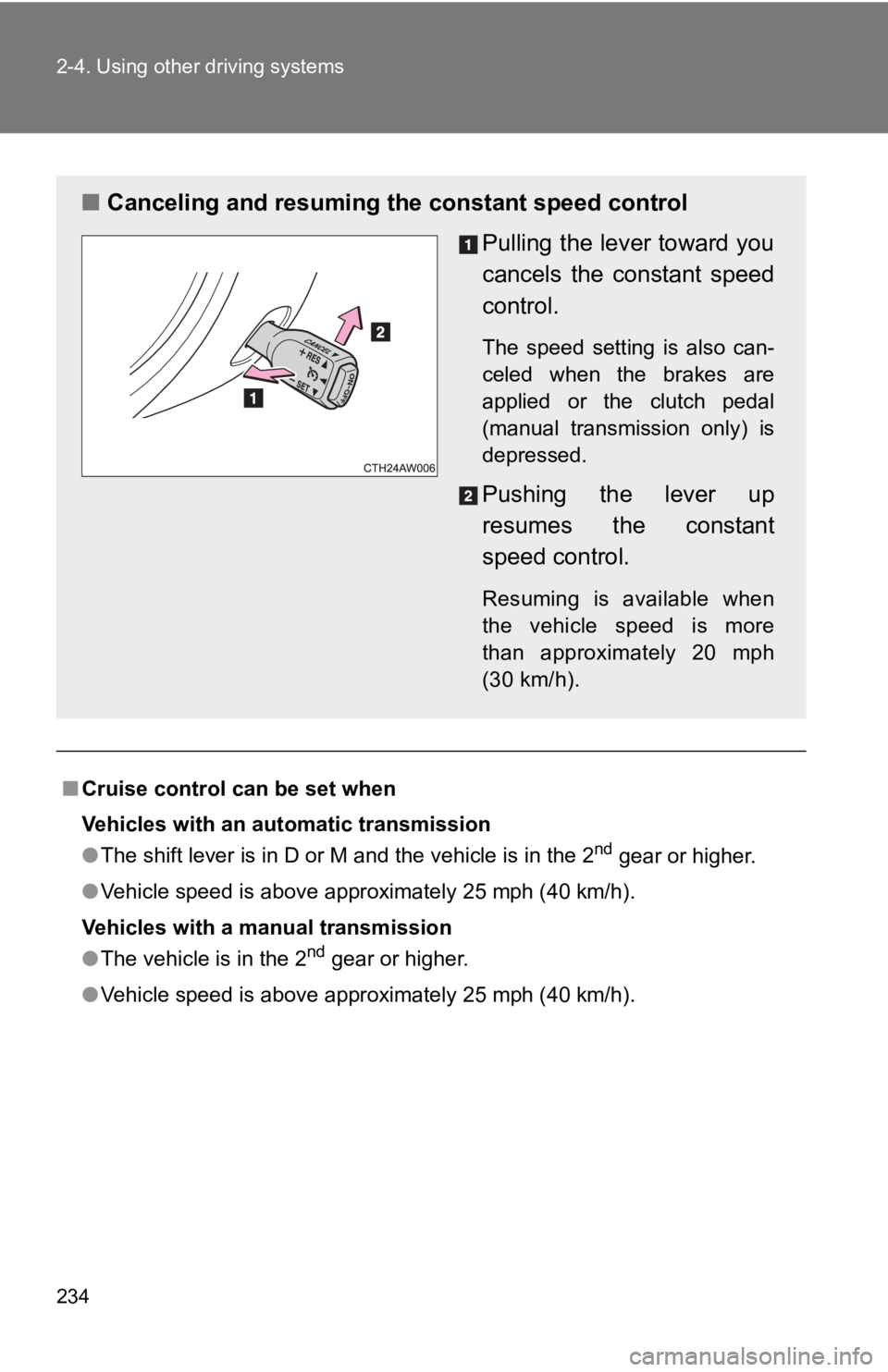
■ Canceling and resuming the constant speed control
Pulling the lever toward you
cancels the constant speed
control.
The speed setting is also can-
celed when the brakes are
applied or the clutch pedal
(manual transmission only) is
depressed.
Pushing the lever up
resumes the constant
speed control.
Resuming is available when
the vehicle speed is more
than approximately 20 mph
(30 km/h).
Page 236 of 532
236 2-4. Using other driving systems
WARNING
■To avoid operating the cruise control by mistake
Switch the cruise control off using the “ON-OFF” button when not in use.
■ Situations unsuitable for cruise control
Do not use cruise control in any of the following situations.
Doing so may result in loss of control and could cause an accident resulting
in death or serious injury.
●In heavy traffic
● On roads with sharp bends
● On winding roads
● On slippery roads, such as those covered with rain, ice or snow
● On steep hills
Vehicle speed may exceed the set speed when driving down a stee p hill.
● During emergency towing
Page 256 of 532
256
2-5. Driving information
Cargo and luggage
Capacity and distributionCargo capacity depends on the to tal weight of the occupants.
(Cargo capacity) = (Tot al load capacity) - (Total weight of occ upants)
Steps for Determini ng Correct Load Limit
(1)Locate the statement “The co mbined weight of occupants and
cargo should never exceed XXX kg or XXX lbs.” on your vehicle's
placard.
(2)Determine the combined weight of the driver and passengers t hat
will be riding in your vehicle.
(3)Subtract the combined weight of the driver and passengers fr om
XXX kg or XXX lbs.
(4)The resulting figure equals the available amount of cargo and lug- gage load capacity.
For example, if the “XXX” amount equals 1400 lbs. and there will
be five 150 lb passengers in your vehicle, the amount of availa ble
cargo and luggage load capacity is 650 lbs. (1400 - 750 (5 150) =
650 lbs.)
(5)Determine the combined wei ght of luggage and cargo being
loaded on the vehicle. That weight may not safely exceed the av ail-
able cargo and luggage load ca pacity calculated in Step 4.
Take notice of the following information about storage precau-
tions, cargo capacity and load:
●Stow cargo and luggage in t he trunk whenever possible.
● Be sure all items are secured in place.
● To maintain vehicle balance while driving, position luggage
evenly within the luggage compartment.
● For better fuel economy, do no t carry unnecessary weight.
Page 257 of 532
257
2-5. Driving information
2
When driving
(6)If your vehicle will be towing a trailer, load from your tra
iler will be
transferred to your vehicle. Cons ult this manual to determine how
this reduces the available cargo and luggage load capacity of y our
vehicle.
( P. 458)
Toyota does not recommend towing a trailer with your vehicle. Y our
vehicle is not designed for trailer towing.
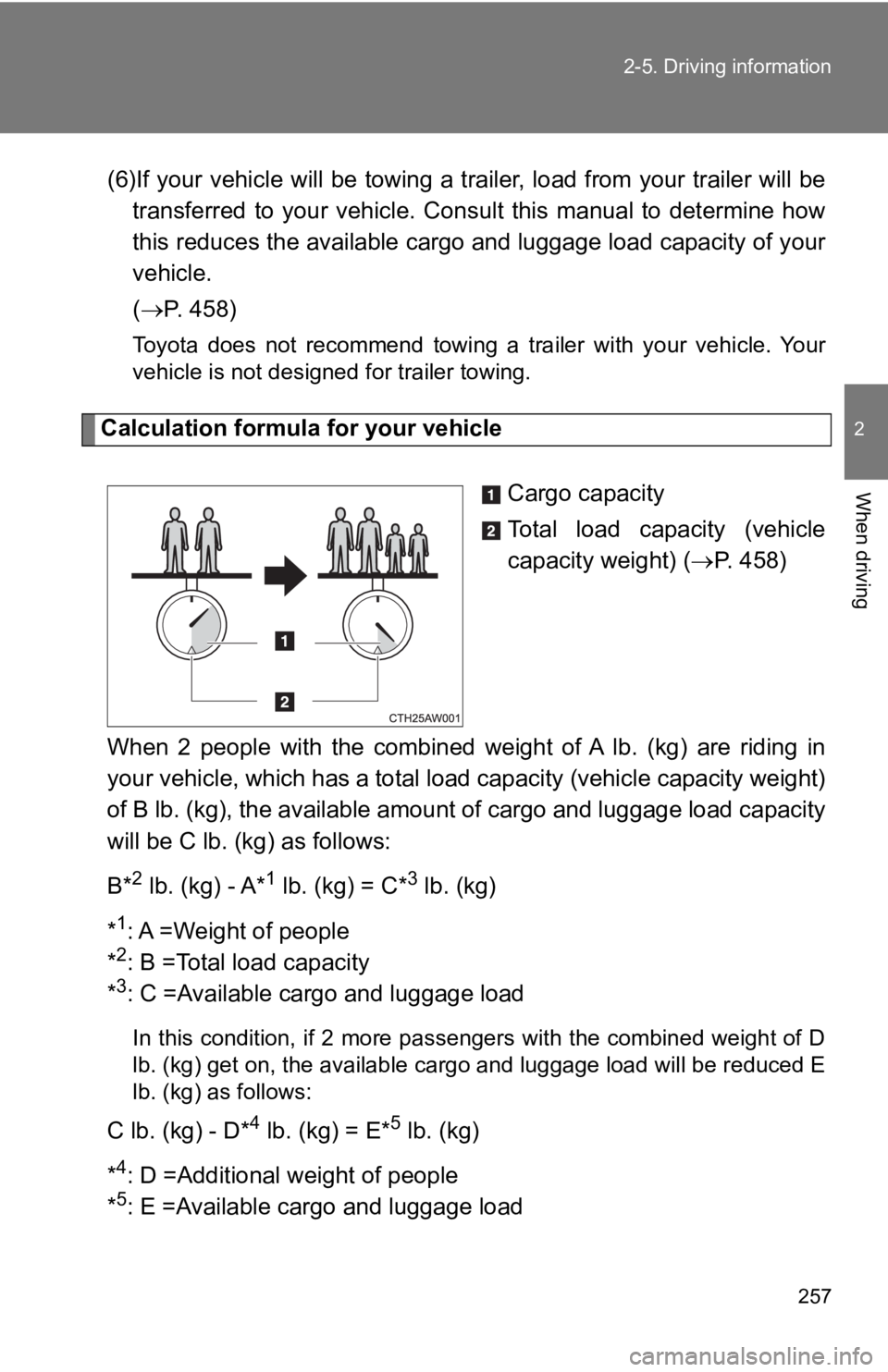
Calculation formula for your vehicle
Cargo capacity
Total load capacity (vehicle
capacity weight) (P. 458)
When 2 people with the combined weight of A lb. (kg) are riding in
your vehicle, which has a total load capacity (vehicle capacity weight)
of B lb. (kg), the available amount of cargo and luggage load c apacity
will be C lb. (kg ) as follows:
B*
2 lb. (kg) - A*1 lb. (kg) = C*3 lb. (kg)
*
1: A =Weight of people
*2: B =Total load capacity
*3: C =Available cargo and luggage load
In this condition, if 2 more passengers with the combined weight of D
lb. (kg) get on, the available cargo and luggage load will be r educed E
lb. (kg) as follows:
C lb. (kg) - D*4 lb. (kg) = E*5 lb. (kg)
*
4: D =Additional we ight of people
*5: E =Available cargo and luggage load
Page 259 of 532
259
2-5. Driving information
2
When driving
WARNING
■Storage precautions
Observe the following precautions.
Failure to do so may result i
n death or serious injury.
●Stow cargo and luggage in the trunk whenever possible.
●To prevent cargo and luggage from sliding forward during brakin g, do
not stack anything in the enlarged trunk. Keep cargo and luggag e low,
as close to the floor as possible.
●When you fold down the rear seats, long items should not be pla ced
directly behind the front seats.
●Never allow anyone to ride in the enlarged trunk. It is not des igned for
passengers. They should ride in their seats with their seat belts prop-
erly fastened. Otherwise, they are much more likely to suffer d eath or
serious bodily injury, in the event of sudden braking, sudden s werving
or an accident.
●Do not place cargo or luggage in or on the following locations as the
item may get under the clutch, brake or accelerator pedal and p revent
the pedals from being depressed properly, block the driver’s vi sion, or
hit the driver or passengers, causing an accident:
• At the feet of the driver
• On the front passenger or rear seats (when stacking items)
• On the package tray
• On the instrument panel
• On the dashboard
●Secure all items in the occupant compartment, as they may shift and
injure someone during sudden braking, sudden swerving or an acc i-
dent.
■Capacity and distribution
●Do not exceed the maximum axle weight rating or the total vehic le
weight rating.
●Even if the total load of occupant's weight and the cargo load is less
than the total load capacity, do not apply the load unevenly. I mproper
loading may cause deterioration of steering or braking control which
may cause death or serious injury.
Page 260 of 532
260
2-5. Driving information
Vehicle load limits
■Total load capacity and seating capacity
These details are described on the tire and loading information label.
( P. 3 5 3 )
WARNING
■Overloading the vehicle
Do not overload the vehicle.
It may not only cause damage to t he tires, but also degrade steering and
braking ability, resulting in an accident.
Vehicle load limits include total load capacity, seating capaci ty,
towing capacity and cargo capacity.
■ Total load capacity (veh icle capacity weight): ( P. 458)
Total load capacity means the combined weight of occupants, car go
and luggage.
■ Seating capacity
Seating capacity means the max imum number of occupants whose
estimated average weight is 150 lb. (68 kg) per person.
■Towing capacity
Toyota does not recommend towing a trailer with your vehicle.
■Cargo capacity
Cargo capacity may increase or decrease depending on the weight
and the number of occupants.
Page 265 of 532
265
2-5. Driving information
2
When driving
Trailer towing
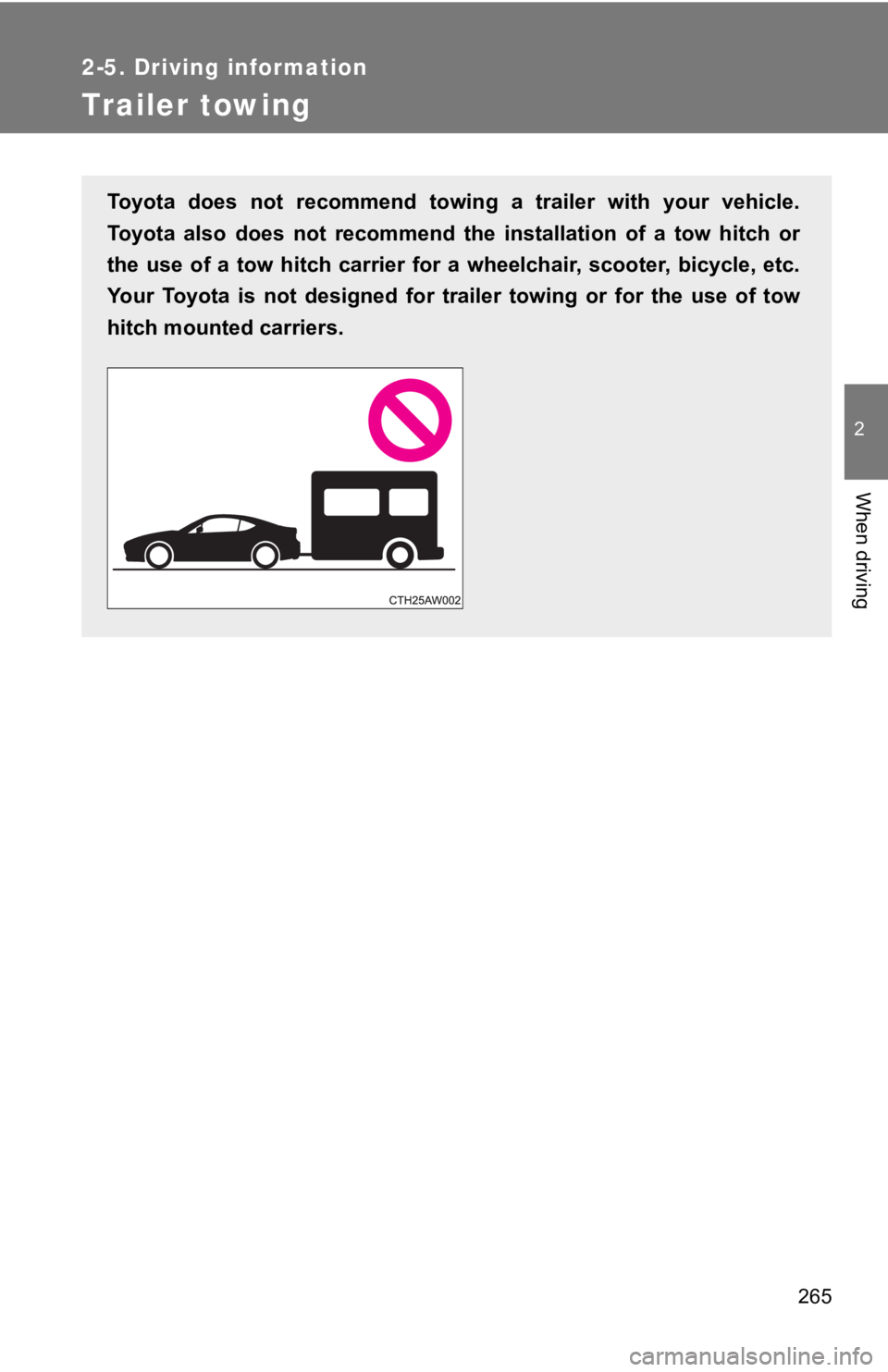
Toyota does not recommend towing a trailer with your vehicle.
Toyota also does not recommend the installation of a tow hitch or
the use of a tow hitch carrier f or a wheelchair, scooter, bicycle, etc.
Your Toyota is not designed for trailer towing or for the use o f tow
hitch mounted carriers.
Page 266 of 532
266
2-5. Driving information
Dinghy towing
NOTICE
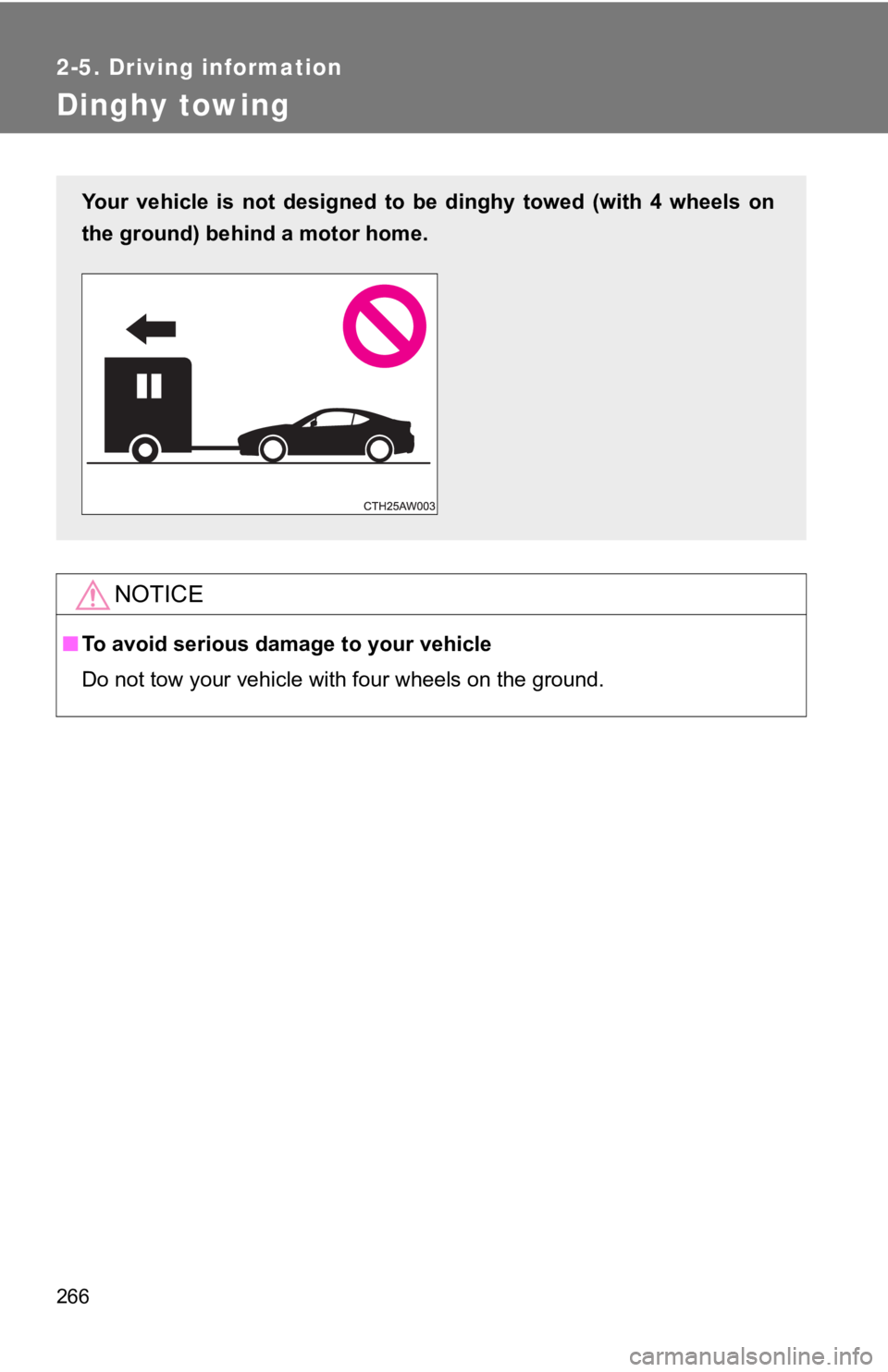
■To avoid serious damage to your vehicle
Do not tow your vehicle with four wheels on the ground.
Your vehicle is not designed to be dinghy towed (with 4 wheels on
the ground) behind a motor home.
Page 271 of 532
271
3-1. Using the air condit
ioning system and defogger
3
Interior features
Switching between outside air and recirculated air modes
Press .
The mode switches between outside air mode (introduces air from out-
side the vehicle) (indicator off) and recirculated air mode (re cycles air
inside the vehicle) (indicator on) each time the button is pres sed.
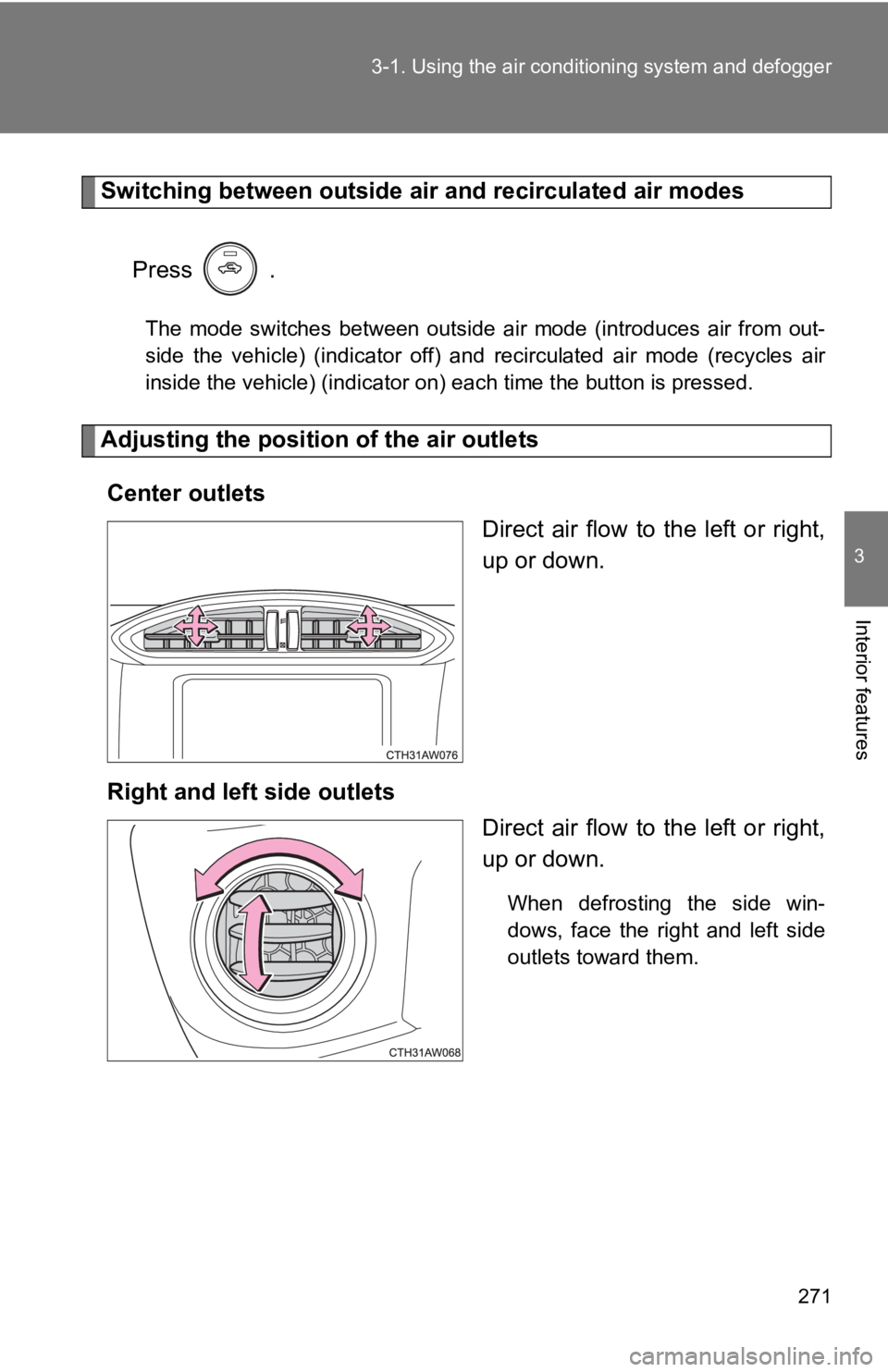
Adjusting the position of the air outlets
Center outlets Direct air flow to the left or right,
up or down.
Right and left side outlets Direct air flow to the left or right,
up or down.
When defrosting the side win-
dows, face the right and left side
outlets toward them.
Page 280 of 532
280 3-1. Using the air conditioning system and defogger
Switching between outside air m ode and recirculated air mode
Press .
The mode switches between outside air mode (indicator off) and recircu-
lated air mode (indicator on) each time is pressed.
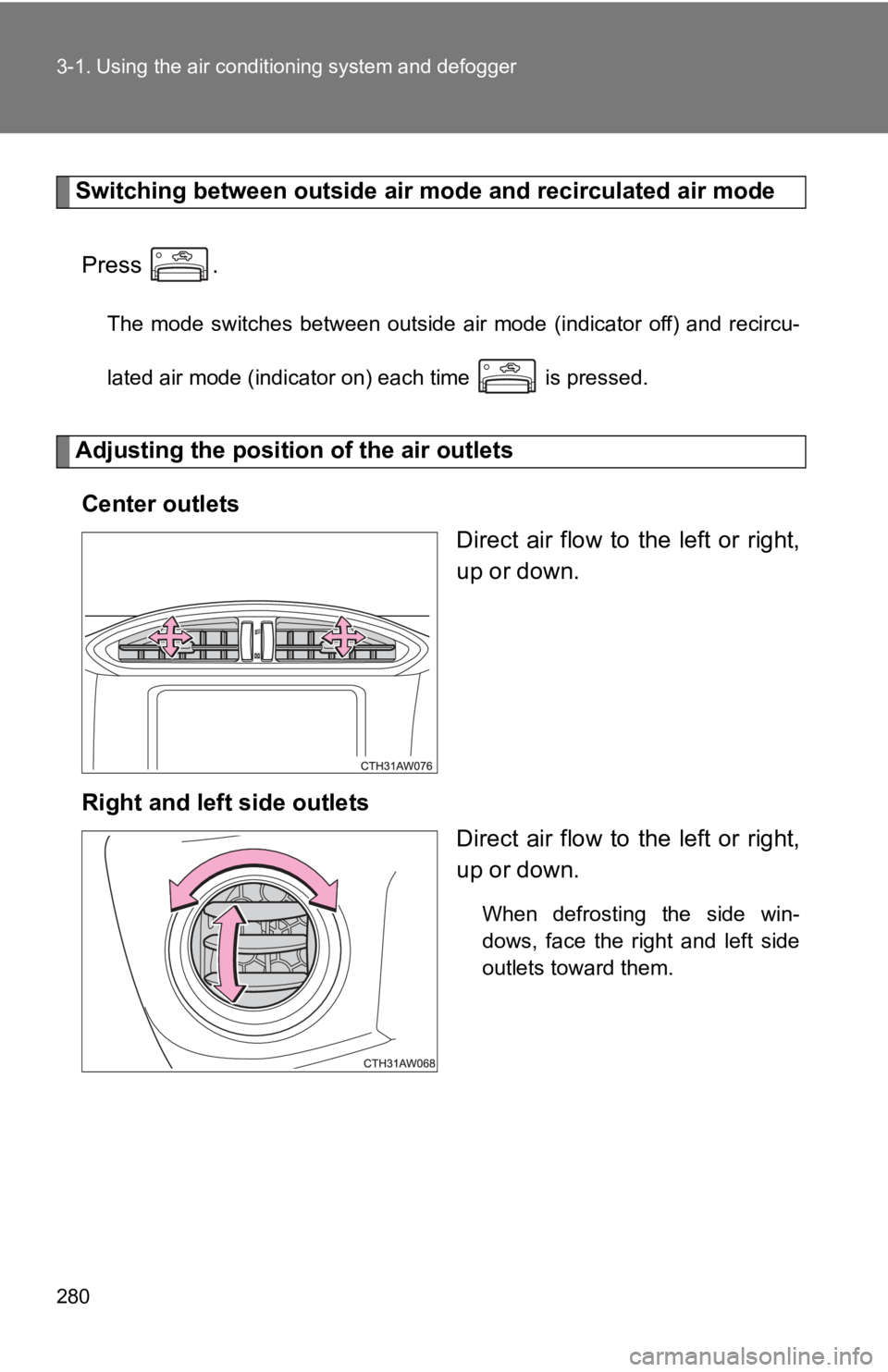
Adjusting the positi on of the air outlets
Center outlets Direct air flow to the left or right,
up or down.
Right and left side outlets
Direct air flow to the left or right,
up or down.
When defrosting the side win-
dows, face the right and left side
outlets toward them.